×

Nigeria🇳🇬 | citiesKanoancient city walls, dye pits, bustling markets | things to do and best time to go

Explore FuntuaExplore Argungu Fishing

Backpacking in Kano
🏆 Top pickcity ranked #8
By Johan Kruseman 🇳🇱 | Updated September 3, 2026

Everyone says you come to Kano for the ancient city walls, but let’s be honest: the real story is what’s happening inside them. Kano sits in northern Nigeria, a trading powerhouse for centuries, and you feel that pulse the moment you step into the old city’s maze—Kurmi Market is chaos in stereo, and the dye pits are as photogenic as they are pungent. Backpackers get a crash course in Hausa culture here, with the Emir’s Palace and Gidan Makama Museum offering more substance than most guidebooks admit. The city is gritty, not polished, and you’ll work for your discoveries—English is spoken, but not everywhere, and you won’t find a backpacker bar on every corner. Costs are low if you eat local and skip imported comforts, but you’ll trade some comfort for authenticity. Safety is variable; daytime is generally fine in busy areas, but you need your wits at night. Compared to Abuja or Jos, Kano is less cosmopolitan, more intense, and far less traveled by foreigners. The vibe? Unfiltered energy, history in motion, and a sense that you’re seeing a side of Nigeria most travelers never will.

Discover everything you want to know in the 📖 Nigeria Travel Guide.
Safety warning

The current risk level for Nigeria is high. Check the advice before going.


Get your Nigeria guide
87 ranked highlights, routes & tips, works offline (322 pages)
Loading the map 🌍
CLICK TO FILTER
cities
towns
landmarks
national parks
hikes
beaches
attractions
festivals
regions
SHOW COUNTRY’S BESTSHOW ALL

✨ Why go?
Ranked #8 city in Nigeria
The unique appeal for travelers

Kano isn’t just a dot on the map; it’s a strategic hub for backpackers who want to maximize their time in northern Nigeria without burning out. The city offers a solid mix of comfort and practicality—think affordable hostels that don’t sacrifice cleanliness or security, plus a walkable old city core where you can soak in local life without needing a car. This makes Kano a smart basecamp for those eyeing nearby day trips, letting you avoid the hassle of packing and unpacking every day. Food here is a genuine draw, too—street stalls and markets serve up hearty, authentic meals that fuel long days of exploration without emptying your wallet. Nightlife isn’t flashy, but it’s lively enough to unwind after a day of trekking through markets or historical sites. The real kicker is Kano’s connectivity: … read more 👉
Kano isn’t just a dot on the map; it’s a strategic hub for backpackers who want to maximize their time in northern Nigeria without burning out. The city offers a solid mix of comfort and practicality—think affordable hostels that don’t sacrifice cleanliness or security, plus a walkable old city core where you can soak in local life without needing a car. This makes Kano a smart basecamp for those eyeing nearby day trips, letting you avoid the hassle of packing and unpacking every day. Food here is a genuine draw, too—street stalls and markets serve up hearty, authentic meals that fuel long days of exploration without emptying your wallet. Nightlife isn’t flashy, but it’s lively enough to unwind after a day of trekking through markets or historical sites. The real kicker is Kano’s connectivity: it’s a key transport node with buses and flights linking you smoothly to other Nigerian cities or neighboring countries. So, if you’re the type who values a balance of comfort, local flavor, and logistical ease, Kano fits neatly into a backpacking route as more than just a quick stop—it’s a practical launchpad that respects your time and budget while keeping things interesting.
Want to include Kano in your Nigeria route?
Create a personalized Nigeria itinerary that includes Kano and the places that fit your trip — based on your travel style, budget, and available time. Get your route in seconds.

Generate my trip

💡 HighlightsEssential experiences to have while visiting Kano

Kano City Walls and Gates
These ancient mud walls once encircled the city, and while erosion and urban sprawl have taken their toll, the surviving gates—especially Kofar Mata and Kofar Nassarawa—still radiate the authority of a city that was once the beating heart of the Hausa empire. Walk the perimeter early in the morning, when the city is waking up and the air is cool. There’s no entrance fee for wandering the walls, but a local guide (expect to pay around 2,000-3,000 NGN for a couple of hours) will unlock stories you’d never find on your own. Allow 1-2 hours for a meaningful visit.

Kurmi Market
Kurmi isn’t just a market; it’s a living museum of commerce, centuries old and still pulsing with energy. You’ll find everything from indigo-dyed fabrics to hand-forged tools and spices that perfume … read more 👉
Kano City Walls and Gates
These ancient mud walls once encircled the city, and while erosion and urban sprawl have taken their toll, the surviving gates—especially Kofar Mata and Kofar Nassarawa—still radiate the authority of a city that was once the beating heart of the Hausa empire. Walk the perimeter early in the morning, when the city is waking up and the air is cool. There’s no entrance fee for wandering the walls, but a local guide (expect to pay around 2,000-3,000 NGN for a couple of hours) will unlock stories you’d never find on your own. Allow 1-2 hours for a meaningful visit.

Kurmi Market
Kurmi isn’t just a market; it’s a living museum of commerce, centuries old and still pulsing with energy. You’ll find everything from indigo-dyed fabrics to hand-forged tools and spices that perfume the air. Go mid-morning to catch the market at its liveliest, but be ready for crowds and sensory overload. Entry is free, but bring cash for purchases and bargaining. Give yourself at least 1-2 hours to wander, longer if you’re a people-watcher or shopper.

Gidan Makama Museum
This 15th-century palace-turned-museum is a crash course in Kano’s layered history. The architecture alone—mud-brick walls, intricate wooden doors—tells a story, but the real payoff is inside: artifacts, musical instruments, and dioramas that make the past feel tactile. Go during the cooler hours (morning or late afternoon). Entry is typically under 1,000 NGN. You’ll want 1-1.5 hours to do it justice.

Emir’s Palace (Gidan Rumfa)
Still the seat of the Emir, this palace is a living symbol of Kano’s political and spiritual life. While full access is restricted, the outer courtyards and architecture are impressive, and you might catch a glimpse of royal processions or traditional ceremonies if you time it right (Fridays and festival days are best). Entry is usually free, but respect protocol—dress modestly and ask before taking photos. A visit takes 30-45 minutes, longer if you linger for people-watching.

Kofar Mata Dye Pits
This is where Kano’s indigo-dyeing tradition comes alive. The pits themselves are centuries old, and the process—men stirring cloth in vats of natural dye—has barely changed. The smell is earthy, the colors electric, and the workers are usually happy to explain their craft (a small tip, 500-1,000 NGN, is appreciated). Go in the morning for the best light and activity. Plan for 30-45 minutes.

Dala Hill
Climb Dala Hill for a panoramic view that stitches together Kano’s past and present. This is the city’s spiritual birthplace, and the climb (about 30 minutes up) is rewarded with sweeping views and a sense of perspective you can’t get at street level. Go at sunrise or sunset for cooler temperatures and dramatic light. No fee, but bring water and sturdy shoes.

For day trips, consider venturing just outside Kano to the ancient city of Daura, the rock formations at Tiga Dam, or the serene Hadejia-Nguru wetlands—each a different chapter in northern Nigeria’s story, and all within striking distance for a well-planned adventure.
Spotted a mistake or missing something? Contact us.

🏘️ NeighborhoodsNeighborhood guide to Kano

Kano’s urban fabric is a mix of bustling markets, historic quarters, and emerging neighborhoods, each with its own rhythm and trade-offs. Knowing where to base yourself can turn a chaotic city into a strategic playground.

Old Kano (Kurmi Market area)
This is the heart of Kano’s history and commerce. Expect narrow, crowded streets filled with traders and the scent of spices. It’s a sensory overload but perfect if you want to dive deep into local life. Walkability is decent if you’re comfortable with crowds and uneven paths. Budget-wise, it’s cheap, but comfort is minimal—think basic guesthouses. Nightlife is low-key; the area quiets down early. Best for short stays focused on exploration rather than relaxation.

Sabon Gari
A more modern, diverse neighborhood with a mix of shops, eateries, … read more 👉
Kano’s urban fabric is a mix of bustling markets, historic quarters, and emerging neighborhoods, each with its own rhythm and trade-offs. Knowing where to base yourself can turn a chaotic city into a strategic playground.

Old Kano (Kurmi Market area)
This is the heart of Kano’s history and commerce. Expect narrow, crowded streets filled with traders and the scent of spices. It’s a sensory overload but perfect if you want to dive deep into local life. Walkability is decent if you’re comfortable with crowds and uneven paths. Budget-wise, it’s cheap, but comfort is minimal—think basic guesthouses. Nightlife is low-key; the area quiets down early. Best for short stays focused on exploration rather than relaxation.

Sabon Gari
A more modern, diverse neighborhood with a mix of shops, eateries, and affordable accommodations. It’s less chaotic than Old Kano but still lively. Transport links are better here, with easy access to buses and taxis. The vibe balances workday bustle with pockets of calm. Nightlife is modest but present, mostly local bars and eateries. Good for medium-length stays where you want a blend of comfort and immersion without the sensory overload.

Gwammaja
This area leans quieter and more residential, offering a break from the city’s intensity. It’s less walkable for tourists since attractions are sparse, but it’s a solid choice if you have a local contact or want to live like a resident. Costs can be slightly higher due to better housing options. Nightlife is nearly nonexistent, so it’s best for longer stays focused on rest or work rather than socializing.

Hotoro
A practical hub for travelers needing quick transport access. It’s close to major roads and bus terminals, making it a launchpad for day trips outside Kano. The vibe is functional, not charming—think busy streets and basic amenities. Accommodation is affordable but spartan. Nightlife is minimal, and the area is noisy during the day. Ideal for short stays when your priority is mobility over comfort or atmosphere.

⌛️ 1 dayWhat you can realistically do in a day

Kano is a city where history and daily life collide in a way that feels immediate and raw. It’s not just a place to tick off a list of sights; it’s a living, breathing hub of commerce, culture, and centuries-old traditions that still shape the rhythm of the streets. The old city, with its ancient walls and bustling markets, offers a window into a world that’s both timeless and intensely practical.

Start your morning in the Kurmi Market, one of West Africa’s oldest markets. It’s a sensory overload—in the best way. The air hums with traders shouting prices, the scent of spices, leather, and fresh produce mixing into a heady perfume. Here, you’re not just a spectator; you’re part of the pulse. Take your time weaving through stalls selling everything from colorful textiles to handmade crafts. … read more 👉
Kano is a city where history and daily life collide in a way that feels immediate and raw. It’s not just a place to tick off a list of sights; it’s a living, breathing hub of commerce, culture, and centuries-old traditions that still shape the rhythm of the streets. The old city, with its ancient walls and bustling markets, offers a window into a world that’s both timeless and intensely practical.

Start your morning in the Kurmi Market, one of West Africa’s oldest markets. It’s a sensory overload—in the best way. The air hums with traders shouting prices, the scent of spices, leather, and fresh produce mixing into a heady perfume. Here, you’re not just a spectator; you’re part of the pulse. Take your time weaving through stalls selling everything from colorful textiles to handmade crafts. It’s a perfect introduction to Kano’s vibrant economy and the skill of its artisans.

By midday, shift gears and head toward the Gidan Makama Museum, located in the old city. This former palace turned museum is a compact but rich dive into Hausa culture and history. The architecture alone—mud-brick walls and intricate wooden carvings—tells stories of a time when Kano was a powerful emirate. It’s a calm, reflective space that contrasts sharply with the market’s chaos, giving you a fuller picture of the city’s identity.

For the afternoon, venture to the Sabon Gari district, the newer part of town where you can see Kano’s modern face. It’s less touristy, more local, and offers a chance to grab a bite at a small eatery serving suya—spiced grilled meat that’s a local favorite. This neighborhood is often overlooked but gives you a real sense of everyday life beyond the historic core.

As evening falls, make your way to the city walls near the Emir’s Palace. Watching the sunset cast long shadows over the ancient ramparts is a quiet, almost meditative experience. It’s a moment to absorb the layers of history and life you’ve encountered throughout the day. Kano isn’t about flashy landmarks; it’s about the texture of its streets and the stories they hold. Spending a day here means choosing depth over speed, and in that choice, you’ll find a city that stays with you long after you leave.
Turn your Kano visit into an Nigeria adventure
Build a complete Nigeria route with Kano, hidden gems, must-see destinations, and realistic travel times included.

Generate my trip

🌤️ When to go?Best time to visit Kano


  • Topic: Weather and Temperature – Kano’s climate is hot and dry most of the year. The best window is between November and February when temperatures drop to a more bearable 20-30°C (68-86°F). Avoid April to June, when it can spike above 40°C (104°F), making daytime trekking exhausting.

  • Topic: Daylight Hours – Daylight is fairly consistent year-round, roughly 11 to 12 hours daily. This steadiness means you can plan hikes or city explorations without worrying about drastically shifting sunset times.

  • Topic: Crowds – Tourist numbers peak during the cooler months, especially December and January, coinciding with holiday travel. Visiting in shoulder months like November or February offers a quieter experience without sacrificing comfort.

  • Topic: Seasonal Activities – Kano’s cultural calendar
read more 👉

  • Topic: Weather and Temperature – Kano’s climate is hot and dry most of the year. The best window is between November and February when temperatures drop to a more bearable 20-30°C (68-86°F). Avoid April to June, when it can spike above 40°C (104°F), making daytime trekking exhausting.

  • Topic: Daylight Hours – Daylight is fairly consistent year-round, roughly 11 to 12 hours daily. This steadiness means you can plan hikes or city explorations without worrying about drastically shifting sunset times.

  • Topic: Crowds – Tourist numbers peak during the cooler months, especially December and January, coinciding with holiday travel. Visiting in shoulder months like November or February offers a quieter experience without sacrificing comfort.

  • Topic: Seasonal Activities – Kano’s cultural calendar heats up during the dry season, with festivals and markets in full swing from November through February. This period offers authentic local engagement, unlike the quieter rainy months.

  • Topic: Price Fluctuations – Accommodation and transport costs rise during peak season (December-January). Booking in November or February can save money while still enjoying favorable weather and activities.


Pro-tip: Target the early dry season—November to February—for a smart balance of comfort, culture, and cost efficiency.


source: climatestotravel.comJANJanuary: excellent for travelingFEBFebruary: highly recommended for travelingMARMarch: good for travelingAPRApril: fair for travelingMAYMay: fair for travelingJUNJune: fair for travelingJULJuly: good for travelingAUGAugust: good for travelingSEPSeptember: good for travelingOCTOctober: good for travelingNOVNovember: highly recommended for travelingDECDecember: excellent for traveling
when-to-go

✈️ The backpacker research shortcutNigeria Travel Guide

An offline-friendly backpacking guide with optimized travel routes, ranked highlights, transport advice, and the best areas to stay.
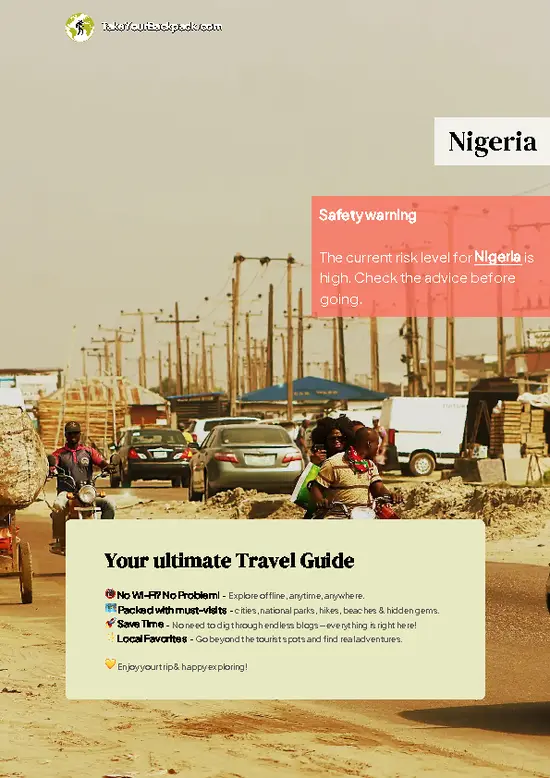
example page 0 from our offline Travel Guide for Nigeria
example page 1 from our offline Travel Guide for Nigeria
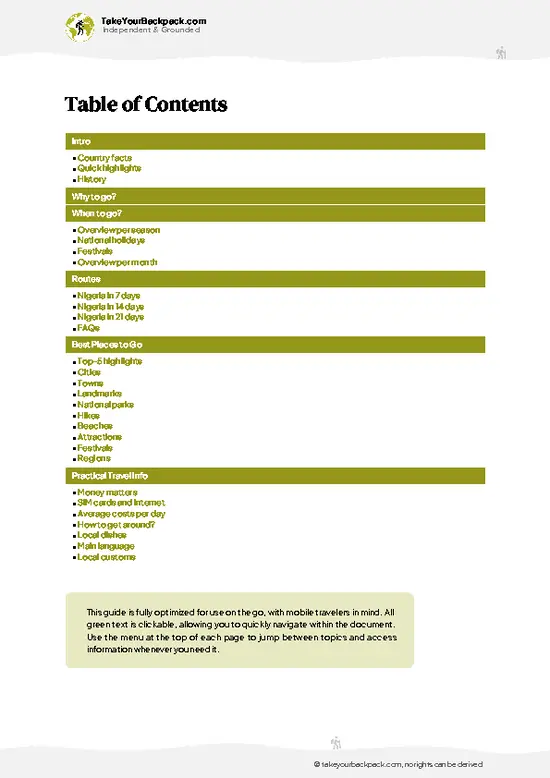
example page 2 from our offline Travel Guide for Nigeria
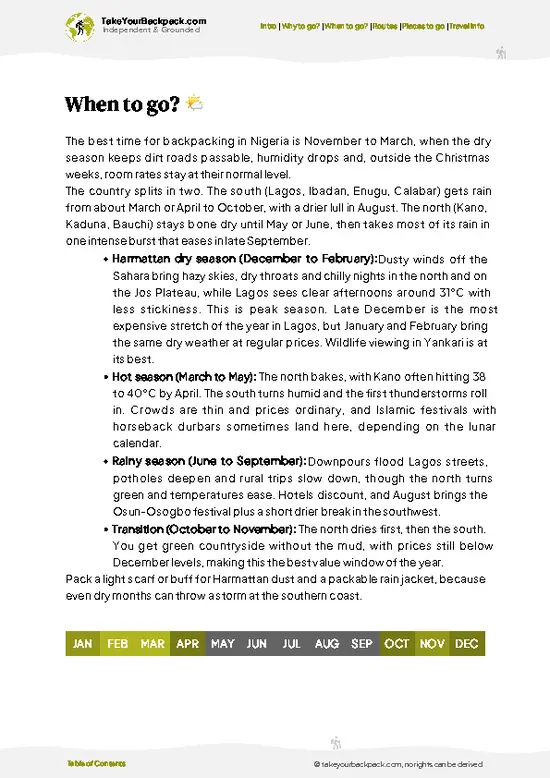
example page 3 from our offline Travel Guide for Nigeria
example page 4 from our offline Travel Guide for Nigeria
example page 5 from our offline Travel Guide for Nigeria
example page 6 from our offline Travel Guide for Nigeria
example page 7 from our offline Travel Guide for Nigeria
The digital guide (322 pages) contains:
87 highlights, ranked by travel appeal
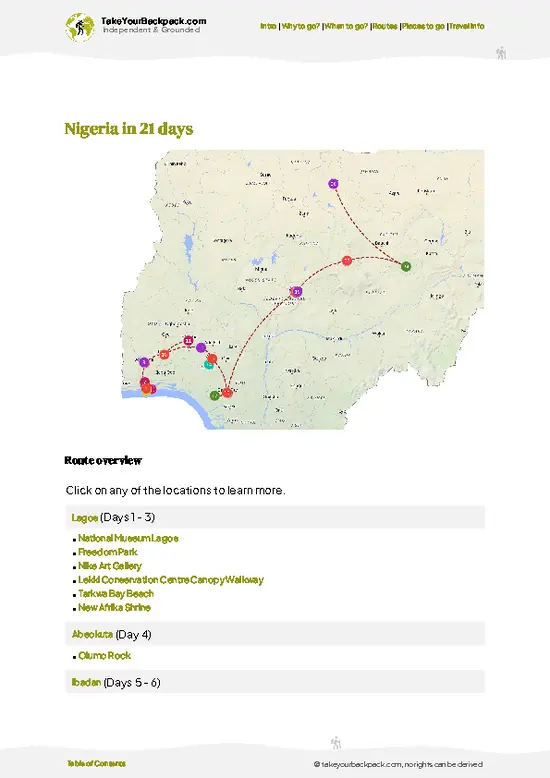
Optimized 7, 14 & 21-day travel routes
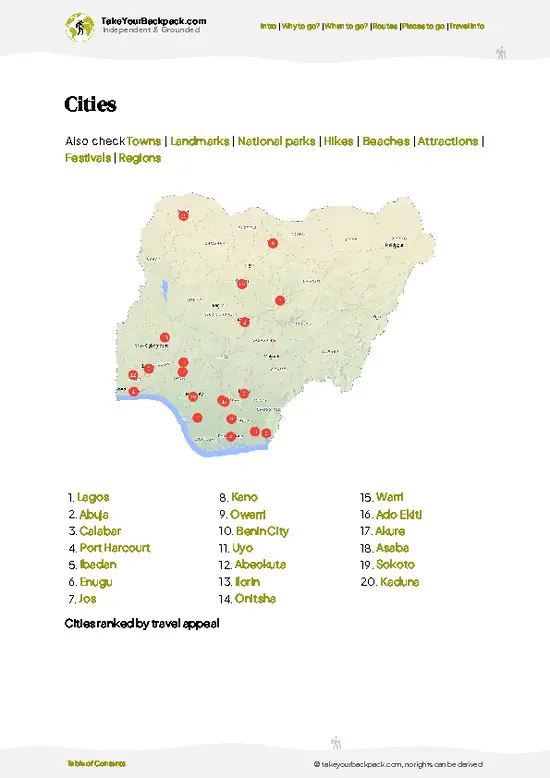
Cities, national parks, landmarks, beaches
How to get around
Offline-friendly for travel without Wi-Fi
👉 Click to see all 30+ guide features

📅 Plan smarter in minutes, not weeks
Month by month travel advice
Festivals & national holidays
Budget expectations

🗺️ Go to the right places, skip the overrated ones
Honest pros & cons of destinations
Top hikes, parks & viewpoints
Lesser-known places most travelers miss
Clear “worth it vs skip it” guidance

🛏️ Travel smoothly without rookie mistakes
Best areas to stay
Transport systems explained simply
Common scams & safety advice
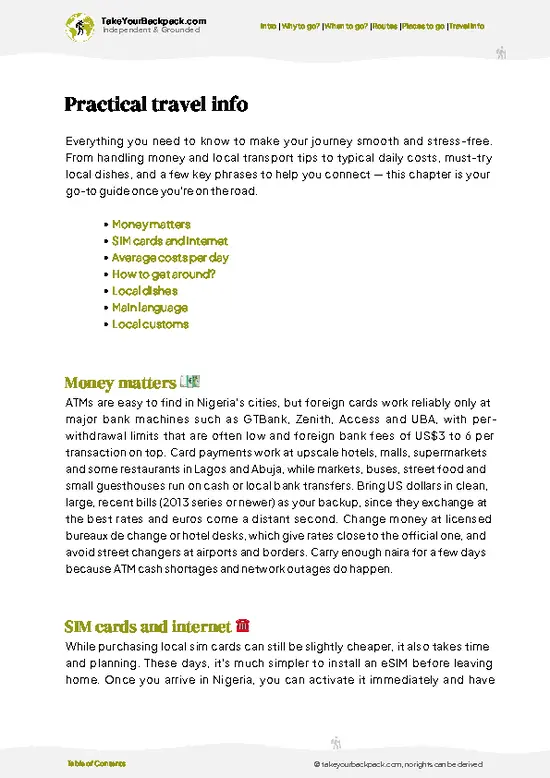
SIM cards, money & practical tips

🌍 Understand the country, not just visit it
Culture & traditions
52 Essential phrases & customs
Festivals worth planning around
Traveler-friendly historical context
Insights that make places more meaningful

📱 Built for real travel conditions
Fully downloadable PDF
Works completely offline
Optimized for phone use
Useful in remote areas & buses
Everything in one place
Save weeks of stressful planning
Get instant access to your full guide. 30‑day money-back guarantee.
+ Add another guide for just US$7.80

By proceeding you agree to our terms.
Sent to your inbox immediately after payment • 100% Secure Checkout
Best Backpacking Travel Advisor 2025 tourism awardBest Backpacking
Travel Advisor
2025
What others say about Take Your Backpack Guides:
⭐⭐⭐⭐⭐
Fantastic, amazing amount of information!
⭐⭐⭐⭐⭐
My goodness this is amazing, it's what I've been looking for hats off too you!
⭐⭐⭐⭐⭐
I think this is absolutely BRILLIANT
⭐⭐⭐⭐
Very complete and informative. It's still missing places, but I gotta to commend you
⭐⭐⭐⭐⭐
This is truly amazing, thank you, can't wait to explore it with my kids!
⭐⭐⭐⭐⭐
Awesome resource, thank you!
⭐⭐⭐⭐⭐
This is amazing! Can't wait to explore the ones I haven't seen
⭐⭐⭐⭐
I love this! Well done, great idea.
⭐⭐⭐⭐⭐
Thanks for taking the time to make this gem!
⭐⭐⭐⭐⭐
This might be the best website I've ever seen.
⭐⭐⭐⭐⭐
Congratulations, and thank you so much for your work; it's incredibly valuable.
⭐⭐⭐⭐
In all seriousness I think you did a great job pointing out the important spots
⭐⭐⭐⭐⭐
10/10 very good
⭐⭐⭐⭐⭐
As someone who's only just starting to visit regularly this is awesome, thank you.
⭐⭐⭐⭐
Thank you very much! I'm going to visit my dad, it's going to be very useful!
⭐⭐⭐⭐⭐
This is really cool! We'll be travelling for the first time and this definitely come in handy.
⭐⭐⭐⭐⭐
You are now our minister of culture, congratulations 👨‍💼
⭐⭐⭐⭐⭐
Just wanted to tell you that this is a pearl! Going to follow your recommendations.
⭐⭐⭐⭐⭐
This is so cool. I'll definitely be using the resource for my travels soon.
⭐⭐⭐⭐⭐
This is very impressive! Good work.
⭐⭐⭐⭐⭐
This is an amazing and informative site. Very well done!

🛏️ Where to stay?Best areas to stay in Nigeria

Kano’s backpacker scene is a puzzle of trade-offs between safety, social buzz, and budget. The best bets cluster around the city center, particularly the areas near Sabon Gari and Fagge. These neighborhoods strike a balance that savvy travelers will appreciate: they’re lively enough to meet fellow backpackers and locals, yet not so chaotic that you’re constantly on edge.

Sabon Gari is the heartbeat for budget travelers. It’s a melting pot of cultures and commerce, with affordable guesthouses and a handful of hostels catering to solo adventurers. The vibe here is gritty but authentic—think bustling … read more 👉
Kano’s backpacker scene is a puzzle of trade-offs between safety, social buzz, and budget. The best bets cluster around the city center, particularly the areas near Sabon Gari and Fagge. These neighborhoods strike a balance that savvy travelers will appreciate: they’re lively enough to meet fellow backpackers and locals, yet not so chaotic that you’re constantly on edge.

Sabon Gari is the heartbeat for budget travelers. It’s a melting pot of cultures and commerce, with affordable guesthouses and a handful of hostels catering to solo adventurers. The vibe here is gritty but authentic—think bustling markets, street food stalls, and a steady hum of activity that keeps you connected without the touristy gloss. Safety-wise, it’s relatively stable compared to the outskirts, but like any busy area, staying alert is non-negotiable.

Fagge offers a slightly quieter alternative, with a more residential feel and fewer crowds. It’s still close enough to the center to tap into social scenes and transport links, but you’ll find a bit more breathing room and a calmer night’s sleep. Hostels and budget lodgings are fewer but tend to be well-regarded for their local flavor and community vibe.

Avoid the outskirts unless you have a local guide or a specific reason. They can be unpredictable and lack the infrastructure that makes a backpacker’s life easier. In Kano, your best move is to nestle into the city’s core, where comfort, cost, and connection intersect in a way that lets you focus on the experience instead of the logistics.

🚌 Getting aroundHow to get around Kano

Kano moves to a rhythm that’s part instinct, part tradition, and only occasionally clockwork. It’s a city where the pulse of daily life is set by the ebb and flow of markets, the calls to prayer, and the hum of motorbikes weaving through narrow streets. You won’t find rigid timetables here; instead, expect a dance of improvisation and negotiation. Time bends around the needs of the moment, and comfort is a flexible concept—sometimes a cramped shared ride is the price for speed, other times a slow stroll reveals the city’s character. Understanding Kano’s transit is about reading between the lines of chaos and order, knowing when to hold on tight and when to let the city carry you.


  • Walking: The most reliable and cost-free way to navigate Kano’s dense neighborhoods and markets. It’s slow
read more 👉
Kano moves to a rhythm that’s part instinct, part tradition, and only occasionally clockwork. It’s a city where the pulse of daily life is set by the ebb and flow of markets, the calls to prayer, and the hum of motorbikes weaving through narrow streets. You won’t find rigid timetables here; instead, expect a dance of improvisation and negotiation. Time bends around the needs of the moment, and comfort is a flexible concept—sometimes a cramped shared ride is the price for speed, other times a slow stroll reveals the city’s character. Understanding Kano’s transit is about reading between the lines of chaos and order, knowing when to hold on tight and when to let the city carry you.


  • Walking: The most reliable and cost-free way to navigate Kano’s dense neighborhoods and markets. It’s slow but immersive, letting you catch the scents of spices and the chatter of vendors. Best for short distances and when you want to soak in the city’s texture without spending a dime.


  • Danfo Buses: These yellow minibuses run on semi-fixed routes but leave when full, so timing is unpredictable. Fares hover around 100–200 NGN, making them the cheapest motorized option. Expect cramped conditions and frequent stops, but they’re a direct line to major hubs like the central market and city center.


  • Motorcycle Taxis (Okada): The fastest way through Kano’s traffic snarls, especially when you’re short on time. Prices vary but generally start around 200 NGN for short trips. Comfort is minimal and safety can be a gamble, but if you’re agile and budget-conscious, they’re unbeatable for quick hops.


  • Shared Taxis: These are private cars or SUVs that fill up with passengers heading the same way. They offer a middle ground between danfo buses and okadas—more comfort and speed, but at a higher price, roughly 300–500 NGN depending on distance. They run until late evening, making them a solid choice for longer trips across town.


  • Private Taxis: The most comfortable but also the priciest option, starting at about 1000 NGN for short rides. No fixed schedule, so you control departure times, but expect to negotiate fares upfront. Ideal if you want to avoid the chaos and don’t mind paying for the convenience.

👛 Costs (as of 3 September 2026)What things cost and how to budget

Backpacking in Kano, Nigeria, offers a range of affordable options for independent travelers. Here's a breakdown of typical daily expenses:
  • Dorm accommodation: High season rates range from USD8 to 15 per night, while off-season prices can drop to USD5 to 10.
  • Meals: Local street food and casual dining typically cost between USD3 and 7 per day, with meals like suya and local stews being budget-friendly.
  • Local transport: Shared minibuses and motorbike taxis usually cost around USD1 to 3 for short trips within the city.
  • City transport pass: Kano does not have a formal city transport pass system; daily transport costs depend on usage but average around USD3 to 5.
  • Basic activities/entry fees: Visiting local markets, cultural sites, and museums generally costs USD2 to 5 per entry.
  • Miscellaneous expenses:
read more 👉
Backpacking in Kano, Nigeria, offers a range of affordable options for independent travelers. Here's a breakdown of typical daily expenses:
  • Dorm accommodation: High season rates range from USD8 to 15 per night, while off-season prices can drop to USD5 to 10.
  • Meals: Local street food and casual dining typically cost between USD3 and 7 per day, with meals like suya and local stews being budget-friendly.
  • Local transport: Shared minibuses and motorbike taxis usually cost around USD1 to 3 for short trips within the city.
  • City transport pass: Kano does not have a formal city transport pass system; daily transport costs depend on usage but average around USD3 to 5.
  • Basic activities/entry fees: Visiting local markets, cultural sites, and museums generally costs USD2 to 5 per entry.
  • Miscellaneous expenses: This includes water, snacks, and small purchases, typically USD2 to 5 daily.

Total daily budget for backpackers in Kano ranges from approximately USD20 to 40, balancing affordable accommodation, food, and transport with some cultural activities.


source: numbeo.com
⚠️ Prices can change and everyone travels differently, so take this as a rough guide. Hope it helps you plan your adventure!

🚌 Day tripsBest day trips from Kano

Kano is a strategic hub for backpackers looking to explore northern Nigeria without the hassle of constant packing and moving. Using Kano as your base unlocks a variety of day trips that balance cultural depth, historical intrigue, and natural beauty—all within a manageable radius.

Kano City Walls and Kurmi Market
Start with the obvious but essential: the ancient Kano City Walls and the bustling Kurmi Market. Both are right in town, so no travel time eats into your day. The walls offer a tangible sense of history, dating back centuries, while Kurmi Market is a sensory overload of fabrics, spices, and crafts. Budget-wise, you’re looking at just a few hundred naira for entry and snacks. The best time to visit is early morning to avoid the midday heat and crowds. A common rookie mistake is … read more 👉
Kano is a strategic hub for backpackers looking to explore northern Nigeria without the hassle of constant packing and moving. Using Kano as your base unlocks a variety of day trips that balance cultural depth, historical intrigue, and natural beauty—all within a manageable radius.

Kano City Walls and Kurmi Market
Start with the obvious but essential: the ancient Kano City Walls and the bustling Kurmi Market. Both are right in town, so no travel time eats into your day. The walls offer a tangible sense of history, dating back centuries, while Kurmi Market is a sensory overload of fabrics, spices, and crafts. Budget-wise, you’re looking at just a few hundred naira for entry and snacks. The best time to visit is early morning to avoid the midday heat and crowds. A common rookie mistake is rushing through the market; slow down, haggle, and soak in the atmosphere.


Gidan Makama Museum
A short 15-minute drive from Kano’s center, Gidan Makama Museum is a compact but rich dive into Hausa culture and history. It’s housed in a traditional palace, so the architecture alone is worth the trip. Entry is inexpensive, and local guides are often available for a small tip, adding layers to your understanding. Visit during the dry season (October to March) to avoid the sticky humidity that can sap your energy. Many travelers overlook this spot, but it’s a perfect half-day escape that keeps you grounded in the region’s heritage.
👉 Explore Gidan Makama Museum

Dutse Rock
If you want a break from urban scenes, Dutse Rock is a solid choice. It’s about a 2-hour drive from Kano, so start early. The climb isn’t technical but offers rewarding views and a chance to stretch your legs in nature. Transport costs are moderate if you share a ride with others or negotiate a day rate with a local driver. Pack water and snacks because amenities are sparse. The dry season is best here, too, as the rock can get slippery during rains. First-timers often underestimate the sun’s intensity, so bring a hat and sunscreen.


Rano Emirate
About 90 minutes from Kano, the Rano Emirate offers a quieter, less touristy glimpse into traditional Hausa governance and rural life. The journey itself is part of the charm, passing through small villages and farmland. Costs are low, especially if you use local transport, but timing is crucial—arrive early to catch the market day or a local festival. Avoid weekends if you want to dodge crowds and inflated prices. This trip rewards patience and curiosity more than speed.


Kofar Mata Dye Pits
A 20-minute ride from Kano’s center, the Kofar Mata Dye Pits are a fascinating, gritty experience. The pits have been in continuous use for centuries, and watching artisans at work is like stepping back in time. It’s cheap to visit, but be prepared for strong smells and a bit of chaos. Early morning visits are best to see the pits in full swing and avoid the afternoon heat. Many backpackers miss this because it’s off the beaten path, but it’s a raw, authentic slice of Kano’s craft culture.
Want to know what more Nigeria offers?
The Nigeria Travel Guide describes 87 highlights, from cities to national parks, from beaches to hikes

Get the Travel Guide -

🍲 FoodEating & Drinking in Kano

Kano’s food scene is a playground for your taste buds, where every bite tells a story of centuries-old Hausa traditions. Start with Suya, the fiery, smoky skewers of spiced meat grilled over open flames. It’s not just food; it’s a social ritual, often enjoyed standing around street stalls with locals swapping stories. Don’t miss Tuwo Shinkafa, a dense rice pudding paired with rich, peppery soups like Miyan Kuka—a baobab leaf stew that’s earthy and slightly tangy, a flavor you won’t find anywhere else.

Backpackers will find their culinary sweet spot in Kano’s bustling markets and street corners, where food vendors serve up fresh, affordable plates that double as cultural immersion. Casual eateries here don’t fuss with menus; you point, you eat, and you join the rhythm of daily life. For drinks, … read more 👉
Kano’s food scene is a playground for your taste buds, where every bite tells a story of centuries-old Hausa traditions. Start with Suya, the fiery, smoky skewers of spiced meat grilled over open flames. It’s not just food; it’s a social ritual, often enjoyed standing around street stalls with locals swapping stories. Don’t miss Tuwo Shinkafa, a dense rice pudding paired with rich, peppery soups like Miyan Kuka—a baobab leaf stew that’s earthy and slightly tangy, a flavor you won’t find anywhere else.

Backpackers will find their culinary sweet spot in Kano’s bustling markets and street corners, where food vendors serve up fresh, affordable plates that double as cultural immersion. Casual eateries here don’t fuss with menus; you point, you eat, and you join the rhythm of daily life. For drinks, Zobo—a hibiscus flower tea—is a refreshing, tart staple, often sold chilled by street vendors. If you’re feeling adventurous, try Fura da Nono, a fermented millet and milk drink that’s creamy, tangy, and surprisingly energizing.

Eating in Kano is a communal affair. Sharing plates is common, and using your right hand is a must—left hand is considered unclean. Expect a lively atmosphere where food is a connector, not just fuel. Dive in with an open mind and a ready appetite; Kano’s flavors demand your full attention.

🛡️ SafetyScams, Hazards, and Annoyances

Kano is a city where the rhythm of daily life moves fast, and blending in is your best safety strategy. Most neighborhoods are straightforward, but the old city and crowded markets demand sharper awareness. Here, pickpockets work in tight spaces, so keep valuables secure and your attention sharp. Solo travelers should avoid wandering these areas after dark; stick to well-lit, busier streets instead. Nighttime isn’t inherently dangerous, but the city’s infrastructure means fewer safe options for late travel, so plan your return before sundown or arrange trusted transport.

Scams aren’t elaborate but often revolve around inflated prices or unofficial guides who promise exclusive access. Politely decline and rely on your own pace—there’s no rush. Annoyances like persistent vendors or touts are … read more 👉
Kano is a city where the rhythm of daily life moves fast, and blending in is your best safety strategy. Most neighborhoods are straightforward, but the old city and crowded markets demand sharper awareness. Here, pickpockets work in tight spaces, so keep valuables secure and your attention sharp. Solo travelers should avoid wandering these areas after dark; stick to well-lit, busier streets instead. Nighttime isn’t inherently dangerous, but the city’s infrastructure means fewer safe options for late travel, so plan your return before sundown or arrange trusted transport.

Scams aren’t elaborate but often revolve around inflated prices or unofficial guides who promise exclusive access. Politely decline and rely on your own pace—there’s no rush. Annoyances like persistent vendors or touts are common but manageable with a firm, friendly “no, thank you.” Kano’s safety isn’t about fear; it’s about respect for local rhythms and a confident, aware presence that lets you navigate smoothly without drama.

FAQFrequently asked questions about Kano

3 to 4 days are sufficient to explore Kano's main attractions, including the ancient city walls, Emir's Palace, and Kurmi Market. This allows time to experience local culture and visit museums without rushing.
Yes, Kano is generally safe for solo backpackers who take standard precautions such as avoiding night travel, dressing modestly, and staying in well-reviewed accommodations. It's advisable to stay informed about local conditions and respect cultural norms.
Kano is known for its rich history as a trading hub in the Sahel region, traditional crafts like leatherwork and textiles, and the ancient Kano City Walls. It is also famous for the bustling Kurmi Market, one of the oldest markets in West Africa.
⚠️ Things can change over time, so always validate details locally before you go.

Other Nigerian cities near Kano

Explore more nearby:

  • Dutse—rocky hills, Friday market, Emir’s palace| 89 km away
  • Zaria—ancient city walls, Emir’s palace, university town| 137 km away
  • Funtua—cotton processing, railway stop, Hausa culture| 149 km away

💡 Not sure where to go next?
Create a personalized itinerary for Nigeria including Kano and the places that fit your trip.

Generate my itinerary

👉 Discover all cities

Or checkout all Nigeria has to offer (think cities, towns, villages, national parks, hikes, beaches, festivals)
Country photo of Nigeria

We 💚 feedbackParting advice and final tips

Kano isn’t for the faint-hearted, but that’s exactly why it sticks with you. The city hums with a raw energy—markets that never quit, streets where history and hustle collide. The surprise? The intricate leatherwork and dye pits hidden behind unassuming walls; it’s craftsmanship that demands a second look. Just remember, the heat and the crowds can wear you down fast, so pace yourself. Kano rewards those who dive in with curiosity and patience, turning every chaotic corner into a story worth telling.

✍️ Help improve this page!
The information on this page is based on in-depth research, insights shared by experienced travelers, and feedback from the local travel community in Nigeria. While every effort is made to keep the information accurate and current, conditions can change — so if you spot anything incorrect or outdated, please get in touch.


🙋‍♂️ Give feedback

👋 Meet the founderWho’s Behind Take Your Backpack?

Johan, backpacker and founder of TakeYourBackpackHi, I’m Johan (Netherlands 🇳🇱), the creator of TakeYourBackpack. Over the past decade, I’ve backpacked through 80+ countries across six continents, gaining extensive experience with independent travel, long-term trips, and overland routes.

This site is built on a combination of firsthand travel experience and carefully curated insights from other backpackers. Many guides are based on places I’ve personally visited, while others bring together tips, observations, and practical advice shared by trusted travelers I’ve met along the way.

The goal is to provide realistic, experience-driven guidance — not generic itineraries — so you can explore destinations with better context, clearer expectations, and more confidence.

Get full Nigeria guide •
Instant download • 87 highlights • Full Offline guide