×

Palau🇵🇼 | landmarksBlue HolesFour chimneys, light beams, cavern exit, Ngemelis Wall | things to do and best time to go

Explore Turtle CoveExplore Airai

Backpacking in Blue Holes
🌟 Highlightunique site ranked #2
By Johan Kruseman 🇳🇱 | Updated October 15, 2026

Dive the Blue Holes on a morning boat trip from Koror and you get four openings in one dip, about an hour’s boat ride from town. The site sits in the southwest of Palau, on the Ngemelis Wall side of the barrier reef, south of Koror. Four vertical chimneys open from the reef top into a big cavern, and sunbeams slant down through them like stage lights. That is the wow-factor, and it is real. Go early, around 8 a.m., and you often share the water with only one or two other boats. By midday the surface fills up with snorkelers and the light flattens. Photographers get silhouettes of divers against blue, though the cave is dim and wide-angle lenses help. It is worth the money if you hold an Advanced or comfortable Open Water certification. Snorkelers see mostly the top of the holes, which is fine but not the main event. Unlike nearby Blue Corner, which is a current-driven fish show on open wall, this is a quiet architectural dive with little drama from the water itself.

Discover everything you want to know in the 📖 Palau Travel Guide.


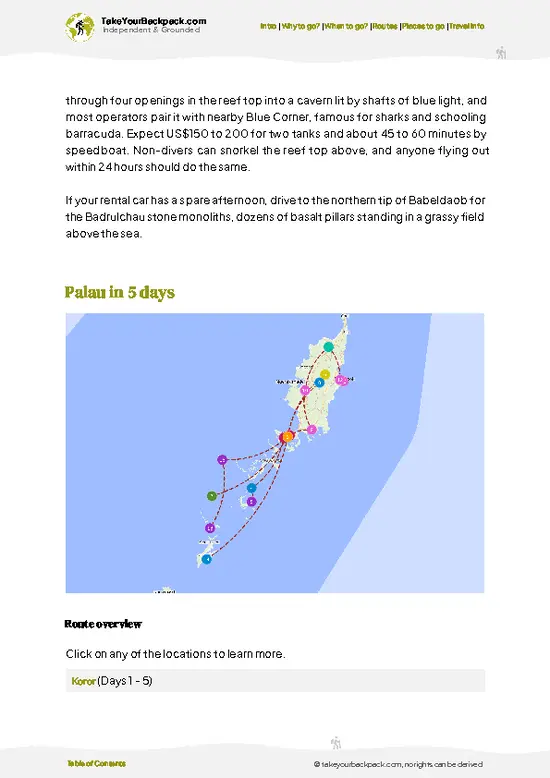
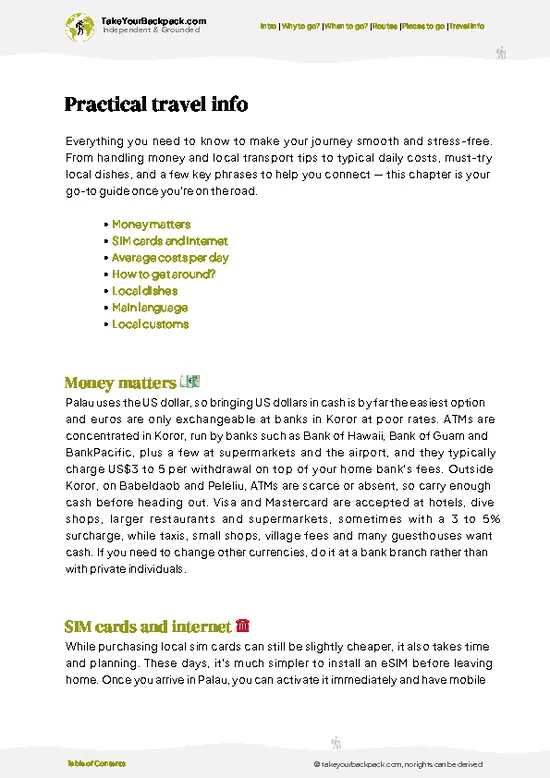
example page 0 from our offline Travel Guide for Palau
example page 1 from our offline Travel Guide for Palau
example page 2 from our offline Travel Guide for Palau
example page 3 from our offline Travel Guide for Palau
example page 4 from our offline Travel Guide for Palau
example page 5 from our offline Travel Guide for Palau
example page 6 from our offline Travel Guide for Palau
example page 7 from our offline Travel Guide for Palau
Loading the map 🌍
CLICK TO FILTER
towns
villages
landmarks
national parks
hikes
beaches
attractions
festivals
regions
SHOW COUNTRY’S BESTSHOW ALL

✨ Why go?
Ranked #2 unique site in Palau
Reasons people choose to visit here

Plenty of places in Palau have good diving, but few offer a geology lesson with a light show attached. The four chimneys drop from about 6 meters on the reef top and join a cavern that opens onto the outer wall, so you swim in through one shaft and out into open blue. That route is rare, and you finish the dive looking down a vertical drop with nothing beneath you. It is the kind of dive that turns a nervous intermediate into someone planning their next trip.

It also works well as part of a bigger day. Operators from Koror usually pair it with Blue Corner and the German Channel, so you cover the reef
from still cavern to roaring current in one trip. Nearby Ngemelis Wall is one of the most talked-about vertical walls in the Pacific, and the boat crews know the tides well enough to schedule … read more 👉
Plenty of places in Palau have good diving, but few offer a geology lesson with a light show attached. The four chimneys drop from about 6 meters on the reef top and join a cavern that opens onto the outer wall, so you swim in through one shaft and out into open blue. That route is rare, and you finish the dive looking down a vertical drop with nothing beneath you. It is the kind of dive that turns a nervous intermediate into someone planning their next trip.

It also works well as part of a bigger day. Operators from Koror usually pair it with Blue Corner and the German Channel, so you cover the reef
from still cavern to roaring current in one trip. Nearby Ngemelis Wall is one of the most talked-about vertical walls in the Pacific, and the boat crews know the tides well enough to schedule each stop at the right time.

If you are building a route through Micronesia, this stop justifies the flight. Book a few days of diving around it and the Rock Islands fill in the rest.

💡 HighlightsEssential experiences to have while visiting Blue Holes

  1. The Four Chimneys: Four vertical shafts open from the shallow reef top and drop into the cavern below. You descend through one, and sunlight pours through the openings in beams that move as the sun climbs.
  2. The Main Cavern: The shafts converge into a large chamber with soft light and a hushed feeling. Swim slowly here, since fins kick up silt and spoil the beams for the divers behind you.
  3. The Light Beams: Mid-morning is when the shafts are brightest. Watch for the beams striking the cavern floor and the dark outlines of your buddies moving through them.
  4. The Wall Exit: The cavern opens onto the outer face of the reef, and you glide into open water above a drop of hundreds of meters. The change from enclosed to endless is the moment most divers remember.
  5. Ngemelis Wall Drift: Beyond the exit the reef
… read more 👉
  1. The Four Chimneys: Four vertical shafts open from the shallow reef top and drop into the cavern below. You descend through one, and sunlight pours through the openings in beams that move as the sun climbs.
  2. The Main Cavern: The shafts converge into a large chamber with soft light and a hushed feeling. Swim slowly here, since fins kick up silt and spoil the beams for the divers behind you.
  3. The Light Beams: Mid-morning is when the shafts are brightest. Watch for the beams striking the cavern floor and the dark outlines of your buddies moving through them.
  4. The Wall Exit: The cavern opens onto the outer face of the reef, and you glide into open water above a drop of hundreds of meters. The change from enclosed to endless is the moment most divers remember.
  5. Ngemelis Wall Drift: Beyond the exit the reef wall is covered in soft corals, sea fans and sponges. Barracuda, jacks and turtles pass through, and the wall is a classic of Palau diving.
  6. Reef Top Shallows: On the safety stop you hover over a healthy reef flat full of anthias, butterflyfish and giant clams. It is an easy place to spend extra air.
  7. Snorkeling the Surface: Snorkelers float above the chimneys and see the shafts as dark blue circles in the reef. It is worth a short swim if you are not diving, though you miss the cavern.
Do the cavern descent first, before the boats stack up, because the beams and the quiet are best when the water is clear and still empty.
Spotted a mistake or missing something? Contact us.

Things to do near Blue Holes

Ratings based on Tripadvisor reviews. When you book through this link, you support our work at no extra cost to you.

🌤️ When to go?Seasonal considerations and timing

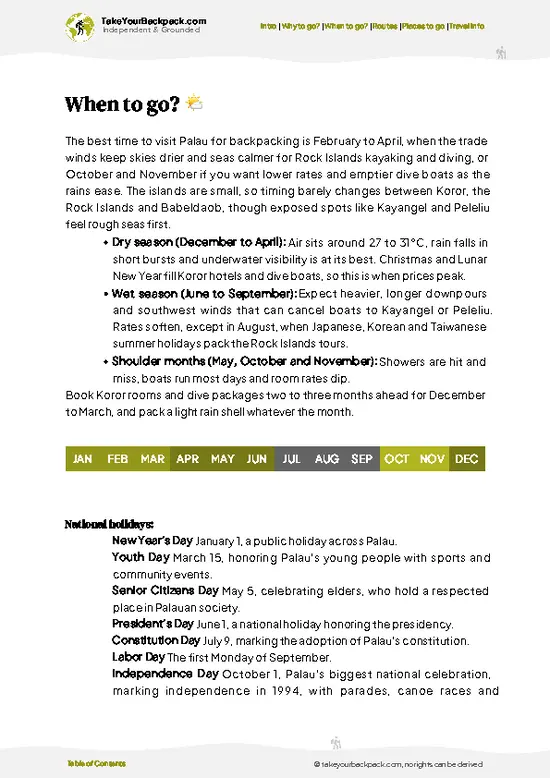
  • Dry Season (December to April): Calmest seas and the best odds of glassy visibility inside the Blue Holes channel. Days run 27 to 31°C (81 to 88°F), with humidity lower than the rest of the year. Boats fill up, and dive operators in Koror book out around Christmas, New Year and Lunar New Year.
  • Wet Season (June to October): Heavy showers arrive in short bursts, air sits around 27 to 30°C (81 to 86°F), and typhoon swells can cancel trips to the exposed outer reef. Visibility inside the holes usually holds up, and dive packages often drop 10 to 20 percent.
  • Transition Months (May and November): Fewer divers, moderate rain and workable seas. Water stays near 28 to 30°C (82 to 86°F) all year.
  • Time of Day: Sunrise is around 6:00 am and sunset around 6:15 pm all year. Morning dives catch light shafts
… read more 👉
  • Dry Season (December to April): Calmest seas and the best odds of glassy visibility inside the Blue Holes channel. Days run 27 to 31°C (81 to 88°F), with humidity lower than the rest of the year. Boats fill up, and dive operators in Koror book out around Christmas, New Year and Lunar New Year.
  • Wet Season (June to October): Heavy showers arrive in short bursts, air sits around 27 to 30°C (81 to 86°F), and typhoon swells can cancel trips to the exposed outer reef. Visibility inside the holes usually holds up, and dive packages often drop 10 to 20 percent.
  • Transition Months (May and November): Fewer divers, moderate rain and workable seas. Water stays near 28 to 30°C (82 to 86°F) all year.
  • Time of Day: Sunrise is around 6:00 am and sunset around 6:15 pm all year. Morning dives catch light shafts dropping through the four openings in the reef roof, and you get the site before the afternoon boats arrive.
Book your Blue Holes dives for a morning slot close to slack tide, since the current outside the channel is what dictates the schedule.


source: climatestotravel.comJANJanuary: excellent for travelingFEBFebruary: excellent for travelingMARMarch: excellent for travelingAPRApril: highly recommended for travelingMAYMay: fair for travelingJUNJune: fair for travelingJULJuly: fair for travelingAUGAugust: fair for travelingSEPSeptember: fair for travelingOCTOctober: fair for travelingNOVNovember: highly recommended for travelingDECDecember: excellent for traveling
palau-unique-site-blue-holes
© Google |

✈️ The backpacker research shortcutPalau Travel Guide

An offline-friendly backpacking guide with optimized travel routes, ranked highlights, transport advice, and the best areas to stay.
example page 0 from our offline Travel Guide for Palau
example page 1 from our offline Travel Guide for Palau
example page 2 from our offline Travel Guide for Palau
example page 3 from our offline Travel Guide for Palau
example page 4 from our offline Travel Guide for Palau
example page 5 from our offline Travel Guide for Palau
example page 6 from our offline Travel Guide for Palau
example page 7 from our offline Travel Guide for Palau
The digital guide (99 pages) contains:
✅ 22 highlights, ranked by travel appeal
✅ Optimized 2, 3 & 5-day travel routes
✅ Cities, national parks, landmarks, beaches
✅ How to get around
✅ Offline-friendly for travel without Wi-Fi
👉 Click to see all 30+ guide features

📅 Plan smarter in minutes, not weeks
✅ Month by month travel advice
✅ Festivals & national holidays
✅ Budget expectations

🗺️ Go to the right places, skip the overrated ones
✅ Honest pros & cons of destinations
✅ Top hikes, parks & viewpoints
✅ Lesser-known places most travelers miss
✅ Clear “worth it vs skip it” guidance

🛏️ Travel smoothly without rookie mistakes
✅ Best areas to stay
✅ Transport systems explained simply
✅ Common scams & safety advice
✅ SIM cards, money & practical tips

🌍 Understand the country, not just visit it
✅ Culture & traditions
✅ 52 Essential phrases & customs
✅ Festivals worth planning around
✅ Traveler-friendly historical context
✅ Insights that make places more meaningful

📱 Built for real travel conditions
✅ Fully downloadable PDF
✅ Works completely offline
✅ Optimized for phone use
✅ Useful in remote areas & buses
✅ Everything in one place
Stop searching, start planning
Get instant access to your full guide. 30‑day money-back guarantee.
+ Add another guide for just

By proceeding you agree to our terms.
Sent to your inbox immediately after payment • 100% Secure Checkout
Best Backpacking Travel Advisor 2025 tourism awardBest Backpacking
Travel Advisor
2025
What others say about Take Your Backpack Guides:
⭐⭐⭐⭐⭐
Fantastic, amazing amount of information!
⭐⭐⭐⭐⭐
My goodness this is amazing, it's what I've been looking for hats off too you!
⭐⭐⭐⭐⭐
I think this is absolutely BRILLIANT
⭐⭐⭐⭐
Very complete and informative. It's still missing places, but I gotta to commend you
⭐⭐⭐⭐⭐
This is truly amazing, thank you, can't wait to explore it with my kids!
⭐⭐⭐⭐⭐
Awesome resource, thank you!
⭐⭐⭐⭐⭐
This is amazing! Can't wait to explore the ones I haven't seen
⭐⭐⭐⭐
I love this! Well done, great idea.
⭐⭐⭐⭐⭐
Thanks for taking the time to make this gem!
⭐⭐⭐⭐⭐
This might be the best website I've ever seen.
⭐⭐⭐⭐⭐
Congratulations, and thank you so much for your work; it's incredibly valuable.
⭐⭐⭐⭐
In all seriousness I think you did a great job pointing out the important spots
⭐⭐⭐⭐⭐
10/10 very good
⭐⭐⭐⭐⭐
As someone who's only just starting to visit regularly this is awesome, thank you.
⭐⭐⭐⭐
Thank you very much! I'm going to visit my dad, it's going to be very useful!
⭐⭐⭐⭐⭐
This is really cool! We'll be travelling for the first time and this definitely come in handy.
⭐⭐⭐⭐⭐
You are now our minister of culture, congratulations 👨‍💼
⭐⭐⭐⭐⭐
Just wanted to tell you that this is a pearl! Going to follow your recommendations.
⭐⭐⭐⭐⭐
This is so cool. I'll definitely be using the resource for my travels soon.
⭐⭐⭐⭐⭐
This is very impressive! Good work.
⭐⭐⭐⭐⭐
This is an amazing and informative site. Very well done!

🛏️ Where to stay?Best areas and accommodation options

Koror is the place to stay, because nearly every Blue Holes trip leaves from its docks, and it is the only part of Palau with a real choice of budget beds. The site sits on the southwest outer reef, roughly 45 minutes to an hour by speedboat from the Koror harbors, so a base on the main island saves you both money and transfer time.
The downtown Koror area, around the main road near the harbors, is the most social. Hostels and guesthouses cluster here, dive shops are a short walk or pickup away, and small restaurants and grocery stores sit within a few blocks. Solo travelers find dive buddies at … read more 👉
Koror is the place to stay, because nearly every Blue Holes trip leaves from its docks, and it is the only part of Palau with a real choice of budget beds. The site sits on the southwest outer reef, roughly 45 minutes to an hour by speedboat from the Koror harbors, so a base on the main island saves you both money and transfer time.
The downtown Koror area, around the main road near the harbors, is the most social. Hostels and guesthouses cluster here, dive shops are a short walk or pickup away, and small restaurants and grocery stores sit within a few blocks. Solo travelers find dive buddies at shared breakfasts and dive-shop briefings, and the area feels safe at night.
The Malakal Island side is quieter and closer to the main dive docks. Many operators pick up there, so early starts are easier. Options are fewer and food is more limited, so stock up in town before heading over.
The Ngermid and Meyuns areas, away from downtown Koror, offer a calmer, more residential feel at lower rates, but you will want a rental car or reliable shuttle.
Book a bed that includes or arranges dive-shop pickup, since taxis are scarce and early departures are common.

👛 Costs (as of 15 October 2026)How expensive it really is

A realistic budget for a backpacker diving the Blue Holes is about US$215 to 400 per day, driven almost entirely by the cost of boat dives. Palau uses the US dollar, so all prices below are in USD.
CategoryBudget RangeLocal Reality
Accommodation (high season)US$40 to 80Dorm beds and basic guesthouse rooms in Koror; private rooms cost more in December to April.
Accommodation (low season)US$30 to 65Rates ease from June to October, and discounts are easier to negotiate on longer stays.
Dive tripUS$100 to 160Two-tank morning trip typically combining Blue Holes with nearby sites such as Blue Corner or German Channel; gear rental adds US$25 to 40 if you travel without your own.
Rock Islands permitUS$50 to 100Required for Rock Islands waters and usually valid for 10 days; some operators fold it into the
… read more 👉
A realistic budget for a backpacker diving the Blue Holes is about US$215 to 400 per day, driven almost entirely by the cost of boat dives. Palau uses the US dollar, so all prices below are in USD.
CategoryBudget RangeLocal Reality
Accommodation (high season)US$40 to 80Dorm beds and basic guesthouse rooms in Koror; private rooms cost more in December to April.
Accommodation (low season)US$30 to 65Rates ease from June to October, and discounts are easier to negotiate on longer stays.
Dive tripUS$100 to 160Two-tank morning trip typically combining Blue Holes with nearby sites such as Blue Corner or German Channel; gear rental adds US$25 to 40 if you travel without your own.
Rock Islands permitUS$50 to 100Required for Rock Islands waters and usually valid for 10 days; some operators fold it into the trip price.
Environmental feeUS$100The Pristine Paradise Environmental Fee is charged once, normally built into your airfare.
FoodUS$20 to 40Local diners and takeout plates cost US$8 to 15; imported groceries are pricey.
Local transportUS$5 to 20Taxis and shuttles around Koror; many dive shops include hotel pickup.
Total Daily BudgetUS$215 to 400Per person, per day, in high season.
⚠️ Prices can change and everyone travels differently, so take this as a rough guide. Hope it helps you plan your adventure!

FAQCommon questions from travelers

The Blue Holes is a dive site on the southwest outer reef of Palau, where four vertical shafts open in the reef top and drop into a large cavern with light beams and sheer walls. Depths range from about 7 meters at the top to 35 meters or more outside the cavern. It is a popular two-tank dive often paired with Blue Corner or the German Channel, and advanced and open-water certified divers both go.
Plan on a half day, about four to five hours including the boat ride, though most operators bundle it into a full-day two-tank trip lasting about 7 to 8 hours. The dive itself usually lasts 40 to 60 minutes. Most visitors stay three to five days in Palau to combine it with other sites.
Take a dive boat from the Koror or Malakal harbors, which takes roughly 45 to 60 minutes each way, depending on sea conditions. Most hotels in Koror offer pickup, and tours cost about US$100 to 160 for two tanks. A Rock Islands permit, about US$50 to 100, is also required. Flights to Palau’s Roman Tmetuchl International Airport connect via Guam, Manila, Taipei or Seoul, and Koror is about 30 to 40 minutes from the airport by road.
⚠️ Things can change over time, so always validate details locally before you go.

Other Palauan landmarks near Blue Holes

Explore more nearby:

  • Turtle Cove—Resident turtles, gentle drift, coral ledges, Rock Islands| 7 km away
  • Jellyfish Lake—Golden jellyfish, ridge trail, mangrove edge, Eil Malk| 17 km away
  • Ulong Channel—Tidal cut, grey reef sharks, giant clams, sandy floor| 17 km away

💡 Not sure where to go next?
Create a personalized itinerary for Palau including Blue Holes and the places that fit your trip.

Generate my itinerary

👉 Discover all landmarks

Or checkout all Palau has to offer (think cities, towns, villages, national parks, hikes, beaches, festivals)
Country photo of Palau

We 💚 feedbackKey takeaways before you go

Give Palau at least five days if you want the Blue Holes to sit alongside Blue Corner, the German Channel and a Jellyfish Lake visit, since weather and tides can shuffle your schedule. A single day gets you the chimneys but nothing else. I would book the Blue Holes dive early in the trip, so a rough-sea day can be swapped without panic.

✍️ Help improve this page!
The information on this page is based on in-depth research, insights shared by experienced travelers, and feedback from the local travel community in Palau. While every effort is made to keep the information accurate and current, conditions can change — so if you spot anything incorrect or outdated, please get in touch.


🙋‍♂️ Give feedback

👋 Meet the founderWho’s Behind Take Your Backpack?

Johan, backpacker and founder of TakeYourBackpackHi, I’m Johan (Netherlands 🇳🇱), the creator of TakeYourBackpack. Over the past 3 decades, I’ve backpacked through 90+ countries across six continents, gaining extensive experience with independent travel, long-term trips, and overland routes.

This site is built on a combination of firsthand travel experience and carefully curated insights from other backpackers. Many guides are based on places I’ve personally visited, while others bring together tips, observations, and practical advice shared by trusted travelers I’ve met along the way.

The goal is to provide realistic, experience-driven guidance — not generic itineraries — so you can explore destinations with better context, clearer expectations, and more confidence.