



×

Papua New Guinea🇵🇬 | townsAlotauMilne Bay gateway, Massim carvings, war memorials, outrigger harbor | things to do and best time to go

Explore WewakExplore Tari

Backpacking in Alotau
🏆 Top picktown ranked #4
By Johan Kruseman 🇳🇱 | Updated October 16, 2026

Alotau puts you at the doorstep of Milne Bay's islands, reefs and WWII relics without a single organized-tour markup if you arrange boats locally. The provincial capital sits in the far southeast of Papua New Guinea, on the shore of a sheltered bay ringed by green ridges. The town itself is small and low-key: a main street, a busy produce market, a waterfront with outrigger canoes pulling in, and a few guesthouses where you swap plans over dinner. You walk the market and leave with a bag of fresh mangoes and a lead on a boat. Flights from Port Moresby make it easy to reach. Evenings are slow and social in a quiet way, so meeting other travelers happens at guesthouses and dive operators. Divers, boat-hoppers and slow travelers will love it. Anyone chasing nightlife or big sights will be bored.

Discover everything you want to know in the 📖 Papua New Guinea Travel Guide.


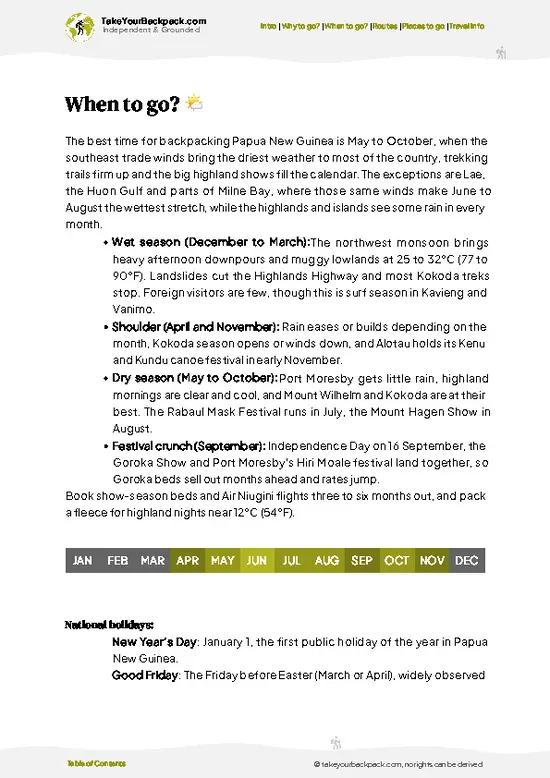
example page 0 from our offline Travel Guide for Papua New Guinea
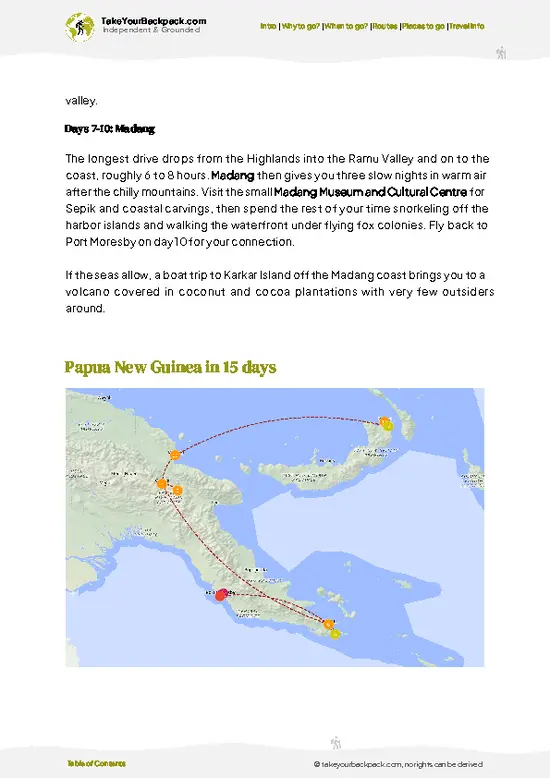
example page 1 from our offline Travel Guide for Papua New Guinea
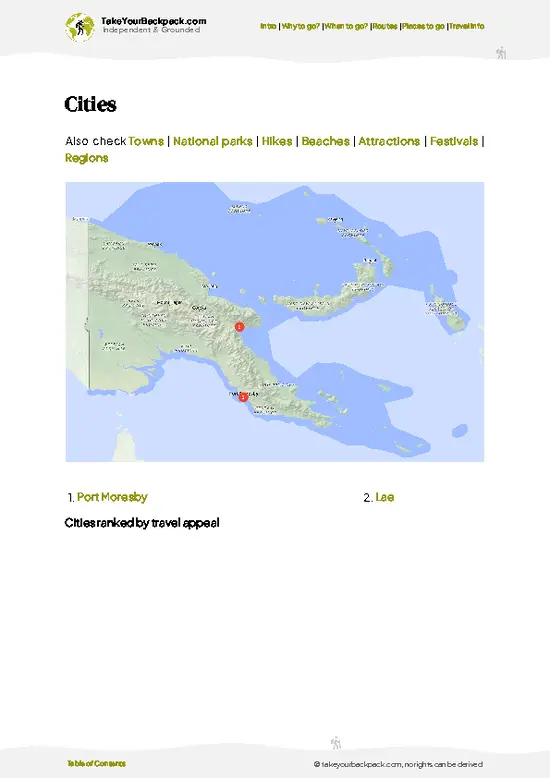
example page 2 from our offline Travel Guide for Papua New Guinea
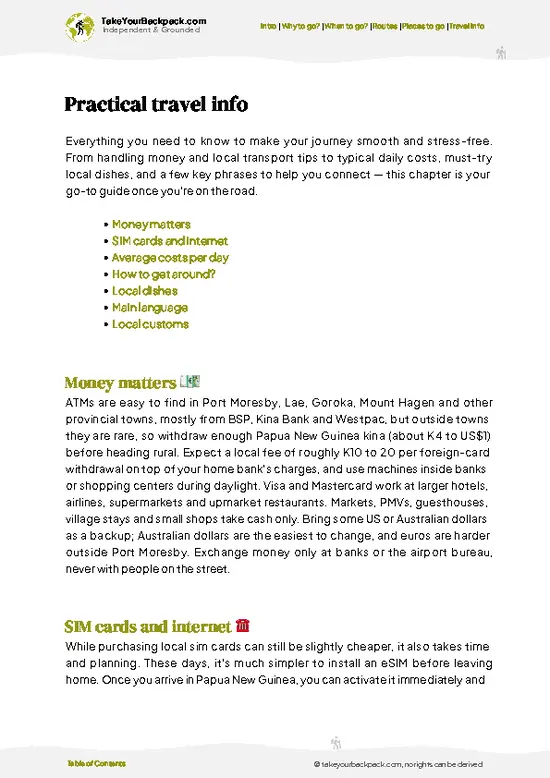
example page 3 from our offline Travel Guide for Papua New Guinea
example page 4 from our offline Travel Guide for Papua New Guinea
example page 5 from our offline Travel Guide for Papua New Guinea
example page 6 from our offline Travel Guide for Papua New Guinea
example page 7 from our offline Travel Guide for Papua New Guinea
Loading the map 🌍
CLICK TO FILTER
cities
towns
national parks
hikes
beaches
attractions
festivals
regions
SHOW COUNTRY’S BESTSHOW ALL

✨ Why go?
Ranked #4 town in Papua New Guinea
The unique appeal for travelers

Alotau earns its place as the launch pad for Milne Bay Province, where reefs, villages and wartime history sit within reach of a small boat. Most travelers use it to arrange trips: diving and snorkeling over reefs, visits to island communities, or a look at the ground where the 1942 Battle of Milne Bay turned back Japanese forces. You will probably stay two or three nights, one to sort logistics and the rest to get out on the water or walk the nearby bay. The town is easy on foot, and the Alotau market is the daily meeting point for villagers, who arrive by boat and truck with taro, bananas, betel nut and fish. Hostel culture is thin, but guesthouses are small enough that you end up talking to everyone. It suits divers, solo travelers comfortable improvising, and anyone who likes slow, village-scale … read more 👉
Alotau earns its place as the launch pad for Milne Bay Province, where reefs, villages and wartime history sit within reach of a small boat. Most travelers use it to arrange trips: diving and snorkeling over reefs, visits to island communities, or a look at the ground where the 1942 Battle of Milne Bay turned back Japanese forces. You will probably stay two or three nights, one to sort logistics and the rest to get out on the water or walk the nearby bay. The town is easy on foot, and the Alotau market is the daily meeting point for villagers, who arrive by boat and truck with taro, bananas, betel nut and fish. Hostel culture is thin, but guesthouses are small enough that you end up talking to everyone. It suits divers, solo travelers comfortable improvising, and anyone who likes slow, village-scale travel. If you need constant activity or tidy schedules, treat it as a brief stop.

💡 HighlightsThe experiences that define the visit

  1. Battle of Milne Bay Memorial: The 1942 battle shaped the region, and the memorial park on the waterfront is quiet and moving. Go in the morning for cooler light. Free, about 45 minutes.
  2. Alotau Market: The produce market is where the province comes to trade, with piles of vegetables, fish, smoked pork and betel nut. Mornings are liveliest. Entry is free, buying a snack costs a little, and an hour is plenty.
  3. Alotau waterfront and harbor: Walk the shore to see outrigger canoes and trade boats arriving from outlying islands. Late afternoon gives the best light and the most activity. Free, 30 to 60 minutes.
  4. Massim Museum and Cultural Centre: Look for local carvings and the famed decorated lime spatulas and canoe prow boards that define Massim art. Hours can be irregular, so ask your guesthouse first.
… read more 👉
  1. Battle of Milne Bay Memorial: The 1942 battle shaped the region, and the memorial park on the waterfront is quiet and moving. Go in the morning for cooler light. Free, about 45 minutes.
  2. Alotau Market: The produce market is where the province comes to trade, with piles of vegetables, fish, smoked pork and betel nut. Mornings are liveliest. Entry is free, buying a snack costs a little, and an hour is plenty.
  3. Alotau waterfront and harbor: Walk the shore to see outrigger canoes and trade boats arriving from outlying islands. Late afternoon gives the best light and the most activity. Free, 30 to 60 minutes.
  4. Massim Museum and Cultural Centre: Look for local carvings and the famed decorated lime spatulas and canoe prow boards that define Massim art. Hours can be irregular, so ask your guesthouse first. Expect a small donation, about 30 to 45 minutes.
  5. Alotau Town Hill lookout: A short climb gives views over the bay and the islands beyond, best at sunrise or an hour before sunset. Free, about an hour with the walk.
Day trips from town include Samarai Island, the diving reefs around Dobu, and the Kwato mission island. The war memorial and the market pair well in one morning, with the waterfront as a slow finish.
Spotted a mistake or missing something? Contact us.

🏘️ NeighborhoodsKey areas and districts to know

Alotau is compact enough to cover in a morning, so lace up and sweep through it area by area.
  • Downtown and Main Street: A short strip of trade stores, banks, a supermarket and the post office, all within a ten-minute walk. Duck into the Alotau Market for fresh fish, betel nut, sweet potato and mud crab, then leave with a cheap, hot lunch of fried fish and rice.
  • Waterfront and Harbor: Stroll the seawall where outboard dinghies and bigger boats load up for the islands. Sunset here turns Milne Bay orange, with the green ridges of the bay's far shore across the water.
  • Kenmore and Hill Roads: Climb the slopes behind town and the grid gives way to leafy lanes, quiet houses and open views over the bay. Go early, because the heat builds fast, and your reward is a breeze and a wide panorama.
  • Alotau Airport
… read more 👉
Alotau is compact enough to cover in a morning, so lace up and sweep through it area by area.
  • Downtown and Main Street: A short strip of trade stores, banks, a supermarket and the post office, all within a ten-minute walk. Duck into the Alotau Market for fresh fish, betel nut, sweet potato and mud crab, then leave with a cheap, hot lunch of fried fish and rice.
  • Waterfront and Harbor: Stroll the seawall where outboard dinghies and bigger boats load up for the islands. Sunset here turns Milne Bay orange, with the green ridges of the bay's far shore across the water.
  • Kenmore and Hill Roads: Climb the slopes behind town and the grid gives way to leafy lanes, quiet houses and open views over the bay. Go early, because the heat builds fast, and your reward is a breeze and a wide panorama.
  • Alotau Airport and Gurney Road: The road toward Gurney heads out past palm groves and village gardens. It is too far to walk comfortably, so hop on a local PMV and you will pass memorial sites from the 1942 Battle of Milne Bay.
  • Waterfront Resort Strip: A handful of seaside restaurants and bars sit along the bay edge. Order a cold SP beer and fresh grilled fish, and watch the boats come in. Nightlife is low-key and mostly finishes early.

⌛️ 1 dayHow to make the most of one day

The day works best on foot in the cool morning, with a taxi or PMV for the farther stops and a long rest through the midday heat.
7:30 AM, Alotau Market: Start where the town wakes up. Villagers unload boats and trucks, and you can graze on fruit and cooked snacks while chatting with sellers.
9:30 AM, Waterfront: Stroll the shore to watch canoes and trade boats. It is an easy walk from the market and a good place to ask about charters.
10:30 AM, Battle of Milne Bay Memorial and Turnbull Memorial Park: Take a taxi between the memorials for an understanding of why this bay mattered in 1942.
12:30 PM, Lunch and rest: Return to town, eat simply at a local cafe or your guesthouse, and stay out of the heat for a couple of hours.
3:30 PM, Back-street villages and church area: Wander the residential edges, … read more 👉
The day works best on foot in the cool morning, with a taxi or PMV for the farther stops and a long rest through the midday heat.
7:30 AM, Alotau Market: Start where the town wakes up. Villagers unload boats and trucks, and you can graze on fruit and cooked snacks while chatting with sellers.
9:30 AM, Waterfront: Stroll the shore to watch canoes and trade boats. It is an easy walk from the market and a good place to ask about charters.
10:30 AM, Battle of Milne Bay Memorial and Turnbull Memorial Park: Take a taxi between the memorials for an understanding of why this bay mattered in 1942.
12:30 PM, Lunch and rest: Return to town, eat simply at a local cafe or your guesthouse, and stay out of the heat for a couple of hours.
3:30 PM, Back-street villages and church area: Wander the residential edges, away from the main street, where gardens, kids' games and church life show everyday Alotau rarely seen by visitors.
5:00 PM, Town Hill lookout: Climb for the bay views and the changing light on the islands.
6:30 PM, Dinner: Finish at a guesthouse table, trading plans with other travelers.

🌤️ When to go?When to go for the best experience

May to October is the drier stretch for Alotau, with daytime highs of 27 to 30°C (81 to 86°F) and nights near 22°C (72°F). Seas are rougher with the southeast trade winds, but diving visibility and road conditions are generally good.
  • Drier Months (May to October): Less rain, breezy days and steady boat travel to the islands. Sunrise is around 6:00 and sunset near 18:00. Most visitors come now, and flights and rooms fill up.
  • Wet Season (December to March): Heavy downpours, humid heat of 30 to 32°C (86 to 90°F) and occasional cyclone swells. Roads turn muddy and boats sometimes cancel, though crowds are thin.
  • Shoulder Months (April and November): Showers ease or begin, prices stay steady and you can usually find space.
  • Festival Time: The National Kenu and Kundu Festival in Alotau runs in early November
… read more 👉
May to October is the drier stretch for Alotau, with daytime highs of 27 to 30°C (81 to 86°F) and nights near 22°C (72°F). Seas are rougher with the southeast trade winds, but diving visibility and road conditions are generally good.
  • Drier Months (May to October): Less rain, breezy days and steady boat travel to the islands. Sunrise is around 6:00 and sunset near 18:00. Most visitors come now, and flights and rooms fill up.
  • Wet Season (December to March): Heavy downpours, humid heat of 30 to 32°C (86 to 90°F) and occasional cyclone swells. Roads turn muddy and boats sometimes cancel, though crowds are thin.
  • Shoulder Months (April and November): Showers ease or begin, prices stay steady and you can usually find space.
  • Festival Time: The National Kenu and Kundu Festival in Alotau runs in early November and brings dancing, canoe races and a surge in bookings.
Book festival flights and rooms several months ahead.


source: climatestotravel.comJANJanuary: fair for travelingFEBFebruary: fair for travelingMARMarch: fair for travelingAPRApril: highly recommended for travelingMAYMay: excellent for travelingJUNJune: excellent for travelingJULJuly: highly recommended for travelingAUGAugust: highly recommended for travelingSEPSeptember: highly recommended for travelingOCTOctober: highly recommended for travelingNOVNovember: highly recommended for travelingDECDecember: fair for traveling
when-to-go

✈️ The backpacker research shortcutPapua New Guinea Travel Guide

An offline-friendly backpacking guide with optimized travel routes, ranked highlights, transport advice, and the best areas to stay.
example page 0 from our offline Travel Guide for Papua New Guinea
example page 1 from our offline Travel Guide for Papua New Guinea
example page 2 from our offline Travel Guide for Papua New Guinea
example page 3 from our offline Travel Guide for Papua New Guinea
example page 4 from our offline Travel Guide for Papua New Guinea
example page 5 from our offline Travel Guide for Papua New Guinea
example page 6 from our offline Travel Guide for Papua New Guinea
example page 7 from our offline Travel Guide for Papua New Guinea
The digital guide (251 pages) contains:
✅ 81 highlights, ranked by travel appeal
✅ Optimized 5, 10 & 15-day travel routes
✅ Cities, national parks, landmarks, beaches
✅ How to get around
✅ Offline-friendly for travel without Wi-Fi
👉 Click to see all 30+ guide features

📅 Plan smarter in minutes, not weeks
✅ Month by month travel advice
✅ Festivals & national holidays
✅ Budget expectations

🗺️ Go to the right places, skip the overrated ones
✅ Honest pros & cons of destinations
✅ Top hikes, parks & viewpoints
✅ Lesser-known places most travelers miss
✅ Clear “worth it vs skip it” guidance

🛏️ Travel smoothly without rookie mistakes
✅ Best areas to stay
✅ Transport systems explained simply
✅ Common scams & safety advice
✅ SIM cards, money & practical tips

🌍 Understand the country, not just visit it
✅ Culture & traditions
✅ 52 Essential phrases & customs
✅ Festivals worth planning around
✅ Traveler-friendly historical context
✅ Insights that make places more meaningful

📱 Built for real travel conditions
✅ Fully downloadable PDF
✅ Works completely offline
✅ Optimized for phone use
✅ Useful in remote areas & buses
✅ Everything in one place
Stop searching, start planning
Get instant access to your full guide. 30‑day money-back guarantee.
+ Add another guide for just

By proceeding you agree to our terms.
Sent to your inbox immediately after payment • 100% Secure Checkout
Best Backpacking Travel Advisor 2025 tourism awardBest Backpacking
Travel Advisor
2025
What others say about Take Your Backpack Guides:
⭐⭐⭐⭐⭐
Fantastic, amazing amount of information!
⭐⭐⭐⭐⭐
My goodness this is amazing, it's what I've been looking for hats off too you!
⭐⭐⭐⭐⭐
I think this is absolutely BRILLIANT
⭐⭐⭐⭐
Very complete and informative. It's still missing places, but I gotta to commend you
⭐⭐⭐⭐⭐
This is truly amazing, thank you, can't wait to explore it with my kids!
⭐⭐⭐⭐⭐
Awesome resource, thank you!
⭐⭐⭐⭐⭐
This is amazing! Can't wait to explore the ones I haven't seen
⭐⭐⭐⭐
I love this! Well done, great idea.
⭐⭐⭐⭐⭐
Thanks for taking the time to make this gem!
⭐⭐⭐⭐⭐
This might be the best website I've ever seen.
⭐⭐⭐⭐⭐
Congratulations, and thank you so much for your work; it's incredibly valuable.
⭐⭐⭐⭐
In all seriousness I think you did a great job pointing out the important spots
⭐⭐⭐⭐⭐
10/10 very good
⭐⭐⭐⭐⭐
As someone who's only just starting to visit regularly this is awesome, thank you.
⭐⭐⭐⭐
Thank you very much! I'm going to visit my dad, it's going to be very useful!
⭐⭐⭐⭐⭐
This is really cool! We'll be travelling for the first time and this definitely come in handy.
⭐⭐⭐⭐⭐
You are now our minister of culture, congratulations 👨‍💼
⭐⭐⭐⭐⭐
Just wanted to tell you that this is a pearl! Going to follow your recommendations.
⭐⭐⭐⭐⭐
This is so cool. I'll definitely be using the resource for my travels soon.
⭐⭐⭐⭐⭐
This is very impressive! Good work.
⭐⭐⭐⭐⭐
This is an amazing and informative site. Very well done!

🛏️ Where to stay?Best areas to stay in Papua New Guinea

The best budget base is central Alotau around Main Street and the waterfront, where basic guesthouses and a few backpacker-priced rooms sit within walking distance of the market, supermarket and boat landings. Beds here run roughly K80 to 200 (US$20 to 50) for a basic room or dorm bed, and options are limited, so book ahead in November and December.

Central streets are noisy at dawn with roosters, PMV horns and market traffic, but they are much easier on the budget because you will not need taxis. Night walking is manageable in the busier parts, though dark side streets are best avoided.

The … read more 👉
The best budget base is central Alotau around Main Street and the waterfront, where basic guesthouses and a few backpacker-priced rooms sit within walking distance of the market, supermarket and boat landings. Beds here run roughly K80 to 200 (US$20 to 50) for a basic room or dorm bed, and options are limited, so book ahead in November and December.

Central streets are noisy at dawn with roosters, PMV horns and market traffic, but they are much easier on the budget because you will not need taxis. Night walking is manageable in the busier parts, though dark side streets are best avoided.

The second option is the hill area above town. It offers cooler breezes, sea views and quieter evenings, with fewer cheap places. You will usually need a short taxi or PMV ride down, so it suits travelers who value sleep and a view over convenience. Hot water and air conditioning are not guaranteed at the cheapest places, so a fan and a mosquito net matter more.

🚌 Getting aroundMoving around without the hassle

The center of Alotau is easy to walk: the market, shops, banks and waterfront all sit within about ten minutes of each other on foot. Walking stops making sense once you head out to the airport, Gurney or the war sites, where distances stretch along hot roads. Public transport is informal, frequent in daylight and cheap.
  • Walking: Free, and it covers the whole center. You get market smells, harbor views and chats with vendors at every corner. Go early or late to dodge midday heat.
  • PMV (public minibus): Fares are roughly K2 to 5 (about US$0.50 to 1.50) around town and a bit more out to Gurney or farther villages. Buses run from about 6:00 until early evening and leave when full. You squeeze in beside villagers and bags, and you see the real bayside routes.
  • Taxi: Licensed taxis cost around K10 to
… read more 👉
The center of Alotau is easy to walk: the market, shops, banks and waterfront all sit within about ten minutes of each other on foot. Walking stops making sense once you head out to the airport, Gurney or the war sites, where distances stretch along hot roads. Public transport is informal, frequent in daylight and cheap.
  • Walking: Free, and it covers the whole center. You get market smells, harbor views and chats with vendors at every corner. Go early or late to dodge midday heat.
  • PMV (public minibus): Fares are roughly K2 to 5 (about US$0.50 to 1.50) around town and a bit more out to Gurney or farther villages. Buses run from about 6:00 until early evening and leave when full. You squeeze in beside villagers and bags, and you see the real bayside routes.
  • Taxi: Licensed taxis cost around K10 to 30 (US$2.50 to 8) for trips inside town or to the airport. Agree the price first. They are the sensible pick after dark.
  • Dinghies and banana boats: Boats to nearby islands and coastal villages typically run K50 to 300 (US$12 to 75) per person depending on distance and fuel. Trips can take 30 minutes to several hours, and you get open water, reefs and island arrivals. Seas can be choppy, so pack dry bags.
  • Hired vehicle with driver: For a day of war sites and waterfalls, expect roughly K300 to 500 (US$75 to 125) split among passengers. It saves time and gets you to places PMVs reach slowly.

👛 Costs (as of 16 October 2026)How expensive it really is

Expect to spend around US$70 to 130 a day in Alotau, because accommodation and food cost more than in much of Southeast Asia.
CategoryBudget RangeLocal Reality
Dorm or basic roomUS$20 to 50Few dorms exist; a basic guesthouse room is typical
MealsUS$15 to 30Market fish, rice and sweet potato are cheapest; restaurants cost more
Local transportUS$5 to 15PMVs are cheap, taxis add up
Activities and entry feesUS$15 to 25Village fees, boat rides and guides
MiscellaneousUS$10 to 15Water, SIM data, snacks and tips
Total Daily BudgetUS$70 to 130Higher if you charter boats
Buy fruit, vegetables and fish at the market and eat at stalls to cut food costs sharply.
⚠️ Prices can change and everyone travels differently, so take this as a rough guide. Hope it helps you plan your adventure!

🚌 Day tripsEasy escapes and nearby places

Alotau works well as a base for short outings, but most trips depend on boats or hired vehicles, so plan around weather and tides.
Milne Bay War Sites:
The road toward Gurney passes memorials and wreck remains from the 1942 Battle of Milne Bay, where Allied forces halted a Japanese landing. Allow a half day with a hired driver for about K150 to 300 (US$40 to 75) total. Go in the morning before heat and showers, and carry small cash for local guides.

Samarai Island:
This former colonial capital sits about an hour or two offshore by boat, with quiet lanes, old ruins and clear water. Boats usually cost K100 to 250 (US$25 to 65) each way, so check return times before leaving. First-timers often miss the last boat, so confirm it in the morning.
👉 Explore Samarai Island
Wagawaga and Bayside Villages: … read more 👉
Alotau works well as a base for short outings, but most trips depend on boats or hired vehicles, so plan around weather and tides.
Milne Bay War Sites:
The road toward Gurney passes memorials and wreck remains from the 1942 Battle of Milne Bay, where Allied forces halted a Japanese landing. Allow a half day with a hired driver for about K150 to 300 (US$40 to 75) total. Go in the morning before heat and showers, and carry small cash for local guides.

Samarai Island:
This former colonial capital sits about an hour or two offshore by boat, with quiet lanes, old ruins and clear water. Boats usually cost K100 to 250 (US$25 to 65) each way, so check return times before leaving. First-timers often miss the last boat, so confirm it in the morning.
👉 Explore Samarai Island
Wagawaga and Bayside Villages:
Villages along the bay offer snorkeling, carving demonstrations and shaded beaches within an hour or so by road or dinghy. Expect K50 to 150 (US$12 to 40) for transport plus a small village fee. May to October gives calmer seas and better visibility.

Waterfall Walks:
Hill streams and small waterfalls inland of town make a cooler half-day outing with a local guide, usually under K100 (US$25) including transport. Wear sturdy shoes, because trails turn slick after rain.

🛡️ SafetyTraveler Safety Guide

Alotau is considered one of the calmer towns in Papua New Guinea, and most visits pass without trouble. Still, petty theft and opportunistic crime happen, so keep phones and cameras out of sight in the market and carry only the cash you need. Avoid walking after dark, especially on unlit side streets or alone. A short taxi ride costs little, and most guesthouses will call one. Solo women should dress modestly and stay in busy areas. Betel nut spitting, loud drunks near some bars at night and persistent vendors are annoyances rather than threats. Ask permission before photographing people. Take advice from your guesthouse about local tensions or land disputes, and get village leaders’ consent before visiting beaches or reefs, since land and sea are customarily owned.

FAQTraveler FAQ

Alotau is worth a few days if you want the sea, not just a stopover on the way to the islands. The Milne Bay town sits on a sheltered harbor with a lively market, WWII sites such as the Turnbull Field airstrip area, and easy boat links to Samarai and the Trobriands. Most travelers give it two to three days, and the dry months of roughly May to November suit it best. Costs run higher than the PNG highlands, with guesthouse beds around K150 to 300 (US$40 to 80).
Plan on two to three days in Alotau itself, or four to five if you add Samarai or a dive trip. One day covers the Alotau market (busiest on Saturday), the harbor front and the Battle of Milne Bay Memorial. A second day suits a boat ride to Samarai Island (about 1.5 to 3 hours by banana boat or ferry) or a beach such as Waema. Allow extra buffer if you are catching the weekly flights or ferries to Misima or the Trobriands, since schedules shift.
A day trip to Alotau works only from within Milne Bay Province, since there is no road link to Port Moresby. The nearest big city, Port Moresby, is about 1 hour 15 minutes away by Air Niugini flight from Gurney Airport, which is roughly 10 km from town, and fares vary from about K400 to 900 (US$100 to 230) each way. Flying in and out on the same day is possible but leaves only a few hours on the ground. You will see far more by staying at least one night.
⚠️ Things can change over time, so always validate details locally before you go.

Other Papua New Guinean towns near Alotau

Explore more nearby:

  • Finschhafen—Scarlet Beach, Huon mission, landing-craft remains, coastal tracks| 503 km away
  • Kainantu—Highway market, coffee cherries, kunai ridges, village tracks| 675 km away
  • Kokopo—Blanche Bay, Tolai shell money, war museum tunnels, Vunapope| 693 km away

💡 Not sure where to go next?
Create a personalized itinerary for Papua New Guinea including Alotau and the places that fit your trip.

Generate my itinerary

👉 Discover all towns

Or checkout all Papua New Guinea has to offer (think cities, towns, villages, national parks, hikes, beaches, festivals)
Country photo of Papua New Guinea

We 💚 feedbackFinal thoughts on visiting Alotau

Most visitors rush through to the islands, but the market is where you learn how the province actually works. Go early, buy something to share, and ask which boat is heading where. I would bring small bills, since change is hard to find.

✍️ Help improve this page!
The information on this page is based on in-depth research, insights shared by experienced travelers, and feedback from the local travel community in Papua New Guinea. While every effort is made to keep the information accurate and current, conditions can change — so if you spot anything incorrect or outdated, please get in touch.


🙋‍♂️ Give feedback

👋 Meet the founderWho’s Behind Take Your Backpack?

Johan, backpacker and founder of TakeYourBackpackHi, I’m Johan (Netherlands 🇳🇱), the creator of TakeYourBackpack. Over the past 3 decades, I’ve backpacked through 90+ countries across six continents, gaining extensive experience with independent travel, long-term trips, and overland routes.

This site is built on a combination of firsthand travel experience and carefully curated insights from other backpackers. Many guides are based on places I’ve personally visited, while others bring together tips, observations, and practical advice shared by trusted travelers I’ve met along the way.

The goal is to provide realistic, experience-driven guidance — not generic itineraries — so you can explore destinations with better context, clearer expectations, and more confidence.