
×

Papua New Guinea🇵🇬 | attractionsRainforest HabitatBirds of paradise, campus orchids, walk-through aviary, student guides | things to do and best time to go

Explore PNG National TheatreExplore Kokopo Cultural Centre

Backpacking in Rainforest Habitat
👌 Worth visitingattraction ranked #8
By Johan Kruseman 🇳🇱 | Updated October 15, 2026

Birds of paradise are the reason you come, and Rainforest Habitat puts them within a few meters of your face instead of a three-day trek away. The overlooked bonus is the setting: a working university campus, so you meet students and researchers along the way. It sits in the Taraka area on the Unitech campus, west of central Lae in Papua New Guinea’s Morobe Province. Public minibuses (PMVs) run along the main road, but they stop short of the gate, so experienced travelers hire a taxi or arrange a driver for the return, since afternoon pickups thin out. Go in the morning, when birds are active and the heat is gentler. Bring small kina notes for entry and cash for a guide. Orchids hang from the branches along the first path.

Discover everything you want to know in the 📖 Papua New Guinea Travel Guide.


example page 0 from our offline Travel Guide for Papua New Guinea
example page 1 from our offline Travel Guide for Papua New Guinea
example page 2 from our offline Travel Guide for Papua New Guinea
example page 3 from our offline Travel Guide for Papua New Guinea
example page 4 from our offline Travel Guide for Papua New Guinea
example page 5 from our offline Travel Guide for Papua New Guinea
example page 6 from our offline Travel Guide for Papua New Guinea
example page 7 from our offline Travel Guide for Papua New Guinea
Loading the map 🌍
CLICK TO FILTER
cities
towns
national parks
hikes
beaches
attractions
festivals
regions
SHOW COUNTRY’S BESTSHOW ALL

✨ Why go?
Ranked #8 attraction in Papua New Guinea
The unique appeal for travelers

Wild birds of paradise mean a long, expensive trip into the highlands, with no guarantee of a sighting. Here you can compare several species at close range in one morning, learn how males display, and ask someone who actually works with them. For a traveler heading to Mount Hagen or Tari later, it works as a warm-up that teaches you what to look and listen for.

The second draw is the orchid collection. Papua New Guinea hosts thousands of orchid species, and seeing a labeled sample saves you guessing on trails where nothing is signed.

It also fits Lae well. The city has few big-ticket attractions, and this gives you a half-day with a real Unitech campus atmosphere, shade, and wildlife, a calm contrast to the port and market side of town.

💡 HighlightsEssential experiences to have while visiting Rainforest Habitat

  1. Birds of paradise displays: The headline act. Watch the plumage, listen to the calls and see why highland dancers copy these birds in their headdresses.
  2. Orchid collection: Native orchids are grouped along the paths, many with name tags. Flowering varies by season, so each visit looks different.
  3. Tree kangaroos: These climbers have thick fur and a long tail used for balance. They are hard to see in the wild, so this is the easy way to meet one.
  4. Cassowaries: Big, helmeted, and properly intimidating. Stay behind the fence and appreciate the blue neck and the legs that can kick hard.
  5. Walk-through aviary and forest paths: Shaded trails let you spot parrots, kingfishers and smaller forest birds, and the canopy keeps the air a few degrees cooler than the street outside.
  6. Campus guides: Staff and students
… read more 👉
  1. Birds of paradise displays: The headline act. Watch the plumage, listen to the calls and see why highland dancers copy these birds in their headdresses.
  2. Orchid collection: Native orchids are grouped along the paths, many with name tags. Flowering varies by season, so each visit looks different.
  3. Tree kangaroos: These climbers have thick fur and a long tail used for balance. They are hard to see in the wild, so this is the easy way to meet one.
  4. Cassowaries: Big, helmeted, and properly intimidating. Stay behind the fence and appreciate the blue neck and the legs that can kick hard.
  5. Walk-through aviary and forest paths: Shaded trails let you spot parrots, kingfishers and smaller forest birds, and the canopy keeps the air a few degrees cooler than the street outside.
  6. Campus guides: Staff and students explain species, habitat loss and local names. A tip is appreciated, and the conversation is worth more than any sign.
For a first visit, start with the birds of paradise, because they are the one thing you will struggle to see anywhere else in the country.
Spotted a mistake or missing something? Contact us.

🌤️ When to go?Choosing the right time of year

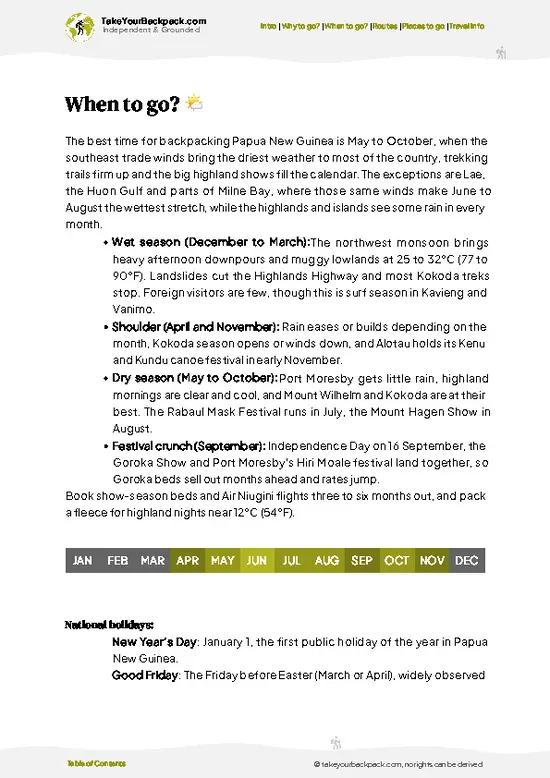
  • Drier Months (June to October): Lae gets its lightest rain here, so the forest paths are less muddy and birds are easier to spot. Daytime highs run 29 to 31°C (84 to 88°F), nights 22 to 24°C (72 to 75°F).
  • Wet Months (December to April): Heavy afternoon downpours are common and humidity is stifling. Temperatures stay similar, but trails turn slick and transport around Lae slows down.
  • Time of Day: Mornings from about 8 am are cooler and the birds are most active. Sunset comes around 6 pm all year, so plan to be back in town well before dark.
  • Crowds and Prices: Visitor numbers stay low in every month, and Lae guesthouse rates barely move with the season. Prices rise around school holidays and events.
Go on a weekday morning in the drier months and you will often have the aviaries almost to yourself.

source: climatestotravel.comJANJanuary: fair for travelingFEBFebruary: fair for travelingMARMarch: fair for travelingAPRApril: fair for travelingMAYMay: highly recommended for travelingJUNJune: excellent for travelingJULJuly: excellent for travelingAUGAugust: excellent for travelingSEPSeptember: excellent for travelingOCTOctober: highly recommended for travelingNOVNovember: fair for travelingDECDecember: fair for traveling
papua-new-guinea-attraction-rainforest-habitat
© Google |

✈️ The backpacker research shortcutPapua New Guinea Travel Guide

An offline-friendly backpacking guide with optimized travel routes, ranked highlights, transport advice, and the best areas to stay.
example page 0 from our offline Travel Guide for Papua New Guinea
example page 1 from our offline Travel Guide for Papua New Guinea
example page 2 from our offline Travel Guide for Papua New Guinea
example page 3 from our offline Travel Guide for Papua New Guinea
example page 4 from our offline Travel Guide for Papua New Guinea
example page 5 from our offline Travel Guide for Papua New Guinea
example page 6 from our offline Travel Guide for Papua New Guinea
example page 7 from our offline Travel Guide for Papua New Guinea
The digital guide (251 pages) contains:
✅ 81 highlights, ranked by travel appeal
✅ Optimized 5, 10 & 15-day travel routes
✅ Cities, national parks, landmarks, beaches
✅ How to get around
✅ Offline-friendly for travel without Wi-Fi
👉 Click to see all 30+ guide features

📅 Plan smarter in minutes, not weeks
✅ Month by month travel advice
✅ Festivals & national holidays
✅ Budget expectations

🗺️ Go to the right places, skip the overrated ones
✅ Honest pros & cons of destinations
✅ Top hikes, parks & viewpoints
✅ Lesser-known places most travelers miss
✅ Clear “worth it vs skip it” guidance

🛏️ Travel smoothly without rookie mistakes
✅ Best areas to stay
✅ Transport systems explained simply
✅ Common scams & safety advice
✅ SIM cards, money & practical tips

🌍 Understand the country, not just visit it
✅ Culture & traditions
✅ 52 Essential phrases & customs
✅ Festivals worth planning around
✅ Traveler-friendly historical context
✅ Insights that make places more meaningful

📱 Built for real travel conditions
✅ Fully downloadable PDF
✅ Works completely offline
✅ Optimized for phone use
✅ Useful in remote areas & buses
✅ Everything in one place
Stop searching, start planning
Get instant access to your full guide. 30‑day money-back guarantee.
+ Add another guide for just

By proceeding you agree to our terms.
Sent to your inbox immediately after payment • 100% Secure Checkout
Best Backpacking Travel Advisor 2025 tourism awardBest Backpacking
Travel Advisor
2025
What others say about Take Your Backpack Guides:
⭐⭐⭐⭐⭐
Fantastic, amazing amount of information!
⭐⭐⭐⭐⭐
My goodness this is amazing, it's what I've been looking for hats off too you!
⭐⭐⭐⭐⭐
I think this is absolutely BRILLIANT
⭐⭐⭐⭐
Very complete and informative. It's still missing places, but I gotta to commend you
⭐⭐⭐⭐⭐
This is truly amazing, thank you, can't wait to explore it with my kids!
⭐⭐⭐⭐⭐
Awesome resource, thank you!
⭐⭐⭐⭐⭐
This is amazing! Can't wait to explore the ones I haven't seen
⭐⭐⭐⭐
I love this! Well done, great idea.
⭐⭐⭐⭐⭐
Thanks for taking the time to make this gem!
⭐⭐⭐⭐⭐
This might be the best website I've ever seen.
⭐⭐⭐⭐⭐
Congratulations, and thank you so much for your work; it's incredibly valuable.
⭐⭐⭐⭐
In all seriousness I think you did a great job pointing out the important spots
⭐⭐⭐⭐⭐
10/10 very good
⭐⭐⭐⭐⭐
As someone who's only just starting to visit regularly this is awesome, thank you.
⭐⭐⭐⭐
Thank you very much! I'm going to visit my dad, it's going to be very useful!
⭐⭐⭐⭐⭐
This is really cool! We'll be travelling for the first time and this definitely come in handy.
⭐⭐⭐⭐⭐
You are now our minister of culture, congratulations 👨‍💼
⭐⭐⭐⭐⭐
Just wanted to tell you that this is a pearl! Going to follow your recommendations.
⭐⭐⭐⭐⭐
This is so cool. I'll definitely be using the resource for my travels soon.
⭐⭐⭐⭐⭐
This is very impressive! Good work.
⭐⭐⭐⭐⭐
This is an amazing and informative site. Very well done!

🛏️ Where to stay?How to pick the right area

Stay in Lae itself, in the central areas around Top Town and Eriku, and use secure transport to reach the habitat on the Unitech side of the city. Lae has the best choice of guesthouses and lodges in the region, and the city center puts you near shops, banks, markets and the PMV routes that fan out across town.
The Taraka and Unitech side is quieter and greener, and a few campus-area guesthouses suit people who want to be near the habitat. Expect fewer restaurants and a rather sleepy evening scene.
Backpacker culture in Papua New Guinea is thin, so dorm-style hostels are rare. Most budget travelers … read more 👉
Stay in Lae itself, in the central areas around Top Town and Eriku, and use secure transport to reach the habitat on the Unitech side of the city. Lae has the best choice of guesthouses and lodges in the region, and the city center puts you near shops, banks, markets and the PMV routes that fan out across town.
The Taraka and Unitech side is quieter and greener, and a few campus-area guesthouses suit people who want to be near the habitat. Expect fewer restaurants and a rather sleepy evening scene.
Backpacker culture in Papua New Guinea is thin, so dorm-style hostels are rare. Most budget travelers use small guesthouses or church-run lodges, where you meet aid workers, researchers and other solo travelers over shared dinners. Pick a place with a walled compound, 24-hour guards and the ability to arrange trusted drivers.
Avoid walking between areas after dark, even for short distances. Ask your host to book a known driver for the ride out to the habitat and back.

👛 Costs (as of 15 October 2026)What things cost and how to budget

A day at Rainforest Habitat runs about US$66 to 121 for a backpacker, with lodging and guiding making up most of it.
CategoryBudget RangeLocal Reality
Entrance feeUS$5 to 12Paid in kina at the gate, usually bundled with a ranger or guide arrangement. Fees are not always posted, so confirm the amount before entering.
GuideUS$15 to 30Guides are strongly advised on forest trails. Rates are negotiated per group and per day.
Accommodation (high season)US$25 to 40Basic guesthouse rooms in Lae or simple lodging nearby, with shared facilities at the low end. Dry season fills rooms fast.
Accommodation (low season)US$18 to 30Rainy months bring easier bargaining and open rooms.
FoodUS$10 to 18Market produce, fried fish and rice from stalls. Restaurant meals cost noticeably more.
Local transportUS$8 to 15Shared
… read more 👉
A day at Rainforest Habitat runs about US$66 to 121 for a backpacker, with lodging and guiding making up most of it.
CategoryBudget RangeLocal Reality
Entrance feeUS$5 to 12Paid in kina at the gate, usually bundled with a ranger or guide arrangement. Fees are not always posted, so confirm the amount before entering.
GuideUS$15 to 30Guides are strongly advised on forest trails. Rates are negotiated per group and per day.
Accommodation (high season)US$25 to 40Basic guesthouse rooms in Lae or simple lodging nearby, with shared facilities at the low end. Dry season fills rooms fast.
Accommodation (low season)US$18 to 30Rainy months bring easier bargaining and open rooms.
FoodUS$10 to 18Market produce, fried fish and rice from stalls. Restaurant meals cost noticeably more.
Local transportUS$8 to 15Shared PMV minibuses cost little per leg, though a hired vehicle for the last stretch to the site raises the total.
Water and extrasUS$3 to 6Bottled water, insect repellent and snacks. Prices climb away from town.
Total Daily BudgetUS$66 to 121Per person, per day, in high season.
⚠️ Prices can change and everyone travels differently, so take this as a rough guide. Hope it helps you plan your adventure!

FAQTraveler FAQ

Plan on 2 to 3 hours for the Rainforest Habitat, which is enough for the aviaries, the orchid areas and the forest paths. Birdwatchers and photographers can easily stretch that to half a day, especially if they arrive around 8 am when the birds are most active. Add travel time from central Lae, which is a short drive of roughly 20 to 30 minutes depending on traffic.
Yes, for most visitors the fee of roughly K20 to 40 (US$5 to 10) is good value, because it gives a close look at birds of paradise, cassowaries and other New Guinea wildlife that are very hard to find in the wild. The habitat is compact and not slick, so it suits wildlife lovers more than anyone expecting a big zoo. If you are short on time in Lae, it is one of the few easy wildlife stops in the city.
Fly into Nadzab Airport, about 40 km (25 miles) from Lae, with direct flights from Port Moresby taking around 1 hour. From Nadzab, a pre-booked transfer into Lae takes roughly 45 minutes and costs about K100 to 200 (US$25 to 50). From central Lae, hire a trusted driver or taxi for the 20 to 30 minute ride to the Unitech side, which is safer than PMVs, and arrange the return trip before you go.
⚠️ Things can change over time, so always validate details locally before you go.

Other Papua New Guinean attractions near Rainforest Habitat

Explore more nearby:


💡 Not sure where to go next?
Create a personalized itinerary for Papua New Guinea including Rainforest Habitat and the places that fit your trip.

Generate my itinerary

👉 Discover all attractions

Or checkout all Papua New Guinea has to offer (think cities, towns, villages, national parks, hikes, beaches, festivals)
Country photo of Papua New Guinea

We 💚 feedbackSumming up the experience

Arrive when the gate opens, ideally on a dry-season morning, when the birds are most active and the air under the trees is cool. Skip midday, when animals rest and the humidity builds. Bring a hat, a water bottle and patience, then stay for a second lap of the orchids before leaving.

✍️ Help improve this page!
The information on this page is based on in-depth research, insights shared by experienced travelers, and feedback from the local travel community in Papua New Guinea. While every effort is made to keep the information accurate and current, conditions can change — so if you spot anything incorrect or outdated, please get in touch.


🙋‍♂️ Give feedback

👋 Meet the founderWho’s Behind Take Your Backpack?

Johan, backpacker and founder of TakeYourBackpackHi, I’m Johan (Netherlands 🇳🇱), the creator of TakeYourBackpack. Over the past 3 decades, I’ve backpacked through 90+ countries across six continents, gaining extensive experience with independent travel, long-term trips, and overland routes.

This site is built on a combination of firsthand travel experience and carefully curated insights from other backpackers. Many guides are based on places I’ve personally visited, while others bring together tips, observations, and practical advice shared by trusted travelers I’ve met along the way.

The goal is to provide realistic, experience-driven guidance — not generic itineraries — so you can explore destinations with better context, clearer expectations, and more confidence.