×

Papua New Guinea🇵🇬 | festivalsSepik River Crocodile Festivalcrocodile scarification, Sepik rituals, river village gatherings | things to do and best time to go

Explore Mount Hagen Cultural ShowExplore Mask Festival

Backpacking in Sepik River Crocodile
🌟 Highlightfestival ranked #7
By Johan Kruseman 🇳🇱 | Updated September 4, 2026

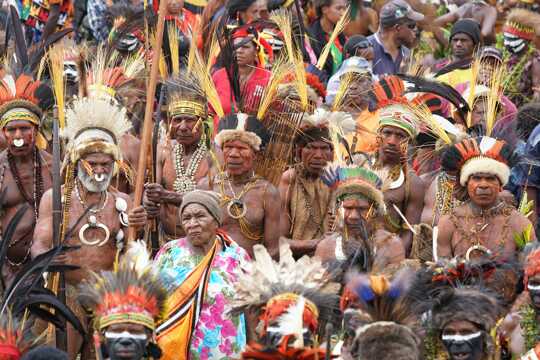
You only realize after you go that the Sepik River Crocodile Festival is basically a three‑day shortcut into Sepik culture that would normally take weeks of village-hopping to piece together. It fires up each August around Ambunti, on the middle Sepik River in northern Papua New Guinea. This is not a glossy EDM thing; you get pounding kundu drums, bamboo flutes, call-and-response chants, and crocodile-themed dances from multiple river communities. The crowd skews local with a thin layer of backpackers, anthropologists, and photographers orbiting the action, so you feel like a guest, not a customer. Expect two to three intense days of ceremonies, canoe parades, and speeches, plus long, muddy walks and basic conditions. It’s worth it if you want raw cultural immersion and don’t mind discomfort; skip it if you crave comfort, nightlife, or tight schedules.

Discover everything you want to know in the 📖 Papua New Guinea Travel Guide.
Loading the map 🌍
CLICK TO FILTER
cities
towns
national parks
hikes
beaches
attractions
festivals
regions
SHOW COUNTRY’S BESTSHOW ALL

✨ Why go?
Ranked #7 festival in Papua New Guinea
What sets this place apart

Backpackers flock to the Sepik River Crocodile Festival for a jolt of social energy and a taste of authentic cultural immersion. This isn’t just another event; it’s a vibrant celebration of local traditions, where communities unite to showcase their heritage through dance, art, and, yes, crocodiles. The festival creates a temporary community that pulses with excitement, drawing travelers into a shared experience that’s hard to replicate elsewhere.

Planning your route around this festival isn’t just smart; it’s essential. It offers a unique chance to connect with locals and fellow travelers, all while soaking in the rich tapestry of Papua New Guinea’s culture. Plus, it’s surprisingly affordable compared to similar events worldwide, allowing you to stretch your budget for those unforgettable … read more 👉
Backpackers flock to the Sepik River Crocodile Festival for a jolt of social energy and a taste of authentic cultural immersion. This isn’t just another event; it’s a vibrant celebration of local traditions, where communities unite to showcase their heritage through dance, art, and, yes, crocodiles. The festival creates a temporary community that pulses with excitement, drawing travelers into a shared experience that’s hard to replicate elsewhere.

Planning your route around this festival isn’t just smart; it’s essential. It offers a unique chance to connect with locals and fellow travelers, all while soaking in the rich tapestry of Papua New Guinea’s culture. Plus, it’s surprisingly affordable compared to similar events worldwide, allowing you to stretch your budget for those unforgettable moments that truly matter.

Integrating the festival into your longer travel plans means you’re not just passing through; you’re diving deep into the heart of the region. This is where the journey transforms from mere travel into an exhilarating adventure.
Want to include Sepik River Crocodile Festival in your Papua New Guinea route?
Create a personalized Papua New Guinea itinerary that includes Sepik River Crocodile Festival and the places that fit your trip — based on your travel style, budget, and available time. Get your route in seconds.

Generate my trip

💡 HighlightsDon't-miss highlights and experiences

  • Crocodile initiation rituals and dances: These ceremonies—where men symbolically link themselves to the crocodile through choreography and traditional body markings—are visceral and raw. It’s not a staged show; you see living myth and clan identity performed the way locals have for generations.
  • Haus Tambaran (spirit-house) performances and mask displays: The massive carved spirit houses and their masks are both architecture and theatre. Watching dancers emerge from painted faces and oversized headdresses gives you a sense of how art, belief and public life are woven together in Sepik culture.
  • Canoe pageants and river processions: The Sepik is the stage—decorated dugout canoes, paddled in precise formation, glide past the riverbanks. It’s uniquely riverine festivaling: movement, smoke,
read more 👉
  • Crocodile initiation rituals and dances: These ceremonies—where men symbolically link themselves to the crocodile through choreography and traditional body markings—are visceral and raw. It’s not a staged show; you see living myth and clan identity performed the way locals have for generations.
  • Haus Tambaran (spirit-house) performances and mask displays: The massive carved spirit houses and their masks are both architecture and theatre. Watching dancers emerge from painted faces and oversized headdresses gives you a sense of how art, belief and public life are woven together in Sepik culture.
  • Canoe pageants and river processions: The Sepik is the stage—decorated dugout canoes, paddled in precise formation, glide past the riverbanks. It’s uniquely riverine festivaling: movement, smoke, water-reflections and people lined along the banks make it cinematic in a way land-based festivals can’t match.
  • Master carvers, live carving demos and the art market: Sepik carving styles are unmistakable—story boards, spirit poles, masks and finely detailed canoes. Seeing a master carve and then find pieces for sale is the closest you’ll get to understanding how everyday objects double as history and ancestry.
  • Nighttime sing-sings, communal feasts and village hospitality: When the formal ceremonies wind down the festival becomes informal and loud—in a good way. Drum-led sing-sings, sago feasts, bilum chats and riverside fires create a warm, immediate atmosphere where visitors actually meet families and clans rather than just watch them.
Spotted a mistake or missing something? Contact us.

🌤️ When to go?When is the celebration of Sepik River Crocodile Festival?


  • Topic: Weather – The festival thrives in the dry season, from June to September. Rainfall drops sharply, making river travel smoother and the air less muggy. Avoid the wet season (November to April) when heavy rains can flood paths and stall boats.

  • Topic: Temperature – Expect daytime highs around 28-32°C (82-90°F), with nights cooling to 20-24°C (68-75°F). The dry season’s heat is manageable, but humidity spikes outside this window can sap your energy fast.

  • Topic: Daylight Hours – Near the equator, daylight stays steady year-round, roughly 11.5 to 12.5 hours. This consistency means you can plan your days without worrying about early sunsets cutting your explorations short.

  • Topic: Crowds – The festival draws local tribes and a handful of adventurous travelers. Peak attendance is mid-August,
read more 👉

  • Topic: Weather – The festival thrives in the dry season, from June to September. Rainfall drops sharply, making river travel smoother and the air less muggy. Avoid the wet season (November to April) when heavy rains can flood paths and stall boats.

  • Topic: Temperature – Expect daytime highs around 28-32°C (82-90°F), with nights cooling to 20-24°C (68-75°F). The dry season’s heat is manageable, but humidity spikes outside this window can sap your energy fast.

  • Topic: Daylight Hours – Near the equator, daylight stays steady year-round, roughly 11.5 to 12.5 hours. This consistency means you can plan your days without worrying about early sunsets cutting your explorations short.

  • Topic: Crowds – The festival draws local tribes and a handful of adventurous travelers. Peak attendance is mid-August, so arriving early or late in the festival window means fewer people and more authentic interactions.

  • Topic: Seasonal Activities – Crocodile rituals and traditional dances peak during the dry months. Outside this, many cultural events slow down, and the river’s mood shifts, limiting your chances to witness the full spectacle.

  • Topic: Price Fluctuations – Costs for guides and boat rides spike during the festival’s height. Booking early or aiming for the edges of the season can save you a chunk of cash without sacrificing the experience.


Pro-tip: Lock in your trip for July or early August—dry, lively, and just before the crowd swells—so you spend energy soaking in culture, not battling weather or inflated prices.


source: climatestotravel.comJANJanuary: not recommended for travelingFEBFebruary: not recommended for travelingMARMarch: not recommended for travelingAPRApril: not recommended for travelingMAYMay: not recommended for travelingJUNJune: highly recommended for travelingJULJuly: highly recommended for travelingAUGAugust: highly recommended for travelingSEPSeptember: highly recommended for travelingOCTOctober: not recommended for travelingNOVNovember: not recommended for travelingDECDecember: not recommended for traveling

✈️ The backpacker research shortcutPapua New Guinea Travel Guide

An offline-friendly backpacking guide with optimized travel routes, ranked highlights, transport advice, and the best areas to stay.
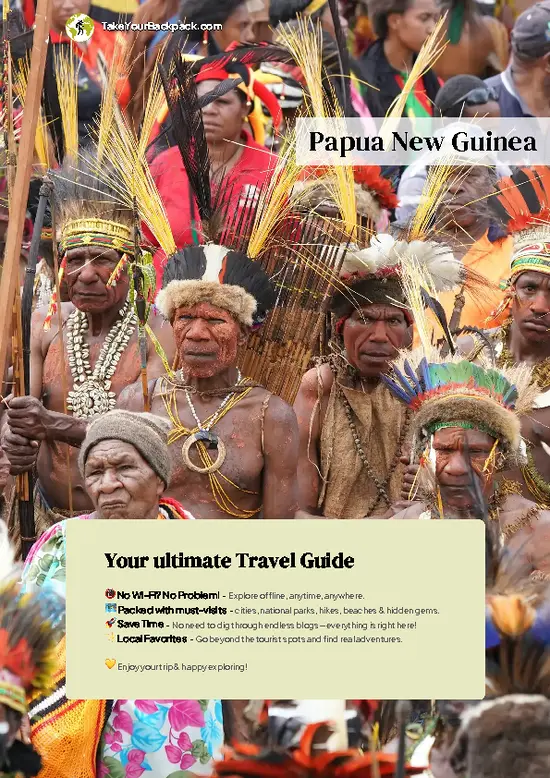
example page 0 from our offline Travel Guide for Papua New Guinea
example page 1 from our offline Travel Guide for Papua New Guinea
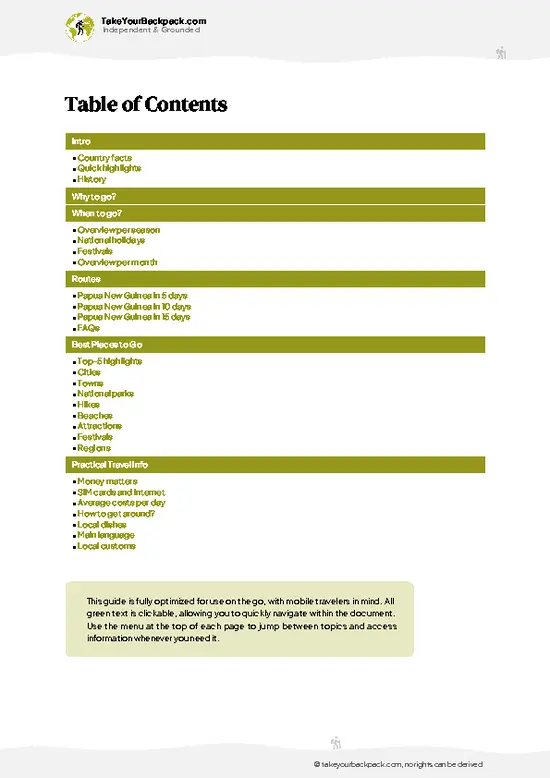
example page 2 from our offline Travel Guide for Papua New Guinea
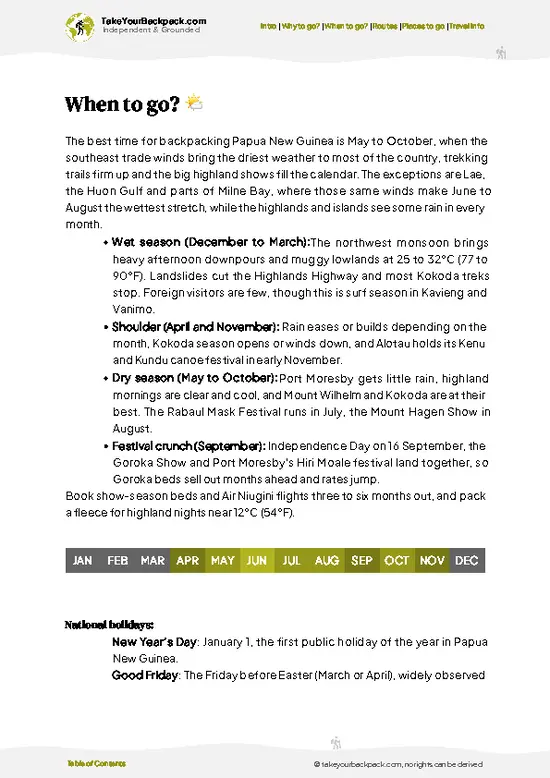
example page 3 from our offline Travel Guide for Papua New Guinea
example page 4 from our offline Travel Guide for Papua New Guinea
example page 5 from our offline Travel Guide for Papua New Guinea
example page 6 from our offline Travel Guide for Papua New Guinea
example page 7 from our offline Travel Guide for Papua New Guinea
The digital guide (319 pages) contains:
86 highlights, ranked by travel appeal
Optimized 5, 10 & 15-day travel routes
Cities, national parks, landmarks, beaches
How to get around
Offline-friendly for travel without Wi-Fi
👉 Click to see all 30+ guide features

📅 Plan smarter in minutes, not weeks
Month by month travel advice
Festivals & national holidays
Budget expectations

🗺️ Go to the right places, skip the overrated ones
Honest pros & cons of destinations
Top hikes, parks & viewpoints
Lesser-known places most travelers miss
Clear “worth it vs skip it” guidance

🛏️ Travel smoothly without rookie mistakes
Best areas to stay
Transport systems explained simply
Common scams & safety advice
SIM cards, money & practical tips

🌍 Understand the country, not just visit it
Culture & traditions
52 Essential phrases & customs
Festivals worth planning around
Traveler-friendly historical context
Insights that make places more meaningful

📱 Built for real travel conditions
Fully downloadable PDF
Works completely offline
Optimized for phone use
Useful in remote areas & buses
Everything in one place
Save weeks of stressful planning
Get instant access to your full guide. 30‑day money-back guarantee.
+ Add another guide for just US$7.80

By proceeding you agree to our terms.
Sent to your inbox immediately after payment • 100% Secure Checkout
Best Backpacking Travel Advisor 2025 tourism awardBest Backpacking
Travel Advisor
2025
What others say about Take Your Backpack Guides:
⭐⭐⭐⭐⭐
Fantastic, amazing amount of information!
⭐⭐⭐⭐⭐
My goodness this is amazing, it's what I've been looking for hats off too you!
⭐⭐⭐⭐⭐
I think this is absolutely BRILLIANT
⭐⭐⭐⭐
Very complete and informative. It's still missing places, but I gotta to commend you
⭐⭐⭐⭐⭐
This is truly amazing, thank you, can't wait to explore it with my kids!
⭐⭐⭐⭐⭐
Awesome resource, thank you!
⭐⭐⭐⭐⭐
This is amazing! Can't wait to explore the ones I haven't seen
⭐⭐⭐⭐
I love this! Well done, great idea.
⭐⭐⭐⭐⭐
Thanks for taking the time to make this gem!
⭐⭐⭐⭐⭐
This might be the best website I've ever seen.
⭐⭐⭐⭐⭐
Congratulations, and thank you so much for your work; it's incredibly valuable.
⭐⭐⭐⭐
In all seriousness I think you did a great job pointing out the important spots
⭐⭐⭐⭐⭐
10/10 very good
⭐⭐⭐⭐⭐
As someone who's only just starting to visit regularly this is awesome, thank you.
⭐⭐⭐⭐
Thank you very much! I'm going to visit my dad, it's going to be very useful!
⭐⭐⭐⭐⭐
This is really cool! We'll be travelling for the first time and this definitely come in handy.
⭐⭐⭐⭐⭐
You are now our minister of culture, congratulations 👨‍💼
⭐⭐⭐⭐⭐
Just wanted to tell you that this is a pearl! Going to follow your recommendations.
⭐⭐⭐⭐⭐
This is so cool. I'll definitely be using the resource for my travels soon.
⭐⭐⭐⭐⭐
This is very impressive! Good work.
⭐⭐⭐⭐⭐
This is an amazing and informative site. Very well done!

🛏️ Where to stay?Choosing the right base

When you’re gearing up for the Sepik River Crocodile Festival, your base matters. Stay in the town of Wewak. It’s buzzing with backpackers, and the vibe is friendly. You’ll find plenty of budget-friendly lodgings that cater to solo travelers. The communal spaces are perfect for swapping stories and tips.

Another solid option is the village of Pagwi. It’s closer to the festival action, and you’ll get a taste of local life. Here, you can connect with villagers, share meals, and immerse yourself in the culture. Just be mindful of your surroundings; keep your valuables secure and stay aware.

Don’t … read more 👉
When you’re gearing up for the Sepik River Crocodile Festival, your base matters. Stay in the town of Wewak. It’s buzzing with backpackers, and the vibe is friendly. You’ll find plenty of budget-friendly lodgings that cater to solo travelers. The communal spaces are perfect for swapping stories and tips.

Another solid option is the village of Pagwi. It’s closer to the festival action, and you’ll get a taste of local life. Here, you can connect with villagers, share meals, and immerse yourself in the culture. Just be mindful of your surroundings; keep your valuables secure and stay aware.

Don’t overlook the riverbanks. Camping near the Sepik River can be an adventure in itself. You’ll wake up to the sounds of nature and have a front-row seat to the festival’s festivities. Just ensure you have the right gear and check in with locals about safety.

Avoid the tourist traps that promise luxury but drain your budget. Focus on places where you can engage with the community and soak up the festival spirit. That’s where the real magic happens.

👛 Costs (as of 4 September 2026)Travel costs and budget guide for Sepik River Crocodile

The Sepik River Crocodile Festival is a vibrant celebration, but navigating the costs can be tricky. Here’s a breakdown to keep your budget in check and your energy focused on the experience.
  • Festival Tickets: Expect to pay around $10 to $20 USD for entry. This gets you into the heart of the festivities, where you can witness traditional dances and the iconic crocodile races. Don’t forget to grab your tickets early, as they can sell out fast.
  • Accommodation: Prices vary widely. Budget hostels start at about $15 to $30 USD per night. If you’re looking for something more comfortable, mid-range hotels can range from $50 to $100 USD. Book ahead to avoid last-minute surprises, especially during the festival.
  • Local Transport: Getting around can be an adventure. Expect to spend $5 to $15 USD on local
read more 👉
The Sepik River Crocodile Festival is a vibrant celebration, but navigating the costs can be tricky. Here’s a breakdown to keep your budget in check and your energy focused on the experience.
  • Festival Tickets: Expect to pay around $10 to $20 USD for entry. This gets you into the heart of the festivities, where you can witness traditional dances and the iconic crocodile races. Don’t forget to grab your tickets early, as they can sell out fast.
  • Accommodation: Prices vary widely. Budget hostels start at about $15 to $30 USD per night. If you’re looking for something more comfortable, mid-range hotels can range from $50 to $100 USD. Book ahead to avoid last-minute surprises, especially during the festival.
  • Local Transport: Getting around can be an adventure. Expect to spend $5 to $15 USD on local buses or shared taxis. If you’re venturing further, hiring a private vehicle might set you back $50 to $100 USD for the day. Factor in the cost of negotiating fares; it’s part of the experience.
  • Food & Drinks: Street food is your best friend here. Meals can cost between $3 to $10 USD, depending on where you eat. Local markets offer delicious options, but if you opt for restaurants, budget around $15 to $30 USD for a meal. Don’t skip the local specialties; they’re worth every cent.
  • Miscellaneous Expenses: This includes souvenirs, tips, and any unexpected costs. Set aside about $20 to $50 USD for these extras. Bargaining is common, so don’t hesitate to negotiate prices at markets.

Keep these figures in mind as you plan. The festival is a unique experience, and being prepared will help you savor every moment without breaking the bank.


source: papuanewguinea.travel
⚠️ Prices can change and everyone travels differently, so take this as a rough guide. Hope it helps you plan your adventure!

🍲 FoodLocal Cuisine & Drinks

At the Sepik River Crocodile Festival, food and drinks pulse with local flavor. You’ll find stalls brimming with sago, a starchy staple that’s a must-try. It’s often served with a side of fresh fish caught right from the river, grilled to perfection. Don’t miss the chance to sample mumu, a traditional dish cooked in an underground oven, where the smoky flavor will dance on your palate.

For drinks, look for kunu, a sweet, fermented beverage made from sago or rice. It’s refreshing and packs a punch, perfect for the tropical heat. If you’re feeling adventurous, grab a cup of coconut water straight from the shell—nothing beats that fresh taste.

Etiquette here is all about sharing. Don’t hesitate to swap bites with fellow festival-goers; it’s part of the experience. Lines can get long, so be … read more 👉
At the Sepik River Crocodile Festival, food and drinks pulse with local flavor. You’ll find stalls brimming with sago, a starchy staple that’s a must-try. It’s often served with a side of fresh fish caught right from the river, grilled to perfection. Don’t miss the chance to sample mumu, a traditional dish cooked in an underground oven, where the smoky flavor will dance on your palate.

For drinks, look for kunu, a sweet, fermented beverage made from sago or rice. It’s refreshing and packs a punch, perfect for the tropical heat. If you’re feeling adventurous, grab a cup of coconut water straight from the shell—nothing beats that fresh taste.

Etiquette here is all about sharing. Don’t hesitate to swap bites with fellow festival-goers; it’s part of the experience. Lines can get long, so be patient and enjoy the lively chatter around you. Cash is king, so keep some handy; card payments are rare. Serving sizes can be generous, so pace yourself—there’s a lot to savor. Embrace the chaos, and let the flavors guide your adventure!

FAQTraveler FAQ

The Sepik River Crocodile Festival takes place annually in August. It usually lasts for about three days, showcasing traditional dances and rituals of the Sepik people.
The cost to attend the Sepik River Crocodile Festival is generally low, often around 20 to 50 Papua New Guinean Kina for entry or participation fees. Additional costs may include travel and accommodation in the Sepik region.
No, you typically do not need tickets in advance for the Sepik River Crocodile Festival. Attendance is usually informal, but it is advisable to confirm locally as arrangements can vary.
⚠️ Things can change over time, so always validate details locally before you go.

Other Papua New Guinean festivals near Sepik River Crocodile

Explore more nearby:


💡 Not sure where to go next?
Create a personalized itinerary for Papua New Guinea including Sepik River Crocodile and the places that fit your trip.

Generate my itinerary

👉 Discover all festivals

Or checkout all Papua New Guinea has to offer (think cities, towns, villages, national parks, hikes, beaches, festivals)
Country photo of Papua New Guinea

We 💚 feedbackFinal thoughts on celebrating the Sepik River Crocodile

The Sepik River Crocodile Festival is a wild ride. Expect vibrant energy, fierce competition, and a community that wears pride like armor. The best surprise? The locals’ genuine warmth; they’ll pull you into their stories and dances. Just a heads-up: the heat can be relentless. Stay hydrated and pace yourself. This isn’t just a festival; it’s a celebration of life along the river. Embrace the chaos, and you’ll leave with a piece of their spirit.

✍️ Help improve this page!
The information on this page is based on in-depth research, insights shared by experienced travelers, and feedback from the local travel community in Papua New Guinea. While every effort is made to keep the information accurate and current, conditions can change — so if you spot anything incorrect or outdated, please get in touch.


🙋‍♂️ Give feedback

👋 Meet the founderWho’s Behind Take Your Backpack?

Johan, backpacker and founder of TakeYourBackpackHi, I’m Johan (Netherlands 🇳🇱), the creator of TakeYourBackpack. Over the past decade, I’ve backpacked through 80+ countries across six continents, gaining extensive experience with independent travel, long-term trips, and overland routes.

This site is built on a combination of firsthand travel experience and carefully curated insights from other backpackers. Many guides are based on places I’ve personally visited, while others bring together tips, observations, and practical advice shared by trusted travelers I’ve met along the way.

The goal is to provide realistic, experience-driven guidance — not generic itineraries — so you can explore destinations with better context, clearer expectations, and more confidence.

Get full country guide •
Instant download • 86 highlights • Full Offline guide