×

Papua New Guinea🇵🇬 | national parksTonda Wildlife Management AreaLandowner-run, wetland birding, cassowary tracks, monsoon forest edge | things to do and best time to go

Explore Crater Mountain Wildlife Management AreaExplore YUS Conservation Area

Backpacking in Tonda Wildlife Management Area
👍 Recommendednational park ranked #5
By Johan Kruseman 🇳🇱 | Updated October 15, 2026

Tonda Wildlife Management Area is run by the landowning communities themselves, not by a park agency, so there is no ranger station, no ticket booth and no signed trail network waiting for you. It lies in the far southwest of Papua New Guinea, in Western Province near the Indonesian border, and its savanna, wetlands and monsoon forest are home to wallabies, cassowaries, birds of paradise and huge flocks of waterbirds. Wildlife is the draw, and the openness of the grassland makes spotting easier than in dense highland forest. The catch is reach. Roads are rough, flights are few and tracks flood in the wet months, which is why crowds are essentially nil. An experienced traveler arranges a local guide and village permission first, because the land is customary and access is negotiated, not bought at a gate. Before going, line up a contact in Western Province, since nothing works on a walk-in basis.

Discover everything you want to know in the 📖 Papua New Guinea Travel Guide.


example page 0 from our offline Travel Guide for Papua New Guinea
example page 1 from our offline Travel Guide for Papua New Guinea
example page 2 from our offline Travel Guide for Papua New Guinea
example page 3 from our offline Travel Guide for Papua New Guinea
example page 4 from our offline Travel Guide for Papua New Guinea
example page 5 from our offline Travel Guide for Papua New Guinea
example page 6 from our offline Travel Guide for Papua New Guinea
example page 7 from our offline Travel Guide for Papua New Guinea
Loading the map 🌍
CLICK TO FILTER
cities
towns
national parks
hikes
beaches
attractions
festivals
regions
SHOW COUNTRY’S BESTSHOW ALL

✨ Why go?
Ranked #5 national park in Papua New Guinea
Reasons people choose to explore here

Backpackers choose Tonda because it is one of the few places in Papua New Guinea where you can walk open savanna instead of hacking through rainforest. Grassland means long sightlines, so wallabies, cassowaries and raptors are far easier to spot than in the highlands. Seasonal wetlands pull in thousands of waterbirds, and the mix of grass, swamp and monsoon forest packs several habitats into short distances.

The second reason is independence of a particular kind. There are no tour operators with set itineraries, so you build the trip with the community: a local guide, a place to sleep in a village, and walks timed to when animals move. That suits self-reliant travelers who are happy to improvise and carry their own supplies. It does not suit anyone wanting schedules, signage or certainty. … read more 👉
Backpackers choose Tonda because it is one of the few places in Papua New Guinea where you can walk open savanna instead of hacking through rainforest. Grassland means long sightlines, so wallabies, cassowaries and raptors are far easier to spot than in the highlands. Seasonal wetlands pull in thousands of waterbirds, and the mix of grass, swamp and monsoon forest packs several habitats into short distances.

The second reason is independence of a particular kind. There are no tour operators with set itineraries, so you build the trip with the community: a local guide, a place to sleep in a village, and walks timed to when animals move. That suits self-reliant travelers who are happy to improvise and carry their own supplies. It does not suit anyone wanting schedules, signage or certainty. Those who go come away with an encounter shaped by customary landowners who know every waterhole, and that is the real appeal.

💡 HighlightsDon't-miss highlights and experiences

  1. Savanna wallaby watching: Open grassland here supports wallabies, best seen at dawn and dusk when they graze at the forest edge.
  2. Wetland birding: Seasonal lagoons and swamps gather egrets, ibis, cranes and ducks in large numbers, easiest to scan from the water’s edge.
  3. Cassowary tracking: The monsoon forest patches shelter southern cassowaries, and local guides read their footprints and fruit-fall sites.
  4. Birds of paradise: Patches of forest hold displaying males in the early morning, a sight guides know by call before sight.
  5. Monsoon forest edge walks: Where grass meets trees, you pass termite mounds, paperbark stands and fruiting figs that attract birds.
  6. Village life with landowners: Staying with the community shows how hunting rules, fire use and land custom shape what you see.
  7. Sunset over the grassland:
… read more 👉
  1. Savanna wallaby watching: Open grassland here supports wallabies, best seen at dawn and dusk when they graze at the forest edge.
  2. Wetland birding: Seasonal lagoons and swamps gather egrets, ibis, cranes and ducks in large numbers, easiest to scan from the water’s edge.
  3. Cassowary tracking: The monsoon forest patches shelter southern cassowaries, and local guides read their footprints and fruit-fall sites.
  4. Birds of paradise: Patches of forest hold displaying males in the early morning, a sight guides know by call before sight.
  5. Monsoon forest edge walks: Where grass meets trees, you pass termite mounds, paperbark stands and fruiting figs that attract birds.
  6. Village life with landowners: Staying with the community shows how hunting rules, fire use and land custom shape what you see.
  7. Sunset over the grassland: Low light turns tall grass gold and brings animals into the open.
If time is short, skip the forest edge walks and put your hours into the wetlands and the dawn wallaby grazing.
Spotted a mistake or missing something? Contact us.

🌤️ When to go?When to go for the best experience

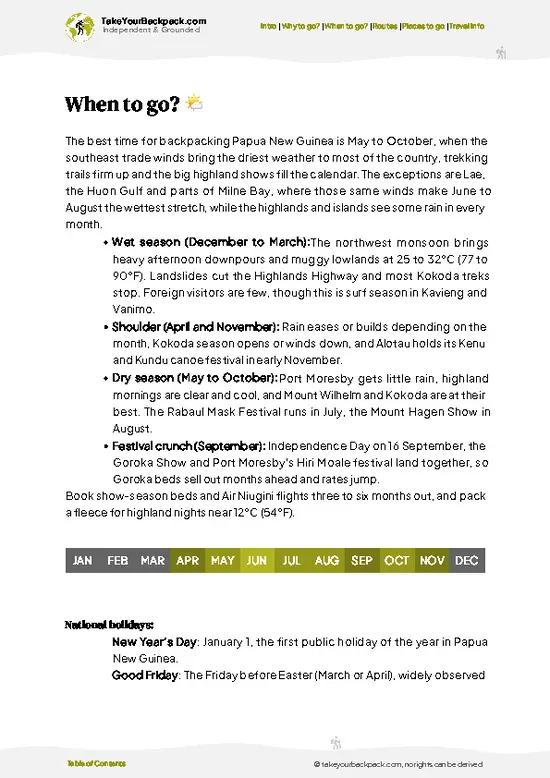
  • Dry Season (May to October): The most workable window for Tonda, with lower rainfall, daytime highs of 29 to 32°C (84 to 90°F) and nights around 22 to 24°C (72 to 75°F). Tracks across the savanna and wetlands are easier to cross, and wallabies and birds gather around shrinking waterholes.
  • Wet Season (November to April): Heavy monsoon rain floods large parts of the flat Trans-Fly plain. Humidity is thick, temperatures stay at 30 to 33°C (86 to 91°F), and roads and tracks turn to mud or go underwater. Mosquitoes multiply.
  • Daylight and crowds: Sunrise and sunset sit close to 6:00 and 18:00 all year. Visitors are very few in any month, and there is no peak pricing, though charter flights and boat hire cost more when fuel is scarce.
Book transport and local guides well ahead for July to September, … read more 👉
  • Dry Season (May to October): The most workable window for Tonda, with lower rainfall, daytime highs of 29 to 32°C (84 to 90°F) and nights around 22 to 24°C (72 to 75°F). Tracks across the savanna and wetlands are easier to cross, and wallabies and birds gather around shrinking waterholes.
  • Wet Season (November to April): Heavy monsoon rain floods large parts of the flat Trans-Fly plain. Humidity is thick, temperatures stay at 30 to 33°C (86 to 91°F), and roads and tracks turn to mud or go underwater. Mosquitoes multiply.
  • Daylight and crowds: Sunrise and sunset sit close to 6:00 and 18:00 all year. Visitors are very few in any month, and there is no peak pricing, though charter flights and boat hire cost more when fuel is scarce.
Book transport and local guides well ahead for July to September, when community and provincial logistics are easiest.


source: climatestotravel.comJANJanuary: fair for travelingFEBFebruary: fair for travelingMARMarch: fair for travelingAPRApril: fair for travelingMAYMay: highly recommended for travelingJUNJune: excellent for travelingJULJuly: excellent for travelingAUGAugust: excellent for travelingSEPSeptember: excellent for travelingOCTOctober: highly recommended for travelingNOVNovember: fair for travelingDECDecember: fair for traveling
when-to-go

✈️ The backpacker research shortcutPapua New Guinea Travel Guide

An offline-friendly backpacking guide with optimized travel routes, ranked highlights, transport advice, and the best areas to stay.
example page 0 from our offline Travel Guide for Papua New Guinea
example page 1 from our offline Travel Guide for Papua New Guinea
example page 2 from our offline Travel Guide for Papua New Guinea
example page 3 from our offline Travel Guide for Papua New Guinea
example page 4 from our offline Travel Guide for Papua New Guinea
example page 5 from our offline Travel Guide for Papua New Guinea
example page 6 from our offline Travel Guide for Papua New Guinea
example page 7 from our offline Travel Guide for Papua New Guinea
The digital guide (251 pages) contains:
✅ 81 highlights, ranked by travel appeal
✅ Optimized 5, 10 & 15-day travel routes
✅ Cities, national parks, landmarks, beaches
✅ How to get around
✅ Offline-friendly for travel without Wi-Fi
👉 Click to see all 30+ guide features

📅 Plan smarter in minutes, not weeks
✅ Month by month travel advice
✅ Festivals & national holidays
✅ Budget expectations

🗺️ Go to the right places, skip the overrated ones
✅ Honest pros & cons of destinations
✅ Top hikes, parks & viewpoints
✅ Lesser-known places most travelers miss
✅ Clear “worth it vs skip it” guidance

🛏️ Travel smoothly without rookie mistakes
✅ Best areas to stay
✅ Transport systems explained simply
✅ Common scams & safety advice
✅ SIM cards, money & practical tips

🌍 Understand the country, not just visit it
✅ Culture & traditions
✅ 52 Essential phrases & customs
✅ Festivals worth planning around
✅ Traveler-friendly historical context
✅ Insights that make places more meaningful

📱 Built for real travel conditions
✅ Fully downloadable PDF
✅ Works completely offline
✅ Optimized for phone use
✅ Useful in remote areas & buses
✅ Everything in one place
Stop searching, start planning
Get instant access to your full guide. 30‑day money-back guarantee.
+ Add another guide for just

By proceeding you agree to our terms.
Sent to your inbox immediately after payment • 100% Secure Checkout
Best Backpacking Travel Advisor 2025 tourism awardBest Backpacking
Travel Advisor
2025
What others say about Take Your Backpack Guides:
⭐⭐⭐⭐⭐
Fantastic, amazing amount of information!
⭐⭐⭐⭐⭐
My goodness this is amazing, it's what I've been looking for hats off too you!
⭐⭐⭐⭐⭐
I think this is absolutely BRILLIANT
⭐⭐⭐⭐
Very complete and informative. It's still missing places, but I gotta to commend you
⭐⭐⭐⭐⭐
This is truly amazing, thank you, can't wait to explore it with my kids!
⭐⭐⭐⭐⭐
Awesome resource, thank you!
⭐⭐⭐⭐⭐
This is amazing! Can't wait to explore the ones I haven't seen
⭐⭐⭐⭐
I love this! Well done, great idea.
⭐⭐⭐⭐⭐
Thanks for taking the time to make this gem!
⭐⭐⭐⭐⭐
This might be the best website I've ever seen.
⭐⭐⭐⭐⭐
Congratulations, and thank you so much for your work; it's incredibly valuable.
⭐⭐⭐⭐
In all seriousness I think you did a great job pointing out the important spots
⭐⭐⭐⭐⭐
10/10 very good
⭐⭐⭐⭐⭐
As someone who's only just starting to visit regularly this is awesome, thank you.
⭐⭐⭐⭐
Thank you very much! I'm going to visit my dad, it's going to be very useful!
⭐⭐⭐⭐⭐
This is really cool! We'll be travelling for the first time and this definitely come in handy.
⭐⭐⭐⭐⭐
You are now our minister of culture, congratulations 👨‍💼
⭐⭐⭐⭐⭐
Just wanted to tell you that this is a pearl! Going to follow your recommendations.
⭐⭐⭐⭐⭐
This is so cool. I'll definitely be using the resource for my travels soon.
⭐⭐⭐⭐⭐
This is very impressive! Good work.
⭐⭐⭐⭐⭐
This is an amazing and informative site. Very well done!

🛏️ Where to stay?Best areas to stay in Papua New Guinea

The only lodge inside Tonda Wildlife Management Area is Bensbach Wildlife Lodge, a pricey fishing lodge on the Bensbach River, so most budget visitors sleep in Daru, Western Province, or arrange a village stay with the local landowners. Tonda is community-owned land, and any overnight in the villages on its edge depends on permission from the local people. Bring your own bedding, a mosquito net and water purification, and expect to sleep on a floor or simple platform in a leaf or timber house.

The usual base for the region is Daru, the provincial capital reached by air from Port Moresby. It has … read more 👉
The only lodge inside Tonda Wildlife Management Area is Bensbach Wildlife Lodge, a pricey fishing lodge on the Bensbach River, so most budget visitors sleep in Daru, Western Province, or arrange a village stay with the local landowners. Tonda is community-owned land, and any overnight in the villages on its edge depends on permission from the local people. Bring your own bedding, a mosquito net and water purification, and expect to sleep on a floor or simple platform in a leaf or timber house.

The usual base for the region is Daru, the provincial capital reached by air from Port Moresby. It has a handful of guesthouses and small hotels, plus a market and shops where you can stock up on food and fuel. Standards are basic, with power and water that can be patchy.

The nearest government station is Morehead, on the eastern side of the area, and Western Province stays are mostly arranged through contacts rather than online. Merauke across the Indonesian border is not a practical overland base. Ask your host to agree on a village fee in advance, and carry small notes in kina.

👛 Costs (as of 15 October 2026)Money, prices, and spending tips

Expect to spend roughly US$60 to 140 a day around Tonda, with transport the biggest variable. The table below counts one accommodation row (high season) in the total.
CategoryBudget RangeLocal Reality
Entrance and community feesUS$5 to 15No formal gate. Landowners usually ask for a negotiated village or access fee.
AccommodationUS$20 to 45Village floor space is cheap. Daru guesthouses cost more and have basic rooms.
Local transportUS$20 to 40Boat hire with fuel drives costs. Shared dinghies are cheaper where available.
GuideUS$10 to 20A local guide is needed for navigation and permission.
Food and suppliesUS$5 to 20Stock up on rice, tinned fish and noodles in Daru. Fish and sago are sold in villages.
Total Daily BudgetUS$60 to 140Flights to Daru from Port Moresby are extra.
⚠️ Prices can change and everyone travels differently, so take this as a rough guide. Hope it helps you plan your adventure!

🥾 TrailsScenic routes and wildlife spotting in Tonda Wildlife Management Area

Tonda has no formally named, marked or measured trails, so walks follow tracks used by hunters and villagers, led by a local guide. Plan around the heat and the wildlife, not the distance.
  • Dawn savanna walk: Start from the village before sunrise and cross open grass for two to three hours. Terrain is flat, tussocky and easy, and this is when wallabies and raptors are most active.
  • Wetland loop: Walk to nearby lagoons and swamp margins in a half day. Ground can be boggy and muddy, so wet feet are normal, and the birdlife is dense in the drier months.
  • Forest patch visit: Short, slower walks into monsoon
… read more 👉
Tonda has no formally named, marked or measured trails, so walks follow tracks used by hunters and villagers, led by a local guide. Plan around the heat and the wildlife, not the distance.
  • Dawn savanna walk: Start from the village before sunrise and cross open grass for two to three hours. Terrain is flat, tussocky and easy, and this is when wallabies and raptors are most active.
  • Wetland loop: Walk to nearby lagoons and swamp margins in a half day. Ground can be boggy and muddy, so wet feet are normal, and the birdlife is dense in the drier months.
  • Forest patch visit: Short, slower walks into monsoon forest for cassowary sign and birds of paradise. Footing is uneven and roots and fallen logs slow you down. Moderate effort, mostly from humidity.
  • Evening grassland stroll: A gentle hour at dusk as animals emerge, with long light and few insects until dark.
Getting there takes planning. Access is by air to the Western Province region followed by rough road or boat travel, and public transport is minimal, so arrange a ride through your local contact. Crowds do not exist; you may be the only visitor. There is no standard entrance fee, but expect to negotiate payment for guiding, access and village hospitality directly with landowners. Carry water, sun protection, insect repellent, sturdy boots and cash in kina, because there are no shops on the walks.
⚠️ Hiking info can sometimes be outdated or inaccurate. Before you hit the trail, check the latest conditions with locals. If you do spot anything that's off, I'd love to hear from you, so I can update it for fellow travelers.

🛡️ SafetyScams, Hazards, and Annoyances

Tonda is flat, hot and remote, so the main issues are heat, water, insects and getting help. Daytime humidity is heavy, so start walks at dawn, carry at least 3 liters of water per person and rest through the midday hours. Malaria is present, so take prophylaxis, sleep under a net and use repellent at dusk. Tracks across the plain flood in the wet season and can vanish under water, so travel with a local guide who knows the routes and the tides on the rivers. Saltwater crocodiles live in rivers and swamp edges here, so stay back from the bank, avoid swimming and never camp right at the water. Snakes are present in the grass, so wear closed shoes. Medical care is limited, so carry a full first aid kit, and agree on boat or plane pickup before you set out. Respect landowner rules on hunting areas.

FAQTraveler FAQ

Plan on 3 to 5 days if you are based in Daru and heading out to Tonda. Travel by boat and on foot takes a large share of the time, and the wet season adds delays. Wildlife viewing is best at dawn and dusk, so a night or two near the savanna is worth arranging.
Not realistically. Tonda has no public transport, and the Trans-Fly area has few roads. You reach it by flight to Daru from Port Moresby (about 1.5 hours), then by chartered boat or a vehicle arranged through local contacts. Budget US$20 to 40 a day for boat hire.
There is no formal park gate, but you need permission from the landowning communities. Expect to pay a negotiated village access or guide fee, often US$5 to 20 a day. Arrange this ahead through a local contact or Western Province tourism officials.
⚠️ Things can change over time, so always validate details locally before you go.

Other Papua New Guinean national parks near Tonda Wildlife Management Area

Explore more nearby:


💡 Not sure where to go next?
Create a personalized itinerary for Papua New Guinea including Tonda Wildlife Management Area and the places that fit your trip.

Generate my itinerary

👉 Discover all national parks

Or checkout all Papua New Guinea has to offer (think cities, towns, villages, national parks, hikes, beaches, festivals)
Country photo of Papua New Guinea

We 💚 feedbackFinal thoughts on exploring Tonda Wildlife Management Area

The classic mistake is turning up and hoping to wing it, then spending days waiting for permission. Contact the community through a Western Province connection beforehand, agree on guide fees up front and bring gifts of food or supplies for your hosts. Then get out at first light, because the animals do not wait for you.

✍️ Help improve this page!
The information on this page is based on in-depth research, insights shared by experienced travelers, and feedback from the local travel community in Papua New Guinea. While every effort is made to keep the information accurate and current, conditions can change — so if you spot anything incorrect or outdated, please get in touch.


🙋‍♂️ Give feedback

👋 Meet the founderWho’s Behind Take Your Backpack?

Johan, backpacker and founder of TakeYourBackpackHi, I’m Johan (Netherlands 🇳🇱), the creator of TakeYourBackpack. Over the past 3 decades, I’ve backpacked through 90+ countries across six continents, gaining extensive experience with independent travel, long-term trips, and overland routes.

This site is built on a combination of firsthand travel experience and carefully curated insights from other backpackers. Many guides are based on places I’ve personally visited, while others bring together tips, observations, and practical advice shared by trusted travelers I’ve met along the way.

The goal is to provide realistic, experience-driven guidance — not generic itineraries — so you can explore destinations with better context, clearer expectations, and more confidence.