×

Peru🇵🇪 | regionsCordillera BlancaGlacial lakes, 6,000-meter peaks, Huaraz base, multi-day treks | things to do and best time to go

Explore Huacachina Desert OasisExplore Lake Titicaca

Backpacking in Cordillera Blanca
🌟 Highlightregion ranked #2
By Johan Kruseman 🇳🇱 | Updated October 19, 2026

Twenty years ago, Cordillera Blanca was a climbers’ secret with a handful of lodgings and trekking gear scrounged from dusty shops. Today, in the north of Peru, it’s the country’s trekking capital, with Huaraz as the base and more than 600 glaciers overhead. The upside is huge: turquoise lakes, 6,000-meter peaks and a Quechua-speaking highland culture that still fills the Sunday markets. The downside is altitude, rutted roads and the odd crowded lake at midday. A private tour saves time but costs more; collectivos cost little and take longer, and for backpackers they give the most. Rooms are comfortable, and hot showers are common. At dawn on a trail, I heard cowbells clanking and the creak of a farmer’s wooden gate, then smelled eucalyptus smoke from his breakfast fire. Push on, because every ridge hides another lake. Active hikers will love it most; anyone who hates thin air or long bus rides won’t.

Discover everything you want to know in the 📖 Peru Travel Guide.


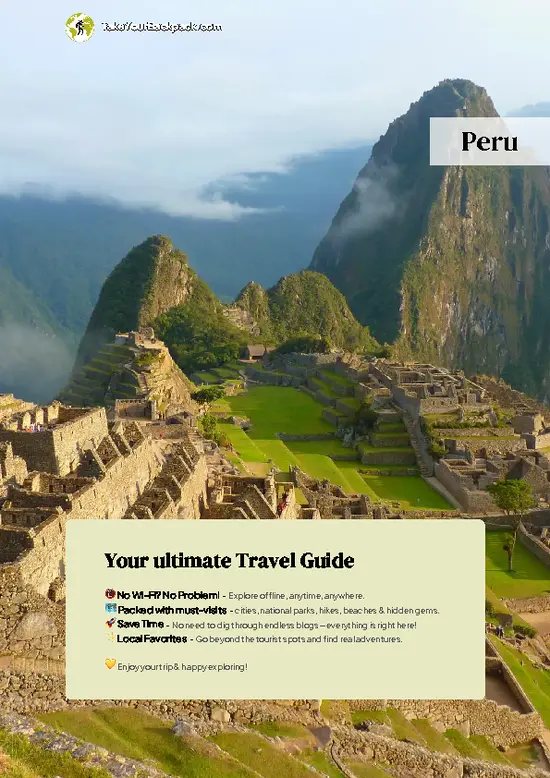
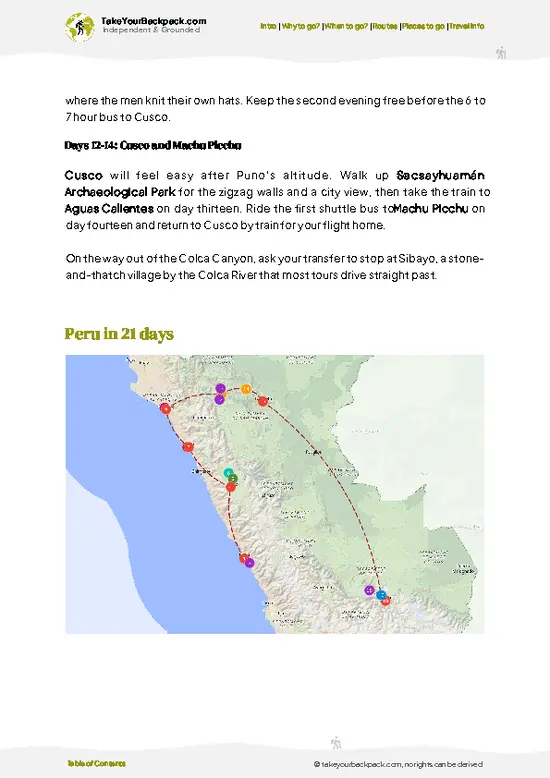
example page 0 from our offline Travel Guide for Peru
example page 1 from our offline Travel Guide for Peru
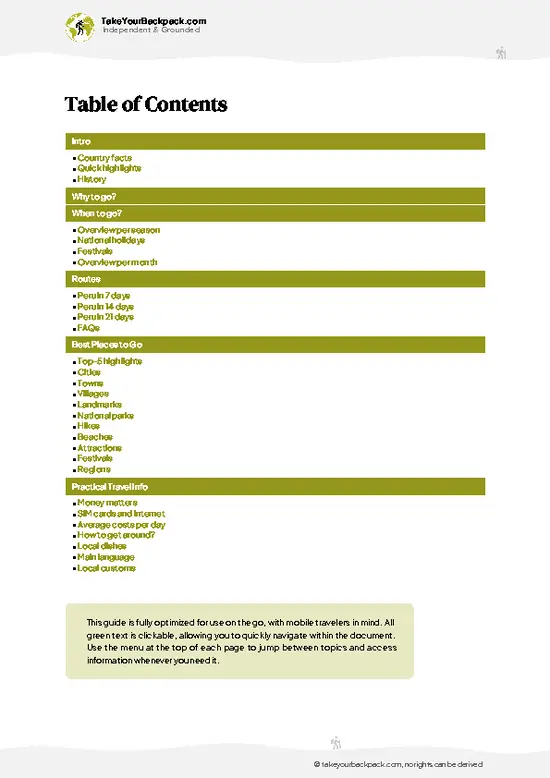
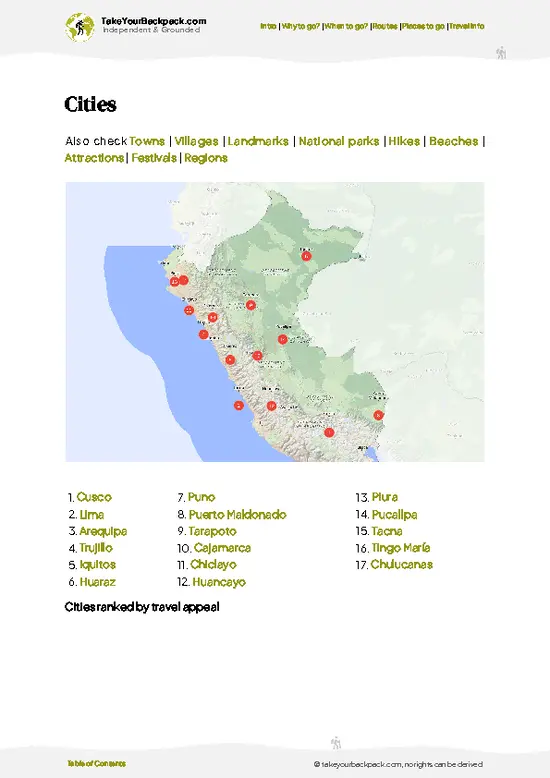
example page 2 from our offline Travel Guide for Peru
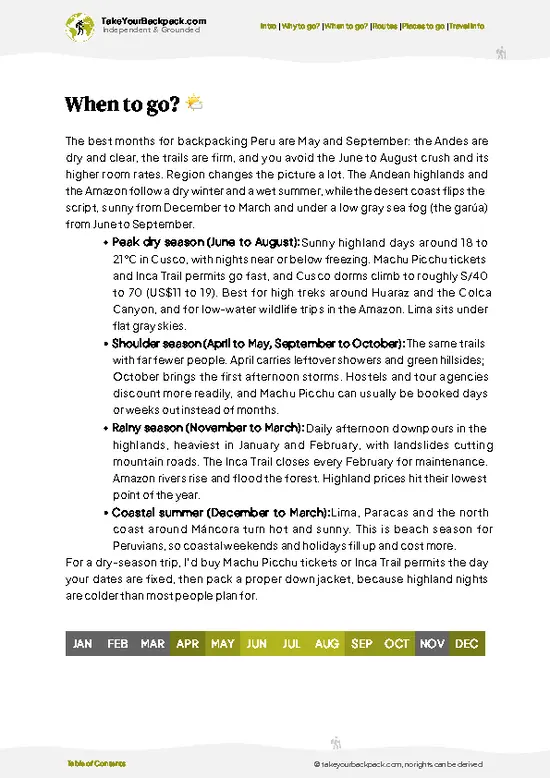
example page 3 from our offline Travel Guide for Peru
example page 4 from our offline Travel Guide for Peru
example page 5 from our offline Travel Guide for Peru
example page 6 from our offline Travel Guide for Peru
example page 7 from our offline Travel Guide for Peru
Loading the map 🌍
CLICK TO FILTER
cities
towns
villages
landmarks
national parks
hikes
beaches
attractions
festivals
regions
SHOW COUNTRY’S BESTSHOW ALL

✨ Why go?
Ranked #2 region in Peru
What makes it a must-see region

Cordillera Blanca gives you a dozen days of different trekking from a single base, which is the main reason backpackers stay. From Huaraz you can sleep in the same bed and still reach glacier lakes, Andean villages and ancient ruins by shared minibus, so you skip the constant packing and relocating. The range holds peaks like Huascarán at 6,768 meters, the highest in Peru, and routes suit very different appetites. Day hikers can reach Laguna 69 in a single long outing, while the multi-day Santa Cruz trek gives four days of camping with mules carrying the load. Rest days work as well, because the Callejón de Huaylas valley is dotted with hot springs, small towns and weekly markets where you can slow down and eat well after a hard push. That mix of tough effort and easy recovery is rare in the … read more 👉
Cordillera Blanca gives you a dozen days of different trekking from a single base, which is the main reason backpackers stay. From Huaraz you can sleep in the same bed and still reach glacier lakes, Andean villages and ancient ruins by shared minibus, so you skip the constant packing and relocating. The range holds peaks like Huascarán at 6,768 meters, the highest in Peru, and routes suit very different appetites. Day hikers can reach Laguna 69 in a single long outing, while the multi-day Santa Cruz trek gives four days of camping with mules carrying the load. Rest days work as well, because the Callejón de Huaylas valley is dotted with hot springs, small towns and weekly markets where you can slow down and eat well after a hard push. That mix of tough effort and easy recovery is rare in the Andes, and it lets you adjust the pace to your legs and the weather. Many travelers arrive planning a week and stay for two.

💡 HighlightsThe experiences that define the visit

  1. Laguna 69: The range’s most famous day hike climbs through a glacial valley to a deep turquoise lake beneath Chacraraju’s snowfields. Allow most of a day, and expect a steep final stretch. Entry to Huascarán National Park is required.
  2. Huascarán National Park: The protected core of the range, where condors, puya plants and glacier-fed valleys fill the horizon. A multi-day ticket is the better choice if you plan several treks.
  3. Santa Cruz Trek: A four-day walk over Punta Unión pass at about 4,750 meters, with campsites beside rivers and views of Alpamayo, often called one of the most beautiful mountains.
  4. Lake Llanganuco: Two connected lakes, Chinancocha and Orconcocha, reached by a rough road, with easy shoreline paths and Huascarán looming above.
  5. Pastoruri Glacier: A high-altitude excursion to a
… read more 👉
  1. Laguna 69: The range’s most famous day hike climbs through a glacial valley to a deep turquoise lake beneath Chacraraju’s snowfields. Allow most of a day, and expect a steep final stretch. Entry to Huascarán National Park is required.
  2. Huascarán National Park: The protected core of the range, where condors, puya plants and glacier-fed valleys fill the horizon. A multi-day ticket is the better choice if you plan several treks.
  3. Santa Cruz Trek: A four-day walk over Punta Unión pass at about 4,750 meters, with campsites beside rivers and views of Alpamayo, often called one of the most beautiful mountains.
  4. Lake Llanganuco: Two connected lakes, Chinancocha and Orconcocha, reached by a rough road, with easy shoreline paths and Huascarán looming above.
  5. Pastoruri Glacier: A high-altitude excursion to a shrinking ice tongue, with a short walk across the plateau and a view of the retreating glacier.
  6. Chavín de Huántar: A pre-Inca ceremonial center with underground stone galleries and the Lanzón monolith, carved around 3,000 years ago. The temple’s tunnels are cool and narrow.
  7. Churup Lake: A short, steep hike from Pitec above Huaraz, good for acclimatizing, with an optional rope-assisted section. Few tourists come here compared with Laguna 69.
  8. Monterrey Hot Springs: Just outside Huaraz, steaming pools that soothe sore legs after trekking. Locals come on weekends, so weekdays are quieter.
  9. Yungay Old Town memorial: The buried site of the town destroyed by the 1970 avalanche, now a quiet field of cemetery markers and palms. Locals tend it with care.
  10. Carhuaz Market: A small town market with fruit, Quechua-speaking vendors and local ice cream, rarely visited by tour groups and a pleasant place to stop between hikes.
Laguna 69 is the best choice for a first visit, since it delivers the full glacier-lake payoff in a single day.
Spotted a mistake or missing something? Contact us.

Things to do near Cordillera Blanca

Ratings based on Tripadvisor reviews. When you book through this link, you support our work at no extra cost to you.

⌛️ 5 days5-day itinerary for Cordillera Blanca

Day 1: Huaraz: Start in Huaraz, because you need a day to adjust to roughly 3,000 meters and the whole range runs from here. Walk the town, book your trek, and join a short climb to Churup Lake if your legs feel good. The transport here is based on minibuses and collectivos radiating from the city, so everything is a day trip or an early start, which sets the pace.
Day 2: Chavín de Huántar: Take the early bus through the Cordillera’s tunnel to the pre-Inca temple of Chavín. The stone galleries are best explored in the morning, and returning the same day keeps your base unchanged. A detour east to the village of San Marcos adds a quiet look at the Quechua valley without breaking the schedule.
Day 3: Laguna 69: Leave before dawn with a tour van, because the road to Llanganuco is slow and the hike … read more 👉
Day 1: Huaraz: Start in Huaraz, because you need a day to adjust to roughly 3,000 meters and the whole range runs from here. Walk the town, book your trek, and join a short climb to Churup Lake if your legs feel good. The transport here is based on minibuses and collectivos radiating from the city, so everything is a day trip or an early start, which sets the pace.
Day 2: Chavín de Huántar: Take the early bus through the Cordillera’s tunnel to the pre-Inca temple of Chavín. The stone galleries are best explored in the morning, and returning the same day keeps your base unchanged. A detour east to the village of San Marcos adds a quiet look at the Quechua valley without breaking the schedule.
Day 3: Laguna 69: Leave before dawn with a tour van, because the road to Llanganuco is slow and the hike needs most of the day. The lake’s color, a hard blue against white ice, makes the steep final stretch worth every breath.
Day 4: Carhuaz and Yungay: Use a collectivo north along the valley to see Carhuaz market and the Yungay memorial. The stops are close together, so you spend more time looking than riding. Finish with soaking in Monterrey’s springs on the way back.
Day 5: Pastoruri or Llanganuco: Choose a lighter final outing, either the glacier at Pastoruri or the shore paths at Llanganuco. If the weather is clear, take the second. My pick for the day that justifies the whole trip is Laguna 69, where the mountain scale finally lands.

🌤️ When to go?When to go for the best experience

The dry season, May to September, is the window for trekking the Cordillera Blanca, with sunny days and frozen nights.
  • Dry Season (May to September): Days reach 18 to 22°C (64 to 72°F) in Huaraz at about 3,050 m, and nights at trekking camps drop to -5 to 0°C (23 to 32°F). Daylight runs roughly 11.5 to 12 hours. This is peak time for Santa Cruz and Huayhuash-style multiday routes, so expect full dorms and higher guide and tour prices, especially in July and August.
  • Shoulder Months (April and October): Skies are mixed, afternoon clouds build, and trails are quieter. Prices soften and you can still catch good mornings for lake hikes like Laguna 69.
  • Wet Season (November to March): Rain falls most afternoons, peaks are often hidden, and highs stay around 17 to 20°C (63 to 68°F). Snow can close high
… read more 👉
The dry season, May to September, is the window for trekking the Cordillera Blanca, with sunny days and frozen nights.
  • Dry Season (May to September): Days reach 18 to 22°C (64 to 72°F) in Huaraz at about 3,050 m, and nights at trekking camps drop to -5 to 0°C (23 to 32°F). Daylight runs roughly 11.5 to 12 hours. This is peak time for Santa Cruz and Huayhuash-style multiday routes, so expect full dorms and higher guide and tour prices, especially in July and August.
  • Shoulder Months (April and October): Skies are mixed, afternoon clouds build, and trails are quieter. Prices soften and you can still catch good mornings for lake hikes like Laguna 69.
  • Wet Season (November to March): Rain falls most afternoons, peaks are often hidden, and highs stay around 17 to 20°C (63 to 68°F). Snow can close high passes. Prices drop and crowds almost vanish, but only day hikes at lower altitude make sense.
Book a June or early September trip to get dry trails without the July and August crush.


source: climatestotravel.comJANJanuary: fair for travelingFEBFebruary: fair for travelingMARMarch: fair for travelingAPRApril: good for travelingMAYMay: excellent for travelingJUNJune: excellent for travelingJULJuly: excellent for travelingAUGAugust: excellent for travelingSEPSeptember: excellent for travelingOCTOctober: highly recommended for travelingNOVNovember: fair for travelingDECDecember: fair for traveling

✈️ The backpacker research shortcutPeru Travel Guide

An offline-friendly backpacking guide with optimized travel routes, ranked highlights, transport advice, and the best areas to stay.
example page 0 from our offline Travel Guide for Peru
example page 1 from our offline Travel Guide for Peru
example page 2 from our offline Travel Guide for Peru
example page 3 from our offline Travel Guide for Peru
example page 4 from our offline Travel Guide for Peru
example page 5 from our offline Travel Guide for Peru
example page 6 from our offline Travel Guide for Peru
example page 7 from our offline Travel Guide for Peru
The digital guide (310 pages) contains:
✅ 102 highlights, ranked by travel appeal
✅ Optimized 7, 14 & 21-day travel routes
✅ Cities, national parks, landmarks, beaches
✅ How to get around
✅ Offline-friendly for travel without Wi-Fi
👉 Click to see all 30+ guide features

📅 Plan smarter in minutes, not weeks
✅ Month by month travel advice
✅ Festivals & national holidays
✅ Budget expectations

🗺️ Go to the right places, skip the overrated ones
✅ Honest pros & cons of destinations
✅ Top hikes, parks & viewpoints
✅ Lesser-known places most travelers miss
✅ Clear “worth it vs skip it” guidance

🛏️ Travel smoothly without rookie mistakes
✅ Best areas to stay
✅ Transport systems explained simply
✅ Common scams & safety advice
✅ SIM cards, money & practical tips

🌍 Understand the country, not just visit it
✅ Culture & traditions
✅ 52 Essential phrases & customs
✅ Festivals worth planning around
✅ Traveler-friendly historical context
✅ Insights that make places more meaningful

📱 Built for real travel conditions
✅ Fully downloadable PDF
✅ Works completely offline
✅ Optimized for phone use
✅ Useful in remote areas & buses
✅ Everything in one place
Stop searching, start planning
Get instant access to your full guide. 30‑day money-back guarantee.
+ Add another guide for just

By proceeding you agree to our terms.
Sent to your inbox immediately after payment • 100% Secure Checkout
Best Backpacking Travel Advisor 2025 tourism awardBest Backpacking
Travel Advisor
2025
What others say about Take Your Backpack Guides:
⭐⭐⭐⭐⭐
Fantastic, amazing amount of information!
⭐⭐⭐⭐⭐
My goodness this is amazing, it's what I've been looking for hats off too you!
⭐⭐⭐⭐⭐
I think this is absolutely BRILLIANT
⭐⭐⭐⭐
Very complete and informative. It's still missing places, but I gotta to commend you
⭐⭐⭐⭐⭐
This is truly amazing, thank you, can't wait to explore it with my kids!
⭐⭐⭐⭐⭐
Awesome resource, thank you!
⭐⭐⭐⭐⭐
This is amazing! Can't wait to explore the ones I haven't seen
⭐⭐⭐⭐
I love this! Well done, great idea.
⭐⭐⭐⭐⭐
Thanks for taking the time to make this gem!
⭐⭐⭐⭐⭐
This might be the best website I've ever seen.
⭐⭐⭐⭐⭐
Congratulations, and thank you so much for your work; it's incredibly valuable.
⭐⭐⭐⭐
In all seriousness I think you did a great job pointing out the important spots
⭐⭐⭐⭐⭐
10/10 very good
⭐⭐⭐⭐⭐
As someone who's only just starting to visit regularly this is awesome, thank you.
⭐⭐⭐⭐
Thank you very much! I'm going to visit my dad, it's going to be very useful!
⭐⭐⭐⭐⭐
This is really cool! We'll be travelling for the first time and this definitely come in handy.
⭐⭐⭐⭐⭐
You are now our minister of culture, congratulations 👨‍💼
⭐⭐⭐⭐⭐
Just wanted to tell you that this is a pearl! Going to follow your recommendations.
⭐⭐⭐⭐⭐
This is so cool. I'll definitely be using the resource for my travels soon.
⭐⭐⭐⭐⭐
This is very impressive! Good work.
⭐⭐⭐⭐⭐
This is an amazing and informative site. Very well done!

🛏️ Where to stay?Best areas to stay in Peru

Huaraz is the best base for backpackers in the Cordillera Blanca, with dorm beds around US$7 to 12 and private rooms from US$20 to 40. It sits at about 3,050 m, so it is also a fair place to acclimatize before heading higher. Trekking agencies, gear rental shops, cheap set-lunch cafés and rooftop hostels cluster within a few blocks of the Plaza de Armas, and you will meet trekking partners over breakfast without trying. Streets around the center are lively at night and generally comfortable, though you should use licensed taxis after dark.
Caraz, about 67 km north, is calmer and cheaper, with beds … read more 👉
Huaraz is the best base for backpackers in the Cordillera Blanca, with dorm beds around US$7 to 12 and private rooms from US$20 to 40. It sits at about 3,050 m, so it is also a fair place to acclimatize before heading higher. Trekking agencies, gear rental shops, cheap set-lunch cafés and rooftop hostels cluster within a few blocks of the Plaza de Armas, and you will meet trekking partners over breakfast without trying. Streets around the center are lively at night and generally comfortable, though you should use licensed taxis after dark.
Caraz, about 67 km north, is calmer and cheaper, with beds from roughly US$6 to 10. It suits hikers aiming for Santa Cruz trek starts, Laguna Parón or Laguna Cullicocha, and it has a sunnier, warmer feel at 2,250 m. Social spots are fewer, but the plaza and market keep things easy.
Carhuaz, between the two, offers a quiet small-town base with a few homestays and guesthouses at US$8 to 15. It works well for Laguna Llaca and Pisco-side hikes, and for avoiding crowds in July and August.
Yungay is mostly a day stop and a rest point rather than a social place to sleep. For most first-timers, spend three or four nights in Huaraz, then shift to Caraz if you want mountain quiet.

🚌 Getting aroundGetting around like a local

A shared colectivo or combi between Huaraz and nearby towns costs about US$0.50 to 3, and you pay the driver or his assistant in cash (soles) as you board or just before you hop off. That’s the engine of the whole Cordillera Blanca, and it runs often, loudly and with enthusiasm. Buses are reliable on the main Callejón de Huaylas road, while remote trailheads need a bit of planning.
  • Colectivos and combis: They shoot up and down the valley between Huaraz, Carhuaz, Yungay and Caraz every 10 to 15 minutes from early morning, usually for US$1 to 3. They’re cramped and you may stand, but they are fast and nearly free, so they give a backpacker the most value for valley hopping.
  • Tour minibuses to trailheads: Day trips to Laguna 69, Pastoruri Glacier or Chavín run about US$10 to 25, with pickup from
… read more 👉
A shared colectivo or combi between Huaraz and nearby towns costs about US$0.50 to 3, and you pay the driver or his assistant in cash (soles) as you board or just before you hop off. That’s the engine of the whole Cordillera Blanca, and it runs often, loudly and with enthusiasm. Buses are reliable on the main Callejón de Huaylas road, while remote trailheads need a bit of planning.
  • Colectivos and combis: They shoot up and down the valley between Huaraz, Carhuaz, Yungay and Caraz every 10 to 15 minutes from early morning, usually for US$1 to 3. They’re cramped and you may stand, but they are fast and nearly free, so they give a backpacker the most value for valley hopping.
  • Tour minibuses to trailheads: Day trips to Laguna 69, Pastoruri Glacier or Chavín run about US$10 to 25, with pickup from your hostel area at 5 to 8 a.m. The ride to Laguna 69 takes around 3 hours each way. You lose flexibility, but you skip complicated transfers, and for a single big hike it is the smartest buy.
  • Taxis: In Huaraz, short rides run roughly US$1 to 2, and a ride to a nearby trailhead such as Wilcacocha can be US$5 to 12. Agree on the fare before climbing in. Comfort is high and speed is good, though costs stack fast if you rely on them.
  • Long-distance buses: Overnight coaches from Lima take 7 to 9 hours and cost about US$12 to 30 depending on the seat. Semi-cama seats are fine, while full cama is worth the extra few dollars for the night ride. Departures are frequent, and this is how nearly everyone arrives.
  • Private driver or arriero: For multiday treks, transport is often bundled with a guide or muleteers at US$50 to 100 per day for a group. It costs the most, yet it opens remote starts like Cashapampa that public vans barely reach.
Start before 7 a.m., carry small coins and bills, and base yourself in Huaraz so you can fan out to every valley by colectivo before lunch.

🍲 FoodLocal Cuisine & Drinks

Start with cuy (roasted guinea pig), crisp-skinned and served with potatoes, a meal many locals save for celebrations, usually US$10 to 18. More everyday is trucha frita, fried mountain trout with rice and salad, and the pachamanca earth-oven feast, where meat and potatoes steam under hot stones with a smoky, herbal edge. For breakfast, try caldo de gallina, a steaming hen broth with noodles and an egg that fortifies you before dawn hikes.
The cheapest wins are menú del día lunches in small family restaurants around Huaraz and Caraz: soup, a main and a drink for about US$2 to 4. Markets are where you taste fresh tamales, fruit juices poured from blenders loaded high, and bread warm from the oven. At night, cafés and backpacker bars pour pisco sour and hot emoliente, a thick herbal drink sold … read more 👉
Start with cuy (roasted guinea pig), crisp-skinned and served with potatoes, a meal many locals save for celebrations, usually US$10 to 18. More everyday is trucha frita, fried mountain trout with rice and salad, and the pachamanca earth-oven feast, where meat and potatoes steam under hot stones with a smoky, herbal edge. For breakfast, try caldo de gallina, a steaming hen broth with noodles and an egg that fortifies you before dawn hikes.
The cheapest wins are menú del día lunches in small family restaurants around Huaraz and Caraz: soup, a main and a drink for about US$2 to 4. Markets are where you taste fresh tamales, fruit juices poured from blenders loaded high, and bread warm from the oven. At night, cafés and backpacker bars pour pisco sour and hot emoliente, a thick herbal drink sold from carts on cold evenings. Bakeries in Caraz sell manjar blanco sweets, a milky caramel that is dense, sticky and very good.
Customs are simple. Say “buen provecho” when you join a table, ask for “la cuenta” to get the bill, and expect it to take a while. Tipping about 10 percent is welcome in sit-down places. Altitude can dull your appetite, so sip mate de coca and go easy on alcohol your first nights.

FAQFrequently asked questions about Cordillera Blanca

Plan on 4 to 7 days for the Cordillera Blanca if you want day hikes only, and 8 to 12 days if you add a multiday trek. Laguna 69, Laguna Parón, Pastoruri Glacier and the Chavín de Huántar ruins each fill a day. The popular Santa Cruz trek takes 4 days, and you should add 2 or 3 days in Huaraz (about 3,050 m) to acclimatize first.
Colectivos and local buses link Huaraz with Carhuaz, Yungay and Caraz every 10 to 15 minutes, for roughly US$1 to 3. For Laguna 69, which since February 2026 is visited only with a SERNANP-authorized agency, book a tour minibus at US$10 to 25. Cordillera Blanca can be covered without a car, though you should leave by 7 a.m. to catch frequent departures.
Cordillera Blanca is known for the highest tropical mountain range in the world, with more than 20 peaks above 6,000 m, including Huascarán at 6,768 m, Peru’s tallest. It is also famous for turquoise glacial lakes like Laguna 69 and Laguna Parón, and for treks such as Santa Cruz. Most of it lies inside Huascarán National Park, where the entry fee is roughly US$8 to 40 depending on the length of your stay.
⚠️ Things can change over time, so always validate details locally before you go.

Other Peruvian regions near Cordillera Blanca

Explore more nearby:


💡 Not sure where to go next?
Create a personalized itinerary for Peru including Cordillera Blanca and the places that fit your trip.

Generate my itinerary

👉 Discover all regions

Or checkout all Peru has to offer (think cities, towns, villages, national parks, hikes, beaches, festivals)
Country photo of Peru

We 💚 feedbackWhat to keep in mind

Cordillera Blanca suits hikers who want big mountains without a climbing résumé, and travelers who like to settle in one base. If you dislike early starts, long rides or thin air, it will test you. I would give yourself at least three days in Huaraz before any serious trek, and bring a warm layer for every outing.

✈️ When did I visit Peru?
Peru I visited during my half year trip through South and Central America back in 2003

✍️ Help improve this page!
The information on this page is based on my own backpacking experience in Peru, supplemented with up-to-date research and feedback from other travelers. Travel details can change, so if you notice anything outdated or incomplete, feel free to let me know.


🙋‍♂️ Give feedback

👋 Meet the founderWho’s Behind Take Your Backpack?

Johan, backpacker and founder of TakeYourBackpackHi, I’m Johan (Netherlands 🇳🇱), the creator of TakeYourBackpack. Over the past 3 decades, I’ve backpacked through 90+ countries across six continents, gaining extensive experience with independent travel, long-term trips, and overland routes.

This site is built on a combination of firsthand travel experience and carefully curated insights from other backpackers. Many guides are based on places I’ve personally visited, while others bring together tips, observations, and practical advice shared by trusted travelers I’ve met along the way.

The goal is to provide realistic, experience-driven guidance — not generic itineraries — so you can explore destinations with better context, clearer expectations, and more confidence.