×

Peru🇵🇪 | best regionsBest 6 regions in Peru

In Peru, the choice of region can dramatically shape your backpacking experience. Each area boasts distinct climates, landscapes, and cultural characters that cater to different travel styles and budgets. The Andes offer breathtaking hikes and ancient ruins, while the Amazon teems with biodiversity and vibrant indigenous cultures. Coastal regions provide a different vibe, with laid-back beach towns and fresh seafood.

Understanding regional nuances is key. For instance, the dry season in the Andes (May to September) is ideal for trekking, but the Amazon is best explored during the wet season (November to March) when wildlife is more active. Your choice impacts not just the ease of travel but also your safety and cultural immersion. Selecting the right region means more than just picking a spot on the map; it’s about aligning your journey with the soul of Peru.

By Johan Kruseman 🇳🇱 | Updated September 5, 2026
Explore the best cities in Peru

Why go?Why Travelers Love These Spots

In Peru, the climatic diversity is a game-changer. From the arid coastal deserts to the lush Amazon rainforest and the towering Andes, each region offers a distinct experience. This variety shapes not only the landscapes but also the cultural character of the people. Each area has its own traditions, languages, and culinary delights, making Peru a microcosm of cultures within a single country.

However, this diversity comes with trade-offs. Traveling between regions often requires significant time and planning. The infrastructure can be a double-edged sword; while major cities are well-connected, remote areas may demand patience and flexibility. This means that while you can cover vast distances, you might sacrifice the depth of exploration in each locale. The challenge lies in balancing the … read more 👉
In Peru, the climatic diversity is a game-changer. From the arid coastal deserts to the lush Amazon rainforest and the towering Andes, each region offers a distinct experience. This variety shapes not only the landscapes but also the cultural character of the people. Each area has its own traditions, languages, and culinary delights, making Peru a microcosm of cultures within a single country.

However, this diversity comes with trade-offs. Traveling between regions often requires significant time and planning. The infrastructure can be a double-edged sword; while major cities are well-connected, remote areas may demand patience and flexibility. This means that while you can cover vast distances, you might sacrifice the depth of exploration in each locale. The challenge lies in balancing the desire to see it all with the need to truly immerse yourself in the unique offerings of each region.

Peru’s historical significance adds another layer to its appeal. The remnants of ancient civilizations, such as the Incas, are woven into the fabric of the landscape. Yet, accessing these sites often involves navigating rugged terrain or long travel times, which can be taxing.

Moreover, the climatic variations mean that the best time to visit one region might not align with another. This requires strategic planning to maximize experiences while minimizing discomfort.

Ultimately, understanding these constraints is crucial. The journey through Peru is as much about the physical act of exploration as it is about the destinations themselves. Embrace the challenge, and let the unique character of each region guide your adventure.
Evaluating the Top Choices
The list of best regions in Peru is created based on landscapes, local culture, attractions, vibes, and overall appeal. If you feel a region is missing in this list, please let us know.

When to go?Timing Your Visit for the Best Experience

Climate Variation
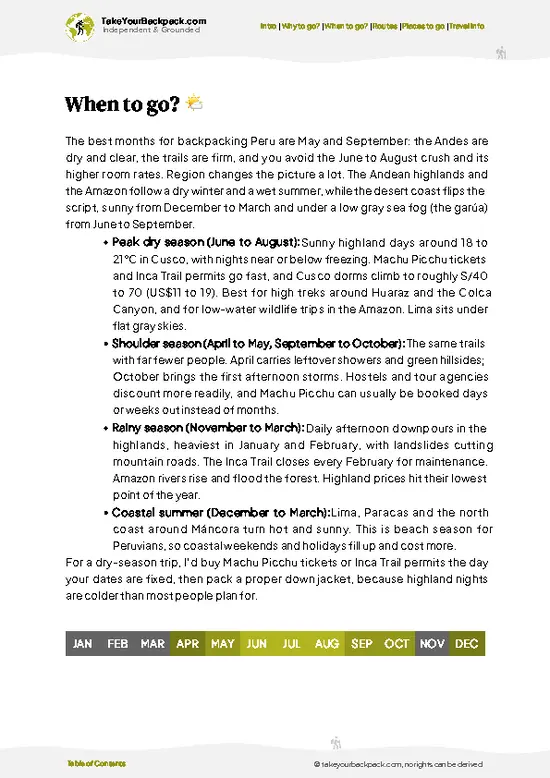
Peru’s climate is a patchwork, shifting dramatically from coast to highlands to jungle. The coastal region experiences a mild desert climate, while the Andes boast a more temperate climate with distinct wet and dry seasons. The Amazon rainforest, on the other hand, is hot and humid year-round, with a pronounced rainy season.

Optimal Months
The dry season, typically from May to September, is ideal for exploring the highlands. This period offers clear skies and pleasant temperatures, perfect for trekking and outdoor activities. However, expect larger crowds and higher prices during peak months. The wet season, from November to March, brings lush landscapes but also heavy rains, particularly in the Andes. This can lead to trail closures and muddy conditions, impacting travel … read more 👉
Climate Variation
Peru’s climate is a patchwork, shifting dramatically from coast to highlands to jungle. The coastal region experiences a mild desert climate, while the Andes boast a more temperate climate with distinct wet and dry seasons. The Amazon rainforest, on the other hand, is hot and humid year-round, with a pronounced rainy season.

Optimal Months
The dry season, typically from May to September, is ideal for exploring the highlands. This period offers clear skies and pleasant temperatures, perfect for trekking and outdoor activities. However, expect larger crowds and higher prices during peak months. The wet season, from November to March, brings lush landscapes but also heavy rains, particularly in the Andes. This can lead to trail closures and muddy conditions, impacting travel plans.

Shoulder Seasons
Visiting during the shoulder months—April and October—can be a savvy choice. These months often provide a balance between decent weather and manageable crowds. Travelers can enjoy lower prices and a more intimate experience with nature. However, be prepared for unpredictable weather; conditions can swing between sunny and rainy.

Peak Periods
Certain festivals and events can significantly influence travel dynamics. Major celebrations often draw crowds, leading to increased accommodation costs and limited availability. Planning around these events can either enhance the experience or complicate logistics.

Seasonal Constraints
Travelers should consider the trade-offs between comfort and experience. The dry season offers the best conditions but comes with a price. The wet season, while less crowded, can hinder access to attractions. Understanding these patterns is crucial for maximizing both budget and energy, ensuring that the journey remains as rewarding as the destination.

region hoppingOptimizing Your Multi-Stop Itinerary

Traveling through Peru requires a strategic approach to maximize experiences while minimizing fatigue. Start by clustering regions based on proximity and travel routes. The Andes, Amazon, and coastal areas each offer distinct flavors, so consider a logical flow: begin in the highlands, move to the jungle, and finish on the coast. This sequence not only saves time but also allows for a gradual acclimatization to varying altitudes and climates.

Time management is crucial. Allocate at least three days for major stops like Cusco and Machu Picchu, where the depth of experience is worth the investment. For regions like Arequipa or the Sacred Valley, two days can suffice, allowing for exploration without feeling rushed. Remember, it’s about savoring the journey, not just ticking boxes.

Common pitfallsread more 👉
Traveling through Peru requires a strategic approach to maximize experiences while minimizing fatigue. Start by clustering regions based on proximity and travel routes. The Andes, Amazon, and coastal areas each offer distinct flavors, so consider a logical flow: begin in the highlands, move to the jungle, and finish on the coast. This sequence not only saves time but also allows for a gradual acclimatization to varying altitudes and climates.

Time management is crucial. Allocate at least three days for major stops like Cusco and Machu Picchu, where the depth of experience is worth the investment. For regions like Arequipa or the Sacred Valley, two days can suffice, allowing for exploration without feeling rushed. Remember, it’s about savoring the journey, not just ticking boxes.

Common pitfalls include over-scheduling and underestimating travel times. Distances can be deceptive; a few hundred kilometers can translate to several hours on winding roads. Flexibility is key. If a local festival or an unexpected opportunity arises, be ready to adjust plans.

Trade-offs are inevitable. Speed often sacrifices depth. Choosing to rush through multiple regions can lead to fatigue and missed connections. Conversely, lingering in one area can deepen understanding but may limit exposure to the country’s diversity. Balance is essential; prioritize experiences that resonate most.

Budget considerations also play a role. While luxury transport options exist, they can drain funds quickly. Opt for local buses or shared shuttles when possible, but don’t skimp on guided tours for culturally rich experiences. The right mix of comfort and adventure will keep energy levels high and spirits higher.

The ListThe Best regions of Peru

1 Cuzco Sacred Valley

Inca ruins, terraced valleys, Andean villages

Trace ancient stonework through highland valleys, where mountain air, local markets, and living traditions shape every day of travel.

peru-region-cuzco-sacred-valley
© Google |

2 Huaraz and the Cordillera Blanca

Snow peaks, glacial lakes, trekking base

Start early to reach turquoise lakes and high passes, with crisp air and rugged trails offering access to Peru’s most dramatic mountain scenery.

3 Lake Titicaca

High-altitude lake, reed boats, island communities

Cross deep blue waters to islands where daily life adapts to altitude, and ancient customs persist on the world’s highest navigable lake.

peru-region-lake-titicaca
© Google | Spca663 Little B

4 Huacachina Desert Oasis

Sand dunes, palm-ringed lagoon, desert sunsets

Ride towering dunes and watch the sun drop behind sand ridges, then unwind by a rare natural lagoon surrounded by desert silence.

5 Paracas and the Ballestas Islands

Coastal reserve, marine wildlife, wind-carved cliffs

Travel by boat past sea lions and seabirds, then walk windswept shores where the desert meets the Pacific in stark, shifting landscapes.

peru-region-paracas-and-the-ballestas-islands
© Google | Simon Lord

6 Puno and the Uros Floating Islands

Totora reed islands, local crafts, lakeshore city

Step onto floating platforms built from reeds, meet families maintaining centuries-old skills, and explore a city shaped by its lakeside setting.

peru-region-puno-and-the-uros-floating-islands
© Google |
Loading the map 🌍

Expert viewPro Tips for Exploring the Best

Geographic Diversity

Peru is a land of extremes, where the Andes rise sharply from the coastal desert and the Amazon rainforest sprawls with untamed vigor. You’ll want to explore at least three regions to truly grasp the country’s essence. Each area offers a distinct flavor, from the arid coast to the lush jungle and the towering mountains. But here’s the catch: the more regions you tackle, the more time you’ll need to adjust to the altitude and climate shifts.

Plan for a minimum of ten days if you want to sample the coast, highlands, and jungle without feeling rushed. Each region demands its own pace. The coastal cities buzz with life, while the Andes invite you to slow down and breathe in the majesty. The jungle? That’s a whole different rhythm, where time seems to stretch and contract … read more 👉

Geographic Diversity

Peru is a land of extremes, where the Andes rise sharply from the coastal desert and the Amazon rainforest sprawls with untamed vigor. You’ll want to explore at least three regions to truly grasp the country’s essence. Each area offers a distinct flavor, from the arid coast to the lush jungle and the towering mountains. But here’s the catch: the more regions you tackle, the more time you’ll need to adjust to the altitude and climate shifts.

Plan for a minimum of ten days if you want to sample the coast, highlands, and jungle without feeling rushed. Each region demands its own pace. The coastal cities buzz with life, while the Andes invite you to slow down and breathe in the majesty. The jungle? That’s a whole different rhythm, where time seems to stretch and contract like the river currents.

Transport Between Regions

Getting around Peru can be a wild ride. Domestic flights are often the quickest way to cover vast distances, especially if you’re hopping from the coast to the jungle. But don’t underestimate the charm of bus travel. It’s slower, yes, but you’ll witness the landscape transform before your eyes. Just be prepared for long hours on the road, and always check the bus company’s reputation. Some are more reliable than others, and safety can vary dramatically.

If you’re short on time, prioritize flights, but factor in the cost. Buses can save you money, but they’ll eat into your travel days. A well-timed flight can open up your itinerary, allowing you to spend more time soaking in the local culture rather than just getting from point A to B.

Cultural Variation

Each region is a cultural tapestry woven from indigenous traditions and colonial influences. The coastal areas are rich in seafood and vibrant markets, while the highlands showcase Andean music and colorful textiles. The jungle, on the other hand, pulses with the rhythm of nature and indigenous customs.

You’ll need to adapt your expectations and approach as you move between these regions. In the highlands, for instance, you might encounter altitude sickness if you rush in without acclimatization. Take it easy, sip on some coca tea, and let your body adjust. In the jungle, be prepared for humidity and the occasional downpour.

Cultural sensitivity is key. Learn a few phrases in Spanish or local dialects; it goes a long way in building rapport. Respect local customs, especially in rural areas where traditions run deep. This isn’t just about being polite; it’s about enriching your experience.

Pacing Trade-Offs

Pacing is everything in Peru. If you’re eager to see it all, you might be tempted to cram too much into your itinerary. Resist that urge. The beauty of Peru lies in its diversity, and rushing through will rob you of the chance to truly connect with each region.

Consider spending more time in fewer places. A week in the Andes allows you to hike, explore local markets, and engage with communities. If you’re drawn to the jungle, a few days can immerse you in its wonders, but don’t expect to see everything in a quick trip.

Budget also plays a role in your pacing. While some experiences are worth the splurge—like guided treks or culinary classes—others can be enjoyed on a shoestring. Street food in the cities is delicious and affordable, while upscale dining can drain your wallet quickly. Prioritize what matters most to you, whether it’s a breathtaking hike or a culinary adventure.

Safety & Cultural Considerations

Safety is paramount, especially in urban areas. Keep your belongings secure and stay aware of your surroundings. In rural regions, the pace slows down, and the people are generally welcoming, but always ask before taking photos of locals.

Health considerations are also crucial. Drink bottled water and be cautious with street food, especially if you have a sensitive stomach. In the highlands, altitude sickness can hit hard, so take it slow and hydrate.

Culturally, be prepared for a mix of modern and traditional lifestyles. In cities, you’ll find a vibrant nightlife, while rural areas may still adhere to ancient customs. Embrace this diversity; it’s what makes Peru captivating.

In summary, the key to a rewarding journey through Peru lies in thoughtful planning. Choose your regions wisely, pace yourself, and immerse yourself in the rich cultural tapestry. The moments that matter will unfold when you allow yourself the space to breathe and explore.

✈️ The backpacker research shortcutPeru Travel Guide

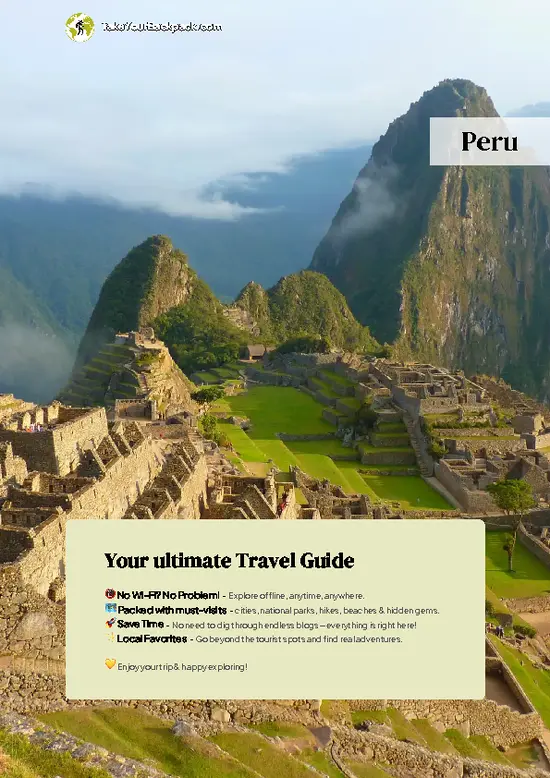
An offline-friendly backpacking guide with optimized travel routes, ranked highlights, transport advice, and the best areas to stay.
example page 0 from our offline Travel Guide for Peru
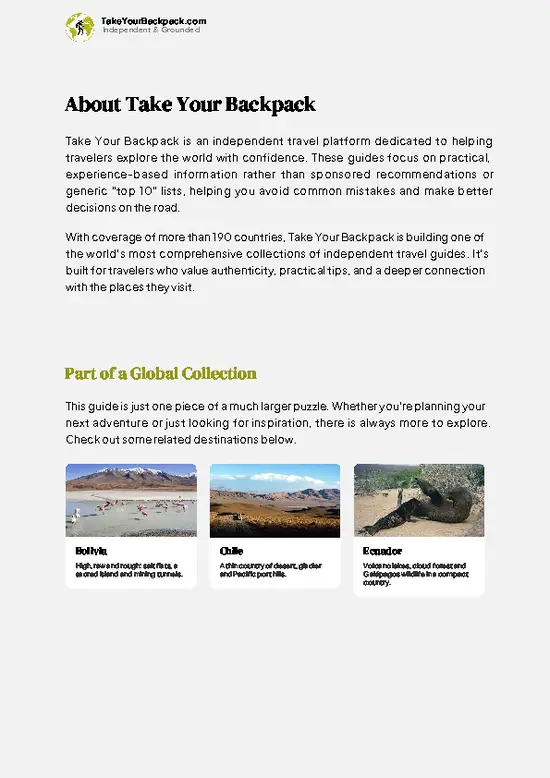
example page 1 from our offline Travel Guide for Peru
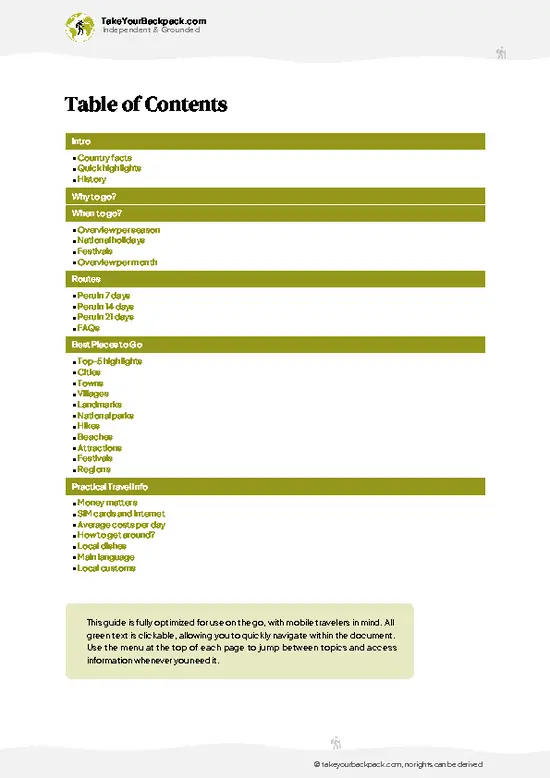
example page 2 from our offline Travel Guide for Peru
example page 3 from our offline Travel Guide for Peru
example page 4 from our offline Travel Guide for Peru
example page 5 from our offline Travel Guide for Peru
example page 6 from our offline Travel Guide for Peru
example page 7 from our offline Travel Guide for Peru
The digital guide (416 pages) contains:
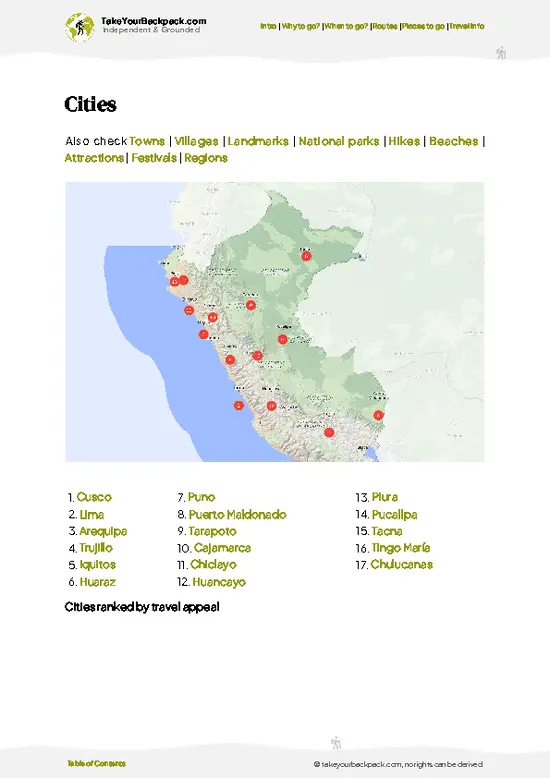
113 highlights, ranked by travel appeal
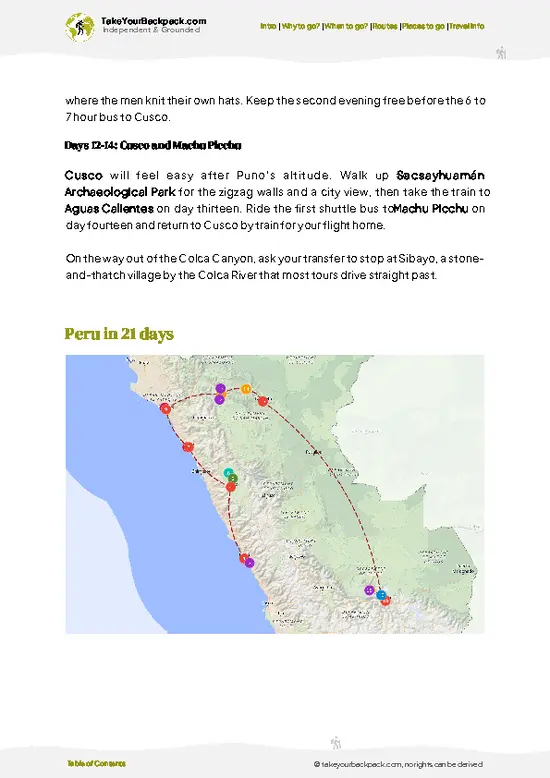
Optimized 7, 14 & 21-day travel routes
Cities, national parks, landmarks, beaches
How to get around
Offline-friendly for travel without Wi-Fi
👉 Click to see all 30+ guide features

📅 Plan smarter in minutes, not weeks
Month by month travel advice
Festivals & national holidays
Budget expectations

🗺️ Go to the right places, skip the overrated ones
Honest pros & cons of destinations
Top hikes, parks & viewpoints
Lesser-known places most travelers miss
Clear “worth it vs skip it” guidance

🛏️ Travel smoothly without rookie mistakes
Best areas to stay
Transport systems explained simply
Common scams & safety advice
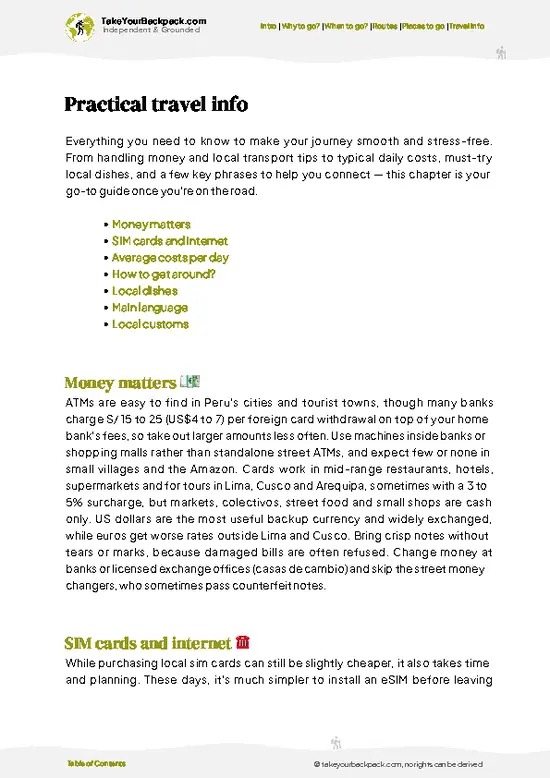
SIM cards, money & practical tips

🌍 Understand the country, not just visit it
Culture & traditions
52 Essential phrases & customs
Festivals worth planning around
Traveler-friendly historical context
Insights that make places more meaningful

📱 Built for real travel conditions
Fully downloadable PDF
Works completely offline
Optimized for phone use
Useful in remote areas & buses
Everything in one place
Save weeks of stressful planning
Get instant access to your full guide. 30‑day money-back guarantee.
+ Add another guide for just US$7.80

By proceeding you agree to our terms.
Sent to your inbox immediately after payment • 100% Secure Checkout
Best Backpacking Travel Advisor 2025 tourism awardBest Backpacking
Travel Advisor
2025
What others say about Take Your Backpack Guides:
⭐⭐⭐⭐⭐
Fantastic, amazing amount of information!
⭐⭐⭐⭐⭐
My goodness this is amazing, it's what I've been looking for hats off too you!
⭐⭐⭐⭐⭐
I think this is absolutely BRILLIANT
⭐⭐⭐⭐
Very complete and informative. It's still missing places, but I gotta to commend you
⭐⭐⭐⭐⭐
This is truly amazing, thank you, can't wait to explore it with my kids!
⭐⭐⭐⭐⭐
Awesome resource, thank you!
⭐⭐⭐⭐⭐
This is amazing! Can't wait to explore the ones I haven't seen
⭐⭐⭐⭐
I love this! Well done, great idea.
⭐⭐⭐⭐⭐
Thanks for taking the time to make this gem!
⭐⭐⭐⭐⭐
This might be the best website I've ever seen.
⭐⭐⭐⭐⭐
Congratulations, and thank you so much for your work; it's incredibly valuable.
⭐⭐⭐⭐
In all seriousness I think you did a great job pointing out the important spots
⭐⭐⭐⭐⭐
10/10 very good
⭐⭐⭐⭐⭐
As someone who's only just starting to visit regularly this is awesome, thank you.
⭐⭐⭐⭐
Thank you very much! I'm going to visit my dad, it's going to be very useful!
⭐⭐⭐⭐⭐
This is really cool! We'll be travelling for the first time and this definitely come in handy.
⭐⭐⭐⭐⭐
You are now our minister of culture, congratulations 👨‍💼
⭐⭐⭐⭐⭐
Just wanted to tell you that this is a pearl! Going to follow your recommendations.
⭐⭐⭐⭐⭐
This is so cool. I'll definitely be using the resource for my travels soon.
⭐⭐⭐⭐⭐
This is very impressive! Good work.
⭐⭐⭐⭐⭐
This is an amazing and informative site. Very well done!

🛏️ Where to stay?Where to Stay in Peru

Yes — Peru has abundant hostels and budget accommodation across cities and tourist routes, with the strongest concentrations in Miraflores and Barranco (Lima), Cusco and San Blas, Sacred Valley towns like Ollantaytambo and Pisac, Arequipa historic center, and northern beach towns such as Máncora.
Miraflores/Barranco are safer with great food, beach access and transport links but pricier; Cusco/San Blas put you next to train departures to Machu Picchu and lively nightlife but are crowded and demand altitude acclimatisation; the Sacred Valley is quieter and cheaper with direct ruin access but has fewer late-night services and limited transport options.
Arequipa’s Cercado gives a compact, safe … read more 👉
Yes — Peru has abundant hostels and budget accommodation across cities and tourist routes, with the strongest concentrations in Miraflores and Barranco (Lima), Cusco and San Blas, Sacred Valley towns like Ollantaytambo and Pisac, Arequipa historic center, and northern beach towns such as Máncora.
Miraflores/Barranco are safer with great food, beach access and transport links but pricier; Cusco/San Blas put you next to train departures to Machu Picchu and lively nightlife but are crowded and demand altitude acclimatisation; the Sacred Valley is quieter and cheaper with direct ruin access but has fewer late-night services and limited transport options.
Arequipa’s Cercado gives a compact, safe colonial base with good long-distance buses but less backpacker nightlife, while northern beach towns offer cheap surf and party hostels yet can be seasonal, have variable infrastructure and less reliable transport connections.

If you enjoy meeting fellow travelers, consider choosing hostels with high ratings for atmosphere. On the other hand, if you prefer having your own space, a hotel might be a better option.

PeruMore of Peru

👋 Meet the founderWho’s Behind Take Your Backpack?

Johan, backpacker and founder of TakeYourBackpackHi, I’m Johan (Netherlands 🇳🇱), the creator of TakeYourBackpack. Over the past decade, I’ve backpacked through 80+ countries across six continents, gaining extensive experience with independent travel, long-term trips, and overland routes.

This site is built on a combination of firsthand travel experience and carefully curated insights from other backpackers. Many guides are based on places I’ve personally visited, while others bring together tips, observations, and practical advice shared by trusted travelers I’ve met along the way.

The goal is to provide realistic, experience-driven guidance — not generic itineraries — so you can explore destinations with better context, clearer expectations, and more confidence.

Get full Peru guide •
Instant download • 113 highlights • Full Offline guide