×

Peru🇵🇪 | citiesTrujilloChimú adobe, Moche temples, pastel colonial grid, reed boats | things to do and best time to go

Explore PunoExplore Huaraz

Backpacking in Trujillo
🏆 Top pickcity ranked #4
By Johan Kruseman 🇳🇱 | Updated October 19, 2026

Trujillo once meant a quick overnight stop on the Pan-American Highway, a place you passed through on the way to somewhere else. Today it is a destination of its own, a pastel colonial grid in the north of Peru with adobe temples and beach towns on its doorstep. Getting here by overnight bus from Lima, I woke when the driver cut the engine at a roadside stop and a woman handed fried yuca through the window for a coin. That is how things work here: the long-distance buses are cheap and run overnight because the coast is a straight desert road, so an experienced traveler takes a semi-cama or cama seat, eats before boarding and arrives with a day saved. Skip the tour desks for the ruins and use local combis instead. Trujillo suits curious, budget-minded explorers who like history, ceviche and surf. It won’t suit anyone wanting nightlife spectacle or polished luxury.

Discover everything you want to know in the 📖 Peru Travel Guide.


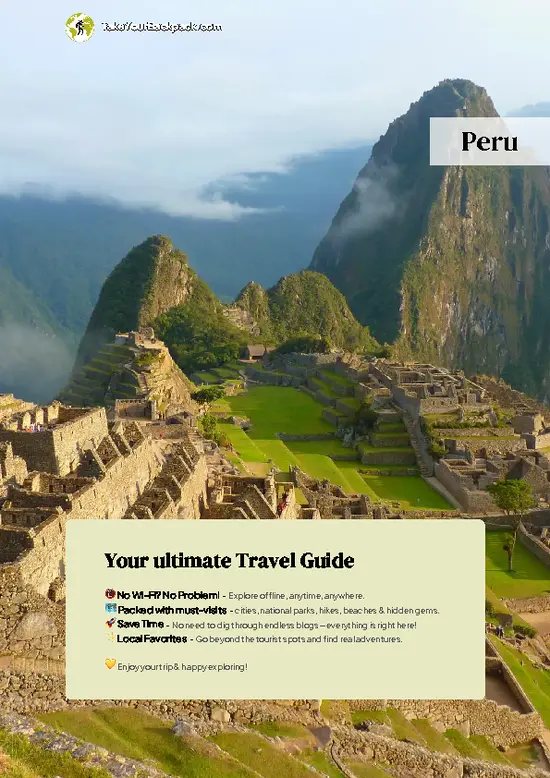
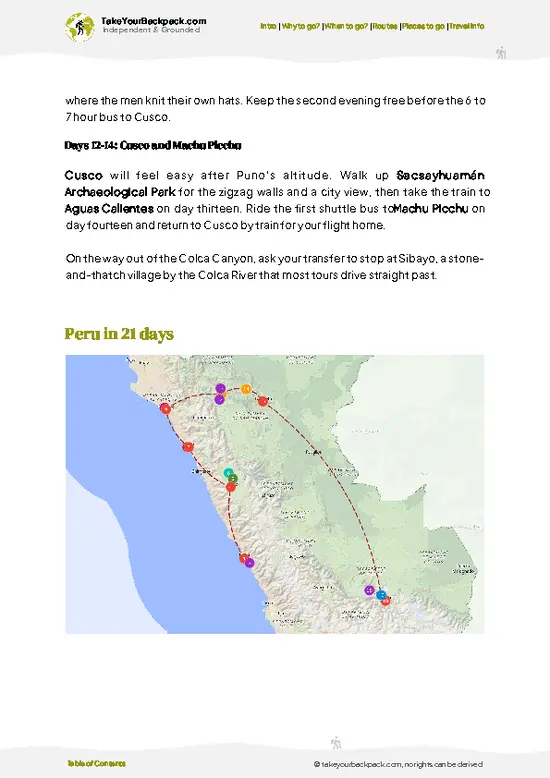
example page 0 from our offline Travel Guide for Peru
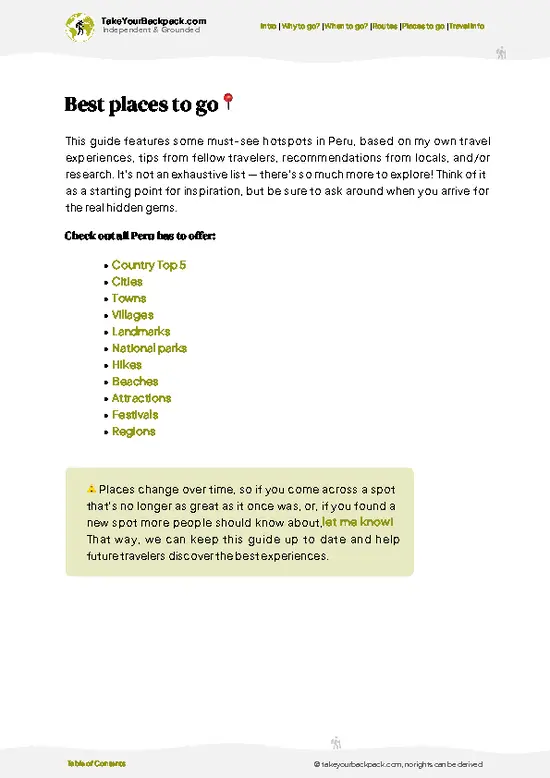
example page 1 from our offline Travel Guide for Peru
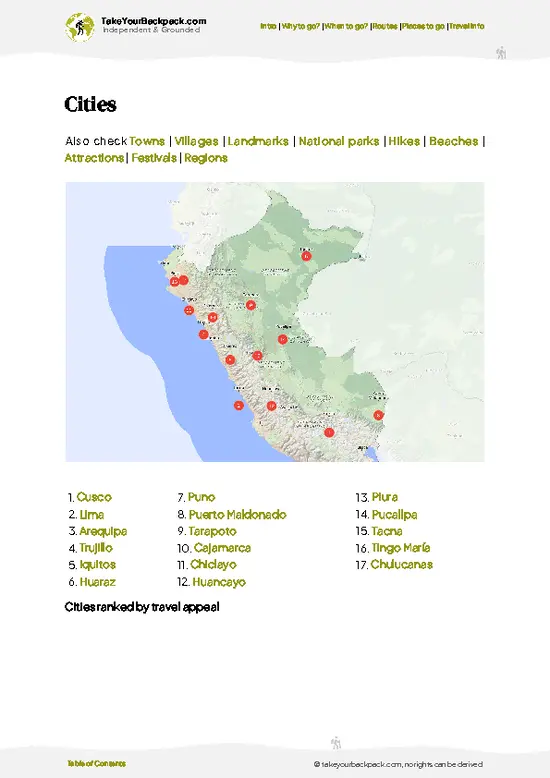
example page 2 from our offline Travel Guide for Peru
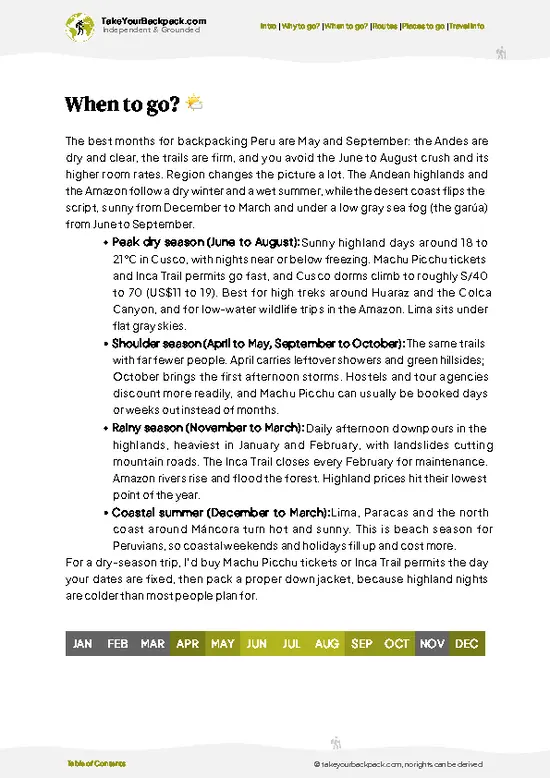
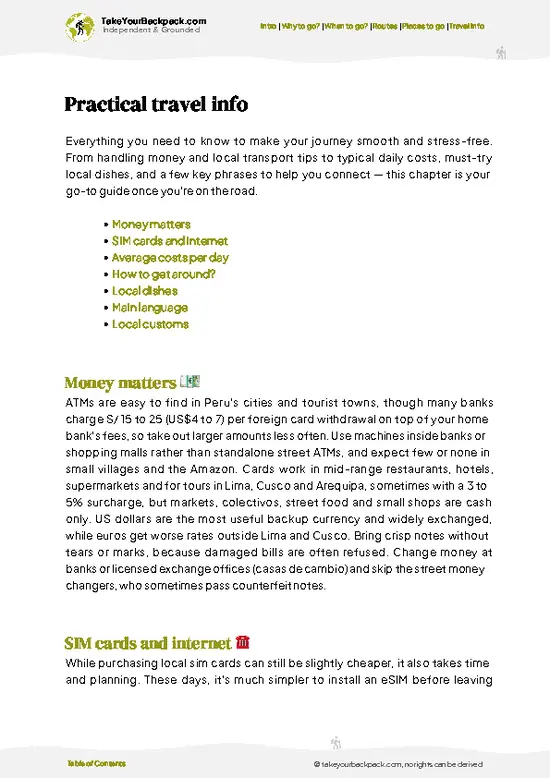
example page 3 from our offline Travel Guide for Peru
example page 4 from our offline Travel Guide for Peru
example page 5 from our offline Travel Guide for Peru
example page 6 from our offline Travel Guide for Peru
example page 7 from our offline Travel Guide for Peru
Loading the map 🌍
CLICK TO FILTER
cities
towns
villages
landmarks
national parks
hikes
beaches
attractions
festivals
regions
SHOW COUNTRY’S BESTSHOW ALL

✨ Why go?
Ranked #4 city in Peru
Why Trujillo should be on your travel list

Trujillo works as a backpacking stop because the biggest pre-Inca sites in Peru sit within reach of the center, and you can see them without a tour group. The city has two enormous adobe complexes, Chan Chan and the Huacas de Moche, plus the surf village of Huanchaco a short ride away, so one base covers archaeology and ocean. Hostels cluster around the Plaza de Armas, which makes the colonial center easy to walk, and the food scene leans heavily on fresh seafood and northern coastal dishes. It also sits on the main north-south route, so it breaks up the haul between Lima and the northern beaches or the Ecuador border. Two or three nights is right. Stay longer only if you want to learn to surf or settle into Huanchaco. If ruins and cebiche are not your thing, this is a stop you can shorten.

💡 HighlightsPlaces and moments you shouldn't skip

  1. Chan Chan: the largest adobe city in the Americas, built by the Chimú. Walk the Tschudi complex with its carved friezes of fish and waves. Go in the morning before the sun is strong. Entry is about US$4 to 8 including the site museum, and you need 2 to 3 hours.
  2. Huaca del Sol y de la Luna: a Moche temple with polychrome reliefs still bright after centuries. Guided visits are included in the ticket of roughly US$4 to 7. Allow 1.5 hours, and aim for morning or late afternoon.
  3. Plaza de Armas: the yellow, blue and pink colonial heart, with the cathedral and the sculpture of Liberty at its center. It is free and best in the early evening when locals gather. Plan 30 to 60 minutes.
  4. Huaca Arco Iris (El Dragón): a small Chimú temple covered in rainbow and dragon-like reliefs, usually quieter than Chan
… read more 👉
  1. Chan Chan: the largest adobe city in the Americas, built by the Chimú. Walk the Tschudi complex with its carved friezes of fish and waves. Go in the morning before the sun is strong. Entry is about US$4 to 8 including the site museum, and you need 2 to 3 hours.
  2. Huaca del Sol y de la Luna: a Moche temple with polychrome reliefs still bright after centuries. Guided visits are included in the ticket of roughly US$4 to 7. Allow 1.5 hours, and aim for morning or late afternoon.
  3. Plaza de Armas: the yellow, blue and pink colonial heart, with the cathedral and the sculpture of Liberty at its center. It is free and best in the early evening when locals gather. Plan 30 to 60 minutes.
  4. Huaca Arco Iris (El Dragón): a small Chimú temple covered in rainbow and dragon-like reliefs, usually quieter than Chan Chan. Entry is around US$3 to 5, and the visit takes about 45 minutes.
  5. Casa de la Emancipación: a colonial mansion where Trujillo’s independence was declared in 1820, now an art and history space. Entry is often free or a small fee, and an hour is plenty.
  6. Mansion Iturregui and other colonial houses: elegant courtyards, wrought iron and ornate balconies around the center. Some charge US$1 to 3. Allow an hour, ideally in daylight.
  7. Huanchaco: a fishing village where reed boats called caballitos de totora are still launched from the beach. Go at sunset for the best light and a seafood lunch. A walk is free, and a surf lesson runs about US$15 to 25 for 1.5 to 2 hours.
Day trips from Trujillo can take in the Moche sites of El Brujo and the Cao Museum, Sipán near Chiclayo, and the ruins of Chavín-era sites in the highlands. Chan Chan and Huaca Arco Iris pair well in a single morning, and Huanchaco makes a good sunset finish.
Spotted a mistake or missing something? Contact us.

Things to do in Trujillo

Ratings based on Tripadvisor reviews. When you book through this link, you support our work at no extra cost to you.

🏘️ NeighborhoodsHow different areas shape the experience

Trujillo sorts itself into a few zones, and knowing which does what saves you hours of aimless wandering.
  • Plaza de Armas and the Historic Center: Start here. Colonial mansions in yellow, turquoise and ochre ring the plaza, and the cathedral and nearby casonas with wrought-iron balconies sit within a few blocks. Most churches and mansions close for a long midday break, so go early or after 4 pm. Everything is walkable, and the ring of old streets inside the former city walls is flat.
  • Pasaje Catedral and the Pedestrian Streets: Cafés and bars cluster here, so this is where evenings start. Order a pisco sour and watch the plaza fill up. Quiet by 11 pm on weekdays, livelier on weekends.
  • Mercado Central area: Chaotic, loud, cheap. Fruit stacks, juice stalls and set-lunch counters crowd the blocks
… read more 👉
Trujillo sorts itself into a few zones, and knowing which does what saves you hours of aimless wandering.
  • Plaza de Armas and the Historic Center: Start here. Colonial mansions in yellow, turquoise and ochre ring the plaza, and the cathedral and nearby casonas with wrought-iron balconies sit within a few blocks. Most churches and mansions close for a long midday break, so go early or after 4 pm. Everything is walkable, and the ring of old streets inside the former city walls is flat.
  • Pasaje Catedral and the Pedestrian Streets: Cafés and bars cluster here, so this is where evenings start. Order a pisco sour and watch the plaza fill up. Quiet by 11 pm on weekdays, livelier on weekends.
  • Mercado Central area: Chaotic, loud, cheap. Fruit stacks, juice stalls and set-lunch counters crowd the blocks southeast of the plaza. Go mid-morning, carry small bills and keep your phone in a front pocket.
  • Huanchaco: A beach town about 20 minutes northwest by combi. Surfers, fishing boats made of reeds (caballitos de totora) and seafood shacks line the sand. Sunset drinks on the pier are the move, and the town is small enough to cover on foot.
  • Víctor Larco and Buenos Aires: Residential seaside districts with newer restaurants and a calmer feel. Taxi in, since the sights are spread out.

⌛️ 1 dayA smart one-day plan

This is a day for ruins, then a slow finish by the sea.
8:00 AM, Plaza de Armas: Start with coffee and a lap of the colonial square, the cathedral and the pastel mansions. It is calm now and the light is soft. Grab a combi toward Chan Chan from the nearby avenues.
9:00 AM, Chan Chan: Spend about two hours in the Tschudi complex and the site museum. The carved friezes and the maze of adobe walls are best seen before the sun gets hot.
11:30 AM, Huaca Arco Iris: A short ride away, this small temple is usually emptier than the main site. The rainbow reliefs are the point, and it takes less than an hour.
1:00 PM, Huanchaco: Take a combi to the fishing village for a seafood lunch. Order cebiche made from that morning’s catch and watch the totora reed boats on the sand.
3:30 PM, Huanchaco pier and church: … read more 👉
This is a day for ruins, then a slow finish by the sea.
8:00 AM, Plaza de Armas: Start with coffee and a lap of the colonial square, the cathedral and the pastel mansions. It is calm now and the light is soft. Grab a combi toward Chan Chan from the nearby avenues.
9:00 AM, Chan Chan: Spend about two hours in the Tschudi complex and the site museum. The carved friezes and the maze of adobe walls are best seen before the sun gets hot.
11:30 AM, Huaca Arco Iris: A short ride away, this small temple is usually emptier than the main site. The rainbow reliefs are the point, and it takes less than an hour.
1:00 PM, Huanchaco: Take a combi to the fishing village for a seafood lunch. Order cebiche made from that morning’s catch and watch the totora reed boats on the sand.
3:30 PM, Huanchaco pier and church: Walk the boardwalk, visit the hilltop church for the view, or book a short surf lesson if you have energy.
6:00 PM, Sunset on the beach: Stay for the glow, then head back by combi.
8:00 PM, Barrio Santa Rosa: A lesser-visited neighborhood of everyday Trujillo, with local eateries. Try a plate of northern criollo food where residents eat, then walk back to the center.

🌤️ When to go?When to go for the best experience

Trujillo is a dry, mild coastal city where the sun shows up most reliably from December to April.
  • Summer (December to April): Sunny and warm, with highs of 26 to 30°C (79 to 86°F) and lows near 19°C (66°F). Beach days in Huanchaco are at their best. Peruvian holidays around Christmas and Easter push up prices and fill beds.
  • Winter (June to September): Garúa, a gray coastal mist, often blankets the city. Highs sit at 19 to 22°C (66 to 72°F), lows near 15°C (59°F). Sights are quiet and rates are lowest, but swells are better for surfers.
  • Shoulder months (May, October, November): Clearing skies, 22 to 25°C (72 to 77°F) and thin crowds. Rain is rare year-round, though El Niño years can bring downpours.
  • Festivals: The Marinera Festival in January and the Spring Festival in late September bring dance
… read more 👉
Trujillo is a dry, mild coastal city where the sun shows up most reliably from December to April.
  • Summer (December to April): Sunny and warm, with highs of 26 to 30°C (79 to 86°F) and lows near 19°C (66°F). Beach days in Huanchaco are at their best. Peruvian holidays around Christmas and Easter push up prices and fill beds.
  • Winter (June to September): Garúa, a gray coastal mist, often blankets the city. Highs sit at 19 to 22°C (66 to 72°F), lows near 15°C (59°F). Sights are quiet and rates are lowest, but swells are better for surfers.
  • Shoulder months (May, October, November): Clearing skies, 22 to 25°C (72 to 77°F) and thin crowds. Rain is rare year-round, though El Niño years can bring downpours.
  • Festivals: The Marinera Festival in January and the Spring Festival in late September bring dance parades and higher prices.
Book ahead for festival weeks and visit the adobe sites in the morning before the sun is high.


source: climatestotravel.comJANJanuary: good for travelingFEBFebruary: fair for travelingMARMarch: fair for travelingAPRApril: fair for travelingMAYMay: highly recommended for travelingJUNJune: excellent for travelingJULJuly: excellent for travelingAUGAugust: excellent for travelingSEPSeptember: excellent for travelingOCTOctober: highly recommended for travelingNOVNovember: fair for travelingDECDecember: good for traveling

✈️ The backpacker research shortcutPeru Travel Guide

An offline-friendly backpacking guide with optimized travel routes, ranked highlights, transport advice, and the best areas to stay.
example page 0 from our offline Travel Guide for Peru
example page 1 from our offline Travel Guide for Peru
example page 2 from our offline Travel Guide for Peru
example page 3 from our offline Travel Guide for Peru
example page 4 from our offline Travel Guide for Peru
example page 5 from our offline Travel Guide for Peru
example page 6 from our offline Travel Guide for Peru
example page 7 from our offline Travel Guide for Peru
The digital guide (310 pages) contains:
✅ 102 highlights, ranked by travel appeal
✅ Optimized 7, 14 & 21-day travel routes
✅ Cities, national parks, landmarks, beaches
✅ How to get around
✅ Offline-friendly for travel without Wi-Fi
👉 Click to see all 30+ guide features

📅 Plan smarter in minutes, not weeks
✅ Month by month travel advice
✅ Festivals & national holidays
✅ Budget expectations

🗺️ Go to the right places, skip the overrated ones
✅ Honest pros & cons of destinations
✅ Top hikes, parks & viewpoints
✅ Lesser-known places most travelers miss
✅ Clear “worth it vs skip it” guidance

🛏️ Travel smoothly without rookie mistakes
✅ Best areas to stay
✅ Transport systems explained simply
✅ Common scams & safety advice
✅ SIM cards, money & practical tips

🌍 Understand the country, not just visit it
✅ Culture & traditions
✅ 52 Essential phrases & customs
✅ Festivals worth planning around
✅ Traveler-friendly historical context
✅ Insights that make places more meaningful

📱 Built for real travel conditions
✅ Fully downloadable PDF
✅ Works completely offline
✅ Optimized for phone use
✅ Useful in remote areas & buses
✅ Everything in one place
Stop searching, start planning
Get instant access to your full guide. 30‑day money-back guarantee.
+ Add another guide for just

By proceeding you agree to our terms.
Sent to your inbox immediately after payment • 100% Secure Checkout
Best Backpacking Travel Advisor 2025 tourism awardBest Backpacking
Travel Advisor
2025
What others say about Take Your Backpack Guides:
⭐⭐⭐⭐⭐
Fantastic, amazing amount of information!
⭐⭐⭐⭐⭐
My goodness this is amazing, it's what I've been looking for hats off too you!
⭐⭐⭐⭐⭐
I think this is absolutely BRILLIANT
⭐⭐⭐⭐
Very complete and informative. It's still missing places, but I gotta to commend you
⭐⭐⭐⭐⭐
This is truly amazing, thank you, can't wait to explore it with my kids!
⭐⭐⭐⭐⭐
Awesome resource, thank you!
⭐⭐⭐⭐⭐
This is amazing! Can't wait to explore the ones I haven't seen
⭐⭐⭐⭐
I love this! Well done, great idea.
⭐⭐⭐⭐⭐
Thanks for taking the time to make this gem!
⭐⭐⭐⭐⭐
This might be the best website I've ever seen.
⭐⭐⭐⭐⭐
Congratulations, and thank you so much for your work; it's incredibly valuable.
⭐⭐⭐⭐
In all seriousness I think you did a great job pointing out the important spots
⭐⭐⭐⭐⭐
10/10 very good
⭐⭐⭐⭐⭐
As someone who's only just starting to visit regularly this is awesome, thank you.
⭐⭐⭐⭐
Thank you very much! I'm going to visit my dad, it's going to be very useful!
⭐⭐⭐⭐⭐
This is really cool! We'll be travelling for the first time and this definitely come in handy.
⭐⭐⭐⭐⭐
You are now our minister of culture, congratulations 👨‍💼
⭐⭐⭐⭐⭐
Just wanted to tell you that this is a pearl! Going to follow your recommendations.
⭐⭐⭐⭐⭐
This is so cool. I'll definitely be using the resource for my travels soon.
⭐⭐⭐⭐⭐
This is very impressive! Good work.
⭐⭐⭐⭐⭐
This is an amazing and informative site. Very well done!

🛏️ Where to stay?Where staying makes the most sense

The historic center around the Plaza de Armas is the best base for a budget stay in Trujillo, with dorm beds typically US$8 to 14. Most hostels cluster within a few blocks of the plaza, so you can walk to museums, the main bus offices and plenty of cheap set-lunch spots without paying for a taxi. The streets are well lit and busy until the evening, and combis to the ruins and the coast pass the edge of the center. Expect some traffic noise, so choose an interior room or bring earplugs.

Huanchaco is the second option if surf, sunsets and a slower pace appeal more than city sightseeing. Beach hostels … read more 👉
The historic center around the Plaza de Armas is the best base for a budget stay in Trujillo, with dorm beds typically US$8 to 14. Most hostels cluster within a few blocks of the plaza, so you can walk to museums, the main bus offices and plenty of cheap set-lunch spots without paying for a taxi. The streets are well lit and busy until the evening, and combis to the ruins and the coast pass the edge of the center. Expect some traffic noise, so choose an interior room or bring earplugs.

Huanchaco is the second option if surf, sunsets and a slower pace appeal more than city sightseeing. Beach hostels offer dorms for roughly US$8 to 15, kitchens and board rental, and the town is relaxed and small, with a backpacker crowd. Nights are quiet, though the walk home along dark beach streets is best done in a group. Combis into Trujillo take 20 to 30 minutes and run until around 10 pm, so a late night in the city means a taxi back for about US$4 to 6.

Book ahead around Christmas, Easter and the festivals in January and September, when both areas fill up.

🚌 Getting aroundTransportation options and practical tips

A combi or micro ride in Trujillo costs about US$0.40 to 0.60, and you pay the cobrador in cash (soles) once you are on board. The historic center is flat and compact, so you will walk most of your sightseeing. Beyond it, traffic is dense and there is no metro, so the smart move is to use the small buses that run the main avenues and shuttle to the ruins and the coast.
  • Walking: Free, and the fastest option inside the old center, where the main sights sit within about a 15-minute loop. Go early to dodge the heat and the midday closures.
  • Combis and micros: Colorful minibuses run set routes with the destination painted on the windshield. Lines to Huanchaco leave frequently from the center and take 20 to 30 minutes for US$0.50 to 0.80. Most run from about 5:30 am to 10 pm. Ask your hostel for the
… read more 👉
A combi or micro ride in Trujillo costs about US$0.40 to 0.60, and you pay the cobrador in cash (soles) once you are on board. The historic center is flat and compact, so you will walk most of your sightseeing. Beyond it, traffic is dense and there is no metro, so the smart move is to use the small buses that run the main avenues and shuttle to the ruins and the coast.
  • Walking: Free, and the fastest option inside the old center, where the main sights sit within about a 15-minute loop. Go early to dodge the heat and the midday closures.
  • Combis and micros: Colorful minibuses run set routes with the destination painted on the windshield. Lines to Huanchaco leave frequently from the center and take 20 to 30 minutes for US$0.50 to 0.80. Most run from about 5:30 am to 10 pm. Ask your hostel for the right letter or number, because stops are loosely marked.
  • Taxis: No meters, so agree on the fare before you get in. Inside the center expect US$1.50 to 2.50, and Huanchaco costs US$4 to 6. Order through a taxi app or have your hostel call a trusted driver, especially after dark.
  • Tours and shared rides: Chan Chan and the Huacas del Sol y de la Luna are reachable by combi, but a shared tour or colectivo for US$8 to 15 links several sites in one morning and saves you waiting by the road.
  • Mototaxis: Three-wheelers handle short hops in Huanchaco and outer districts for US$1 to 2. They are open-sided and slow on hills, but handy for narrow streets.

👛 Costs (as of 19 October 2026)Travel costs and budget guide for Trujillo

Backpacking in Trujillo costs roughly US$32 to 50 a day, and the total below is US$41 with a high-season dorm bed.
CategoryBudget RangeLocal Reality
Dorm (high season)US$10 to 15Beds in the center or Huanchaco, higher around holidays and festivals
Dorm (off-season)US$8 to 12June to September, often with a free breakfast
MealsUS$9 to 14Set lunch for US$2.50 to 4, ceviche US$5 to 9, simple dinner
Local transportUS$2 to 4Combis cost under US$1 per ride, short taxis US$1.50 to 2.50
City transport passNot availableNo pass, pay cash on each ride
Activities and entry feesUS$8 to 12Chan Chan and Huaca de la Luna each around US$4 to 5
MiscellaneousUS$3 to 5Water, snacks, laundry, SIM data
Total Daily BudgetUS$32 to 50About US$41 with a high-season dorm bed
To save money, buy a combined ticket that covers several … read more 👉
Backpacking in Trujillo costs roughly US$32 to 50 a day, and the total below is US$41 with a high-season dorm bed.
CategoryBudget RangeLocal Reality
Dorm (high season)US$10 to 15Beds in the center or Huanchaco, higher around holidays and festivals
Dorm (off-season)US$8 to 12June to September, often with a free breakfast
MealsUS$9 to 14Set lunch for US$2.50 to 4, ceviche US$5 to 9, simple dinner
Local transportUS$2 to 4Combis cost under US$1 per ride, short taxis US$1.50 to 2.50
City transport passNot availableNo pass, pay cash on each ride
Activities and entry feesUS$8 to 12Chan Chan and Huaca de la Luna each around US$4 to 5
MiscellaneousUS$3 to 5Water, snacks, laundry, SIM data
Total Daily BudgetUS$32 to 50About US$41 with a high-season dorm bed
To save money, buy a combined ticket that covers several archaeological sites and eat the set lunch (menú) as your main meal.


source: peru.travel
⚠️ Prices can change and everyone travels differently, so take this as a rough guide. Hope it helps you plan your adventure!

🚌 Day tripsShort trips worth adding

Trujillo is one of Peru’s easiest bases for day trips, because the major pre-Inca sites and a surf beach sit within an hour by cheap local transport.
Chan Chan:
The Chimú capital, with carved friezes of fish and waves in the Tschudi complex. It is about 20 minutes by combi from the center, and entry is roughly US$4 to 5. Go in the morning, and budget two to three hours. Skip the midday heat, since there is little shade.
👉 Explore Chan Chan
Huaca de la Luna:
A temple with vivid painted reliefs, about 20 to 30 minutes from the center by combi for US$1 plus about US$4 to 5 for the guided entry. Visits are guided only, so wait for the next English tour. A common mistake is arriving after the last tour in the late afternoon. Total cost is under US$10 with lunch.

Huanchaco:
A relaxed beach town with … read more 👉
Trujillo is one of Peru’s easiest bases for day trips, because the major pre-Inca sites and a surf beach sit within an hour by cheap local transport.
Chan Chan:
The Chimú capital, with carved friezes of fish and waves in the Tschudi complex. It is about 20 minutes by combi from the center, and entry is roughly US$4 to 5. Go in the morning, and budget two to three hours. Skip the midday heat, since there is little shade.
👉 Explore Chan Chan
Huaca de la Luna:
A temple with vivid painted reliefs, about 20 to 30 minutes from the center by combi for US$1 plus about US$4 to 5 for the guided entry. Visits are guided only, so wait for the next English tour. A common mistake is arriving after the last tour in the late afternoon. Total cost is under US$10 with lunch.

Huanchaco:
A relaxed beach town with reed fishing boats, surf lessons for about US$15 to 25 and fresh ceviche. It is 20 to 30 minutes by combi for under US$1. The water is best from December to April, and the pier is best at dusk. Leave before the combis thin out around 10 pm.

El Brujo Complex:
Home to the Lady of Cao mummy and a large decorated temple, about 1 hour to 1.5 hours north by combi plus a taxi. Count on US$10 to 15 total. Go on a weekday morning when it is quiet, and confirm opening hours the day before.

🍲 FoodLocal Cuisine & Drinks

Trujillo’s coastal position shapes the menu, and the star is ceviche made with the day’s catch, served at lunchtime and often with sweet potato, corn and a wedge of cabbage-onion salad. Shambar, a Monday soup of wheat, beans and cured pork, is found at neighborhood eateries, and sopa teóloga, a green bread and chicken soup, is another northern coastal dish. Cabrito a la norteña, goat stewed with beans and chicha de jora, is a northern favorite worth a lunchtime splurge. Sweet-tooths should look for King Kong layered cake with fruit paste and the local alfajores.

For cheap eats, head to the Mercado Central for juices, fruit salads and set lunches called menús that run about US$2.50 to 4. Small cevicherías near the center and in Huanchaco serve fresh plates for around US$5 to 9, mostly at lunch … read more 👉
Trujillo’s coastal position shapes the menu, and the star is ceviche made with the day’s catch, served at lunchtime and often with sweet potato, corn and a wedge of cabbage-onion salad. Shambar, a Monday soup of wheat, beans and cured pork, is found at neighborhood eateries, and sopa teóloga, a green bread and chicken soup, is another northern coastal dish. Cabrito a la norteña, goat stewed with beans and chicha de jora, is a northern favorite worth a lunchtime splurge. Sweet-tooths should look for King Kong layered cake with fruit paste and the local alfajores.

For cheap eats, head to the Mercado Central for juices, fruit salads and set lunches called menús that run about US$2.50 to 4. Small cevicherías near the center and in Huanchaco serve fresh plates for around US$5 to 9, mostly at lunch because the fish is cleared by evening. In the evening, the pedestrian streets off the Plaza de Armas fill with cafés and bars pouring pisco sours and local craft beer.

🛡️ SafetyTraveler Safety Guide

Trujillo is manageable for backpackers with ordinary city habits, but petty theft is the main issue. Pickpocketing and phone snatching happen around the Mercado Central, in crowded combis and on the busy central avenues, so carry your phone in a front pocket and keep your bag on your lap. Stay in the lit historic center after dark and take a licensed taxi booked through an app or your hostel rather than hailing one on the street. Solo travelers, women included, tend to do fine in the center and Huanchaco, though walking empty streets or the beach at night is best avoided. Visit the ruins with a guide or in a group, since isolated stretches around the archaeological sites have seen opportunistic theft. Taxi drivers may quote inflated fares, so settle the price first. Keep valuables out of sight and carry only what you need for the day.

FAQFrequently asked questions about Trujillo

Two to three days is enough in Trujillo. Spend one day on the colonial center and the Plaza de Armas, one on Chan Chan and Huaca de la Luna (about US$4 to 5 each), and add a half day in Huanchaco, 20 to 30 minutes away by combi. A third full day lets you reach El Brujo, about 1 to 1.5 hours north.
Trujillo is reasonably safe for solo backpackers who use common sense. Petty theft around the Mercado Central and in crowded combis is the main risk, so keep your phone and bag close. Stay in the lit historic center at night, take app or hostel-booked taxis (US$1.50 to 2.50 in town), and visit the ruins with a guide or group.
Trujillo is known for Chan Chan, the vast adobe city of the Chimú that is a UNESCO World Heritage Site, and for the painted temple of Huaca de la Luna. It also has colorful colonial mansions around the Plaza de Armas, the Marinera dance festival each January and the surf town of Huanchaco, with its reed fishing boats. Local ceviche and cabrito a la norteña round out the reputation.
⚠️ Things can change over time, so always validate details locally before you go.

Other Peruvian cities near Trujillo

Explore more nearby:

  • Cajamarca—Thermal springs, Atahualpa’s ransom room, market cheese, cool highlands| 120 km away
  • Chiclayo—Moche tombs, Lambayeque museums, mototaxis, market herbalists| 175 km away
  • Huaraz—Cordillera Blanca, glacier lakes, trekking base, altitude prep| 227 km away

💡 Not sure where to go next?
Create a personalized itinerary for Peru including Trujillo and the places that fit your trip.

Generate my itinerary

👉 Discover all cities

Or checkout all Peru has to offer (think cities, towns, villages, national parks, hikes, beaches, festivals)
Country photo of Peru

We 💚 feedbackSumming up the experience

Trujillo is for people who like their history with a side of surf and don’t mind a modest, slightly scruffy city. If ruins and ocean sound like a good pairing, you’ll love it. I would skip the guided tours, take local combis and give Huanchaco a full afternoon. Bring a hat, because the desert sun is fierce.

✈️ When did I visit Peru?
Peru I visited during my half year trip through South and Central America back in 2003

✍️ Help improve this page!
The information on this page is based on my own backpacking experience in Peru, supplemented with up-to-date research and feedback from other travelers. Travel details can change, so if you notice anything outdated or incomplete, feel free to let me know.


🙋‍♂️ Give feedback

👋 Meet the founderWho’s Behind Take Your Backpack?

Johan, backpacker and founder of TakeYourBackpackHi, I’m Johan (Netherlands 🇳🇱), the creator of TakeYourBackpack. Over the past 3 decades, I’ve backpacked through 90+ countries across six continents, gaining extensive experience with independent travel, long-term trips, and overland routes.

This site is built on a combination of firsthand travel experience and carefully curated insights from other backpackers. Many guides are based on places I’ve personally visited, while others bring together tips, observations, and practical advice shared by trusted travelers I’ve met along the way.

The goal is to provide realistic, experience-driven guidance — not generic itineraries — so you can explore destinations with better context, clearer expectations, and more confidence.