×

Peru🇵🇪 | best citiesBest 10 cities in Peru

Peru throws its cities at you in three completely different flavors, and picking the right one shapes your whole trip. The coast is dry desert wrapped in fog, with sprawling, modern urban hubs where seafood, surf and nightlife run late and flights land daily. The Andean highlands climb above 3,000 meters, where cobbled lanes, Inca stonework and colonial plazas pack tight together, backpacker hostels cluster near the main squares, and the crowds swell around Machu Picchu. The Amazon basin flips the script with jungle heat, river ports and boats instead of buses. Costs drop fast once you leave the capital, and a dorm bed in most highland towns runs well under what you would pay on the coast. Independent travel is easy here, with cheap long-distance buses and a dense hostel network. Pack for altitude, pick your region first, and start exploring.

By Johan Kruseman 🇳🇱 | Updated October 20, 2026
Explore the best towns in Peru

Why go?Why Travelers Love These Spots

Peru stacks three worlds into one country, and that geography built its cities. The Pacific desert, the Andes and the Amazon each pushed people to settle differently, so urban life here changes dramatically every few hundred kilometers. Few countries let you move from a sea-level capital to a 3,400-meter mountain town to a river port in the rainforest without leaving the same border.

History adds the second layer. The Inca Empire laid out stone cities and a road network across the mountains, then Spanish colonizers built plazas, cathedrals and balconied mansions directly on top of that masonry. Walk the streets and you often see Inca foundations carrying colonial walls. Pre-Inca cultures such as the Moche, Nazca and Chimú left adobe capitals and ceremonial sites near the northern and southern … read more 👉
Peru stacks three worlds into one country, and that geography built its cities. The Pacific desert, the Andes and the Amazon each pushed people to settle differently, so urban life here changes dramatically every few hundred kilometers. Few countries let you move from a sea-level capital to a 3,400-meter mountain town to a river port in the rainforest without leaving the same border.

History adds the second layer. The Inca Empire laid out stone cities and a road network across the mountains, then Spanish colonizers built plazas, cathedrals and balconied mansions directly on top of that masonry. Walk the streets and you often see Inca foundations carrying colonial walls. Pre-Inca cultures such as the Moche, Nazca and Chimú left adobe capitals and ceremonial sites near the northern and southern coast, so the past reaches well beyond the famous highland circuit.

Before you commit, know the tradeoffs. Altitude is real: many highland cities sit above 3,000 meters, and the first days bring headaches, breathlessness and slow stairs. Distances are huge, and the Andes make road journeys long, winding and slower than the map suggests. Infrastructure is uneven, with good tourist services in the main hubs and thinner options elsewhere, and strikes or landslides sometimes block roads. Cards work in larger cities, while smaller towns run on cash in soles.

On the plus side, Peru is a value destination. Food culture is a headline attraction on its own, with markets, set lunches called menús and a celebrated restaurant scene. Pack layers, expect sun and chill in the same hour, and approach the cities as a country-wide sampler rather than a single region.
How the List Was Created
The list of best cities in Peru is created based on culture, vibe, attractions, transport ease, and local charm. If you feel a city is missing in this list, please let us know.

When to go?Timing Your Visit for the Best Experience

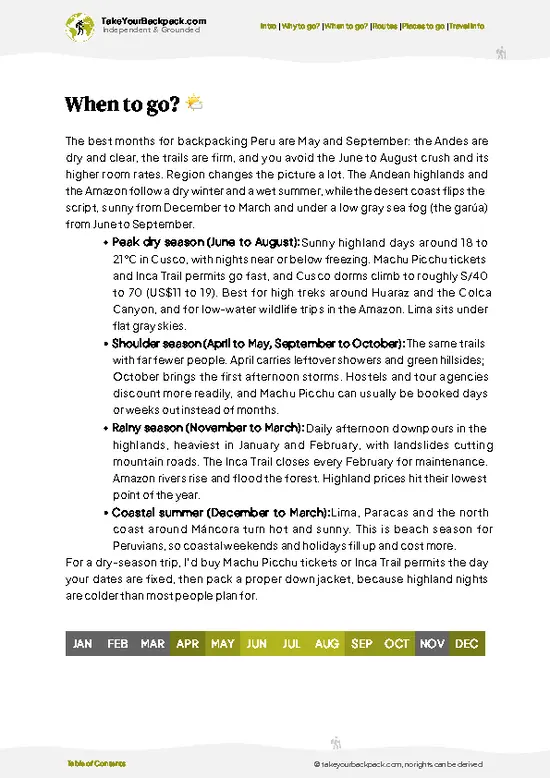
Best Months for Peru’s Cities: May to September is the best window for cities in Peru, because the Andes and the southern highlands turn dry, with clear blue skies and little rain. Highland days hit 18 to 22°C, but nights drop to around 0°C or below at altitude, so pack a proper jacket and a warm sleeping layer.

Coast, Highlands and Jungle Differ: The highlands run a wet season from roughly November to March, with rainfall peaking in January and February. Trails and roads can close, and some trains and routes get disrupted. The coast flips the logic: the Lima area enjoys sunny summers from December to April at 24 to 28°C, while June to October brings gray, damp garúa fog and temperatures of 15 to 19°C. The Amazon stays hot and humid at 26 to 32°C all year, with the driest stretch from June … read more 👉
Best Months for Peru’s Cities: May to September is the best window for cities in Peru, because the Andes and the southern highlands turn dry, with clear blue skies and little rain. Highland days hit 18 to 22°C, but nights drop to around 0°C or below at altitude, so pack a proper jacket and a warm sleeping layer.

Coast, Highlands and Jungle Differ: The highlands run a wet season from roughly November to March, with rainfall peaking in January and February. Trails and roads can close, and some trains and routes get disrupted. The coast flips the logic: the Lima area enjoys sunny summers from December to April at 24 to 28°C, while June to October brings gray, damp garúa fog and temperatures of 15 to 19°C. The Amazon stays hot and humid at 26 to 32°C all year, with the driest stretch from June to September and heavy downpours from December to March.

Peak Season and Shoulder Months: June to August is peak season, driven by dry weather and international holidays. Cusco-area hotels and permits sell out early, and prices can run 20 to 40 percent above low-season rates. Late July also brings national holidays around Fiestas Patrias (July 28 and 29), when domestic travel surges and buses fill. The shoulder months of April, May, September and October offer a sharp compromise, with fewer people, lower prices and mostly dry mountain weather. Book Machu Picchu entry well ahead in any month, since tickets are timed and capped.

Wet Season Bargains: November to March is the cheapest stretch, when hostels and tours often drop their rates and queues vanish. If you accept afternoon showers, it suits flexible travelers focused on coastal cities and food. Check rail and road status before heading into the mountains, and keep a buffer day in the schedule.

city hoppingOptimizing Your Multi-Stop Itinerary

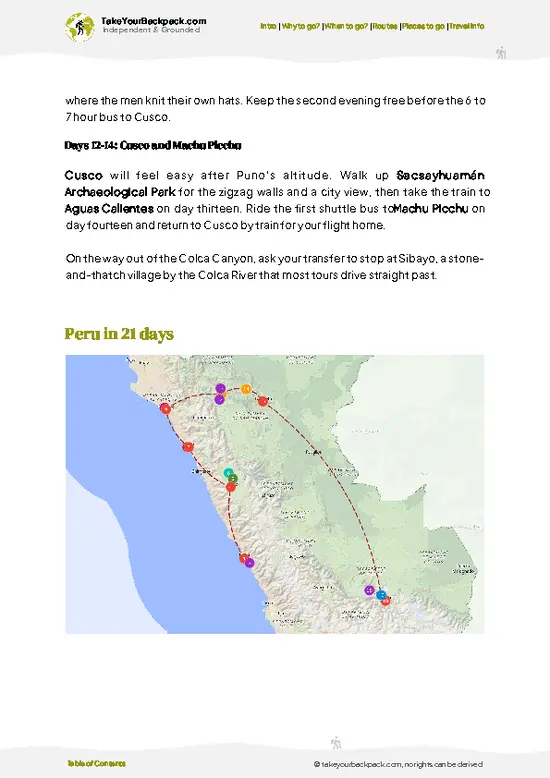
How Long a Multi-City Trip Takes: A trip linking several cities in Peru needs 10 to 21 days, with 14 days being the practical minimum for a coast, highlands and one extra region loop. Anything shorter turns into airport hopping.

Which Regions Cluster and Which Way to Go: Three clusters make sense. The central coast around Lima is the arrival hub. The southern highlands near Cusco and Arequipa and Puno form the classic circuit, linked by long buses or short flights. The northern coast and Andes and the Amazon work as separate add-ons, each needing its own days. Travel south and then east, starting at the coast, moving into the mountains, and finishing at Lake Titicaca or heading back by plane. This sequence lets your body adjust gradually to altitude, rather than shocking it on day one.

Time … read more 👉
How Long a Multi-City Trip Takes: A trip linking several cities in Peru needs 10 to 21 days, with 14 days being the practical minimum for a coast, highlands and one extra region loop. Anything shorter turns into airport hopping.

Which Regions Cluster and Which Way to Go: Three clusters make sense. The central coast around Lima is the arrival hub. The southern highlands near Cusco and Arequipa and Puno form the classic circuit, linked by long buses or short flights. The northern coast and Andes and the Amazon work as separate add-ons, each needing its own days. Travel south and then east, starting at the coast, moving into the mountains, and finishing at Lake Titicaca or heading back by plane. This sequence lets your body adjust gradually to altitude, rather than shocking it on day one.

Time Per Stop and Travel Times: Give each coastal city 2 to 3 nights and each highland city 3 to 4 nights, with an extra day or two in the Cusco area for acclimatization before any hiking. Lima to Cusco flights take about 1 hour 30 minutes. Cusco to Puno by bus takes 6 to 8 hours. Arequipa to Cusco by overnight bus is roughly 10 to 11 hours, and Lima to Arequipa by bus is around 15 to 17 hours, so flying saves a day. Northern routes along the coast run 8 to 12 hours between major stops.

Planning Mistakes to Skip: Trying to cover everything is the classic error. Peru is more than 1.2 million square kilometers, so choose two regions and go deep. Flying straight into Cusco and climbing hard on day one invites altitude sickness, so spend a night or two lower first in the Sacred Valley. Booking tight connections ignores strikes and landslide delays, so leave a spare day before international flights. Overnight buses save a hotel night but cost you the daytime views and sleep, so use them only on the long legs.

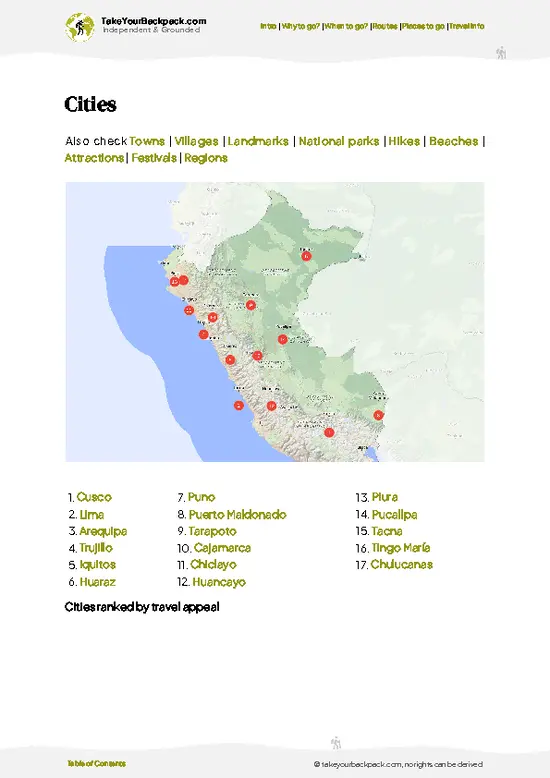
The ListThe Best cities of Peru

1 Cusco

Inca masonry, steep cobbles, Sacred Valley gateway, San Blas workshops

Trace twelve-angled stones along Hatunrumiyoc, climb to Sacsayhuamán’s giant walls, and spend afternoons among San Blas’s whitewashed lanes and artisan studios.

Peru - Cusco

2 Lima

Ceviche, Pacific cliffs, Barranco murals, pyramid in Miraflores

Cross the capital from catacombs and Pizarro’s tomb to Barranco’s galleries, with paragliders above the Miraflores cliffs and market lunches along the way.

Peru - Lima

3 Arequipa

Sillar stone, volcano views, picanterías, convent lanes

Walk blue and terracotta cloister lanes, then climb to Yanahuara’s carved arches for Misti at sunset, with rocoto relleno waiting back in town.

peru-city-arequipa
© Google | Javier Rischmoller

4 Trujillo

Chimú adobe, Moche temples, pastel colonial grid, reed boats

Walk carved friezes at Chan Chan, see bright Moche reliefs at the Huacas, then finish with seafood and caballitos de totora at Huanchaco.

5 Iquitos

Amazon port, Belén market, stilt houses, no road access

Wander Belén’s riverside stalls, paddle past houses rising with the water, and watch sunset over the Itaya from the Malecón Tarapacá.

6 Huaraz

Cordillera Blanca, glacier lakes, trekking base, altitude prep

Acclimatize on the Rataquenua viewpoint walk, then head for turquoise Llanganuco or the long day hike to Laguna 69 beneath glaciers.

7 Puno

Lake Titicaca, reed islands, Taquile knitters, 3,830 meters

Board a morning boat to the Uros reed islands or Taquile, then return for Jirón Lima’s street music and a steamship moored by the lake.

8 Puerto Maldonado

Madre de Dios, macaw clay lick, Tambopata access, oxbow lake

Compare lodge quotes at the port, then paddle Lago Sandoval for giant otters or rise before dawn to watch macaws gather at riverbank clay.

9 Tarapoto

Jungle foothills, cacao tastings, river swimming holes, mototaxi rides

Taste local chocolate and coffee, then cool off in Río Shilcayo’s swimming holes.

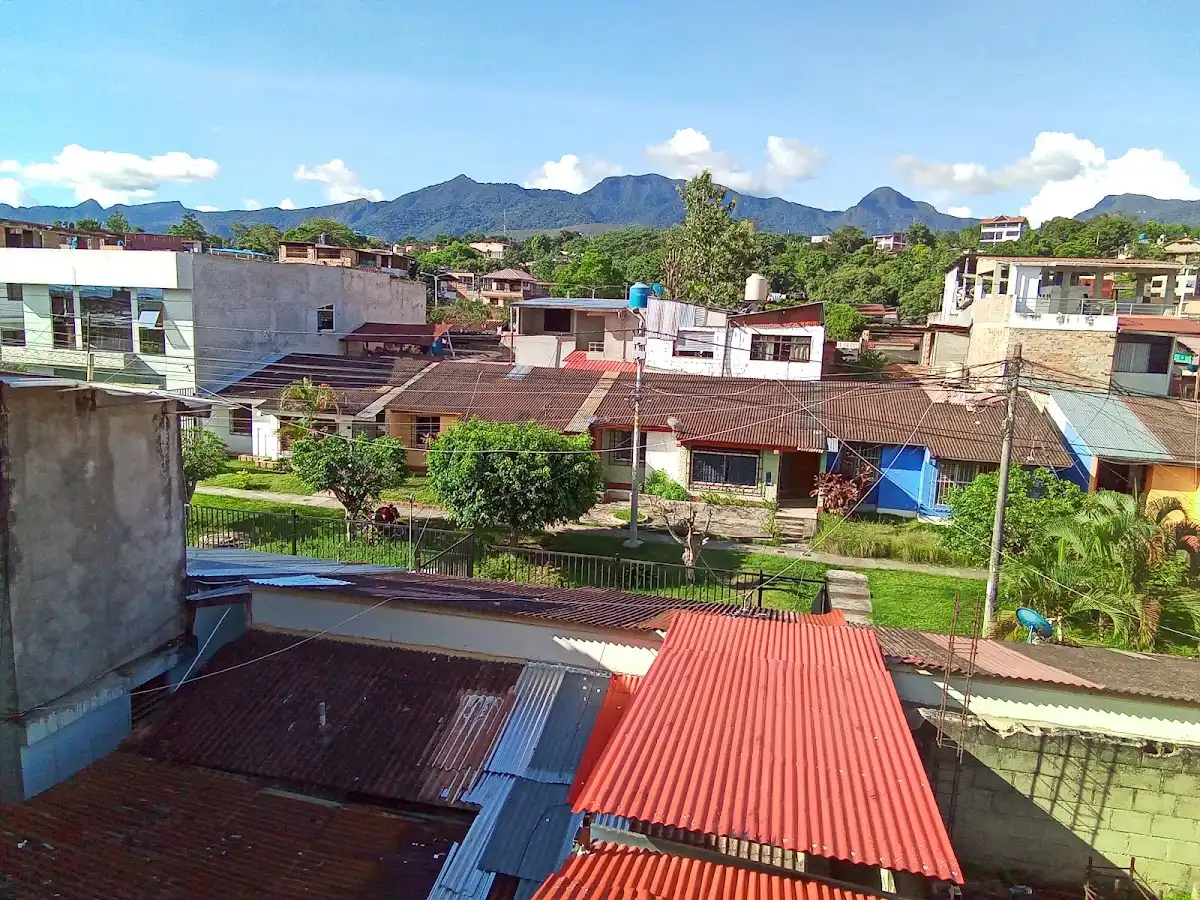
peru-city-tarapoto
© Google |

10 Cajamarca

Thermal springs, Atahualpa’s ransom room, market cheese, cool highlands

Soak in steaming Inca springs, stand inside the chamber where Atahualpa was held, then climb Santa Apolonia for views over red-tiled roofs.

11 Chiclayo

Moche tombs, Lambayeque museums, mototaxis, market herbalists

Base yourself here to reach gold-filled royal burials and ceramic collections in nearby Lambayeque, then browse Mercado Modelo among herbal healers.

peru-city-chiclayo
© Google |

12 Huancayo

Sunday market, Mantaro Valley, weaving villages, trout lunches

Time your arrival for Sunday, when Avenida Huancavelica fills with textiles, produce and snacks, then head to eroded clay towers on the hillside.

peru-city-huancayo
© Google |

13 Piura

Northern desert, goat stew, Vicús gold, beach gateway

Break the journey toward Máncora with a long market lunch, Vicús gold in a small museum, and an evening stroll along the Piura River.

14 Pucallpa

Ucayali port, Yarinacocha lagoon, Shipibo kené, motocars

Hop a boat across Yarinacocha’s oxbow lake to a Shipibo village, buy embroidered kené cloth straight from artisans, and end at the riverfront.

15 Tacna

Border city, Eiffel fountain, railway museum, desert valley

Stay a night before crossing to Chile to see the Eiffel-workshop fountain, old locomotives, and families gathering beneath the parabolic arch at dusk.

16 Tingo María

Oilbird cave, Huallaga valley, waterfall pools, Sleeping Beauty ridge

Enter the Cueva de las Lechuzas among squealing oilbirds, swim in river and waterfall pools, then watch the Bella Durmiente ridge at dawn.

17 Chulucanas

Burnished pottery, family workshops, mango market, quiet plaza

Visit family studios where potters polish clay with smooth stones, then cool off with fresh juice in the shaded plaza.

Think you know Peru?

Prove you’re a true local — uncover 7 lesser-known cities in Peru that locals tend to keep to themselves.
Loading the map 🌍

Expert viewPro Tips for Exploring the Best

How Many Cities to Visit: Pick four to six cities for two to three weeks, because Peru punishes rushed schedules with altitude, long road legs and tired days. Fewer stops mean you can say yes to the unplanned, like a market lunch or a last-minute festival. Beyond six, you spend more time in terminals than in plazas.

Prioritizing the Kind of City: Match the city type to your style. Culture and history hunters should weight the Andean highland cities, where Inca and colonial layers sit side by side. Food lovers and surfers should give the coast extra nights, since the restaurant scene and ocean access are strongest there. Adventure seekers should spend time in highland bases for trekking and in the Amazon river ports for jungle lodges. Budget-minded backpackers get the best value in smaller … read more 👉
How Many Cities to Visit: Pick four to six cities for two to three weeks, because Peru punishes rushed schedules with altitude, long road legs and tired days. Fewer stops mean you can say yes to the unplanned, like a market lunch or a last-minute festival. Beyond six, you spend more time in terminals than in plazas.

Prioritizing the Kind of City: Match the city type to your style. Culture and history hunters should weight the Andean highland cities, where Inca and colonial layers sit side by side. Food lovers and surfers should give the coast extra nights, since the restaurant scene and ocean access are strongest there. Adventure seekers should spend time in highland bases for trekking and in the Amazon river ports for jungle lodges. Budget-minded backpackers get the best value in smaller highland and northern towns, where prices stay lower and crowds thin out. One highland, one coast and one lesser-known city is a balanced mix.

What a Day Costs: Plan on US$30 to 50 a day for a comfortable backpacker budget: a dorm bed at US$8 to 15, a menú lunch at S/10 to 18 (about US$3 to 5), local transport and a few paid sights. Tighter budgets can reach US$25 a day with cooked food and few tours. Costs run higher in Lima and the Cusco area. Add per-visit costs: the Cusco Boleto Turístico runs about S/130 to 190 (US$35 to 50) depending on the ticket, Machu Picchu entry about S/152 to 200 plus transport, and a guide for a walking tour of a historic center US$15 to 40. Expect long-distance buses at US$10 to 40 per leg, and flights from US$40 to 120 if booked ahead.

Costs and Delays That Catch Travelers Out: Machu Picchu tickets sell out in peak months, so book weeks ahead and match the entry time to your train. Taxis without a fixed fare often charge tourists double, so agree on the price before getting in or use a ride app. Cash matters outside big hubs, and ATMs charge fees of S/15 to 30, so withdraw larger sums less often. Altitude sickness steals days if ignored. Drink water, go easy on the first day, carry coca tea or altitude tablets approved by your doctor and be ready to descend if symptoms worsen. Landslides and strikes can shut roads for a day or more, so skip tight connections and buy flexible tickets.

Safety and Cultural Sense: Petty theft is the main risk in cities, especially in crowded bus terminals and markets. Keep your phone out of sight on the street, use a front-facing bag and ride only licensed or app-booked taxis at night. Choose reputable bus companies with terminal check-in for overnight legs. Nightlife areas call for extra caution with drinks and walking alone late.

Beyond security, small courtesies go far. Greet shopkeepers with a buenos días before asking for anything, and ask before photographing people in traditional dress, since many expect a few soles in return. Bargaining is normal in markets but not in shops with posted prices. Carry small bills, because vendors often cannot break large ones. Dress modestly in churches, and treat sacred Andean sites with respect by staying on marked paths. Tap water is not drinkable, so buy bottled or filtered water and skip ice outside reliable restaurants.

✈️ The backpacker research shortcutPeru Travel Guide

An offline-friendly backpacking guide with optimized travel routes, ranked highlights, transport advice, and the best areas to stay.
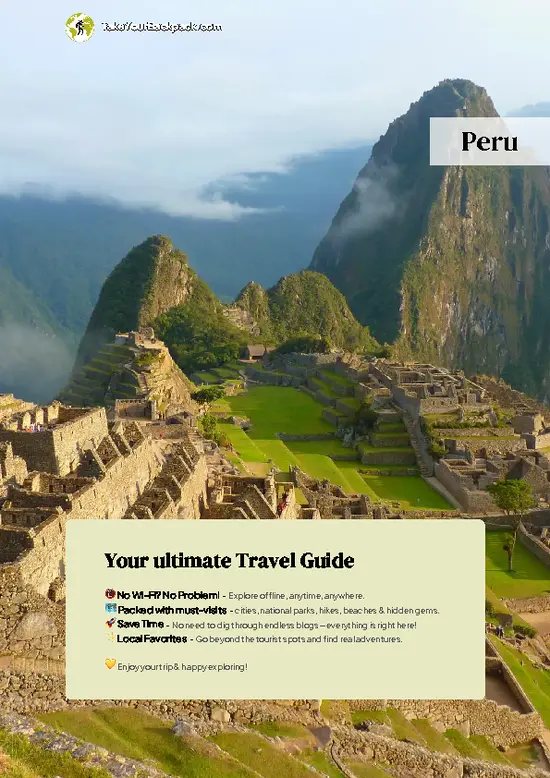
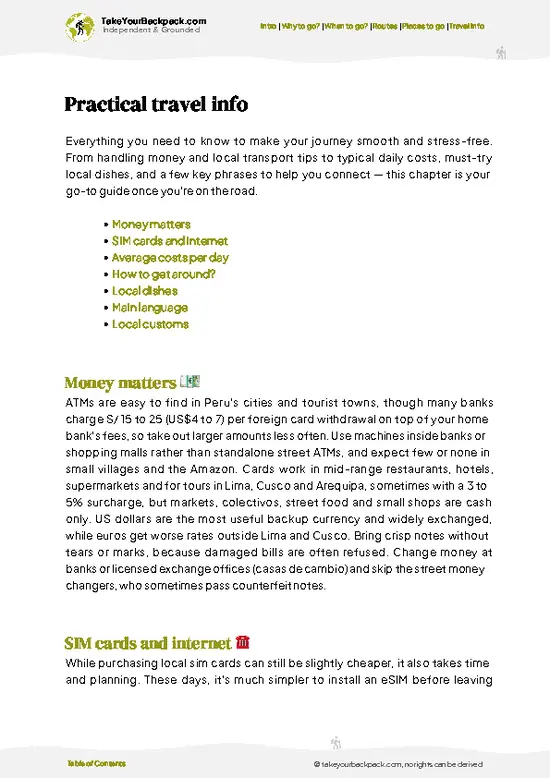
example page 0 from our offline Travel Guide for Peru
example page 1 from our offline Travel Guide for Peru
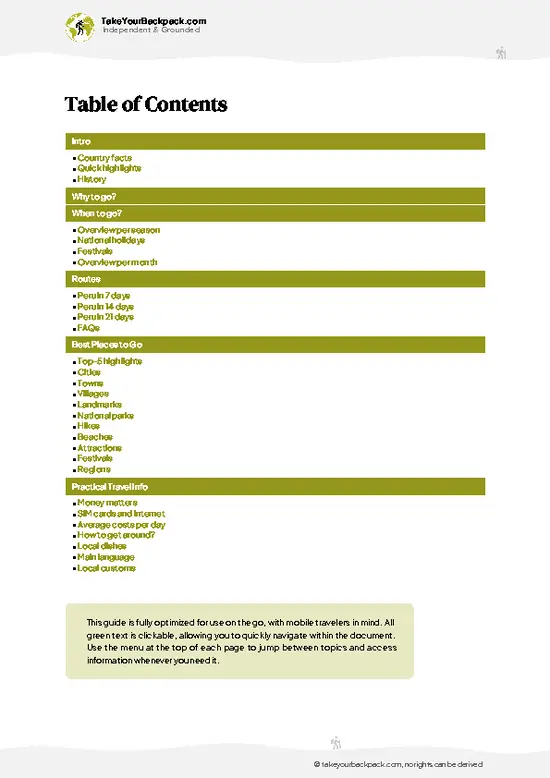
example page 2 from our offline Travel Guide for Peru
example page 3 from our offline Travel Guide for Peru
example page 4 from our offline Travel Guide for Peru
example page 5 from our offline Travel Guide for Peru
example page 6 from our offline Travel Guide for Peru
example page 7 from our offline Travel Guide for Peru
The digital guide (310 pages) contains:
✅ 102 highlights, ranked by travel appeal
✅ Optimized 7, 14 & 21-day travel routes
✅ Cities, national parks, landmarks, beaches
✅ How to get around
✅ Offline-friendly for travel without Wi-Fi
👉 Click to see all 30+ guide features

📅 Plan smarter in minutes, not weeks
✅ Month by month travel advice
✅ Festivals & national holidays
✅ Budget expectations

🗺️ Go to the right places, skip the overrated ones
✅ Honest pros & cons of destinations
✅ Top hikes, parks & viewpoints
✅ Lesser-known places most travelers miss
✅ Clear “worth it vs skip it” guidance

🛏️ Travel smoothly without rookie mistakes
✅ Best areas to stay
✅ Transport systems explained simply
✅ Common scams & safety advice
✅ SIM cards, money & practical tips

🌍 Understand the country, not just visit it
✅ Culture & traditions
✅ 52 Essential phrases & customs
✅ Festivals worth planning around
✅ Traveler-friendly historical context
✅ Insights that make places more meaningful

📱 Built for real travel conditions
✅ Fully downloadable PDF
✅ Works completely offline
✅ Optimized for phone use
✅ Useful in remote areas & buses
✅ Everything in one place
Stop searching, start planning
Get instant access to your full guide. 30‑day money-back guarantee.
+ Add another guide for just

By proceeding you agree to our terms.
Sent to your inbox immediately after payment • 100% Secure Checkout
Best Backpacking Travel Advisor 2025 tourism awardBest Backpacking
Travel Advisor
2025
What others say about Take Your Backpack Guides:
⭐⭐⭐⭐⭐
Fantastic, amazing amount of information!
⭐⭐⭐⭐⭐
My goodness this is amazing, it's what I've been looking for hats off too you!
⭐⭐⭐⭐⭐
I think this is absolutely BRILLIANT
⭐⭐⭐⭐
Very complete and informative. It's still missing places, but I gotta to commend you
⭐⭐⭐⭐⭐
This is truly amazing, thank you, can't wait to explore it with my kids!
⭐⭐⭐⭐⭐
Awesome resource, thank you!
⭐⭐⭐⭐⭐
This is amazing! Can't wait to explore the ones I haven't seen
⭐⭐⭐⭐
I love this! Well done, great idea.
⭐⭐⭐⭐⭐
Thanks for taking the time to make this gem!
⭐⭐⭐⭐⭐
This might be the best website I've ever seen.
⭐⭐⭐⭐⭐
Congratulations, and thank you so much for your work; it's incredibly valuable.
⭐⭐⭐⭐
In all seriousness I think you did a great job pointing out the important spots
⭐⭐⭐⭐⭐
10/10 very good
⭐⭐⭐⭐⭐
As someone who's only just starting to visit regularly this is awesome, thank you.
⭐⭐⭐⭐
Thank you very much! I'm going to visit my dad, it's going to be very useful!
⭐⭐⭐⭐⭐
This is really cool! We'll be travelling for the first time and this definitely come in handy.
⭐⭐⭐⭐⭐
You are now our minister of culture, congratulations 👨‍💼
⭐⭐⭐⭐⭐
Just wanted to tell you that this is a pearl! Going to follow your recommendations.
⭐⭐⭐⭐⭐
This is so cool. I'll definitely be using the resource for my travels soon.
⭐⭐⭐⭐⭐
This is very impressive! Good work.
⭐⭐⭐⭐⭐
This is an amazing and informative site. Very well done!

🛏️ Where to stay?Best Places to Stay in Peru

Peru has a deep hostel scene, with dorm beds from roughly S/ 30 to 60 (US$8 to 16) and simple private rooms from about S/ 80 to 150 (US$21 to 40), with the most choice in Lima, Cusco and Arequipa. In Lima, Miraflores is the safest and easiest base with ocean-cliff walks and plenty of restaurants, while Barranco next door has the better bars and street art but gets noisy on weekends. In Cusco, rooms around the Plaza de Armas put you closest to tour offices and nightlife (thin walls, loud Fridays), and San Blas is quieter and artsier but means steep cobbled climbs at 3,400 meters, while Arequipa’s Historic Center keeps everything walkable and calm after dark.

If you enjoy meeting fellow travelers, … read more 👉
Peru has a deep hostel scene, with dorm beds from roughly S/ 30 to 60 (US$8 to 16) and simple private rooms from about S/ 80 to 150 (US$21 to 40), with the most choice in Lima, Cusco and Arequipa. In Lima, Miraflores is the safest and easiest base with ocean-cliff walks and plenty of restaurants, while Barranco next door has the better bars and street art but gets noisy on weekends. In Cusco, rooms around the Plaza de Armas put you closest to tour offices and nightlife (thin walls, loud Fridays), and San Blas is quieter and artsier but means steep cobbled climbs at 3,400 meters, while Arequipa’s Historic Center keeps everything walkable and calm after dark.

If you enjoy meeting fellow travelers, consider choosing hostels with high ratings for atmosphere. On the other hand, if you prefer having your own space, a hotel might be a better option.

PeruExplore Peru

👋 Meet the founderWho’s Behind Take Your Backpack?

Johan, backpacker and founder of TakeYourBackpackHi, I’m Johan (Netherlands 🇳🇱), the creator of TakeYourBackpack. Over the past 3 decades, I’ve backpacked through 90+ countries across six continents, gaining extensive experience with independent travel, long-term trips, and overland routes.

This site is built on a combination of firsthand travel experience and carefully curated insights from other backpackers. Many guides are based on places I’ve personally visited, while others bring together tips, observations, and practical advice shared by trusted travelers I’ve met along the way.

The goal is to provide realistic, experience-driven guidance — not generic itineraries — so you can explore destinations with better context, clearer expectations, and more confidence.