


×

Philippines🇵🇭 | citiesCatarmanprovincial capital, river crossing, rice fields | things to do and best time to go

Explore Masbate CityExplore Mati

Backpacking in Catarman
👀 For curious travelerscity ranked #30
By Johan Kruseman 🇳🇱 | Updated June 3, 2026

Most people skip Catarman, assuming “provincial airport town,” but it’s actually one of the cheapest springboards to raw, small-island Philippines you can still walk through in an afternoon. Catarman sits on the northern coast of Samar in Eastern Visayas. For backpackers, it’s low-key: a scruffy center, a simple plaza, a few sea-view spots, and access to Lavezares boats and inland waterfalls. It’s safe but sleepy, cheaper and rougher than nearby Calbayog or Tacloban, and you’ll meet more curious locals than fellow travelers.

Discover everything you want to know in the 📖 Philippines Travel Guide.
Loading the map 🌍
CLICK TO FILTER
cities
towns
landmarks
national parks
hikes
beaches
attractions
festivals
regions
SHOW COUNTRY’S BESTSHOW ALL

✨ Why go?
Ranked #30 city in Philippines
What makes it a must-see city

Catarman serves as a strategic basecamp for backpackers exploring the region. Its walkability makes it easy to navigate, while a range of hostels offers budget-friendly options that foster a social vibe. The food scene is diverse, from local street eats to cozy cafes, ensuring you won’t go hungry. Plus, the city’s nightlife is lively enough to unwind after a day of adventures. With easy onward travel options, you can seamlessly connect to day trips or other destinations. Catarman may not be the main event, but it’s a smart stop that balances comfort and value for your journey.
Want to include Catarman in your Philippines route?
Create a personalized Philippines itinerary that includes Catarman and the places that fit your trip — based on your travel style, budget, and available time. Get your route in seconds.

Generate my trip

💡 HighlightsPlaces and moments you shouldn't skip

  • Catarman Cathedral (seat of the Diocese of Catarman) — The main Catholic church and religious center for the province; visit for its role in local festivals, quiet architecture, and to feel how faith shapes daily life in the city.
  • Northern Samar Provincial Capitol — The provincial government complex and landmark civic space; the grounds and surrounding buildings give a sense of local politics, public art, and occasional public events.
  • Catarman Public Market — A chaotic, colorful slice of real life: fresh seafood, regional produce, local snacks, and vendors. Great for tasting local street food, buying dried fish, and observing market culture.
  • Catarman Town Plaza (Rizal Park) — The civic plaza where people meet, vendors cluster, and town life unfolds; it’s the best spot for people-watching,
read more 👉
  • Catarman Cathedral (seat of the Diocese of Catarman) — The main Catholic church and religious center for the province; visit for its role in local festivals, quiet architecture, and to feel how faith shapes daily life in the city.
  • Northern Samar Provincial Capitol — The provincial government complex and landmark civic space; the grounds and surrounding buildings give a sense of local politics, public art, and occasional public events.
  • Catarman Public Market — A chaotic, colorful slice of real life: fresh seafood, regional produce, local snacks, and vendors. Great for tasting local street food, buying dried fish, and observing market culture.
  • Catarman Town Plaza (Rizal Park) — The civic plaza where people meet, vendors cluster, and town life unfolds; it’s the best spot for people-watching, catching small concerts or parades, and seeing the town’s social pulse.
  • Catarman National Airport (regional terminal) — More than a transport hub: the small terminal and its surroundings show the city’s connection to the rest of the islands, and arriving or leaving gives a useful snapshot of regional travel and logistics.
Nearby day trips include the Biri Islands rock formations (my personal favorite), Capul Island with its Spanish-era seafaring history and lighthouse, and the coastal beaches around Lavezares and Laoang.
Spotted a mistake or missing something? Contact us.

Things to do near Catarman

Ratings based on Tripadvisor reviews. When you book through this link, you support our work at no extra cost to you.

🏘️ NeighborhoodsNeighborhood guide to Catarman

Catarman offers a unique blend of culture and convenience for backpackers. Here’s how its neighborhoods stack up:

Downtown Catarman: The heart of the city, buzzing with local markets and eateries. It’s affordable and walkable, perfect for short stays. Nightlife is low-key, but you’ll find some bars to unwind after a day of exploring.

San Jose: A quieter area with a more residential vibe. Ideal for longer stays, it offers a glimpse into local life. Transport options are decent, but you might need to rely on tricycles for late-night returns.

Bagacay: Close to the coast, this neighborhood is great for beach lovers. It’s a bit pricier, but the views are worth it. Walkability is good, and you can easily hop on a jeepney to reach other parts of the city.

⌛️ 1 dayA smart one-day plan

Catarman, the capital of Northern Samar, is a blend of rich history and vibrant local culture. It’s not on everyone’s radar, but that’s what makes it special. Start your day at the bustling Catarman Public Market. The aroma of fresh produce and local delicacies fills the air. Grab a breakfast of “suman” (rice cake) and a cup of strong coffee while chatting with friendly vendors.

In the afternoon, head to the San Juanico Bridge. This iconic structure connects Samar and Leyte, offering stunning views. It’s a perfect spot for photos and a leisurely walk. If you’re feeling adventurous, explore the nearby town of San Antonio, where you can find the lesser-known but beautiful Calicoan Island. The pristine beaches are often overlooked, but they’re worth the trip.

As the sun sets, return to Catarman … read more 👉
Catarman, the capital of Northern Samar, is a blend of rich history and vibrant local culture. It’s not on everyone’s radar, but that’s what makes it special. Start your day at the bustling Catarman Public Market. The aroma of fresh produce and local delicacies fills the air. Grab a breakfast of “suman” (rice cake) and a cup of strong coffee while chatting with friendly vendors.

In the afternoon, head to the San Juanico Bridge. This iconic structure connects Samar and Leyte, offering stunning views. It’s a perfect spot for photos and a leisurely walk. If you’re feeling adventurous, explore the nearby town of San Antonio, where you can find the lesser-known but beautiful Calicoan Island. The pristine beaches are often overlooked, but they’re worth the trip.

As the sun sets, return to Catarman and unwind at a local eatery. Try the “kinilaw” (raw fish salad) paired with a cold drink. This day is a delightful mix of local flavors and hidden treasures, making Catarman a memorable stop on your journey.
Turn your Catarman visit into an Philippines adventure
Build a complete Philippines route with Catarman, hidden gems, must-see destinations, and realistic travel times included.

Generate my trip

🌤️ When to go?When to go for the best experience


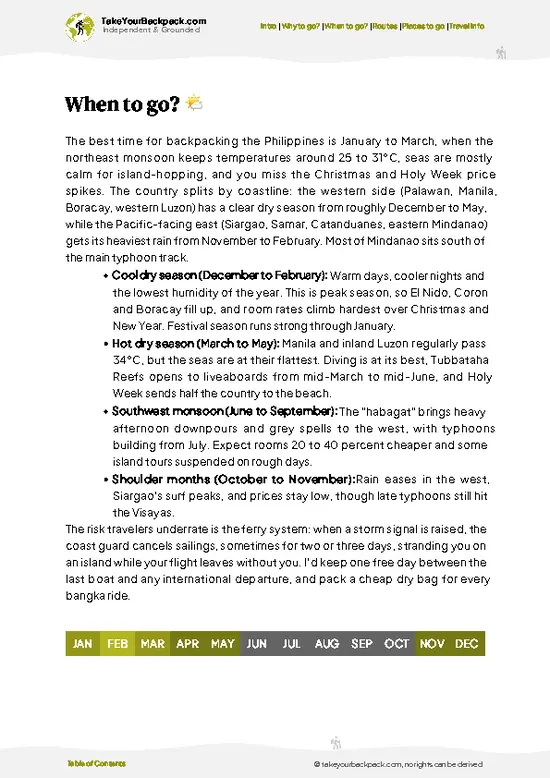
  • Weather: The dry season from November to April is your best bet. Expect minimal rain, making trails and outdoor spots accessible. Avoid May to October when heavy monsoon rains can flood paths and dampen plans.

  • Temperature: Temperatures hover between 25°C to 32°C (77°F to 90°F) year-round. The dry season feels less humid, so it’s more comfortable for hiking and exploring.

  • Daylight Hours: Roughly 11 to 12 hours of daylight year-round, but the dry months offer clearer skies, maximizing your daylight for activities.

  • Crowds: Tourist numbers peak during the dry season, especially around holidays. If you want fewer people, shoulder months like November or April balance weather and crowd size well.

  • Seasonal Activities: Festivals and local events often align with the dry season, adding cultural
read more 👉

  • Weather: The dry season from November to April is your best bet. Expect minimal rain, making trails and outdoor spots accessible. Avoid May to October when heavy monsoon rains can flood paths and dampen plans.

  • Temperature: Temperatures hover between 25°C to 32°C (77°F to 90°F) year-round. The dry season feels less humid, so it’s more comfortable for hiking and exploring.

  • Daylight Hours: Roughly 11 to 12 hours of daylight year-round, but the dry months offer clearer skies, maximizing your daylight for activities.

  • Crowds: Tourist numbers peak during the dry season, especially around holidays. If you want fewer people, shoulder months like November or April balance weather and crowd size well.

  • Seasonal Activities: Festivals and local events often align with the dry season, adding cultural flavor to your trip. Wet months limit outdoor festivities.

  • Price Fluctuations: Accommodation and transport costs rise during peak dry months. Booking early or traveling in shoulder months can save money without sacrificing comfort.


Pro-tip: Aim for late November or early April to hit sweet spots in weather, crowd size, and cost—smart timing turns a good trip into a great one.


source: climatestotravel.comJANJanuary: excellent for travelingFEBFebruary: excellent for travelingMARMarch: excellent for travelingAPRApril: highly recommended for travelingMAYMay: fair for travelingJUNJune: below average for travelingJULJuly: below average for travelingAUGAugust: below average for travelingSEPSeptember: below average for travelingOCTOctober: fair for travelingNOVNovember: highly recommended for travelingDECDecember: excellent for traveling
when-to-go

✈️ The backpacker research shortcutPhilippines Travel Guide

An offline-friendly backpacking guide with optimized travel routes, ranked highlights, transport advice, and the best areas to stay.
example page 0 from our offline Travel Guide for Philippines
example page 1 from our offline Travel Guide for Philippines
example page 2 from our offline Travel Guide for Philippines
example page 3 from our offline Travel Guide for Philippines
example page 4 from our offline Travel Guide for Philippines
example page 5 from our offline Travel Guide for Philippines
example page 6 from our offline Travel Guide for Philippines
example page 7 from our offline Travel Guide for Philippines
The digital guide (505 pages) contains:
144 highlights, ranked by travel appeal
Optimized 7, 14 & 21-day travel routes
Cities, national parks, landmarks, beaches
How to get around
Offline-friendly for travel without Wi-Fi
👉 Click to see all 30+ guide features

📅 Plan smarter in minutes, not weeks
Month by month travel advice
Festivals & national holidays
Budget expectations

🗺️ Go to the right places, skip the overrated ones
Honest pros & cons of destinations
Top hikes, parks & viewpoints
Lesser-known places most travelers miss
Clear “worth it vs skip it” guidance

🛏️ Travel smoothly without rookie mistakes
Best areas to stay
Transport systems explained simply
Common scams & safety advice
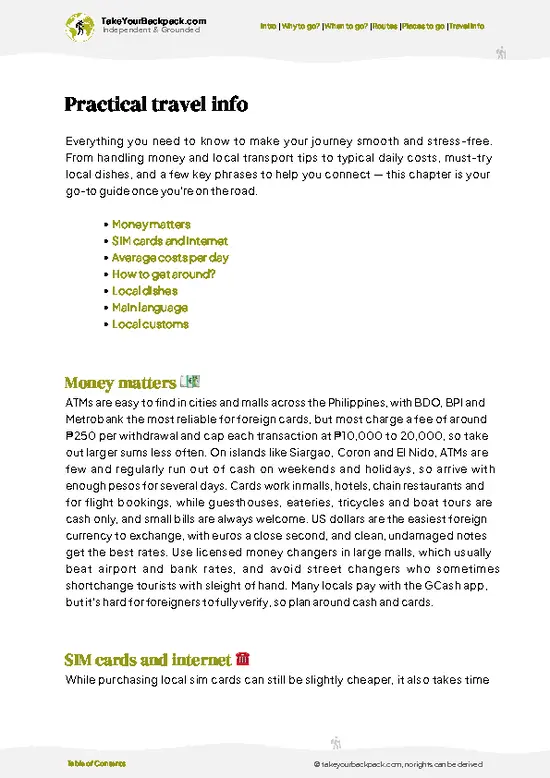
SIM cards, money & practical tips

🌍 Understand the country, not just visit it
Culture & traditions
52 Essential phrases & customs
Festivals worth planning around
Traveler-friendly historical context
Insights that make places more meaningful

📱 Built for real travel conditions
Fully downloadable PDF
Works completely offline
Optimized for phone use
Useful in remote areas & buses
Everything in one place
Save weeks of stressful planning
Get instant access to your full guide. 30‑day money-back guarantee.


By proceeding you agree to our terms.
Sent to your inbox immediately after payment • 100% Secure Checkout
Best Backpacking Travel Advisor 2025 tourism awardBest Backpacking
Travel Advisor
2025
What others say about Take Your Backpack Guides:
⭐⭐⭐⭐⭐
Fantastic, amazing amount of information!
⭐⭐⭐⭐⭐
My goodness this is amazing, it's what I've been looking for hats off too you!
⭐⭐⭐⭐⭐
I think this is absolutely BRILLIANT
⭐⭐⭐⭐
Very complete and informative. It's still missing places, but I gotta to commend you
⭐⭐⭐⭐⭐
This is truly amazing, thank you, can't wait to explore it with my kids!
⭐⭐⭐⭐⭐
Awesome resource, thank you!
⭐⭐⭐⭐⭐
This is amazing! Can't wait to explore the ones I haven't seen
⭐⭐⭐⭐
I love this! Well done, great idea.
⭐⭐⭐⭐⭐
Thanks for taking the time to make this gem!
⭐⭐⭐⭐⭐
This might be the best website I've ever seen.
⭐⭐⭐⭐⭐
Congratulations, and thank you so much for your work; it's incredibly valuable.
⭐⭐⭐⭐
In all seriousness I think you did a great job pointing out the important spots
⭐⭐⭐⭐⭐
10/10 very good
⭐⭐⭐⭐⭐
As someone who's only just starting to visit regularly this is awesome, thank you.
⭐⭐⭐⭐
Thank you very much! I'm going to visit my dad, it's going to be very useful!
⭐⭐⭐⭐⭐
This is really cool! We'll be travelling for the first time and this definitely come in handy.
⭐⭐⭐⭐⭐
You are now our minister of culture, congratulations 👨‍💼
⭐⭐⭐⭐⭐
Just wanted to tell you that this is a pearl! Going to follow your recommendations.
⭐⭐⭐⭐⭐
This is so cool. I'll definitely be using the resource for my travels soon.
⭐⭐⭐⭐⭐
This is very impressive! Good work.
⭐⭐⭐⭐⭐
This is an amazing and informative site. Very well done!

🛏️ Where to stay?Best areas and accommodation options

In Catarman, the sweet spot for backpackers is the downtown area near the public market and the main plaza. This zone nails the balance between safety, social buzz, and budget-friendly options. Hostels cluster here, making it easy to meet fellow travelers without sacrificing your wallet. The vibe is lively but not overwhelming—think local eateries, street vendors, and a steady flow of day-to-day life that invites you in rather than shuts you out. Compared to the quieter, more residential outskirts, downtown offers a practical base with quick access to transport and essentials, turning your stay … read more 👉
In Catarman, the sweet spot for backpackers is the downtown area near the public market and the main plaza. This zone nails the balance between safety, social buzz, and budget-friendly options. Hostels cluster here, making it easy to meet fellow travelers without sacrificing your wallet. The vibe is lively but not overwhelming—think local eateries, street vendors, and a steady flow of day-to-day life that invites you in rather than shuts you out. Compared to the quieter, more residential outskirts, downtown offers a practical base with quick access to transport and essentials, turning your stay into a smooth, connected experience rather than a logistical headache.

🚌 Getting aroundHow to get around Catarman

Catarman moves at its own rhythm—neither a frantic rush nor a laid-back drift. It’s a city where schedules exist but bend to the local pulse, a blend of predictable routes and spontaneous detours. You’ll find that time here is a flexible currency, traded between the clock and the crowd’s mood. Understanding this flow means you’re not just getting from A to B; you’re mastering the city’s tempo, turning transit into a strategic play rather than a chore.


  • Walking: The most reliable and free option, perfect for short distances downtown. It’s slow but lets you absorb the city’s texture and avoid waiting on any schedule.

  • Tricycles: These motorized three-wheelers run from early morning until late evening, costing around 10-20 PHP per short ride. They’re quick through traffic but can get cramped
read more 👉
Catarman moves at its own rhythm—neither a frantic rush nor a laid-back drift. It’s a city where schedules exist but bend to the local pulse, a blend of predictable routes and spontaneous detours. You’ll find that time here is a flexible currency, traded between the clock and the crowd’s mood. Understanding this flow means you’re not just getting from A to B; you’re mastering the city’s tempo, turning transit into a strategic play rather than a chore.


  • Walking: The most reliable and free option, perfect for short distances downtown. It’s slow but lets you absorb the city’s texture and avoid waiting on any schedule.

  • Tricycles: These motorized three-wheelers run from early morning until late evening, costing around 10-20 PHP per short ride. They’re quick through traffic but can get cramped and noisy.

  • Jeepneys: The backbone of local transit, operating roughly from 5 AM to 9 PM. Fares hover around 8-15 PHP depending on distance. They’re cheap and frequent but often packed, so comfort is minimal.

  • Motorcycle Taxis (Habal-Habal): Available 24/7, these are the fastest way to navigate narrow or off-route areas. Expect to pay 20-50 PHP. They sacrifice comfort and safety for speed and access.

  • Public Vans (V-Hire): For longer trips out of Catarman, these run on fixed schedules, usually early morning and late afternoon, with fares around 100-150 PHP. They balance speed and comfort but require planning.

👛 Costs (as of 17 October 2025)Travel costs and budget guide for Catarman

Backpacking in Catarman, Philippines, is a study in balancing modest costs with the occasional splurge for comfort or convenience. Here’s how the daily expenses typically stack up for an independent traveler navigating this laid-back city.
  • Dorm Accommodation (High Season): Expect to pay around $8 to $12 per night. High season drives prices up slightly, especially near the town center or popular spots.
  • Dorm Accommodation (Off-Season): Prices drop to about $5 to $8. Fewer tourists mean better deals, but options might be more limited.
  • Meals: Street food and local eateries keep costs low, roughly $2 to $5 per meal. A full day of eating well without fuss usually runs $6 to $12.
  • Local Transport: Jeepneys and tricycles dominate, with fares typically between $0.15 and $0.50 per ride. Budget around
read more 👉
Backpacking in Catarman, Philippines, is a study in balancing modest costs with the occasional splurge for comfort or convenience. Here’s how the daily expenses typically stack up for an independent traveler navigating this laid-back city.
  • Dorm Accommodation (High Season): Expect to pay around $8 to $12 per night. High season drives prices up slightly, especially near the town center or popular spots.
  • Dorm Accommodation (Off-Season): Prices drop to about $5 to $8. Fewer tourists mean better deals, but options might be more limited.
  • Meals: Street food and local eateries keep costs low, roughly $2 to $5 per meal. A full day of eating well without fuss usually runs $6 to $12.
  • Local Transport: Jeepneys and tricycles dominate, with fares typically between $0.15 and $0.50 per ride. Budget around $1 to $2 daily if you’re hopping around frequently.
  • City Transport Pass: Not commonly used here; most travelers rely on single-ride fares. If available, a pass might cost around $3 to $5 but isn’t essential.
  • Basic Activities/Entry Fees: Many natural and cultural sites charge minimal fees, usually $1 to $3. Budget $3 to $6 daily if you’re visiting a couple of spots.
  • Miscellaneous Expenses: Think bottled water, snacks, occasional coffee, or small tips—around $1 to $3 per day.

All told, a realistic daily budget for backpacking in Catarman ranges from about $15 on a shoestring to $30 if you lean into a bit more comfort or activity. The trick is knowing when to save and when to spend: a cheap dorm and street food keep you nimble, while a few paid activities or a tricycle ride can add memorable layers without breaking the bank.
⚠️ Prices can change and everyone travels differently, so take this as a rough guide. Hope it helps you plan your adventure!

🚌 Day tripsShort trips worth adding

Catarman serves as an excellent launchpad for exploring the natural beauty and cultural richness of the Philippines. Here are some day trips that pack a punch without draining your wallet.

**Mount Pulag Adventure**
A trek to Mount Pulag, the country’s second-highest peak, is a must. The journey takes about 2.5 hours by bus, and the hike rewards you with breathtaking views of the sea of clouds at sunrise. Expect to spend around $10 for transportation and a small fee for the park. The best time to visit is between November and February when the weather is cooler. First-timers often underestimate the cold at the summit, so pack layers.


**Kalanggaman Island Getaway**
Kalanggaman Island is famous for its long, white sandbars. It’s a 3-hour trip by van and boat, but the pristine waters … read more 👉
Catarman serves as an excellent launchpad for exploring the natural beauty and cultural richness of the Philippines. Here are some day trips that pack a punch without draining your wallet.

**Mount Pulag Adventure**
A trek to Mount Pulag, the country’s second-highest peak, is a must. The journey takes about 2.5 hours by bus, and the hike rewards you with breathtaking views of the sea of clouds at sunrise. Expect to spend around $10 for transportation and a small fee for the park. The best time to visit is between November and February when the weather is cooler. First-timers often underestimate the cold at the summit, so pack layers.


**Kalanggaman Island Getaway**
Kalanggaman Island is famous for its long, white sandbars. It’s a 3-hour trip by van and boat, but the pristine waters make it worthwhile. Budget around $15 for transport and entrance fees. The ideal time to visit is during the dry season, from November to May. A common mistake is not bringing enough water and snacks, as amenities are limited.
👉 Explore Kalanggaman Island

**Biri Island Rock Formations**
A trip to Biri Island offers stunning rock formations sculpted by the sea. It takes about 1.5 hours to reach the ferry terminal and another 30 minutes by boat. Expect to spend around $20 for the round trip. The best time to go is during the dry season for clearer views. Many first-timers miss the tidal schedule, so check ahead to avoid disappointment.
Want to know what more Philippines offers?
The Philippines Travel Guide describes 144 highlights, from cities to national parks, from beaches to hikes

Get the Travel Guide -

🍲 FoodLocal Flavors for Backpackers

In Catarman, the **local cuisine** is a feast for the senses. Dive into **tinola**, a comforting chicken soup with ginger and leafy greens, or savor **laing**, a spicy dish made from dried taro leaves simmered in coconut milk. Street food stalls are your best bet for **kwek-kwek**, quail eggs coated in orange batter, served with a tangy vinegar dip.

The **drinking culture** is equally vibrant. Locals often gather at casual bars for **tuba**, a fermented coconut drink that packs a punch. When dining, expect a communal vibe; sharing is the norm, and it’s polite to offer food to others. Embrace the **lively atmosphere**—it’s all part of the experience!

🛡️ SafetyScams, Hazards, and Annoyances

Catarman is generally safe, but like any place, a little awareness goes a long way. Stick to well-lit areas at night, especially if you’re solo. The local market can be bustling, so keep your belongings close; pickpockets are rare but not unheard of.

Watch for overly friendly locals offering unsolicited help—sometimes it leads to a request for payment. Trust your instincts; if something feels off, it probably is. Carry yourself confidently, and you’ll blend in just fine. Enjoy the experience; it’s all part of the adventure!

Other Filipino cities near Catarman

Explore more nearby:

  • Catbalogan—harbor town, Samar gateway, seafood stalls| 71 km away
  • Sorsogon City—whale shark tours, hot springs, mangrove forests| 92 km away
  • Masbate City—rodeo festival, gold mining, island ferries| 117 km away

💡 Not sure where to go next?
Create a personalized itinerary for Philippines including Catarman and the places that fit your trip.

Generate my itinerary

👉 Discover all cities

Or checkout all Philippines has to offer (think cities, towns, villages, national parks, hikes, beaches, festivals)
Country photo of Philippines

We 💚 feedbackWhat to keep in mind

Catarman is a gateway to stunning natural wonders, like the nearby Kalanggaman Island. You’ll find pristine beaches and a laid-back vibe that’s hard to resist. Just be ready for limited amenities; it’s not the place for luxury, but that’s part of its charm.

✈️ When did I visit Philippines?
Philippines being one of my favorites, due to the people and their mentality. I visited it first in 2010 and came back in January 2016 as part of my 1.5 year world trip.

✍️ Help improve this page!
The information on this page is based on my own backpacking experience in Philippines, supplemented with up-to-date research and feedback from other travelers. Travel details can change, so if you notice anything outdated or incomplete, feel free to let me know.


🙋‍♂️ Give feedback

👋 Meet the founderWho’s Behind Take Your Backpack?

Johan, backpacker and founder of TakeYourBackpackHi, I’m Johan (Netherlands 🇳🇱), the creator of TakeYourBackpack. Over the past decade, I’ve backpacked through 80+ countries across six continents, gaining extensive experience with independent travel, long-term trips, and overland routes.

This site is built on a combination of firsthand travel experience and carefully curated insights from other backpackers. Many guides are based on places I’ve personally visited, while others bring together tips, observations, and practical advice shared by trusted travelers I’ve met along the way.

The goal is to provide realistic, experience-driven guidance — not generic itineraries — so you can explore destinations with better context, clearer expectations, and more confidence.

Get full country guide •
Instant download • 144 highlights • Full Offline guide