×

Puerto Rico🇵🇷 | attractionsParque de las Cavernas del Río CamuyCueva Clara, tram descent, Tres Pueblos sinkhole, underground river | things to do and best time to go

Explore Arecibo C3 Science and Visitor CenterExplore Centro de Bellas Artes Luis A. Ferré

Backpacking in Parque de las Cavernas del Río Camuy
🌟 Highlightattraction ranked #4
By Johan Kruseman 🇳🇱 | Updated October 23, 2026

Most people come for Cueva Clara, a lit-up limestone cave of stalactites and a tram ride down into a sinkhole, and it is the part worth your morning. What gets overlooked is the setting: a green karst landscape of mogotes and sinkholes that feels nothing like the beaches an hour north. The park sits in the northwest of Puerto Rico, inland from the town of Camuy, and you need a car to reach it. Book a timed slot ahead, because walk-ups often find the day sold out. Go for the first tour of the day, when the guides are fresh and the groups are small. The Tres Pueblos sinkhole and Spiral Sinkhole are quick stops you can skip if you are short on time. Compared with nearby Cueva Ventana, which gives you a hillside window onto the valley, Camuy is the bigger, more polished, more guided experience, with a proper tram, paved paths and a real cave to walk through.

Discover everything you want to know in the 📖 Puerto Rico Travel Guide.


example page 0 from our offline Travel Guide for Puerto Rico
example page 1 from our offline Travel Guide for Puerto Rico
example page 2 from our offline Travel Guide for Puerto Rico
example page 3 from our offline Travel Guide for Puerto Rico
example page 4 from our offline Travel Guide for Puerto Rico
example page 5 from our offline Travel Guide for Puerto Rico
example page 6 from our offline Travel Guide for Puerto Rico
example page 7 from our offline Travel Guide for Puerto Rico
Loading the map 🌍
CLICK TO FILTER
cities
towns
villages
landmarks
national parks
hikes
beaches
attractions
festivals
regions
SHOW COUNTRY’S BESTSHOW ALL

✨ Why go?
Ranked #4 attraction in Puerto Rico
What sets this place apart

Parque de las Cavernas del Río Camuy holds one of the largest cave systems in the Western Hemisphere, and walking into it is the clearest way to see what lies under Puerto Rico's green hills. The Camuy River has carved more than 10 miles (16 km) of mapped caverns here, with chambers big enough to swallow a house. You descend by tram, then on foot, past Cueva Clara, where stalactites and curtains of rock hang in lit passages and bats stir overhead. The cave stays cool and damp, a welcome change on a hot island day.
The second reason is the landscape above ground. This is karst country, pocked with sinkholes and steep hills, and the drive in shows you a rural interior most beach-focused travelers never see. If you are crossing the island between the north coast and the west, the park fits neatly … read more 👉
Parque de las Cavernas del Río Camuy holds one of the largest cave systems in the Western Hemisphere, and walking into it is the clearest way to see what lies under Puerto Rico's green hills. The Camuy River has carved more than 10 miles (16 km) of mapped caverns here, with chambers big enough to swallow a house. You descend by tram, then on foot, past Cueva Clara, where stalactites and curtains of rock hang in lit passages and bats stir overhead. The cave stays cool and damp, a welcome change on a hot island day.
The second reason is the landscape above ground. This is karst country, pocked with sinkholes and steep hills, and the drive in shows you a rural interior most beach-focused travelers never see. If you are crossing the island between the north coast and the west, the park fits neatly into a half-day detour, and the guided format means you need no caving experience, no gear and no special fitness. It is an easy win for first-timers and a good break for veterans tired of hiking.

💡 HighlightsWhat this place is best known for

  1. Cueva Clara: the main event. A guided walk through a lit cave of stalactites, stalagmites and flowstone, with bats overhead and the air noticeably cooler and wetter than outside.
  2. The tram ride down: an open-air trolley carries you from the visitor area through dense forest to the cave entrance, with bamboo and tree ferns pressing close along the way.
  3. Tres Pueblos Sinkhole: a huge collapsed hole, about 185 meters (600 feet) long and 125 meters (410 feet) deep, where you look down from a platform to the Camuy River far below. The name refers to the three towns whose borders meet nearby.
  4. Spiral Sinkhole: a deep, round pit with a viewing deck, where you can see the river flowing into the cave system below. It is a quick stop, but a dramatic one.
  5. The Camuy River: you can hear it rushing in the cave
… read more 👉
  1. Cueva Clara: the main event. A guided walk through a lit cave of stalactites, stalagmites and flowstone, with bats overhead and the air noticeably cooler and wetter than outside.
  2. The tram ride down: an open-air trolley carries you from the visitor area through dense forest to the cave entrance, with bamboo and tree ferns pressing close along the way.
  3. Tres Pueblos Sinkhole: a huge collapsed hole, about 185 meters (600 feet) long and 125 meters (410 feet) deep, where you look down from a platform to the Camuy River far below. The name refers to the three towns whose borders meet nearby.
  4. Spiral Sinkhole: a deep, round pit with a viewing deck, where you can see the river flowing into the cave system below. It is a quick stop, but a dramatic one.
  5. The Camuy River: you can hear it rushing in the cave and see how it drops underground, which makes the scale of the karst system real.
  6. The cave guides: bilingual guides explain how limestone dissolves into chambers and point out the small details you would walk past, such as cave life and rock formations.
  7. Forest trails around the visitor area: short, shaded paths with tropical trees and birdsong, good for a pause before or after your tour.
Cueva Clara and the Tres Pueblos Sinkhole combine well in one morning, since both sit along the same tram route and take about half a day together.
Spotted a mistake or missing something? Contact us.

🌤️ When to go?Best time to visit Parque de las Cavernas del Río Camuy

  • Dry Season (December to April): Rain is least likely, so cave tours run on schedule and the trails stay firmer underfoot. Highs reach 28 to 30°C (82 to 86°F), lows 19 to 21°C (66 to 70°F). Holiday weeks and weekends fill tour slots early.
  • Shoulder Months (May to June, November): Showers arrive mostly in the afternoon, so morning visits stay dry. Temperatures run 29 to 31°C (84 to 88°F) with lighter crowds.
  • Wet Season (July to October): Heavy downpours and hurricane risk can close the park without notice. Highs of 30 to 33°C (86 to 91°F) feel sticky, though the forest around the sinkholes turns its deepest green.
  • Daylight: Roughly 11 hours in December and 13 in June. Tours run in the daytime only, and the cave interior stays near 22°C (72°F) all year.
Book the first tour slot of the day on a weekday, … read more 👉
  • Dry Season (December to April): Rain is least likely, so cave tours run on schedule and the trails stay firmer underfoot. Highs reach 28 to 30°C (82 to 86°F), lows 19 to 21°C (66 to 70°F). Holiday weeks and weekends fill tour slots early.
  • Shoulder Months (May to June, November): Showers arrive mostly in the afternoon, so morning visits stay dry. Temperatures run 29 to 31°C (84 to 88°F) with lighter crowds.
  • Wet Season (July to October): Heavy downpours and hurricane risk can close the park without notice. Highs of 30 to 33°C (86 to 91°F) feel sticky, though the forest around the sinkholes turns its deepest green.
  • Daylight: Roughly 11 hours in December and 13 in June. Tours run in the daytime only, and the cave interior stays near 22°C (72°F) all year.
Book the first tour slot of the day on a weekday, whatever the month, and check that the park is open before you go.


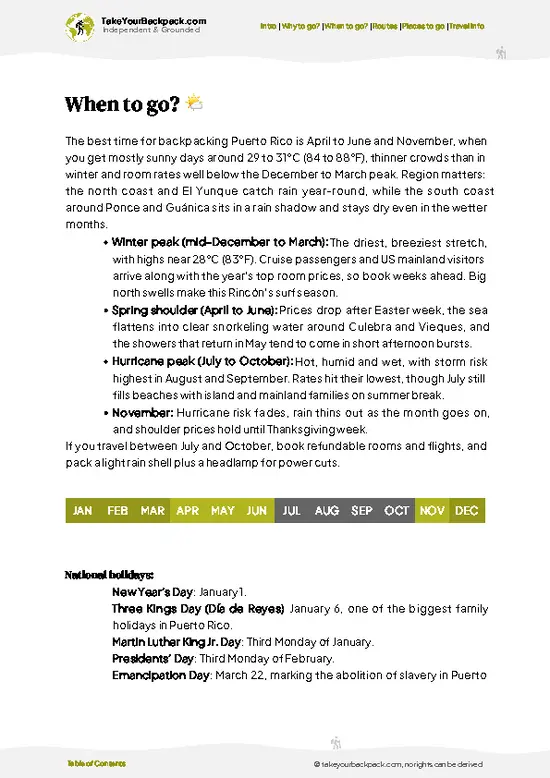
source: climatestotravel.comJANJanuary: excellent for travelingFEBFebruary: excellent for travelingMARMarch: excellent for travelingAPRApril: highly recommended for travelingMAYMay: fair for travelingJUNJune: fair for travelingJULJuly: good for travelingAUGAugust: good for travelingSEPSeptember: fair for travelingOCTOctober: fair for travelingNOVNovember: highly recommended for travelingDECDecember: excellent for traveling
when-to-go

✈️ The backpacker research shortcutPuerto Rico Travel Guide

An offline-friendly backpacking guide with optimized travel routes, ranked highlights, transport advice, and the best areas to stay.
example page 0 from our offline Travel Guide for Puerto Rico
example page 1 from our offline Travel Guide for Puerto Rico
example page 2 from our offline Travel Guide for Puerto Rico
example page 3 from our offline Travel Guide for Puerto Rico
example page 4 from our offline Travel Guide for Puerto Rico
example page 5 from our offline Travel Guide for Puerto Rico
example page 6 from our offline Travel Guide for Puerto Rico
example page 7 from our offline Travel Guide for Puerto Rico
The digital guide (310 pages) contains:
✅ 81 highlights, ranked by travel appeal
✅ Optimized 5, 10 & 15-day travel routes
✅ Cities, national parks, landmarks, beaches
✅ How to get around
✅ Offline-friendly for travel without Wi-Fi
👉 Click to see all 30+ guide features

📅 Plan smarter in minutes, not weeks
✅ Month by month travel advice
✅ Festivals & national holidays
✅ Budget expectations

🗺️ Go to the right places, skip the overrated ones
✅ Honest pros & cons of destinations
✅ Top hikes, parks & viewpoints
✅ Lesser-known places most travelers miss
✅ Clear “worth it vs skip it” guidance

🛏️ Travel smoothly without rookie mistakes
✅ Best areas to stay
✅ Transport systems explained simply
✅ Common scams & safety advice
✅ SIM cards, money & practical tips

🌍 Understand the country, not just visit it
✅ Culture & traditions
✅ 52 Essential phrases & customs
✅ Festivals worth planning around
✅ Traveler-friendly historical context
✅ Insights that make places more meaningful

📱 Built for real travel conditions
✅ Fully downloadable PDF
✅ Works completely offline
✅ Optimized for phone use
✅ Useful in remote areas & buses
✅ Everything in one place
Stop searching, start planning
Get instant access to your full guide. 30‑day money-back guarantee.
+ Add another guide for just

By proceeding you agree to our terms.
Sent to your inbox immediately after payment • 100% Secure Checkout
Best Backpacking Travel Advisor 2025 tourism awardBest Backpacking
Travel Advisor
2025
What others say about Take Your Backpack Guides:
⭐⭐⭐⭐⭐
Fantastic, amazing amount of information!
⭐⭐⭐⭐⭐
My goodness this is amazing, it's what I've been looking for hats off too you!
⭐⭐⭐⭐⭐
I think this is absolutely BRILLIANT
⭐⭐⭐⭐
Very complete and informative. It's still missing places, but I gotta to commend you
⭐⭐⭐⭐⭐
This is truly amazing, thank you, can't wait to explore it with my kids!
⭐⭐⭐⭐⭐
Awesome resource, thank you!
⭐⭐⭐⭐⭐
This is amazing! Can't wait to explore the ones I haven't seen
⭐⭐⭐⭐
I love this! Well done, great idea.
⭐⭐⭐⭐⭐
Thanks for taking the time to make this gem!
⭐⭐⭐⭐⭐
This might be the best website I've ever seen.
⭐⭐⭐⭐⭐
Congratulations, and thank you so much for your work; it's incredibly valuable.
⭐⭐⭐⭐
In all seriousness I think you did a great job pointing out the important spots
⭐⭐⭐⭐⭐
10/10 very good
⭐⭐⭐⭐⭐
As someone who's only just starting to visit regularly this is awesome, thank you.
⭐⭐⭐⭐
Thank you very much! I'm going to visit my dad, it's going to be very useful!
⭐⭐⭐⭐⭐
This is really cool! We'll be travelling for the first time and this definitely come in handy.
⭐⭐⭐⭐⭐
You are now our minister of culture, congratulations 👨‍💼
⭐⭐⭐⭐⭐
Just wanted to tell you that this is a pearl! Going to follow your recommendations.
⭐⭐⭐⭐⭐
This is so cool. I'll definitely be using the resource for my travels soon.
⭐⭐⭐⭐⭐
This is very impressive! Good work.
⭐⭐⭐⭐⭐
This is an amazing and informative site. Very well done!

🛏️ Where to stay?How to pick the right area

Arecibo is the most practical base for backpackers, about 25 to 35 minutes by car from the park, with the most hostel and guesthouse beds in the area plus restaurants, a waterfront boardwalk and the Observatory region close by. Lodging runs about US$30 to 70 a night, and the center feels safe in daylight. Quebradillas, roughly 20 minutes away, is a quiet surf town with small guesthouses and a cluster of beach bars. Solo travelers meet others there easily, and the town sits on the north coast road between the cave park and the beaches. Isabela, around 40 minutes west, is the social pick. Surf schools, … read more 👉
Arecibo is the most practical base for backpackers, about 25 to 35 minutes by car from the park, with the most hostel and guesthouse beds in the area plus restaurants, a waterfront boardwalk and the Observatory region close by. Lodging runs about US$30 to 70 a night, and the center feels safe in daylight. Quebradillas, roughly 20 minutes away, is a quiet surf town with small guesthouses and a cluster of beach bars. Solo travelers meet others there easily, and the town sits on the north coast road between the cave park and the beaches. Isabela, around 40 minutes west, is the social pick. Surf schools, beach hostels and cheap taco spots draw a steady crowd of budget travelers, and Jobos Beach is lively after dark. Prices there are slightly higher, about US$35 to 80 for a dorm or simple private room. Camuy town itself has few beds, so most people sleep elsewhere and drive in. Public transit is thin, so choose a place where you can split a rental car with other travelers and reach the park by opening time.

👛 Costs (as of 23 October 2026)What things cost and how to budget

A day at Parque de las Cavernas del Río Camuy costs about US$115 for a backpacker with a shared rental car, including entry, food and lodging.
CategoryBudget RangeLocal Reality
Park EntryUS$18 to 20Adults pay for the cave tram tour. Online booking is recommended since slots are limited and sell out.
ParkingUS$0 to 5Check at the gate, as parking is sometimes included.
Accommodation (high season)US$35 to 70Dorm or basic room in Arecibo, Quebradillas or Isabela.
Accommodation (low season)US$30 to 55Slightly cheaper from May to October.
TransportUS$25 to 40Share a rental car and fuel. Few buses reach the park, and taxis or rideshares from Arecibo cost more.
FoodUS$12 to 25Roadside kiosks and bakeries sell sandwiches and fried snacks. The park cafeteria costs more.
ExtrasUS$0 to 10Snacks, water and small
… read more 👉
A day at Parque de las Cavernas del Río Camuy costs about US$115 for a backpacker with a shared rental car, including entry, food and lodging.
CategoryBudget RangeLocal Reality
Park EntryUS$18 to 20Adults pay for the cave tram tour. Online booking is recommended since slots are limited and sell out.
ParkingUS$0 to 5Check at the gate, as parking is sometimes included.
Accommodation (high season)US$35 to 70Dorm or basic room in Arecibo, Quebradillas or Isabela.
Accommodation (low season)US$30 to 55Slightly cheaper from May to October.
TransportUS$25 to 40Share a rental car and fuel. Few buses reach the park, and taxis or rideshares from Arecibo cost more.
FoodUS$12 to 25Roadside kiosks and bakeries sell sandwiches and fried snacks. The park cafeteria costs more.
ExtrasUS$0 to 10Snacks, water and small souvenirs. Cash is useful for roadside stands.
Total Daily BudgetUS$115Uses the high-season lodging row and mid-range figures.


source: descubrapuertorico.com
⚠️ Prices can change and everyone travels differently, so take this as a rough guide. Hope it helps you plan your adventure!

FAQTraveler FAQ

Plan on 3 to 4 hours at Parque de las Cavernas del Río Camuy. The guided tour of Cueva Clara takes about 45 minutes to an hour, and you can add the Tres Pueblos and Spiral sinkholes. Arriving at opening time on a weekday gives you the shortest waits.
Parque de las Cavernas del Río Camuy is worth the entrance fee of roughly US$18 to 20 if you like caves and rainforest. You ride a tram down into the forest, then walk through Cueva Clara with its stalactites and bats, and the sinkhole viewpoints are included. Combined with Arecibo or Isabela nearby, it fills a half day cheaply.
Driving is the simplest way to reach Parque de las Cavernas del Río Camuy, about 1.5 to 2 hours from San Juan along Route 22 and then PR-129. The drive from Arecibo takes roughly 30 minutes. Few buses go close, so most backpackers rent a car or split a rideshare or taxi from Arecibo or Quebradillas.
⚠️ Things can change over time, so always validate details locally before you go.

Other Puerto Rican attractions near Parque de las Cavernas del Río Camuy

Explore more nearby:


💡 Not sure where to go next?
Create a personalized itinerary for Puerto Rico including Parque de las Cavernas del Río Camuy and the places that fit your trip.

Generate my itinerary

👉 Discover all attractions

Or checkout all Puerto Rico has to offer (think cities, towns, villages, national parks, hikes, beaches, festivals)
Country photo of Puerto Rico

We 💚 feedbackWhat to keep in mind

Parque de las Cavernas del Río Camuy is best on a weekday morning, ideally on the first tour slot, when the forest is cool and the cave is nearly quiet. Bring a light rain layer and shoes with grip, since the cave floor stays wet. I would skip weekends and school holidays, when the lines slow everything down.

✍️ Help improve this page!
The information on this page is based on in-depth research, insights shared by experienced travelers, and feedback from the local travel community in Puerto Rico. While every effort is made to keep the information accurate and current, conditions can change — so if you spot anything incorrect or outdated, please get in touch.


🙋‍♂️ Give feedback

👋 Meet the founderWho’s Behind Take Your Backpack?

Johan, backpacker and founder of TakeYourBackpackHi, I’m Johan (Netherlands 🇳🇱), the creator of TakeYourBackpack. Over the past 3 decades, I’ve backpacked through 90+ countries across six continents, gaining extensive experience with independent travel, long-term trips, and overland routes.

This site is built on a combination of firsthand travel experience and carefully curated insights from other backpackers. Many guides are based on places I’ve personally visited, while others bring together tips, observations, and practical advice shared by trusted travelers I’ve met along the way.

The goal is to provide realistic, experience-driven guidance — not generic itineraries — so you can explore destinations with better context, clearer expectations, and more confidence.