×

Puerto Rico🇵🇷 | best attractionsExplore the 10 Best attractions in Puerto Rico

Attractions in Puerto Rico come in clusters, and each cluster has its own rhythm. The San Juan side is dense, walkable and busy when cruise ships dock (usually mornings), so go late afternoon and the stone streets cool off and empty out. The east and the islands are all about beaches and reserves, where you may need to book entry ahead. The interior mountains and the southwest are quieter, cheaper and slower, but a rental car makes them far easier. For backpackers and independent travelers, that mix means big variety in a small package, with costs ranging from free coastal stretches to timed-entry fees.

By Johan Kruseman 🇳🇱 | Updated October 23, 2026
Explore the best festivals in Puerto Rico

Why go?What Makes Them Special

Puerto Rico packs an unusual range into an island about 160 km (100 miles) long. It is a U.S. territory with Spanish colonial roots, so you get 500 years of layered history, Taíno heritage and Afro-Caribbean culture, all on roads, signage and infrastructure that feel familiar to American travelers. No passport is needed for U.S. citizens, the dollar is the currency, and phones usually work without roaming fees for many U.S. carriers.

Geography does the rest. A central mountain spine (the Cordillera Central) sits just an hour or two from beaches on both coasts, so rainforest, dry forest, caves and coral reefs can all share one trip. The tropical climate keeps everything open year-round, though afternoon showers are routine in the mountains.

Before choosing the island, know a few things. Public … read more 👉
Puerto Rico packs an unusual range into an island about 160 km (100 miles) long. It is a U.S. territory with Spanish colonial roots, so you get 500 years of layered history, Taíno heritage and Afro-Caribbean culture, all on roads, signage and infrastructure that feel familiar to American travelers. No passport is needed for U.S. citizens, the dollar is the currency, and phones usually work without roaming fees for many U.S. carriers.

Geography does the rest. A central mountain spine (the Cordillera Central) sits just an hour or two from beaches on both coasts, so rainforest, dry forest, caves and coral reefs can all share one trip. The tropical climate keeps everything open year-round, though afternoon showers are routine in the mountains.

Before choosing the island, know a few things. Public transportation is limited outside the San Juan metro, and most attractions are best reached by car. Several popular sites now use timed tickets or reservations, so spots can sell out days ahead in busy periods. Hurricanes and past earthquakes have left some places with rough roads or partial closures, so check current status before you go. Spanish is the everyday language, and a few words go a long way with locals.
Our Approach to Ranking
The list of best attractions in Puerto Rico is created based on cultural significance or entertainment value. If you feel a attraction is missing in this list, please let us know.

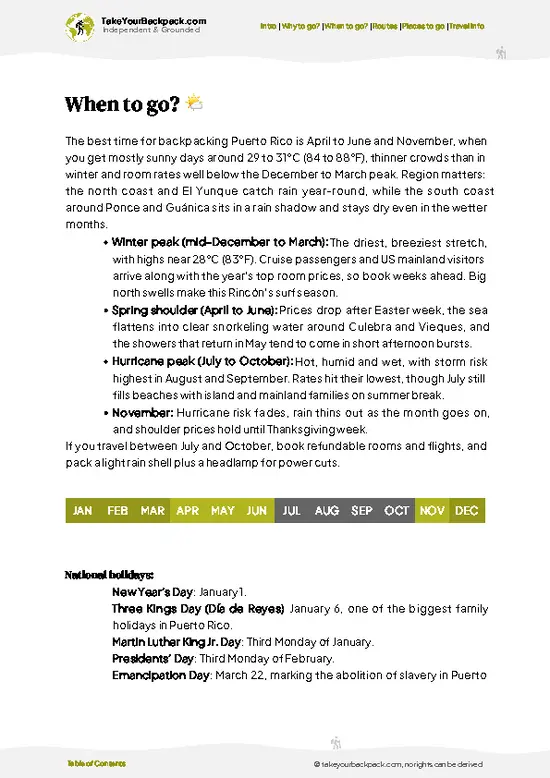
When to go?Seasonal Guide to Visiting

Best months and weather: The best months for attractions in Puerto Rico are April to early June and November, when it is warm, crowds thin out after winter and rainfall is lower than in late summer. Temperatures sit around 27 to 31°C (80 to 88°F) at the coast almost all year, and the mountains run roughly 5 to 8°C cooler.
Peak season: December to March is the driest stretch and the busiest. Hotels and rental cars can cost 30 to 60 percent more, especially around Christmas and Presidents’ Day weekend, and popular reservation sites fill up early. Book transport and entry slots a few weeks ahead if you travel then.
Shoulder and low season: From mid-June to October, it is hotter and more humid, with temperatures often feeling like 35°C (95°F) or more. This is also hurricane season, with the highest … read more 👉
Best months and weather: The best months for attractions in Puerto Rico are April to early June and November, when it is warm, crowds thin out after winter and rainfall is lower than in late summer. Temperatures sit around 27 to 31°C (80 to 88°F) at the coast almost all year, and the mountains run roughly 5 to 8°C cooler.
Peak season: December to March is the driest stretch and the busiest. Hotels and rental cars can cost 30 to 60 percent more, especially around Christmas and Presidents’ Day weekend, and popular reservation sites fill up early. Book transport and entry slots a few weeks ahead if you travel then.
Shoulder and low season: From mid-June to October, it is hotter and more humid, with temperatures often feeling like 35°C (95°F) or more. This is also hurricane season, with the highest risk from August through September. Prices drop, but a storm can close parks and cancel flights, so flexible bookings matter.
Regional differences: The north and east, including the rainforest, get the most rain, often 200 cm (80 inches) a year or more in the mountains. The southwest around Guánica and Cabo Rojo is much drier and sunnier. Mountain mornings are clearer, with rain building after about 2 p.m., so start early.

attraction hoppingSuggested Travel Strategies

How many days to plan: A trip linking several attractions in Puerto Rico needs 7 to 10 days, and 5 days works if you stick to two regions. The island is small, but mountain roads are slow and distances are deceiving.
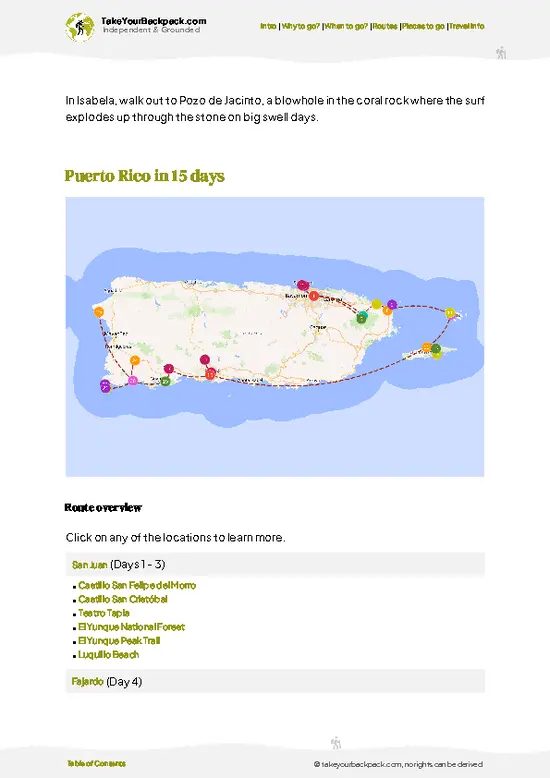
Grouping the regions: Start in the San Juan area (the main airport hub, SJU) and spend 2 to 3 days there. Then head east toward the rainforest and Fajardo, which is 45 to 90 minutes from the capital, and spend 2 to 3 days. From there, loop south and west through Ponce and the southwest, a 2 to 3 hour drive, giving it 2 to 3 days. Finish with the mountain interior or the north coast on the way back, 2 to 3 hours to San Juan. Moving in one loop avoids doubling back.
Getting around: A rental car is the practical choice outside San Juan. Taxis and ride shares work in the metro, and … read more 👉
How many days to plan: A trip linking several attractions in Puerto Rico needs 7 to 10 days, and 5 days works if you stick to two regions. The island is small, but mountain roads are slow and distances are deceiving.
Grouping the regions: Start in the San Juan area (the main airport hub, SJU) and spend 2 to 3 days there. Then head east toward the rainforest and Fajardo, which is 45 to 90 minutes from the capital, and spend 2 to 3 days. From there, loop south and west through Ponce and the southwest, a 2 to 3 hour drive, giving it 2 to 3 days. Finish with the mountain interior or the north coast on the way back, 2 to 3 hours to San Juan. Moving in one loop avoids doubling back.
Getting around: A rental car is the practical choice outside San Juan. Taxis and ride shares work in the metro, and public vans (públicos) connect towns but run on loose schedules. Budget 1.5 to 3 hours for what looks like a 50 km drive in the hills.
Common planning mistakes: Travelers often cram two regions into one day, then arrive after sites close, typically between 3 and 5 p.m. Plan one main stop per day plus a short one. Others book lodging far from the next stop. Sleep near the next morning’s destination instead. Many forget that reservations lock in times, so build the schedule around them first and fill the gaps afterward.

The ListTop attractions of Puerto Rico

1 Castillo San Felipe del Morro

Six-level fortress, gun decks, lighthouse, kite lawn

Follow stone ramps up to seaward cannons and a pale lighthouse, then drop to the open lawn where locals fly kites.

puerto-rico-attraction-castillo-san-felipe-del-morro
© Google |

2 Castillo San Cristóbal

Cannon decks, tunnel network, dry moats, garita

Climb through layered walls, dim underground passages and ditches to a sentry box perched above the Atlantic, spread across roughly 27 acres.

puerto-rico-attraction-castillo-san-cristobal
© Google |

3 Arecibo C3 Science and Visitor Center

Empty dish overlook, 2020 collapse story, 1974 message to M13, karst bowl

Look across the sinkhole bowl where a 305-meter reflector once hung, then trace the collapse, the pulsar discoveries and the coded message sent skyward.

4 Parque de las Cavernas del Río Camuy

Cueva Clara, tram descent, Tres Pueblos sinkhole, underground river

Ride down through dense forest into a lit limestone cave, then peer into sinkholes where the Camuy River disappears underground.

5 Casa Bacardí Rum Distillery

Bat logo, barrel aging, cocktail workshop, rum flights

Ride the tram through a working distillery, then mix your own mojito and compare white, gold and aged rums side by side.

6 Museo de Arte de Puerto Rico

Oller canvases, Campeche altarpieces, sculpture garden, glass atrium

Work through four centuries of island painting, from colonial altarpieces to bold contemporary canvases, and end among sculptures in a shaded garden.

puerto-rico-attraction-museo-de-arte-de-puerto-rico
© Google |

7 Museo de las Américas

Santos de palo, Ballajá barracks, Taíno artifacts, arcaded courtyard

Study hand-carved wooden saints and craft traditions from Indigenous, African and Latin American roots inside a 19th-century military barracks.

8 Museo de Arte Contemporáneo de Puerto Rico

Restored schoolhouse, island politics, video rooms, museum shop

Move through tall neoclassical rooms of contemporary Puerto Rican and Caribbean work, then walk out into the mural-covered blocks of Santurce.

9 Hacienda Buena Vista

Water-driven corn mill, coffee drying patios, stone aqueduct, highland trails

Join a small guided tour of a restored coffee estate where river water still turns the wheel and grinds the corn.

10 Museo Castillo Serrallés

Spanish Revival mansion, Don Q family, hilltop terrace, El Vigía cross

Tour tiled rooms and sugar-and-rum exhibits, then take in Ponce’s rooftops and the Caribbean from the terrace or the cross-shaped tower.

puerto-rico-attraction-museo-castillo-serralles
© Google |

11 Centro de Bellas Artes Luis A. Ferré

Symphony hall, Festival Casals, black-box theater, Santurce plaza

Catch an orchestra, ballet or experimental play in one of its halls, then step out to the plaza and nearby murals.

12 Teatro Tapia

Horseshoe balconies, Plaza de Colón, Spanish-language theater

Watch a play, concert or dance program from tiered wooden balconies in a small 19th-century hall facing the plaza.

13 Yaucromatic

Downtown murals, Plaza Fernando Pacheco, Teatro Ideal, highland coffee

Wander painted facades street by street, then rest in the shaded plaza with a cup of local highland coffee.

Think you know Puerto Rico?

Prove you’re a true local — uncover 3 lesser-known attractions in Puerto Rico that locals tend to keep to themselves.
Loading the map 🌍

Expert viewPro Tips for Exploring the Best

How many to visit: Aim for 8 to 12 attractions over a week to ten days, which means about one main stop a day with a lighter extra on some days. Past that, drives, heat and afternoon rain eat the time, and you end up seeing things from a car window.
Choosing by travel style: If you like history and food, put colonial sites and museums first, since they are compact and easy without a car. If you want nature, prioritize rainforest, reserves and bays, and reserve the ones that need timed entry first. If money is tight, mix in free public beaches (balnearios), town plazas and mountain viewpoints. If you have limited days, skip the far corners and stay in two regions.
Budget: Count on roughly US$70 to 120 a day for a backpacker with a shared car, hostel or guesthouse and self-catered meals. Lodging … read more 👉
How many to visit: Aim for 8 to 12 attractions over a week to ten days, which means about one main stop a day with a lighter extra on some days. Past that, drives, heat and afternoon rain eat the time, and you end up seeing things from a car window.
Choosing by travel style: If you like history and food, put colonial sites and museums first, since they are compact and easy without a car. If you want nature, prioritize rainforest, reserves and bays, and reserve the ones that need timed entry first. If money is tight, mix in free public beaches (balnearios), town plazas and mountain viewpoints. If you have limited days, skip the far corners and stay in two regions.
Budget: Count on roughly US$70 to 120 a day for a backpacker with a shared car, hostel or guesthouse and self-catered meals. Lodging is the big cost, since dorm beds run about US$30 to 60 and private rooms often exceed US$100. Typical entry fees run from free to about US$10 to 20 for reserves, forts and caves, and some require advance reservations. Guided kayak or snorkel tours, including the bioluminescent bay trips, cost roughly US$40 to 70. Car rental runs about US$40 to 80 a day, with parking US$10 to 25 in the old city. Ferries to the offshore islands cost about US$2 to 5 each way for the public one, with higher prices for private catamarans.
Safety: Petty theft from parked cars at beaches and trailheads is the main risk, so leave nothing visible and bring only what you need. Rip currents are serious on the north and west coasts, so swim where lifeguards are posted and heed red flags. River and waterfall areas can flash flood after heavy rain even when your spot is dry. Roads in the mountains are narrow, with sharp curves and few guardrails, so avoid driving unfamiliar routes after dark. Bring reef-safe sunscreen, because several protected waters restrict harmful products.
Cultural notes: Greet people with a “buenos días” or “buenas” when entering shops and small restaurants, which goes a long way. Follow posted rules in protected areas, including no touching coral or taking shells. Many local spots are cash-friendly, so keep US$20 to 40 in small bills for roadside kiosks and small fees. Sundays can be quiet in smaller towns, with some places closed.

✈️ The backpacker research shortcutPuerto Rico Travel Guide

An offline-friendly backpacking guide with optimized travel routes, ranked highlights, transport advice, and the best areas to stay.
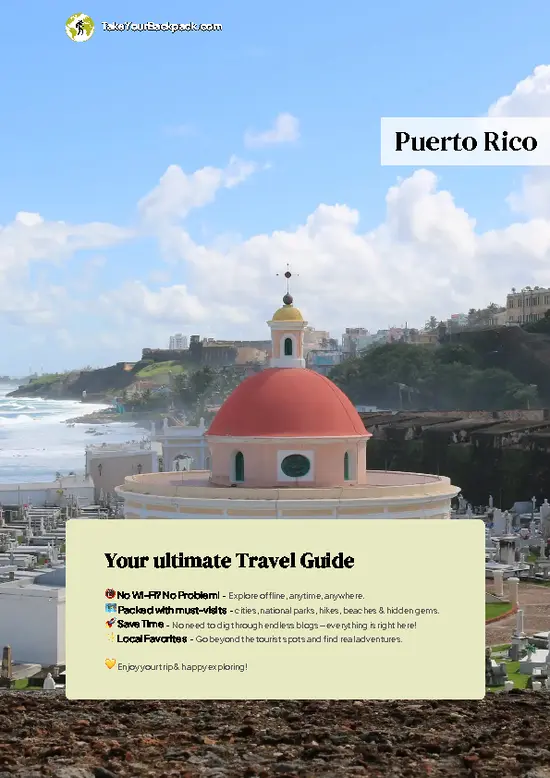
example page 0 from our offline Travel Guide for Puerto Rico
example page 1 from our offline Travel Guide for Puerto Rico
example page 2 from our offline Travel Guide for Puerto Rico
example page 3 from our offline Travel Guide for Puerto Rico
example page 4 from our offline Travel Guide for Puerto Rico
example page 5 from our offline Travel Guide for Puerto Rico
example page 6 from our offline Travel Guide for Puerto Rico
example page 7 from our offline Travel Guide for Puerto Rico
The digital guide (310 pages) contains:
✅ 81 highlights, ranked by travel appeal
✅ Optimized 5, 10 & 15-day travel routes
✅ Cities, national parks, landmarks, beaches
✅ How to get around
✅ Offline-friendly for travel without Wi-Fi
👉 Click to see all 30+ guide features

📅 Plan smarter in minutes, not weeks
✅ Month by month travel advice
✅ Festivals & national holidays
✅ Budget expectations

🗺️ Go to the right places, skip the overrated ones
✅ Honest pros & cons of destinations
✅ Top hikes, parks & viewpoints
✅ Lesser-known places most travelers miss
✅ Clear “worth it vs skip it” guidance

🛏️ Travel smoothly without rookie mistakes
✅ Best areas to stay
✅ Transport systems explained simply
✅ Common scams & safety advice
✅ SIM cards, money & practical tips

🌍 Understand the country, not just visit it
✅ Culture & traditions
✅ 52 Essential phrases & customs
✅ Festivals worth planning around
✅ Traveler-friendly historical context
✅ Insights that make places more meaningful

📱 Built for real travel conditions
✅ Fully downloadable PDF
✅ Works completely offline
✅ Optimized for phone use
✅ Useful in remote areas & buses
✅ Everything in one place
Stop searching, start planning
Get instant access to your full guide. 30‑day money-back guarantee.
+ Add another guide for just

By proceeding you agree to our terms.
Sent to your inbox immediately after payment • 100% Secure Checkout
Best Backpacking Travel Advisor 2025 tourism awardBest Backpacking
Travel Advisor
2025
What others say about Take Your Backpack Guides:
⭐⭐⭐⭐⭐
Fantastic, amazing amount of information!
⭐⭐⭐⭐⭐
My goodness this is amazing, it's what I've been looking for hats off too you!
⭐⭐⭐⭐⭐
I think this is absolutely BRILLIANT
⭐⭐⭐⭐
Very complete and informative. It's still missing places, but I gotta to commend you
⭐⭐⭐⭐⭐
This is truly amazing, thank you, can't wait to explore it with my kids!
⭐⭐⭐⭐⭐
Awesome resource, thank you!
⭐⭐⭐⭐⭐
This is amazing! Can't wait to explore the ones I haven't seen
⭐⭐⭐⭐
I love this! Well done, great idea.
⭐⭐⭐⭐⭐
Thanks for taking the time to make this gem!
⭐⭐⭐⭐⭐
This might be the best website I've ever seen.
⭐⭐⭐⭐⭐
Congratulations, and thank you so much for your work; it's incredibly valuable.
⭐⭐⭐⭐
In all seriousness I think you did a great job pointing out the important spots
⭐⭐⭐⭐⭐
10/10 very good
⭐⭐⭐⭐⭐
As someone who's only just starting to visit regularly this is awesome, thank you.
⭐⭐⭐⭐
Thank you very much! I'm going to visit my dad, it's going to be very useful!
⭐⭐⭐⭐⭐
This is really cool! We'll be travelling for the first time and this definitely come in handy.
⭐⭐⭐⭐⭐
You are now our minister of culture, congratulations 👨‍💼
⭐⭐⭐⭐⭐
Just wanted to tell you that this is a pearl! Going to follow your recommendations.
⭐⭐⭐⭐⭐
This is so cool. I'll definitely be using the resource for my travels soon.
⭐⭐⭐⭐⭐
This is very impressive! Good work.
⭐⭐⭐⭐⭐
This is an amazing and informative site. Very well done!

🛏️ Where to stay?Where to Base Yourself

Puerto Rico has a small but solid hostel scene, with dorm beds usually running US$30 to 50 a night and private rooms in guesthouses or short-term rentals from about US$80, which is pricier than most of the Caribbean backpacker circuit. In San Juan, Old San Juan puts you within walking distance of the forts and the bar streets but gets loud on weekend nights, Santurce is the pick for nightlife around the La Placita market area and for murals and cheaper food, while Condado and Ocean Park trade some of that buzz for beach access and quieter, generally safe streets (Isla Verde works mainly for a late arrival or early flight). Outside the capital, surf town Rincón on the west coast and the islands … read more 👉
Puerto Rico has a small but solid hostel scene, with dorm beds usually running US$30 to 50 a night and private rooms in guesthouses or short-term rentals from about US$80, which is pricier than most of the Caribbean backpacker circuit. In San Juan, Old San Juan puts you within walking distance of the forts and the bar streets but gets loud on weekend nights, Santurce is the pick for nightlife around the La Placita market area and for murals and cheaper food, while Condado and Ocean Park trade some of that buzz for beach access and quieter, generally safe streets (Isla Verde works mainly for a late arrival or early flight). Outside the capital, surf town Rincón on the west coast and the islands of Vieques and Culebra have guesthouses and a few hostels that fill up fast on weekends and holidays, so book ahead there.

If you enjoy meeting fellow travelers, consider choosing hostels with high ratings for atmosphere. On the other hand, if you prefer having your own space, a hotel might be a better option.

Puerto RicoExpand Your Journey

👋 Meet the founderWho’s Behind Take Your Backpack?

Johan, backpacker and founder of TakeYourBackpackHi, I’m Johan (Netherlands 🇳🇱), the creator of TakeYourBackpack. Over the past 3 decades, I’ve backpacked through 90+ countries across six continents, gaining extensive experience with independent travel, long-term trips, and overland routes.

This site is built on a combination of firsthand travel experience and carefully curated insights from other backpackers. Many guides are based on places I’ve personally visited, while others bring together tips, observations, and practical advice shared by trusted travelers I’ve met along the way.

The goal is to provide realistic, experience-driven guidance — not generic itineraries — so you can explore destinations with better context, clearer expectations, and more confidence.