×

Congo🇨🇬 | townsEwoCuvette-Ouest capital, plantain grills, forest edge, laterite dust | things to do and best time to go

Explore Nganga LingoloExplore Impfondo

Backpacking in Ewo
🏆 Top picktown ranked #2
By Johan Kruseman 🇳🇱 | Updated October 22, 2026

Ewo is a place where you can get a plain bed, a plate of grilled fish and a conversation with a stranger without anyone trying to sell you a tour. It sits in the northwest of the Republic of the Congo, as the administrative center of the Cuvette-Ouest department, surrounded by forest. Getting here means a long, dusty or muddy road ride that tests your patience, and there are no hostels or backpacker cafés. Evenings are slow, lit by phone torches and charcoal fires, and you will meet townspeople far more often than other travelers. What you get is an unpolished provincial town on its own terms, useful as a pause between the forest regions and the northern road. Red laterite dust coats everything in the dry months, and at dusk the smell of woodsmoke and frying plantain drifts down the main road.

Discover everything you want to know in the 📖 Congo Travel Guide.
Safety warning

The current risk level for Congo is high. Check the advice before going.


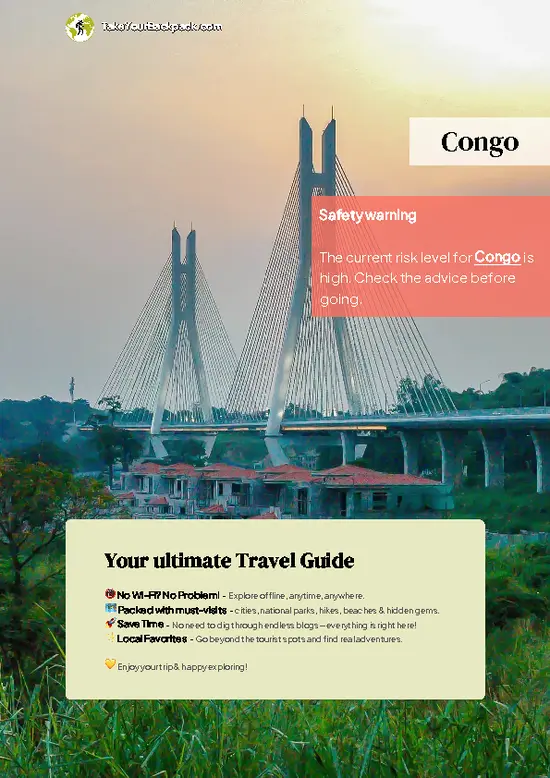
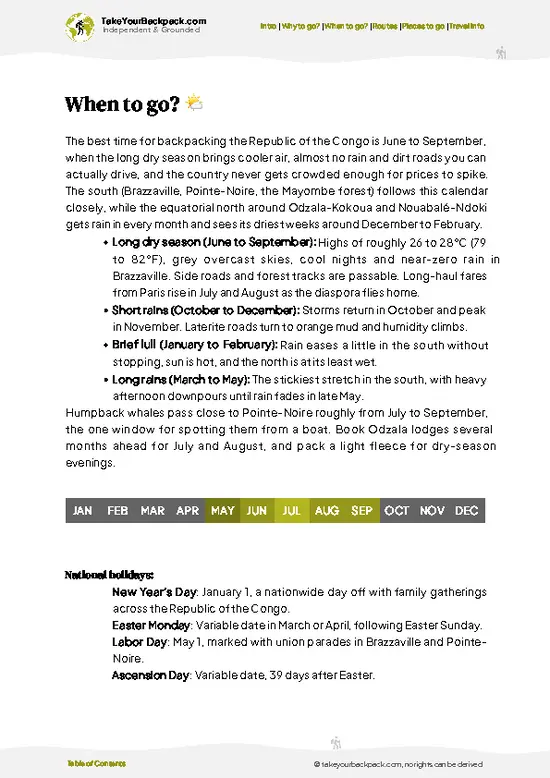
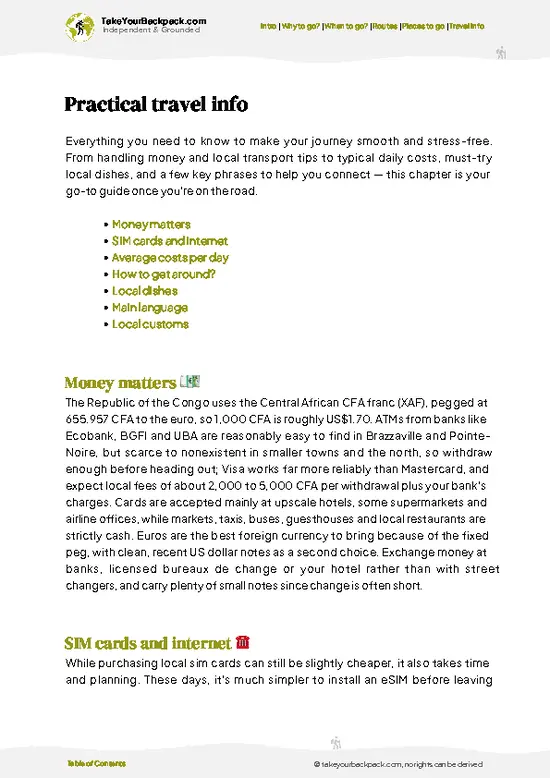
example page 0 from our offline Travel Guide for Republic of the Congo
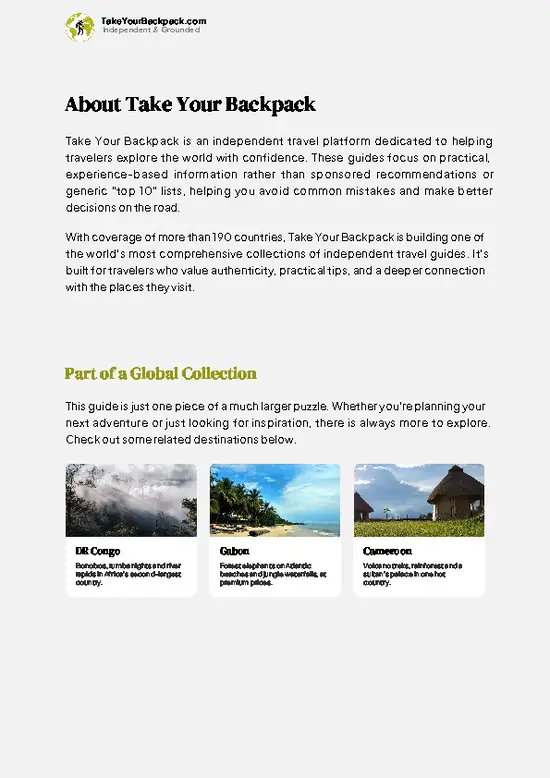
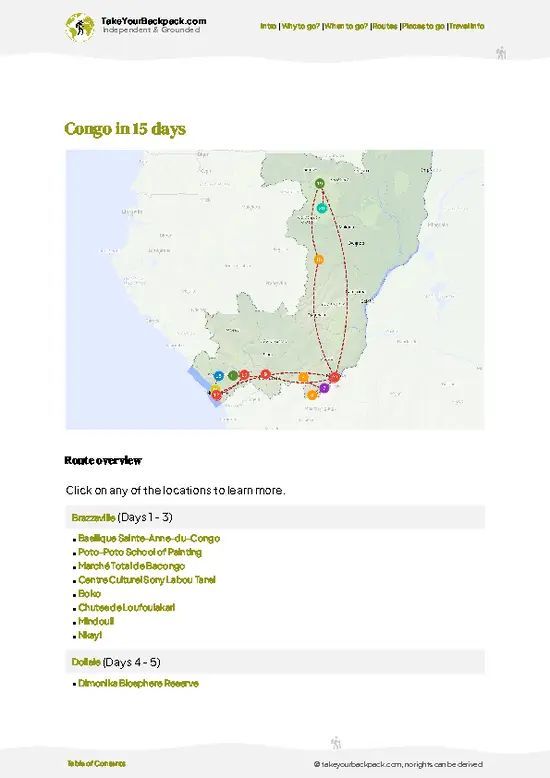
example page 1 from our offline Travel Guide for Republic of the Congo
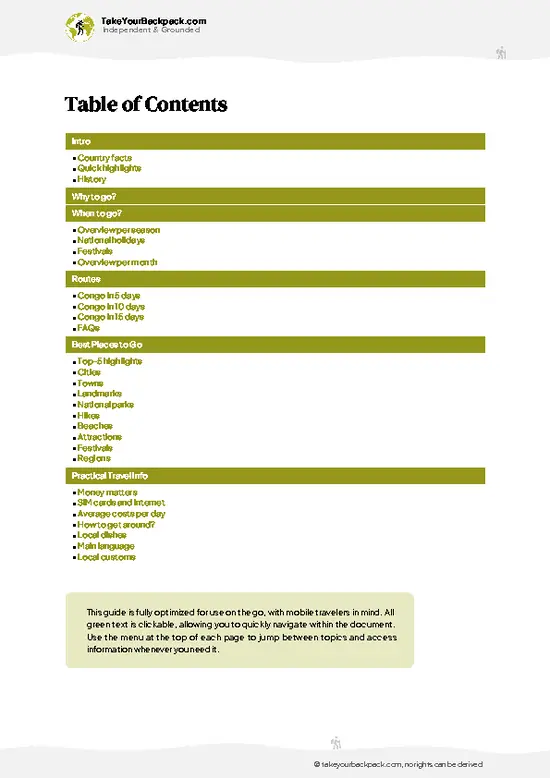
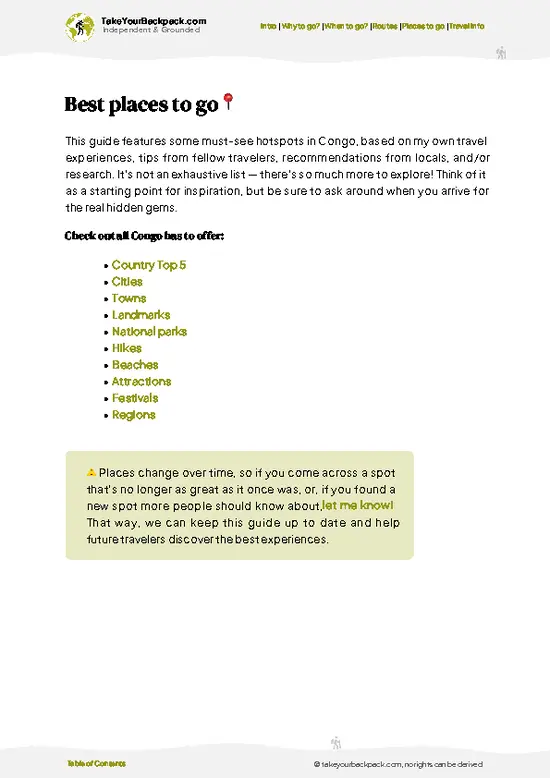
example page 2 from our offline Travel Guide for Republic of the Congo
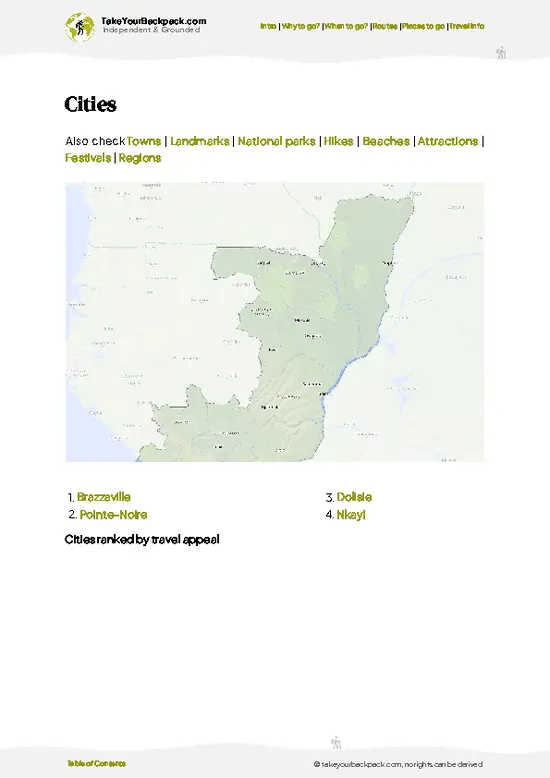
example page 3 from our offline Travel Guide for Republic of the Congo
example page 4 from our offline Travel Guide for Republic of the Congo
example page 5 from our offline Travel Guide for Republic of the Congo
example page 6 from our offline Travel Guide for Republic of the Congo
example page 7 from our offline Travel Guide for Republic of the Congo
Loading the map 🌍
CLICK TO FILTER
cities
towns
landmarks
national parks
hikes
beaches
attractions
festivals
regions
SHOW COUNTRY’S BESTSHOW ALL

✨ Why go?
Ranked #2 town in Congo
What makes this town worth visiting

Ewo suits the backpacker who wants a stretch of real Congolese provincial life rather than a checklist. Its draw is the Cuvette-Ouest forest road, which links the town toward the park gateways and logging villages in the northwest, so it works as a rest point where you can recover, restock and get local advice. Most people stay one or two nights, and a third makes sense if you want to watch the daily rhythm of the central market, where forest produce like cassava leaves, smoked fish and wild fruit changes by season. It is quiet, there is almost no nightlife, and you will rely on guesthouse owners and market vendors for information. Slow travelers, solo travelers comfortable with French and anyone building a long overland route through the north will enjoy it most. If you need sights, tours … read more 👉
Ewo suits the backpacker who wants a stretch of real Congolese provincial life rather than a checklist. Its draw is the Cuvette-Ouest forest road, which links the town toward the park gateways and logging villages in the northwest, so it works as a rest point where you can recover, restock and get local advice. Most people stay one or two nights, and a third makes sense if you want to watch the daily rhythm of the central market, where forest produce like cassava leaves, smoked fish and wild fruit changes by season. It is quiet, there is almost no nightlife, and you will rely on guesthouse owners and market vendors for information. Slow travelers, solo travelers comfortable with French and anyone building a long overland route through the north will enjoy it most. If you need sights, tours and a social scene, treat Ewo as one night only and keep moving. The friendliness of small-town conversation is the real reason to linger.

💡 HighlightsDon't-miss highlights and experiences

  1. Ewo Central Market: The town’s social heart, with piles of cassava, smoked fish, forest greens, charcoal and secondhand clothes under tin roofs and tarps. Go in the morning when stock is freshest and the vendors are chatty. Entry is free, and a coffee or snack costs under €1. Allow 1 to 2 hours, and ask before photographing people.
  2. Main road evening stalls: As the day cools, women set up grills and frying pots along the central road. You get grilled fish, plantain, skewers and bread with a seat on a wooden bench and a view of motorbikes weaving through the dust. Go from late afternoon until dark. A full meal typically costs €2 to 5. Plan on 1 to 2 hours.
  3. Forest-edge walks around town: A short walk from the last houses, tracks lead through gardens, cassava fields and the first belt of rainforest,
… read more 👉
  1. Ewo Central Market: The town’s social heart, with piles of cassava, smoked fish, forest greens, charcoal and secondhand clothes under tin roofs and tarps. Go in the morning when stock is freshest and the vendors are chatty. Entry is free, and a coffee or snack costs under €1. Allow 1 to 2 hours, and ask before photographing people.
  2. Main road evening stalls: As the day cools, women set up grills and frying pots along the central road. You get grilled fish, plantain, skewers and bread with a seat on a wooden bench and a view of motorbikes weaving through the dust. Go from late afternoon until dark. A full meal typically costs €2 to 5. Plan on 1 to 2 hours.
  3. Forest-edge walks around town: A short walk from the last houses, tracks lead through gardens, cassava fields and the first belt of rainforest, with hornbills and parrots calling and the air noticeably cooler under the canopy. Early morning is best, before the heat and the haze. It is free and takes 1 to 3 hours. Walk with a local guide or neighbor if you plan to go beyond the farm paths.
Beyond Ewo, the forest road leads toward Odzala-Kokoua National Park through the gateway village of Mbomo, and toward the logging area around Etoumbi, which are best treated as separate multi-day trips rather than quick outings. The market and the evening stalls combine well in one day, with produce shopping in the morning and a grilled dinner at dusk.
Spotted a mistake or missing something? Contact us.

🏘️ NeighborhoodsNeighborhood guide to Ewo

Ewo is a small administrative town in the Cuvette-Ouest region, and you can cover all of it on foot in an afternoon, so think of it as a handful of distinct pockets rather than districts.
  • Central market area: Red dirt lanes fill each morning with the smell of smoked fish, cassava leaf and frying beignets. Stalls sell manioc, bushmeat when in season, bananas and basic hardware, and the chatter is mostly Lingala and Kituba. Go early, before the heat flattens everything, and you leave with a cheap breakfast and a feel for how the region trades.
  • Administrative quarter: Prefecture buildings, a few shaded avenues and the occasional pickup parked under mango trees make this the quiet part. Evenings are almost silent apart from generators. It is the easiest place to stroll, and you get long open views
… read more 👉
Ewo is a small administrative town in the Cuvette-Ouest region, and you can cover all of it on foot in an afternoon, so think of it as a handful of distinct pockets rather than districts.
  • Central market area: Red dirt lanes fill each morning with the smell of smoked fish, cassava leaf and frying beignets. Stalls sell manioc, bushmeat when in season, bananas and basic hardware, and the chatter is mostly Lingala and Kituba. Go early, before the heat flattens everything, and you leave with a cheap breakfast and a feel for how the region trades.
  • Administrative quarter: Prefecture buildings, a few shaded avenues and the occasional pickup parked under mango trees make this the quiet part. Evenings are almost silent apart from generators. It is the easiest place to stroll, and you get long open views of the forest edge.
  • Road and transport junction: Trucks, motorbikes and shared vehicles gather along the main road, throwing dust that coats your sandals and tongue. Roadside grills sell skewered meat and grilled plantain after dark, and the glow of charcoal is your light. Loud, gritty, and the best place to ask about onward rides.
  • Riverside and outskirts: Paths drop toward streams and small farm plots where women wash clothes and children fish with nets. Footing is muddy after rain. You get birdsong, palm-wine sellers and a glimpse of village life unfiltered.
Nightlife means a few open-air bars with a speaker, cold Primus beer and the occasional dance. Bring a flashlight, since street lighting is patchy.

⌛️ 1 dayWhat you can realistically do in a day

This is a river-and-market day, slow and on foot, with long pauses in the shade.
7:00 AM: Central market
Start where Ewo wakes up first. Women set out cassava, smoked fish, caterpillars in basins and bunches of green leaves, and the air smells of woodsmoke and palm oil. Buy a fried doughnut and a sweet coffee from a stall, and greet people before you point at anything. Walk along the main road toward the administrative center when the crowd thins.
9:30 AM: Main avenue and town center
Walk the wide, dusty avenue past the prefecture buildings, small shops and moto-taxi stands. Red earth sticks to your boots, and the hum of motorbikes never really stops. Look at the colonial-era brick and concrete buildings, now faded and patched, and notice how quiet the town is compared with the market. Head down … read more 👉
This is a river-and-market day, slow and on foot, with long pauses in the shade.
7:00 AM: Central market
Start where Ewo wakes up first. Women set out cassava, smoked fish, caterpillars in basins and bunches of green leaves, and the air smells of woodsmoke and palm oil. Buy a fried doughnut and a sweet coffee from a stall, and greet people before you point at anything. Walk along the main road toward the administrative center when the crowd thins.
9:30 AM: Main avenue and town center
Walk the wide, dusty avenue past the prefecture buildings, small shops and moto-taxi stands. Red earth sticks to your boots, and the hum of motorbikes never really stops. Look at the colonial-era brick and concrete buildings, now faded and patched, and notice how quiet the town is compared with the market. Head down toward the lower part of town and the river.
11:30 AM: Riverbank on the Kouyou
Sit at the water’s edge and watch dugout canoes cross with fishermen, firewood and sacks of manioc. Ask permission before taking photos of people. The reward is a long view of green forest on the far bank and a breeze that is welcome by now. Walk back up through the neighborhoods to find lunch.
1:00 PM: Lunch at a maquis
Find a plain open-air eatery and order grilled fish or chicken with plantain or chikwangue (steamed cassava bread). Expect a plastic chair, a cold drink and a bill that is easy on a backpacker’s wallet. Rest through the hottest hours here, and carry water.
3:30 PM: Side streets and the back neighborhoods
This is the part of the day the standard route ignores. Wander the residential lanes behind the main road, where mango trees shade clay houses, children play football with a rag ball and people sell small piles of peanuts from doorsteps. Say hello often. You will be invited to chat, and that is the best part of the afternoon.
5:30 PM: Evening drink
End at a simple bar near the center, with a cold local beer as the light drops and generators start to hum. Watch the motorbikes stream home, then walk back to your lodging before full dark.

🌤️ When to go?Choosing the right time of year

The long dry season from June to August is the easiest window for Ewo, when roads are firmest and mud stops dictating your schedule.
  • Long Dry Season (June to August): Days reach 27 to 30°C (81 to 86°F), nights cool to about 19 to 21°C (66 to 70°F). Skies stay hazy and gray, rain is rare, and the dirt tracks toward the town are passable. Prices for transport rarely jump, though fuel shortages can.
  • Short Dry Spell (December to February): Slightly hotter at 29 to 32°C (84 to 90°F), with brighter sun and fewer downpours. Good for forest walks and village visits.
  • Rainy Seasons (March to May, September to November): Heavy afternoon storms of 1 to 2 hours turn laterite roads to slick red clay. Journeys can double in length, and shared vehicles sometimes wait for a day. Humidity stays above 80 percent.
… read more 👉
The long dry season from June to August is the easiest window for Ewo, when roads are firmest and mud stops dictating your schedule.
  • Long Dry Season (June to August): Days reach 27 to 30°C (81 to 86°F), nights cool to about 19 to 21°C (66 to 70°F). Skies stay hazy and gray, rain is rare, and the dirt tracks toward the town are passable. Prices for transport rarely jump, though fuel shortages can.
  • Short Dry Spell (December to February): Slightly hotter at 29 to 32°C (84 to 90°F), with brighter sun and fewer downpours. Good for forest walks and village visits.
  • Rainy Seasons (March to May, September to November): Heavy afternoon storms of 1 to 2 hours turn laterite roads to slick red clay. Journeys can double in length, and shared vehicles sometimes wait for a day. Humidity stays above 80 percent.
  • Crowds and daylight: Ewo sees almost no tourists in any month, and daylight runs about 12 hours year-round.
Plan arrival for early morning in any season, since breakdowns are easier to handle with a full day of light ahead.


source: climatestotravel.comJANJanuary: fair for travelingFEBFebruary: fair for travelingMARMarch: fair for travelingAPRApril: fair for travelingMAYMay: fair for travelingJUNJune: highly recommended for travelingJULJuly: excellent for travelingAUGAugust: excellent for travelingSEPSeptember: highly recommended for travelingOCTOctober: fair for travelingNOVNovember: fair for travelingDECDecember: fair for traveling
when-to-go

✈️ The backpacker research shortcutCongo Travel Guide

An offline-friendly backpacking guide with optimized travel routes, ranked highlights, transport advice, and the best areas to stay.
example page 0 from our offline Travel Guide for Republic of the Congo
example page 1 from our offline Travel Guide for Republic of the Congo
example page 2 from our offline Travel Guide for Republic of the Congo
example page 3 from our offline Travel Guide for Republic of the Congo
example page 4 from our offline Travel Guide for Republic of the Congo
example page 5 from our offline Travel Guide for Republic of the Congo
example page 6 from our offline Travel Guide for Republic of the Congo
example page 7 from our offline Travel Guide for Republic of the Congo
The digital guide (205 pages) contains:
✅ 46 highlights, ranked by travel appeal
✅ Optimized 5, 10 & 15-day travel routes
✅ Cities, national parks, landmarks, beaches
✅ How to get around
✅ Offline-friendly for travel without Wi-Fi
👉 Click to see all 30+ guide features

📅 Plan smarter in minutes, not weeks
✅ Month by month travel advice
✅ Festivals & national holidays
✅ Budget expectations

🗺️ Go to the right places, skip the overrated ones
✅ Honest pros & cons of destinations
✅ Top hikes, parks & viewpoints
✅ Lesser-known places most travelers miss
✅ Clear “worth it vs skip it” guidance

🛏️ Travel smoothly without rookie mistakes
✅ Best areas to stay
✅ Transport systems explained simply
✅ Common scams & safety advice
✅ SIM cards, money & practical tips

🌍 Understand the country, not just visit it
✅ Culture & traditions
✅ 52 Essential phrases & customs
✅ Festivals worth planning around
✅ Traveler-friendly historical context
✅ Insights that make places more meaningful

📱 Built for real travel conditions
✅ Fully downloadable PDF
✅ Works completely offline
✅ Optimized for phone use
✅ Useful in remote areas & buses
✅ Everything in one place
Stop searching, start planning
Get instant access to your full guide. 30‑day money-back guarantee.
+ Add another guide for just

By proceeding you agree to our terms.
Sent to your inbox immediately after payment • 100% Secure Checkout
Best Backpacking Travel Advisor 2025 tourism awardBest Backpacking
Travel Advisor
2025
What others say about Take Your Backpack Guides:
⭐⭐⭐⭐⭐
Fantastic, amazing amount of information!
⭐⭐⭐⭐⭐
My goodness this is amazing, it's what I've been looking for hats off too you!
⭐⭐⭐⭐⭐
I think this is absolutely BRILLIANT
⭐⭐⭐⭐
Very complete and informative. It's still missing places, but I gotta to commend you
⭐⭐⭐⭐⭐
This is truly amazing, thank you, can't wait to explore it with my kids!
⭐⭐⭐⭐⭐
Awesome resource, thank you!
⭐⭐⭐⭐⭐
This is amazing! Can't wait to explore the ones I haven't seen
⭐⭐⭐⭐
I love this! Well done, great idea.
⭐⭐⭐⭐⭐
Thanks for taking the time to make this gem!
⭐⭐⭐⭐⭐
This might be the best website I've ever seen.
⭐⭐⭐⭐⭐
Congratulations, and thank you so much for your work; it's incredibly valuable.
⭐⭐⭐⭐
In all seriousness I think you did a great job pointing out the important spots
⭐⭐⭐⭐⭐
10/10 very good
⭐⭐⭐⭐⭐
As someone who's only just starting to visit regularly this is awesome, thank you.
⭐⭐⭐⭐
Thank you very much! I'm going to visit my dad, it's going to be very useful!
⭐⭐⭐⭐⭐
This is really cool! We'll be travelling for the first time and this definitely come in handy.
⭐⭐⭐⭐⭐
You are now our minister of culture, congratulations 👨‍💼
⭐⭐⭐⭐⭐
Just wanted to tell you that this is a pearl! Going to follow your recommendations.
⭐⭐⭐⭐⭐
This is so cool. I'll definitely be using the resource for my travels soon.
⭐⭐⭐⭐⭐
This is very impressive! Good work.
⭐⭐⭐⭐⭐
This is an amazing and informative site. Very well done!

🛏️ Where to stay?Best areas and accommodation options

The best option is the central area near the market and main road, where the few guesthouses and basic lodgings in Ewo cluster. Beds are scarce, so expect simple private rooms at roughly €8 to 20 a night rather than dorms, and do not count on online booking.

The center works because everything you need is within a short walk: food stalls, phone credit sellers, moto-taxis and the pickup points for onward transport. Early departures are easy when your ride is five minutes away. It is noisy from dawn with traffic, radios and market traders, and generator hum can run into the evening, so earplugs … read more 👉
The best option is the central area near the market and main road, where the few guesthouses and basic lodgings in Ewo cluster. Beds are scarce, so expect simple private rooms at roughly €8 to 20 a night rather than dorms, and do not count on online booking.

The center works because everything you need is within a short walk: food stalls, phone credit sellers, moto-taxis and the pickup points for onward transport. Early departures are easy when your ride is five minutes away. It is noisy from dawn with traffic, radios and market traders, and generator hum can run into the evening, so earplugs help. Night walks are generally calm, but keep to lit streets.

The quieter administrative quarter is the second choice. A handful of rooms sit among broader, shaded avenues, with less dust and less engine noise, and the walk to the market is about 10 to 15 minutes. The drawback is fewer food options after dark and less transport nearby, so you will rely on moto-taxis for early starts.

Power and water can be intermittent in either area, so ask whether a room has a bucket and a working fan or generator hours. Bring cash in CFA francs, because cards and transfers are not accepted. Arrive during daylight to find a room without stress.

🚌 Getting aroundMoving around without the hassle

Ewo has no formal bus station, so you arrive wherever your shared vehicle or truck stops along the main road, and the center is a 5 to 15 minute walk or a €0.30 to 0.70 moto-taxi ride from there. Roads are dusty in dry months and slick red clay in wet ones, traffic is light, and nothing runs to a timetable. Expect to ask around and wait.
  • Walking: Free, and the best way to cover the whole town in a couple of hours. Dirt lanes are shaded by mango and palm trees, you pass market smells and radio music, and everyone greets you. Carry a flashlight after dark because lighting is spotty.
  • Moto-taxi: The everyday local ride, usually €0.30 to 1 within town and €1.50 to 4 to nearby villages. Settle the price before climbing on, hold tight over ruts, and wear a scarf over your mouth in the dry season. You
… read more 👉
Ewo has no formal bus station, so you arrive wherever your shared vehicle or truck stops along the main road, and the center is a 5 to 15 minute walk or a €0.30 to 0.70 moto-taxi ride from there. Roads are dusty in dry months and slick red clay in wet ones, traffic is light, and nothing runs to a timetable. Expect to ask around and wait.
  • Walking: Free, and the best way to cover the whole town in a couple of hours. Dirt lanes are shaded by mango and palm trees, you pass market smells and radio music, and everyone greets you. Carry a flashlight after dark because lighting is spotty.
  • Moto-taxi: The everyday local ride, usually €0.30 to 1 within town and €1.50 to 4 to nearby villages. Settle the price before climbing on, hold tight over ruts, and wear a scarf over your mouth in the dry season. You get to places no car can reach, with a rider who often knows every shortcut.
  • Shared pickups and minibuses: The main way to reach other towns along the route toward Etoumbi, Kellé or the road to Owando. Fares run roughly €5 to 25 depending on distance and road state, and vehicles leave when full, usually early morning. Count on 4 to 10 hours for regional hops, longer after rain, and pack water and snacks. Sitting wedged beside sacks of cassava and chickens is half the experience.
  • Trucks and cargo vehicles: When shared vehicles are scarce, logging and goods trucks take paying passengers for similar or slightly lower fares. Seats are open-air atop loads, bumpy and sunburning, but the elevated view of forest walls and red road is superb.
  • Domestic flights and long-distance links: Services to the town are limited and unreliable, so most backpackers plan overland connections via larger hubs. Check locally for current options rather than counting on a schedule.

👛 Costs (as of 22 October 2026)What things cost and how to budget

Ewo suits a daily budget of about €28 for a backpacker in high season, mostly because rooms are few and everything is paid in cash. Prices are rough estimates and vary with fuel supply and road conditions.
CategoryBudget RangeLocal Reality
Dorm accommodation€8 to 12 (high season), €6 to 10 (low season)No true dorms exist, so you pay for a basic private room with a fan and shared bucket bath.
Meals€5 to 8Street grills, rice with beans, cassava with fish or chicken, and beignets for breakfast. Restaurants are few.
Local transport€2 to 4A couple of moto-taxi rides in town; longer trips to other towns cost extra.
Basic activities/entry fees€2 to 4Mostly free walking, with small tips for local guides to streams or villages.
Miscellaneous expenses€2 to 3Phone credit, bottled water, cold Primus beer and
… read more 👉
Ewo suits a daily budget of about €28 for a backpacker in high season, mostly because rooms are few and everything is paid in cash. Prices are rough estimates and vary with fuel supply and road conditions.
CategoryBudget RangeLocal Reality
Dorm accommodation€8 to 12 (high season), €6 to 10 (low season)No true dorms exist, so you pay for a basic private room with a fan and shared bucket bath.
Meals€5 to 8Street grills, rice with beans, cassava with fish or chicken, and beignets for breakfast. Restaurants are few.
Local transport€2 to 4A couple of moto-taxi rides in town; longer trips to other towns cost extra.
Basic activities/entry fees€2 to 4Mostly free walking, with small tips for local guides to streams or villages.
Miscellaneous expenses€2 to 3Phone credit, bottled water, cold Primus beer and bottled soda.
Total Daily Budget€28Expect more when you add onward transport out of town.
Buy water in larger bottles and fruit at the market in the morning, which saves around €1 to 2 a day compared with small shop bottles. Bring enough cash in advance because banking is limited.
⚠️ Prices can change and everyone travels differently, so take this as a rough guide. Hope it helps you plan your adventure!

🚌 Day tripsExploring the surroundings

Ewo works as a base for short rural outings, though everything depends on finding a moto or shared ride, and there are no organized tours.
Forest villages along the road: Small villages within 10 to 25 km reward you with farm plots, smoked-fish racks and women pounding cassava under thatched shelters. A moto round trip costs roughly €6 to 15 with waiting time, and the ride takes 30 to 60 minutes each way. Go in the dry months, when tracks hold, and bring a small gift such as sugar or salt when visiting a home. First-timers often forget to agree on the return price.

Etoumbi: The neighboring town in the forest belt is known for timber and for access to wildlife areas where bushmeat trade is a local issue. The journey by shared pickup takes about 2 to 4 hours each way in good weather, with fares … read more 👉
Ewo works as a base for short rural outings, though everything depends on finding a moto or shared ride, and there are no organized tours.
Forest villages along the road: Small villages within 10 to 25 km reward you with farm plots, smoked-fish racks and women pounding cassava under thatched shelters. A moto round trip costs roughly €6 to 15 with waiting time, and the ride takes 30 to 60 minutes each way. Go in the dry months, when tracks hold, and bring a small gift such as sugar or salt when visiting a home. First-timers often forget to agree on the return price.

Etoumbi: The neighboring town in the forest belt is known for timber and for access to wildlife areas where bushmeat trade is a local issue. The journey by shared pickup takes about 2 to 4 hours each way in good weather, with fares of €4 to 10, so leave at first light to make it back the same day. It is only realistic in June to August. Do not count on a late return vehicle.

Streams and fishing spots: Walk 3 to 6 km to nearby creeks where locals fish with nets and traps. It costs nothing beyond a guide tip of about €3 to 6, and you get a quiet morning among kingfishers and palm trees. Rain makes paths slippery and leeches are common after storms, so wear closed shoes.

🛡️ SafetyStaying Safe: What Travelers Should Know

Ewo is a small, quiet town where most problems are practical rather than criminal. Petty theft is uncommon, but keep your phone and cash out of sight in the market crowds and on moto-taxis. After dark, street lighting is patchy, so carry a flashlight and stick to main lanes, ideally walking with someone. Solo travelers, including women, generally report friendliness, though unsolicited attention in bars can happen and a firm, polite refusal works.

The real annoyances are officials and checkpoints. Police or gendarmes along the road may ask to see your passport and visa, and occasionally hint at a fee. Stay calm, carry photocopies plus the original, smile, and do not hand over money without an official receipt. Photographing government buildings, soldiers or uniformed staff can cause trouble, … read more 👉
Ewo is a small, quiet town where most problems are practical rather than criminal. Petty theft is uncommon, but keep your phone and cash out of sight in the market crowds and on moto-taxis. After dark, street lighting is patchy, so carry a flashlight and stick to main lanes, ideally walking with someone. Solo travelers, including women, generally report friendliness, though unsolicited attention in bars can happen and a firm, polite refusal works.

The real annoyances are officials and checkpoints. Police or gendarmes along the road may ask to see your passport and visa, and occasionally hint at a fee. Stay calm, carry photocopies plus the original, smile, and do not hand over money without an official receipt. Photographing government buildings, soldiers or uniformed staff can cause trouble, so ask first.

Prices for foreigners sometimes start high, particularly for moto rides, so agree the fare beforehand. Malaria is the larger health risk, so use repellent and a net. Carry a small first-aid kit because pharmacies are basic and the nearest solid hospital is far away.

FAQTraveler FAQ

Ewo is worth a short visit if you want rural Congo without tourists, but it is mainly a stop on the way through the Cuvette-Ouest region. You get a lively morning market, forest villages within 10 to 25 km and cheap grilled food, while sights in the formal sense are few. Rooms cost roughly €8 to 20 a night, and the best months are June to August.
Ewo needs one to two days. One full day covers the market, the administrative quarter and a moto trip to a nearby village at around €6 to 15. A second day makes sense if you want to reach Etoumbi, which takes 2 to 4 hours each way, or if road conditions delay your onward ride.
Ewo is not realistic as a day trip from a large city, since the nearest major hubs are many hours away by rough road and shared vehicles run irregularly. Even from Owando, expect 5 to 10 hours each way depending on the season, which leaves no time on the ground. It works best as an overnight stop with a room at about €8 to 20.
⚠️ Things can change over time, so always validate details locally before you go.

Other Congolese towns near Ewo

Explore more nearby:

  • Mossaka—Congo floodplain, river mouth, fish market, sandy lanes| 224 km away
  • Bambama—Red dirt roads, cassava market, Chaillu hill paths, dusk bars| 232 km away
  • Sembé—Sangha forest town, mission choir, raffia groves, stream washing spots| 283 km away

💡 Not sure where to go next?
Create a personalized itinerary for Congo including Ewo and the places that fit your trip.

Generate my itinerary

👉 Discover all towns

Or checkout all Congo has to offer (think cities, towns, villages, national parks, hikes, beaches, festivals)
Country photo of Congo

We 💚 feedbackParting advice and final tips

Ewo is for the patient overlander who likes a conversation more than a checklist. Bring a few phrases of French or Lingala, small bills and a headlamp, and spend your evenings at the grill stalls rather than looking for nightlife. I would give it one full day, enough to learn the market and the forest-edge paths.

✍️ Help improve this page!
The information on this page is based on in-depth research, insights shared by experienced travelers, and feedback from the local travel community in Congo. While every effort is made to keep the information accurate and current, conditions can change — so if you spot anything incorrect or outdated, please get in touch.


🙋‍♂️ Give feedback

👋 Meet the founderWho’s Behind Take Your Backpack?

Johan, backpacker and founder of TakeYourBackpackHi, I’m Johan (Netherlands 🇳🇱), the creator of TakeYourBackpack. Over the past 3 decades, I’ve backpacked through 90+ countries across six continents, gaining extensive experience with independent travel, long-term trips, and overland routes.

This site is built on a combination of firsthand travel experience and carefully curated insights from other backpackers. Many guides are based on places I’ve personally visited, while others bring together tips, observations, and practical advice shared by trusted travelers I’ve met along the way.

The goal is to provide realistic, experience-driven guidance — not generic itineraries — so you can explore destinations with better context, clearer expectations, and more confidence.