×

Congo🇨🇬 | townsSouankéSangha hills, border trade, mission church, roasted cassava | things to do and best time to go

Explore Madingo-KayesExplore Sembé

Backpacking in Souanké
🌟 Highlighttown ranked #5
By Johan Kruseman 🇳🇱 | Updated October 22, 2026

Souanké is known for the Sembé-Souanké road country and the Sangha forest edge, yet what matters just as much is that it works as a border-region halt where almost nobody else is traveling. It sits in the north of the Republic of the Congo, in Sangha Department, close to the Cameroon and Gabon frontiers. Expect red laterite dust, the hiss of rain on tin roofs, woodsmoke at dusk and the smell of roasted cassava from roadside stalls. Reaching it is slow and rough, and guesthouses are basic, so evenings are quiet, with a few bars and little backpacker chatter. The market and the forested hills around town deserve your time, while formal sights are thin and a long stay is hard to justify. Compared with Ouesso, the Sangha river hub to the east, Souanké is smaller, cooler and far more remote.

Discover everything you want to know in the 📖 Congo Travel Guide.
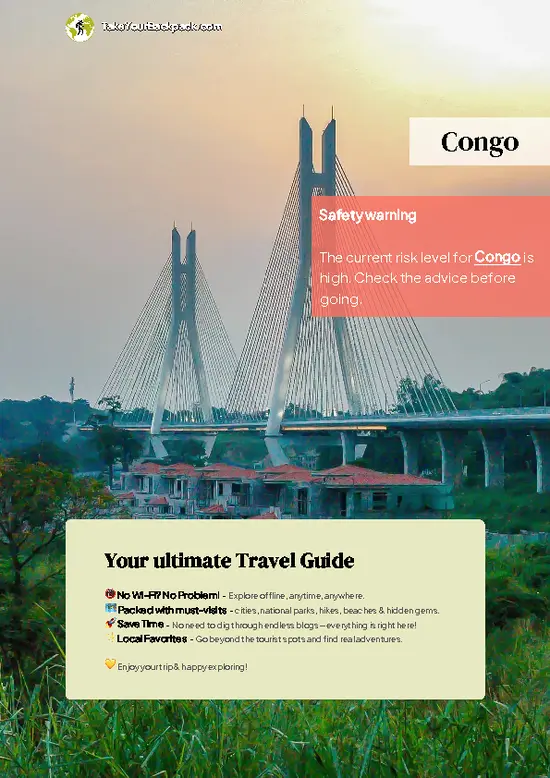
Safety warning

The current risk level for Congo is high. Check the advice before going.


example page 0 from our offline Travel Guide for Republic of the Congo
example page 1 from our offline Travel Guide for Republic of the Congo
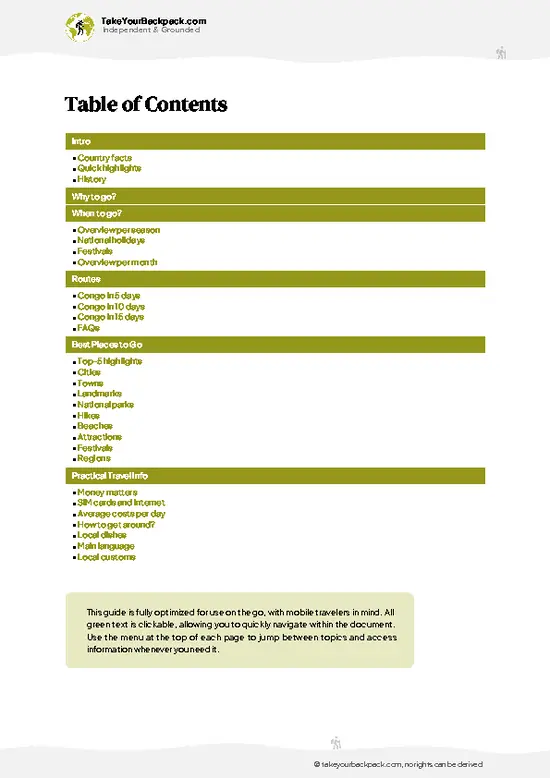
example page 2 from our offline Travel Guide for Republic of the Congo
example page 3 from our offline Travel Guide for Republic of the Congo
example page 4 from our offline Travel Guide for Republic of the Congo
example page 5 from our offline Travel Guide for Republic of the Congo
example page 6 from our offline Travel Guide for Republic of the Congo
example page 7 from our offline Travel Guide for Republic of the Congo
Loading the map 🌍
CLICK TO FILTER
cities
towns
landmarks
national parks
hikes
beaches
attractions
festivals
regions
SHOW COUNTRY’S BESTSHOW ALL

✨ Why go?
Ranked #5 town in Congo
Reasons people choose to visit here

Souanké suits travelers who want the northern Congo as locals live it, without tour desks or hostel crowds. The pull is the setting: a hill town in the forested far north, with cooler evenings than the river lowlands and tracks leading toward the Cameroon border and the Sangha forest belt. Lodging is a handful of simple guesthouses, so you meet people through the market, the church steps and the bars rather than through other backpackers. Most visitors pass through for a night or two while crossing the region, and that is the right length for anyone who needs comfort. Slow travelers, solo overlanders and people curious about Kota and Sangha communities will get more out of it, and a few extra days only make sense if you enjoy walking forest paths and chatting in French. If you need nightlife, ATMs or easy company, keep moving.

💡 HighlightsThe experiences that define the visit

  1. Souanké central market: The town’s main draw is the daily trading, with cassava, smoked fish, bushmeat, forest fruit and cloth from across the border. Go in the morning, when stalls are fullest. Browsing is free, and 1 hour is plenty. Buy a few snacks for roughly €1 to 2.
  2. Saint-Pierre area mission church: The Catholic mission is a landmark for the hill community and a good place to see Sunday gatherings with choir singing. Visit on Sunday morning. Entry is free, and 30 to 45 minutes works.
  3. Hill viewpoints above town: Short walks uphill from the center give wide views over rooftops and the green forest canopy. Early morning is clearest and coolest. It costs nothing and takes 1 to 2 hours return.
  4. Forest edge walks: Tracks beyond the last houses pass farm plots and secondary forest where you hear
… read more 👉
  1. Souanké central market: The town’s main draw is the daily trading, with cassava, smoked fish, bushmeat, forest fruit and cloth from across the border. Go in the morning, when stalls are fullest. Browsing is free, and 1 hour is plenty. Buy a few snacks for roughly €1 to 2.
  2. Saint-Pierre area mission church: The Catholic mission is a landmark for the hill community and a good place to see Sunday gatherings with choir singing. Visit on Sunday morning. Entry is free, and 30 to 45 minutes works.
  3. Hill viewpoints above town: Short walks uphill from the center give wide views over rooftops and the green forest canopy. Early morning is clearest and coolest. It costs nothing and takes 1 to 2 hours return.
  4. Forest edge walks: Tracks beyond the last houses pass farm plots and secondary forest where you hear hornbills and cicadas. Go early, ask a local to walk with you, and expect €3 to 6 for a guide. Allow 2 to 3 hours.
  5. Roadside food stalls: Grilled fish, manioc sticks and plantain are sold along the main road at dusk. A meal costs about €1.50 to 4. Stay 45 minutes and eat standing up with locals.
Souanké makes a base for forest and border-country day trips toward Sembé, Ouesso and the Cameroon frontier villages, though roads are rough and need local advice. For a first visit, start with the central market, because it explains the town faster than anything else.
Spotted a mistake or missing something? Contact us.

🏘️ NeighborhoodsUnderstanding the local layout

Souanké is small enough to cover on foot in an afternoon, and the areas below differ more by mood than by distance. Skip hunting for sights and spend your time where people actually gather.
  • Town center and main market: This is where you should start. Red laterite dust coats the stalls, and you smell smoked fish, cassava leaves and palm oil before you see them. Women sell peanuts, plantains and bush produce from the forest, and mornings are far livelier than afternoons. Walkable in ten minutes, and the best place for a cheap plate of cassava with grilled fish.
  • Main road and transport yard: Loud, dusty and a little chaotic when a truck or pickup loads up. Worth a look only because you will pass through, not to linger.
  • Mission and church quarter: Quieter, with shaded paths, birdsong and the hum
… read more 👉
Souanké is small enough to cover on foot in an afternoon, and the areas below differ more by mood than by distance. Skip hunting for sights and spend your time where people actually gather.
  • Town center and main market: This is where you should start. Red laterite dust coats the stalls, and you smell smoked fish, cassava leaves and palm oil before you see them. Women sell peanuts, plantains and bush produce from the forest, and mornings are far livelier than afternoons. Walkable in ten minutes, and the best place for a cheap plate of cassava with grilled fish.
  • Main road and transport yard: Loud, dusty and a little chaotic when a truck or pickup loads up. Worth a look only because you will pass through, not to linger.
  • Mission and church quarter: Quieter, with shaded paths, birdsong and the hum of generators at dusk. A pleasant walk when the midday heat flattens everything, and a good spot to meet locals who speak decent French.
  • Edges toward the forest: Footpaths lead past small farm plots and into thick green forest, with frog noise after dark. Go with a local guide, since trails split and mud is deep after rain. Nightlife is a handful of open-air bars with warm beer and loud music, and they are best before 10 pm.

⌛️ 1 daySeeing the highlights in 24 hours

7:30 AM: Central market Start here before the heat builds. Stalls are being laid out, smoke rises from fish racks and you can eat a warm fritter for breakfast. Walk every lane, then buy fruit for later.
9:30 AM: Mission church Stroll up through the neighborhood to the church. Sit for a few minutes in the shade and watch the town go about its business.
11:00 AM: Hill viewpoint Continue uphill by footpath for views across the tin roofs to the forest. This is the best place to understand how isolated the town is.
1:00 PM: Lunch at a roadside stall Eat grilled fish with manioc or plantain. Rest through the hottest hours, since afternoon rain is common.
3:00 PM: Forest edge path Few visitors walk beyond the last houses. Follow a track past gardens and cassava plots with a local companion, listening … read more 👉
7:30 AM: Central market Start here before the heat builds. Stalls are being laid out, smoke rises from fish racks and you can eat a warm fritter for breakfast. Walk every lane, then buy fruit for later.
9:30 AM: Mission church Stroll up through the neighborhood to the church. Sit for a few minutes in the shade and watch the town go about its business.
11:00 AM: Hill viewpoint Continue uphill by footpath for views across the tin roofs to the forest. This is the best place to understand how isolated the town is.
1:00 PM: Lunch at a roadside stall Eat grilled fish with manioc or plantain. Rest through the hottest hours, since afternoon rain is common.
3:00 PM: Forest edge path Few visitors walk beyond the last houses. Follow a track past gardens and cassava plots with a local companion, listening for birds and insects. Turn back after about an hour.
5:30 PM: Main road at dusk Walk back as lamps and charcoal grills come on. Stop for a cold drink at a simple bar and chat with whoever sits nearby. Finish with dinner at a stall.

🌤️ When to go?Best time to visit Souanké

Souanké sits in the far north near the Cameroon border, with rain in most months and only short breaks in the dry spells.
  • Main dry spell (December to February): Your best window. Days reach 28 to 31°C (82 to 88°F), roads are firmer and dust replaces mud. Demand is low, but transport prices rise slightly around the holidays.
  • Short dry break (June to August): Cloudier and slightly cooler, around 24 to 28°C (75 to 82°F), with fewer downpours. Forest trails are walkable but still damp.
  • Wet months (March to May and September to November): Heavy afternoon storms, mud on the tracks and sometimes cut roads. Nights stay near 18 to 21°C (64 to 70°F). Prices barely change, but delays are common.
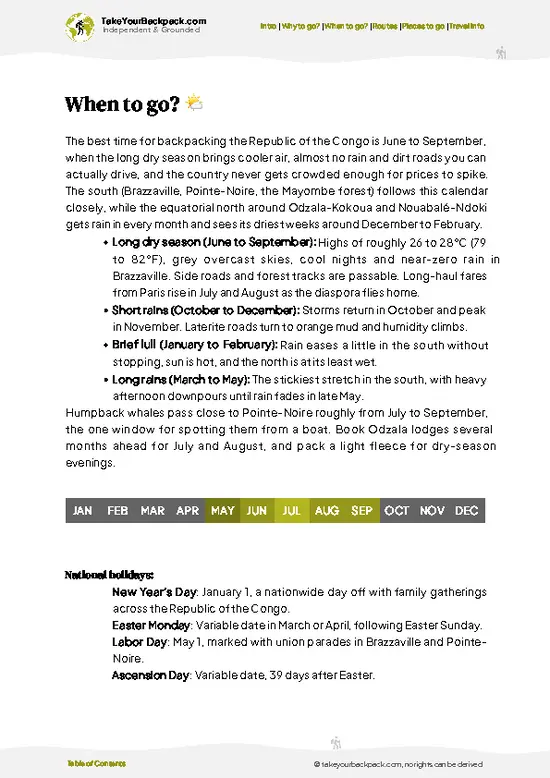
Daylight is close to twelve hours all year, so plan on dark by early evening. Book onward trips with a buffer of a day or two in any wet month.

source: climatestotravel.comJANJanuary: fair for travelingFEBFebruary: fair for travelingMARMarch: fair for travelingAPRApril: fair for travelingMAYMay: good for travelingJUNJune: excellent for travelingJULJuly: excellent for travelingAUGAugust: highly recommended for travelingSEPSeptember: highly recommended for travelingOCTOctober: fair for travelingNOVNovember: fair for travelingDECDecember: fair for traveling
when-to-go

✈️ The backpacker research shortcutCongo Travel Guide

An offline-friendly backpacking guide with optimized travel routes, ranked highlights, transport advice, and the best areas to stay.
example page 0 from our offline Travel Guide for Republic of the Congo
example page 1 from our offline Travel Guide for Republic of the Congo
example page 2 from our offline Travel Guide for Republic of the Congo
example page 3 from our offline Travel Guide for Republic of the Congo
example page 4 from our offline Travel Guide for Republic of the Congo
example page 5 from our offline Travel Guide for Republic of the Congo
example page 6 from our offline Travel Guide for Republic of the Congo
example page 7 from our offline Travel Guide for Republic of the Congo
The digital guide (205 pages) contains:
✅ 46 highlights, ranked by travel appeal
✅ Optimized 5, 10 & 15-day travel routes
✅ Cities, national parks, landmarks, beaches
✅ How to get around
✅ Offline-friendly for travel without Wi-Fi
👉 Click to see all 30+ guide features

📅 Plan smarter in minutes, not weeks
✅ Month by month travel advice
✅ Festivals & national holidays
✅ Budget expectations

🗺️ Go to the right places, skip the overrated ones
✅ Honest pros & cons of destinations
✅ Top hikes, parks & viewpoints
✅ Lesser-known places most travelers miss
✅ Clear “worth it vs skip it” guidance

🛏️ Travel smoothly without rookie mistakes
✅ Best areas to stay
✅ Transport systems explained simply
✅ Common scams & safety advice
✅ SIM cards, money & practical tips

🌍 Understand the country, not just visit it
✅ Culture & traditions
✅ 52 Essential phrases & customs
✅ Festivals worth planning around
✅ Traveler-friendly historical context
✅ Insights that make places more meaningful

📱 Built for real travel conditions
✅ Fully downloadable PDF
✅ Works completely offline
✅ Optimized for phone use
✅ Useful in remote areas & buses
✅ Everything in one place
Stop searching, start planning
Get instant access to your full guide. 30‑day money-back guarantee.
+ Add another guide for just

By proceeding you agree to our terms.
Sent to your inbox immediately after payment • 100% Secure Checkout
Best Backpacking Travel Advisor 2025 tourism awardBest Backpacking
Travel Advisor
2025
What others say about Take Your Backpack Guides:
⭐⭐⭐⭐⭐
Fantastic, amazing amount of information!
⭐⭐⭐⭐⭐
My goodness this is amazing, it's what I've been looking for hats off too you!
⭐⭐⭐⭐⭐
I think this is absolutely BRILLIANT
⭐⭐⭐⭐
Very complete and informative. It's still missing places, but I gotta to commend you
⭐⭐⭐⭐⭐
This is truly amazing, thank you, can't wait to explore it with my kids!
⭐⭐⭐⭐⭐
Awesome resource, thank you!
⭐⭐⭐⭐⭐
This is amazing! Can't wait to explore the ones I haven't seen
⭐⭐⭐⭐
I love this! Well done, great idea.
⭐⭐⭐⭐⭐
Thanks for taking the time to make this gem!
⭐⭐⭐⭐⭐
This might be the best website I've ever seen.
⭐⭐⭐⭐⭐
Congratulations, and thank you so much for your work; it's incredibly valuable.
⭐⭐⭐⭐
In all seriousness I think you did a great job pointing out the important spots
⭐⭐⭐⭐⭐
10/10 very good
⭐⭐⭐⭐⭐
As someone who's only just starting to visit regularly this is awesome, thank you.
⭐⭐⭐⭐
Thank you very much! I'm going to visit my dad, it's going to be very useful!
⭐⭐⭐⭐⭐
This is really cool! We'll be travelling for the first time and this definitely come in handy.
⭐⭐⭐⭐⭐
You are now our minister of culture, congratulations 👨‍💼
⭐⭐⭐⭐⭐
Just wanted to tell you that this is a pearl! Going to follow your recommendations.
⭐⭐⭐⭐⭐
This is so cool. I'll definitely be using the resource for my travels soon.
⭐⭐⭐⭐⭐
This is very impressive! Good work.
⭐⭐⭐⭐⭐
This is an amazing and informative site. Very well done!

🛏️ Where to stay?Best areas to stay in Congo

The area around the main road and market is the best bet in Souanké for a budget bed, with simple guesthouses at about €10 to 22 a night. Expect basic rooms, a fan, bucket showers and power that depends on the generator, so ask about hours of electricity. Hostels as backpackers know them do not exist here.

Being near the center means you can walk everywhere, find food quickly and reach the transport yard at dawn without a taxi. The trade-off is noise: motorbikes, trucks, roosters and early market sounds start before 6 am. Bring earplugs.

The quieter streets around the mission and church quarter … read more 👉
The area around the main road and market is the best bet in Souanké for a budget bed, with simple guesthouses at about €10 to 22 a night. Expect basic rooms, a fan, bucket showers and power that depends on the generator, so ask about hours of electricity. Hostels as backpackers know them do not exist here.

Being near the center means you can walk everywhere, find food quickly and reach the transport yard at dawn without a taxi. The trade-off is noise: motorbikes, trucks, roosters and early market sounds start before 6 am. Bring earplugs.

The quieter streets around the mission and church quarter are the second option. They are calmer at night, a little greener and still within a short walk of the market. Rooms may be fewer and more informal, sometimes arranged through church contacts or local introductions, so ask around on arrival. Night safety is good in both areas, but use a flashlight on unlit paths. Carry cash, since cards are not used, and pay in advance only for one night until you have seen the room.

🚌 Getting aroundTransportation options and practical tips

From the transport yard on the main road, the center of Souanké is a ten-minute walk, or a few minutes on a motorbike taxi for about €0.50. Nothing here is far, and nothing runs on a timetable. The roads in are rough, red and slick after rain, and getting in or out takes planning more than money.
  • Walking: Your default, and the right call. The town is compact, shaded in patches and full of greetings. Carry water, because the midday sun is heavy, and wear closed shoes for the mud and puddles.
  • Motorbike taxis: The everyday local option, about €0.30 to 1 for a ride across town. Agree the price first, hold on tight and expect a dusty face. Wear a helmet if the driver has a spare. Few run after dark.
  • Shared pickups and trucks: The main way to reach villages and the road toward Ouesso or the Cameroon
… read more 👉
From the transport yard on the main road, the center of Souanké is a ten-minute walk, or a few minutes on a motorbike taxi for about €0.50. Nothing here is far, and nothing runs on a timetable. The roads in are rough, red and slick after rain, and getting in or out takes planning more than money.
  • Walking: Your default, and the right call. The town is compact, shaded in patches and full of greetings. Carry water, because the midday sun is heavy, and wear closed shoes for the mud and puddles.
  • Motorbike taxis: The everyday local option, about €0.30 to 1 for a ride across town. Agree the price first, hold on tight and expect a dusty face. Wear a helmet if the driver has a spare. Few run after dark.
  • Shared pickups and trucks: The main way to reach villages and the road toward Ouesso or the Cameroon border. Seats are often benches or space on top of cargo. Fares to Ouesso are roughly €25 to 40 for a long, bone-rattling day or two, depending on rain and breakdowns. Vehicles leave when full, usually early morning, so arrive by 6 am.
  • Minibuses and long-distance cars: Occasionally available on better stretches. Costs are similar to pickups, with slightly more comfort and less luggage chaos. Ask at the yard the day before.
  • Private hire: A driver and 4x4 for a day costs about €60 to 110 including fuel. Worth it for forest tracks or splitting among three or four people, and not necessary inside town.
Bring small bills, since drivers rarely have change, and pay in Central African francs. Keep a day of slack in your schedule because rain can stall everything.

👛 Costs (as of 22 October 2026)Travel costs and budget guide for Souanké

Souanké costs about €30 to 65 a day for a backpacker, with most of the money going to transport and a guesthouse bed. Prices here run higher than the rest of the country because goods arrive by long, rough roads, and you pay in Central African francs, almost always in cash.
CategoryBudget RangeLocal Reality
Dorm accommodation€10 to 22 (high season)No dorms exist. A simple private guesthouse room with a fan is the standard, and low season is slightly cheaper.
Meals€6 to 12Cassava, plantain, grilled fish or chicken and rice at small eateries, and market snacks are cheapest.
Local transport€2 to 8Motorbike taxis for short rides, and shared pickups for nearby villages.
Basic activities/entry fees€8 to 15A local guide for a forest walk or village visit, with few formal entry fees.
Miscellaneous expenses€4
… read more 👉
Souanké costs about €30 to 65 a day for a backpacker, with most of the money going to transport and a guesthouse bed. Prices here run higher than the rest of the country because goods arrive by long, rough roads, and you pay in Central African francs, almost always in cash.
CategoryBudget RangeLocal Reality
Dorm accommodation€10 to 22 (high season)No dorms exist. A simple private guesthouse room with a fan is the standard, and low season is slightly cheaper.
Meals€6 to 12Cassava, plantain, grilled fish or chicken and rice at small eateries, and market snacks are cheapest.
Local transport€2 to 8Motorbike taxis for short rides, and shared pickups for nearby villages.
Basic activities/entry fees€8 to 15A local guide for a forest walk or village visit, with few formal entry fees.
Miscellaneous expenses€4 to 8Bottled water, phone credit, snacks and small tips for helpers.
Total Daily Budget€30 to 65Roughly €50 for a typical day in high season.
Buy fruit, peanuts and bread at the morning market instead of eating every meal at a restaurant, and bring plenty of small notes since change is scarce.
⚠️ Prices can change and everyone travels differently, so take this as a rough guide. Hope it helps you plan your adventure!

🚌 Day tripsShort trips worth adding

Souanké works as a base for short forest and village outings, though everything depends on rain, road conditions and finding a driver or guide.
Forest Trails Near Souanké:
Walking into the surrounding rainforest takes you past farm plots, giant trees and loud insects within an hour of town. A local guide costs about €8 to 15 for half a day. Go in the drier months, wear boots and do not set off alone, as trails split and look identical.

Sembé:
The nearby town sits along the forest road and gives a feel for the wider Sangha region, with a larger market and Sunday crowds. Allow a half to full day by shared pickup, about €5 to 12 return plus food. A common mistake is leaving late, and trucks stop filling by mid-morning.
👉 Explore Sembé
Border Villages Toward Cameroon:
The road north passes small … read more 👉
Souanké works as a base for short forest and village outings, though everything depends on rain, road conditions and finding a driver or guide.
Forest Trails Near Souanké:
Walking into the surrounding rainforest takes you past farm plots, giant trees and loud insects within an hour of town. A local guide costs about €8 to 15 for half a day. Go in the drier months, wear boots and do not set off alone, as trails split and look identical.

Sembé:
The nearby town sits along the forest road and gives a feel for the wider Sangha region, with a larger market and Sunday crowds. Allow a half to full day by shared pickup, about €5 to 12 return plus food. A common mistake is leaving late, and trucks stop filling by mid-morning.
👉 Explore Sembé
Border Villages Toward Cameroon:
The road north passes small Bakwele and Bangando villages with farms, cocoa and carved wooden homes. Hire a motorbike or driver for €20 to 40 for the day. Bring your passport for checkpoints, and avoid wet months when stretches turn to thick mud.

🛡️ SafetyScams, Hazards, and Annoyances

Souanké is quiet and low on crime, and the real trouble is practical rather than criminal. Petty theft is uncommon, but carry only the cash you need and keep your phone out of sight in the market crowd. Solo travelers, including women, usually find people curious and helpful, though dressing modestly helps avoid unwanted attention. After dark, streets are poorly lit, so carry a flashlight and avoid walking forest paths at night.

Checkpoints along the roads are routine. Keep your passport, visa and a few photocopies handy, stay polite and patient, and small unofficial requests for money are best met with a calm smile and a firm no. Photography near officials, soldiers or government buildings needs permission. Agree prices for motorbike rides and guides before you go, and drink only bottled … read more 👉
Souanké is quiet and low on crime, and the real trouble is practical rather than criminal. Petty theft is uncommon, but carry only the cash you need and keep your phone out of sight in the market crowd. Solo travelers, including women, usually find people curious and helpful, though dressing modestly helps avoid unwanted attention. After dark, streets are poorly lit, so carry a flashlight and avoid walking forest paths at night.

Checkpoints along the roads are routine. Keep your passport, visa and a few photocopies handy, stay polite and patient, and small unofficial requests for money are best met with a calm smile and a firm no. Photography near officials, soldiers or government buildings needs permission. Agree prices for motorbike rides and guides before you go, and drink only bottled or treated water. Malaria is present, so use repellent and sleep under a net.

FAQFrequently asked questions about Souanké

Souanké is worth visiting if you want remote forest country and village life near the Cameroon border, but it is not a place for ticking off sights. Expect market mornings, forest walks with a guide for about €8 to 15, and few other travelers. Reaching it takes real effort on rough roads, so go only if that appeals.
Two to three days is enough in Souanké to see the market, walk the forest trails and visit a nearby village. Add a day or two as a buffer because rain can delay pickups or close stretches of road. Budget about €38 to 62 a day including a guide and guesthouse.
Souanké is not realistic as a day trip from a nearby city, because roads are rough and the nearest large towns, such as Ouesso, are a long day or more away by shared pickup. Fares run roughly €25 to 40 each way, and vehicles leave early when full. Plan to sleep in Souanké for at least one night.
⚠️ Things can change over time, so always validate details locally before you go.

Other Congolese towns near Souanké

Explore more nearby:

  • Sembé—Sangha forest town, mission choir, raffia groves, stream washing spots| 66 km away
  • Ewo—Cuvette-Ouest capital, plantain grills, forest edge, laterite dust| 336 km away
  • Epena—Likouala-aux-Herbes landing, flooded forest, riverside beer, forest paths| 377 km away

💡 Not sure where to go next?
Create a personalized itinerary for Congo including Souanké and the places that fit your trip.

Generate my itinerary

👉 Discover all towns

Or checkout all Congo has to offer (think cities, towns, villages, national parks, hikes, beaches, festivals)
Country photo of Congo

We 💚 feedbackFinal thoughts on visiting Souanké

Souanké pairs best with a longer northern loop, ideally combined with Ouesso on the river and a crossing toward Cameroon or Gabon. I would give it one night, bring cash, a headlamp and rain gear, and skip any plan that depends on tight schedules.

✍️ Help improve this page!
The information on this page is based on in-depth research, insights shared by experienced travelers, and feedback from the local travel community in Congo. While every effort is made to keep the information accurate and current, conditions can change — so if you spot anything incorrect or outdated, please get in touch.


🙋‍♂️ Give feedback

👋 Meet the founderWho’s Behind Take Your Backpack?

Johan, backpacker and founder of TakeYourBackpackHi, I’m Johan (Netherlands 🇳🇱), the creator of TakeYourBackpack. Over the past 3 decades, I’ve backpacked through 90+ countries across six continents, gaining extensive experience with independent travel, long-term trips, and overland routes.

This site is built on a combination of firsthand travel experience and carefully curated insights from other backpackers. Many guides are based on places I’ve personally visited, while others bring together tips, observations, and practical advice shared by trusted travelers I’ve met along the way.

The goal is to provide realistic, experience-driven guidance — not generic itineraries — so you can explore destinations with better context, clearer expectations, and more confidence.