×

Rwanda🇷🇼 | townsCyanguguFishing boats, Rusizi River crossing, Bukavu border, Nyungwe gateway | things to do and best time to go

Explore ByumbaExplore Ngororero

Backpacking in Cyangugu
🌟 Highlighttown ranked #2
By Johan Kruseman 🇳🇱 | Updated October 22, 2026

Cyangugu is officially called Rusizi now, and the old name survives mostly in conversation, on older signs and in the local diocese. The town sits in the southwest of Rwanda, where the southern tip of Lake Kivu meets the Rusizi River and the border with Bukavu in the Democratic Republic of the Congo. Don’t come for a beach scene. The lake here is a working waterfront, and the better lakeside stays are further north. What deserves your time is the market, the border-river viewpoints and the town’s role as the gateway to Nyungwe Forest. The sights in town itself are modest, so one night is enough unless you are using it as a base. Buses arrive from Kigali and Huye, and the town is easy to reach. Evenings are quiet, with a few lakeside bars and hotels, and you will meet few other backpackers. Mornings begin with fishing boats on the water and motorbike taxis climbing the steep roads above Kamembe.

Discover everything you want to know in the 📖 Rwanda Travel Guide.


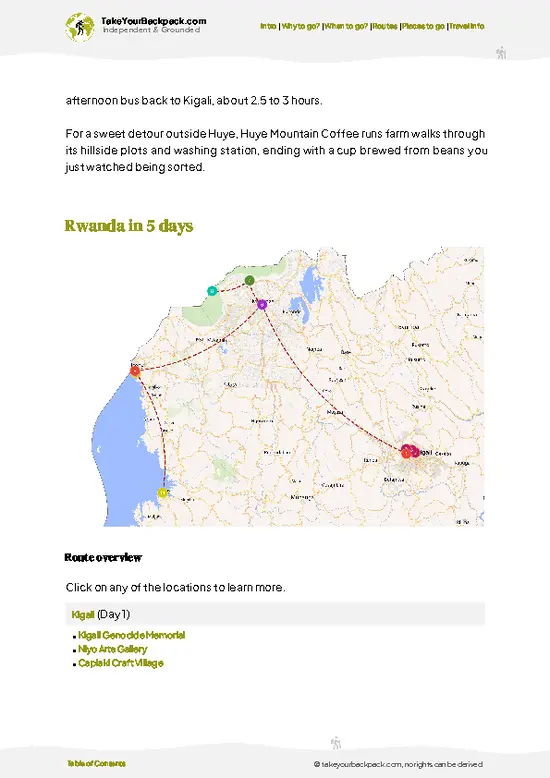
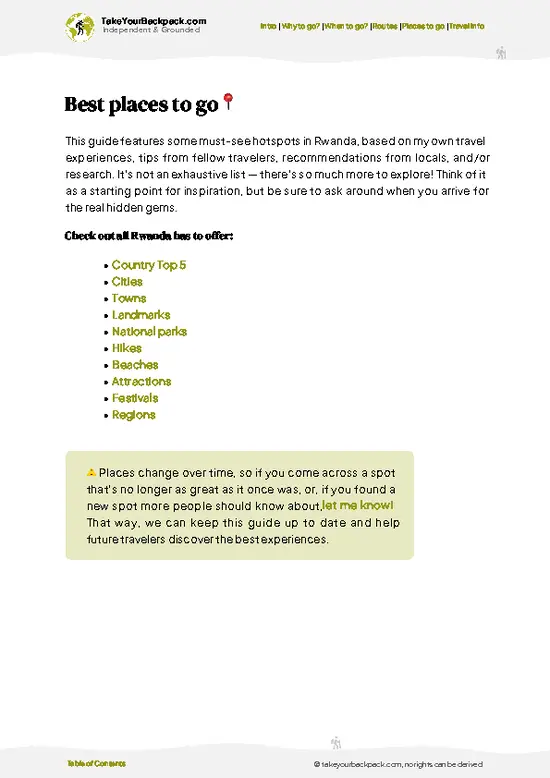
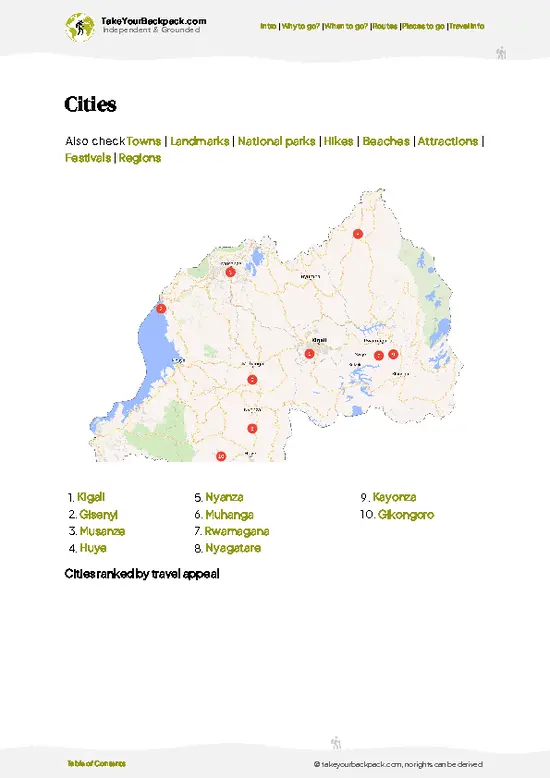
example page 0 from our offline Travel Guide for Rwanda
example page 1 from our offline Travel Guide for Rwanda
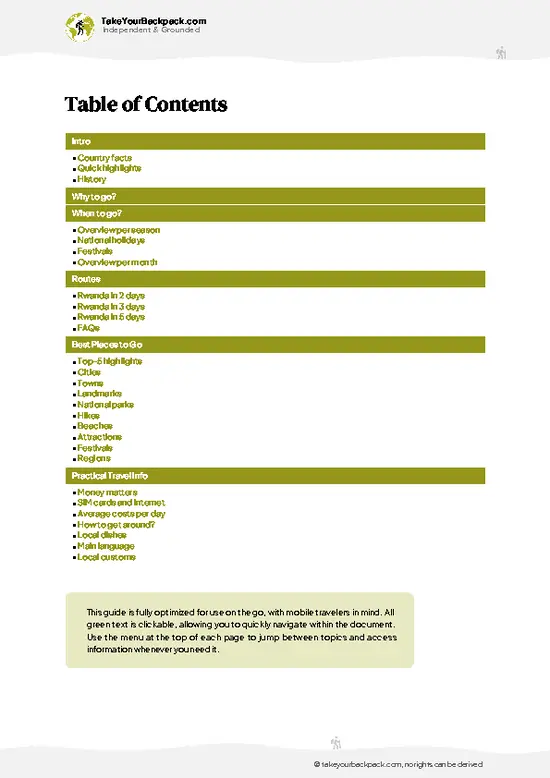
example page 2 from our offline Travel Guide for Rwanda
example page 3 from our offline Travel Guide for Rwanda
example page 4 from our offline Travel Guide for Rwanda
example page 5 from our offline Travel Guide for Rwanda
example page 6 from our offline Travel Guide for Rwanda
example page 7 from our offline Travel Guide for Rwanda
Loading the map 🌍
CLICK TO FILTER
cities
towns
landmarks
national parks
hikes
beaches
attractions
festivals
regions
SHOW COUNTRY’S BESTSHOW ALL

✨ Why go?
Ranked #2 town in Rwanda
Why visitors keep coming back

Cyangugu earns its place on a route as the southwestern door to Rwanda, and as the launch point for Nyungwe National Park, one of the oldest rainforests in Africa. Most travelers stay one or two nights here, long enough to arrange a chimp trek or canopy walk and to wander without a schedule. The town is small and walkable at its core, with steep slopes between the lakeshore and the Kamembe hill. Guesthouses are modest and run by local families, and you will pick up more advice from them than from any desk. Food is simple. Grilled tilapia from Lake Kivu with potatoes or plantain is the dish to order. The social scene is low-key, which suits solo travelers and anyone who likes to read, eat well and go to bed early before a forest start. If you want to cross to the DRC, the Rusizi border bridge … read more 👉
Cyangugu earns its place on a route as the southwestern door to Rwanda, and as the launch point for Nyungwe National Park, one of the oldest rainforests in Africa. Most travelers stay one or two nights here, long enough to arrange a chimp trek or canopy walk and to wander without a schedule. The town is small and walkable at its core, with steep slopes between the lakeshore and the Kamembe hill. Guesthouses are modest and run by local families, and you will pick up more advice from them than from any desk. Food is simple. Grilled tilapia from Lake Kivu with potatoes or plantain is the dish to order. The social scene is low-key, which suits solo travelers and anyone who likes to read, eat well and go to bed early before a forest start. If you want to cross to the DRC, the Rusizi border bridge is a short ride from the center, and the crossing is part of the town’s everyday life. Hikers will like it most. Nightlife seekers should keep going.

💡 HighlightsThe experiences that define the visit

  1. Lake Kivu shoreline at Rusizi. The southern end of the lake is where Cyangugu feels most like itself, with fishing boats, small jetties and hills across the water. Walk it in the early morning, when the air is cool and the boats are coming in. It is free and takes about 1 hour.
  2. Rusizi River border viewpoints. Along the river you can watch the daily flow of traders, porters and bicycles between Rwanda and Bukavu, which tells you more about the town than any plaque. The light is best in the late afternoon. It is free, and 30 to 45 minutes is plenty. Take photos of the river, not of border officials or the checkpoint.
  3. Kamembe Market. This is the town’s main produce market, with beans, cassava, tomatoes, passion fruit and fish stalls, plus secondhand clothes. Go in the morning when stocks are fresh.
… read more 👉
  1. Lake Kivu shoreline at Rusizi. The southern end of the lake is where Cyangugu feels most like itself, with fishing boats, small jetties and hills across the water. Walk it in the early morning, when the air is cool and the boats are coming in. It is free and takes about 1 hour.
  2. Rusizi River border viewpoints. Along the river you can watch the daily flow of traders, porters and bicycles between Rwanda and Bukavu, which tells you more about the town than any plaque. The light is best in the late afternoon. It is free, and 30 to 45 minutes is plenty. Take photos of the river, not of border officials or the checkpoint.
  3. Kamembe Market. This is the town’s main produce market, with beans, cassava, tomatoes, passion fruit and fish stalls, plus secondhand clothes. Go in the morning when stocks are fresh. Browsing is free, and snacks cost about US$0.50 to 2. Allow 1 hour.
  4. Cyangugu Cathedral. The seat of the local Catholic diocese is a calm place, and a quiet stop if you enjoy church architecture and local life. Mass days bring choirs and crowds. Entry is free, and 20 to 30 minutes is enough.
  5. Nyarushishi Genocide Memorial. It stands on the edge of town near the former camp where Tutsi survivors sheltered in 1994. It is a sober visit, best in the morning. A donation is welcome, and you should allow 1 hour. Go with a local guide or driver, since the site is not signposted well.
For day trips, Cyangugu works well for Nyungwe Forest and its canopy walk, the Bugarama hot springs, the Gisakura tea estates and the northern stretches of the Congo Nile Trail. The cheapest item on the list is a tie between the lakeshore, the viewpoints and the cathedral, all free.
Spotted a mistake or missing something? Contact us.

Things to do near Cyangugu

Ratings based on Tripadvisor reviews. When you book through this link, you support our work at no extra cost to you.

🏘️ NeighborhoodsUnderstanding the local layout

Cyangugu sits on the southern tip of Lake Kivu, pressed against the Ruzizi River and the border with Bukavu, and the areas are small enough to cover in a single day on foot or by moto.
  • Kamembe is the working center, on the ridge above the lake. It holds the bus park, banks with ATMs, small restaurants serving brochettes, tilapia and rice, and the minibus offices. It is busy by day and quiet by 9 pm. Walking is fine, but the slopes are steep. Spend an hour here for logistics and no more.
  • Cyangugu lakeshore is the lower town along Lake Kivu, with a calm waterfront, a few terrace bars and the best views at dusk. This is where you sit with a cold Primus and watch fishing boats. It deserves your evening, and the walk down from Kamembe takes 20 to 30 minutes.
  • Rusizi border area surrounds the Rusizi
… read more 👉
Cyangugu sits on the southern tip of Lake Kivu, pressed against the Ruzizi River and the border with Bukavu, and the areas are small enough to cover in a single day on foot or by moto.
  • Kamembe is the working center, on the ridge above the lake. It holds the bus park, banks with ATMs, small restaurants serving brochettes, tilapia and rice, and the minibus offices. It is busy by day and quiet by 9 pm. Walking is fine, but the slopes are steep. Spend an hour here for logistics and no more.
  • Cyangugu lakeshore is the lower town along Lake Kivu, with a calm waterfront, a few terrace bars and the best views at dusk. This is where you sit with a cold Primus and watch fishing boats. It deserves your evening, and the walk down from Kamembe takes 20 to 30 minutes.
  • Rusizi border area surrounds the Rusizi 1 bridge to the Democratic Republic of the Congo. It is a crossing point, with money changers and porters, and nothing here is worth lingering for unless you are crossing.
  • Gisakura and the Nyungwe road are the tea-growing hills east of town. The air is cooler, the landscape is green and ordered, and the area suits a half-day by moto rather than a stroll.

⌛️ 1 dayWhat you can realistically do in a day

A slow lake-and-border day suits Cyangugu, with a market in the middle and time to wander.
7:30 AM, Lake Kivu shoreline: Start with coffee and a walk along the water, where fishing boats unload and the hills of the DRC show across the lake. The air is cool and the town is waking up, so you can stroll without rushing.
9:00 AM, Kamembe Market: Walk or take a short motorbike ride uphill. Browse the produce, try fresh passion fruit and buy bananas for the road. It is busiest in the morning, and it is the best place to hear Swahili and Kinyarwanda together.
11:00 AM, Cyangugu Cathedral: A quiet pause. Sit inside for a few minutes, then continue on foot toward the center.
12:30 PM, Lunch: Look for a local restaurant serving grilled tilapia with chips or plantain. Eat slowly, because afternoons here … read more 👉
A slow lake-and-border day suits Cyangugu, with a market in the middle and time to wander.
7:30 AM, Lake Kivu shoreline: Start with coffee and a walk along the water, where fishing boats unload and the hills of the DRC show across the lake. The air is cool and the town is waking up, so you can stroll without rushing.
9:00 AM, Kamembe Market: Walk or take a short motorbike ride uphill. Browse the produce, try fresh passion fruit and buy bananas for the road. It is busiest in the morning, and it is the best place to hear Swahili and Kinyarwanda together.
11:00 AM, Cyangugu Cathedral: A quiet pause. Sit inside for a few minutes, then continue on foot toward the center.
12:30 PM, Lunch: Look for a local restaurant serving grilled tilapia with chips or plantain. Eat slowly, because afternoons here are slow anyway.
2:00 PM, Nyarushishi Genocide Memorial: Hire a moto driver to take you out of the center to this memorial. Few travelers come here, and it gives the town’s story a human scale. Stay about an hour and keep your voice low.
4:00 PM, Rusizi River border viewpoints: Return toward the river and watch cross-border traffic from a respectful distance. Traders, bicycles and porters make it a good place for people-watching, and you do not need to cross.
6:00 PM, Lakeside dinner: Finish at a lakefront hotel terrace with a Primus beer or a hot tea, watching the lights come on in Bukavu. Go to bed early if you have a forest start the next day.

🌤️ When to go?Seasonal considerations and timing

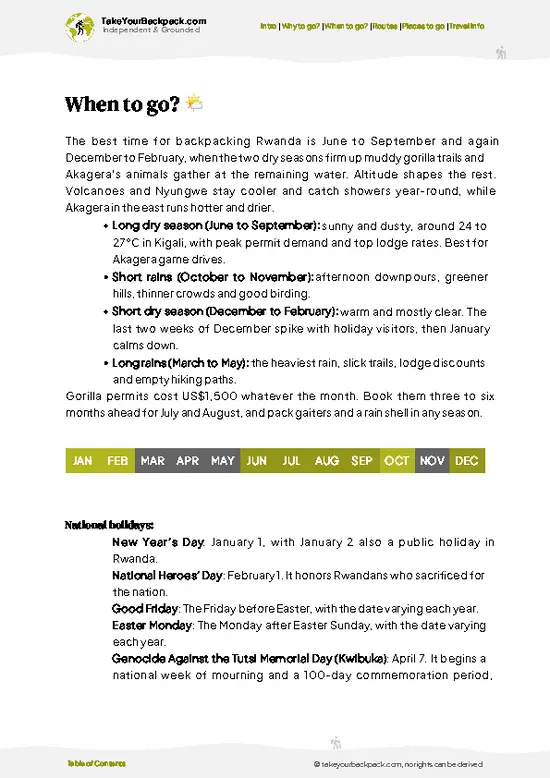
June to August is the driest stretch, and it is the easiest for hiking, boat trips and the road toward Nyungwe.
  • Long Dry Season (June to August): Days reach 26 to 28°C (79 to 82°F) with cool nights near 16°C (61°F). Rain is light, roads are firm and rooms are easiest to fill, so book ahead for August.
  • Short Dry Spell (December to February): Warm, with highs around 27°C (81°F), and rain falls less often. Holiday weeks bring some Rwandan and diaspora visitors.
  • Long Rains (March to May): The wettest period. Showers arrive in the afternoon, lake views can disappear into cloud, and the mountain roads turn slick. Lodging prices tend to soften.
  • Short Rains (October to November): Frequent but shorter storms, with mornings often clear.
Temperatures change little through the year, so plan around rain and … read more 👉
June to August is the driest stretch, and it is the easiest for hiking, boat trips and the road toward Nyungwe.
  • Long Dry Season (June to August): Days reach 26 to 28°C (79 to 82°F) with cool nights near 16°C (61°F). Rain is light, roads are firm and rooms are easiest to fill, so book ahead for August.
  • Short Dry Spell (December to February): Warm, with highs around 27°C (81°F), and rain falls less often. Holiday weeks bring some Rwandan and diaspora visitors.
  • Long Rains (March to May): The wettest period. Showers arrive in the afternoon, lake views can disappear into cloud, and the mountain roads turn slick. Lodging prices tend to soften.
  • Short Rains (October to November): Frequent but shorter storms, with mornings often clear.
Temperatures change little through the year, so plan around rain and road conditions, not heat. Aim for early mornings for views.


source: climatestotravel.comJANJanuary: fair for travelingFEBFebruary: fair for travelingMARMarch: fair for travelingAPRApril: fair for travelingMAYMay: highly recommended for travelingJUNJune: highly recommended for travelingJULJuly: good for travelingAUGAugust: good for travelingSEPSeptember: highly recommended for travelingOCTOctober: highly recommended for travelingNOVNovember: fair for travelingDECDecember: fair for traveling
when-to-go

✈️ The backpacker research shortcutRwanda Travel Guide

An offline-friendly backpacking guide with optimized travel routes, ranked highlights, transport advice, and the best areas to stay.
example page 0 from our offline Travel Guide for Rwanda
example page 1 from our offline Travel Guide for Rwanda
example page 2 from our offline Travel Guide for Rwanda
example page 3 from our offline Travel Guide for Rwanda
example page 4 from our offline Travel Guide for Rwanda
example page 5 from our offline Travel Guide for Rwanda
example page 6 from our offline Travel Guide for Rwanda
example page 7 from our offline Travel Guide for Rwanda
The digital guide (233 pages) contains:
✅ 57 highlights, ranked by travel appeal
✅ Optimized 2, 3 & 5-day travel routes
✅ Cities, national parks, landmarks, beaches
✅ How to get around
✅ Offline-friendly for travel without Wi-Fi
👉 Click to see all 30+ guide features

📅 Plan smarter in minutes, not weeks
✅ Month by month travel advice
✅ Festivals & national holidays
✅ Budget expectations

🗺️ Go to the right places, skip the overrated ones
✅ Honest pros & cons of destinations
✅ Top hikes, parks & viewpoints
✅ Lesser-known places most travelers miss
✅ Clear “worth it vs skip it” guidance

🛏️ Travel smoothly without rookie mistakes
✅ Best areas to stay
✅ Transport systems explained simply
✅ Common scams & safety advice
✅ SIM cards, money & practical tips

🌍 Understand the country, not just visit it
✅ Culture & traditions
✅ 52 Essential phrases & customs
✅ Festivals worth planning around
✅ Traveler-friendly historical context
✅ Insights that make places more meaningful

📱 Built for real travel conditions
✅ Fully downloadable PDF
✅ Works completely offline
✅ Optimized for phone use
✅ Useful in remote areas & buses
✅ Everything in one place
Stop searching, start planning
Get instant access to your full guide. 30‑day money-back guarantee.
+ Add another guide for just

By proceeding you agree to our terms.
Sent to your inbox immediately after payment • 100% Secure Checkout
Best Backpacking Travel Advisor 2025 tourism awardBest Backpacking
Travel Advisor
2025
What others say about Take Your Backpack Guides:
⭐⭐⭐⭐⭐
Fantastic, amazing amount of information!
⭐⭐⭐⭐⭐
My goodness this is amazing, it's what I've been looking for hats off too you!
⭐⭐⭐⭐⭐
I think this is absolutely BRILLIANT
⭐⭐⭐⭐
Very complete and informative. It's still missing places, but I gotta to commend you
⭐⭐⭐⭐⭐
This is truly amazing, thank you, can't wait to explore it with my kids!
⭐⭐⭐⭐⭐
Awesome resource, thank you!
⭐⭐⭐⭐⭐
This is amazing! Can't wait to explore the ones I haven't seen
⭐⭐⭐⭐
I love this! Well done, great idea.
⭐⭐⭐⭐⭐
Thanks for taking the time to make this gem!
⭐⭐⭐⭐⭐
This might be the best website I've ever seen.
⭐⭐⭐⭐⭐
Congratulations, and thank you so much for your work; it's incredibly valuable.
⭐⭐⭐⭐
In all seriousness I think you did a great job pointing out the important spots
⭐⭐⭐⭐⭐
10/10 very good
⭐⭐⭐⭐⭐
As someone who's only just starting to visit regularly this is awesome, thank you.
⭐⭐⭐⭐
Thank you very much! I'm going to visit my dad, it's going to be very useful!
⭐⭐⭐⭐⭐
This is really cool! We'll be travelling for the first time and this definitely come in handy.
⭐⭐⭐⭐⭐
You are now our minister of culture, congratulations 👨‍💼
⭐⭐⭐⭐⭐
Just wanted to tell you that this is a pearl! Going to follow your recommendations.
⭐⭐⭐⭐⭐
This is so cool. I'll definitely be using the resource for my travels soon.
⭐⭐⭐⭐⭐
This is very impressive! Good work.
⭐⭐⭐⭐⭐
This is an amazing and informative site. Very well done!

🛏️ Where to stay?Best areas and accommodation options

Kamembe is the most practical area for a budget bed, since it has the bus park, banks and ATMs, and the cheapest guesthouses within a short walk. Budget rooms here run roughly US$12 to 30, dorm-style beds are rare, and basic private rooms are the norm. Streets are quiet at night, though early coach departures and moto engines start noise around 5 am. Moving on is easy: you can walk to your bus with a pack.

The lakeshore is the other sensible choice, a calmer pocket with water views and a breeze that makes nights cooler. Options are fewer and slightly pricier, often US$20 to 40 for a simple room, … read more 👉
Kamembe is the most practical area for a budget bed, since it has the bus park, banks and ATMs, and the cheapest guesthouses within a short walk. Budget rooms here run roughly US$12 to 30, dorm-style beds are rare, and basic private rooms are the norm. Streets are quiet at night, though early coach departures and moto engines start noise around 5 am. Moving on is easy: you can walk to your bus with a pack.

The lakeshore is the other sensible choice, a calmer pocket with water views and a breeze that makes nights cooler. Options are fewer and slightly pricier, often US$20 to 40 for a simple room, but you pay for peace and a balcony over Lake Kivu. The trade-off is distance from the bus park, so you will need a moto in the early morning with luggage. The road down is steep and lit only in patches, so take a ride back after dark instead of walking.

Avoid sleeping next to the Rusizi border post unless you cross at dawn. It is busy with trucks and porters from first light, and the rooms there do not offer better prices. Book ahead on weekends and during the August dry-season peak, since the town has limited rooms in total.

🚌 Getting aroundGetting around like a local

Moto-taxis are the easiest way to get around Cyangugu, because the town climbs steep slopes between the lakeshore and Kamembe ridge, and a short ride costs little and saves your legs. Walking works along the flat waterfront, while the hills make longer routes tiring in the heat. Traffic is light, and public transport is reliable for the main road to Kigali and Huye but thins out after late afternoon.
  • Moto-taxi: A ride within town costs about US$0.40 to 1, and trips to outlying hills run US$1.50 to 3. Agree on the price first, and ask for the helmet, which is required by law. They run from early morning until about 8 or 9 pm.
  • Walking: The lakeshore and Kamembe center are walkable, and the 20 to 30 minute stroll between them is pleasant downhill and tiring back up. Roads are paved with few sidewalks,
… read more 👉
Moto-taxis are the easiest way to get around Cyangugu, because the town climbs steep slopes between the lakeshore and Kamembe ridge, and a short ride costs little and saves your legs. Walking works along the flat waterfront, while the hills make longer routes tiring in the heat. Traffic is light, and public transport is reliable for the main road to Kigali and Huye but thins out after late afternoon.
  • Moto-taxi: A ride within town costs about US$0.40 to 1, and trips to outlying hills run US$1.50 to 3. Agree on the price first, and ask for the helmet, which is required by law. They run from early morning until about 8 or 9 pm.
  • Walking: The lakeshore and Kamembe center are walkable, and the 20 to 30 minute stroll between them is pleasant downhill and tiring back up. Roads are paved with few sidewalks, so watch for motos.
  • Minibuses and coaches: Companies run from the Kamembe bus park to Kigali (about 6 to 7 hours, roughly US$8 to 10) and Huye (about 3.5 to 4 hours, US$4 to 6). Buses toward Nyungwe and Kigali start early, often from 5 am, and the last departures leave in the afternoon. Buy tickets at the company offices.
  • Shared local minibuses: Nearby villages and Rubavu-bound routes use smaller vehicles that leave when full. Fares for short hops are US$0.50 to 2. Late in the day, waiting times grow.
  • Boat: Lake Kivu services connect to other lakeshore towns, though schedules shift and it is slower than the road. Ask at the port for current departures and prices.
Cross-border trips to Bukavu need a visa and a clear check of current conditions before you go. Day travel is simplest, and Kigali-bound coaches are best booked the evening before.

👛 Costs (as of 22 October 2026)Money, prices, and spending tips

Cyangugu costs about US$40 to 60 a day for a backpacker who sleeps in simple guesthouses and eats local food.
CategoryBudget RangeLocal Reality
Dorm accommodationUS$12 to 25Dorm beds are rare, so most travelers take a basic private room with shared or private bath.
MealsUS$8 to 15Buffet-style lunches of beans, rice and plantain cost US$2 to 4, while grilled fish or brochettes at a lakeside spot run US$5 to 8.
Local transportUS$2 to 5Short moto rides cost US$0.40 to 1, and longer hill trips US$1.50 to 3.
Basic activities/entry feesUS$5 to 15Tea estate visits and lakeshore walks are cheap, while Nyungwe permits cost far more and are budgeted separately.
Miscellaneous expensesUS$3 to 6Covers water, SIM data, snacks and the occasional Primus beer at US$1 to 2.
Total Daily BudgetUS$40 to 60Around US$50
… read more 👉
Cyangugu costs about US$40 to 60 a day for a backpacker who sleeps in simple guesthouses and eats local food.
CategoryBudget RangeLocal Reality
Dorm accommodationUS$12 to 25Dorm beds are rare, so most travelers take a basic private room with shared or private bath.
MealsUS$8 to 15Buffet-style lunches of beans, rice and plantain cost US$2 to 4, while grilled fish or brochettes at a lakeside spot run US$5 to 8.
Local transportUS$2 to 5Short moto rides cost US$0.40 to 1, and longer hill trips US$1.50 to 3.
Basic activities/entry feesUS$5 to 15Tea estate visits and lakeshore walks are cheap, while Nyungwe permits cost far more and are budgeted separately.
Miscellaneous expensesUS$3 to 6Covers water, SIM data, snacks and the occasional Primus beer at US$1 to 2.
Total Daily BudgetUS$40 to 60Around US$50 for a typical day in high season.
Eat at the local buffet restaurants around Kamembe for lunch, since a filling plate costs a fraction of tourist-oriented places and you can skip a heavy dinner.
⚠️ Prices can change and everyone travels differently, so take this as a rough guide. Hope it helps you plan your adventure!

🚌 Day tripsExploring the surroundings

Cyangugu works well as a base for day trips because Nyungwe, the lake and the tea hills all lie within a couple of hours by road, and moto or minibus services run daily.
Nyungwe Forest National Park (Uwinka and Gisakura):
This is the main draw, a mountain rainforest with canopy walkway and primate trails. Reaching Uwinka takes about 1.5 to 2 hours by shared transport, then a moto onward. The canopy walk costs about US$60 for foreigners, and guided treks cost more, so budget US$80 to 120 total with transport. Start at dawn, because forest trails are best before the clouds close in, and the drier months from June to August are easiest. First-timers often try to arrive after noon and miss the morning birdlife.
👉 Explore Nyungwe Forest National Park
Gisakura Tea Estate:
The tea plantations on the … read more 👉
Cyangugu works well as a base for day trips because Nyungwe, the lake and the tea hills all lie within a couple of hours by road, and moto or minibus services run daily.
Nyungwe Forest National Park (Uwinka and Gisakura):
This is the main draw, a mountain rainforest with canopy walkway and primate trails. Reaching Uwinka takes about 1.5 to 2 hours by shared transport, then a moto onward. The canopy walk costs about US$60 for foreigners, and guided treks cost more, so budget US$80 to 120 total with transport. Start at dawn, because forest trails are best before the clouds close in, and the drier months from June to August are easiest. First-timers often try to arrive after noon and miss the morning birdlife.
👉 Explore Nyungwe Forest National Park
Gisakura Tea Estate:
The tea plantations on the road toward Nyungwe make an easy half-day outing, about 45 minutes to an hour by moto or minibus. Factory visits are possible and cost roughly US$5 to 15 with transport, and the green slopes are good walking terrain. Go in the morning when workers are picking, and avoid the rains of March to May when paths get slippery.

Kibuye (Karongi) along Lake Kivu:
Kibuye is a long day, about 4 hours each way, so it only works if you leave early. It has quiet beaches, boat trips between islands and lakeside cafes. Budget US$25 to 40 including transport, and expect to catch the last bus back in the afternoon. Many people underestimate the return trip and end up stranded.
👉 Explore Kibuye

🛡️ SafetyStaying Safe: What Travelers Should Know

Cyangugu is calm and low-key, and most trouble for travelers comes from small, avoidable situations rather than crime. Walk the center in daylight without worry, but take a moto home after dark on the unlit slope between the lakeshore and Kamembe. Solo travelers, including women, report few problems, though dressing modestly helps draw less attention. Near the Rusizi border post, money changers press for deals and rates are poor, so use banks or ATMs instead and keep your passport and cash zipped away in crowds. Moto-taxi drivers sometimes quote higher prices to foreigners, so settle the fare first and insist on a helmet. Plastic bags are banned in Rwanda, so expect bag checks on arrival. Check current guidance before any crossing into the Democratic Republic of the Congo, since conditions across the border can change quickly.

FAQCommon questions from travelers

Cyangugu is worth a short visit mainly as the gateway to Nyungwe Forest, though the lakeshore setting on Lake Kivu is pleasant in its own right. Sunset by the water and the tea hills of Gisakura fill an easy day, and Nyungwe lies about 1.5 to 2 hours away. Travelers heading between Kigali and the forest or crossing to Bukavu often pass through anyway.
Cyangugu needs one to two days by itself, and a third if you add a full day in Nyungwe Forest. One day covers the lakeshore, Kamembe and a tea estate visit, while a second day suits the forest canopy walk at about US$60. The Kigali coach ride is 6 to 7 hours, so factor in travel time at both ends.
Cyangugu is too far from Kigali for a sensible day trip, since the coach takes about 6 to 7 hours each way and costs roughly US$8 to 10. From Huye it is more realistic at 3.5 to 4 hours each way, but still a long day. A better plan is to stay at least one night and use the town as a base for Nyungwe and the lake.
⚠️ Things can change over time, so always validate details locally before you go.

Other Rwandan towns near Cyangugu

Explore more nearby:

  • Kibuye—Harbor brochettes, bat island, kayaks, lodge dinners| 69 km away
  • Ngororero—Highland market, tea slopes, goat brochettes, district center| 106 km away
  • Byumba—Northern highway stop, memorial, cathedral, ridge views| 165 km away

💡 Not sure where to go next?
Create a personalized itinerary for Rwanda including Cyangugu and the places that fit your trip.

Generate my itinerary

👉 Discover all towns

Or checkout all Rwanda has to offer (think cities, towns, villages, national parks, hikes, beaches, festivals)
Country photo of Rwanda

We 💚 feedbackSumming up the experience

Cyangugu is best at dawn, when the lake is calm, fishing boats are in and the town is still quiet. Come in the dry months of June to August if you plan to continue to Nyungwe, since the forest roads are easier then. I would stay one night, eat the lake fish and leave the next morning.

✍️ Help improve this page!
The information on this page is based on in-depth research, insights shared by experienced travelers, and feedback from the local travel community in Rwanda. While every effort is made to keep the information accurate and current, conditions can change — so if you spot anything incorrect or outdated, please get in touch.


🙋‍♂️ Give feedback

👋 Meet the founderWho’s Behind Take Your Backpack?

Johan, backpacker and founder of TakeYourBackpackHi, I’m Johan (Netherlands 🇳🇱), the creator of TakeYourBackpack. Over the past 3 decades, I’ve backpacked through 90+ countries across six continents, gaining extensive experience with independent travel, long-term trips, and overland routes.

This site is built on a combination of firsthand travel experience and carefully curated insights from other backpackers. Many guides are based on places I’ve personally visited, while others bring together tips, observations, and practical advice shared by trusted travelers I’ve met along the way.

The goal is to provide realistic, experience-driven guidance — not generic itineraries — so you can explore destinations with better context, clearer expectations, and more confidence.