×

St. Lucia🇱🇨 | national parksPigeon Island National LandmarkFort Rodney ruins, causeway walk, Martinique views, Jambe de Bois Beach | things to do and best time to go

Explore Maria Islands Nature ReserveExplore Soufrière Marine Management Area

Backpacking in Pigeon Island National Landmark
🏆 Top picknational park ranked #1
By Johan Kruseman 🇳🇱 | Updated October 22, 2026

Pigeon Island was an actual island until 1972, when a causeway built from landfill joined it to the mainland, so you can now walk onto it from Rodney Bay without a boat. Pigeon Island National Landmark sits in the far north of Saint Lucia, close to Gros Islet, and that causeway is why it works as an easy independent outing. The park has two hills with short, steep paths, ruined British fortifications, a small beach and sea views that reach Martinique on clear days. Wildlife is modest: lizards, birds and the odd iguana. It is small, so nobody comes here for a multi-day trek. Cruise-ship days and Friday night Jump Up crowds in Gros Islet can clog the road, so check the ship schedule and go early. Pay the entrance in cash if you can, and carry your own water, since prices at the on-site stalls climb. Taxi drivers sometimes quote tourist rates, so agree the fare before you get in. A good first day: arrive at opening, climb Fort Rodney while it’s cool, then swim and lunch on the beach.

Discover everything you want to know in the 📖 St. Lucia Travel Guide.


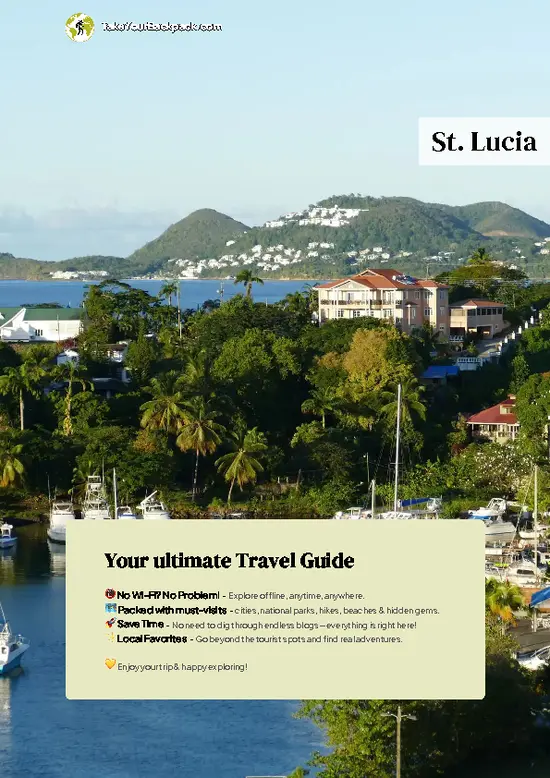
example page 0 from our offline Travel Guide for Saint Lucia
example page 1 from our offline Travel Guide for Saint Lucia
example page 2 from our offline Travel Guide for Saint Lucia
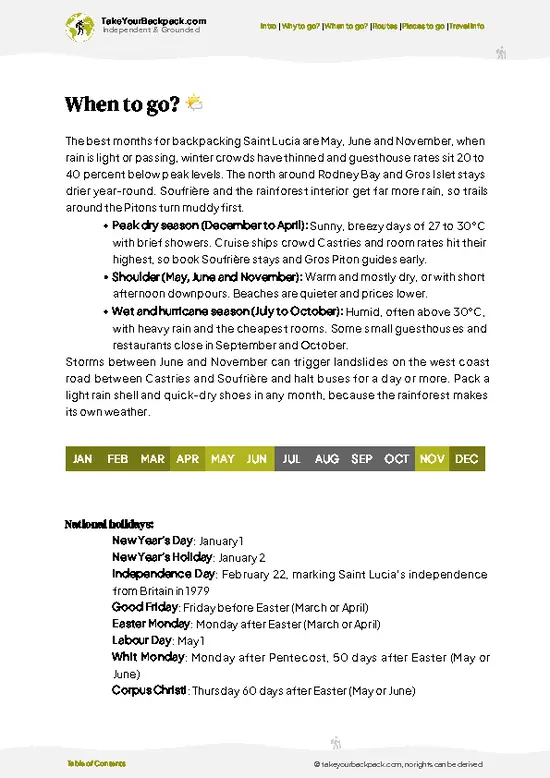
example page 3 from our offline Travel Guide for Saint Lucia
example page 4 from our offline Travel Guide for Saint Lucia
example page 5 from our offline Travel Guide for Saint Lucia
example page 6 from our offline Travel Guide for Saint Lucia
example page 7 from our offline Travel Guide for Saint Lucia
Loading the map 🌍
CLICK TO FILTER
towns
landmarks
national parks
hikes
beaches
attractions
festivals
regions
SHOW COUNTRY’S BESTSHOW ALL

✨ Why go?
Ranked #1 national park in St. Lucia
What sets this place apart

Pigeon Island National Landmark rewards people who like to wander on their own schedule. You pay one entry and the whole site is yours to walk, with no guide required. Paths are signed, short and easy to link, so you can build your own loop in an afternoon without a tour operator. The island suits self-guided travelers because the history is explained on boards and in the small museum, and the climbs are quick enough to pair with a swim.

The Fort Rodney summit is the main draw. It was Admiral Rodney’s lookout in the 1780s, used to watch the French fleet at Martinique, and you can still see the cannons pointing out to sea. You stand among the old stone walls and look across the channel, which is far more atmospheric than reading about it.

The other pull is how well it fits a budget route … read more 👉
Pigeon Island National Landmark rewards people who like to wander on their own schedule. You pay one entry and the whole site is yours to walk, with no guide required. Paths are signed, short and easy to link, so you can build your own loop in an afternoon without a tour operator. The island suits self-guided travelers because the history is explained on boards and in the small museum, and the climbs are quick enough to pair with a swim.

The Fort Rodney summit is the main draw. It was Admiral Rodney’s lookout in the 1780s, used to watch the French fleet at Martinique, and you can still see the cannons pointing out to sea. You stand among the old stone walls and look across the channel, which is far more atmospheric than reading about it.

The other pull is how well it fits a budget route in the north. The causeway walk from Rodney Bay lets you reach the park cheaply, and the area around has plenty of low-cost places to eat and sleep. Add the beach and you have a full day of history, exercise and swimming without needing a car or a booked excursion.

💡 HighlightsPlaces and moments you shouldn't skip

  1. Fort Rodney: The best-known sight, a restored British battery on the Fort Rock summit with cannons, stone remains and a wide view over the channel toward Martinique. The climb is short but steep.
  2. Signal Peak: The island’s higher hill, with a longer climb than Fort Rodney. It gives a broader panorama of Rodney Bay, the north coast and the coastline south. Good in the cooler morning.
  3. Pigeon Island Museum and Interpretive Centre: Housed in the old Officers’ Mess, it covers the island’s history, from early Amerindian use to the British naval period. A small display, but useful before you climb.
  4. Ruins of the Soldiers’ Barracks and Garrison: Stone remains of the garrison buildings, including the old barracks, kitchens and the hospital area. They give a feel for daily military life on the island.
  5. Jambe
… read more 👉
  1. Fort Rodney: The best-known sight, a restored British battery on the Fort Rock summit with cannons, stone remains and a wide view over the channel toward Martinique. The climb is short but steep.
  2. Signal Peak: The island’s higher hill, with a longer climb than Fort Rodney. It gives a broader panorama of Rodney Bay, the north coast and the coastline south. Good in the cooler morning.
  3. Pigeon Island Museum and Interpretive Centre: Housed in the old Officers’ Mess, it covers the island’s history, from early Amerindian use to the British naval period. A small display, but useful before you climb.
  4. Ruins of the Soldiers’ Barracks and Garrison: Stone remains of the garrison buildings, including the old barracks, kitchens and the hospital area. They give a feel for daily military life on the island.
  5. Jambe de Bois Beach: A small, sheltered beach on the western side with calm water and shade. It suits a swim after the climbs and has simple food stalls nearby.
  6. Rodney Bay Causeway Walk: The narrow land link that turned the island into a peninsula. A pleasant walk with water on both sides before you enter the park.
  7. Captain’s Cellar and Gunpowder Magazine Area: Old storage structures near the shore that show how the garrison kept supplies and ammunition, with sea views from nearby paths.
Start with Fort Rodney soon after you enter, because the stone walls and open summit are hot by midday and the view is clearest early.
Spotted a mistake or missing something? Contact us.

🌤️ When to go?Best time to explore Pigeon Island National Landmark

  • Dry Season (December to April): Pigeon Island National Landmark is at its most comfortable, with days of 28 to 30°C (82 to 86°F), cooler evenings near 22°C (72°F), steady trade-wind breezes on the Signal Peak climb and about 11.5 hours of daylight. Cruise ships and Christmas week bring the biggest crowds and the highest hotel rates in nearby Rodney Bay.
  • Wet Season (June to November): Expect 29 to 32°C (84 to 90°F), humid air and short heavy downpours, usually in the afternoon. The grassy paths turn slick, but the park is quieter and Rodney Bay rooms often drop 20 to 30 percent. Hurricane season peaks August to October, so book flexible rates.
  • Shoulder Weeks (May and early December): Showers are lighter, the hillsides are green, and prices sit between the two extremes.
  • Time of Day: Cruise groups
… read more 👉
  • Dry Season (December to April): Pigeon Island National Landmark is at its most comfortable, with days of 28 to 30°C (82 to 86°F), cooler evenings near 22°C (72°F), steady trade-wind breezes on the Signal Peak climb and about 11.5 hours of daylight. Cruise ships and Christmas week bring the biggest crowds and the highest hotel rates in nearby Rodney Bay.
  • Wet Season (June to November): Expect 29 to 32°C (84 to 90°F), humid air and short heavy downpours, usually in the afternoon. The grassy paths turn slick, but the park is quieter and Rodney Bay rooms often drop 20 to 30 percent. Hurricane season peaks August to October, so book flexible rates.
  • Shoulder Weeks (May and early December): Showers are lighter, the hillsides are green, and prices sit between the two extremes.
  • Time of Day: Cruise groups arrive from late morning, so the ruins and beaches are calmest early. Late afternoon gives cooler light for the Fort Rodney viewpoint.
  • Events: The St. Lucia Jazz and Arts Festival in May brings concerts to the grounds, with extra crowds on those evenings.
On a cruise-ship day, go right at opening and be done by 11.


source: climatestotravel.comJANJanuary: excellent for travelingFEBFebruary: excellent for travelingMARMarch: excellent for travelingAPRApril: highly recommended for travelingMAYMay: highly recommended for travelingJUNJune: good for travelingJULJuly: fair for travelingAUGAugust: fair for travelingSEPSeptember: fair for travelingOCTOctober: fair for travelingNOVNovember: good for travelingDECDecember: excellent for traveling
saint-lucia-national-park-pigeon-island-national-landmark
© Google | Ryan Vilela

✈️ The backpacker research shortcutSt. Lucia Travel Guide

An offline-friendly backpacking guide with optimized travel routes, ranked highlights, transport advice, and the best areas to stay.
example page 0 from our offline Travel Guide for Saint Lucia
example page 1 from our offline Travel Guide for Saint Lucia
example page 2 from our offline Travel Guide for Saint Lucia
example page 3 from our offline Travel Guide for Saint Lucia
example page 4 from our offline Travel Guide for Saint Lucia
example page 5 from our offline Travel Guide for Saint Lucia
example page 6 from our offline Travel Guide for Saint Lucia
example page 7 from our offline Travel Guide for Saint Lucia
The digital guide (146 pages) contains:
✅ 31 highlights, ranked by travel appeal
✅ Optimized 2, 3 & 5-day travel routes
✅ Cities, national parks, landmarks, beaches
✅ How to get around
✅ Offline-friendly for travel without Wi-Fi
👉 Click to see all 30+ guide features

📅 Plan smarter in minutes, not weeks
✅ Month by month travel advice
✅ Festivals & national holidays
✅ Budget expectations

🗺️ Go to the right places, skip the overrated ones
✅ Honest pros & cons of destinations
✅ Top hikes, parks & viewpoints
✅ Lesser-known places most travelers miss
✅ Clear “worth it vs skip it” guidance

🛏️ Travel smoothly without rookie mistakes
✅ Best areas to stay
✅ Transport systems explained simply
✅ Common scams & safety advice
✅ SIM cards, money & practical tips

🌍 Understand the country, not just visit it
✅ Culture & traditions
✅ 52 Essential phrases & customs
✅ Festivals worth planning around
✅ Traveler-friendly historical context
✅ Insights that make places more meaningful

📱 Built for real travel conditions
✅ Fully downloadable PDF
✅ Works completely offline
✅ Optimized for phone use
✅ Useful in remote areas & buses
✅ Everything in one place
Stop searching, start planning
Get instant access to your full guide. 30‑day money-back guarantee.
+ Add another guide for just

By proceeding you agree to our terms.
Sent to your inbox immediately after payment • 100% Secure Checkout
Best Backpacking Travel Advisor 2025 tourism awardBest Backpacking
Travel Advisor
2025
What others say about Take Your Backpack Guides:
⭐⭐⭐⭐⭐
Fantastic, amazing amount of information!
⭐⭐⭐⭐⭐
My goodness this is amazing, it's what I've been looking for hats off too you!
⭐⭐⭐⭐⭐
I think this is absolutely BRILLIANT
⭐⭐⭐⭐
Very complete and informative. It's still missing places, but I gotta to commend you
⭐⭐⭐⭐⭐
This is truly amazing, thank you, can't wait to explore it with my kids!
⭐⭐⭐⭐⭐
Awesome resource, thank you!
⭐⭐⭐⭐⭐
This is amazing! Can't wait to explore the ones I haven't seen
⭐⭐⭐⭐
I love this! Well done, great idea.
⭐⭐⭐⭐⭐
Thanks for taking the time to make this gem!
⭐⭐⭐⭐⭐
This might be the best website I've ever seen.
⭐⭐⭐⭐⭐
Congratulations, and thank you so much for your work; it's incredibly valuable.
⭐⭐⭐⭐
In all seriousness I think you did a great job pointing out the important spots
⭐⭐⭐⭐⭐
10/10 very good
⭐⭐⭐⭐⭐
As someone who's only just starting to visit regularly this is awesome, thank you.
⭐⭐⭐⭐
Thank you very much! I'm going to visit my dad, it's going to be very useful!
⭐⭐⭐⭐⭐
This is really cool! We'll be travelling for the first time and this definitely come in handy.
⭐⭐⭐⭐⭐
You are now our minister of culture, congratulations 👨‍💼
⭐⭐⭐⭐⭐
Just wanted to tell you that this is a pearl! Going to follow your recommendations.
⭐⭐⭐⭐⭐
This is so cool. I'll definitely be using the resource for my travels soon.
⭐⭐⭐⭐⭐
This is very impressive! Good work.
⭐⭐⭐⭐⭐
This is an amazing and informative site. Very well done!

🛏️ Where to stay?Best areas to stay in St. Lucia

Nobody sleeps inside Pigeon Island National Landmark, so your bed will be in Rodney Bay or Gros Islet, a 10 to 25 minute walk or a short minibus ride away. There is no camping on the landmark.

Gros Islet is the budget pick. Guesthouses and small apartments here run roughly US$45 to 90 a night, the village is a short walk from the causeway entrance, and the Friday night street party is the local draw, loud and smoky with grilled fish and loud speakers until late. Light sleepers should ask for a room away from the main street.

Rodney Bay is the practical base. It has the widest choice of mid-range … read more 👉
Nobody sleeps inside Pigeon Island National Landmark, so your bed will be in Rodney Bay or Gros Islet, a 10 to 25 minute walk or a short minibus ride away. There is no camping on the landmark.

Gros Islet is the budget pick. Guesthouses and small apartments here run roughly US$45 to 90 a night, the village is a short walk from the causeway entrance, and the Friday night street party is the local draw, loud and smoky with grilled fish and loud speakers until late. Light sleepers should ask for a room away from the main street.

Rodney Bay is the practical base. It has the widest choice of mid-range hotels and apartments at about US$80 to 160 a night, plus supermarkets, ATMs, restaurants and the minibus stop for routes south to Castries. Reduit Beach is the main strip, and rooms a street or two back cost noticeably less than those on the sand.

Cap Estate, just north of the landmark, has villas and a few upscale resorts, mostly US$200 and up, and suits people with a rental car. Hostel-style dorms are scarce on this coast, so solo travelers should look for private rooms in shared apartments or book early in high season, December to April, when the cheaper rooms go first.

👛 Costs (as of 22 October 2026)How expensive it really is

A day at Pigeon Island National Landmark costs roughly US$71 to 167 for a backpacker, with the entrance fee as the only fixed expense. Prices are quoted in US dollars here, though you pay in Eastern Caribbean dollars at local counters, and US dollars are widely accepted.
CategoryBudget RangeLocal Reality
Entrance feeUS$10 to 12Paid per adult at the gate, with lower rates for children and residents. It covers the forts, trails, museum and beaches.
Accommodation (high season)US$45 to 90Guesthouses and apartments in Gros Islet or Rodney Bay. Mid-range hotels cost US$80 to 160 and low season is cheaper.
Local transportUS$1 to 15Minibuses from Castries to Rodney Bay cost about US$1 to 2. A taxi from Rodney Bay to the gate runs about US$10 to 15 each way.
FoodUS$12 to 35Local lunch plates cost US$6 to
… read more 👉
A day at Pigeon Island National Landmark costs roughly US$71 to 167 for a backpacker, with the entrance fee as the only fixed expense. Prices are quoted in US dollars here, though you pay in Eastern Caribbean dollars at local counters, and US dollars are widely accepted.
CategoryBudget RangeLocal Reality
Entrance feeUS$10 to 12Paid per adult at the gate, with lower rates for children and residents. It covers the forts, trails, museum and beaches.
Accommodation (high season)US$45 to 90Guesthouses and apartments in Gros Islet or Rodney Bay. Mid-range hotels cost US$80 to 160 and low season is cheaper.
Local transportUS$1 to 15Minibuses from Castries to Rodney Bay cost about US$1 to 2. A taxi from Rodney Bay to the gate runs about US$10 to 15 each way.
FoodUS$12 to 35Local lunch plates cost US$6 to 10 in Gros Islet. Rodney Bay restaurants charge US$15 to 30 for dinner, and the on-site beach restaurant is pricier.
Gear and extrasUS$3 to 15Water, sunscreen, and a snorkel or chair rental at the beach, at roughly US$5 to 15.
Total Daily BudgetUS$71 to 167Based on the entrance fee, one high-season room, minibus travel, food and extras.
⚠️ Prices can change and everyone travels differently, so take this as a rough guide. Hope it helps you plan your adventure!

🥾 TrailsBest hikes in Pigeon Island National Landmark national park

Pigeon Island National Landmark is compact, and most visitors cover its paths in half a day. The terrain is volcanic rock, grass and dry coastal woodland, with stone steps in places and loose ground on the steeper parts.

  • Fort Rodney Trail: About 15 to 25 minutes up from the museum area. Moderate, with steep steps and uneven stone. The summit has the restored battery, cannons and the main lookout toward Martinique.
  • Signal Peak Trail: About 30 to 45 minutes one way from the lower paths. Moderate to demanding because it is steeper and more exposed to sun. The reward is the highest viewpoint on the
… read more 👉
Pigeon Island National Landmark is compact, and most visitors cover its paths in half a day. The terrain is volcanic rock, grass and dry coastal woodland, with stone steps in places and loose ground on the steeper parts.

  • Fort Rodney Trail: About 15 to 25 minutes up from the museum area. Moderate, with steep steps and uneven stone. The summit has the restored battery, cannons and the main lookout toward Martinique.
  • Signal Peak Trail: About 30 to 45 minutes one way from the lower paths. Moderate to demanding because it is steeper and more exposed to sun. The reward is the highest viewpoint on the island, with the north coast spread below.
  • Garrison Loop: A gentle walk of roughly 30 to 45 minutes past the barracks ruins, the old hospital area and shaded paths. Easy on mostly flat ground, good for slow exploring and reading the signs.
  • Coastal Path to Jambe de Bois: A short, easy stroll of about 10 to 15 minutes down to the western beach. Sand and packed earth, with sea views and shade from trees.
Wildlife is small scale: lizards on the walls, hummingbirds and other birds in the trees, and sometimes iguanas in the scrub. Do not expect large animals.

Getting there is simple. Local minibuses run to Gros Islet and Rodney Bay, and you can walk the last stretch along the causeway road, which is short and flat. Taxis from Rodney Bay are a quick ride. Entry is charged at the gate, with a fee of US$10 for adults, and it is payable in cash or sometimes card. Hours are normally daytime only.

The site is busiest when cruise ships dock and on days with events or concerts held in the grounds, so mornings are quieter. Shade is limited on the summits, so wear a hat and sturdy shoes with grip. Mosquitoes can bother you in the evenings near the vegetation, and the stone steps get slippery after rain.
⚠️ Hiking info can sometimes be outdated or inaccurate. Before you hit the trail, check the latest conditions with locals. If you do spot anything that's off, I'd love to hear from you, so I can update it for fellow travelers.

🛡️ SafetyStaying Safe: What Travelers Should Know

Pigeon Island National Landmark is a compact, well-managed park where the main hazards are sun, heat and slippery stone. The paths to Fort Rodney and the Signal Peak summit are short, but the upper sections are steep with uneven rock steps and little shade, and they get slick after rain. Wear shoes with grip rather than flip-flops, and bring water because refill points are limited. Start early or late to avoid the midday glare, and use reef-safe sunscreen and a hat.

The landmark has no dangerous large wildlife. You may meet iguanas, lizards and sometimes hermit crabs, which are harmless if left alone, so keep your distance and never feed them. Swimming at the beaches is generally calm, but there are no lifeguards on every stretch, so stay within your depth and watch for boat traffic near … read more 👉
Pigeon Island National Landmark is a compact, well-managed park where the main hazards are sun, heat and slippery stone. The paths to Fort Rodney and the Signal Peak summit are short, but the upper sections are steep with uneven rock steps and little shade, and they get slick after rain. Wear shoes with grip rather than flip-flops, and bring water because refill points are limited. Start early or late to avoid the midday glare, and use reef-safe sunscreen and a hat.

The landmark has no dangerous large wildlife. You may meet iguanas, lizards and sometimes hermit crabs, which are harmless if left alone, so keep your distance and never feed them. Swimming at the beaches is generally calm, but there are no lifeguards on every stretch, so stay within your depth and watch for boat traffic near the causeway.

Petty theft occurs on Rodney Bay beaches, so keep valuables out of unattended bags. Stay on marked paths near the cliff edges, which have limited fencing.

FAQTraveler FAQ

Half a day is enough for Pigeon Island National Landmark, and three to four hours covers the Signal Peak climb, Fort Rodney, the ruins and a swim. Add a full day if you want to linger on the two beaches or snorkel. Most backpackers pair it with an afternoon in Rodney Bay, about 15 minutes away.
Yes, Pigeon Island National Landmark is easy without a car. Minibuses run from Castries to Rodney Bay for about US$1 to 2 in roughly 30 to 45 minutes, and from there a taxi costs around US$10 to 15, or you can walk the 3 km (about 2 miles) road from Gros Islet in under an hour. Taxis are easy to find for the return.
Yes, Pigeon Island National Landmark charges an entrance fee of about US$10 to 12 per adult, paid at the gate on the causeway side. Children pay less, and no separate hiking permit is needed. Cruise passengers often arrive on tours that include the ticket, and you should keep your receipt for the day.
⚠️ Things can change over time, so always validate details locally before you go.

Other Saint Lucian national parks near Pigeon Island National Landmark

Explore more nearby:


💡 Not sure where to go next?
Create a personalized itinerary for St. Lucia including Pigeon Island National Landmark and the places that fit your trip.

Generate my itinerary

👉 Discover all national parks

Or checkout all St. Lucia has to offer (think cities, towns, villages, national parks, hikes, beaches, festivals)
Country photo of St. Lucia

We 💚 feedbackIs it worth it?

Pigeon Island National Landmark rewards the people who look down as well as out. The ruins of the old British garrison get the photos, but the real find is the narrow causeway you walk in on, with Rodney Bay on one side and open Atlantic swell on the other. I would bring water shoes for the small coves, skip the midday slot when the stone paths hold the heat, and save Fort Rodney for late afternoon, when the breeze finally shows up.

✍️ Help improve this page!
The information on this page is based on in-depth research, insights shared by experienced travelers, and feedback from the local travel community in St. Lucia. While every effort is made to keep the information accurate and current, conditions can change — so if you spot anything incorrect or outdated, please get in touch.


🙋‍♂️ Give feedback

👋 Meet the founderWho’s Behind Take Your Backpack?

Johan, backpacker and founder of TakeYourBackpackHi, I’m Johan (Netherlands 🇳🇱), the creator of TakeYourBackpack. Over the past 3 decades, I’ve backpacked through 90+ countries across six continents, gaining extensive experience with independent travel, long-term trips, and overland routes.

This site is built on a combination of firsthand travel experience and carefully curated insights from other backpackers. Many guides are based on places I’ve personally visited, while others bring together tips, observations, and practical advice shared by trusted travelers I’ve met along the way.

The goal is to provide realistic, experience-driven guidance — not generic itineraries — so you can explore destinations with better context, clearer expectations, and more confidence.