×

São Tomé and Príncipe🇸🇹 | townsSantanaEast coast stopover, canoe beach, market loop, quiet evenings | things to do and best time to go

Explore TrindadeExplore Guadalupe

Backpacking in Santana
🌟 Highlighttown ranked #4
By Johan Kruseman 🇳🇱 | Updated October 22, 2026

Santana works best as a stopover on the road south, and the decision is whether to give it a night or just a morning. A morning is enough if you only want the market and the shore. A night makes sense if you want the east coast at its own speed. It sits on the east coast of São Tomé island, in São Tomé and Príncipe, in the Cantagalo district. Expect humid air that smells of woodsmoke, salt fish and wet earth, and the steady slap of surf. Tourist infrastructure is thin, so you pay in cash and eat where locals eat. Evenings are quiet, with few other backpackers. A first day could mean a slow walk to the shore at first light, a market loop, and grilled fish with a cold drink as the sky turns gray-pink.

Discover everything you want to know in the 📖 São Tomé and Príncipe Travel Guide.


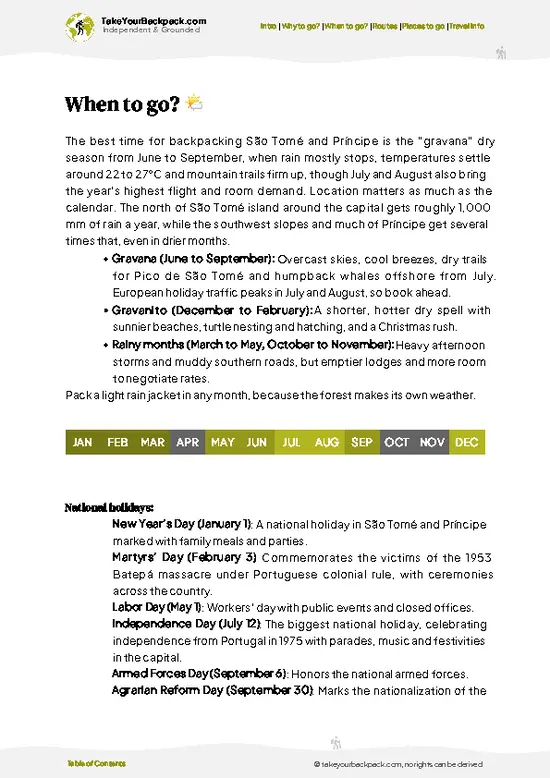
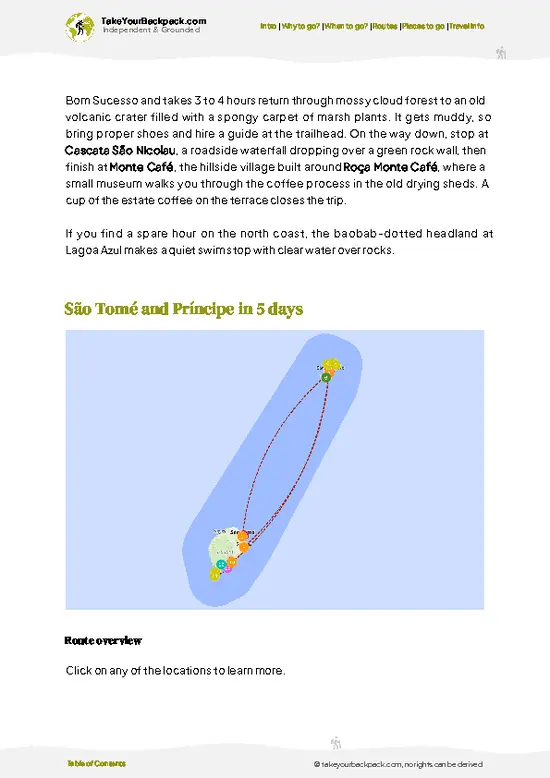
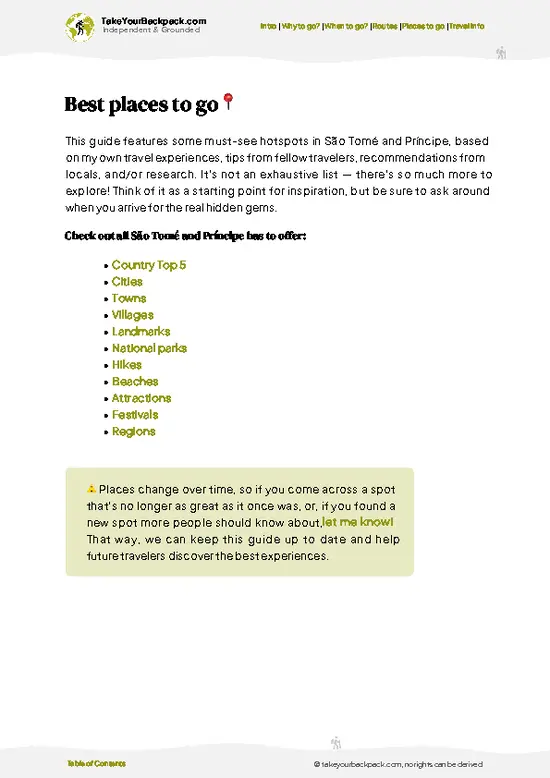
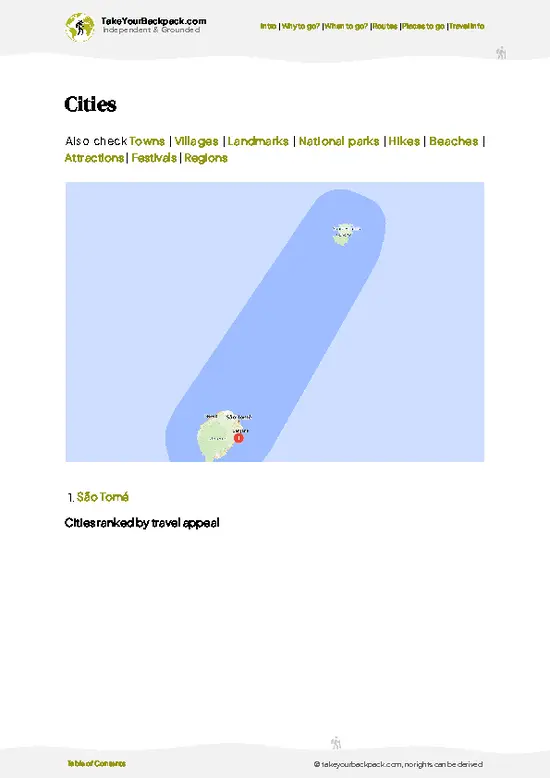
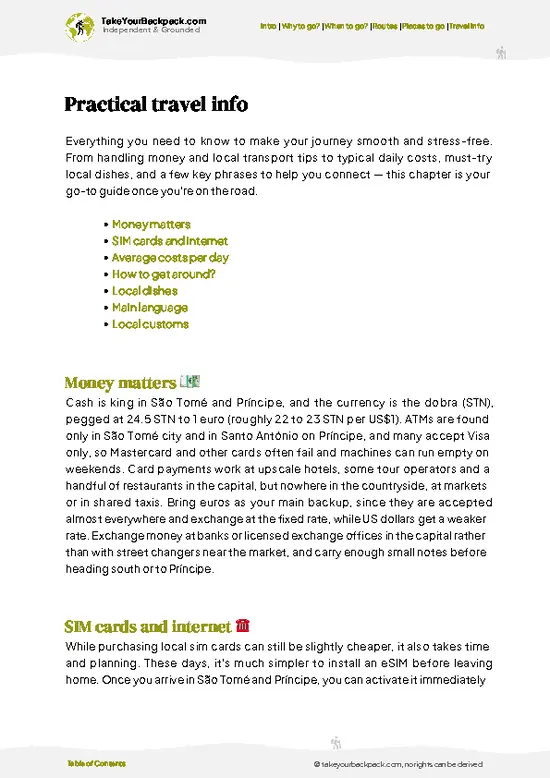
example page 0 from our offline Travel Guide for São Tomé and Príncipe
example page 1 from our offline Travel Guide for São Tomé and Príncipe
example page 2 from our offline Travel Guide for São Tomé and Príncipe
example page 3 from our offline Travel Guide for São Tomé and Príncipe
example page 4 from our offline Travel Guide for São Tomé and Príncipe
example page 5 from our offline Travel Guide for São Tomé and Príncipe
example page 6 from our offline Travel Guide for São Tomé and Príncipe
example page 7 from our offline Travel Guide for São Tomé and Príncipe
Loading the map 🌍
CLICK TO FILTER
cities
towns
villages
landmarks
national parks
hikes
beaches
attractions
festivals
regions
SHOW COUNTRY’S BESTSHOW ALL

✨ Why go?
Ranked #4 town in São Tomé and Príncipe
What sets this place apart

Santana suits the slow traveler who wants the east coast without the capital’s traffic. There is no checklist here. The draw is a working district town where fishing boats pulled onto the sand are part of the daily routine, and where you can watch the catch sold within minutes. It also sits close to the former plantation country of Cantagalo, so you can pair it with a day among the old roças, the colonial cocoa estates, whose crumbling workers’ housing explains the island’s history better than any museum. Most people stay one night. Linger for two if you like walking, photographing, or just talking with locals, since a few words of Portuguese go a long way. Hikers, solo travelers who like quiet, and anyone building a loop around the island’s east coast road will enjoy it. If you need hostels, … read more 👉
Santana suits the slow traveler who wants the east coast without the capital’s traffic. There is no checklist here. The draw is a working district town where fishing boats pulled onto the sand are part of the daily routine, and where you can watch the catch sold within minutes. It also sits close to the former plantation country of Cantagalo, so you can pair it with a day among the old roças, the colonial cocoa estates, whose crumbling workers’ housing explains the island’s history better than any museum. Most people stay one night. Linger for two if you like walking, photographing, or just talking with locals, since a few words of Portuguese go a long way. Hikers, solo travelers who like quiet, and anyone building a loop around the island’s east coast road will enjoy it. If you need hostels, bars and a crowd, stay in the capital and treat Santana as a short stop.

💡 HighlightsThe experiences that define the visit

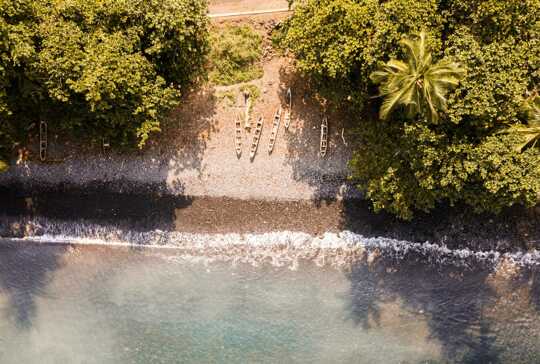
  1. Santana waterfront and fishing beach: The best-known scene here is canoes hauled up on dark sand and nets being untangled. Go early morning when the boats return. Free, 1 hour.
  2. Santana central market: Small and local, with bananas, breadfruit, cassava, dried and fresh fish, and chili paste. Mornings are liveliest. Bring small notes. Free to enter, 45 minutes.
  3. Igreja de Santana (parish church): The town’s main landmark, with a plain whitewashed look that fits the setting. Visit in the morning or late afternoon when the heat eases. Free, 20 minutes.
  4. Town square and main street: A walk past tin-roofed shops, kids playing football and men at domino tables shows daily life better than any sight. Late afternoon is best. Free, 1 hour.
Day trips from Santana can take in the old plantation buildings of … read more 👉
  1. Santana waterfront and fishing beach: The best-known scene here is canoes hauled up on dark sand and nets being untangled. Go early morning when the boats return. Free, 1 hour.
  2. Santana central market: Small and local, with bananas, breadfruit, cassava, dried and fresh fish, and chili paste. Mornings are liveliest. Bring small notes. Free to enter, 45 minutes.
  3. Igreja de Santana (parish church): The town’s main landmark, with a plain whitewashed look that fits the setting. Visit in the morning or late afternoon when the heat eases. Free, 20 minutes.
  4. Town square and main street: A walk past tin-roofed shops, kids playing football and men at domino tables shows daily life better than any sight. Late afternoon is best. Free, 1 hour.
Day trips from Santana can take in the old plantation buildings of Água Izé (Roça Agostinho Neto) in the Cantagalo area, the beaches of the south and the dramatic volcanic spire of Pico Cão Grande. Start with the waterfront at dawn, because the boats and the soft light are gone by mid-morning.
Spotted a mistake or missing something? Contact us.

Things to do near Santana

Ratings based on Tripadvisor reviews. When you book through this link, you support our work at no extra cost to you.

🏘️ NeighborhoodsHow different areas shape the experience

Santana is a small town on the northeast coast of São Tomé island, and everything worth seeing sits within a 20-minute walk of the main road. Distances are short because the town grew in a strip between the sea and the forested hills, so you rarely need a ride within it.
  • Main road and market area: This is the center, where motorbike taxis idle, grilled fish smoke drifts from roadside stalls and the pavement is cracked and warm by midday. Shops here sell phone credit, bread and fruit, so stock up early because stock thins by afternoon. Walk it in the cooler morning.
  • Waterfront and fishing beach: Painted canoes are hauled onto dark volcanic sand, and you hear gutting knives and shouted prices at dawn when the catch lands. Buy fish or ask for a plate cooked nearby, since few places have menus.
… read more 👉
Santana is a small town on the northeast coast of São Tomé island, and everything worth seeing sits within a 20-minute walk of the main road. Distances are short because the town grew in a strip between the sea and the forested hills, so you rarely need a ride within it.
  • Main road and market area: This is the center, where motorbike taxis idle, grilled fish smoke drifts from roadside stalls and the pavement is cracked and warm by midday. Shops here sell phone credit, bread and fruit, so stock up early because stock thins by afternoon. Walk it in the cooler morning.
  • Waterfront and fishing beach: Painted canoes are hauled onto dark volcanic sand, and you hear gutting knives and shouted prices at dawn when the catch lands. Buy fish or ask for a plate cooked nearby, since few places have menus. Swim with care, as currents can pull and there are no lifeguards.
  • Residential lanes inland: Houses on stilts and cocoa-drying yards give way to banana and breadfruit groves, with a damp, sweet smell after rain. Paths turn to red mud in wet months, so wear sandals you can rinse. Greet people, because a simple “bom dia” opens doors and gets you directions.
  • Edges toward the hills: The air cools and birdsong replaces engines. There is no nightlife anywhere in Santana, so evenings are quiet bars, music from a speaker and an early night.

⌛️ 1 dayA smart one-day plan

6:30 AM, Santana waterfront: Walk down to the shore as the canoes come in. Watch fishermen sort the catch and haul nets across the dark sand. Greet people first, and ask before photographing anyone.
8:00 AM, Breakfast near the market: Find a small stall or café for fried banana, eggs, bread and strong coffee. It is a short walk uphill from the beach.
9:00 AM, Santana central market: Browse the fruit, fish and spice stalls while trading is at its busiest. Buy a few bananas or a bag of roasted cocoa nibs to eat later.
10:30 AM, Igreja de Santana and the square: Walk to the church, then circle the square and the main street. Drop in on the shops and see how the town runs.
12:30 PM, Lunch: Eat grilled fish with rice, beans and cooked breadfruit at a local restaurant. Order whatever came in that morning. … read more 👉
6:30 AM, Santana waterfront: Walk down to the shore as the canoes come in. Watch fishermen sort the catch and haul nets across the dark sand. Greet people first, and ask before photographing anyone.
8:00 AM, Breakfast near the market: Find a small stall or café for fried banana, eggs, bread and strong coffee. It is a short walk uphill from the beach.
9:00 AM, Santana central market: Browse the fruit, fish and spice stalls while trading is at its busiest. Buy a few bananas or a bag of roasted cocoa nibs to eat later.
10:30 AM, Igreja de Santana and the square: Walk to the church, then circle the square and the main street. Drop in on the shops and see how the town runs.
12:30 PM, Lunch: Eat grilled fish with rice, beans and cooked breadfruit at a local restaurant. Order whatever came in that morning.
2:30 PM, Village backstreets (off the usual route): Walk the lanes behind the main road toward the old workers’ houses and small cocoa plots. You will see drying cocoa beans laid on mats and meet people who have little contact with visitors. Go in the cooler part of the afternoon and keep to marked paths.
5:00 PM, Return to the shore: Sit on the sand or a low wall as the light fades and the boats are readied for the night. Finish with a cold drink and a plate of local snacks.

🌤️ When to go?Best time to visit Santana

The dry season from June to September is the most comfortable window, with temperatures around 22 to 28°C (72 to 82°F) and noticeably less rain on the northeast coast.
  • Gravana (dry season, June to September): Cooler nights, firmer trails and calmer sea. Days feel breezy and overcast more than sunny. Flights and rooms rise slightly in July and August.
  • Main rains (October to May): Heavy showers, humidity and highs of 28 to 31°C (82 to 88°F). Trails turn to slick mud, but crowds are almost absent and prices are flat.
  • Short dry break (December to February): Lighter rain and warm sea around 27°C (81°F), good for beach days. Cocoa harvesting is active on nearby plantations in this period.
  • Daylight: Days stay close to 12 hours all year, so plan outings to finish before dusk.
Arrive in late June to catch … read more 👉
The dry season from June to September is the most comfortable window, with temperatures around 22 to 28°C (72 to 82°F) and noticeably less rain on the northeast coast.
  • Gravana (dry season, June to September): Cooler nights, firmer trails and calmer sea. Days feel breezy and overcast more than sunny. Flights and rooms rise slightly in July and August.
  • Main rains (October to May): Heavy showers, humidity and highs of 28 to 31°C (82 to 88°F). Trails turn to slick mud, but crowds are almost absent and prices are flat.
  • Short dry break (December to February): Lighter rain and warm sea around 27°C (81°F), good for beach days. Cocoa harvesting is active on nearby plantations in this period.
  • Daylight: Days stay close to 12 hours all year, so plan outings to finish before dusk.
Arrive in late June to catch drier weather before the peak July and August bookings.


source: climatestotravel.comJANJanuary: fair for travelingFEBFebruary: fair for travelingMARMarch: fair for travelingAPRApril: fair for travelingMAYMay: fair for travelingJUNJune: highly recommended for travelingJULJuly: highly recommended for travelingAUGAugust: highly recommended for travelingSEPSeptember: highly recommended for travelingOCTOctober: fair for travelingNOVNovember: fair for travelingDECDecember: fair for traveling
when-to-go

✈️ The backpacker research shortcutSão Tomé and Príncipe Travel Guide

An offline-friendly backpacking guide with optimized travel routes, ranked highlights, transport advice, and the best areas to stay.
example page 0 from our offline Travel Guide for São Tomé and Príncipe
example page 1 from our offline Travel Guide for São Tomé and Príncipe
example page 2 from our offline Travel Guide for São Tomé and Príncipe
example page 3 from our offline Travel Guide for São Tomé and Príncipe
example page 4 from our offline Travel Guide for São Tomé and Príncipe
example page 5 from our offline Travel Guide for São Tomé and Príncipe
example page 6 from our offline Travel Guide for São Tomé and Príncipe
example page 7 from our offline Travel Guide for São Tomé and Príncipe
The digital guide (151 pages) contains:
✅ 38 highlights, ranked by travel appeal
✅ Optimized 2, 3 & 5-day travel routes
✅ Cities, national parks, landmarks, beaches
✅ How to get around
✅ Offline-friendly for travel without Wi-Fi
👉 Click to see all 30+ guide features

📅 Plan smarter in minutes, not weeks
✅ Month by month travel advice
✅ Festivals & national holidays
✅ Budget expectations

🗺️ Go to the right places, skip the overrated ones
✅ Honest pros & cons of destinations
✅ Top hikes, parks & viewpoints
✅ Lesser-known places most travelers miss
✅ Clear “worth it vs skip it” guidance

🛏️ Travel smoothly without rookie mistakes
✅ Best areas to stay
✅ Transport systems explained simply
✅ Common scams & safety advice
✅ SIM cards, money & practical tips

🌍 Understand the country, not just visit it
✅ Culture & traditions
✅ 52 Essential phrases & customs
✅ Festivals worth planning around
✅ Traveler-friendly historical context
✅ Insights that make places more meaningful

📱 Built for real travel conditions
✅ Fully downloadable PDF
✅ Works completely offline
✅ Optimized for phone use
✅ Useful in remote areas & buses
✅ Everything in one place
Stop searching, start planning
Get instant access to your full guide. 30‑day money-back guarantee.
+ Add another guide for just

By proceeding you agree to our terms.
Sent to your inbox immediately after payment • 100% Secure Checkout
Best Backpacking Travel Advisor 2025 tourism awardBest Backpacking
Travel Advisor
2025
What others say about Take Your Backpack Guides:
⭐⭐⭐⭐⭐
Fantastic, amazing amount of information!
⭐⭐⭐⭐⭐
My goodness this is amazing, it's what I've been looking for hats off too you!
⭐⭐⭐⭐⭐
I think this is absolutely BRILLIANT
⭐⭐⭐⭐
Very complete and informative. It's still missing places, but I gotta to commend you
⭐⭐⭐⭐⭐
This is truly amazing, thank you, can't wait to explore it with my kids!
⭐⭐⭐⭐⭐
Awesome resource, thank you!
⭐⭐⭐⭐⭐
This is amazing! Can't wait to explore the ones I haven't seen
⭐⭐⭐⭐
I love this! Well done, great idea.
⭐⭐⭐⭐⭐
Thanks for taking the time to make this gem!
⭐⭐⭐⭐⭐
This might be the best website I've ever seen.
⭐⭐⭐⭐⭐
Congratulations, and thank you so much for your work; it's incredibly valuable.
⭐⭐⭐⭐
In all seriousness I think you did a great job pointing out the important spots
⭐⭐⭐⭐⭐
10/10 very good
⭐⭐⭐⭐⭐
As someone who's only just starting to visit regularly this is awesome, thank you.
⭐⭐⭐⭐
Thank you very much! I'm going to visit my dad, it's going to be very useful!
⭐⭐⭐⭐⭐
This is really cool! We'll be travelling for the first time and this definitely come in handy.
⭐⭐⭐⭐⭐
You are now our minister of culture, congratulations 👨‍💼
⭐⭐⭐⭐⭐
Just wanted to tell you that this is a pearl! Going to follow your recommendations.
⭐⭐⭐⭐⭐
This is so cool. I'll definitely be using the resource for my travels soon.
⭐⭐⭐⭐⭐
This is very impressive! Good work.
⭐⭐⭐⭐⭐
This is an amazing and informative site. Very well done!

🛏️ Where to stay?Best areas to stay in São Tomé and Príncipe

The center of Santana along the main road is the best spot for a budget stay, with the market, food stalls and transport pickup points all a short walk away. Budget beds here are mostly simple guesthouses and family-run rooms rather than traditional hostels, so dorm options are rare and a private room is the usual choice. Nights are quiet, though roosters, motorbikes and music from a nearby bar can start early or run late, so bring earplugs.

The quieter stretch toward the fishing beach is the second option. It is calmer after dark, with sea sound at night, and you stay within walking distance … read more 👉
The center of Santana along the main road is the best spot for a budget stay, with the market, food stalls and transport pickup points all a short walk away. Budget beds here are mostly simple guesthouses and family-run rooms rather than traditional hostels, so dorm options are rare and a private room is the usual choice. Nights are quiet, though roosters, motorbikes and music from a nearby bar can start early or run late, so bring earplugs.

The quieter stretch toward the fishing beach is the second option. It is calmer after dark, with sea sound at night, and you stay within walking distance of the center. Lighting is limited on side lanes, so carry a headlamp for the walk back. Rooms nearer the water can be damp, so check for fans or nets.

Book ahead in July and August, since limited supply fills quickly. Outside those months, walking in and negotiating usually gets a better rate. Transport links are best from the main road, where shared taxis to the capital pass and stop.

🚌 Getting aroundTransportation options and practical tips

Walking is the easiest way to move around Santana, because the center, market and fishing beach all sit within about 1.5 km (1 mile) of each other. Traffic is light, mostly motorbikes and shared vans, and public transport is informal, so timing depends on when vehicles fill.
  • Walking: Free, and best before 10 a.m. when the heat is mild. Pavement ends quickly, so you share the road with motorbikes. Carry water, because shade is patchy on the main road.
  • Motorbike taxis: Cost about €0.50 to 2 for short hops around town and out to nearby villages. They are fast and loud, with the smell of exhaust and wet earth after rain. Agree the fare before getting on, since there are no meters, and ask for a helmet.
  • Shared taxis (candongueiros): These are open-bed trucks or minibuses running along the coastal
… read more 👉
Walking is the easiest way to move around Santana, because the center, market and fishing beach all sit within about 1.5 km (1 mile) of each other. Traffic is light, mostly motorbikes and shared vans, and public transport is informal, so timing depends on when vehicles fill.
  • Walking: Free, and best before 10 a.m. when the heat is mild. Pavement ends quickly, so you share the road with motorbikes. Carry water, because shade is patchy on the main road.
  • Motorbike taxis: Cost about €0.50 to 2 for short hops around town and out to nearby villages. They are fast and loud, with the smell of exhaust and wet earth after rain. Agree the fare before getting on, since there are no meters, and ask for a helmet.
  • Shared taxis (candongueiros): These are open-bed trucks or minibuses running along the coastal road toward São Tomé city, about 30 to 40 km (19 to 25 miles) away, for roughly €1 to 2.50. They leave when full, usually from early morning until mid-afternoon, and ride packed with sacks and chatter. Go in the morning, since afternoon departures dry up.
  • Private taxi: A car with driver for the run to the capital or its airport costs around €25 to 40, depending on your bargaining and the day. It is the sensible choice with a big pack or an early flight, as roads wind and potholes slow progress to 1 to 1.5 hours.
Small change helps, because drivers rarely break large notes. Roads wash out in heavy rain, so ask locals about conditions before heading anywhere distant.

👛 Costs (as of 22 October 2026)How expensive it really is

Santana costs a backpacker about €36 per day in high season, with simple rooms and local food keeping spending low.
CategoryBudget RangeLocal Reality
Dorm accommodation€10 to 18 (high season); €8 to 14 (low season)Dorms are rare, so a basic private guesthouse room is the norm. Prices climb in July and August.
Meals€8 to 14Grilled fish, rice and cassava at local stalls cost €2 to 5. Tourist-oriented restaurants cost more.
Local transport€2 to 5Motorbike taxis and shared vans cover the coast. Private cars cost far more.
Basic activities/entry fees€3 to 8Most beaches and walks are free. Guides, plantation visits and museum fees add up.
Miscellaneous expenses€2 to 4Water, phone credit and snacks. Cash is needed, as machines are scarce.
Total Daily Budget€36Based on one high-season room and local eating.
… read more 👉
Santana costs a backpacker about €36 per day in high season, with simple rooms and local food keeping spending low.
CategoryBudget RangeLocal Reality
Dorm accommodation€10 to 18 (high season); €8 to 14 (low season)Dorms are rare, so a basic private guesthouse room is the norm. Prices climb in July and August.
Meals€8 to 14Grilled fish, rice and cassava at local stalls cost €2 to 5. Tourist-oriented restaurants cost more.
Local transport€2 to 5Motorbike taxis and shared vans cover the coast. Private cars cost far more.
Basic activities/entry fees€3 to 8Most beaches and walks are free. Guides, plantation visits and museum fees add up.
Miscellaneous expenses€2 to 4Water, phone credit and snacks. Cash is needed, as machines are scarce.
Total Daily Budget€36Based on one high-season room and local eating.
Buy fish straight from the canoes at the beach and have a stall cook it, which costs far less than a restaurant meal.


source: visitstp.org
⚠️ Prices can change and everyone travels differently, so take this as a rough guide. Hope it helps you plan your adventure!

🚌 Day tripsExploring the surroundings

Santana works well as a base for day trips because the coastal road gives easy access to the north and the capital, though you rely on shared taxis and motorbikes, so start early.
São Tomé city:
The capital, about 1 to 1.5 hours away, has the market, the old Portuguese fort and the National Museum. Expect €3 to 6 for round-trip transport and a modest meal, plus a small museum fee. Go on a weekday morning, because the market quiets by afternoon. First-timers often leave too late and miss the last shared ride back.
👉 Explore São Tomé
Lagoa Azul:
This bright blue bay to the north suits snorkeling and a long lunch of grilled fish. Count on €6 to 12 including transport, depending on whether you hire a motorbike or car. Dry season brings the clearest water. Bring your own mask, since rentals are scarce. … read more 👉
Santana works well as a base for day trips because the coastal road gives easy access to the north and the capital, though you rely on shared taxis and motorbikes, so start early.
São Tomé city:
The capital, about 1 to 1.5 hours away, has the market, the old Portuguese fort and the National Museum. Expect €3 to 6 for round-trip transport and a modest meal, plus a small museum fee. Go on a weekday morning, because the market quiets by afternoon. First-timers often leave too late and miss the last shared ride back.
👉 Explore São Tomé
Lagoa Azul:
This bright blue bay to the north suits snorkeling and a long lunch of grilled fish. Count on €6 to 12 including transport, depending on whether you hire a motorbike or car. Dry season brings the clearest water. Bring your own mask, since rentals are scarce.
👉 Explore Lagoa Azul
Roça Água Izé:
This former cocoa plantation to the south shows crumbling colonial buildings and workers’ housing, with the smell of drying cocoa in the yard. Transport takes around 1.5 to 2 hours each way, and costs about €8 to 15 round trip by shared taxi or €30 or more by private car. Go on a clear morning, and carry cash since there are no machines nearby.

Boca do Inferno:
At this blowhole on the coast, waves surge through a rock cleft and spray high. It lies on the road toward the capital, so combine it with a city trip for about €2 to 5 extra. Visit at high tide and keep well back from the wet rocks.

🛡️ SafetyScams, Hazards, and Annoyances

Santana is broadly safe, and most problems are minor: opportunistic theft of phones or cash left unattended, mostly in the market and on the beach. Keep valuables out of sight, leave spare cash in your room and carry only what you need for the day. Solo travelers, including women, usually find people friendly and curious, though persistent attention can happen, and a calm, firm refusal works. After dark, side lanes have little lighting, so carry a headlamp and avoid walking alone on the beach or the edges of town late at night. A motorbike taxi home is cheap. Scams are uncommon, but prices for foreigners can rise, so agree fares and meal costs first. Strong currents at the fishing beach are a bigger risk than crime, and there are no lifeguards. Mosquitoes carry malaria, so use repellent and … read more 👉
Santana is broadly safe, and most problems are minor: opportunistic theft of phones or cash left unattended, mostly in the market and on the beach. Keep valuables out of sight, leave spare cash in your room and carry only what you need for the day. Solo travelers, including women, usually find people friendly and curious, though persistent attention can happen, and a calm, firm refusal works. After dark, side lanes have little lighting, so carry a headlamp and avoid walking alone on the beach or the edges of town late at night. A motorbike taxi home is cheap. Scams are uncommon, but prices for foreigners can rise, so agree fares and meal costs first. Strong currents at the fishing beach are a bigger risk than crime, and there are no lifeguards. Mosquitoes carry malaria, so use repellent and check with a doctor about prophylaxis before you go.

FAQFrequently asked questions about Santana

Santana is worth a short stop rather than a long stay, mainly for its working fishing beach, quiet pace and easy access to the northeast coast. Fishing boats land the catch at dawn, and the town is a calm alternative to the capital. Pair it with Lagoa Azul and the coastal road for a fuller trip.
Santana needs one to two days. One day covers the market, the fishing beach and a walk through the inland lanes, and a second allows a trip to Lagoa Azul or Boca do Inferno. Staying longer only makes sense if you want a very slow stretch by the sea.
Santana can be done as a day trip from São Tomé city, which is roughly 30 to 40 km (19 to 25 miles) away and 1 to 1.5 hours by road. Shared taxis cost about €1 to 2.50, while a private taxi runs around €25 to 40 round trip. Leave early, because shared rides back thin out in the afternoon.
⚠️ Things can change over time, so always validate details locally before you go.

Other São Toméan towns near Santana

Explore more nearby:

  • Trindade—Cool hill air, red-mud streets, Sunday mass, cacao drying| 8 km away
  • São João dos Angolares—Fish landing, cocoa plantation lanes, family-run lunch, basic guesthouses| 17 km away
  • Guadalupe—North coast road, black-sand shore, morning fish stalls, minibus stop| 18 km away

💡 Not sure where to go next?
Create a personalized itinerary for São Tomé and Príncipe including Santana and the places that fit your trip.

Generate my itinerary

👉 Discover all towns

Or checkout all São Tomé and Príncipe has to offer (think cities, towns, villages, national parks, hikes, beaches, festivals)
Country photo of São Tomé and Príncipe

We 💚 feedbackKey takeaways before you go

Santana deserves one night, two if you want to explore the roça country around it. One night gives you a dawn at the fishing beach and an evening of nothing in particular. I would bring cash in small notes, a headlamp for power cuts and a rain jacket, and skip rushing through on a tight schedule.

✍️ Help improve this page!
The information on this page is based on in-depth research, insights shared by experienced travelers, and feedback from the local travel community in São Tomé and Príncipe. While every effort is made to keep the information accurate and current, conditions can change — so if you spot anything incorrect or outdated, please get in touch.


🙋‍♂️ Give feedback

👋 Meet the founderWho’s Behind Take Your Backpack?

Johan, backpacker and founder of TakeYourBackpackHi, I’m Johan (Netherlands 🇳🇱), the creator of TakeYourBackpack. Over the past 3 decades, I’ve backpacked through 90+ countries across six continents, gaining extensive experience with independent travel, long-term trips, and overland routes.

This site is built on a combination of firsthand travel experience and carefully curated insights from other backpackers. Many guides are based on places I’ve personally visited, while others bring together tips, observations, and practical advice shared by trusted travelers I’ve met along the way.

The goal is to provide realistic, experience-driven guidance — not generic itineraries — so you can explore destinations with better context, clearer expectations, and more confidence.