×

São Tomé and Príncipe🇸🇹 | townsTrindadeCool hill air, red-mud streets, Sunday mass, cacao drying | things to do and best time to go

Explore São João dos AngolaresExplore Santana

Backpacking in Trindade
👍 Recommendedtown ranked #5
By Johan Kruseman 🇳🇱 | Updated October 22, 2026

Trindade is a hill town about 300 meters above sea level, so the air is cooler and wetter than at the beach. It sits in the north of São Tomé and Príncipe, southwest of São Tomé city along the road that climbs toward the coffee estates. Minibuses honk, the market smells of fried fish, ripe bananas and wet earth, and rain can turn the red-brown side streets to slick mud. Beds are scarce, there is no hostel scene and nights end early, so you will mostly meet other travelers on the road, not in town. In return you get a real working Santomean town, a fast hop to Monte Café and the botanical garden, and plenty of conversation over a coffee at a roadside stall. Slow travelers and hikers will like it most. Anyone after beaches, nightlife or polished facilities won’t.

Discover everything you want to know in the 📖 São Tomé and Príncipe Travel Guide.


example page 0 from our offline Travel Guide for São Tomé and Príncipe
example page 1 from our offline Travel Guide for São Tomé and Príncipe
example page 2 from our offline Travel Guide for São Tomé and Príncipe
example page 3 from our offline Travel Guide for São Tomé and Príncipe
example page 4 from our offline Travel Guide for São Tomé and Príncipe
example page 5 from our offline Travel Guide for São Tomé and Príncipe
example page 6 from our offline Travel Guide for São Tomé and Príncipe
example page 7 from our offline Travel Guide for São Tomé and Príncipe
Loading the map 🌍
CLICK TO FILTER
cities
towns
villages
landmarks
national parks
hikes
beaches
attractions
festivals
regions
SHOW COUNTRY’S BESTSHOW ALL

✨ Why go?
Ranked #5 town in São Tomé and Príncipe
Why visitors keep coming back

Trindade works as a foothold in the island’s green interior, a place to pause for a night or two without paying capital prices. Its main use is access: the shaded plantation roads of the old roças start nearby, along with the road up to Monte Café and the cool slopes of Bom Sucesso. You can go out in the morning, when the cloud is still off the ridges, and return for lunch among locals. Few places in town cater to backpackers, so you eat what residents eat: grilled fish, breadfruit, cassava, and cheap beer in a plastic chair. Lingering suits slow travelers, hikers and solo visitors who like speaking Portuguese with strangers, since the pace is gentle and people are curious. Small groups can hire a local driver for the hill roads. If you need a social hostel or a sunset bar, stay in the capital and treat Trindade as a day out.

💡 HighlightsEssential experiences to have while visiting Trindade

  1. Igreja de Trindade and the central square. The church and the open space around it form the town’s social center, with schoolchildren in uniform, men playing cards and motorbike taxis idling in the shade. Come on a Sunday morning, when mass spills sound into the street and people dress up. Entry is free and 30 to 45 minutes is plenty, longer if you sit with a coffee.
  2. Trindade Market. This is the most useful stop for understanding daily life here: pyramids of tomatoes and peppers, hands of tiny sweet bananas, dried fish, palm oil in recycled bottles and cacao beans laid out to buy. Go in the morning before about 11:00, when stock is freshest and the aisles are busiest. It costs nothing to wander, small snacks run about €0.50 to 2, and an hour is enough. Ask before photographing sellers.
  3. The main
… read more 👉
  1. Igreja de Trindade and the central square. The church and the open space around it form the town’s social center, with schoolchildren in uniform, men playing cards and motorbike taxis idling in the shade. Come on a Sunday morning, when mass spills sound into the street and people dress up. Entry is free and 30 to 45 minutes is plenty, longer if you sit with a coffee.
  2. Trindade Market. This is the most useful stop for understanding daily life here: pyramids of tomatoes and peppers, hands of tiny sweet bananas, dried fish, palm oil in recycled bottles and cacao beans laid out to buy. Go in the morning before about 11:00, when stock is freshest and the aisles are busiest. It costs nothing to wander, small snacks run about €0.50 to 2, and an hour is enough. Ask before photographing sellers.
  3. The main street walk. The road through Trindade is a lesson in the island’s layers: faded colonial buildings with peeling pastel paint, tin-roofed houses on stilts, cacao drying on tarps and glimpses of forest behind the rooftops. Early morning is best, when the air is cool and misty, and late afternoon works too if the rain holds off. It is free and takes 1 to 1.5 hours at an unhurried pace, with stops for a fresh bread roll or a cup of local coffee for under €1.
Beyond town, the coffee estate of Monte Café with its small museum, the Bom Sucesso botanical garden, the crater lake of Lagoa Amélia and the old plantation of Roça Bela Vista make good day trips from Trindade. All of the sights in town together take about half a day.
Spotted a mistake or missing something? Contact us.

Things to do near Trindade

Ratings based on Tripadvisor reviews. When you book through this link, you support our work at no extra cost to you.

🏘️ NeighborhoodsUnderstanding the local layout

Trindade is small enough to read in an afternoon, and its areas blur into each other along the main road that runs toward the capital.
  • Town center and main road: Low colonial-era buildings, a market area and a few shops line the strip. Motorbike taxis whine past, roosters answer from every yard, and the smell of grilled fish and frying bananas drifts out at midday. Everything is walkable in 15 minutes, and you leave with a cheap plate of fish and rice eaten at a plastic table.
  • Roça Trindade area: The old plantation buildings sit just off the center, with weathered facades, peeling paint and wide courtyards where children play football. Walk it in the morning before the heat flattens you. You get the clearest picture of the cocoa past, framed by green hills.
  • Coast to the north and east: Short
… read more 👉
Trindade is small enough to read in an afternoon, and its areas blur into each other along the main road that runs toward the capital.
  • Town center and main road: Low colonial-era buildings, a market area and a few shops line the strip. Motorbike taxis whine past, roosters answer from every yard, and the smell of grilled fish and frying bananas drifts out at midday. Everything is walkable in 15 minutes, and you leave with a cheap plate of fish and rice eaten at a plastic table.
  • Roça Trindade area: The old plantation buildings sit just off the center, with weathered facades, peeling paint and wide courtyards where children play football. Walk it in the morning before the heat flattens you. You get the clearest picture of the cocoa past, framed by green hills.
  • Coast to the north and east: Short rides lead to rocky shoreline and small black-sand coves. The surf is loud, the sand is hot underfoot and shade is scarce, so bring water. You get a swim with almost nobody around.
  • Hillside lanes: Dirt tracks climb behind town through banana and cocoa trees. Mud is part of the deal after rain, and the air smells of wet leaves and fermenting fruit. At the top you get a view over the roofs to the sea.

⌛️ 1 day1-day itinerary for Trindade

8:00 AM: Trindade Market. Start here, before anything else, because this is where the town is at its most alive. Walk the stalls for pepper, cassava and tiny bananas, buy a fresh bread roll and eat it standing among the sellers. The noise and smell tell you more than any sign.
9:30 AM: Central square and church. Cross the road to the square and sit in the shade with a small strong coffee. Step inside the church if it is open, then watch the motorbike taxis and school groups come and go.
11:00 AM: Main street walk. Follow the main road uphill at a slow pace, past pastel colonial buildings and cacao drying on tarps. Branch down a side lane to see ordinary homes and gardens with coffee and banana plants. The forest closes in quickly, and the air gets cooler.
1:00 PM: Lunch at a local eatery. Pick … read more 👉
8:00 AM: Trindade Market. Start here, before anything else, because this is where the town is at its most alive. Walk the stalls for pepper, cassava and tiny bananas, buy a fresh bread roll and eat it standing among the sellers. The noise and smell tell you more than any sign.
9:30 AM: Central square and church. Cross the road to the square and sit in the shade with a small strong coffee. Step inside the church if it is open, then watch the motorbike taxis and school groups come and go.
11:00 AM: Main street walk. Follow the main road uphill at a slow pace, past pastel colonial buildings and cacao drying on tarps. Branch down a side lane to see ordinary homes and gardens with coffee and banana plants. The forest closes in quickly, and the air gets cooler.
1:00 PM: Lunch at a local eatery. Pick a simple place filled with residents and order grilled fish with breadfruit or rice and beans. Eat slowly, since service is unhurried and the rain often arrives around now.
3:00 PM: Back lanes beyond the center. Skip the standard circuit and wander the quieter paths on the edge of town, where farm plots, small chapels and drying racks sit among banana trees. People will greet you, and a few words of Portuguese go a long way. Return to the main road by late afternoon to catch a ride back before dusk.

🌤️ When to go?Choosing the right time of year

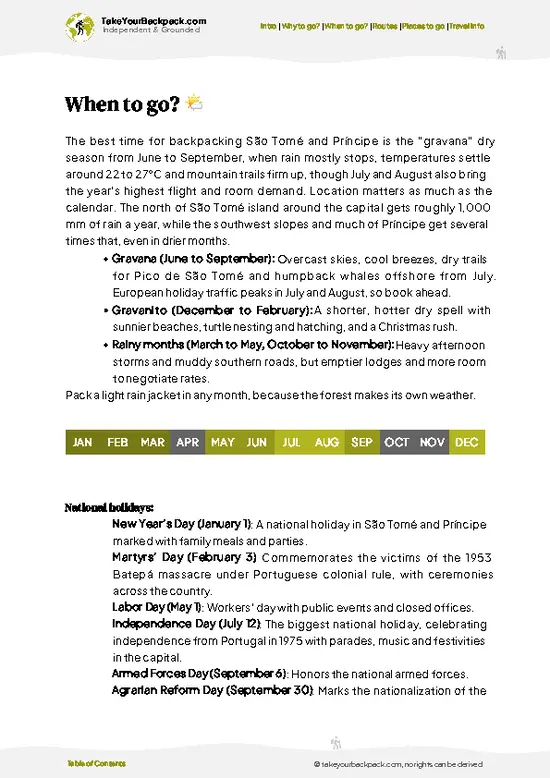
The dry season, gravana, from June to September gives the easiest weather for backpacking around Trindade.
  • Gravana (June to September): Mostly dry and cooler, about 22 to 28°C (72 to 82°F), with gray skies and breezy mornings. Roads stay passable and hikes are firmer underfoot. Flights and rooms book up a little around July and August.
  • Main rains (October to May): Warm and humid, 24 to 31°C (75 to 88°F), with heavy afternoon downpours that turn dirt tracks to mud. Prices stay low and the hills are intensely green.
  • Short dry spell (January to February): Rain eases and the sun is stronger, making it a fine window for beaches.
  • Daylight: Days run close to 12 hours all year, so plan hikes to finish by late afternoon.
Book your return flight early if you travel in July or August.

source: climatestotravel.comJANJanuary: fair for travelingFEBFebruary: fair for travelingMARMarch: fair for travelingAPRApril: fair for travelingMAYMay: highly recommended for travelingJUNJune: excellent for travelingJULJuly: excellent for travelingAUGAugust: excellent for travelingSEPSeptember: highly recommended for travelingOCTOctober: fair for travelingNOVNovember: fair for travelingDECDecember: fair for traveling
when-to-go

✈️ The backpacker research shortcutSão Tomé and Príncipe Travel Guide

An offline-friendly backpacking guide with optimized travel routes, ranked highlights, transport advice, and the best areas to stay.
example page 0 from our offline Travel Guide for São Tomé and Príncipe
example page 1 from our offline Travel Guide for São Tomé and Príncipe
example page 2 from our offline Travel Guide for São Tomé and Príncipe
example page 3 from our offline Travel Guide for São Tomé and Príncipe
example page 4 from our offline Travel Guide for São Tomé and Príncipe
example page 5 from our offline Travel Guide for São Tomé and Príncipe
example page 6 from our offline Travel Guide for São Tomé and Príncipe
example page 7 from our offline Travel Guide for São Tomé and Príncipe
The digital guide (151 pages) contains:
✅ 38 highlights, ranked by travel appeal
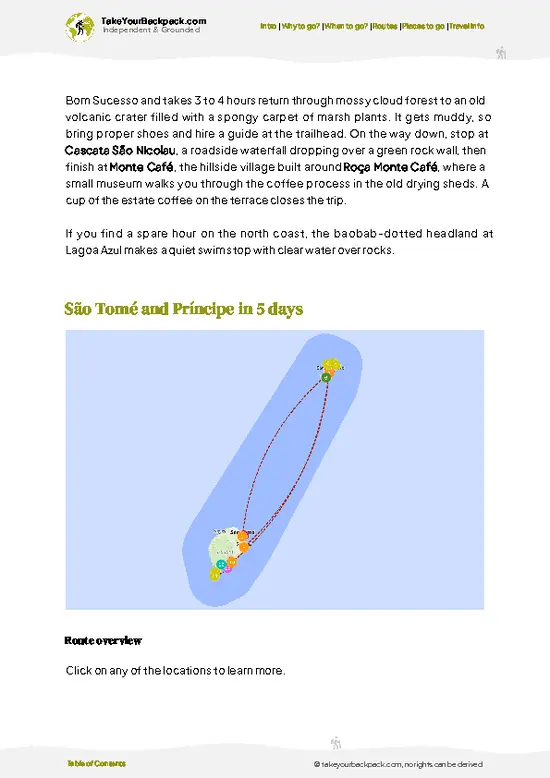
✅ Optimized 2, 3 & 5-day travel routes
✅ Cities, national parks, landmarks, beaches
✅ How to get around
✅ Offline-friendly for travel without Wi-Fi
👉 Click to see all 30+ guide features

📅 Plan smarter in minutes, not weeks
✅ Month by month travel advice
✅ Festivals & national holidays
✅ Budget expectations

🗺️ Go to the right places, skip the overrated ones
✅ Honest pros & cons of destinations
✅ Top hikes, parks & viewpoints
✅ Lesser-known places most travelers miss
✅ Clear “worth it vs skip it” guidance

🛏️ Travel smoothly without rookie mistakes
✅ Best areas to stay
✅ Transport systems explained simply
✅ Common scams & safety advice
✅ SIM cards, money & practical tips

🌍 Understand the country, not just visit it
✅ Culture & traditions
✅ 52 Essential phrases & customs
✅ Festivals worth planning around
✅ Traveler-friendly historical context
✅ Insights that make places more meaningful

📱 Built for real travel conditions
✅ Fully downloadable PDF
✅ Works completely offline
✅ Optimized for phone use
✅ Useful in remote areas & buses
✅ Everything in one place
Stop searching, start planning
Get instant access to your full guide. 30‑day money-back guarantee.
+ Add another guide for just

By proceeding you agree to our terms.
Sent to your inbox immediately after payment • 100% Secure Checkout
Best Backpacking Travel Advisor 2025 tourism awardBest Backpacking
Travel Advisor
2025
What others say about Take Your Backpack Guides:
⭐⭐⭐⭐⭐
Fantastic, amazing amount of information!
⭐⭐⭐⭐⭐
My goodness this is amazing, it's what I've been looking for hats off too you!
⭐⭐⭐⭐⭐
I think this is absolutely BRILLIANT
⭐⭐⭐⭐
Very complete and informative. It's still missing places, but I gotta to commend you
⭐⭐⭐⭐⭐
This is truly amazing, thank you, can't wait to explore it with my kids!
⭐⭐⭐⭐⭐
Awesome resource, thank you!
⭐⭐⭐⭐⭐
This is amazing! Can't wait to explore the ones I haven't seen
⭐⭐⭐⭐
I love this! Well done, great idea.
⭐⭐⭐⭐⭐
Thanks for taking the time to make this gem!
⭐⭐⭐⭐⭐
This might be the best website I've ever seen.
⭐⭐⭐⭐⭐
Congratulations, and thank you so much for your work; it's incredibly valuable.
⭐⭐⭐⭐
In all seriousness I think you did a great job pointing out the important spots
⭐⭐⭐⭐⭐
10/10 very good
⭐⭐⭐⭐⭐
As someone who's only just starting to visit regularly this is awesome, thank you.
⭐⭐⭐⭐
Thank you very much! I'm going to visit my dad, it's going to be very useful!
⭐⭐⭐⭐⭐
This is really cool! We'll be travelling for the first time and this definitely come in handy.
⭐⭐⭐⭐⭐
You are now our minister of culture, congratulations 👨‍💼
⭐⭐⭐⭐⭐
Just wanted to tell you that this is a pearl! Going to follow your recommendations.
⭐⭐⭐⭐⭐
This is so cool. I'll definitely be using the resource for my travels soon.
⭐⭐⭐⭐⭐
This is very impressive! Good work.
⭐⭐⭐⭐⭐
This is an amazing and informative site. Very well done!

🛏️ Where to stay?Where staying makes the most sense

The best budget base for Trindade is the town center near the main road, with the capital as a backup if you want more choice. Rooms in the center are mostly simple guesthouses and homestays, and dorm beds are rare, so expect private rooms at roughly €15 to 30 a night. The location puts you steps from the market, eating spots and the minibus stop. Nights are quiet apart from roosters, dogs and the occasional motorbike, and the streets are calm after dark, though a flashlight helps on unlit stretches.
São Tomé city, a short ride away, has the widest range of hostels and budget rooms, plus restaurants, … read more 👉
The best budget base for Trindade is the town center near the main road, with the capital as a backup if you want more choice. Rooms in the center are mostly simple guesthouses and homestays, and dorm beds are rare, so expect private rooms at roughly €15 to 30 a night. The location puts you steps from the market, eating spots and the minibus stop. Nights are quiet apart from roosters, dogs and the occasional motorbike, and the streets are calm after dark, though a flashlight helps on unlit stretches.
São Tomé city, a short ride away, has the widest range of hostels and budget rooms, plus restaurants, banks and onward transport. It is louder, with traffic and late bars, but you can easily return to Trindade by shared minibus for the day. Book ahead in July and August, when beds fill.

🚌 Getting aroundMoving around without the hassle

Trindade’s center is walkable end to end in 15 minutes, but walking stops making sense once you head for the coast, the hills or the capital, where heat and distance take over. The main road is paved and shared by motorbikes, minibuses and the odd truck, while side lanes turn to red mud in the rains. Public transport is informal and runs when it fills.
  • Walking: Free and the best way to see the old plantation buildings and market. Go early, when the air is cool and smells of woodsmoke and coffee. You get to stop at any stall you like.
  • Shared minibus (candongueiro): The cheap link toward São Tomé city, roughly €0.50 to 1 for the ride of about 20 to 30 minutes. Vehicles leave when full, mostly from early morning until late afternoon, and you sit tightly packed with locals and bags. You arrive having
… read more 👉
Trindade’s center is walkable end to end in 15 minutes, but walking stops making sense once you head for the coast, the hills or the capital, where heat and distance take over. The main road is paved and shared by motorbikes, minibuses and the odd truck, while side lanes turn to red mud in the rains. Public transport is informal and runs when it fills.
  • Walking: Free and the best way to see the old plantation buildings and market. Go early, when the air is cool and smells of woodsmoke and coffee. You get to stop at any stall you like.
  • Shared minibus (candongueiro): The cheap link toward São Tomé city, roughly €0.50 to 1 for the ride of about 20 to 30 minutes. Vehicles leave when full, mostly from early morning until late afternoon, and you sit tightly packed with locals and bags. You arrive having heard half the town’s news.
  • Motorbike taxi: €0.50 to 2 for short hops to beaches or hillside lanes. Agree on the price first and hold on over the potholes. You reach coves buses never touch.
  • Taxi or hired car with driver: About €30 to 50 for a day of touring, more for long trips. Good for reaching waterfalls and plantations in comfort, with air to cool you down between stops.

👛 Costs (as of 22 October 2026)Travel costs and budget guide for Trindade

Trindade costs about €42 a day for a backpacker who eats local and uses shared transport. The island is not the cheapest in Africa because many goods are imported.
CategoryBudget RangeLocal Reality
Dorm accommodation€15 to 25Dorms are rare, so a simple private room is the norm and costs more in July and August.
Meals€8 to 14Grilled fish, rice and bananas at small local spots cost far less than restaurant meals.
Local transport€1 to 4Shared minibuses cost under €1, and motorbike taxis are €0.50 to 2 per hop.
Basic activities/entry fees€2 to 6Plantation visits and waterfalls charge small fees, while beaches are free.
Miscellaneous expenses€3 to 5Water, snacks, repellent and the odd tip.
Total Daily Budget€42A comfortable, simple day.
Buy fruit and bread at the market and eat your main meal at a local counter to save a few euros a day.
⚠️ Prices can change and everyone travels differently, so take this as a rough guide. Hope it helps you plan your adventure!

🚌 Day tripsShort trips worth adding

Trindade works well as a base because the island is small and most sights are one to two hours away.São Tomé city: Colonial buildings, the fortress and the waterfront market make an easy half-day. The shared minibus takes about 30 minutes and costs under €1 each way. Go on a weekday morning and carry small notes for the market.
👉 Explore São ToméBoa Entrada and Roça São João: Wander old plantation grounds and see cocoa drying on terraces, with a roughly 45 minute ride each way. Budget about €10 to 20 with transport. The dry months keep the tracks easier, and first-timers often forget water and shade.
👉 Explore Roça São João dos AngolaresPraia Jalé and Praia Piscina: These beaches on the quieter side of the island involve a trip of about 1.5 to 2 hours by hired driver. Costs run €30 to 50 shared. … read more 👉
Trindade works well as a base because the island is small and most sights are one to two hours away.São Tomé city: Colonial buildings, the fortress and the waterfront market make an easy half-day. The shared minibus takes about 30 minutes and costs under €1 each way. Go on a weekday morning and carry small notes for the market.
👉 Explore São ToméBoa Entrada and Roça São João: Wander old plantation grounds and see cocoa drying on terraces, with a roughly 45 minute ride each way. Budget about €10 to 20 with transport. The dry months keep the tracks easier, and first-timers often forget water and shade.
👉 Explore Roça São João dos AngolaresPraia Jalé and Praia Piscina: These beaches on the quieter side of the island involve a trip of about 1.5 to 2 hours by hired driver. Costs run €30 to 50 shared. Check sea conditions locally, since swimming can be rough.
👉 Explore Praia PiscinaSão Nicolau Waterfall: A cool, loud drop surrounded by green hills, about an hour away. Entry is small and a driver costs €25 to 40 per group. Visit in the drier months, when the track is less slick.

🛡️ SafetyTraveler Safety Guide

Trindade is broadly safe, and most problems are petty. Daytime walking is relaxed, and locals tend to greet you. After dark, streets are poorly lit and uneven, so carry a flashlight and avoid walking alone on empty stretches, especially if solo. Opportunistic theft of phones and cameras can happen at crowded markets and beaches, so keep valuables out of sight and never leave bags unattended on the sand. Prices for foreigners sometimes drift upward with taxis and guides, so settle fares before you set off. Currents at some beaches are strong, and there are no lifeguards. Carry cash in small notes, drink bottled or treated water and use mosquito repellent, since malaria is present on the island.

FAQFrequently asked questions about Trindade

Trindade is worth a stop of a day or two rather than a long stay, mainly for its old cocoa plantation buildings and quiet coast. The town is a short ride from São Tomé city, and a minibus costs under €1. If you want beaches, waterfalls and more dining choice, you will use it as a calm base rather than a destination.
Two days is enough for Trindade, one for the plantation area and town, one for nearby beaches or hill walks. Add a third day if you want waterfalls or longer hikes with a driver costing around €30 to 50. Stay longer only if you want to slow down.
Yes, Trindade is easy as a day trip from São Tomé city, about 20 to 30 minutes by shared minibus for under €1. Leave in the morning and return before dusk, because minibuses thin out in the evening. A full day lets you see the old plantation and nearby coves without overnighting.
⚠️ Things can change over time, so always validate details locally before you go.

Other São Toméan towns near Trindade

Explore more nearby:

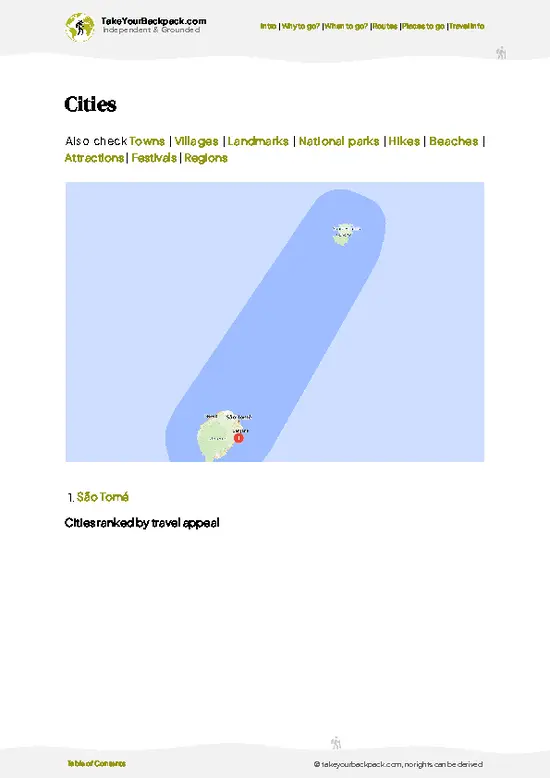
  • Santana—East coast stopover, canoe beach, market loop, quiet evenings| 8 km away
  • Guadalupe—North coast road, black-sand shore, morning fish stalls, minibus stop| 10 km away
  • São João dos Angolares—Fish landing, cocoa plantation lanes, family-run lunch, basic guesthouses| 18 km away

💡 Not sure where to go next?
Create a personalized itinerary for São Tomé and Príncipe including Trindade and the places that fit your trip.

Generate my itinerary

👉 Discover all towns

Or checkout all São Tomé and Príncipe has to offer (think cities, towns, villages, national parks, hikes, beaches, festivals)
Country photo of São Tomé and Príncipe

We 💚 feedbackSumming up the experience

Most travelers treat Trindade as a quick pass-through on the way to the coffee estates, and miss the town itself. Give it a full morning instead: reach the market early, eat where the locals eat, then head uphill. Bring a light rain jacket, small bills and a few Portuguese greetings. That combination gets you far here.

✍️ Help improve this page!
The information on this page is based on in-depth research, insights shared by experienced travelers, and feedback from the local travel community in São Tomé and Príncipe. While every effort is made to keep the information accurate and current, conditions can change — so if you spot anything incorrect or outdated, please get in touch.


🙋‍♂️ Give feedback

👋 Meet the founderWho’s Behind Take Your Backpack?

Johan, backpacker and founder of TakeYourBackpackHi, I’m Johan (Netherlands 🇳🇱), the creator of TakeYourBackpack. Over the past 3 decades, I’ve backpacked through 90+ countries across six continents, gaining extensive experience with independent travel, long-term trips, and overland routes.

This site is built on a combination of firsthand travel experience and carefully curated insights from other backpackers. Many guides are based on places I’ve personally visited, while others bring together tips, observations, and practical advice shared by trusted travelers I’ve met along the way.

The goal is to provide realistic, experience-driven guidance — not generic itineraries — so you can explore destinations with better context, clearer expectations, and more confidence.