v2.webp)



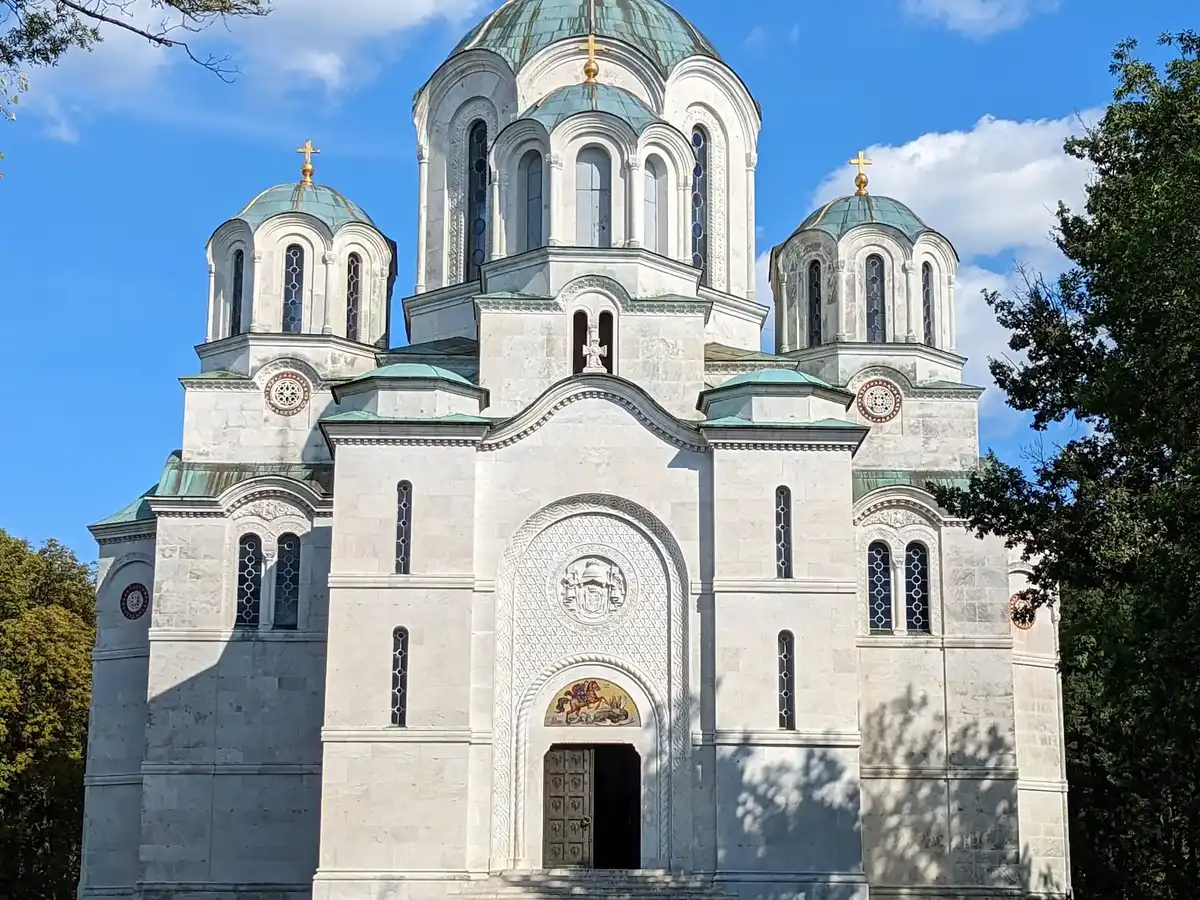
- St. George’s Church (Crkva Svetog Đorđa) — The showstopper: a domed, Serbian-Byzantine church whose interior is almost entirely covered with mosaics made from millions of tiny pieces that recreate medieval frescoes from Serbian monasteries. It feels less like a church and more like a hand-stitched visual history of the nation.
- Royal Mausoleum of the Karađorđević dynasty — The burial place of Serbia’s modern royal family. The marble sarcophagi and quiet, reverent spaces give real context to 19th-20th century Serbian history; it’s where politics, family story and national memory meet.
- Panoramic views from Oplenac hill — Walk the terraces and paths for broad Šumadija vistas: rolling vineyards, walnut and chestnut groves, and Topola spread below. Good spot for a slow, camera-friendly hour,
- St. George’s Church (Crkva Svetog Đorđa) — The showstopper: a domed, Serbian-Byzantine church whose interior is almost entirely covered with mosaics made from millions of tiny pieces that recreate medieval frescoes from Serbian monasteries. It feels less like a church and more like a hand-stitched visual history of the nation.
- Royal Mausoleum of the Karađorđević dynasty — The burial place of Serbia’s modern royal family. The marble sarcophagi and quiet, reverent spaces give real context to 19th-20th century Serbian history; it’s where politics, family story and national memory meet.
- Panoramic views from Oplenac hill — Walk the terraces and paths for broad Šumadija vistas: rolling vineyards, walnut and chestnut groves, and Topola spread below. Good spot for a slow, camera-friendly hour, especially late afternoon light.
- Royal complex park and gardens — Landscaped grounds with formal avenues and old trees that feel intentionally peaceful. It’s a neat contrast to the ornate church: great for a picnic, a reflective stroll, or to see how the royals planned their public face.
- Royal museum and period rooms — Small museum displays personal belongings, uniforms, documents and household rooms tied to the Karađorđevićs. It’s not huge, but it’s well curated and helps you understand the people behind the monuments.
- Oplenac winery and local wine tasting — The slopes were planted by the royals and wine is still part of the place. Try local bottles and simple tastings—tasting a regional wine on the hill where it was grown makes the visit feel rooted.
- Unique blend of architecture and national identity — The complex is interesting because it intentionally mixes religious art, revivalist architecture and national symbolism. Visiting Oplenac is as much about seeing beautiful craft as it is about feeling how Serbs staged their history.
Spotted a mistake or missing something? Contact us.

Business-class Airport Taxi Transfer in Belgrade

Airport Nis Shuttle Taxi

Full-Day Trip from Belgrade: Tara National Park & The Drina River Valley

A Crash Course through Serbian History

Nis Sightseeing Tour

Belgrade Private City Tour

Belgrade Airport to City Center Transfers

Private Transfer

History and Culture in my Belgrade

 Best Backpacking
.jpg) Hi, I’m Johan (Netherlands 🇳🇱), the creator of TakeYourBackpack. Over the past 3 decades, I’ve backpacked through 90+ countries across six continents, gaining extensive experience with independent travel, long-term trips, and overland routes.
Hi, I’m Johan (Netherlands 🇳🇱), the creator of TakeYourBackpack. Over the past 3 decades, I’ve backpacked through 90+ countries across six continents, gaining extensive experience with independent travel, long-term trips, and overland routes.