×

Sierra Leone🇸🇱 | hikesOutamba-Kilimi Walking Safarisavanna woodland, river crossings, hippo pools, open grassland | things to do and best time to go

Explore Gola Rainforest TrekExplore Gola Rainforest National Park

Backpacking in Outamba-Kilimi Walking Safari
By Johan Kruseman 🇳🇱 | Updated October 15, 2026

Most guides gloss over this, but here’s the truth: Outamba-Kilimi isn’t just a wildlife stroll—it’s a sweat-soaked, river-crossing, mud-on-your-boots trek where you’ll earn every hippo sighting. Outamba-Kilimi National Park sits in Sierra Leone’s far north, brushing the border with Guinea, a full day’s journey from Freetown’s chaos. The walking safari here is raw and unpredictable. Trails snake through grasslands that scratch your shins, then plunge into thick forest where the air hangs heavy and the ground squelches underfoot. You’ll spot chimpanzees if you’re lucky, but you’ll definitely feel the burn in your calves. The hike isn’t long—usually 8 to 12 kilometers—but the humidity and river crossings crank up the difficulty. Public transport drops you hours away, so getting to the trailhead means bargaining for a moto or hitching a ride with a local truck. Compared to the easy-access, tamer trails near Freetown, Outamba-Kilimi is wild, remote, and absolutely worth the effort when you finally collapse beside the river, boots off, watching elephants graze at dusk.

Discover everything you want to know in the 📖 Sierra Leone Travel Guide.
Best time to go: November - April
Duration: 5 days
Distance: 50 kilometers
Total ascent: 1,200 meters


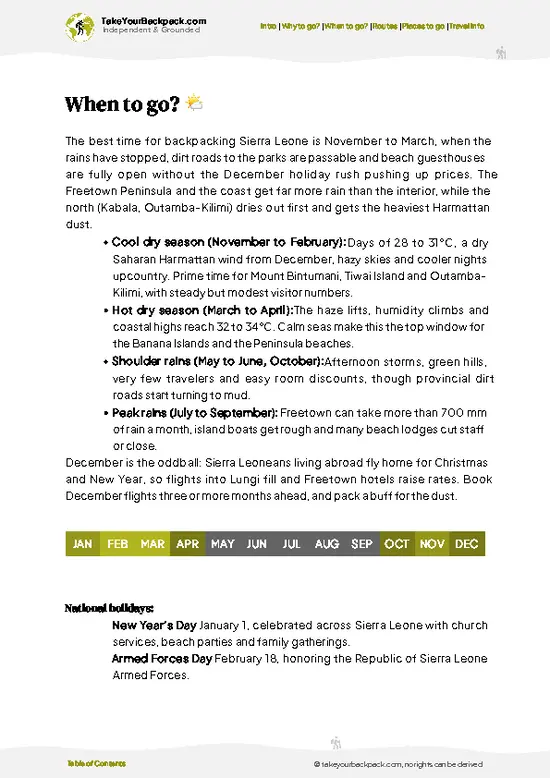
example page 0 from our offline Travel Guide for Sierra Leone
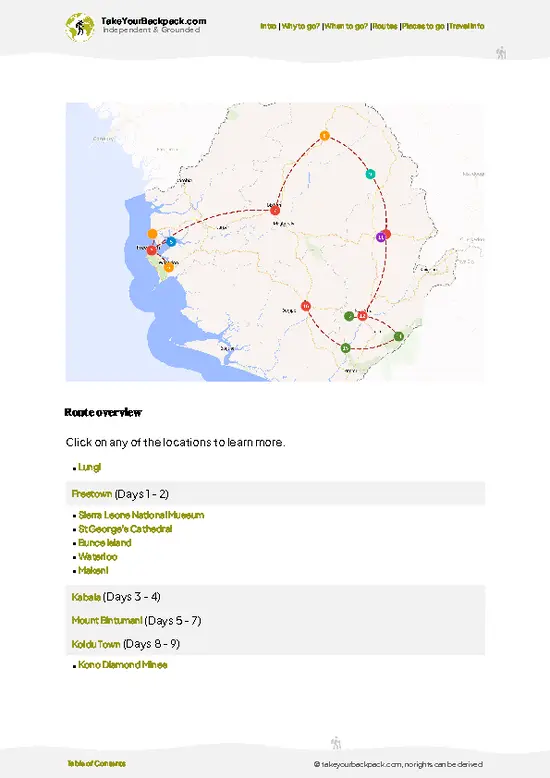
example page 1 from our offline Travel Guide for Sierra Leone
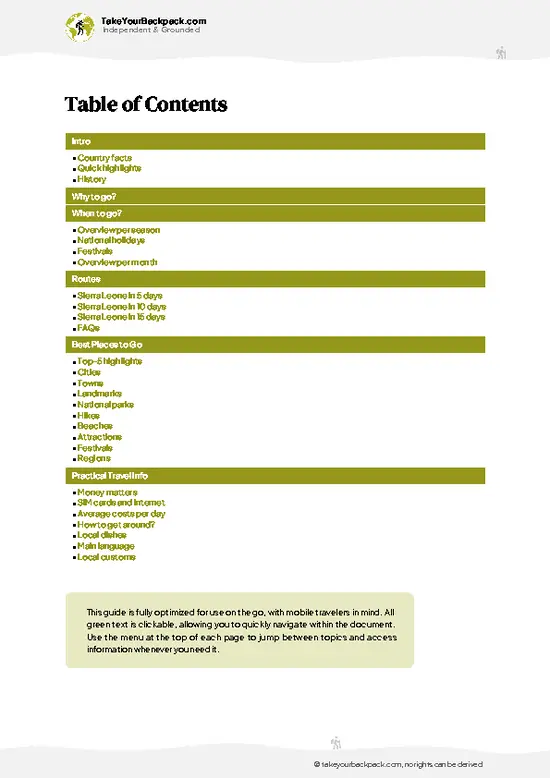
example page 2 from our offline Travel Guide for Sierra Leone
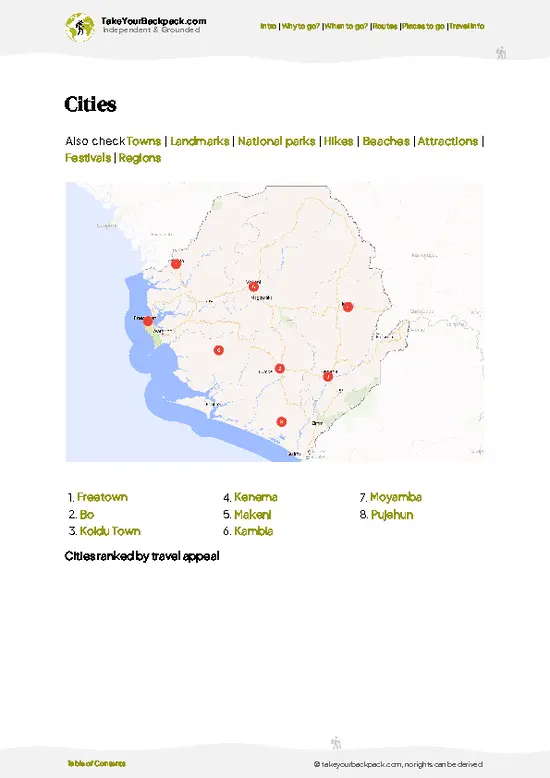
example page 3 from our offline Travel Guide for Sierra Leone
example page 4 from our offline Travel Guide for Sierra Leone
example page 5 from our offline Travel Guide for Sierra Leone
example page 6 from our offline Travel Guide for Sierra Leone
example page 7 from our offline Travel Guide for Sierra Leone
Loading the map 🌍
CLICK TO FILTER
cities
towns
landmarks
national parks
hikes
beaches
attractions
festivals
regions
SHOW COUNTRY’S BESTSHOW ALL

✨ Why go?
Ranked #99 hike in Sierra Leone
Why Outamba-Kilimi Walking Safari should be on your travel list

The Outamba-Kilimi Walking Safari in Sierra Leone is a magnet for backpackers craving a raw, immersive experience. Picture this: you’re trekking through lush, undulating hills, the air thick with the scent of earth and foliage. The scenery-to-effort ratio here is unbeatable; you’ll sweat it out on the trails, but the payoff is jaw-dropping vistas that stretch for miles.

Getting there is a breeze with public transport access from major hubs like Freetown. Hop on a local bus, and you’re on your way to adventure without breaking the bank. The low cost of the hike means you can splurge on a cold beer at the end, relishing the taste of victory after a day on the trails.

What’s more, the flexible distances cater to all levels, whether you want a leisurely stroll or a challenging trek. This hike … read more 👉
The Outamba-Kilimi Walking Safari in Sierra Leone is a magnet for backpackers craving a raw, immersive experience. Picture this: you’re trekking through lush, undulating hills, the air thick with the scent of earth and foliage. The scenery-to-effort ratio here is unbeatable; you’ll sweat it out on the trails, but the payoff is jaw-dropping vistas that stretch for miles.

Getting there is a breeze with public transport access from major hubs like Freetown. Hop on a local bus, and you’re on your way to adventure without breaking the bank. The low cost of the hike means you can splurge on a cold beer at the end, relishing the taste of victory after a day on the trails.

What’s more, the flexible distances cater to all levels, whether you want a leisurely stroll or a challenging trek. This hike fits seamlessly into a longer backpacking route, making it a perfect stopover. Each step is a challenge, but the rewards—both in scenery and personal triumph—are what keep backpackers coming back for more.

💡 HighlightsThe experiences that define the visit

  1. Granite inselbergs and cliff-top viewpoints — Jagged, weather-polished domes rise out of the woodland and give you uninterrupted views across the park’s forest-savanna patchwork and river floodplains. Hiking up these short, steep rock faces rewards you with sunrise/sunset panoramas that feel far wilder than the usual trail overlook — no handrails, no other tourists, just wind and long views.
  2. Close-up primate encounters (chimpanzees, colobus, Diana monkeys) — Outamba-Kilimi’s walking safaris track active primate groups on foot, so sightings tend to be intimate and natural rather than from a bus. Guides and local trackers read the forest well, which means you’ll often watch chimps and colorful monkeys feeding and moving through the canopy at eye level — a proper “in-the-field” primate experience.
… read more 👉
  1. Granite inselbergs and cliff-top viewpoints — Jagged, weather-polished domes rise out of the woodland and give you uninterrupted views across the park’s forest-savanna patchwork and river floodplains. Hiking up these short, steep rock faces rewards you with sunrise/sunset panoramas that feel far wilder than the usual trail overlook — no handrails, no other tourists, just wind and long views.
  2. Close-up primate encounters (chimpanzees, colobus, Diana monkeys) — Outamba-Kilimi’s walking safaris track active primate groups on foot, so sightings tend to be intimate and natural rather than from a bus. Guides and local trackers read the forest well, which means you’ll often watch chimps and colorful monkeys feeding and moving through the canopy at eye level — a proper “in-the-field” primate experience.
  3. Riverside wildlife and hippo pools — The park’s rivers cut through the landscape and concentrate wildlife: hippos at dusk, wary crocodiles, and a loud opera of waterbirds by day. Trails along the riverbanks are prime for spotting animals that don’t wander far into the dry bush — and the soundtrack of splashing and bird calls is a big part of the walk’s atmosphere.
  4. Forest-savanna mosaic and big trees — The constant flip between open grassland, gallery forest and isolated forest islands makes every hour on the trail look different. You’ll pass ancient baobabs, tall mahoganies and dense buttress-rooted trees that shelter butterflies, insects and small mammals — a biodiversity buffet that feels more varied than single-ecosystem hikes.
  5. Village visits and guided cultural trails — Many circuits thread right past small Limba and Susu villages, community camps and salt-lick sites where people and wildlife share the same edges. Those guided stops turn a walking safari into a real place-based trip: you learn local tracking techniques, hear stories around a fire, and see how conservation and community life intersect — the sort of cultural layer most big parks miss.
Spotted a mistake or missing something? Contact us.

🌤️ When to go?When to go for the best experience

  • Weather: The dry season from November to April is your best bet. Trails stay firm, and the air is clear, making every step count. The rainy season (May to October) turns paths into mud traps and floods some areas, grinding your pace to a crawl.
  • Temperature: Expect daytime highs around 28-32°C (82-90°F) during the dry months—warm but manageable with early starts. Nights cool down to 20-22°C (68-72°F), perfect for campfires without shivering.
  • Daylight Hours: Roughly 11-12 hours of daylight year-round, but the dry season offers more predictable light. Start hikes at dawn to maximize your trekking window and avoid the midday heat.
  • Crowds: The park is off the beaten path, so crowds are minimal year-round. However, the dry season draws a few more eco-tourists, so expect a handful of fellow
… read more 👉
  • Weather: The dry season from November to April is your best bet. Trails stay firm, and the air is clear, making every step count. The rainy season (May to October) turns paths into mud traps and floods some areas, grinding your pace to a crawl.
  • Temperature: Expect daytime highs around 28-32°C (82-90°F) during the dry months—warm but manageable with early starts. Nights cool down to 20-22°C (68-72°F), perfect for campfires without shivering.
  • Daylight Hours: Roughly 11-12 hours of daylight year-round, but the dry season offers more predictable light. Start hikes at dawn to maximize your trekking window and avoid the midday heat.
  • Crowds: The park is off the beaten path, so crowds are minimal year-round. However, the dry season draws a few more eco-tourists, so expect a handful of fellow adventurers rather than solitude.
  • Seasonal Activities: Dry months bring better wildlife sightings as animals gather near waterholes. Birdwatchers will find this period especially rewarding with migratory species present.
  • Price Fluctuations: Expect slightly higher rates during the dry season due to demand. Off-season deals pop up but come with the trade-off of slippery trails and unpredictable weather.
Pro-tip: Lock in your trek for the dry season’s start—November—when the landscape is fresh from rains but the ground is solid, giving you the best balance of challenge and reward.


source: climatestotravel.comJANJanuary: excellent for travelingFEBFebruary: excellent for travelingMARMarch: excellent for travelingAPRApril: excellent for travelingMAYMay: fair for travelingJUNJune: below average for travelingJULJuly: below average for travelingAUGAugust: below average for travelingSEPSeptember: fair for travelingOCTOctober: fair for travelingNOVNovember: excellent for travelingDECDecember: excellent for traveling
when-to-go

✈️ The backpacker research shortcutSierra Leone Travel Guide

An offline-friendly backpacking guide with optimized travel routes, ranked highlights, transport advice, and the best areas to stay.
example page 0 from our offline Travel Guide for Sierra Leone
example page 1 from our offline Travel Guide for Sierra Leone
example page 2 from our offline Travel Guide for Sierra Leone
example page 3 from our offline Travel Guide for Sierra Leone
example page 4 from our offline Travel Guide for Sierra Leone
example page 5 from our offline Travel Guide for Sierra Leone
example page 6 from our offline Travel Guide for Sierra Leone
example page 7 from our offline Travel Guide for Sierra Leone
The digital guide (242 pages) contains:
✅ 50 highlights, ranked by travel appeal
✅ Optimized 5, 10 & 15-day travel routes
✅ Cities, national parks, landmarks, beaches
✅ How to get around
✅ Offline-friendly for travel without Wi-Fi
👉 Click to see all 30+ guide features

📅 Plan smarter in minutes, not weeks
✅ Month by month travel advice
✅ Festivals & national holidays
✅ Budget expectations

🗺️ Go to the right places, skip the overrated ones
✅ Honest pros & cons of destinations
✅ Top hikes, parks & viewpoints
✅ Lesser-known places most travelers miss
✅ Clear “worth it vs skip it” guidance

🛏️ Travel smoothly without rookie mistakes
✅ Best areas to stay
✅ Transport systems explained simply
✅ Common scams & safety advice
✅ SIM cards, money & practical tips

🌍 Understand the country, not just visit it
✅ Culture & traditions
✅ 52 Essential phrases & customs
✅ Festivals worth planning around
✅ Traveler-friendly historical context
✅ Insights that make places more meaningful

📱 Built for real travel conditions
✅ Fully downloadable PDF
✅ Works completely offline
✅ Optimized for phone use
✅ Useful in remote areas & buses
✅ Everything in one place
Stop searching, start planning
Get instant access to your full guide. 30‑day money-back guarantee.
+ Add another guide for just

By proceeding you agree to our terms.
Sent to your inbox immediately after payment • 100% Secure Checkout
Best Backpacking Travel Advisor 2025 tourism awardBest Backpacking
Travel Advisor
2025
What others say about Take Your Backpack Guides:
⭐⭐⭐⭐⭐
Fantastic, amazing amount of information!
⭐⭐⭐⭐⭐
My goodness this is amazing, it's what I've been looking for hats off too you!
⭐⭐⭐⭐⭐
I think this is absolutely BRILLIANT
⭐⭐⭐⭐
Very complete and informative. It's still missing places, but I gotta to commend you
⭐⭐⭐⭐⭐
This is truly amazing, thank you, can't wait to explore it with my kids!
⭐⭐⭐⭐⭐
Awesome resource, thank you!
⭐⭐⭐⭐⭐
This is amazing! Can't wait to explore the ones I haven't seen
⭐⭐⭐⭐
I love this! Well done, great idea.
⭐⭐⭐⭐⭐
Thanks for taking the time to make this gem!
⭐⭐⭐⭐⭐
This might be the best website I've ever seen.
⭐⭐⭐⭐⭐
Congratulations, and thank you so much for your work; it's incredibly valuable.
⭐⭐⭐⭐
In all seriousness I think you did a great job pointing out the important spots
⭐⭐⭐⭐⭐
10/10 very good
⭐⭐⭐⭐⭐
As someone who's only just starting to visit regularly this is awesome, thank you.
⭐⭐⭐⭐
Thank you very much! I'm going to visit my dad, it's going to be very useful!
⭐⭐⭐⭐⭐
This is really cool! We'll be travelling for the first time and this definitely come in handy.
⭐⭐⭐⭐⭐
You are now our minister of culture, congratulations 👨‍💼
⭐⭐⭐⭐⭐
Just wanted to tell you that this is a pearl! Going to follow your recommendations.
⭐⭐⭐⭐⭐
This is so cool. I'll definitely be using the resource for my travels soon.
⭐⭐⭐⭐⭐
This is very impressive! Good work.
⭐⭐⭐⭐⭐
This is an amazing and informative site. Very well done!

🛏️ Where to stay?Where staying makes the most sense

If you enjoy meeting fellow travelers, consider choosing hostels with high ratings for atmosphere. On the other hand, if you prefer having your own space, a hotel might be a better option.

🥾 Hike detailsTrail overview: what to expect on the hike

Total Distance: The Outamba-Kilimi Walking Safari spans approximately 70 kilometers (about 43 miles) over several days, depending on your chosen route and pace.

Estimated Duration: Most hikers take around 5 to 7 days to complete the trail, allowing time to soak in the scenery and wildlife.

Difficulty Level: This trail is generally considered moderate to challenging. You’ll encounter some steep sections and uneven terrain, so a decent level of fitness is recommended.

Starting Point: The trail typically begins at the Outamba-Kilimi National Park entrance. To get there by public transport, you … read more 👉
Total Distance: The Outamba-Kilimi Walking Safari spans approximately 70 kilometers (about 43 miles) over several days, depending on your chosen route and pace.

Estimated Duration: Most hikers take around 5 to 7 days to complete the trail, allowing time to soak in the scenery and wildlife.

Difficulty Level: This trail is generally considered moderate to challenging. You’ll encounter some steep sections and uneven terrain, so a decent level of fitness is recommended.

Starting Point: The trail typically begins at the Outamba-Kilimi National Park entrance. To get there by public transport, you can take a bus or shared taxi from Freetown to Kabala, which is the nearest town. From Kabala, you might need to hire a local taxi or arrange for a park guide to take you to the entrance.

Major Landmarks Along the Route:
  • Outamba-Kilimi National Park: This is the main highlight, featuring stunning landscapes and rich biodiversity.
  • Waterfalls: There are several beautiful waterfalls along the way, perfect for a refreshing dip.
  • Local Villages: You’ll pass through small villages where you can interact with locals and experience their culture.

Type of Terrain and Scenery: Expect a mix of rugged trails, dense forests, and open grasslands. The scenery transitions from lush vegetation to rocky paths, often with stunning views of the surrounding hills.

Typical Vegetation and Wildlife:
  • Vegetation: You’ll see a variety of plants, including tall grasses, palm trees, and dense tropical forests.
  • Wildlife: Keep an eye out for monkeys, various bird species, and maybe even some antelope. The park is known for its diverse fauna, so be ready for some sightings!

Pack plenty of water, snacks, and a good camera. And don’t forget your sense of adventure!
⚠️ Hiking info can sometimes be outdated or inaccurate. Before you hit the trail, check the latest conditions with locals. If you do spot anything that's off, I'd love to hear from you, so I can update it for fellow travelers.

🛡️ SafetyStaying Safe: What Travelers Should Know

The Outamba-Kilimi Walking Safari is a thrilling blend of rugged terrain and vibrant wildlife, but it demands respect and preparation. Expect variable weather; rain can sweep in unexpectedly, so pack a reliable waterproof jacket. The trails can be steep and uneven, with roots and rocks that require focus. Good hiking boots are essential for grip and support.

Wildlife encounters are part of the experience. You might spot monkeys or colorful birds, but keep your distance. Observe quietly; this is their home, not yours.

Timing is crucial. Early mornings are cooler and the wildlife is more active. Pace yourself; the trails can be challenging, but the payoff—a panoramic view from a ridge or the sound of a distant waterfall—is worth every step. Stay hydrated, and don’t rush. The journey is as rewarding as the destination.

FAQCommon questions from travelers

The Outamba-Kilimi Walking Safari typically takes 3 to 5 days depending on the chosen route and pace. Most treks cover around 40 to 60 kilometers through the park. It is advisable to plan for multiple days to fully experience the wildlife and scenery.
The hike is moderately difficult due to uneven terrain, tropical climate, and occasional river crossings. It requires a reasonable level of fitness and stamina, as daily walking distances can range from 8 to 15 kilometers. The trails are not highly technical but can be physically demanding.
Yes, a guide and permit are required for the Outamba-Kilimi Walking Safari. The park authorities mandate guided tours to ensure safety and conservation compliance. Permits typically cost around $20 to $30 and must be arranged in advance through the park office or tour operators.
⚠️ Things can change over time, so always validate details locally before you go.

Other Sierra Leonean hikes near Outamba-Kilimi Walking Safari

Explore more nearby:

  • Mount Bintumani—Sierra Leone’s highest summit, dripping montane forest, tussock ridges, foot-village guides| 115 km away
  • Loma Mountains—steep escarpments, cloud forest, hidden waterfalls, upland plateaus| 118 km away
  • Gola Rainforest Trek—dense canopy, rare primates, birdwatching hotspots, forest trails| 264 km away

💡 Not sure where to go next?
Create a personalized itinerary for Sierra Leone including Outamba-Kilimi Walking Safari and the places that fit your trip.

Generate my itinerary

👉 Discover all hikes

Or checkout all Sierra Leone has to offer (think cities, towns, villages, national parks, hikes, beaches, festivals)
Country photo of Sierra Leone

We 💚 feedbackSumming up the experience

Outamba-Kilimi is raw and real. The trails are rugged, and the sweat drips down your back, but the payoff? A sunrise over the savannah that feels like a secret just for you. Expect to share the path with curious monkeys and the occasional local farmer, which adds a layer of warmth to the challenge. Just a heads-up: the bugs can be relentless, so pack that repellent. But trust me, the thrill of this wild landscape will stick with you long after you leave.

✍️ Help improve this page!
The information on this page is based on in-depth research, insights shared by experienced travelers, and feedback from the local travel community in Sierra Leone. While every effort is made to keep the information accurate and current, conditions can change — so if you spot anything incorrect or outdated, please get in touch.


🙋‍♂️ Give feedback

👋 Meet the founderWho’s Behind Take Your Backpack?

Johan, backpacker and founder of TakeYourBackpackHi, I’m Johan (Netherlands 🇳🇱), the creator of TakeYourBackpack. Over the past 3 decades, I’ve backpacked through 90+ countries across six continents, gaining extensive experience with independent travel, long-term trips, and overland routes.

This site is built on a combination of firsthand travel experience and carefully curated insights from other backpackers. Many guides are based on places I’ve personally visited, while others bring together tips, observations, and practical advice shared by trusted travelers I’ve met along the way.

The goal is to provide realistic, experience-driven guidance — not generic itineraries — so you can explore destinations with better context, clearer expectations, and more confidence.