×

Sierra Leone🇸🇱 | best hikesWhere to Find the Best hikes in Sierra Leone

Hikes in Sierra Leone are short, steep and humid, climbing through red-earth paths, cocoa shade and dripping forest where the air smells of woodsmoke and wet leaves. Almost nothing is signposted, and almost nobody else is on the trail. The Freetown Peninsula offers the easiest access, with hills above the capital reached by shared taxi and a local guide. Upcountry, the Loma Mountains and Tingi Hills mean long, bumpy road days, basic village stays and costs driven by transport, not entry fees. Independent travel works, but expect to improvise and sweat.

By Johan Kruseman 🇳🇱 | Updated October 23, 2026
Explore the best beaches in Sierra Leone

Why go?Key Factors That Shape the Experience

Sierra Leone’s name comes from the “lion mountains” seen by early Portuguese sailors, and the steep green ridges above the Atlantic still define the landscape. Granite domes, rainforest and savanna ridgelines sit within a small country, so the terrain changes sharply within a day’s drive. Because tourism infrastructure is thin after the civil war (1991 to 2002) and the Ebola outbreak, trails are quiet, guides are usually villagers or community-run groups, and money spent goes directly into small communities. Expect birdsong, chainsaw-free silence on remote ridges, and the smell of palm oil cooking in valley villages.

Before choosing the country for its hikes, know that this is not a trekking destination with maintained trails. Paths are often unmarked, maps are poor, and a local guide is … read more 👉
Sierra Leone’s name comes from the “lion mountains” seen by early Portuguese sailors, and the steep green ridges above the Atlantic still define the landscape. Granite domes, rainforest and savanna ridgelines sit within a small country, so the terrain changes sharply within a day’s drive. Because tourism infrastructure is thin after the civil war (1991 to 2002) and the Ebola outbreak, trails are quiet, guides are usually villagers or community-run groups, and money spent goes directly into small communities. Expect birdsong, chainsaw-free silence on remote ridges, and the smell of palm oil cooking in valley villages.

Before choosing the country for its hikes, know that this is not a trekking destination with maintained trails. Paths are often unmarked, maps are poor, and a local guide is the practical way to find the route. Roads to the best upcountry areas are rough, especially in rain, and mobile coverage drops out in the hills. Accommodation near trailheads can be a guesthouse room with a bucket shower or a village homestay. Heat and humidity are constant, so even a two-hour climb leaves clothes soaked. Bring water purification and cash in Sierra Leonean leones, since cards rarely work outside Freetown. Come prepared to be flexible and the country rewards you with raw, uncrowded terrain.
Behind the Scenes of Selection
The list of best hikes in Sierra Leone is created based on scenery, challenge, trail quality, landmarks, and overall enjoyment. If you feel a hike is missing in this list, please let us know.

When to go?Best Time to Visit Sierra Leone for hikes

Best months for hiking: The best months are December to March, when the dry season brings clear skies, little rain and trails firm underfoot. Days reach 30 to 34°C along the coast and in the lowlands, and the harmattan wind from the Sahara can bring a dusty haze, particularly from December to February, which softens long views and turns sunrise a flat orange. Nights in the Loma Mountains and other upland areas are noticeably cooler, often around 15 to 20°C.
Shoulder seasons and the rains: November and April to May are workable shoulders. November still has green hills and drying trails, while April and May grow hotter and stickier, with thunderstorms arriving in the afternoon. June to October is the wet season, and Freetown and the coast receive some of the heaviest rainfall in West Africa, … read more 👉
Best months for hiking: The best months are December to March, when the dry season brings clear skies, little rain and trails firm underfoot. Days reach 30 to 34°C along the coast and in the lowlands, and the harmattan wind from the Sahara can bring a dusty haze, particularly from December to February, which softens long views and turns sunrise a flat orange. Nights in the Loma Mountains and other upland areas are noticeably cooler, often around 15 to 20°C.
Shoulder seasons and the rains: November and April to May are workable shoulders. November still has green hills and drying trails, while April and May grow hotter and stickier, with thunderstorms arriving in the afternoon. June to October is the wet season, and Freetown and the coast receive some of the heaviest rainfall in West Africa, often exceeding 3,000 mm over the year, with a peak in July and August. Trails turn to slick red mud, rivers swell, leeches and insects increase, and upcountry laterite roads can become impassable for days.
Crowds and prices: Even in peak dry season trails are quiet, though Freetown hotels and the beach areas fill around Christmas and New Year, when diaspora visitors return and rooms cost more. Guide and transport prices are largely stable across the year, but wet-season travel can mean extra for 4WD hire.

hike hoppingOptimizing Your Multi-Stop Itinerary

How long to allow: A trip combining several hikes in Sierra Leone needs 8 to 14 days, because the gaps between regions are measured in rough road hours, not kilometers. The most logical structure begins in Freetown, where you can adjust to the heat and humidity on peninsula trails, arrange cash, and book guides. From there move upcountry toward the Bo and Kenema hub, then continue north or east toward the Tingi Hills, Loma Mountains, or Outamba-Kilimi, depending on your interests. Ending in the east or north usually works better than looping back, since it avoids repeating the same tough roads.
Timing and transport: Allow 1 to 2 days for each major hike area and a rest day after any long overland stretch. Freetown to Bo typically takes 4 to 6 hours by shared car, Bo to Kenema around 2 to 3 … read more 👉
How long to allow: A trip combining several hikes in Sierra Leone needs 8 to 14 days, because the gaps between regions are measured in rough road hours, not kilometers. The most logical structure begins in Freetown, where you can adjust to the heat and humidity on peninsula trails, arrange cash, and book guides. From there move upcountry toward the Bo and Kenema hub, then continue north or east toward the Tingi Hills, Loma Mountains, or Outamba-Kilimi, depending on your interests. Ending in the east or north usually works better than looping back, since it avoids repeating the same tough roads.
Timing and transport: Allow 1 to 2 days for each major hike area and a rest day after any long overland stretch. Freetown to Bo typically takes 4 to 6 hours by shared car, Bo to Kenema around 2 to 3 hours, and onward travel to remote hill areas can take another 4 to 8 hours by 4WD or motorbike taxi. Bush roads are red dust and potholes in the dry season, then deep mud when it rains. Vehicles leave when full, not at fixed times.
Common planning mistakes: The biggest mistake is cramming too many regions into a short trip. Another is assuming arrival-day hikes are realistic after a long drive. Instead, build in buffer days, start hikes at dawn before the heat, and confirm guides and lodging a day ahead by phone.

The ListThe Best hikes of Sierra Leone

1 Mount Bintumani

Sierra Leone’s highest summit, dripping montane forest, tussock ridges, foot-village guides

Climb from farming villages through dim, muddy forest to an open grassy dome, and reach the top early before mist pours through.

Loading the map 🌍

Expert viewWhat You Should Know

How many hikes to plan: Plan three to four hikes, because the real work in Sierra Leone is getting to the trailheads. Each upcountry stop can swallow most of a day in transit over rutted red roads, and humidity wears you down faster than elevation. Three or four lets you enjoy the ridgeline views, the forest sounds and the village evenings without spending the whole trip in the back of a shared taxi.
Choosing the kind of hike: For a first West Africa trip or a short stay, choose peninsula and coastal-hill hikes near Freetown. They are easy to reach, cheap, and you finish with a cold drink and fresh fish on the beach. For wilder terrain, favor upcountry mountain and forest hikes, which demand more time and money but deliver empty summits, cool nights and chimpanzee or bird calls through the … read more 👉
How many hikes to plan: Plan three to four hikes, because the real work in Sierra Leone is getting to the trailheads. Each upcountry stop can swallow most of a day in transit over rutted red roads, and humidity wears you down faster than elevation. Three or four lets you enjoy the ridgeline views, the forest sounds and the village evenings without spending the whole trip in the back of a shared taxi.
Choosing the kind of hike: For a first West Africa trip or a short stay, choose peninsula and coastal-hill hikes near Freetown. They are easy to reach, cheap, and you finish with a cold drink and fresh fish on the beach. For wilder terrain, favor upcountry mountain and forest hikes, which demand more time and money but deliver empty summits, cool nights and chimpanzee or bird calls through the canopy. Wildlife-focused travelers should consider the northern reserves, though sightings are never guaranteed.
What it costs: Budget around US$35 to 70 a day including food, simple lodging, local transport and guide fees. Freetown guesthouses run roughly US$25 to 60 a night, upcountry rooms US$10 to 25, and meals of rice with stew or grilled fish cost US$2 to 6. Local guides usually charge US$15 to 40 a day, and community or park entry fees run about US$5 to 20 per person. Private 4WD hire to remote areas can reach US$100 to 150 a day, so sharing costs is smart. A full trip of three to four hikes typically totals US$400 to 900 including transport. Carry plenty of small-denomination leones, since change is scarce and cards are rare outside the capital.
Safety and etiquette: Hire a local guide for every hike. Trails are unmarked, paths fork constantly in thick forest, and the guide is your link with landowners and communities. Start at dawn, since heat builds quickly by mid-morning, and carry at least 3 liters of water plus purification. Take malaria prophylaxis, use repellent, and confirm yellow fever vaccination, which is required for entry. Wear sturdy shoes, since wet clay is slippery and snakes and thorns are real hazards.
Respecting the communities: Greet elders first, ask before photographing people, and dress modestly in villages, especially in Muslim-majority areas. Some hills and forests hold sacred or society grounds, so follow your guide’s instructions without argument. Accept a stool in the shade and a cup of water when offered, and bring a small donation for village stays. Paying fair guide rates and buying food locally keeps money in these communities.

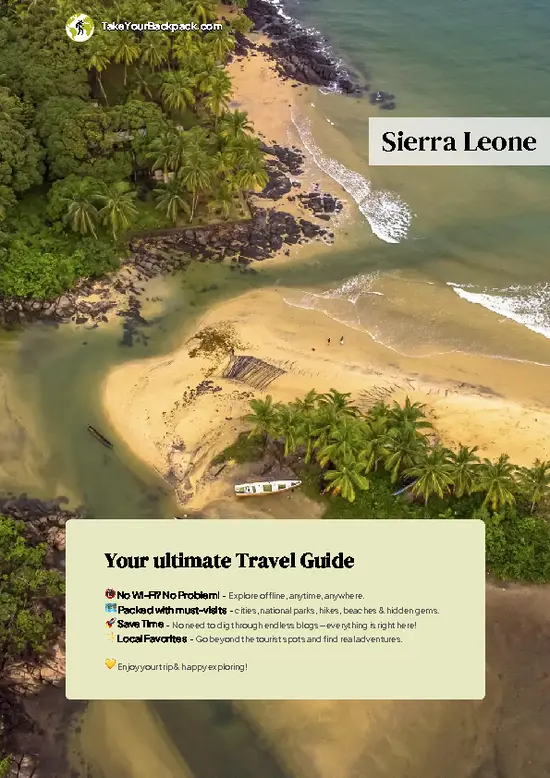
✈️ The backpacker research shortcutSierra Leone Travel Guide

An offline-friendly backpacking guide with optimized travel routes, ranked highlights, transport advice, and the best areas to stay.
example page 0 from our offline Travel Guide for Sierra Leone
example page 1 from our offline Travel Guide for Sierra Leone
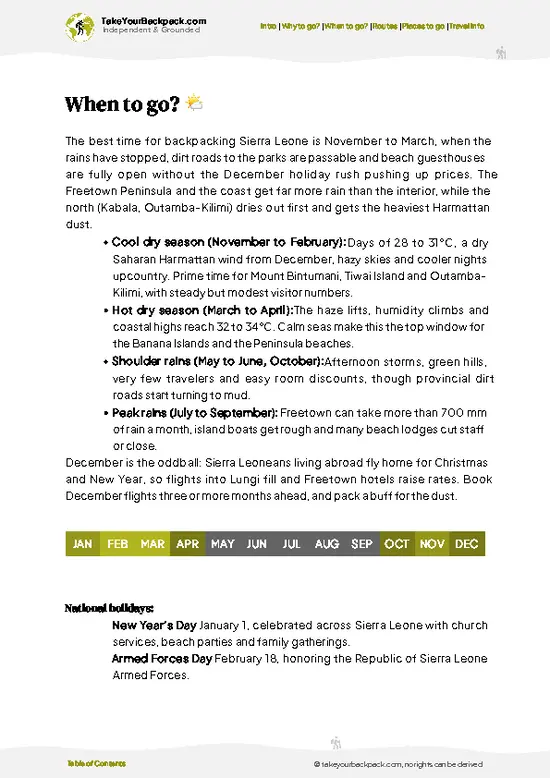
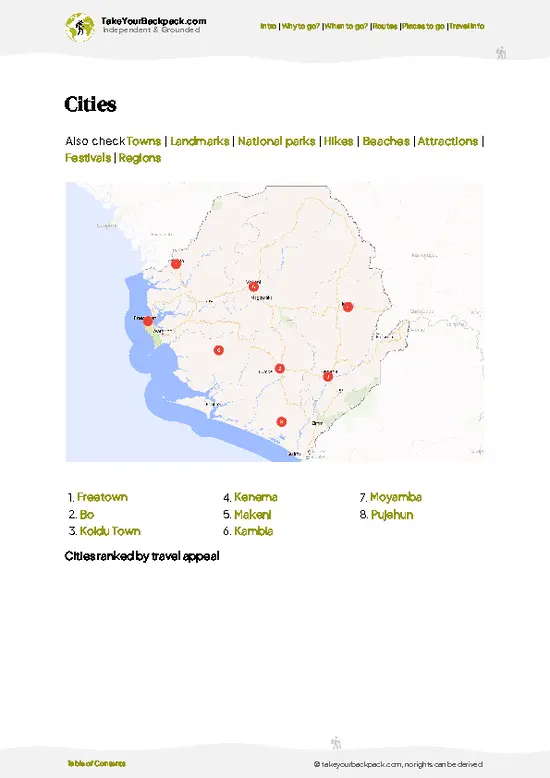
example page 2 from our offline Travel Guide for Sierra Leone
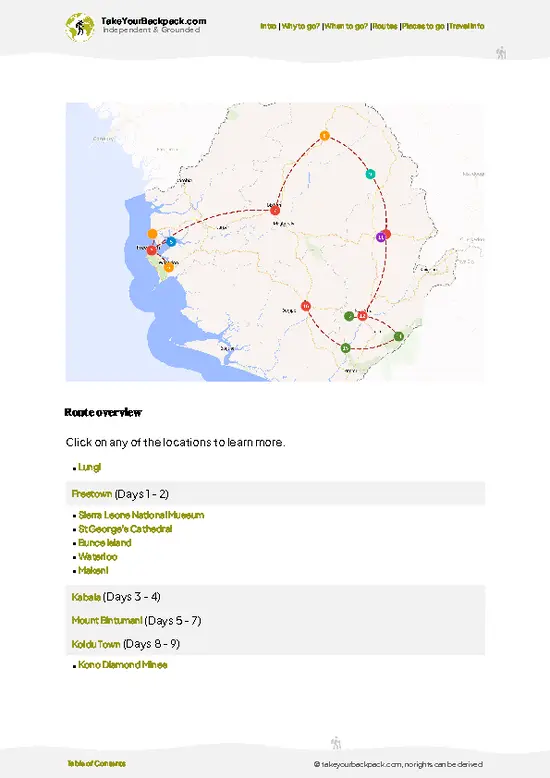
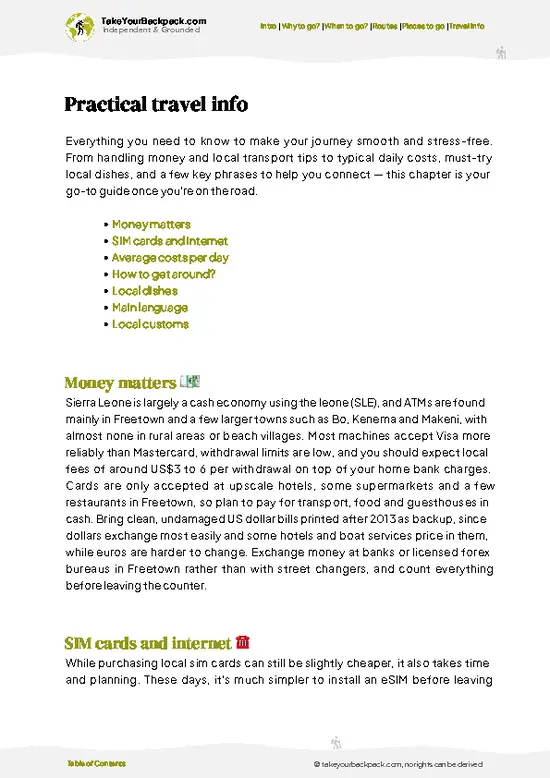
example page 3 from our offline Travel Guide for Sierra Leone
example page 4 from our offline Travel Guide for Sierra Leone
example page 5 from our offline Travel Guide for Sierra Leone
example page 6 from our offline Travel Guide for Sierra Leone
example page 7 from our offline Travel Guide for Sierra Leone
The digital guide (242 pages) contains:
✅ 50 highlights, ranked by travel appeal
✅ Optimized 5, 10 & 15-day travel routes
✅ Cities, national parks, landmarks, beaches
✅ How to get around
✅ Offline-friendly for travel without Wi-Fi
👉 Click to see all 30+ guide features

📅 Plan smarter in minutes, not weeks
✅ Month by month travel advice
✅ Festivals & national holidays
✅ Budget expectations

🗺️ Go to the right places, skip the overrated ones
✅ Honest pros & cons of destinations
✅ Top hikes, parks & viewpoints
✅ Lesser-known places most travelers miss
✅ Clear “worth it vs skip it” guidance

🛏️ Travel smoothly without rookie mistakes
✅ Best areas to stay
✅ Transport systems explained simply
✅ Common scams & safety advice
✅ SIM cards, money & practical tips

🌍 Understand the country, not just visit it
✅ Culture & traditions
✅ 52 Essential phrases & customs
✅ Festivals worth planning around
✅ Traveler-friendly historical context
✅ Insights that make places more meaningful

📱 Built for real travel conditions
✅ Fully downloadable PDF
✅ Works completely offline
✅ Optimized for phone use
✅ Useful in remote areas & buses
✅ Everything in one place
Stop searching, start planning
Get instant access to your full guide. 30‑day money-back guarantee.
+ Add another guide for just

By proceeding you agree to our terms.
Sent to your inbox immediately after payment • 100% Secure Checkout
Best Backpacking Travel Advisor 2025 tourism awardBest Backpacking
Travel Advisor
2025
What others say about Take Your Backpack Guides:
⭐⭐⭐⭐⭐
Fantastic, amazing amount of information!
⭐⭐⭐⭐⭐
My goodness this is amazing, it's what I've been looking for hats off too you!
⭐⭐⭐⭐⭐
I think this is absolutely BRILLIANT
⭐⭐⭐⭐
Very complete and informative. It's still missing places, but I gotta to commend you
⭐⭐⭐⭐⭐
This is truly amazing, thank you, can't wait to explore it with my kids!
⭐⭐⭐⭐⭐
Awesome resource, thank you!
⭐⭐⭐⭐⭐
This is amazing! Can't wait to explore the ones I haven't seen
⭐⭐⭐⭐
I love this! Well done, great idea.
⭐⭐⭐⭐⭐
Thanks for taking the time to make this gem!
⭐⭐⭐⭐⭐
This might be the best website I've ever seen.
⭐⭐⭐⭐⭐
Congratulations, and thank you so much for your work; it's incredibly valuable.
⭐⭐⭐⭐
In all seriousness I think you did a great job pointing out the important spots
⭐⭐⭐⭐⭐
10/10 very good
⭐⭐⭐⭐⭐
As someone who's only just starting to visit regularly this is awesome, thank you.
⭐⭐⭐⭐
Thank you very much! I'm going to visit my dad, it's going to be very useful!
⭐⭐⭐⭐⭐
This is really cool! We'll be travelling for the first time and this definitely come in handy.
⭐⭐⭐⭐⭐
You are now our minister of culture, congratulations 👨‍💼
⭐⭐⭐⭐⭐
Just wanted to tell you that this is a pearl! Going to follow your recommendations.
⭐⭐⭐⭐⭐
This is so cool. I'll definitely be using the resource for my travels soon.
⭐⭐⭐⭐⭐
This is very impressive! Good work.
⭐⭐⭐⭐⭐
This is an amazing and informative site. Very well done!

🛏️ Where to stay?Best Places to Stay in Sierra Leone

Backpacking Sierra Leone means budget guesthouses and simple beach huts rather than true hostels, with basic double rooms in Freetown typically running SLE 450 to 900 (about US$20 to 40) a night and dorm beds rare. Aberdeen and Lumley on the western side of the city have the most choice, with the beach, bars and nightlife on your doorstep and a calmer, safer feel, while the cheaper rooms around the city center sit near the markets and the Cotton Tree but come with traffic noise and streets that get sketchy after dark. For quiet, head down the peninsula to River Number Two, Tokeh or Bureh Beach, where beach huts and camping put you right on the sand but far from shops, ATMs and anything open … read more 👉
Backpacking Sierra Leone means budget guesthouses and simple beach huts rather than true hostels, with basic double rooms in Freetown typically running SLE 450 to 900 (about US$20 to 40) a night and dorm beds rare. Aberdeen and Lumley on the western side of the city have the most choice, with the beach, bars and nightlife on your doorstep and a calmer, safer feel, while the cheaper rooms around the city center sit near the markets and the Cotton Tree but come with traffic noise and streets that get sketchy after dark. For quiet, head down the peninsula to River Number Two, Tokeh or Bureh Beach, where beach huts and camping put you right on the sand but far from shops, ATMs and anything open late.

If you enjoy meeting fellow travelers, consider choosing hostels with high ratings for atmosphere. On the other hand, if you prefer having your own space, a hotel might be a better option.

Sierra LeoneExplore Sierra Leone

👋 Meet the founderWho’s Behind Take Your Backpack?

Johan, backpacker and founder of TakeYourBackpackHi, I’m Johan (Netherlands 🇳🇱), the creator of TakeYourBackpack. Over the past 3 decades, I’ve backpacked through 90+ countries across six continents, gaining extensive experience with independent travel, long-term trips, and overland routes.

This site is built on a combination of firsthand travel experience and carefully curated insights from other backpackers. Many guides are based on places I’ve personally visited, while others bring together tips, observations, and practical advice shared by trusted travelers I’ve met along the way.

The goal is to provide realistic, experience-driven guidance — not generic itineraries — so you can explore destinations with better context, clearer expectations, and more confidence.