×

Sierra Leone🇸🇱 | national parksTiwai Island Wildlife SanctuaryDugout crossing, Moa River island, pygmy hippo habitat, canopy tower | things to do and best time to go

Explore Tacugama Chimpanzee SanctuaryExplore Outamba-Kilimi National Park

Backpacking in Tiwai Island Wildlife Sanctuary
🏆 Top picknational park ranked #2
By Johan Kruseman 🇳🇱 | Updated October 22, 2026

The real decision at Tiwai Island Wildlife Sanctuary is whether to stay overnight or leave after a day, and an overnight tips it, because primates are most active at dawn and the forest sounds change after dark. Tiwai sits in the Moa River in the south-east of Sierra Leone, in Pujehun and Kenema districts. You cross by dugout canoe, since there is no bridge, and the boatmen from Kambama village run the crossing as part of the community-managed setup. Expect heat that clings, wet leaf litter underfoot, hornbills clattering overhead and the chorus of frogs at dusk. Eleven primate species live here, including pygmy hippos that you will rarely see. The island is small, so trails are short and flat to rolling. Crowds are nonexistent, but the roads in are rough, so plan for a slow journey. A first day could go like this: cross at midday, drop your pack at camp, then take a late afternoon walk with a guide to the forest edge as the monkeys start moving.

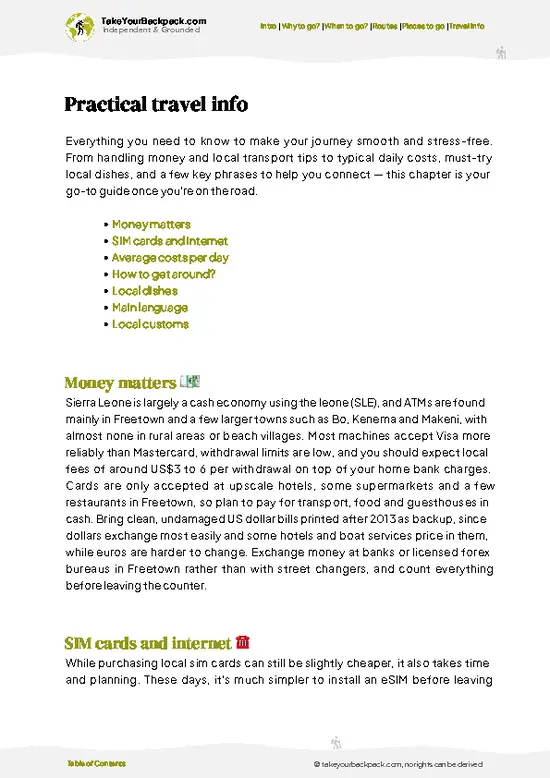
Discover everything you want to know in the 📖 Sierra Leone Travel Guide.


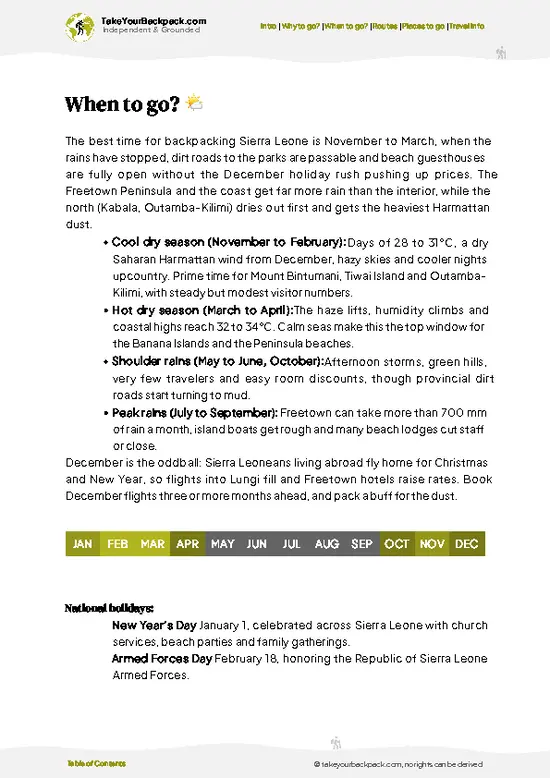
example page 0 from our offline Travel Guide for Sierra Leone
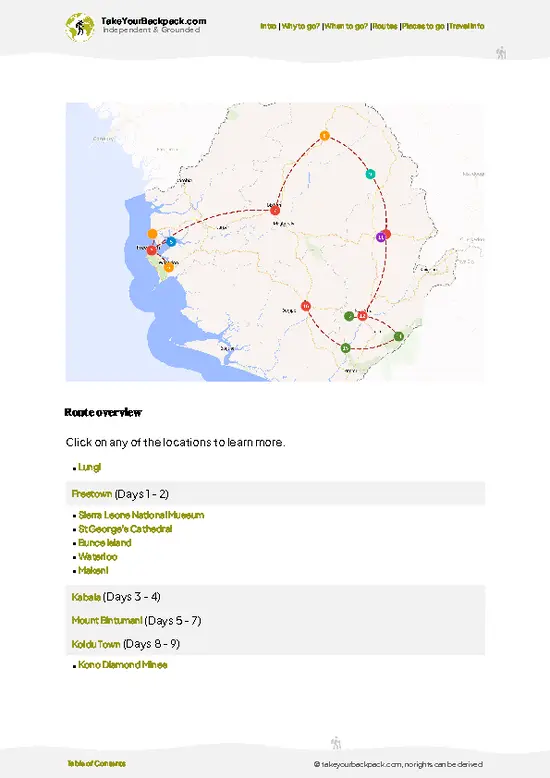
example page 1 from our offline Travel Guide for Sierra Leone
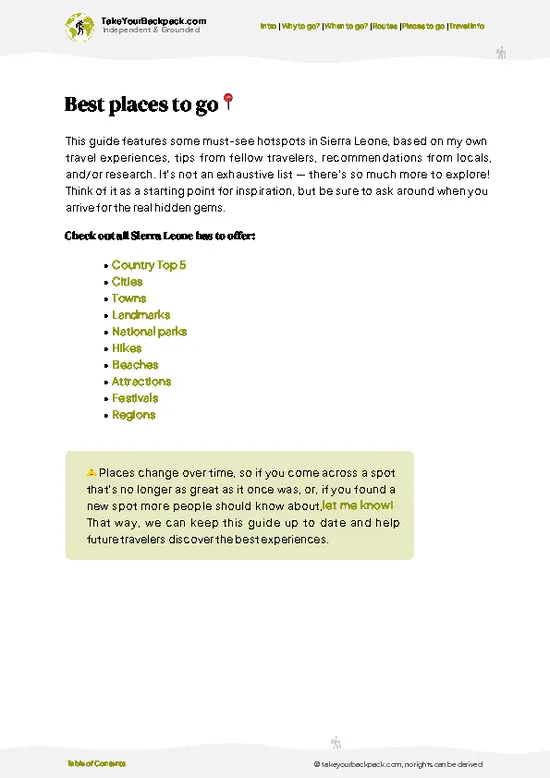
example page 2 from our offline Travel Guide for Sierra Leone
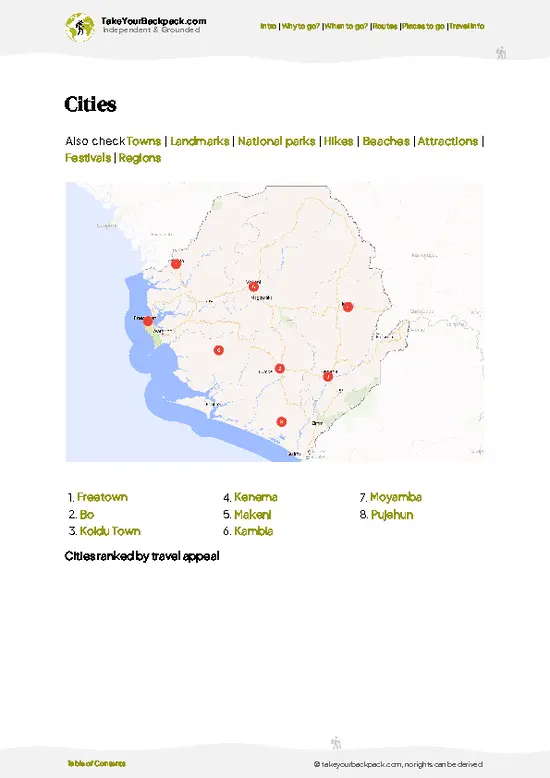
example page 3 from our offline Travel Guide for Sierra Leone
example page 4 from our offline Travel Guide for Sierra Leone
example page 5 from our offline Travel Guide for Sierra Leone
example page 6 from our offline Travel Guide for Sierra Leone
example page 7 from our offline Travel Guide for Sierra Leone
Loading the map 🌍
CLICK TO FILTER
cities
towns
landmarks
national parks
hikes
beaches
attractions
festivals
regions
SHOW COUNTRY’S BESTSHOW ALL

✨ Why go?
Ranked #2 national park in Sierra Leone
Why Tiwai Island Wildlife Sanctuary should be on your travel list

Tiwai Island Wildlife Sanctuary suits backpackers who like their wildlife without a vehicle, a fence or a tour bus. The island is only about 12 square kilometers, yet it holds one of the densest primate populations in West Africa, and you cover it on foot with a local guide from the surrounding villages. Money you spend goes to those communities, which own and manage the sanctuary, so your visit has a visible effect. The reasons that matter most:
Eleven primate species in a few square kilometers, including Diana monkeys, red colobus and chimpanzees nearby, means short walks can produce real sightings without long treks.
The dugout canoe crossing from Kambama sets the tone: you arrive quietly, on water, with the forest right at the bank.
It is easy to go self-guided in spirit, since you arrange … read more 👉
Tiwai Island Wildlife Sanctuary suits backpackers who like their wildlife without a vehicle, a fence or a tour bus. The island is only about 12 square kilometers, yet it holds one of the densest primate populations in West Africa, and you cover it on foot with a local guide from the surrounding villages. Money you spend goes to those communities, which own and manage the sanctuary, so your visit has a visible effect. The reasons that matter most:
Eleven primate species in a few square kilometers, including Diana monkeys, red colobus and chimpanzees nearby, means short walks can produce real sightings without long treks.
The dugout canoe crossing from Kambama sets the tone: you arrive quietly, on water, with the forest right at the bank.
It is easy to go self-guided in spirit, since you arrange guides and camping directly at the site, set your own pace and choose dawn, dusk or night walks. Bring your own food and water treatment, and expect basic facilities. Anyone wanting comfort and guaranteed sightings should look elsewhere; anyone happy with patience and mud will find it hard to beat.

💡 HighlightsThe experiences that define the visit

  1. Pygmy hippo watching: Tiwai is famous for these shy, forest-dwelling animals. Sightings are rare, but guides know the water channels, and tracks and dung are common, so the effort is part of the thrill.
  2. Dawn primate walk: Diana monkeys, red colobus and Campbell’s monkeys feed in the canopy at first light, and the noise of troops crashing through branches is unmissable.
  3. Moa River canoe crossing: The dugout trip from Kambama is short, but the river is brown and wide and you smell wet earth the moment you board.
  4. Night walk: Bushbabies, tree hyraxes and frogs appear in headlamp beams, and the forest sounds completely different after dark.
  5. Observation tower: A wooden platform lifts you into the canopy for birdwatching, with hornbills, parrots and turacos among over 130 recorded bird species.
  6. Chimpanzee
… read more 👉
  1. Pygmy hippo watching: Tiwai is famous for these shy, forest-dwelling animals. Sightings are rare, but guides know the water channels, and tracks and dung are common, so the effort is part of the thrill.
  2. Dawn primate walk: Diana monkeys, red colobus and Campbell’s monkeys feed in the canopy at first light, and the noise of troops crashing through branches is unmissable.
  3. Moa River canoe crossing: The dugout trip from Kambama is short, but the river is brown and wide and you smell wet earth the moment you board.
  4. Night walk: Bushbabies, tree hyraxes and frogs appear in headlamp beams, and the forest sounds completely different after dark.
  5. Observation tower: A wooden platform lifts you into the canopy for birdwatching, with hornbills, parrots and turacos among over 130 recorded bird species.
  6. Chimpanzee and sooty mangabey spotting: Chimpanzees live on the island, and guides will tell you where recent sign is. Seeing them takes luck, but hearing them is common.
  7. Kambama village visit: The community that runs the sanctuary lives here. Meeting your guides and seeing the surrounding farmland adds context to the forest.
  8. Riverside forest trails: Narrow paths wind through giant buttressed trees and swampy patches, with butterflies and ant columns crossing the path.
Start with the dawn primate walk, because activity peaks early and the forest cools before the heat settles in.
Spotted a mistake or missing something? Contact us.

🌤️ When to go?Seasonal considerations and timing

  • Late Dry Season (December to February): Days run 30 to 34°C (86 to 93°F) with cooler nights near 21°C (70°F), and the harmattan haze softens the light. Trails are firm, river levels are low, and this is when most visitors come, so book the camp ahead.
  • Hot Transition (March to April): Highs reach 33 to 36°C (91 to 97°F) and humidity builds. Primates are easier to spot near fruiting trees, but afternoon walks are sticky.
  • Rainy Season (May to October): Expect 25 to 30°C (77 to 86°F), near-daily downpours and the heaviest falls in July and August. Paths turn to mud, the Moa River rises, and boat crossings can be delayed. Few other travelers show up, and lodging rarely needs reserving.
  • Daylight: Close to the equator, days are steady at about 12 hours all year, so plan dawn walks for the best monkey
… read more 👉
  • Late Dry Season (December to February): Days run 30 to 34°C (86 to 93°F) with cooler nights near 21°C (70°F), and the harmattan haze softens the light. Trails are firm, river levels are low, and this is when most visitors come, so book the camp ahead.
  • Hot Transition (March to April): Highs reach 33 to 36°C (91 to 97°F) and humidity builds. Primates are easier to spot near fruiting trees, but afternoon walks are sticky.
  • Rainy Season (May to October): Expect 25 to 30°C (77 to 86°F), near-daily downpours and the heaviest falls in July and August. Paths turn to mud, the Moa River rises, and boat crossings can be delayed. Few other travelers show up, and lodging rarely needs reserving.
  • Daylight: Close to the equator, days are steady at about 12 hours all year, so plan dawn walks for the best monkey activity.
Aim for December or January for dry trails, and book the community camp and boatman at least a week out.


source: climatestotravel.comJANJanuary: excellent for travelingFEBFebruary: excellent for travelingMARMarch: excellent for travelingAPRApril: highly recommended for travelingMAYMay: fair for travelingJUNJune: below average for travelingJULJuly: below average for travelingAUGAugust: below average for travelingSEPSeptember: fair for travelingOCTOctober: fair for travelingNOVNovember: highly recommended for travelingDECDecember: excellent for traveling
when-to-go

✈️ The backpacker research shortcutSierra Leone Travel Guide

An offline-friendly backpacking guide with optimized travel routes, ranked highlights, transport advice, and the best areas to stay.
example page 0 from our offline Travel Guide for Sierra Leone
example page 1 from our offline Travel Guide for Sierra Leone
example page 2 from our offline Travel Guide for Sierra Leone
example page 3 from our offline Travel Guide for Sierra Leone
example page 4 from our offline Travel Guide for Sierra Leone
example page 5 from our offline Travel Guide for Sierra Leone
example page 6 from our offline Travel Guide for Sierra Leone
example page 7 from our offline Travel Guide for Sierra Leone
The digital guide (242 pages) contains:
✅ 50 highlights, ranked by travel appeal
✅ Optimized 5, 10 & 15-day travel routes
✅ Cities, national parks, landmarks, beaches
✅ How to get around
✅ Offline-friendly for travel without Wi-Fi
👉 Click to see all 30+ guide features

📅 Plan smarter in minutes, not weeks
✅ Month by month travel advice
✅ Festivals & national holidays
✅ Budget expectations

🗺️ Go to the right places, skip the overrated ones
✅ Honest pros & cons of destinations
✅ Top hikes, parks & viewpoints
✅ Lesser-known places most travelers miss
✅ Clear “worth it vs skip it” guidance

🛏️ Travel smoothly without rookie mistakes
✅ Best areas to stay
✅ Transport systems explained simply
✅ Common scams & safety advice
✅ SIM cards, money & practical tips

🌍 Understand the country, not just visit it
✅ Culture & traditions
✅ 52 Essential phrases & customs
✅ Festivals worth planning around
✅ Traveler-friendly historical context
✅ Insights that make places more meaningful

📱 Built for real travel conditions
✅ Fully downloadable PDF
✅ Works completely offline
✅ Optimized for phone use
✅ Useful in remote areas & buses
✅ Everything in one place
Stop searching, start planning
Get instant access to your full guide. 30‑day money-back guarantee.
+ Add another guide for just

By proceeding you agree to our terms.
Sent to your inbox immediately after payment • 100% Secure Checkout
Best Backpacking Travel Advisor 2025 tourism awardBest Backpacking
Travel Advisor
2025
What others say about Take Your Backpack Guides:
⭐⭐⭐⭐⭐
Fantastic, amazing amount of information!
⭐⭐⭐⭐⭐
My goodness this is amazing, it's what I've been looking for hats off too you!
⭐⭐⭐⭐⭐
I think this is absolutely BRILLIANT
⭐⭐⭐⭐
Very complete and informative. It's still missing places, but I gotta to commend you
⭐⭐⭐⭐⭐
This is truly amazing, thank you, can't wait to explore it with my kids!
⭐⭐⭐⭐⭐
Awesome resource, thank you!
⭐⭐⭐⭐⭐
This is amazing! Can't wait to explore the ones I haven't seen
⭐⭐⭐⭐
I love this! Well done, great idea.
⭐⭐⭐⭐⭐
Thanks for taking the time to make this gem!
⭐⭐⭐⭐⭐
This might be the best website I've ever seen.
⭐⭐⭐⭐⭐
Congratulations, and thank you so much for your work; it's incredibly valuable.
⭐⭐⭐⭐
In all seriousness I think you did a great job pointing out the important spots
⭐⭐⭐⭐⭐
10/10 very good
⭐⭐⭐⭐⭐
As someone who's only just starting to visit regularly this is awesome, thank you.
⭐⭐⭐⭐
Thank you very much! I'm going to visit my dad, it's going to be very useful!
⭐⭐⭐⭐⭐
This is really cool! We'll be travelling for the first time and this definitely come in handy.
⭐⭐⭐⭐⭐
You are now our minister of culture, congratulations 👨‍💼
⭐⭐⭐⭐⭐
Just wanted to tell you that this is a pearl! Going to follow your recommendations.
⭐⭐⭐⭐⭐
This is so cool. I'll definitely be using the resource for my travels soon.
⭐⭐⭐⭐⭐
This is very impressive! Good work.
⭐⭐⭐⭐⭐
This is an amazing and informative site. Very well done!

🛏️ Where to stay?How to pick the right area

The best place to stay is inside the sanctuary itself, at the community-run Tiwai Island camp, where you sleep in simple huts a short walk from the primate trails. Accommodation is basic: thatched or tin-roofed rooms with beds and mosquito nets, shared bucket-wash facilities and meals cooked by villagers on request. Bring a sleeping sheet, a headlamp and your own water treatment. There is also space for tents at the camp. Spending a night or two here puts you in position for the dawn and night walks, when the monkeys and nocturnal animals are most active.
The nearest base for supplies and onward … read more 👉
The best place to stay is inside the sanctuary itself, at the community-run Tiwai Island camp, where you sleep in simple huts a short walk from the primate trails. Accommodation is basic: thatched or tin-roofed rooms with beds and mosquito nets, shared bucket-wash facilities and meals cooked by villagers on request. Bring a sleeping sheet, a headlamp and your own water treatment. There is also space for tents at the camp. Spending a night or two here puts you in position for the dawn and night walks, when the monkeys and nocturnal animals are most active.
The nearest base for supplies and onward transport is Bo, the country’s second city, roughly 3 to 4 hours away by road, with guesthouses and hotels for US$15 to 50 a night, ATMs and markets. Kenema is another option on the eastern side. Closer to the island, the village of Kambama sits on the riverbank and is where boats leave for Tiwai. Basic village rooms may be arranged through the community, but options are limited and not formally listed. Stock up on food, cash and phone credit in Bo or Kenema before you head out, because the island has no shop or reliable signal.

👛 Costs (as of 22 October 2026)Typical daily expenses

Tiwai Island Wildlife Sanctuary costs roughly US$45 to 90 a day for a backpacker, with most of that going to the camp, guides and the long road in. The table gives typical ranges.
CategoryBudget RangeLocal Reality
Entrance and conservation feeUS$10 to 20Paid at the community office or camp, per person, and often covers the boat crossing; ask when you book.
Accommodation (high season)US$10 to 25Simple huts or camping at the island camp; bring your own sheet and net.
Guide and boatmanUS$10 to 20Local guide for dawn and night walks, shared between a group if possible.
Local transportUS$10 to 20Shared taxis or minibuses from Bo to Kambama village, plus a short motorbike hop; private hire costs more.
Food and suppliesUS$5 to 10Rice and sauce cooked by villagers; snacks and water must be bought in Bo
… read more 👉
Tiwai Island Wildlife Sanctuary costs roughly US$45 to 90 a day for a backpacker, with most of that going to the camp, guides and the long road in. The table gives typical ranges.
CategoryBudget RangeLocal Reality
Entrance and conservation feeUS$10 to 20Paid at the community office or camp, per person, and often covers the boat crossing; ask when you book.
Accommodation (high season)US$10 to 25Simple huts or camping at the island camp; bring your own sheet and net.
Guide and boatmanUS$10 to 20Local guide for dawn and night walks, shared between a group if possible.
Local transportUS$10 to 20Shared taxis or minibuses from Bo to Kambama village, plus a short motorbike hop; private hire costs more.
Food and suppliesUS$5 to 10Rice and sauce cooked by villagers; snacks and water must be bought in Bo or Kenema.
Total Daily BudgetUS$45 to 90Higher end if you hire a car or are traveling solo; paid in cash, in local currency.
⚠️ Prices can change and everyone travels differently, so take this as a rough guide. Hope it helps you plan your adventure!

🥾 TrailsScenic routes and wildlife spotting in Tiwai Island Wildlife Sanctuary

Tiwai Island Wildlife Sanctuary is walked rather than hiked in the strenuous sense: its paths are short, flat to gently rolling, and run through lowland rainforest and riverside swamp. Trails are not marked with formal names and distances for visitors; guides lead you along loops that cover different habitats, and you decide how long to stay out.
  • Morning primate loop: Starts near camp and passes through high canopy where Diana monkeys and colobus feed. Plan about 2 to 3 hours, easy but humid, with muddy patches and roots.
  • Pygmy hippo and river trail: Follows the island’s waterways to spots where
… read more 👉
Tiwai Island Wildlife Sanctuary is walked rather than hiked in the strenuous sense: its paths are short, flat to gently rolling, and run through lowland rainforest and riverside swamp. Trails are not marked with formal names and distances for visitors; guides lead you along loops that cover different habitats, and you decide how long to stay out.
  • Morning primate loop: Starts near camp and passes through high canopy where Diana monkeys and colobus feed. Plan about 2 to 3 hours, easy but humid, with muddy patches and roots.
  • Pygmy hippo and river trail: Follows the island’s waterways to spots where hippos wallow and feed. About 2 hours at a slow pace, easy to moderate, with wet ground and some low branches.
  • Canopy tower walk: A short approach to the platform for birding and views over the treetops. Around 1 to 2 hours, easy, best early when birds are most active.
  • Night walk: A guided loop near camp with headlamps for nocturnal animals. Roughly 1 to 2 hours, easy, with uneven footing in the dark.
  • Longer forest circuit: Combines several habitats and takes half a day or more. Moderate because of heat, humidity and slippery ground rather than steepness.
Wear long trousers, sturdy shoes with grip and a light rain layer. Bring insect repellent and plenty of water. Silence helps; guides will ask you to walk slowly and pause often, which is how animals are seen.
Getting here takes effort. There is no scheduled public transport to the sanctuary itself. Most travelers reach the area by shared taxi or minibus toward Kenema or Bo, then continue by motorbike or hired vehicle along rough tracks to Kambama, where the canoe crossing begins. The roads can become very difficult in heavy rain, so allow extra time. Crowds are essentially nil, and you may have the forest to yourself. There is an entrance and guide fee paid at the site, with camping and canoe crossing arranged through the local community.
⚠️ Hiking info can sometimes be outdated or inaccurate. Before you hit the trail, check the latest conditions with locals. If you do spot anything that's off, I'd love to hear from you, so I can update it for fellow travelers.

🛡️ SafetyScams, Hazards, and Annoyances

Tiwai is a calm, community-managed sanctuary, and the main hazards are heat, mud and malaria rather than wildlife. Hire the local guides who run the trails. They know the footing, the river and where the monkeys are, and walking without one makes it easy to lose the paths in dense forest. Trails are mostly flat but turn slick in the rains, so wear boots with grip and carry at least 2 liters of water per person for morning walks. The island is reached by a short canoe or boat crossing of the Moa River; wear a life jacket if offered and keep your phone and passport in a dry bag. Primates, including chimpanzees nearby, and pygmy hippos are shy. Keep your distance, stay quiet and never feed anything. Hippos are rarely seen and best left alone. Start antimalarials before you arrive, use repellent … read more 👉
Tiwai is a calm, community-managed sanctuary, and the main hazards are heat, mud and malaria rather than wildlife. Hire the local guides who run the trails. They know the footing, the river and where the monkeys are, and walking without one makes it easy to lose the paths in dense forest. Trails are mostly flat but turn slick in the rains, so wear boots with grip and carry at least 2 liters of water per person for morning walks. The island is reached by a short canoe or boat crossing of the Moa River; wear a life jacket if offered and keep your phone and passport in a dry bag. Primates, including chimpanzees nearby, and pygmy hippos are shy. Keep your distance, stay quiet and never feed anything. Hippos are rarely seen and best left alone. Start antimalarials before you arrive, use repellent at dusk, sleep under a net and bring a basic first aid kit, since the nearest clinic is hours away.

FAQCommon questions from travelers

Two nights on the island is the ideal stay at Tiwai Island Wildlife Sanctuary, giving you a dawn walk, a night walk and a boat trip on the Moa River. One night works if you are short on time, though a travel day each way from Bo, about 3 to 4 hours by road, makes a quick visit feel rushed. Add a third day only if you want a second primate trek.
Yes, Tiwai Island Wildlife Sanctuary can be reached without a car using shared taxis or minibuses from Bo or Kenema to the village of Kambama, which takes roughly 3 to 4 hours depending on road conditions. From the village a short motorbike ride or walk leads to the riverbank, where a community boat crosses to the island. Once there, everything is explored on foot with a guide, and fares for the whole trip typically come to US$10 to 20 each way.
Yes, Tiwai Island Wildlife Sanctuary charges a conservation fee, typically around US$10 to 20 per person, paid at the community office or camp and often including the boat crossing. Guides are normally required for walks and cost roughly US$10 to 20 a day, shared across a group. No separate permit is needed, but book ahead through the community or a tour operator in Bo or Freetown, and carry cash.
⚠️ Things can change over time, so always validate details locally before you go.

Other Sierra Leonean national parks near Tiwai Island Wildlife Sanctuary

Explore more nearby:


💡 Not sure where to go next?
Create a personalized itinerary for Sierra Leone including Tiwai Island Wildlife Sanctuary and the places that fit your trip.

Generate my itinerary

👉 Discover all national parks

Or checkout all Sierra Leone has to offer (think cities, towns, villages, national parks, hikes, beaches, festivals)
Country photo of Sierra Leone

We 💚 feedbackKey takeaways before you go

Tiwai Island Wildlife Sanctuary is at its best in the early hours of a dry-season morning, when the forest is cool, the canopy is loud and the mud is firmer underfoot. I would sleep over so you are on the trail at first light, and I would bring a headlamp and a good pair of binoculars. Patience beats luck here.

✍️ Help improve this page!
The information on this page is based on in-depth research, insights shared by experienced travelers, and feedback from the local travel community in Sierra Leone. While every effort is made to keep the information accurate and current, conditions can change — so if you spot anything incorrect or outdated, please get in touch.


🙋‍♂️ Give feedback

👋 Meet the founderWho’s Behind Take Your Backpack?

Johan, backpacker and founder of TakeYourBackpackHi, I’m Johan (Netherlands 🇳🇱), the creator of TakeYourBackpack. Over the past 3 decades, I’ve backpacked through 90+ countries across six continents, gaining extensive experience with independent travel, long-term trips, and overland routes.

This site is built on a combination of firsthand travel experience and carefully curated insights from other backpackers. Many guides are based on places I’ve personally visited, while others bring together tips, observations, and practical advice shared by trusted travelers I’ve met along the way.

The goal is to provide realistic, experience-driven guidance — not generic itineraries — so you can explore destinations with better context, clearer expectations, and more confidence.