×

Solomon Islands🇸🇧 | regionsNggela IslandsTulagi wartime ruins, Mboli Passage, village stays, wreck dives | things to do and best time to go

Explore Simbo IslandExplore Malaita Island

Backpacking in Nggela Islands
🏆 Top pickregion ranked #1
By Johan Kruseman 🇳🇱 | Updated October 22, 2026

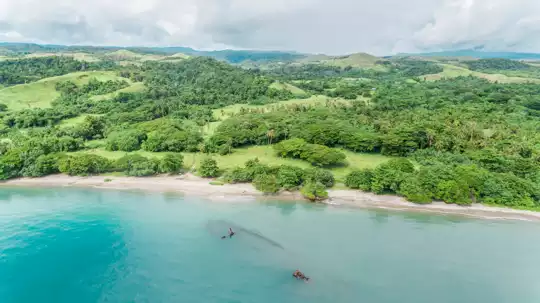
Ngella is the local name for the Florida Islands, and it has no connection to the US state; it is a separate island group of Central Province, a boat crossing from Guadalcanal. It lies in the north of the Solomon Islands, across the strait from Honiara. Tulagi, the old British capital, sits on a small island off its southern coast. Diesel, wet jungle and frangipani hang in the air, and the water goes from milky green to deep blue within a few paddle strokes. WWII wrecks lie in the harbor, and village life goes on at its own pace. The downsides are plain: little transport, few shops, and no mainland roads to speak of. A resort stay costs more but saves hours of waiting for a public boat, while a guesthouse in Tulagi is cheaper and rougher, and gives a backpacker the most for the money. A first day could mean stepping off the boat at Tulagi, walking up the hill in the heat, then swimming off the jetty as the light turns copper.

Discover everything you want to know in the 📖 Solomon Islands Travel Guide.


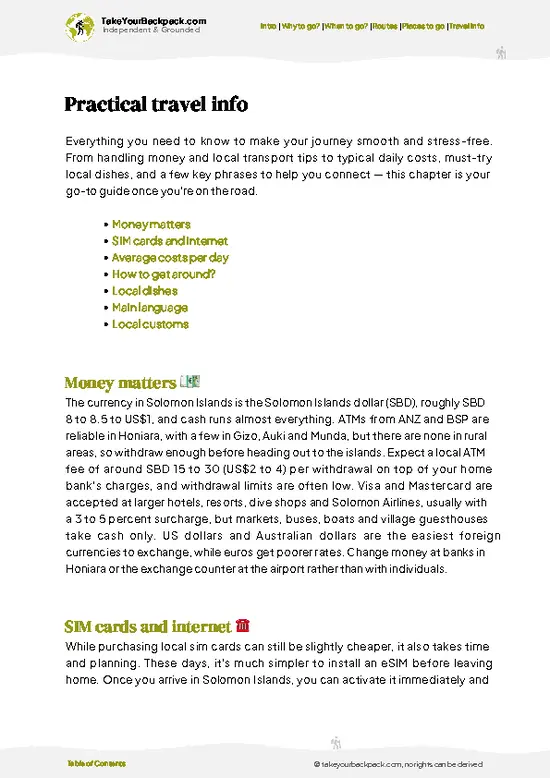
example page 0 from our offline Travel Guide for Solomon Islands
example page 1 from our offline Travel Guide for Solomon Islands
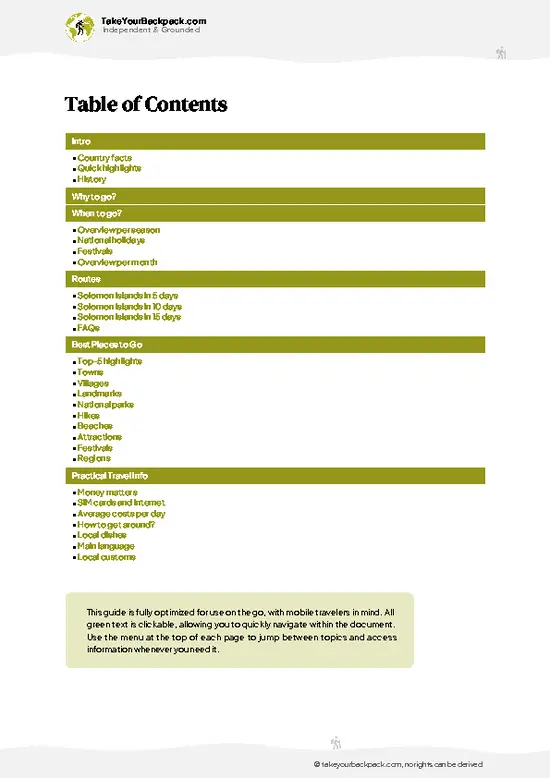
example page 2 from our offline Travel Guide for Solomon Islands
example page 3 from our offline Travel Guide for Solomon Islands
example page 4 from our offline Travel Guide for Solomon Islands
example page 5 from our offline Travel Guide for Solomon Islands
example page 6 from our offline Travel Guide for Solomon Islands
example page 7 from our offline Travel Guide for Solomon Islands
Loading the map 🌍
CLICK TO FILTER
towns
villages
landmarks
national parks
hikes
beaches
attractions
festivals
regions
SHOW COUNTRY’S BESTSHOW ALL

✨ Why go?
Ranked #1 region in Solomon Islands
Reasons people choose to visit here

Ngella suits slow travelers because everything of interest sits within reach of a few short channel crossings, so you never repack for a long haul. In one stay you can walk through the colonial and wartime remains of Tulagi, swim over wrecks, and spend an afternoon in a village without needing to cross the whole country.
The second reason is the village side. On Ngella Sule, staying in village guesthouses puts money straight into households, and evenings pass with kerosene lamps, fish grilled on coals and local string-band guitars.
The third is the water. The narrow Mboli Passage funnels tide through mangroves, and the reefs around Tulagi and Gavutu are shallow enough for snorkeling off a canoe. A small, quiet group of islands rewards anyone willing to let the boat schedule set the pace rather than fight it.

💡 HighlightsThe experiences that define the visit

  1. Tulagi Hill: A short, steep climb through heat and cicada noise to a lookout over the harbor, with old Japanese defensive positions along the way. Go early.
  2. Tulagi old Residency area: Overgrown colonial-era grounds and stone remains on the island that once ran the British protectorate. It is quiet, shady and rarely visited.
  3. Gavutu: A tiny, hill-shaped island joined by causeway to its neighbor, with the remains of a Japanese seaplane base and rusting wartime structures you can walk among.
  4. Tanambogo: The even smaller island beside Gavutu, reached across the causeway, where fighting in 1942 left scattered debris on a rocky shore. Walk it slowly and watch your footing.
  5. Tulagi Harbour wreck dives: The New Zealand minesweeper HMNZS Moa, sunk by Japanese aircraft in April 1943, lies in the harbor, and
… read more 👉
  1. Tulagi Hill: A short, steep climb through heat and cicada noise to a lookout over the harbor, with old Japanese defensive positions along the way. Go early.
  2. Tulagi old Residency area: Overgrown colonial-era grounds and stone remains on the island that once ran the British protectorate. It is quiet, shady and rarely visited.
  3. Gavutu: A tiny, hill-shaped island joined by causeway to its neighbor, with the remains of a Japanese seaplane base and rusting wartime structures you can walk among.
  4. Tanambogo: The even smaller island beside Gavutu, reached across the causeway, where fighting in 1942 left scattered debris on a rocky shore. Walk it slowly and watch your footing.
  5. Tulagi Harbour wreck dives: The New Zealand minesweeper HMNZS Moa, sunk by Japanese aircraft in April 1943, lies in the harbor, and the water around it holds coral and small reef fish. A local dive operator is the safest way to see it.
  6. Mboli Passage: A narrow channel between Ngella Sule and Ngella Pile, framed by mangroves and strong tide. Paddle it with a local guide, since the current is fast.
  7. Maravagi Resort reef: Shallow house reef off a beach on Ngella Sule with easy snorkeling and calm water. The cost is higher than a village stay, but the setting is relaxed.
  8. Tulagi waterfront and market: Stalls of cassava, bananas, smoked fish and betel nut, plus the jetty where canoes and boats arrive. Local life shows here.
Allow three to five days to see all of it comfortably, as boat timing sets the pace.
Spotted a mistake or missing something? Contact us.

Things to do near Nggela Islands

Ratings based on Tripadvisor reviews. When you book through this link, you support our work at no extra cost to you.

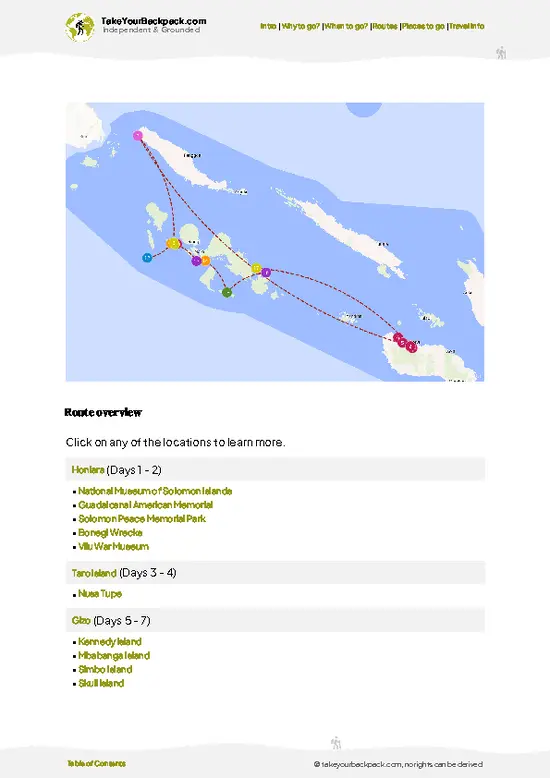
⌛️ 5 days5-day itinerary for Nggela Islands

Day 1: Tulagi: A harbor-and-hill day, slow by design. Arrive by boat, drop your pack at a guesthouse and walk the waterfront and market while the heat is still bearable. Climb Tulagi Hill in the afternoon light, then wander the old Residency grounds. Boats in this region run on tide, fuel and local need rather than a clock, so staying on Tulagi for a full day lets you settle in without fighting a timetable.
Day 2: Gavutu and Tanambogo: Cross to the connected islands of Gavutu and Tanambogo by canoe or hired boat. They are tiny, so you can walk both before lunch, then snorkel or dive Tulagi Harbour in the afternoon. Keeping this trip close to Tulagi means one short, predictable boat ride and no gamble on a public service.
Day 3: Ngella Sule and Haleta: Move to the larger island, where villages … read more 👉
Day 1: Tulagi: A harbor-and-hill day, slow by design. Arrive by boat, drop your pack at a guesthouse and walk the waterfront and market while the heat is still bearable. Climb Tulagi Hill in the afternoon light, then wander the old Residency grounds. Boats in this region run on tide, fuel and local need rather than a clock, so staying on Tulagi for a full day lets you settle in without fighting a timetable.
Day 2: Gavutu and Tanambogo: Cross to the connected islands of Gavutu and Tanambogo by canoe or hired boat. They are tiny, so you can walk both before lunch, then snorkel or dive Tulagi Harbour in the afternoon. Keeping this trip close to Tulagi means one short, predictable boat ride and no gamble on a public service.
Day 3: Ngella Sule and Haleta: Move to the larger island, where villages and resorts stand along the coast. Spend the day walking between villages, then stay in a village or at a beach resort. Splitting the trip into two bases keeps the number of boat transfers down.
Day 4: Mboli Passage: This is the detour. Join a guide for a paddle or motorboat run through the channel, where mangroves close in and the tide dictates the route. It adds a lot and needs only a half day, so Day 5 stays free.
Day 5: Maravagi: Rest on a beach, snorkel the reef and wait for your boat back.
If you only get one day to justify the trip, make it Day 2. Gavutu and Tanambogo pack wartime history, reef and a causeway walk into a few compact hours that nowhere else in the country matches.

🌤️ When to go?Seasonal considerations and timing

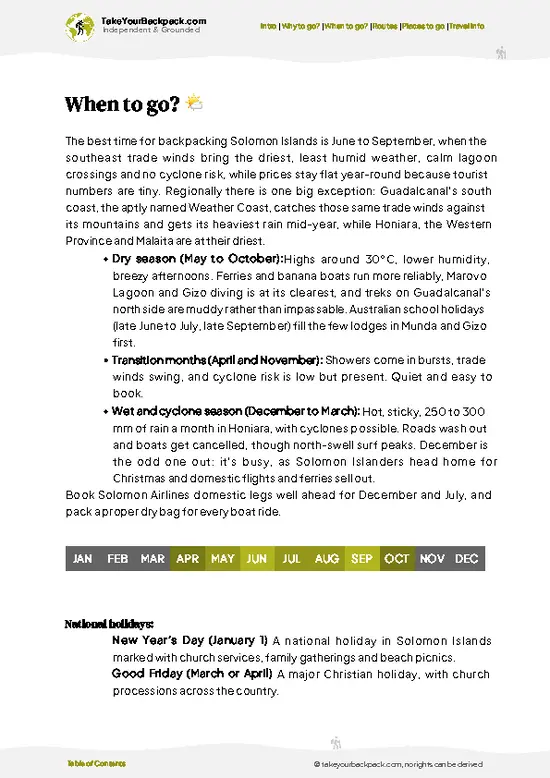
The best window for the Nggela Islands (Nggela) is May to October, when southeast trade winds keep the air drier and the water clearer for snorkeling and diving around Tulagi and the Sandfly Passage.
  • Dry-ish Season (May to October): Days run roughly 27 to 30°C (81 to 86°F) with cooler, breezy nights near 23°C (73°F). Seas can be choppy on exposed crossings, but visibility on the reefs and WWII wrecks is at its best. Sunrise is around 6:00 and sunset around 17:45.
  • Wet Season (November to April): Expect humid heat of 28 to 32°C (82 to 90°F), heavy downpours, and cyclone risk from January to March. Mud makes village paths slippery, and boats are sometimes canceled when swells build.
  • Crowds and Prices: Ngella never gets crowded. Visitors are mostly divers, yachties and a few backpackers, and village
… read more 👉
The best window for the Nggela Islands (Nggela) is May to October, when southeast trade winds keep the air drier and the water clearer for snorkeling and diving around Tulagi and the Sandfly Passage.
  • Dry-ish Season (May to October): Days run roughly 27 to 30°C (81 to 86°F) with cooler, breezy nights near 23°C (73°F). Seas can be choppy on exposed crossings, but visibility on the reefs and WWII wrecks is at its best. Sunrise is around 6:00 and sunset around 17:45.
  • Wet Season (November to April): Expect humid heat of 28 to 32°C (82 to 90°F), heavy downpours, and cyclone risk from January to March. Mud makes village paths slippery, and boats are sometimes canceled when swells build.
  • Crowds and Prices: Ngella never gets crowded. Visitors are mostly divers, yachties and a few backpackers, and village guesthouse rates stay flat all year. Dive operators and resorts may charge more in July and August, when Australians travel.
  • Events: Village church festivals around Christmas and Easter bring feasting and singing, but transport is erratic then.
Book your Honiara boat connection a day ahead in any season, since weather can shift departures.


source: climatestotravel.comJANJanuary: below average for travelingFEBFebruary: below average for travelingMARMarch: fair for travelingAPRApril: highly recommended for travelingMAYMay: excellent for travelingJUNJune: excellent for travelingJULJuly: excellent for travelingAUGAugust: excellent for travelingSEPSeptember: excellent for travelingOCTOctober: highly recommended for travelingNOVNovember: below average for travelingDECDecember: below average for traveling
when-to-go

✈️ The backpacker research shortcutSolomon Islands Travel Guide

An offline-friendly backpacking guide with optimized travel routes, ranked highlights, transport advice, and the best areas to stay.
example page 0 from our offline Travel Guide for Solomon Islands
example page 1 from our offline Travel Guide for Solomon Islands
example page 2 from our offline Travel Guide for Solomon Islands
example page 3 from our offline Travel Guide for Solomon Islands
example page 4 from our offline Travel Guide for Solomon Islands
example page 5 from our offline Travel Guide for Solomon Islands
example page 6 from our offline Travel Guide for Solomon Islands
example page 7 from our offline Travel Guide for Solomon Islands
The digital guide (145 pages) contains:
✅ 33 highlights, ranked by travel appeal
✅ Optimized 5, 10 & 15-day travel routes
✅ Cities, national parks, landmarks, beaches
✅ How to get around
✅ Offline-friendly for travel without Wi-Fi
👉 Click to see all 30+ guide features

📅 Plan smarter in minutes, not weeks
✅ Month by month travel advice
✅ Festivals & national holidays
✅ Budget expectations

🗺️ Go to the right places, skip the overrated ones
✅ Honest pros & cons of destinations
✅ Top hikes, parks & viewpoints
✅ Lesser-known places most travelers miss
✅ Clear “worth it vs skip it” guidance

🛏️ Travel smoothly without rookie mistakes
✅ Best areas to stay
✅ Transport systems explained simply
✅ Common scams & safety advice
✅ SIM cards, money & practical tips

🌍 Understand the country, not just visit it
✅ Culture & traditions
✅ 52 Essential phrases & customs
✅ Festivals worth planning around
✅ Traveler-friendly historical context
✅ Insights that make places more meaningful

📱 Built for real travel conditions
✅ Fully downloadable PDF
✅ Works completely offline
✅ Optimized for phone use
✅ Useful in remote areas & buses
✅ Everything in one place
Stop searching, start planning
Get instant access to your full guide. 30‑day money-back guarantee.
+ Add another guide for just

By proceeding you agree to our terms.
Sent to your inbox immediately after payment • 100% Secure Checkout
Best Backpacking Travel Advisor 2025 tourism awardBest Backpacking
Travel Advisor
2025
What others say about Take Your Backpack Guides:
⭐⭐⭐⭐⭐
Fantastic, amazing amount of information!
⭐⭐⭐⭐⭐
My goodness this is amazing, it's what I've been looking for hats off too you!
⭐⭐⭐⭐⭐
I think this is absolutely BRILLIANT
⭐⭐⭐⭐
Very complete and informative. It's still missing places, but I gotta to commend you
⭐⭐⭐⭐⭐
This is truly amazing, thank you, can't wait to explore it with my kids!
⭐⭐⭐⭐⭐
Awesome resource, thank you!
⭐⭐⭐⭐⭐
This is amazing! Can't wait to explore the ones I haven't seen
⭐⭐⭐⭐
I love this! Well done, great idea.
⭐⭐⭐⭐⭐
Thanks for taking the time to make this gem!
⭐⭐⭐⭐⭐
This might be the best website I've ever seen.
⭐⭐⭐⭐⭐
Congratulations, and thank you so much for your work; it's incredibly valuable.
⭐⭐⭐⭐
In all seriousness I think you did a great job pointing out the important spots
⭐⭐⭐⭐⭐
10/10 very good
⭐⭐⭐⭐⭐
As someone who's only just starting to visit regularly this is awesome, thank you.
⭐⭐⭐⭐
Thank you very much! I'm going to visit my dad, it's going to be very useful!
⭐⭐⭐⭐⭐
This is really cool! We'll be travelling for the first time and this definitely come in handy.
⭐⭐⭐⭐⭐
You are now our minister of culture, congratulations 👨‍💼
⭐⭐⭐⭐⭐
Just wanted to tell you that this is a pearl! Going to follow your recommendations.
⭐⭐⭐⭐⭐
This is so cool. I'll definitely be using the resource for my travels soon.
⭐⭐⭐⭐⭐
This is very impressive! Good work.
⭐⭐⭐⭐⭐
This is an amazing and informative site. Very well done!

🛏️ Where to stay?Where staying makes the most sense

Tulagi, the old colonial capital, and the village guesthouses scattered across Ngella Sule and Ngella Pile are the best bases for a backpacker on a budget. Tulagi has the most infrastructure, with a small market, a few stores, a harbor and the easiest boat links to Honiara. It also holds WWII relics, and dive boats leave from nearby, so you will meet other travelers, mostly divers and a few Australians. It feels safe and relaxed, with locals greeting you on every path.
For something quieter, village stays on the Ngella mainland coast offer simple leaf-house or timber rooms, shared bucket showers, … read more 👉
Tulagi, the old colonial capital, and the village guesthouses scattered across Ngella Sule and Ngella Pile are the best bases for a backpacker on a budget. Tulagi has the most infrastructure, with a small market, a few stores, a harbor and the easiest boat links to Honiara. It also holds WWII relics, and dive boats leave from nearby, so you will meet other travelers, mostly divers and a few Australians. It feels safe and relaxed, with locals greeting you on every path.
For something quieter, village stays on the Ngella mainland coast offer simple leaf-house or timber rooms, shared bucket showers, and meals cooked by your hosts. These are not party spots. Evenings are spent talking with families, listening to church singing, and watching stars with almost no light pollution. Social contact comes from the village rather than other backpackers.
Smaller islets in the Sandfly Passage and around Gavutu and Tanambogo suit those who want beach time with snorkeling right off the shore. Accommodation there is basic and sometimes solar powered, so charge devices when you can.
Keep cash on you, since card machines are rare. Always ask permission before camping or using beaches, because land is customary and owned by families, and a small fee or gift is normal.

🚌 Getting aroundGetting around like a local

The villages of Ngella are small enough to cross on foot in minutes, and walking stops making sense the moment you want to reach another island or the far side of the main one, because the islands are separated by narrow channels and the interior is thick jungle ridges with few roads. Almost everything moves by boat. Expect salt spray, the smell of two-stroke fuel, and schedules that bend with tide, weather and how many passengers turn up. It works, but patience is the price.
  • Public Boat from Honiara: The cheapest way in, run by fiberglass boats and occasional larger vessels, usually costing about SBD 100 to 250 (US$12 to 30) and taking roughly 1.5 to 3 hours. It is crowded and open to rain and spray, but for a backpacker it gives the most value, and you will share the deck with families, bagged
… read more 👉
The villages of Ngella are small enough to cross on foot in minutes, and walking stops making sense the moment you want to reach another island or the far side of the main one, because the islands are separated by narrow channels and the interior is thick jungle ridges with few roads. Almost everything moves by boat. Expect salt spray, the smell of two-stroke fuel, and schedules that bend with tide, weather and how many passengers turn up. It works, but patience is the price.
  • Public Boat from Honiara: The cheapest way in, run by fiberglass boats and occasional larger vessels, usually costing about SBD 100 to 250 (US$12 to 30) and taking roughly 1.5 to 3 hours. It is crowded and open to rain and spray, but for a backpacker it gives the most value, and you will share the deck with families, bagged rice and chickens.
  • Chartered Motorized Canoe: A local dinghy with an outboard is the only way to hop between villages, Tulagi and the small islets. A short hop might run SBD 150 to 500 (US$18 to 60) depending on fuel, which is steep alone but sensible when split among four. Comfort is basic, but you choose the time and can stop to snorkel.
  • Resort or Dive Shuttle Boats: Operators and larger lodges run pickups from Honiara for roughly US$60 to 150 per trip. They are faster and drier and have life jackets, which is worth it if you carry dive gear or arrive in rough weather, though the cost is several times the public boat.
  • Walking Tracks: Footpaths link villages on the same island, through coconut groves and along black-sand shores. They are free, shaded and good for 30 to 90 minute stretches, but mud and heat slow you down, so wear sandals that can get wet.
Carry small bills for boat fuel contributions, pack everything in dry bags, and ask your guesthouse host to radio or call a boat owner the evening before so you are not waiting on the beach at dawn.

🍲 FoodWhat to Eat & Drink

Food on Ngella is built around root crops, fresh fish and coconut. Expect taro, cassava and sweet potato steamed or baked, often in a ground oven, served with grilled reef fish, tuna or crab. The best dish is anything cooked in coconut milk, with sweet, smoky greens like kangkong or slippery cabbage alongside. Poi, a sticky pounded taro paste, shows up at feasts, and puddings of grated cassava or nut baked in leaves make a dense, lightly sweet finish.
Backpackers mostly eat what their guesthouse family cooks, usually for about SBD 50 to 100 (US$6 to 12) a meal, so tell them in advance. Tulagi has a small market and stores for fruit, tinned fish, noodles and crackers, and you can buy fresh tuna or lobster from canoes arriving at the shore. Cafés are scarce, so carry snacks for boat days.
Drink … read more 👉
Food on Ngella is built around root crops, fresh fish and coconut. Expect taro, cassava and sweet potato steamed or baked, often in a ground oven, served with grilled reef fish, tuna or crab. The best dish is anything cooked in coconut milk, with sweet, smoky greens like kangkong or slippery cabbage alongside. Poi, a sticky pounded taro paste, shows up at feasts, and puddings of grated cassava or nut baked in leaves make a dense, lightly sweet finish.
Backpackers mostly eat what their guesthouse family cooks, usually for about SBD 50 to 100 (US$6 to 12) a meal, so tell them in advance. Tulagi has a small market and stores for fruit, tinned fish, noodles and crackers, and you can buy fresh tuna or lobster from canoes arriving at the shore. Cafés are scarce, so carry snacks for boat days.
Drink coconut water cut by a child with a machete, or sweet tea. Bring bottled or purified water, since tap water is not reliable. Betel nut is chewed widely, and you will see red-stained smiles and spit marks.
Meals are shared, and it is polite to wait until the host invites you to eat, and to accept a little of everything. Sunday is for church, so do not expect much cooked or sold.

FAQFrequently asked questions about Nggela Islands

Plan 3 to 5 days for Ngella. That gives you a day for the boat from Honiara and settling in, a day for snorkeling or diving WWII wrecks near Tulagi and Gavutu, and a day or two for village walks and swimming on the Sandfly Passage. Divers can easily fill a week, while a day trip from Honiara is possible but leaves little time.
Boats are the way around, since the islands are split by channels and have almost no roads. Public boats from Honiara take roughly 1.5 to 3 hours and cost about SBD 100 to 250 (US$12 to 30), while chartered village canoes run SBD 150 to 500 (US$18 to 60) per short hop. Within an island you can walk coastal paths between villages in 30 to 90 minutes.
Ngella is known for WWII history, since Tulagi was the Allied base and Japanese headquarters early in 1942, and Gavutu and Tanambogo saw fierce fighting. The Sandfly Passage and Iron Bottom Sound reefs offer dive sites with wrecks and coral, and the area is also known for quiet village life and easy snorkeling. Expect plain accommodation, local food and almost no crowds.
⚠️ Things can change over time, so always validate details locally before you go.

Other Solomon Islander regions near Nggela Islands

Explore more nearby:

  • Savo Island—Black sand, steaming crater, hot springs, megapode nests| 47 km away
  • Malaita Island—Artificial lagoon islands, shell money, Kwaio highlands, Auki market| 80 km away
  • Simbo Island—Patukio crater, megapode sands, hot springs, tapu skull shrines| 417 km away

💡 Not sure where to go next?
Create a personalized itinerary for Solomon Islands including Nggela Islands and the places that fit your trip.

Generate my itinerary

👉 Discover all regions

Or checkout all Solomon Islands has to offer (think cities, towns, villages, national parks, hikes, beaches, festivals)
Country photo of Solomon Islands

We 💚 feedbackKey takeaways before you go

Most visitors rush Tulagi and miss the tide. Mboli Passage and the channels between the islands run fast and change the whole feel of a boat trip, so ask locals when the water is slack before you plan any paddle. I would bring cash in small notes, because village stops and boat hire rarely take anything else, and pack a headlamp for the long, dark evenings.

✍️ Help improve this page!
The information on this page is based on in-depth research, insights shared by experienced travelers, and feedback from the local travel community in Solomon Islands. While every effort is made to keep the information accurate and current, conditions can change — so if you spot anything incorrect or outdated, please get in touch.


🙋‍♂️ Give feedback

👋 Meet the founderWho’s Behind Take Your Backpack?

Johan, backpacker and founder of TakeYourBackpackHi, I’m Johan (Netherlands 🇳🇱), the creator of TakeYourBackpack. Over the past 3 decades, I’ve backpacked through 90+ countries across six continents, gaining extensive experience with independent travel, long-term trips, and overland routes.

This site is built on a combination of firsthand travel experience and carefully curated insights from other backpackers. Many guides are based on places I’ve personally visited, while others bring together tips, observations, and practical advice shared by trusted travelers I’ve met along the way.

The goal is to provide realistic, experience-driven guidance — not generic itineraries — so you can explore destinations with better context, clearer expectations, and more confidence.