×

Somalia🇸🇴 | citiesKismayoSouthern deep-water port, long beach, lighthouse, faded colonial buildings | things to do and best time to go

Explore BosasoExplore Borama

Backpacking in Kismayo
🌟 Highlightcity ranked #5
By Johan Kruseman 🇳🇱 | Updated November 1, 2026

Kismayo has one of the few deep-water ports on Somalia’s southern coast, and that is why almost everything here, from charcoal to sugar, moves through it. The city sits in the south of Somalia, on the Indian Ocean in the Lower Juba region, close to the Kenyan border. It suits experienced travelers with a local contact or arranged escort who want a real Somali port city with a long clean beach. It does not suit anyone after hostels, nightlife or a tick-list. Security rules the day, so independent wandering is not on the menu, and the sensible move is to arrange a local host before you arrive. Skip the port area itself, which is working industrial ground. Spend your time on the shoreline and the old center. Unlike Mogadishu, which is larger and louder, Kismayo is calmer, more compact and easier to read.

Part of Backpacking in Somalia: all 68 places on one map, with routes and the best time to go.
Discover everything you want to know in the 📖 Somalia Travel Guide.
Safety warning

The current risk level for Somalia is high. Check the advice before going.


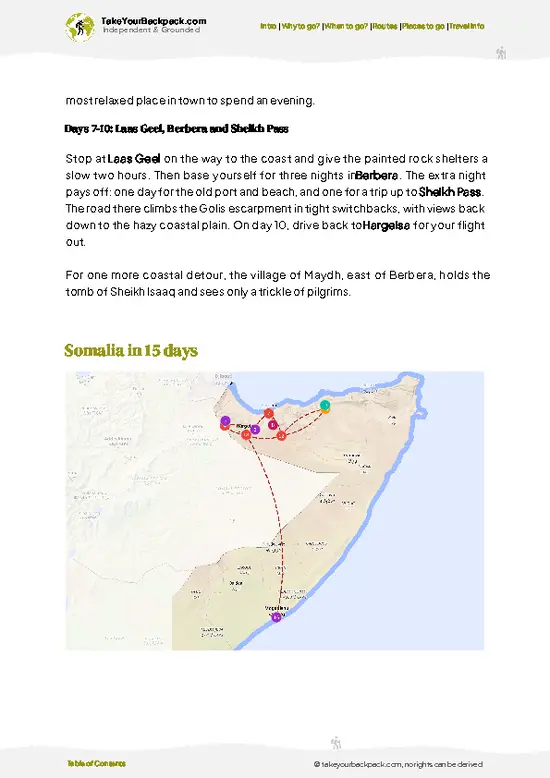
example page 0 from our offline Travel Guide for Somalia
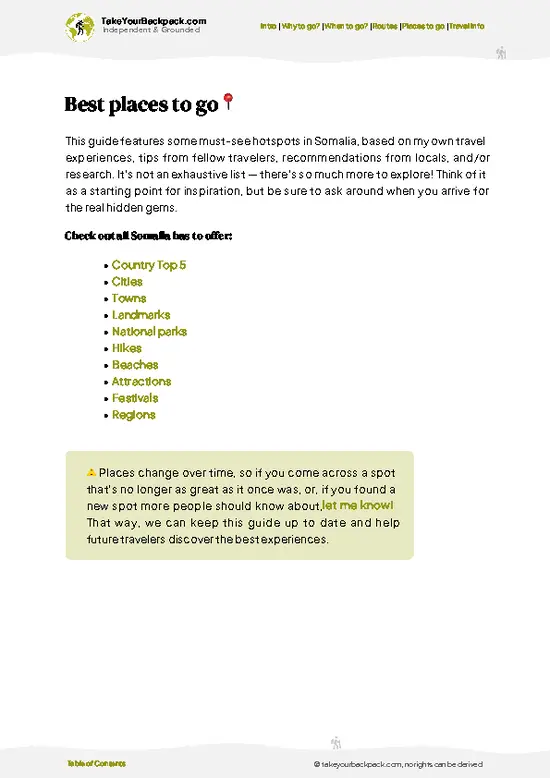
example page 1 from our offline Travel Guide for Somalia
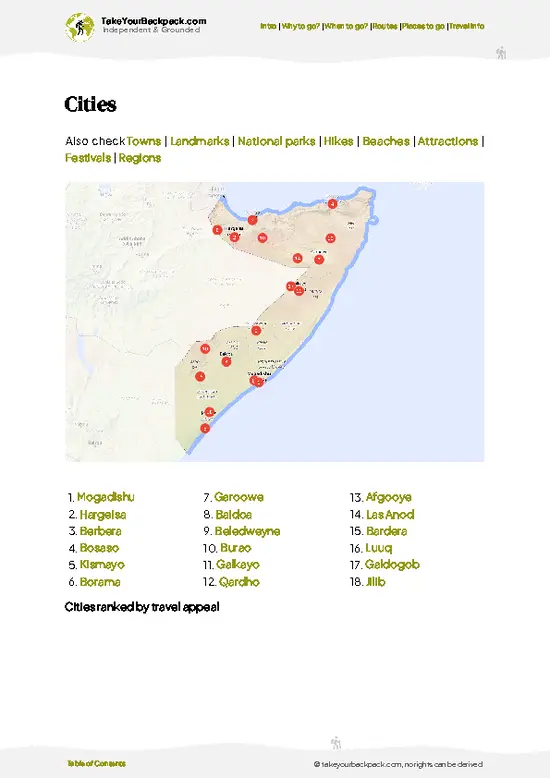
example page 2 from our offline Travel Guide for Somalia
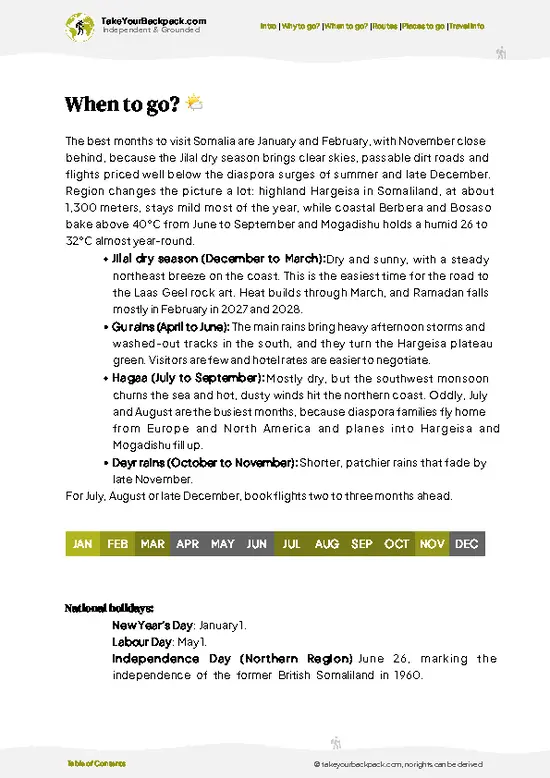
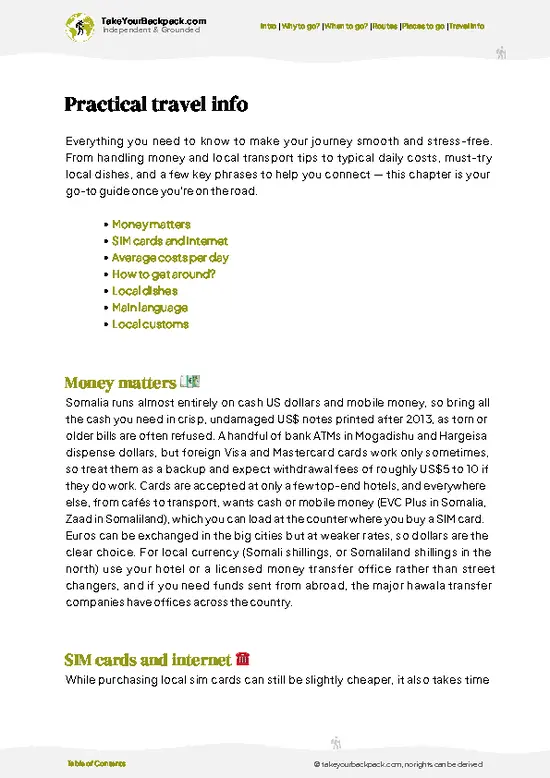
example page 3 from our offline Travel Guide for Somalia
example page 4 from our offline Travel Guide for Somalia
example page 5 from our offline Travel Guide for Somalia
example page 6 from our offline Travel Guide for Somalia
example page 7 from our offline Travel Guide for Somalia
Loading the map 🌍
CLICK TO FILTER
cities
towns
landmarks
national parks
hikes
beaches
attractions
festivals
regions
SHOW COUNTRY’S BESTSHOW ALL

✨ Why go?
Ranked #5 city in Somalia
What sets this place apart

Kismayo earns a place on a Somalia route because it is the main gateway to the south, and a far gentler introduction than the capital. Its long Indian Ocean shoreline runs right beside town, so a beach walk is a daily habit for locals rather than a special outing. The city is compact enough that a driver or host can show you the center in a morning, and the fishing harbor gives you a front-row view of how a Somali coastal economy works. Seafood is the main food draw, and it is fresh because the boats land a few minutes away. Do not come expecting backpacker infrastructure, a hostel scene or a long list of organized activities. This is a place for travelers who want conversation, local tea and an honest look at a city rebuilding itself. It works best as a two or three day stop between other … read more 👉
Kismayo earns a place on a Somalia route because it is the main gateway to the south, and a far gentler introduction than the capital. Its long Indian Ocean shoreline runs right beside town, so a beach walk is a daily habit for locals rather than a special outing. The city is compact enough that a driver or host can show you the center in a morning, and the fishing harbor gives you a front-row view of how a Somali coastal economy works. Seafood is the main food draw, and it is fresh because the boats land a few minutes away. Do not come expecting backpacker infrastructure, a hostel scene or a long list of organized activities. This is a place for travelers who want conversation, local tea and an honest look at a city rebuilding itself. It works best as a two or three day stop between other Somali destinations or on the way in from Kenya, with onward travel arranged ahead through your contacts.

💡 HighlightsWhat this place is best known for

  1. Kismayo Port: The deep-water port is the reason the city matters, and watching dhows and cargo ships load from the edge of the harbor area shows you the local economy at work. Come early in the morning when the unloading is busiest. Entry to the public approach is free, but photography near the docks can draw attention from port security, so ask before you raise a camera. Allow 45 minutes to 1 hour.
  2. Kismayo Lighthouse: An old coastal navigation landmark that locals use as a reference point on the shoreline. It gives a sense of how the city has looked out to sea for generations. Late afternoon brings cooler air and softer light. No ticket is normally needed. Allow 30 minutes.
  3. Kismayo Beach: A long Indian Ocean strip of pale sand at the edge of town, where families gather in the evening and local
… read more 👉
  1. Kismayo Port: The deep-water port is the reason the city matters, and watching dhows and cargo ships load from the edge of the harbor area shows you the local economy at work. Come early in the morning when the unloading is busiest. Entry to the public approach is free, but photography near the docks can draw attention from port security, so ask before you raise a camera. Allow 45 minutes to 1 hour.
  2. Kismayo Lighthouse: An old coastal navigation landmark that locals use as a reference point on the shoreline. It gives a sense of how the city has looked out to sea for generations. Late afternoon brings cooler air and softer light. No ticket is normally needed. Allow 30 minutes.
  3. Kismayo Beach: A long Indian Ocean strip of pale sand at the edge of town, where families gather in the evening and local boys play football on the flat sand at low tide. Go from late afternoon until dusk. It is free, and an hour or two is plenty. Swim modestly dressed, since this is a conservative city, and keep to the areas where locals are present.
  4. Fish Market at the Fishing Harbor: Small boats land tuna, kingfish and lobster here, and the auction-style haggling over the catch is the best free show in town. Go at first light, when the boats come in. Looking costs nothing, and a grilled fish bought nearby is about US$3 to 6. Allow 1 hour.
  5. Old Town Streets and Colonial-Era Buildings: The core of Kismayo holds faded Italian and British-era buildings with arched doorways and weathered coral stone, mixed with newer concrete. Walk it in the morning before the heat builds. Free, and a loop takes 1 to 2 hours. Go with a local host, who can also explain which blocks are best avoided.
  6. Kismayo Central Market (Suuqa Weyn): The main trading area, where camel milk, bananas, mangoes, fabric, sandals and phone credit all sell within a few blocks. Visit before midday, when stalls are fully stocked and the heat is manageable. Entry is free, and tea or a snack runs about US$1 to 2. Allow 1 to 2 hours.
Kismayo also has natural areas outside the city worth exploring as day trips, including the Bush Bush National Park region and the Jubba River mouth, with the coast toward Ras Kamboni further out. All of the sights above fit into a single unhurried day of about 5 to 7 hours.
Spotted a mistake or missing something? Contact us.

🏘️ NeighborhoodsNeighborhood guide to Kismayo

Kismayo is compact, and most of what a visitor needs sits within a 20-minute walk of the port. Walk in daylight only, since street lighting is patchy and the center empties after dark.
  • Old Town: Crumbling Italian-era and Arab-style buildings sit along narrow lanes above the harbor. Spend an hour here for the architecture and the fishing-port bustle, then move on. Go with a local contact, because unaccompanied foreigners draw attention and questions.
  • Port and Fish Market: Boats unload tuna, kingfish and lobster in the morning, and this is the best free show in town. Arrive early, before the catch is sold. Expect smell, wet ground and sharp haggling, so wear shoes you can hose off.
  • Calanley and Farjano: Residential districts with small shops, tea stalls and local restaurants. Food is cheaper here
… read more 👉
Kismayo is compact, and most of what a visitor needs sits within a 20-minute walk of the port. Walk in daylight only, since street lighting is patchy and the center empties after dark.
  • Old Town: Crumbling Italian-era and Arab-style buildings sit along narrow lanes above the harbor. Spend an hour here for the architecture and the fishing-port bustle, then move on. Go with a local contact, because unaccompanied foreigners draw attention and questions.
  • Port and Fish Market: Boats unload tuna, kingfish and lobster in the morning, and this is the best free show in town. Arrive early, before the catch is sold. Expect smell, wet ground and sharp haggling, so wear shoes you can hose off.
  • Calanley and Farjano: Residential districts with small shops, tea stalls and local restaurants. Food is cheaper here than near the port, and the pace is calm. Walkable, but a motorbike taxi saves time in the heat.
  • Beachfront: Long sandy shoreline with a strong swell. Locals gather at dusk, but swimming is not worth the risk because of currents, and nightlife is essentially absent. Sit with tea and watch instead.

⌛️ 1 dayA smart one-day plan

7:00 AM: Fishing Harbor Start where the day starts. Boats come in with tuna and lobster, and the bargaining is the best free show in town. Go with your host, keep cameras discreet and ask before photographing anyone. Then drive a few minutes to the center.
9:00 AM: Old Town streets Walk the older quarter slowly, looking at the coral stone and Italian-era buildings, some scarred, some restored. It is a clear picture of the city’s layers. Stop for sweet tea at a local tea house.
11:00 AM: Central market Browse cloth, dates, spices and camel milk before the heat peaks. Buy a small gift or phone credit and practice a few Somali greetings. Vendors are generous with time if you are polite.
1:00 PM: Seafood lunch Eat grilled fish with rice and banana at a coastal restaurant. Rest through the hottest … read more 👉
7:00 AM: Fishing Harbor Start where the day starts. Boats come in with tuna and lobster, and the bargaining is the best free show in town. Go with your host, keep cameras discreet and ask before photographing anyone. Then drive a few minutes to the center.
9:00 AM: Old Town streets Walk the older quarter slowly, looking at the coral stone and Italian-era buildings, some scarred, some restored. It is a clear picture of the city’s layers. Stop for sweet tea at a local tea house.
11:00 AM: Central market Browse cloth, dates, spices and camel milk before the heat peaks. Buy a small gift or phone credit and practice a few Somali greetings. Vendors are generous with time if you are polite.
1:00 PM: Seafood lunch Eat grilled fish with rice and banana at a coastal restaurant. Rest through the hottest hours indoors.
3:30 PM: Jubaland community neighborhoods Off the standard route, ask your host to take you through a residential district where new homes are going up beside older ones. It shows ordinary life better than any monument, and neighbors often invite you in for tea.
5:00 PM: Kismayo Beach Finish on the sand as families arrive. Walk the shoreline, watch the football games and stay until just after dusk, then return with your host before dark.

🌤️ When to go?When to go for the best experience

December to March is the easiest window for Kismayo, with dry, sunny days of roughly 29 to 33°C (84 to 91°F) and little rain.
  • Jilaal (Dec to Mar): Hot, dry and breezy, with the clearest skies. Days are close to 12 hours long all year, so daylight never shifts much. Prices for rooms and car hire stay steady, since visitor numbers are low.
  • Gu Rains (Apr to Jun): Heavy downpours turn dirt roads to mud and can cut off routes outside town. Temperatures run 27 to 31°C (81 to 88°F) with high humidity.
  • Xagaa (Jul to Sep): Cooler at 24 to 29°C (75 to 84°F), but windy with a rough sea and drizzle. Ocean swell makes boat trips unreliable.
  • Deyr Rains (Oct to Nov): Shorter, lighter showers and a warm 27 to 31°C (81 to 88°F). Roads are usually passable.
Book flights a few days ahead, since schedules change with security and weather.

source: climatestotravel.comJANJanuary: excellent for travelingFEBFebruary: excellent for travelingMARMarch: highly recommended for travelingAPRApril: fair for travelingMAYMay: fair for travelingJUNJune: fair for travelingJULJuly: good for travelingAUGAugust: good for travelingSEPSeptember: good for travelingOCTOctober: good for travelingNOVNovember: highly recommended for travelingDECDecember: excellent for traveling
when-to-go

✈️ The backpacker research shortcutSomalia Travel Guide

What the free pages can't give you: ready-made routes, every place ranked, and it works offline. All in 1 guide.
example page 0 from our offline Travel Guide for Somalia
example page 1 from our offline Travel Guide for Somalia
example page 2 from our offline Travel Guide for Somalia
example page 3 from our offline Travel Guide for Somalia
example page 4 from our offline Travel Guide for Somalia
example page 5 from our offline Travel Guide for Somalia
example page 6 from our offline Travel Guide for Somalia
example page 7 from our offline Travel Guide for Somalia
The digital guide (237 pages) contains:-page digital guide:
✅ Ready-made 5, 10 & 15-day routes
✅ All 68 places ranked, so you skip the overrated ones
✅ Works offline, all in 1 guide
✅ Cities, national parks, landmarks, beaches
✅ How to get around
👉 Click to see all 30+ guide features

📅 Plan smarter in minutes, not weeks
✅ Month by month travel advice
✅ Festivals & national holidays
✅ Budget expectations

🗺️ Go to the right places, skip the overrated ones
✅ Honest pros & cons of destinations
✅ Top hikes, parks & viewpoints
✅ Lesser-known places most travelers miss
✅ Clear “worth it vs skip it” guidance

🛏️ Travel smoothly without rookie mistakes
✅ Best areas to stay
✅ Transport systems explained simply
✅ Common scams & safety advice
✅ SIM cards, money & practical tips

🌍 Understand the country, not just visit it
✅ Culture & traditions
✅ 52 Essential phrases & customs
✅ Festivals worth planning around
✅ Traveler-friendly historical context
✅ Insights that make places more meaningful

📱 Built for real travel conditions
✅ Fully downloadable PDF
✅ Works completely offline
✅ Optimized for phone use
✅ Useful in remote areas & buses
✅ All in 1 guide
Stop searching, start planning
Get instant access to your full guide. 30‑day money-back guarantee.


By proceeding you agree to our terms.
Sent to your inbox immediately after payment • 100% Secure Checkout
Best Backpacking Travel Advisor 2025 tourism awardBest Backpacking
Travel Advisor
2025
What others say about Take Your Backpack Guides:
⭐⭐⭐⭐⭐
Fantastic, amazing amount of information!
⭐⭐⭐⭐⭐
My goodness this is amazing, it's what I've been looking for hats off too you!
⭐⭐⭐⭐⭐
I think this is absolutely BRILLIANT
⭐⭐⭐⭐
Very complete and informative. It's still missing places, but I gotta to commend you
⭐⭐⭐⭐⭐
This is truly amazing, thank you, can't wait to explore it with my kids!
⭐⭐⭐⭐⭐
Awesome resource, thank you!
⭐⭐⭐⭐⭐
This is amazing! Can't wait to explore the ones I haven't seen
⭐⭐⭐⭐
I love this! Well done, great idea.
⭐⭐⭐⭐⭐
Thanks for taking the time to make this gem!
⭐⭐⭐⭐⭐
This might be the best website I've ever seen.
⭐⭐⭐⭐⭐
Congratulations, and thank you so much for your work; it's incredibly valuable.
⭐⭐⭐⭐
In all seriousness I think you did a great job pointing out the important spots
⭐⭐⭐⭐⭐
10/10 very good
⭐⭐⭐⭐⭐
As someone who's only just starting to visit regularly this is awesome, thank you.
⭐⭐⭐⭐
Thank you very much! I'm going to visit my dad, it's going to be very useful!
⭐⭐⭐⭐⭐
This is really cool! We'll be travelling for the first time and this definitely come in handy.
⭐⭐⭐⭐⭐
You are now our minister of culture, congratulations 👨‍💼
⭐⭐⭐⭐⭐
Just wanted to tell you that this is a pearl! Going to follow your recommendations.
⭐⭐⭐⭐⭐
This is so cool. I'll definitely be using the resource for my travels soon.
⭐⭐⭐⭐⭐
This is very impressive! Good work.
⭐⭐⭐⭐⭐
This is an amazing and informative site. Very well done!

🛏️ Where to stay?Best areas and accommodation options

The area around the port and central Kismayo is where almost every budget traveler sleeps, because it holds most of the town’s guesthouses and simple hotels. Dedicated backpacker hostels with dorms are essentially nonexistent, so expect private rooms in small guesthouses, usually priced at US$15 to 40 a night. Prices rise for rooms with air conditioning and reliable generator power, which matter in the heat.

Staying central keeps restaurants, money-transfer shops and transport within walking distance, and it is easier to arrange a driver. Many places have gated entrances and guards, which is … read more 👉
The area around the port and central Kismayo is where almost every budget traveler sleeps, because it holds most of the town’s guesthouses and simple hotels. Dedicated backpacker hostels with dorms are essentially nonexistent, so expect private rooms in small guesthouses, usually priced at US$15 to 40 a night. Prices rise for rooms with air conditioning and reliable generator power, which matter in the heat.

Staying central keeps restaurants, money-transfer shops and transport within walking distance, and it is easier to arrange a driver. Many places have gated entrances and guards, which is the norm and a plus for security. Noise comes mostly from generators, mosques at dawn and the occasional rooster, so bring earplugs.

The quieter residential districts such as Calanley are a second option. They are calmer at night and cheaper for meals, but fewer rooms exist and a bajaj ride is needed to reach the harbor. Book ahead by phone or through a local contact, and confirm that water and power are running before paying.

🚌 Getting aroundHow to get from A to B

Kismayo has no ride-hailing apps and no scheduled city buses, so travelers who wait for a metered taxi lose hours; flag a bajaj or arrange a driver instead. The center is small enough to cross on foot in 20 to 30 minutes, though heat and dust make short rides welcome. Roads in town are partly paved, and traffic is light compared with Mogadishu.
  • Walking: Free and the best option for the port, old town and market, all within about 2 km of each other. Go in the morning, because midday heat is punishing and the lanes are shadeless.
  • Bajaj (three-wheeled auto-rickshaw): The standard way to get around, costing US$1 to 3 per ride in town. Agree the fare before you climb in, because there are no meters. Not worth using at night.
  • Motorbike taxi: Quickest in congested streets and costs US$1 to 2 for short
… read more 👉
Kismayo has no ride-hailing apps and no scheduled city buses, so travelers who wait for a metered taxi lose hours; flag a bajaj or arrange a driver instead. The center is small enough to cross on foot in 20 to 30 minutes, though heat and dust make short rides welcome. Roads in town are partly paved, and traffic is light compared with Mogadishu.
  • Walking: Free and the best option for the port, old town and market, all within about 2 km of each other. Go in the morning, because midday heat is punishing and the lanes are shadeless.
  • Bajaj (three-wheeled auto-rickshaw): The standard way to get around, costing US$1 to 3 per ride in town. Agree the fare before you climb in, because there are no meters. Not worth using at night.
  • Motorbike taxi: Quickest in congested streets and costs US$1 to 2 for short hops. Skip it if you are carrying a big pack or are uneasy on the back of a bike, as helmets are rare.
  • Private car with driver: The practical choice for the airport, which is a short drive from the center, and for anything outside town. Expect US$10 to 25 for a local transfer or half-day, more with an escort. Ask your hotel to arrange a trusted driver instead of picking one up on the street.
  • Minibus and shared car to other towns: Departures to places like Afmadow run when seats fill, usually in the morning, costing roughly US$5 to 15. Roads outside the city are rough and security conditions change, so confirm the route locally the day before.

👛 Costs (as of 1 November 2026)Money, prices, and spending tips

Kismayo costs a backpacker about US$39 to 68 a day when staying in a simple guesthouse and eating locally.
CategoryBudget RangeLocal Reality
Dorm accommodation (high season)US$20 to 30No true dorms; a basic private room in a guesthouse is the equivalent.
Dorm accommodation (off-season)US$15 to 25Rooms are slightly cheaper in the rainy months, and bargaining helps.
MealsUS$8 to 15Fish plates, rice dishes and tea at local restaurants.
Local transportUS$3 to 8Bajaj and motorbike rides within town.
City transport passNot availableNo pass exists; you pay per ride in cash.
Basic activities/entry feesUS$5 to 10Most sights are free; budget for a driver or guide for outings.
MiscellaneousUS$3 to 5SIM card, water, tips and small purchases.
Total Daily BudgetUS$39 to 68About US$55 for a typical day in high season.
… read more 👉
Kismayo costs a backpacker about US$39 to 68 a day when staying in a simple guesthouse and eating locally.
CategoryBudget RangeLocal Reality
Dorm accommodation (high season)US$20 to 30No true dorms; a basic private room in a guesthouse is the equivalent.
Dorm accommodation (off-season)US$15 to 25Rooms are slightly cheaper in the rainy months, and bargaining helps.
MealsUS$8 to 15Fish plates, rice dishes and tea at local restaurants.
Local transportUS$3 to 8Bajaj and motorbike rides within town.
City transport passNot availableNo pass exists; you pay per ride in cash.
Basic activities/entry feesUS$5 to 10Most sights are free; budget for a driver or guide for outings.
MiscellaneousUS$3 to 5SIM card, water, tips and small purchases.
Total Daily BudgetUS$39 to 68About US$55 for a typical day in high season.
Carry small US dollar bills, which are widely accepted, and use them to bargain firmly for rides and rooms.
⚠️ Prices can change and everyone travels differently, so take this as a rough guide. Hope it helps you plan your adventure!

🚌 Day tripsBest day trips from Kismayo

Kismayo works as a base for short outings by road or sea, but security conditions limit how far you can safely go, so arrange everything locally and travel only with a trusted driver.
Kismayo Beaches and Fishing Boats:
The shoreline just outside town is the easiest escape, 10 to 20 minutes by bajaj for US$2 to 5 return. Come in the cooler morning to watch boats land their catch. Many first-timers swim where the surf is strong, so stay in the shallows.

Jubba River Mouth and Mangroves:
The Jubba meets the Indian Ocean north of the city, where sandbars, birds and mangrove channels make a quiet half day. Hire a car and a local guide for roughly US$40 to 80 total, and go in the dry months from December to March when tracks are firm. First-timers often set off without an escort or local clearance, … read more 👉
Kismayo works as a base for short outings by road or sea, but security conditions limit how far you can safely go, so arrange everything locally and travel only with a trusted driver.
Kismayo Beaches and Fishing Boats:
The shoreline just outside town is the easiest escape, 10 to 20 minutes by bajaj for US$2 to 5 return. Come in the cooler morning to watch boats land their catch. Many first-timers swim where the surf is strong, so stay in the shallows.

Jubba River Mouth and Mangroves:
The Jubba meets the Indian Ocean north of the city, where sandbars, birds and mangrove channels make a quiet half day. Hire a car and a local guide for roughly US$40 to 80 total, and go in the dry months from December to March when tracks are firm. First-timers often set off without an escort or local clearance, which can turn them back at checkpoints.

Bajuni Islands:
The islands and reefs of the Bajuni coast offshore are known for clear water and seabirds. Boat trips depend on calm seas, so aim for December to March, and ask at the port for a fisherman’s rate, typically US$50 to 100 for the boat. Check weather the evening before, because winds can cancel departures.

Afmadow:
This inland market town lies a few hours by road and shows daily life away from the coast, with livestock trading and tea houses. Shared cars cost about US$5 to 15 each way, but conditions and access change, so only go with local advice and a return plan before dark.
👉 Explore Afmadow

🍲 FoodEating & Drinking in Kismayo

Seafood is what sets Kismayo apart from inland Somalia. The port lands lobster, kingfish and tuna, often grilled over charcoal and served with lime, chili sauce and flatbread (canjeero or chapati). Prices are low, typically US$3 to 8 for a fresh fish plate, and lobster costs more.

The coastal location also brings a taste of Swahili and Bajuni cooking, with coconut and rice dishes that you rarely meet farther north. Try fresh coconut water and tamarind juice, and finish with sweet spiced shaah tea at a roadside stall, usually under US$1. Mango and banana come from Jubba valley farms, so fruit juice is thick and cheap in season.

Backpackers mostly eat at small local restaurants near the port and in the central streets, plus tea stalls and juice bars that fill up after the evening prayer. Eat … read more 👉
Seafood is what sets Kismayo apart from inland Somalia. The port lands lobster, kingfish and tuna, often grilled over charcoal and served with lime, chili sauce and flatbread (canjeero or chapati). Prices are low, typically US$3 to 8 for a fresh fish plate, and lobster costs more.

The coastal location also brings a taste of Swahili and Bajuni cooking, with coconut and rice dishes that you rarely meet farther north. Try fresh coconut water and tamarind juice, and finish with sweet spiced shaah tea at a roadside stall, usually under US$1. Mango and banana come from Jubba valley farms, so fruit juice is thick and cheap in season.

Backpackers mostly eat at small local restaurants near the port and in the central streets, plus tea stalls and juice bars that fill up after the evening prayer. Eat where the grill is busy, and go for lunch when the day’s catch is freshest. Alcohol is not sold openly.

🛡️ SafetyStaying Safe: What Travelers Should Know

Kismayo is far more stable than it was a decade ago, but Somalia remains a place where independent travel needs local arrangement and current advice. Stay in the central port area, avoid outlying roads and keep to daylight, since checkpoints and security conditions shift. Foreigners are conspicuous, so hosting by a local contact or hotel is the standard way to move around. Solo and night-time wandering is not sensible; take a trusted driver after dark. Dress modestly, particularly women, who should cover hair and arms. Ask before photographing people, ports or officials, as this causes real trouble. Petty theft exists in the market, so carry little cash and keep your phone out of sight. Overcharging of outsiders happens, so confirm bajaj fares first.

FAQCommon questions from travelers

Two to three days is enough for Kismayo itself. One day covers the port, fish market and old town, and another suits the beach or a Jubba River outing for US$40 to 80. Allow extra days for flight delays and for arranging local transport.
Kismayo is manageable for experienced solo travelers who arrange a local host or trusted driver, but it is not a place for unplanned wandering. Stay in the central port area, avoid travel after dark and skip outlying roads, since conditions change. Budget about US$10 to 25 for a driver when going beyond the center.
Kismayo is known for its deep-water port on the Indian Ocean and for fresh seafood, especially lobster and kingfish grilled for US$3 to 8 a plate. It is also the main city of Somalia’s Jubaland region, near the Jubba River mouth. Its long beaches and Italian-era old town are the main sights.
⚠️ Things can change over time, so always validate details locally before you go.

Other Somali cities near Kismayo

Explore more nearby:

  • Jilib—Middle Juba farms, irrigation channels, maize and sesame trade, post-conflict old town| 98 km away
  • Bardera—Jubba riverbank, mango and papaya plots, unfinished dam, camel-milk market| 301 km away
  • Afgooye—Shabelle farmland, banana plantations, roadside fruit stands, day outing from Mogadishu| 399 km away

💡 Not sure where to go next?
Create a personalized itinerary for Somalia including Kismayo and the places that fit your trip.

Generate my itinerary

👉 Discover all cities

Or checkout all Somalia has to offer (think cities, towns, villages, national parks, hikes, beaches, festivals)
Country photo of Somalia

We 💚 feedbackFinal thoughts on visiting Kismayo

Give Kismayo two full days. One covers the harbor, old town and market, and the second lets you slow down on the beach and accept the tea invitations that make the trip worthwhile. I would arrange my host and transport before arriving and leave the port area alone.

✍️ Help improve this page!
The information on this page is based on in-depth research, insights shared by experienced travelers, and feedback from the local travel community in Somalia. While every effort is made to keep the information accurate and current, conditions can change — so if you spot anything incorrect or outdated, please get in touch.


🙋‍♂️ Give feedback

👋 Meet the founderWho’s Behind Take Your Backpack?

Johan, backpacker and founder of TakeYourBackpackHi, I’m Johan (Netherlands 🇳🇱), the creator of TakeYourBackpack. Over the past 30 years, I’ve backpacked through 88 countries across six continents, gaining extensive experience with independent travel, long-term trips, and overland routes.

This site is built on a combination of firsthand travel experience and carefully curated insights from other backpackers. Many guides are based on places I’ve personally visited, while others bring together tips, observations, and practical advice shared by trusted travelers I’ve met along the way.

The goal is to provide realistic, experience-driven guidance — not generic itineraries — so you can explore destinations with better context, clearer expectations, and more confidence.