×

Somalia🇸🇴 | best citiesYour Guide to the 10 Best cities in Somalia

Cities in Somalia fall into three kinds, and only one suits most independent travelers. Somaliland in the northwest is the calmest, the cheapest and the easiest to move around, with towns you can walk by day. Puntland in the northeast costs more and works best with a local fixer. The federal south, including the capital, has rebuilt seafronts and loud markets, but every movement needs vetted hotels, armed escorts and a current security briefing. That multiplies costs several times over. For backpacking, start in the north and skip the south on a first trip. Crowds are not an issue anywhere, since foreign visitors are rare.

By Johan Kruseman 🇳🇱 | Updated November 10, 2026
Explore the best towns in Somalia

Why go?What Makes Them Special

Somalia’s cities exist because of the coast and the caravan routes. The country has the longest mainland coastline in Africa, roughly 3,300 km, and ports here traded with Arabia, Persia and India for centuries. Inland, pastoral nomadism shaped everything else: towns grew as livestock markets and clan meeting points, not as planned centers. The result is cities that are lively, commercial and intensely social, with tea houses, goat markets and money-changers working from stacks of cash on the street.

What they lack is tourist infrastructure. Three decades after the state collapsed in 1991, diaspora remittances and mobile money pay for most new building. Expect no hostel scene, few sights with signs or tickets, and card payments almost nowhere. Hot, arid conditions along the coast limit comfortable … read more 👉
Somalia’s cities exist because of the coast and the caravan routes. The country has the longest mainland coastline in Africa, roughly 3,300 km, and ports here traded with Arabia, Persia and India for centuries. Inland, pastoral nomadism shaped everything else: towns grew as livestock markets and clan meeting points, not as planned centers. The result is cities that are lively, commercial and intensely social, with tea houses, goat markets and money-changers working from stacks of cash on the street.

What they lack is tourist infrastructure. Three decades after the state collapsed in 1991, diaspora remittances and mobile money pay for most new building. Expect no hostel scene, few sights with signs or tickets, and card payments almost nowhere. Hot, arid conditions along the coast limit comfortable walking to early morning and evening.

Before choosing Somalia for its cities, know that most governments advise against all or most travel to the country, and standard travel insurance often excludes it. The security picture differs sharply between the north and the south, so the region you pick matters more than the city. Budget for a visa, a local contact and a specialist insurance policy before looking at flights. Do not plan this as a spontaneous trip.
Why These Made the Cut
The list of best cities in Somalia is created based on culture, vibe, attractions, transport ease, and local charm. If you feel a city is missing in this list, please let us know.

When to go?When to Plan Your Trip

Best months: December to February: The best months for Somalia’s cities are December to February, when the northern highlands are dry and cool and the coast is at its most bearable. Highland days sit around 20 to 27°C with nights dropping to roughly 8 to 14°C, so bring a warm layer. Coastal towns stay at 27 to 32°C in the same months.Shoulder seasons and rains: March and October to November are workable shoulders. The main rains (Gu) fall from April to June, and a second, shorter rainy season (Deyr) comes in October and November. Highland areas receive about 300 to 500 mm a year in total, but storms turn dirt roads to mud and flood low streets for a day or two, which wrecks overland timings. The northwest also gets a smaller burst of rain in July to September.Months to skip: Skip June to September … read more 👉
Best months: December to February: The best months for Somalia’s cities are December to February, when the northern highlands are dry and cool and the coast is at its most bearable. Highland days sit around 20 to 27°C with nights dropping to roughly 8 to 14°C, so bring a warm layer. Coastal towns stay at 27 to 32°C in the same months.Shoulder seasons and rains: March and October to November are workable shoulders. The main rains (Gu) fall from April to June, and a second, shorter rainy season (Deyr) comes in October and November. Highland areas receive about 300 to 500 mm a year in total, but storms turn dirt roads to mud and flood low streets for a day or two, which wrecks overland timings. The northwest also gets a smaller burst of rain in July to September.Months to skip: Skip June to September on the northern coast. Temperatures reach 38 to 45°C, humidity is heavy and there is little to do between 11 am and 4 pm. In the south the same months bring the southwest monsoon, with rough seas and strong winds along the shore. Plan around Ramadan, too: restaurants shut by day and business hours shrink. Prices do not follow a tourist calendar, since there is no real peak season, but flights and hotel rooms tighten around Eid and in December, when diaspora visitors arrive.

city hoppingSuggested Travel Strategies

How long a multi-city trip takes: A trip combining several cities in Somalia needs 10 to 14 days in the north, and the same again as a buffer if the south is included. The north clusters cleanly: Hargeisa works as the hub, with the Berbera coast, Borama and Burao each reachable on a day trip or a short overnight. Travel runs outward from Hargeisa and back, not in a long loop, because road links between regions are poor.Time per stop and between regions: Allow 2 to 3 nights in the hub and 1 to 2 nights in each satellite. Hargeisa to Berbera is about 150 km, roughly 2.5 to 3 hours by road. Hargeisa to Borama or Burao takes about 3 to 4 hours. Between Somaliland and Puntland or the south, fly. Overland journeys cross contested areas, run 12 hours or more, and are not worth the risk or the time. … read more 👉
How long a multi-city trip takes: A trip combining several cities in Somalia needs 10 to 14 days in the north, and the same again as a buffer if the south is included. The north clusters cleanly: Hargeisa works as the hub, with the Berbera coast, Borama and Burao each reachable on a day trip or a short overnight. Travel runs outward from Hargeisa and back, not in a long loop, because road links between regions are poor.Time per stop and between regions: Allow 2 to 3 nights in the hub and 1 to 2 nights in each satellite. Hargeisa to Berbera is about 150 km, roughly 2.5 to 3 hours by road. Hargeisa to Borama or Burao takes about 3 to 4 hours. Between Somaliland and Puntland or the south, fly. Overland journeys cross contested areas, run 12 hours or more, and are not worth the risk or the time. Flights usually connect through Addis Ababa, Djibouti or Dubai and often depart in the early morning.Planning mistakes: The commonest error is packing in too many stops. Delays are normal: flights get retimed, road checkpoints stack up, and permits take a day. Leave a free day between each regional move. Another is booking onward flights with tight connections; allow 48 hours before an international departure. Do not arrange ground transport on the day, either. Book drivers and escorts through your hotel or fixer at least a week ahead.

The ListThe Best cities of Somalia

1 Mogadishu

Hamar Weyne, 13th-century mosques, Shangani arcades, Lido Beach

Move through war-scarred coral-stone lanes and medieval mosques with an escort, then finish with grilled fish and families on a broad white beach.

2 Hargeisa

MiG-17 memorial, Waaheen market, highland coolness, Somaliland arch

Stand beside a mounted fighter jet marking the 1988 bombing, watch money changers stack notes in the open, and browse a cultural center library.

3 Berbera

Ottoman coral-stone houses, fish landing, deep-water port, Batalaale Beach

Wander cracked merchant houses with carved balconies, watch tuna landed at dawn, then spend late afternoon on a calm, shallow beach.

4 Bosaso

Dhow harbor, lobster and tuna landings, frankincense stalls, Cal Madow backdrop

Watch porters load livestock onto dhows, buy frankincense in crowded lanes, and finish with grilled fish and rice on the waterfront.

5 Kismayo

Southern deep-water port, long beach, lighthouse, faded colonial buildings

Watch cargo and dhows work the harbor, stroll the old arched streets with a host, and end the day on a long pale beach.

6 Borama

Amoud University, highland valley, khat and fabric stalls, rocky hill walks

Meet students on a campus founded by community effort, then climb the rocky slopes above town for views over the valley rooftops.

7 Garoowe

Puntland capital, Nugaal Valley, parliament quarter, university cafés

Look out over a dry riverbed that greens after rain, pass the government offices, and meet English-speaking students near the university.

8 Baidoa

Sorghum market, Isha water source, former parliament, red-soil farm belt

Trace how surrounding farmland feeds a regional capital, from grain-stacked market stalls to the old water source and the exterior of the former parliament.

9 Beledweyne

Shabelle bridge, flood-prone river, livestock market, Hiraan tea sessions

Cross the bridge linking both halves of town, haggle-watch at the animal market, and hear regional news over tea beside irrigated riverside plots.

10 Burao

Togdheer riverbed, mass livestock trade, money changers, Somaliland independence squares

Cross a wide dry channel that floods briefly after rain, watch camels traded for export, and linger over tea on the main street.

11 Galkayo

Puntland-Galmudug divide, truck traffic, camel-milk stalls, evening tea talk

Cross a line that separates two administrations within minutes, then take in trucks, markets and evening tea-house talk about trade and drought.

12 Qardho

Karkaar Hills, goat and camel market, highway tea stops, Puntland interior

Sip sweet tea beside parked pickups, watch goats and camels sold at the morning market, and climb rocky slopes for views across dry plains.

13 Afgooye

Shabelle farmland, banana plantations, roadside fruit stands, day outing from Mogadishu

Follow the Shabelle past irrigated banana and fruit farms, then browse a working market and sip spiced tea with local residents.

14 Las Anod

Sool plateau, Burao-Garowe road stop, camel-milk sellers

Break an overland crossing with a morning among livestock traders, an afternoon of tea-house talk, and acacia plains just beyond the last houses.

15 Bardera

Jubba riverbank, mango and papaya plots, unfinished dam, camel-milk market

Walk hand-irrigated plots along the Jubba, watch livestock deals, and visit the dam site planned in the 1980s that was never completed.

16 Luuq

Jubba river town, Qur'anic schools, mud-brick lanes, Gedo conversation

Walk to the Jubba where townspeople draw water, browse river-farm produce at the market, and spend the evening in tea-house conversation.

17 Galdogob

Mudug plains, herder economy, roadside tea, acacia scrub

Sit in a roadside tea house for news of grazing and rain, then walk the town edge where herders move goats and camels.

18 Jilib

Middle Juba farms, irrigation channels, maize and sesame trade, post-conflict old town

Walk irrigation channels between banana and papaya plots with a local host, then read the valley's trade at the market and a roadside tea stall.

Think you know Somalia?

Prove you’re a true local — uncover 8 lesser-known cities in Somalia that locals tend to keep to themselves.
Loading the map 🌍

Expert viewExpert Commentary on cities

How many cities to visit: Visit two or three cities, and no more. Distances are long, the flights are few, and every move costs a day to arrange. Depth beats ticking off places here, because a fixer or host who knows you personally is what makes a city open up. Anything above three means paying for extra transport and security for diminishing returns.Which kind of city for which traveler: First-timers and budget travelers should choose Somaliland. You can walk daytime streets, eat at local restaurants and move without an armed escort, which keeps costs down. Travelers who want the capital and the south need a different budget and a different mindset: a vetted hotel, a security company and a fixer are non-negotiable. A port town on the north coast suits those who want the sea and a quieter … read more 👉
How many cities to visit: Visit two or three cities, and no more. Distances are long, the flights are few, and every move costs a day to arrange. Depth beats ticking off places here, because a fixer or host who knows you personally is what makes a city open up. Anything above three means paying for extra transport and security for diminishing returns.Which kind of city for which traveler: First-timers and budget travelers should choose Somaliland. You can walk daytime streets, eat at local restaurants and move without an armed escort, which keeps costs down. Travelers who want the capital and the south need a different budget and a different mindset: a vetted hotel, a security company and a fixer are non-negotiable. A port town on the north coast suits those who want the sea and a quieter pace, but only in the cooler months.What it costs: In Somaliland, budget US$40 to 70 a day: guesthouse rooms US$20 to 45, meals US$3 to 8, a local guide or fixer US$30 to 60 a day, and shared minibuses at US$5 to 10 a ride. A private car for a day trip runs US$60 to 100. In the south, plan for US$200 to 350 a day once hotel (US$80 to 150), armed escort and vehicle (often US$100 to 200 a day) are counted. Domestic and regional flights cost roughly US$100 to 300 each way. Visa fees run about US$60 to 100 depending on the territory. US dollars are the working currency, so carry clean, recent notes, because worn or old bills get refused. Cards rarely work, and mobile money needs a local SIM and a local contact.Costs and delays that catch people out: Skipping insurance is the costly mistake. Standard policies exclude Somalia, so buy a specialist policy with evacuation cover before you go. Arriving without a pre-booked room causes delays, since taxis from the airport and security checks go much faster with a named host. Photographing without permission causes real trouble. Never photograph airports, soldiers, checkpoints or government buildings, and ask before photographing people. Do not walk after dark, even in the calmer north.Cultural considerations: Somalia is almost entirely Muslim. Dress modestly: long sleeves and trousers for men, and a headscarf with loose, covering clothing for women. Alcohol is not available. Afternoons slow down as khat chewing starts, so do business in the morning. Greet with a handshake from the same gender only, unless the other person offers first. Carry copies of your passport and visa, and check in with your host every day.

✈️ The backpacker research shortcutSomalia Travel Guide

What the free pages can't give you: ready-made routes, every place ranked, and it works offline. All in 1 guide.
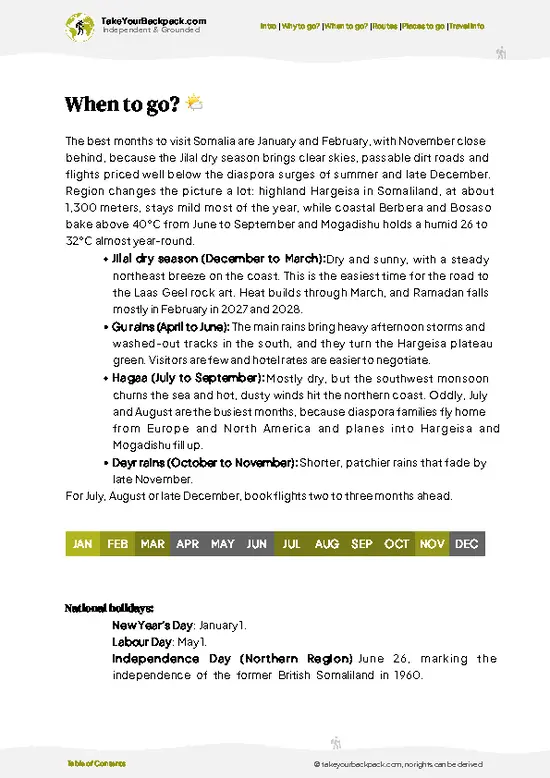
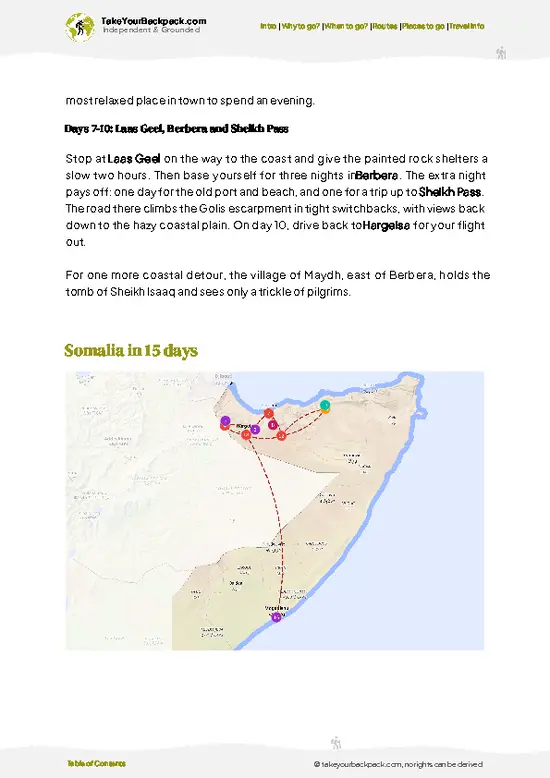
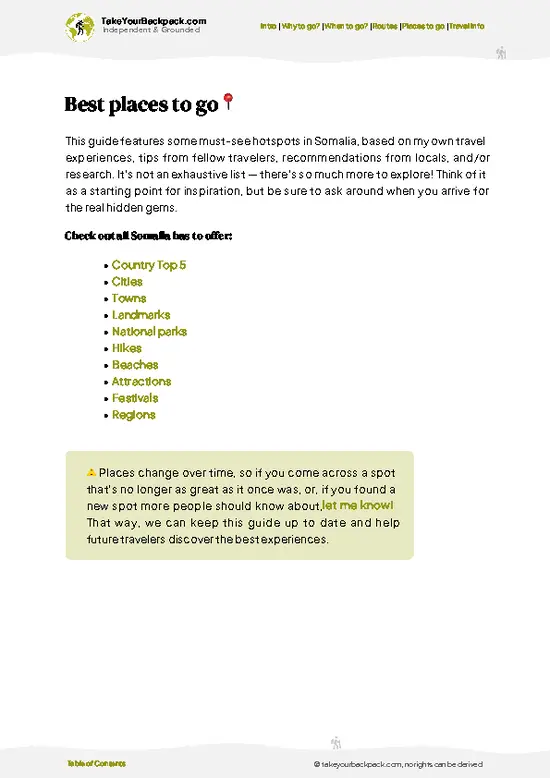
example page 0 from our offline Travel Guide for Somalia
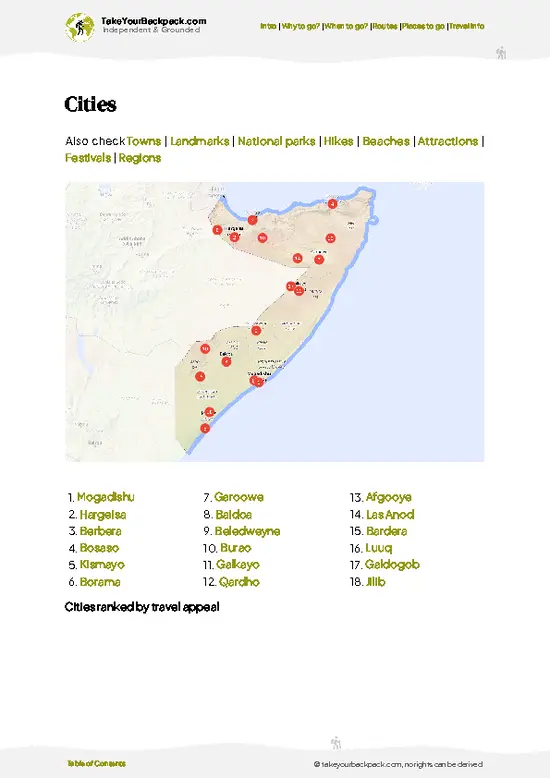
example page 1 from our offline Travel Guide for Somalia
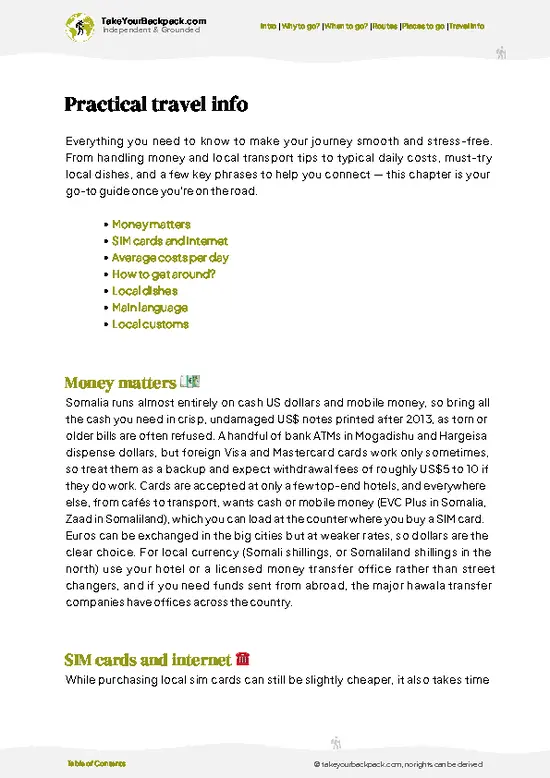
example page 2 from our offline Travel Guide for Somalia
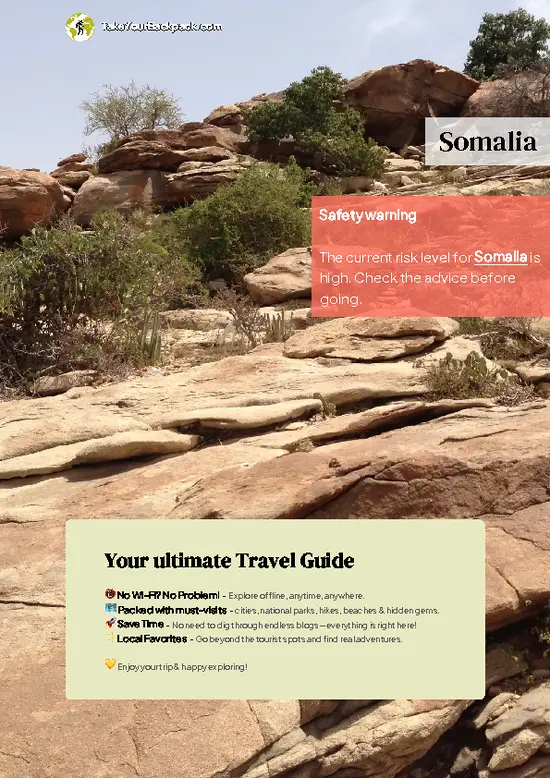
example page 3 from our offline Travel Guide for Somalia
example page 4 from our offline Travel Guide for Somalia
example page 5 from our offline Travel Guide for Somalia
example page 6 from our offline Travel Guide for Somalia
example page 7 from our offline Travel Guide for Somalia
The digital guide (237 pages) contains:-page digital guide:
✅ Ready-made 5, 10 & 15-day routes
✅ All 68 places ranked, so you skip the overrated ones
✅ Works offline, all in 1 guide
✅ Cities, national parks, landmarks, beaches
✅ How to get around
👉 Click to see all 30+ guide features

📅 Plan smarter in minutes, not weeks
✅ Month by month travel advice
✅ Festivals & national holidays
✅ Budget expectations

🗺️ Go to the right places, skip the overrated ones
✅ Honest pros & cons of destinations
✅ Top hikes, parks & viewpoints
✅ Lesser-known places most travelers miss
✅ Clear “worth it vs skip it” guidance

🛏️ Travel smoothly without rookie mistakes
✅ Best areas to stay
✅ Transport systems explained simply
✅ Common scams & safety advice
✅ SIM cards, money & practical tips

🌍 Understand the country, not just visit it
✅ Culture & traditions
✅ 52 Essential phrases & customs
✅ Festivals worth planning around
✅ Traveler-friendly historical context
✅ Insights that make places more meaningful

📱 Built for real travel conditions
✅ Fully downloadable PDF
✅ Works completely offline
✅ Optimized for phone use
✅ Useful in remote areas & buses
✅ All in 1 guide
Stop searching, start planning
Get instant access to your full guide. 30‑day money-back guarantee.


By proceeding you agree to our terms.
Sent to your inbox immediately after payment • 100% Secure Checkout
Best Backpacking Travel Advisor 2025 tourism awardBest Backpacking
Travel Advisor
2025
What others say about Take Your Backpack Guides:
⭐⭐⭐⭐⭐
Fantastic, amazing amount of information!
⭐⭐⭐⭐⭐
My goodness this is amazing, it's what I've been looking for hats off too you!
⭐⭐⭐⭐⭐
I think this is absolutely BRILLIANT
⭐⭐⭐⭐
Very complete and informative. It's still missing places, but I gotta to commend you
⭐⭐⭐⭐⭐
This is truly amazing, thank you, can't wait to explore it with my kids!
⭐⭐⭐⭐⭐
Awesome resource, thank you!
⭐⭐⭐⭐⭐
This is amazing! Can't wait to explore the ones I haven't seen
⭐⭐⭐⭐
I love this! Well done, great idea.
⭐⭐⭐⭐⭐
Thanks for taking the time to make this gem!
⭐⭐⭐⭐⭐
This might be the best website I've ever seen.
⭐⭐⭐⭐⭐
Congratulations, and thank you so much for your work; it's incredibly valuable.
⭐⭐⭐⭐
In all seriousness I think you did a great job pointing out the important spots
⭐⭐⭐⭐⭐
10/10 very good
⭐⭐⭐⭐⭐
As someone who's only just starting to visit regularly this is awesome, thank you.
⭐⭐⭐⭐
Thank you very much! I'm going to visit my dad, it's going to be very useful!
⭐⭐⭐⭐⭐
This is really cool! We'll be travelling for the first time and this definitely come in handy.
⭐⭐⭐⭐⭐
You are now our minister of culture, congratulations 👨‍💼
⭐⭐⭐⭐⭐
Just wanted to tell you that this is a pearl! Going to follow your recommendations.
⭐⭐⭐⭐⭐
This is so cool. I'll definitely be using the resource for my travels soon.
⭐⭐⭐⭐⭐
This is very impressive! Good work.
⭐⭐⭐⭐⭐
This is an amazing and informative site. Very well done!

🛏️ Where to stay?Best Stay Options in Somalia

Somalia has no real backpacker hostel scene, so budget travel here means simple guesthouses and local hotels at roughly US$20 to 40 a night in Hargeisa and Garowe, while secure hotels in Mogadishu typically cost US$50 to 150 because guards, blast walls and airport transfers are built into the price. In Mogadishu, Lido puts you near the beach and the city’s seafront cafes but draws crowds and has been targeted before, while Hodan and the KM4 area sit closer to the airport road, with more mid-range options and fewer late-night crowds. Hargeisa’s city center around the main market is the easiest base for walking to restaurants and money changers, though it gets noisy with traffic and the call to … read more 👉
Somalia has no real backpacker hostel scene, so budget travel here means simple guesthouses and local hotels at roughly US$20 to 40 a night in Hargeisa and Garowe, while secure hotels in Mogadishu typically cost US$50 to 150 because guards, blast walls and airport transfers are built into the price. In Mogadishu, Lido puts you near the beach and the city’s seafront cafes but draws crowds and has been targeted before, while Hodan and the KM4 area sit closer to the airport road, with more mid-range options and fewer late-night crowds. Hargeisa’s city center around the main market is the easiest base for walking to restaurants and money changers, though it gets noisy with traffic and the call to prayer from early morning.

If you enjoy meeting fellow travelers, consider choosing hostels with high ratings for atmosphere. On the other hand, if you prefer having your own space, a hotel might be a better option.

SomaliaWhere to Go Next

👋 Meet the founderWho’s Behind Take Your Backpack?

Johan, backpacker and founder of TakeYourBackpackHi, I’m Johan (Netherlands 🇳🇱), the creator of TakeYourBackpack. Over the past 30 years, I’ve backpacked through 88 countries across six continents, gaining extensive experience with independent travel, long-term trips, and overland routes.

This site is built on a combination of firsthand travel experience and carefully curated insights from other backpackers. Many guides are based on places I’ve personally visited, while others bring together tips, observations, and practical advice shared by trusted travelers I’ve met along the way.

The goal is to provide realistic, experience-driven guidance — not generic itineraries — so you can explore destinations with better context, clearer expectations, and more confidence.