×

South Korea🇰🇷 | hikesJeju Olle Trailcoastal paths, stone walls, rural villages | things to do and best time to go

Explore Seoraksan Ulsanbawi Rock TrailExplore Namsan Mountain Trail

Backpacking in Jeju Olle Trail
🏆 Top pickhike ranked #3
By Johan Kruseman 🇳🇱 | Updated September 4, 2026

Most people think the Jeju Olle Trail is one single thru-hike you “knock off” in a few days; it’s actually a web of numbered coastal and village routes that you stitch together, section by section. The trail network wraps around Jeju Island, off South Korea’s southern coast, a short flight from Seoul or Busan and an easy bus ride from Jeju City to most trailheads. You walk on lava rock coast, tangerine orchards, fishing harbors, and low volcanic hills, with the sea in your ears almost all day. Sections range from casual half-day strolls to long, leg-burning 20+ km pushes, and the constant hard surfaces can pound your feet more than you expect. Compared with Korea’s steep mainland peaks like Hallasan or Seoraksan, Jeju Olle is less vertical but more cumulative; it rewards stubborn walkers with big horizons, salt on your skin, and that first icy convenience-store beer at the village bus stop.

Discover everything you want to know in the 📖 South Korea Travel Guide.
Best time to go: March - June, September - November
Duration: 7 days
Distance: 426 kilometers
Total ascent: 3,000 meters
Loading the map 🌍
CLICK TO FILTER
cities
towns
villages
landmarks
national parks
hikes
beaches
attractions
festivals
regions
SHOW COUNTRY’S BESTSHOW ALL

✨ Why go?
Ranked #3 hike in South Korea
Why visitors keep coming back

The Jeju Olle Trail is a magnet for backpackers craving a mix of challenge and reward. Picture this: you’re striding along coastal cliffs, the ocean crashing below, and the scent of pine in the air. The scenery-to-effort ratio is off the charts. You can tackle sections that range from easy strolls to more demanding treks, making it perfect for any skill level.

Getting there is a breeze. Public transport access is seamless, with buses whisking you to trailheads. You can hop on and off, letting your feet dictate the pace. Plus, it’s low cost—no pricey permits or entrance fees. Just lace up your boots and go.

The flexible distances mean you can customize your adventure. Whether you want a quick day hike or a multi-day journey, the trail accommodates. It fits smoothly into a longer backpacking … read more 👉
The Jeju Olle Trail is a magnet for backpackers craving a mix of challenge and reward. Picture this: you’re striding along coastal cliffs, the ocean crashing below, and the scent of pine in the air. The scenery-to-effort ratio is off the charts. You can tackle sections that range from easy strolls to more demanding treks, making it perfect for any skill level.

Getting there is a breeze. Public transport access is seamless, with buses whisking you to trailheads. You can hop on and off, letting your feet dictate the pace. Plus, it’s low cost—no pricey permits or entrance fees. Just lace up your boots and go.

The flexible distances mean you can customize your adventure. Whether you want a quick day hike or a multi-day journey, the trail accommodates. It fits smoothly into a longer backpacking route around Jeju Island, allowing you to explore volcanic landscapes, lush forests, and quaint villages.

Every step is a chance to soak in the island’s spirit, and when you finally kick back with a cold beer at the end of the day, you’ll know it was all worth it.
Want to include Jeju Olle Trail in your South Korea route?
Create a personalized South Korea itinerary that includes Jeju Olle Trail and the places that fit your trip — based on your travel style, budget, and available time. Get your route in seconds.

Generate my trip

💡 HighlightsPlaces and moments you shouldn't skip

  1. Seongsan Ilchulbong (Sunrise Peak) — A tuff cone with a perfectly rimmed crater that throws a jaw-dropping sunrise over the ocean; the climb is short but the 360° views of the sea, neighboring islets and the crater itself make it feel cinematic compared with most forested hikes.
  2. Jusangjeolli Cliff — Giant hexagonal basalt pillars sculpted by cooling lava and crashing waves; it’s geology you can read like a book and the seaside drama (waves slamming into stacked columns) is rare on most inland trails.
  3. Gotjawal Forest — A weird, primeval lava-formed woodland where rainwater disappears into the porous ground, creating unique microhabitats and an eerily cool, mossy canopy; great if you like quiet, ancient-feeling forest that’s ecologically different from typical temperate woods.
  4. Haenyeo villages
read more 👉
  1. Seongsan Ilchulbong (Sunrise Peak) — A tuff cone with a perfectly rimmed crater that throws a jaw-dropping sunrise over the ocean; the climb is short but the 360° views of the sea, neighboring islets and the crater itself make it feel cinematic compared with most forested hikes.
  2. Jusangjeolli Cliff — Giant hexagonal basalt pillars sculpted by cooling lava and crashing waves; it’s geology you can read like a book and the seaside drama (waves slamming into stacked columns) is rare on most inland trails.
  3. Gotjawal Forest — A weird, primeval lava-formed woodland where rainwater disappears into the porous ground, creating unique microhabitats and an eerily cool, mossy canopy; great if you like quiet, ancient-feeling forest that’s ecologically different from typical temperate woods.
  4. Haenyeo villages and coastal fishing culture — Small seaside communities where you can watch (or sometimes chat with) Jeju’s female freedivers harvesting abalone and sea urchin; that living cultural scene—hands-on seafood stalls, diving suits on rocks—gives the trail a local, human texture you don’t get on generic long-distance routes.
  5. Oreums (parasitic volcanic cones) and lava fields — Dozens of squat volcanic cones and black lava plains punctuate the route, offering short climbs, wide vistas and strange rock textures; the contrast between grassy cone tops, bare lava and tidy tangerine orchards nearby is quintessentially Jeju and visually unlike most coastal hikes elsewhere.
Spotted a mistake or missing something? Contact us.

Things to do around Jeju Olle Trail

Ratings based on Tripadvisor reviews. When you book through this link, you support our work at no extra cost to you.

🌤️ When to go?Choosing the right time of year


  • Weather: Spring (April to June) and fall (September to November) deliver the best weather. Expect mild, dry days perfect for pounding the trail without sweating buckets or battling relentless rain. Summer’s monsoon season (July-August) drenches the island, turning paths slippery and miserable.

  • Temperature: Spring temps hover around 13-20°C (55-68°F), while fall cools down to 11-18°C (52-64°F). These ranges keep your pace steady without overheating or freezing your fingers off.

  • Daylight Hours: Longer days in spring and fall mean you can stretch your hikes comfortably from dawn to dusk, roughly 12-14 hours of light. Winter shortens the window, forcing early starts and rushed finishes.

  • Crowds: Peak tourist season in summer swells the trail with groups and families, diluting the solitude.
read more 👉

  • Weather: Spring (April to June) and fall (September to November) deliver the best weather. Expect mild, dry days perfect for pounding the trail without sweating buckets or battling relentless rain. Summer’s monsoon season (July-August) drenches the island, turning paths slippery and miserable.

  • Temperature: Spring temps hover around 13-20°C (55-68°F), while fall cools down to 11-18°C (52-64°F). These ranges keep your pace steady without overheating or freezing your fingers off.

  • Daylight Hours: Longer days in spring and fall mean you can stretch your hikes comfortably from dawn to dusk, roughly 12-14 hours of light. Winter shortens the window, forcing early starts and rushed finishes.

  • Crowds: Peak tourist season in summer swells the trail with groups and families, diluting the solitude. Spring and fall offer quieter paths where you can hear the crunch of your boots and the ocean’s whisper.

  • Seasonal Activities: Spring bursts with wildflowers and cherry blossoms, while fall paints the landscape with fiery foliage. Both seasons add a natural spectacle that rewards every step.

  • Price Fluctuations: Accommodation and transport costs spike in summer and major holidays. Booking in shoulder seasons like spring or fall often nets better deals and more availability.


Pro-tip: Aim for mid-April or late October to catch the sweet spot of weather, light, and crowd balance—when the trail feels like it’s yours alone.


source: climatestotravel.comJANJanuary: fair for travelingFEBFebruary: fair for travelingMARMarch: good for travelingAPRApril: excellent for travelingMAYMay: excellent for travelingJUNJune: highly recommended for travelingJULJuly: below average for travelingAUGAugust: below average for travelingSEPSeptember: excellent for travelingOCTOctober: excellent for travelingNOVNovember: highly recommended for travelingDECDecember: fair for traveling
when-to-go

✈️ The backpacker research shortcutSouth Korea Travel Guide

An offline-friendly backpacking guide with optimized travel routes, ranked highlights, transport advice, and the best areas to stay.
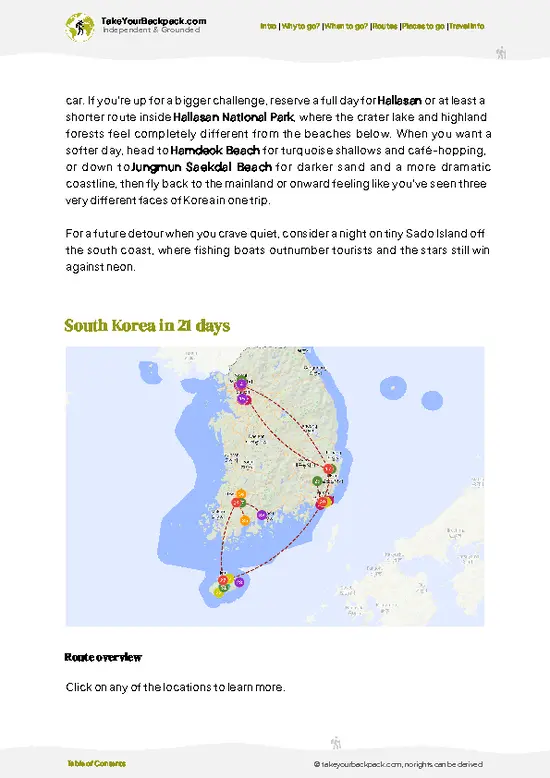
example page 0 from our offline Travel Guide for South Korea
example page 1 from our offline Travel Guide for South Korea
example page 2 from our offline Travel Guide for South Korea
example page 3 from our offline Travel Guide for South Korea
example page 4 from our offline Travel Guide for South Korea
example page 5 from our offline Travel Guide for South Korea
example page 6 from our offline Travel Guide for South Korea
example page 7 from our offline Travel Guide for South Korea
The digital guide (439 pages) contains:
124 highlights, ranked by travel appeal
Optimized 7, 14 & 21-day travel routes
Cities, national parks, landmarks, beaches
How to get around
Offline-friendly for travel without Wi-Fi
👉 Click to see all 30+ guide features

📅 Plan smarter in minutes, not weeks
Month by month travel advice
Festivals & national holidays
Budget expectations

🗺️ Go to the right places, skip the overrated ones
Honest pros & cons of destinations
Top hikes, parks & viewpoints
Lesser-known places most travelers miss
Clear “worth it vs skip it” guidance

🛏️ Travel smoothly without rookie mistakes
Best areas to stay
Transport systems explained simply
Common scams & safety advice
SIM cards, money & practical tips

🌍 Understand the country, not just visit it
Culture & traditions
52 Essential phrases & customs
Festivals worth planning around
Traveler-friendly historical context
Insights that make places more meaningful

📱 Built for real travel conditions
Fully downloadable PDF
Works completely offline
Optimized for phone use
Useful in remote areas & buses
Everything in one place
Save weeks of stressful planning
Get instant access to your full guide. 30‑day money-back guarantee.
+ Add another guide for just US$7.80

By proceeding you agree to our terms.
Sent to your inbox immediately after payment • 100% Secure Checkout
Best Backpacking Travel Advisor 2025 tourism awardBest Backpacking
Travel Advisor
2025
What others say about Take Your Backpack Guides:
⭐⭐⭐⭐⭐
Fantastic, amazing amount of information!
⭐⭐⭐⭐⭐
My goodness this is amazing, it's what I've been looking for hats off too you!
⭐⭐⭐⭐⭐
I think this is absolutely BRILLIANT
⭐⭐⭐⭐
Very complete and informative. It's still missing places, but I gotta to commend you
⭐⭐⭐⭐⭐
This is truly amazing, thank you, can't wait to explore it with my kids!
⭐⭐⭐⭐⭐
Awesome resource, thank you!
⭐⭐⭐⭐⭐
This is amazing! Can't wait to explore the ones I haven't seen
⭐⭐⭐⭐
I love this! Well done, great idea.
⭐⭐⭐⭐⭐
Thanks for taking the time to make this gem!
⭐⭐⭐⭐⭐
This might be the best website I've ever seen.
⭐⭐⭐⭐⭐
Congratulations, and thank you so much for your work; it's incredibly valuable.
⭐⭐⭐⭐
In all seriousness I think you did a great job pointing out the important spots
⭐⭐⭐⭐⭐
10/10 very good
⭐⭐⭐⭐⭐
As someone who's only just starting to visit regularly this is awesome, thank you.
⭐⭐⭐⭐
Thank you very much! I'm going to visit my dad, it's going to be very useful!
⭐⭐⭐⭐⭐
This is really cool! We'll be travelling for the first time and this definitely come in handy.
⭐⭐⭐⭐⭐
You are now our minister of culture, congratulations 👨‍💼
⭐⭐⭐⭐⭐
Just wanted to tell you that this is a pearl! Going to follow your recommendations.
⭐⭐⭐⭐⭐
This is so cool. I'll definitely be using the resource for my travels soon.
⭐⭐⭐⭐⭐
This is very impressive! Good work.
⭐⭐⭐⭐⭐
This is an amazing and informative site. Very well done!

🛏️ Where to stay?Best areas and accommodation options

If you enjoy meeting fellow travelers, consider choosing hostels with high ratings for atmosphere. On the other hand, if you prefer having your own space, a hotel might be a better option.

🥾 Hike detailsRoute, distance, and difficulty explained

Total Distance: The Jeju Olle Trail spans approximately 426 kilometers in total, divided into 26 different routes. Each individual route varies in length, typically ranging from 10 to 20 kilometers.

Estimated Duration: Completing the entire trail can take about 10 to 14 days, depending on your pace and how much you stop to enjoy the scenery. Most day hikes last around 4 to 7 hours.

Difficulty Level: The trail is generally rated as moderate. Some sections are relatively easy, while others can be steep or rocky, so a decent level of fitness is recommended.

Starting Point: Many hikers begin at … read more 👉
Total Distance: The Jeju Olle Trail spans approximately 426 kilometers in total, divided into 26 different routes. Each individual route varies in length, typically ranging from 10 to 20 kilometers.

Estimated Duration: Completing the entire trail can take about 10 to 14 days, depending on your pace and how much you stop to enjoy the scenery. Most day hikes last around 4 to 7 hours.

Difficulty Level: The trail is generally rated as moderate. Some sections are relatively easy, while others can be steep or rocky, so a decent level of fitness is recommended.

Starting Point: Many hikers begin at Route 1, which starts in the town of Moseulpo.
  • Public Transport: From Jeju City, you can take a bus (Bus 100 or 200) to Moseulpo, which takes about 1.5 hours. It’s pretty straightforward, just make sure to check the bus schedules since they can vary.

Major Landmarks Along the Route: The trail offers a variety of landmarks to explore, including:
  • Seongsan Ilchulbong: A UNESCO World Heritage site and a stunning volcanic crater.
  • Cheonjiyeon Waterfall: A beautiful waterfall that’s perfect for a refreshing break.
  • Oedolgae Rock: A striking rock formation with scenic coastal views.

Type of Terrain and Scenery: Expect a mix of coastal paths, forested areas, and volcanic landscapes. The terrain can be rocky and uneven, especially near cliffs, but the views are often breathtaking, featuring both ocean vistas and lush greenery.

Typical Vegetation and Wildlife: The trail is rich in biodiversity. You’ll see:
  • Vegetation: Dense forests, wildflowers, and various grasses dominate the landscape. Look out for the iconic Hallasan Mountain, which is surrounded by unique flora.
  • Wildlife: Keep an eye out for various bird species, including the endangered Jeju Magpie, and maybe even some hares or deer if you’re lucky.

Overall, the Jeju Olle Trail is a fantastic adventure for independent hikers looking to soak in the natural beauty of South Korea. Just remember to pack enough water and snacks, and enjoy the journey!
⚠️ Hiking info can sometimes be outdated or inaccurate. Before you hit the trail, check the latest conditions with locals. If you do spot anything that's off, I'd love to hear from you, so I can update it for fellow travelers.

🛡️ SafetyStaying Safe: What Travelers Should Know

The Jeju Olle Trail is a feast for the senses, but it demands respect. Weather can shift quickly; a sunny morning can morph into a misty afternoon. Dress in layers and pack a light rain jacket. The terrain varies from smooth coastal paths to rocky inclines. Some sections are steep, so watch your footing, especially after rain when trails can be slippery.

Wildlife is part of the charm. You might spot a deer or a rare bird, but keep your distance. Don’t feed animals; they’re part of the ecosystem, not your hiking buddies.

Navigation is straightforward, thanks to clear signage, but don’t let your guard down. A map or a GPS app can be a lifesaver if you wander off the beaten path.

Timing is key. Start early to avoid the midday heat and enjoy the trails with fewer crowds. With the right preparation, … read more 👉
The Jeju Olle Trail is a feast for the senses, but it demands respect. Weather can shift quickly; a sunny morning can morph into a misty afternoon. Dress in layers and pack a light rain jacket. The terrain varies from smooth coastal paths to rocky inclines. Some sections are steep, so watch your footing, especially after rain when trails can be slippery.

Wildlife is part of the charm. You might spot a deer or a rare bird, but keep your distance. Don’t feed animals; they’re part of the ecosystem, not your hiking buddies.

Navigation is straightforward, thanks to clear signage, but don’t let your guard down. A map or a GPS app can be a lifesaver if you wander off the beaten path.

Timing is key. Start early to avoid the midday heat and enjoy the trails with fewer crowds. With the right preparation, the reward is a breathtaking view or a cold beer at a local café, making every step worth it.

FAQFrequently asked questions about Jeju Olle Trail

The Jeju Olle Trail takes about 8 to 15 days to complete, depending on your pace and the number of stages you choose to hike. The entire trail covers approximately 425 kilometers divided into 21 main routes. Most hikers spend around 10 days to cover the popular sections comfortably.
The difficulty of the Jeju Olle Trail varies by route but is generally moderate. Some stages have steep climbs and uneven terrain, while others are relatively flat and easy. Proper footwear and a reasonable fitness level are recommended to handle the mixed terrain and occasional volcanic rock paths.
No guide or permit is required to hike the Jeju Olle Trail. The trail is well-marked with blue and orange ribbons and signposts, making it easy to navigate independently. However, guided tours are available for those who prefer structured support or detailed local insights.
⚠️ Things can change over time, so always validate details locally before you go.

Other South Korean hikes near Jeju Olle Trail

Explore more nearby:


💡 Not sure where to go next?
Create a personalized itinerary for South Korea including Jeju Olle Trail and the places that fit your trip.

Generate my itinerary

👉 Discover all hikes

Or checkout all South Korea has to offer (think cities, towns, villages, national parks, hikes, beaches, festivals)
Country photo of South Korea

We 💚 feedbackSumming up the experience

The Jeju Olle Trail is a wild ride through nature’s playground. You’ll feel the salty breeze on your face as you navigate rocky paths and lush forests. The best surprise? Stumbling upon a local market where you can snag fresh tangerines and homemade snacks—fuel for your next leg. Just a heads-up: some sections can be steep and slippery, so watch your footing. But trust me, that first glimpse of the ocean after a tough climb? Worth every step.

✍️ Help improve this page!
The information on this page is based on in-depth research, insights shared by experienced travelers, and feedback from the local travel community in South Korea. While every effort is made to keep the information accurate and current, conditions can change — so if you spot anything incorrect or outdated, please get in touch.


🙋‍♂️ Give feedback

👋 Meet the founderWho’s Behind Take Your Backpack?

Johan, backpacker and founder of TakeYourBackpackHi, I’m Johan (Netherlands 🇳🇱), the creator of TakeYourBackpack. Over the past decade, I’ve backpacked through 80+ countries across six continents, gaining extensive experience with independent travel, long-term trips, and overland routes.

This site is built on a combination of firsthand travel experience and carefully curated insights from other backpackers. Many guides are based on places I’ve personally visited, while others bring together tips, observations, and practical advice shared by trusted travelers I’ve met along the way.

The goal is to provide realistic, experience-driven guidance — not generic itineraries — so you can explore destinations with better context, clearer expectations, and more confidence.

Get full country guide •
Instant download • 124 highlights • Full Offline guide