×

South Korea🇰🇷 | landmarksHaeinsa TempleTripitaka Koreana, mountain monastery, Buddhist relics | things to do and best time to go

Explore Gaya TumuliExplore Hwaseong Fortress

Backpacking in Haeinsa Temple
🌟 Highlightunique site ranked #3
By Johan Kruseman 🇳🇱 | Updated July 14, 2026

Most people online sell Haeinsa as a quiet, misty mountain retreat; in reality, parts of it feel more like a small working village than a silent monastery, with delivery trucks, school groups, and monks on smartphones between chants. Haeinsa sits in Gayasan National Park, near Hapcheon in South Gyeongsang Province, roughly in the south-central part of South Korea. As a backpacker destination, it’s a weirdly perfect mix: the Tripitaka Koreana woodblocks are jaw-dropping in their scale and preservation, the temple stay program can be genuinely grounding, and the surrounding forest trails give you that “Korea beyond Seoul” hit. But it’s not cheap by backpacker standards, day-trippers can clog the main courtyard, and getting there involves a bus shuffle that eats time. Photos are strong on atmosphere rather than drama: wooden halls, foggy ridgelines, monks moving through their day while you try not to feel like a spectator.

Discover everything you want to know in the 📖 South Korea Travel Guide.
Loading the map 🌍
CLICK TO FILTER
cities
towns
villages
landmarks
national parks
hikes
beaches
attractions
festivals
regions
SHOW COUNTRY’S BESTSHOW ALL

✨ Why go?
Ranked #3 unique site in South Korea
Why Haeinsa Temple should be on your travel list

Haeinsa Temple is a must-see for backpackers who crave authenticity over Instagram likes. Sure, it’s a UNESCO World Heritage site, but let’s get real: the crowds can be overwhelming, especially on weekends. Yet, the moment you step into the temple complex, the chaos fades. You’re surrounded by ancient wooden structures that house the Tripitaka Koreana, the world’s oldest surviving collection of Buddhist scriptures.

The effort-to-reward ratio here is solid. It’s a bit of a trek from major cities, but that’s part of the charm. You can easily fit it into a broader route through the Gyeongsangnam-do region, making it a natural stop between Busan and Gyeongju. Plus, the entry fee is minimal, so you won’t break the bank.

What really sets Haeinsa apart is the tranquility you find among the towering … read more 👉
Haeinsa Temple is a must-see for backpackers who crave authenticity over Instagram likes. Sure, it’s a UNESCO World Heritage site, but let’s get real: the crowds can be overwhelming, especially on weekends. Yet, the moment you step into the temple complex, the chaos fades. You’re surrounded by ancient wooden structures that house the Tripitaka Koreana, the world’s oldest surviving collection of Buddhist scriptures.

The effort-to-reward ratio here is solid. It’s a bit of a trek from major cities, but that’s part of the charm. You can easily fit it into a broader route through the Gyeongsangnam-do region, making it a natural stop between Busan and Gyeongju. Plus, the entry fee is minimal, so you won’t break the bank.

What really sets Haeinsa apart is the tranquility you find among the towering trees and the serene atmosphere. Take a moment to meditate or just breathe it all in. This isn’t just a stop; it’s a soulful experience that enriches your journey.
Want to include Haeinsa Temple in your South Korea route?
Create a personalized South Korea itinerary that includes Haeinsa Temple and the places that fit your trip — based on your travel style, budget, and available time. Get your route in seconds.

Generate my trip

💡 HighlightsPlaces and moments you shouldn't skip

  • The Tripitaka Koreana (Palman Daejanggyeong) — The single most famous thing here: a complete, carefully carved set of 81,258 wooden printing blocks containing Buddhist scriptures from the 13th century. It’s remarkable for its age, precision and completeness — basically the world’s most impressive pre-digital encyclopedia carved in wood.
  • Janggyeong Panjeon (the Scripture Depositories) — The buildings that house the Tripitaka Koreana. They’re UNESCO-listed not just for what’s inside but for their ingenious passive preservation design: raised floors, special ventilation and layout tuned to the valley’s microclimate so paper and wood stay dry without modern HVAC.
  • Daejeokgwangjeon (Main Buddha Hall) — The temple’s main hall and spiritual center. It’s a calm, stoic space with traditional wooden
read more 👉
  • The Tripitaka Koreana (Palman Daejanggyeong) — The single most famous thing here: a complete, carefully carved set of 81,258 wooden printing blocks containing Buddhist scriptures from the 13th century. It’s remarkable for its age, precision and completeness — basically the world’s most impressive pre-digital encyclopedia carved in wood.
  • Janggyeong Panjeon (the Scripture Depositories) — The buildings that house the Tripitaka Koreana. They’re UNESCO-listed not just for what’s inside but for their ingenious passive preservation design: raised floors, special ventilation and layout tuned to the valley’s microclimate so paper and wood stay dry without modern HVAC.
  • Daejeokgwangjeon (Main Buddha Hall) — The temple’s main hall and spiritual center. It’s a calm, stoic space with traditional wooden architecture and Buddhist statues; standing on the hall’s wooden porch you get the best sense of temple life and ritual rhythm.
  • Gayasan National Park setting — Haeinsa sits in a narrow valley under the peaks of Gayasan, so the mountain scenery and forest trails are part of the experience. In spring and autumn especially the light and foliage lift the whole place into something quieter and more cinematic than the photos.
  • Temple-stay and morning chanting — You can join short temple-stay programs to try meditation, tea ceremonies, and early-morning chanting. It’s one of the few places where you can actually live a bit of monastic routine instead of just snapping pictures.
  • Traditional wooden architecture and courtyards — The compound has a layered, intimate layout: gates, courtyards, angled roofs and painted wooden brackets. Look closely at the joinery and dancheong (paintwork) — small details show centuries of craft and repair.
  • Historic artifacts, pagodas and stonework — Scattered around the grounds are carved stones, pagodas and smaller shrines that span several eras. They add texture to the place and give a sense of continuous use and memory — not a frozen museum but a living site with deep roots.
Spotted a mistake or missing something? Contact us.

Things to do around Haeinsa Temple

Ratings based on Tripadvisor reviews. When you book through this link, you support our work at no extra cost to you.

🌤️ When to go?Choosing the right time of year


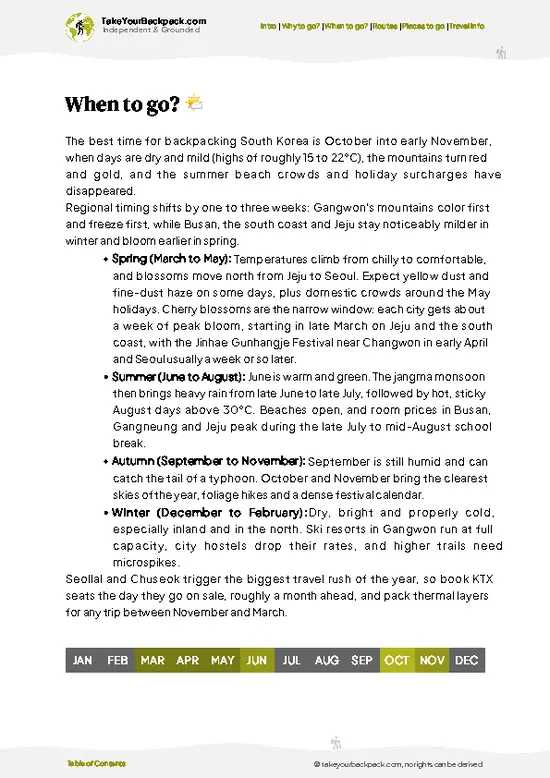
  • Weather: Spring (April to June) and autumn (September to November) offer the most comfortable weather. Expect mild temperatures around 15-22°C (59-72°F). Summers can be brutally humid and rainy, while winters drop below freezing, making the temple grounds slippery and less enjoyable.

  • Temperature: Spring and autumn days hover between 15-22°C (59-72°F), perfect for hiking and exploring without overheating or freezing. Winter nights can dip to -5°C (23°F) or lower, which is harsh if you’re camping or trekking nearby.

  • Daylight Hours: Longer daylight in late spring and early autumn means more time to soak in the temple’s atmosphere. Winters have shorter days, cutting your exploration window.

  • Crowds: Peak tourist season hits in late spring and autumn weekends, especially Korean holidays.
read more 👉

  • Weather: Spring (April to June) and autumn (September to November) offer the most comfortable weather. Expect mild temperatures around 15-22°C (59-72°F). Summers can be brutally humid and rainy, while winters drop below freezing, making the temple grounds slippery and less enjoyable.

  • Temperature: Spring and autumn days hover between 15-22°C (59-72°F), perfect for hiking and exploring without overheating or freezing. Winter nights can dip to -5°C (23°F) or lower, which is harsh if you’re camping or trekking nearby.

  • Daylight Hours: Longer daylight in late spring and early autumn means more time to soak in the temple’s atmosphere. Winters have shorter days, cutting your exploration window.

  • Crowds: Peak tourist season hits in late spring and autumn weekends, especially Korean holidays. Weekdays in these seasons are quieter. Winter and summer see fewer visitors but come with weather trade-offs.

  • Seasonal Activities: Autumn brings vibrant foliage that frames the temple’s ancient architecture, a photographer’s dream. Spring offers blooming azaleas and cherry blossoms, but these attract more tourists. Winter’s snow adds a serene, almost otherworldly vibe, though access can be tricky.

  • Price Fluctuations: Accommodation and transport costs spike during peak seasons (spring and autumn weekends). Off-peak winter months offer better deals but fewer services and harsher conditions.


Pro-tip: Aim for midweek visits in late April or early October to dodge crowds, enjoy crisp weather, and catch the temple at its most atmospheric without the tourist crush.


source: climatestotravel.comJANJanuary: fair for travelingFEBFebruary: fair for travelingMARMarch: good for travelingAPRApril: excellent for travelingMAYMay: excellent for travelingJUNJune: highly recommended for travelingJULJuly: below average for travelingAUGAugust: below average for travelingSEPSeptember: excellent for travelingOCTOctober: excellent for travelingNOVNovember: highly recommended for travelingDECDecember: fair for traveling
south-korea-unique-site-haeinsa-temple
© Google |

✈️ The backpacker research shortcutSouth Korea Travel Guide

An offline-friendly backpacking guide with optimized travel routes, ranked highlights, transport advice, and the best areas to stay.
example page 0 from our offline Travel Guide for South Korea
example page 1 from our offline Travel Guide for South Korea
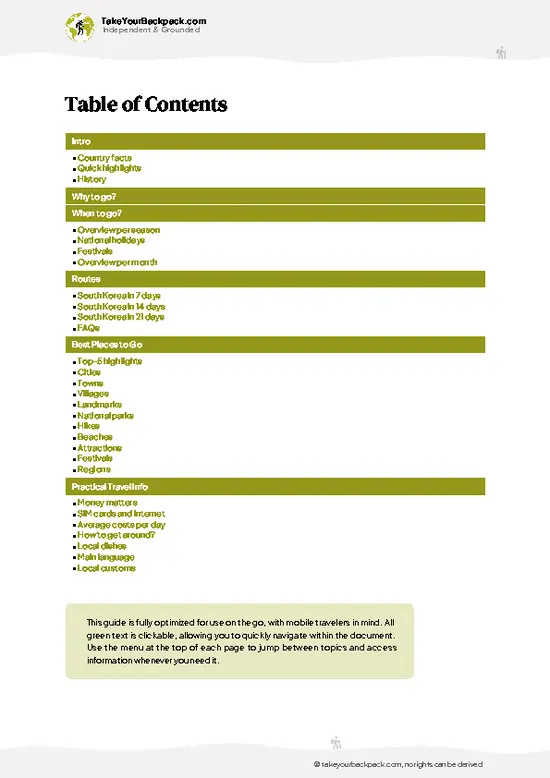
example page 2 from our offline Travel Guide for South Korea
example page 3 from our offline Travel Guide for South Korea
example page 4 from our offline Travel Guide for South Korea
example page 5 from our offline Travel Guide for South Korea
example page 6 from our offline Travel Guide for South Korea
example page 7 from our offline Travel Guide for South Korea
The digital guide (439 pages) contains:
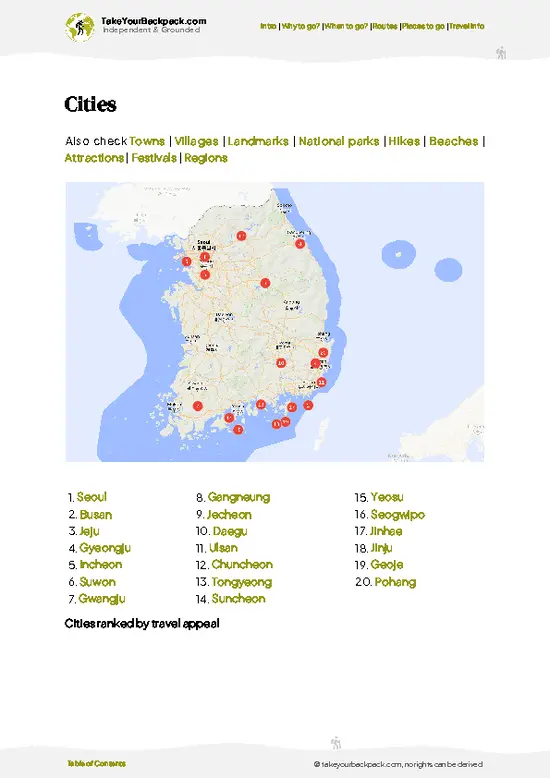
124 highlights, ranked by travel appeal
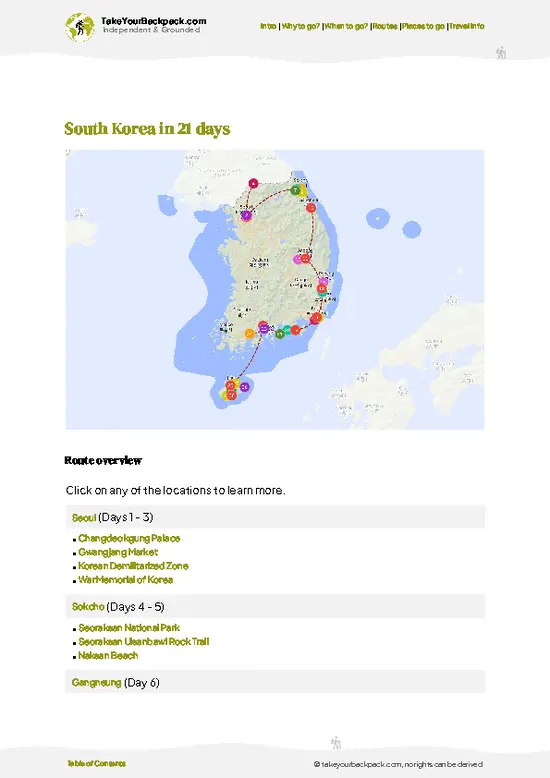
Optimized 7, 14 & 21-day travel routes
Cities, national parks, landmarks, beaches
How to get around
Offline-friendly for travel without Wi-Fi
👉 Click to see all 30+ guide features

📅 Plan smarter in minutes, not weeks
Month by month travel advice
Festivals & national holidays
Budget expectations

🗺️ Go to the right places, skip the overrated ones
Honest pros & cons of destinations
Top hikes, parks & viewpoints
Lesser-known places most travelers miss
Clear “worth it vs skip it” guidance

🛏️ Travel smoothly without rookie mistakes
Best areas to stay
Transport systems explained simply
Common scams & safety advice
SIM cards, money & practical tips

🌍 Understand the country, not just visit it
Culture & traditions
52 Essential phrases & customs
Festivals worth planning around
Traveler-friendly historical context
Insights that make places more meaningful

📱 Built for real travel conditions
Fully downloadable PDF
Works completely offline
Optimized for phone use
Useful in remote areas & buses
Everything in one place
Save weeks of stressful planning
Get instant access to your full guide. 30‑day money-back guarantee.


By proceeding you agree to our terms.
Sent to your inbox immediately after payment • 100% Secure Checkout
Best Backpacking Travel Advisor 2025 tourism awardBest Backpacking
Travel Advisor
2025
What others say about Take Your Backpack Guides:
⭐⭐⭐⭐⭐
Fantastic, amazing amount of information!
⭐⭐⭐⭐⭐
My goodness this is amazing, it's what I've been looking for hats off too you!
⭐⭐⭐⭐⭐
I think this is absolutely BRILLIANT
⭐⭐⭐⭐
Very complete and informative. It's still missing places, but I gotta to commend you
⭐⭐⭐⭐⭐
This is truly amazing, thank you, can't wait to explore it with my kids!
⭐⭐⭐⭐⭐
Awesome resource, thank you!
⭐⭐⭐⭐⭐
This is amazing! Can't wait to explore the ones I haven't seen
⭐⭐⭐⭐
I love this! Well done, great idea.
⭐⭐⭐⭐⭐
Thanks for taking the time to make this gem!
⭐⭐⭐⭐⭐
This might be the best website I've ever seen.
⭐⭐⭐⭐⭐
Congratulations, and thank you so much for your work; it's incredibly valuable.
⭐⭐⭐⭐
In all seriousness I think you did a great job pointing out the important spots
⭐⭐⭐⭐⭐
10/10 very good
⭐⭐⭐⭐⭐
As someone who's only just starting to visit regularly this is awesome, thank you.
⭐⭐⭐⭐
Thank you very much! I'm going to visit my dad, it's going to be very useful!
⭐⭐⭐⭐⭐
This is really cool! We'll be travelling for the first time and this definitely come in handy.
⭐⭐⭐⭐⭐
You are now our minister of culture, congratulations 👨‍💼
⭐⭐⭐⭐⭐
Just wanted to tell you that this is a pearl! Going to follow your recommendations.
⭐⭐⭐⭐⭐
This is so cool. I'll definitely be using the resource for my travels soon.
⭐⭐⭐⭐⭐
This is very impressive! Good work.
⭐⭐⭐⭐⭐
This is an amazing and informative site. Very well done!

🛏️ Where to stay?Best areas to stay in South Korea

Haeinsa Temple is a must-see, but let’s cut through the Instagram gloss. The crowds can be overwhelming, especially during peak seasons. You’ll see tourists snapping selfies instead of soaking in the temple’s serene atmosphere. But don’t let that deter you; the real magic lies in the surrounding areas.

Stay in the nearby town of Hapcheon. It’s a solid base for backpackers. You’ll find a mix of budget-friendly guesthouses and hostels where the vibe is chill and social. The locals are friendly, and you can easily strike up conversations over a bowl of kimchi stew. Plus, it’s a short bus ride to … read more 👉
Haeinsa Temple is a must-see, but let’s cut through the Instagram gloss. The crowds can be overwhelming, especially during peak seasons. You’ll see tourists snapping selfies instead of soaking in the temple’s serene atmosphere. But don’t let that deter you; the real magic lies in the surrounding areas.

Stay in the nearby town of Hapcheon. It’s a solid base for backpackers. You’ll find a mix of budget-friendly guesthouses and hostels where the vibe is chill and social. The locals are friendly, and you can easily strike up conversations over a bowl of kimchi stew. Plus, it’s a short bus ride to the temple, so you can beat the morning rush.

Another option is the village of Gayasan. It’s quieter, with fewer tourists and a more authentic feel. Here, you can enjoy the stunning mountain views and explore local trails. The accommodations are simple but welcoming, often run by families who are eager to share their culture.

Both areas offer a chance to connect with fellow travelers and locals, making your experience richer. Embrace the journey, and you’ll find that the real treasures are often off the beaten path.

👛 Costs (as of 27 March 2026)How expensive it really is

Visiting Haeinsa Temple is a journey into the heart of Korean spirituality, but it comes with its own set of costs. Here’s the real breakdown:
  • Entrance Fee: Expect to pay around 3,000 to 5,000 KRW (approximately $2.50 to $4.20 USD). This fee grants you access to the temple grounds, where you can soak in the serene atmosphere and stunning architecture.
  • Transportation: Getting to Haeinsa can vary. If you’re taking a bus from Daegu, it’ll cost you about 10,000 to 15,000 KRW ($8.50 to $12.70 USD) one way. If you opt for a taxi, be prepared to shell out around 50,000 to 70,000 KRW ($42 to $59 USD) depending on your starting point.
  • Accommodation: Staying overnight at the temple’s guesthouse is a unique experience. Prices range from 40,000 to 80,000 KRW ($34 to $68 USD) per night. This includes meals
read more 👉
Visiting Haeinsa Temple is a journey into the heart of Korean spirituality, but it comes with its own set of costs. Here’s the real breakdown:
  • Entrance Fee: Expect to pay around 3,000 to 5,000 KRW (approximately $2.50 to $4.20 USD). This fee grants you access to the temple grounds, where you can soak in the serene atmosphere and stunning architecture.
  • Transportation: Getting to Haeinsa can vary. If you’re taking a bus from Daegu, it’ll cost you about 10,000 to 15,000 KRW ($8.50 to $12.70 USD) one way. If you opt for a taxi, be prepared to shell out around 50,000 to 70,000 KRW ($42 to $59 USD) depending on your starting point.
  • Accommodation: Staying overnight at the temple’s guesthouse is a unique experience. Prices range from 40,000 to 80,000 KRW ($34 to $68 USD) per night. This includes meals and the chance to participate in monastic life, which is a rare opportunity.
  • Food: Meals at the temple are typically included if you stay overnight. If you’re just visiting, local eateries nearby offer meals for around 7,000 to 15,000 KRW ($6 to $12.70 USD). Don’t miss trying the temple cuisine; it’s simple yet deeply nourishing.
  • Souvenirs: If you’re looking to take a piece of Haeinsa home, budget around 5,000 to 20,000 KRW ($4.20 to $17 USD) for small items like prayer beads or local crafts. These are often made by the monks themselves and carry a special significance.

This isn’t just a tourist stop; it’s a place that invites you to reflect and connect. The costs are reasonable for the depth of experience you’ll gain.


source: english.visitkorea.or.kr
⚠️ Prices can change and everyone travels differently, so take this as a rough guide. Hope it helps you plan your adventure!

Other South Korean landmarks near Haeinsa Temple

Explore more nearby:

  • Gaya Tumuli—Ancient burial mounds, earthen tombs, Gaya Confederacy| 46 km away
  • Suncheon Bay—Coastal wetlands, reed fields, migratory birds| 114 km away
  • Oedo Botania—Island gardens, subtropical plants, sculpted terraces| 127 km away

💡 Not sure where to go next?
Create a personalized itinerary for South Korea including Haeinsa Temple and the places that fit your trip.

Generate my itinerary

👉 Discover all landmarks

Or checkout all South Korea has to offer (think cities, towns, villages, national parks, hikes, beaches, festivals)
Country photo of South Korea

We 💚 feedbackFinal thoughts on visiting Haeinsa Temple

Haeinsa Temple is a breath of fresh air amid the tourist chaos. Sure, it can get crowded, but the moment you step into the serene courtyard, the noise fades. The real magic? The Tripitaka Koreana, those ancient wooden blocks, are a mind-boggling sight. Just be ready for a bit of a hike to get there—it’s worth every step. Don’t rush; soak in the vibe. Grab a cup of tea from a local vendor afterward. You’ll thank yourself later.

✍️ Help improve this page!
The information on this page is based on in-depth research, insights shared by experienced travelers, and feedback from the local travel community in South Korea. While every effort is made to keep the information accurate and current, conditions can change — so if you spot anything incorrect or outdated, please get in touch.


🙋‍♂️ Give feedback

👋 Meet the founderWho’s Behind Take Your Backpack?

Johan, backpacker and founder of TakeYourBackpackHi, I’m Johan (Netherlands 🇳🇱), the creator of TakeYourBackpack. Over the past decade, I’ve backpacked through 80+ countries across six continents, gaining extensive experience with independent travel, long-term trips, and overland routes.

This site is built on a combination of firsthand travel experience and carefully curated insights from other backpackers. Many guides are based on places I’ve personally visited, while others bring together tips, observations, and practical advice shared by trusted travelers I’ve met along the way.

The goal is to provide realistic, experience-driven guidance — not generic itineraries — so you can explore destinations with better context, clearer expectations, and more confidence.

Get full country guide •
Instant download • 124 highlights • Full Offline guide