
×

Sudan🇸🇩 | beachesPort Sudan BeachWorking harbor shore, Beja coffee stalls, Umbria wreck, Sanganeb Atoll diving | things to do and best time to go

Explore Sudan National TheatreExplore Red Sea Coast

Backpacking in Port Sudan Beach
🏆 Top pickbeach ranked #1
By Johan Kruseman 🇳🇱 | Updated October 22, 2026

Diesel and grilled fish hit first, then the clatter of a jebena pot on a charcoal burner as a Beja woman waved me toward a plastic stool at the water’s edge. That was my arrival at Port Sudan Beach, and it set expectations correctly. This is a working Red Sea waterfront in the east of Sudan, beside the country’s main port, not a resort strip. Skip it if you want powder sand and empty turquoise bays. The shoreline near the harbor is gritty, litter collects in places, and swimming is far better off a boat than off the town sand. Spend your time on the coffee stalls, the cheap grilled fish, the simple guesthouses in town, and above all the diving, because the Umbria wreck and Sanganeb Atoll are the real draw. Crowds are thin and locals are curious and friendly. The detail that stays with me: tiny cups of ginger-spiced coffee, refilled until you cover the top with your hand.

Discover everything you want to know in the 📖 Sudan Travel Guide.
Safety warning

The current risk level for Sudan is high. Check the advice before going.


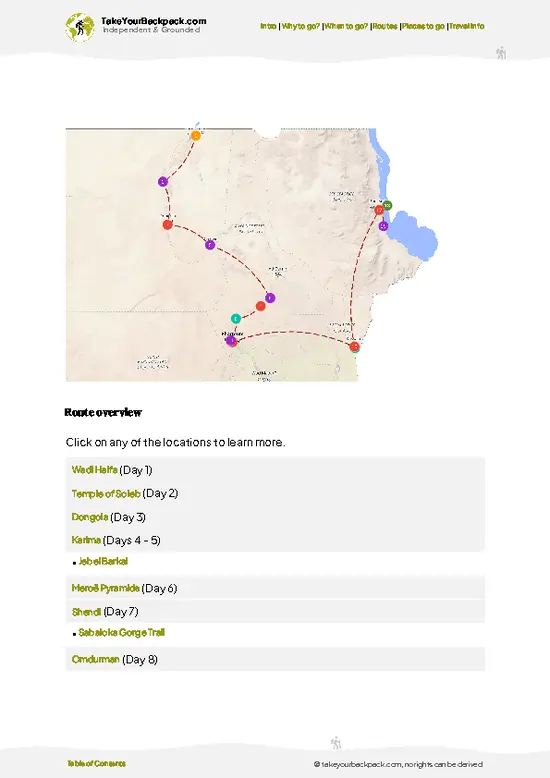
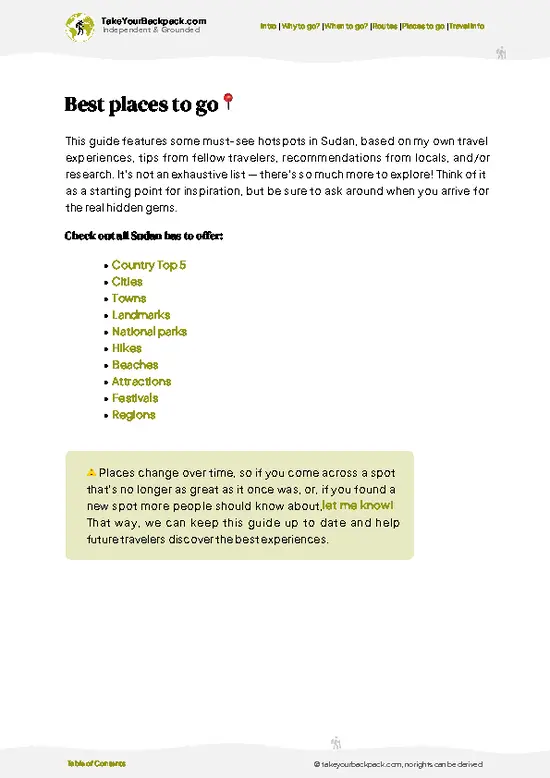
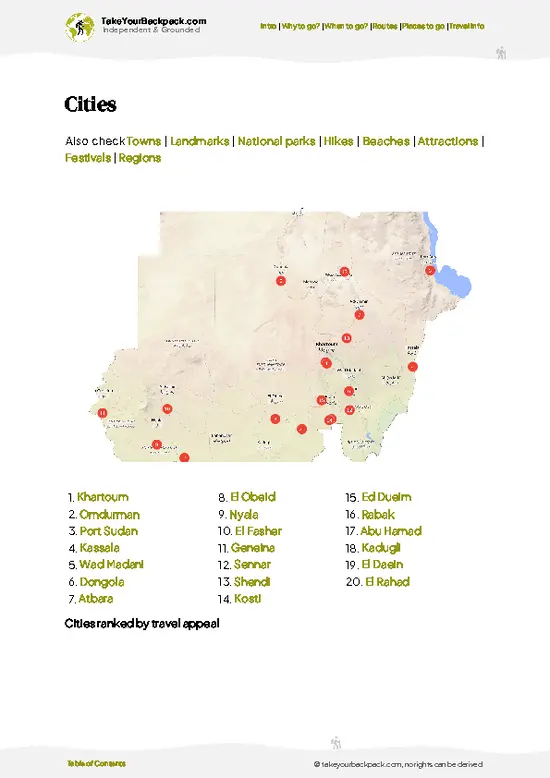
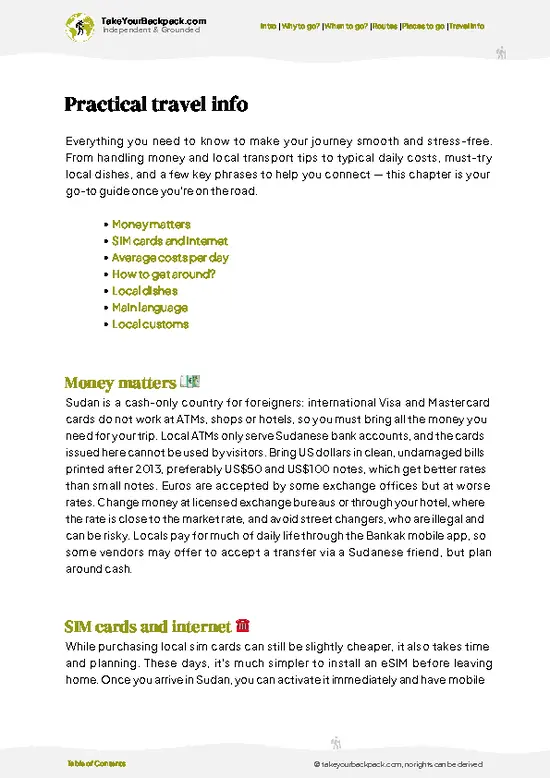
example page 0 from our offline Travel Guide for Sudan
example page 1 from our offline Travel Guide for Sudan
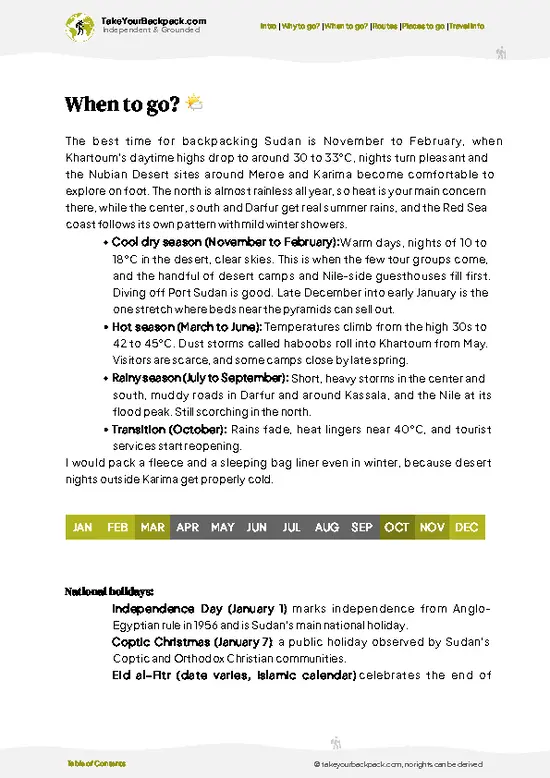
example page 2 from our offline Travel Guide for Sudan
example page 3 from our offline Travel Guide for Sudan
example page 4 from our offline Travel Guide for Sudan
example page 5 from our offline Travel Guide for Sudan
example page 6 from our offline Travel Guide for Sudan
example page 7 from our offline Travel Guide for Sudan
Loading the map 🌍
CLICK TO FILTER
cities
towns
landmarks
national parks
hikes
beaches
attractions
festivals
regions
SHOW COUNTRY’S BESTSHOW ALL

✨ Why go?
Ranked #1 beach in Sudan
Why visitors keep coming back

Port Sudan Beach is where Sudan’s Red Sea diving starts, and that is the main reason backpackers stop. The town is the launch point for liveaboards and day boats heading to Sanganeb Atoll and the Umbria wreck, sites that rank among the best in the entire Red Sea and see a fraction of the divers you meet on the Egyptian side. Arrive, sort a trip with an operator, and the days settle into a routine of boat in the morning and shade in the afternoon.

The second reason is the coast itself. Port Sudan Beach works as a base for the Red Sea strip: you can head south toward the ruined coral-stone port of Suakin, or use the town as a breather after the long overland haul from the Nile valley. Food and beds are cheap by regional standards, and nobody rushes you out of a tea stall.

Socially it is quiet. … read more 👉
Port Sudan Beach is where Sudan’s Red Sea diving starts, and that is the main reason backpackers stop. The town is the launch point for liveaboards and day boats heading to Sanganeb Atoll and the Umbria wreck, sites that rank among the best in the entire Red Sea and see a fraction of the divers you meet on the Egyptian side. Arrive, sort a trip with an operator, and the days settle into a routine of boat in the morning and shade in the afternoon.

The second reason is the coast itself. Port Sudan Beach works as a base for the Red Sea strip: you can head south toward the ruined coral-stone port of Suakin, or use the town as a breather after the long overland haul from the Nile valley. Food and beds are cheap by regional standards, and nobody rushes you out of a tea stall.

Socially it is quiet. You will not find a beach-party circuit. What you get is conversation with Beja tea sellers, dive guides and the occasional fellow traveler, which suits anyone who prefers a slow, low-key stop with real water access just offshore.

💡 HighlightsPlaces and moments you shouldn't skip

  1. Umbria wreck dive: The Italian cargo ship scuttled by its captain in 1940 lies upright on a reef shelf not far offshore. Its holds still contain crates of bottles, Fiat cars and construction material, which makes it a rare wreck where you swim among cargo rather than just steel. Visibility is usually good, and the shallow depth suits newer divers too.
  2. Sanganeb Atoll: A reef rising from deep water with a lighthouse on its tip, built in the 19th century. Divers come for reef sharks, barracuda schools and sheer walls. Snorkelers can float over the shallower plateau, which feels like looking into a vertical aquarium.
  3. Sha’ab Rumi and Precontinent II: Jacques Cousteau built his underwater living experiment here in the 1960s. Divers can still see the hangar and the remains of the structures on the
… read more 👉
  1. Umbria wreck dive: The Italian cargo ship scuttled by its captain in 1940 lies upright on a reef shelf not far offshore. Its holds still contain crates of bottles, Fiat cars and construction material, which makes it a rare wreck where you swim among cargo rather than just steel. Visibility is usually good, and the shallow depth suits newer divers too.
  2. Sanganeb Atoll: A reef rising from deep water with a lighthouse on its tip, built in the 19th century. Divers come for reef sharks, barracuda schools and sheer walls. Snorkelers can float over the shallower plateau, which feels like looking into a vertical aquarium.
  3. Sha’ab Rumi and Precontinent II: Jacques Cousteau built his underwater living experiment here in the 1960s. Divers can still see the hangar and the remains of the structures on the sea floor, and it is one of the few dive sites anywhere where you visit a piece of ocean-exploration history.
  4. Suakin old town: The ruined Ottoman-era port of coral-stone merchant houses sits south of the city, with crumbling balconies and arches facing a quiet lagoon. It is eerie, photogenic and best explored on foot with a local guide who knows which structures are stable.
  5. Beja coffee on the waterfront: Women of the Beja community brew spiced coffee and ginger tea in clay jebena pots over charcoal, right on the shore. It costs very little, takes an hour if you let it, and is the easiest way to talk with locals. Evenings, when the heat eases and the harbor lights come on, are the best time to settle in.
At Port Sudan Beach, the Umbria and Sanganeb dives need booking ahead with a dive operator, since boats, permits and gear are arranged in advance, while everything else on this list is free to walk up to.
Spotted a mistake or missing something? Contact us.

🌤️ When to go?When to go for the best experience

  • Winter (November to March): Port Sudan is at its most comfortable, with daytime highs of 26 to 31°C (79 to 88°F) and nights of 20 to 24°C (68 to 75°F). The Red Sea is a pleasant 24 to 27°C (75 to 81°F), and this is the main season for divers and snorkelers. Daylight runs roughly 11 to 12 hours. Expect the highest boat and dive prices.
  • Spring (April to May): Highs climb to 33 to 38°C (91 to 100°F) and humidity builds. Visibility underwater stays good, and fewer people are around, so rates soften.
  • Summer (June to September): Brutal and sticky, with highs of 38 to 45°C (100 to 113°F) and nights that barely drop below 30°C (86°F). Rain is scarce, but the heat makes midday on the sand miserable. Daylight stretches to about 13 hours. Prices are lowest, and the beach is mostly empty.
  • Autumn (October):
… read more 👉
  • Winter (November to March): Port Sudan is at its most comfortable, with daytime highs of 26 to 31°C (79 to 88°F) and nights of 20 to 24°C (68 to 75°F). The Red Sea is a pleasant 24 to 27°C (75 to 81°F), and this is the main season for divers and snorkelers. Daylight runs roughly 11 to 12 hours. Expect the highest boat and dive prices.
  • Spring (April to May): Highs climb to 33 to 38°C (91 to 100°F) and humidity builds. Visibility underwater stays good, and fewer people are around, so rates soften.
  • Summer (June to September): Brutal and sticky, with highs of 38 to 45°C (100 to 113°F) and nights that barely drop below 30°C (86°F). Rain is scarce, but the heat makes midday on the sand miserable. Daylight stretches to about 13 hours. Prices are lowest, and the beach is mostly empty.
  • Autumn (October): Heat eases to 32 to 35°C (90 to 95°F). Brief, rare showers can arrive late in the year, mostly between October and December.
Book diving and boat trips a few days ahead in winter, and in summer plan to swim at dawn or after dusk.


source: climatestotravel.comJANJanuary: excellent for travelingFEBFebruary: excellent for travelingMARMarch: highly recommended for travelingAPRApril: fair for travelingMAYMay: below average for travelingJUNJune: below average for travelingJULJuly: below average for travelingAUGAugust: below average for travelingSEPSeptember: fair for travelingOCTOctober: fair for travelingNOVNovember: highly recommended for travelingDECDecember: excellent for traveling
when-to-go

✈️ The backpacker research shortcutSudan Travel Guide

An offline-friendly backpacking guide with optimized travel routes, ranked highlights, transport advice, and the best areas to stay.
example page 0 from our offline Travel Guide for Sudan
example page 1 from our offline Travel Guide for Sudan
example page 2 from our offline Travel Guide for Sudan
example page 3 from our offline Travel Guide for Sudan
example page 4 from our offline Travel Guide for Sudan
example page 5 from our offline Travel Guide for Sudan
example page 6 from our offline Travel Guide for Sudan
example page 7 from our offline Travel Guide for Sudan
The digital guide (268 pages) contains:
✅ 62 highlights, ranked by travel appeal
✅ Optimized 5, 10 & 15-day travel routes
✅ Cities, national parks, landmarks, beaches
✅ How to get around
✅ Offline-friendly for travel without Wi-Fi
👉 Click to see all 30+ guide features

📅 Plan smarter in minutes, not weeks
✅ Month by month travel advice
✅ Festivals & national holidays
✅ Budget expectations

🗺️ Go to the right places, skip the overrated ones
✅ Honest pros & cons of destinations
✅ Top hikes, parks & viewpoints
✅ Lesser-known places most travelers miss
✅ Clear “worth it vs skip it” guidance

🛏️ Travel smoothly without rookie mistakes
✅ Best areas to stay
✅ Transport systems explained simply
✅ Common scams & safety advice
✅ SIM cards, money & practical tips

🌍 Understand the country, not just visit it
✅ Culture & traditions
✅ 52 Essential phrases & customs
✅ Festivals worth planning around
✅ Traveler-friendly historical context
✅ Insights that make places more meaningful

📱 Built for real travel conditions
✅ Fully downloadable PDF
✅ Works completely offline
✅ Optimized for phone use
✅ Useful in remote areas & buses
✅ Everything in one place
Stop searching, start planning
Get instant access to your full guide. 30‑day money-back guarantee.
+ Add another guide for just

By proceeding you agree to our terms.
Sent to your inbox immediately after payment • 100% Secure Checkout
Best Backpacking Travel Advisor 2025 tourism awardBest Backpacking
Travel Advisor
2025
What others say about Take Your Backpack Guides:
⭐⭐⭐⭐⭐
Fantastic, amazing amount of information!
⭐⭐⭐⭐⭐
My goodness this is amazing, it's what I've been looking for hats off too you!
⭐⭐⭐⭐⭐
I think this is absolutely BRILLIANT
⭐⭐⭐⭐
Very complete and informative. It's still missing places, but I gotta to commend you
⭐⭐⭐⭐⭐
This is truly amazing, thank you, can't wait to explore it with my kids!
⭐⭐⭐⭐⭐
Awesome resource, thank you!
⭐⭐⭐⭐⭐
This is amazing! Can't wait to explore the ones I haven't seen
⭐⭐⭐⭐
I love this! Well done, great idea.
⭐⭐⭐⭐⭐
Thanks for taking the time to make this gem!
⭐⭐⭐⭐⭐
This might be the best website I've ever seen.
⭐⭐⭐⭐⭐
Congratulations, and thank you so much for your work; it's incredibly valuable.
⭐⭐⭐⭐
In all seriousness I think you did a great job pointing out the important spots
⭐⭐⭐⭐⭐
10/10 very good
⭐⭐⭐⭐⭐
As someone who's only just starting to visit regularly this is awesome, thank you.
⭐⭐⭐⭐
Thank you very much! I'm going to visit my dad, it's going to be very useful!
⭐⭐⭐⭐⭐
This is really cool! We'll be travelling for the first time and this definitely come in handy.
⭐⭐⭐⭐⭐
You are now our minister of culture, congratulations 👨‍💼
⭐⭐⭐⭐⭐
Just wanted to tell you that this is a pearl! Going to follow your recommendations.
⭐⭐⭐⭐⭐
This is so cool. I'll definitely be using the resource for my travels soon.
⭐⭐⭐⭐⭐
This is very impressive! Good work.
⭐⭐⭐⭐⭐
This is an amazing and informative site. Very well done!

🛏️ Where to stay?Best areas and accommodation options

The best base for backpackers is central Port Sudan, in the grid of streets around the old Quarter Mile and the market area, a short ride from the waterfront. Sudan has no beach-hostel scene like Southeast Asia, so the social side of travel here comes from the town itself, not from a strip of dorms on the sand.
The downtown area gives you the cheapest beds, with simple guesthouses and small hotels at roughly US$10 to 30 a night. Tea stalls, bean-and-bread breakfast counters and fish restaurants are all within walking distance, and this is where you meet other travelers, dive staff and Sudanese … read more 👉
The best base for backpackers is central Port Sudan, in the grid of streets around the old Quarter Mile and the market area, a short ride from the waterfront. Sudan has no beach-hostel scene like Southeast Asia, so the social side of travel here comes from the town itself, not from a strip of dorms on the sand.
The downtown area gives you the cheapest beds, with simple guesthouses and small hotels at roughly US$10 to 30 a night. Tea stalls, bean-and-bread breakfast counters and fish restaurants are all within walking distance, and this is where you meet other travelers, dive staff and Sudanese students who like practicing English. Transport to the bus station and the port is easy from here, and shared rooms help keep costs down.
The seafront and Corniche side of town is quieter and breezier, with a bit more comfort for US$30 to 60. It suits those who want a sea view and a calmer evening, though the walk to food is longer.
If diving is the point, look for rooms near the dive operators around the harbor and the north end of town. You get early starts, boat departures and gear talk over dinner, which is the closest thing to a backpacker scene here.

🛡️ SafetyScams, Hazards, and Annoyances

Port Sudan Beach is calm and uncomplicated for swimmers, and the bigger issues are heat and local etiquette. Water is sheltered, with gentle waves and no strong rips or tides to speak of, so most swimmers just wade out and float. Reef edges and sea urchins sit close to shore in places, so wear water shoes and watch your footing over coral. Jellyfish are rare, and sharks are not a concern from the shore.
The sun is the real hazard. Midday heat is intense for most of the year, so swim early or toward evening, carry a hat and plenty of water, and use strong sunscreen. Locals tend to swim in the cooler hours, and modest clothing is the norm, including for swimming. Women often swim in loose clothes, so pack a rash guard and shorts or leggings.
Petty theft is uncommon, but keep your phone and cash … read more 👉
Port Sudan Beach is calm and uncomplicated for swimmers, and the bigger issues are heat and local etiquette. Water is sheltered, with gentle waves and no strong rips or tides to speak of, so most swimmers just wade out and float. Reef edges and sea urchins sit close to shore in places, so wear water shoes and watch your footing over coral. Jellyfish are rare, and sharks are not a concern from the shore.
The sun is the real hazard. Midday heat is intense for most of the year, so swim early or toward evening, carry a hat and plenty of water, and use strong sunscreen. Locals tend to swim in the cooler hours, and modest clothing is the norm, including for swimming. Women often swim in loose clothes, so pack a rash guard and shorts or leggings.
Petty theft is uncommon, but keep your phone and cash with you rather than on the sand. Ask permission before taking photos near the port or military areas.

FAQFrequently asked questions about Port Sudan Beach

Port Sudan Beach lies right at the city on the Red Sea coast, so you reach it by taxi, rickshaw or a walk from downtown, usually 5 to 20 minutes and US$1 to 4. Most travelers arrive in Port Sudan by bus from Khartoum, a long trip of about 12 to 16 hours, or by plane to Port Sudan Airport, about 10 km from the center. Rickshaws are the cheapest way along the waterfront.
Port Sudan Beach is best for casual swimming and shore snorkeling, as the water is warm at 24 to 30°C (75 to 86°F) and usually calm. Reef edges with fish are close to the shore in places, though the best diving and snorkeling are on boat trips to reefs such as Sanganeb, a few hours offshore, with day trips from around US$60 to 120. Surfing is not an option because there is almost no swell.
Port Sudan Beach is free to walk and swim at where the public shoreline is open, and there is no general entry fee. Some resort or club sections charge day access of roughly US$5 to 15, and boat or dive trips cost extra. Travel permits for the Red Sea State may be needed, so carry your passport and copies.
⚠️ Things can change over time, so always validate details locally before you go.

Other Sudanese beaches near Port Sudan Beach

Explore more nearby:

  • Sanganeb Beach—marine park, lighthouse, clear waters, reef plateau| 28 km away
  • Red Sea Coast—long stretches, desert backdrop, offshore islands, marine biodiversity| 36 km away

💡 Not sure where to go next?
Create a personalized itinerary for Sudan including Port Sudan Beach and the places that fit your trip.

Generate my itinerary

👉 Discover all beaches

Or checkout all Sudan has to offer (think cities, towns, villages, national parks, hikes, beaches, festivals)
Country photo of Sudan

We 💚 feedbackIs it worth it?

Port Sudan Beach rewards winter more than summer, from roughly December to February, when the sea feels refreshing and boat days stay comfortable. Pick the early morning for any dive or snorkel trip, then spend evenings with a jebena of coffee on the shore. I would skip swimming right by the harbor and save the water time for the reefs.

✈️ When did I visit Sudan?
Sudan I visited back in October 2017. I combined the trip with a visit to Ethiopia.

✍️ Help improve this page!
The information on this page is based on my own backpacking experience in Sudan, supplemented with up-to-date research and feedback from other travelers. Travel details can change, so if you notice anything outdated or incomplete, feel free to let me know.


🙋‍♂️ Give feedback

👋 Meet the founderWho’s Behind Take Your Backpack?

Johan, backpacker and founder of TakeYourBackpackHi, I’m Johan (Netherlands 🇳🇱), the creator of TakeYourBackpack. Over the past 3 decades, I’ve backpacked through 90+ countries across six continents, gaining extensive experience with independent travel, long-term trips, and overland routes.

This site is built on a combination of firsthand travel experience and carefully curated insights from other backpackers. Many guides are based on places I’ve personally visited, while others bring together tips, observations, and practical advice shared by trusted travelers I’ve met along the way.

The goal is to provide realistic, experience-driven guidance — not generic itineraries — so you can explore destinations with better context, clearer expectations, and more confidence.