
×

Suriname🇸🇷 | national parksBigi PanScarlet ibis roosts, mangrove channels, stilt fishing huts, brackish lagoon | things to do and best time to go

Explore Boven Coesewijne Nature ReserveExplore Tumuc-Humac Mountains

Backpacking in Bigi Pan
🌟 Highlightnational park ranked #4
By Johan Kruseman 🇳🇱 | Updated October 19, 2026

The boat engine cuts out and the sound that replaces it is wings: thousands of scarlet ibis and egrets lifting off the mangrove flats in one rustling sheet, while the air smells of salt mud and diesel. Bigi Pan sits in the northwest of Suriname, in Nickerie District, a brackish lagoon and mangrove reserve between the Atlantic coast and the rice fields. It is flat, so there is no real hiking, and the heat on open water is relentless. Access works through local operators because the lagoon has no public boats, so experienced travelers arrange a guide in Nieuw Nickerie and go at low light to avoid the glare and the worst mosquitoes. Crowds are essentially nil. The vibe is quiet, damp and a little rough. Bring long sleeves and repellent. Fishermen’s stilt huts lean over the water at the end of the channel, drying nets draped over their railings.

Discover everything you want to know in the 📖 Suriname Travel Guide.


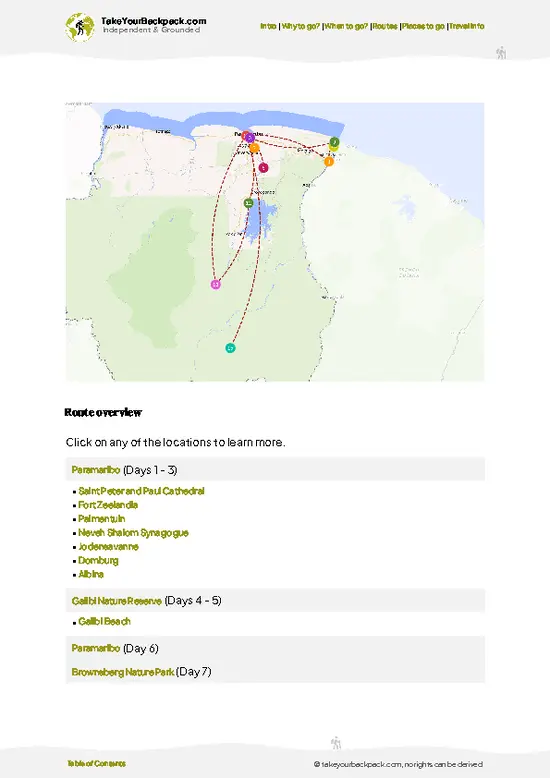
example page 0 from our offline Travel Guide for Suriname
example page 1 from our offline Travel Guide for Suriname
example page 2 from our offline Travel Guide for Suriname
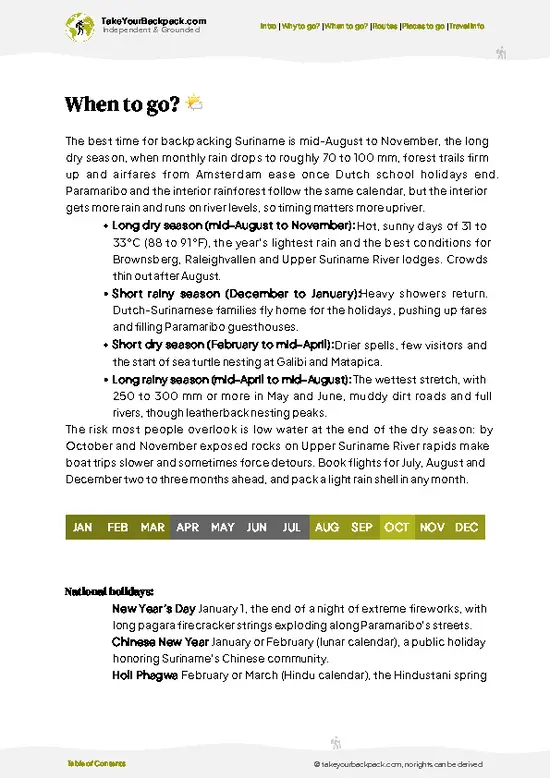
example page 3 from our offline Travel Guide for Suriname
example page 4 from our offline Travel Guide for Suriname
example page 5 from our offline Travel Guide for Suriname
example page 6 from our offline Travel Guide for Suriname
example page 7 from our offline Travel Guide for Suriname
Loading the map 🌍
CLICK TO FILTER
cities
towns
villages
landmarks
national parks
hikes
beaches
attractions
festivals
regions
SHOW COUNTRY’S BESTSHOW ALL

✨ Why go?
Ranked #4 national park in Suriname
What makes this national park worth exploring

Bigi Pan rewards backpackers who want wildlife without a jungle expedition. The reserve is a wetland of about 68,000 hectares, and its mangrove channels hold scarlet ibis roosting in the hundreds, along with herons, spoonbills and migratory shorebirds that arrive from North America. Tours here are small and run by local guides, but you can arrange them independently in Nieuw Nickerie, which keeps the experience personal and flexible. That suits self-guided travelers who like to haggle, adjust the route and skip a packaged itinerary. The second pull is the stilt-house fishing settlement on the lagoon, where simple lodging and home-cooked fish give a view of working coastal life that few visitors see. It also pairs well with a wider trip along Suriname’s western coast, since the surrounding … read more 👉
Bigi Pan rewards backpackers who want wildlife without a jungle expedition. The reserve is a wetland of about 68,000 hectares, and its mangrove channels hold scarlet ibis roosting in the hundreds, along with herons, spoonbills and migratory shorebirds that arrive from North America. Tours here are small and run by local guides, but you can arrange them independently in Nieuw Nickerie, which keeps the experience personal and flexible. That suits self-guided travelers who like to haggle, adjust the route and skip a packaged itinerary. The second pull is the stilt-house fishing settlement on the lagoon, where simple lodging and home-cooked fish give a view of working coastal life that few visitors see. It also pairs well with a wider trip along Suriname’s western coast, since the surrounding Nickerie rice country and the Corantijn River are close at hand. If you care more about birds, mud and open sky than summits and waterfalls, this place fits.

💡 HighlightsDon't-miss highlights and experiences

  1. Scarlet ibis roosts: the sight Bigi Pan is known for. At dusk the red birds return to the mangroves in long lines, turning whole trees crimson.
  2. Mangrove channels by boat: narrow waterways with roots arching overhead, where you drift close to herons and kingfishers.
  3. The open lagoon: a wide brackish flat of shallow water, good for spoonbills, egrets and wading birds feeding at low tide.
  4. Stilt fishing huts: weathered wooden houses over the water, where fishers dry catch and mend nets.
  5. Migratory shorebirds: sandpipers and plovers gather on the mudflats in the northern winter months, a draw for birders.
  6. Atlantic coast mudbanks: the outer edge of the reserve, where sediment from the Amazon builds shifting banks and young mangroves take hold.
  7. Dusk and night sky: with no town glare, the stars over the lagoon
… read more 👉
  1. Scarlet ibis roosts: the sight Bigi Pan is known for. At dusk the red birds return to the mangroves in long lines, turning whole trees crimson.
  2. Mangrove channels by boat: narrow waterways with roots arching overhead, where you drift close to herons and kingfishers.
  3. The open lagoon: a wide brackish flat of shallow water, good for spoonbills, egrets and wading birds feeding at low tide.
  4. Stilt fishing huts: weathered wooden houses over the water, where fishers dry catch and mend nets.
  5. Migratory shorebirds: sandpipers and plovers gather on the mudflats in the northern winter months, a draw for birders.
  6. Atlantic coast mudbanks: the outer edge of the reserve, where sediment from the Amazon builds shifting banks and young mangroves take hold.
  7. Dusk and night sky: with no town glare, the stars over the lagoon are sharp, and frogs and insects fill the dark with sound.
For a first visit, the evening ibis roost is the one to book.
Spotted a mistake or missing something? Contact us.

🌤️ When to go?When to go for the best experience

  • Main Dry Season (August to mid-November): Bigi Pan is easiest to reach now, with lower water, fewer storms and the best bird viewing on the mudflats. Days run 28 to 33°C (82 to 91°F), nights about 23°C (73°F). Lodges and boat operators are busiest, so prices sit at their highest.
  • Short Wet Season (mid-November to January): Showers come in bursts, humidity climbs and mosquitoes multiply. Temperatures stay near 27 to 31°C (81 to 88°F). Quieter, and boat trips still run between squalls.
  • Short Dry Spell (February to April): Fewer showers and a good second window for birds, with similar warmth and moderate crowds.
  • Long Wet Season (May to July): Heavy downpours turn the coastal roads muddy and boats can be canceled in rough weather. Expect 26 to 30°C (79 to 86°F) and the lowest prices, though some
… read more 👉
  • Main Dry Season (August to mid-November): Bigi Pan is easiest to reach now, with lower water, fewer storms and the best bird viewing on the mudflats. Days run 28 to 33°C (82 to 91°F), nights about 23°C (73°F). Lodges and boat operators are busiest, so prices sit at their highest.
  • Short Wet Season (mid-November to January): Showers come in bursts, humidity climbs and mosquitoes multiply. Temperatures stay near 27 to 31°C (81 to 88°F). Quieter, and boat trips still run between squalls.
  • Short Dry Spell (February to April): Fewer showers and a good second window for birds, with similar warmth and moderate crowds.
  • Long Wet Season (May to July): Heavy downpours turn the coastal roads muddy and boats can be canceled in rough weather. Expect 26 to 30°C (79 to 86°F) and the lowest prices, though some guides take fewer bookings.
Daylight stays steady at about 12 hours all year, so plan boat trips for early morning when winds are calm and the birds are active. Book a guide a few days ahead in August to October.


source: climatestotravel.comJANJanuary: fair for travelingFEBFebruary: fair for travelingMARMarch: fair for travelingAPRApril: fair for travelingMAYMay: fair for travelingJUNJune: fair for travelingJULJuly: fair for travelingAUGAugust: excellent for travelingSEPSeptember: excellent for travelingOCTOctober: excellent for travelingNOVNovember: excellent for travelingDECDecember: fair for traveling
when-to-go

✈️ The backpacker research shortcutSuriname Travel Guide

An offline-friendly backpacking guide with optimized travel routes, ranked highlights, transport advice, and the best areas to stay.
example page 0 from our offline Travel Guide for Suriname
example page 1 from our offline Travel Guide for Suriname
example page 2 from our offline Travel Guide for Suriname
example page 3 from our offline Travel Guide for Suriname
example page 4 from our offline Travel Guide for Suriname
example page 5 from our offline Travel Guide for Suriname
example page 6 from our offline Travel Guide for Suriname
example page 7 from our offline Travel Guide for Suriname
The digital guide (153 pages) contains:
✅ 40 highlights, ranked by travel appeal
✅ Optimized 5, 10 & 15-day travel routes
✅ Cities, national parks, landmarks, beaches
✅ How to get around
✅ Offline-friendly for travel without Wi-Fi
👉 Click to see all 30+ guide features

📅 Plan smarter in minutes, not weeks
✅ Month by month travel advice
✅ Festivals & national holidays
✅ Budget expectations

🗺️ Go to the right places, skip the overrated ones
✅ Honest pros & cons of destinations
✅ Top hikes, parks & viewpoints
✅ Lesser-known places most travelers miss
✅ Clear “worth it vs skip it” guidance

🛏️ Travel smoothly without rookie mistakes
✅ Best areas to stay
✅ Transport systems explained simply
✅ Common scams & safety advice
✅ SIM cards, money & practical tips

🌍 Understand the country, not just visit it
✅ Culture & traditions
✅ 52 Essential phrases & customs
✅ Festivals worth planning around
✅ Traveler-friendly historical context
✅ Insights that make places more meaningful

📱 Built for real travel conditions
✅ Fully downloadable PDF
✅ Works completely offline
✅ Optimized for phone use
✅ Useful in remote areas & buses
✅ Everything in one place
Stop searching, start planning
Get instant access to your full guide. 30‑day money-back guarantee.
+ Add another guide for just

By proceeding you agree to our terms.
Sent to your inbox immediately after payment • 100% Secure Checkout
Best Backpacking Travel Advisor 2025 tourism awardBest Backpacking
Travel Advisor
2025
What others say about Take Your Backpack Guides:
⭐⭐⭐⭐⭐
Fantastic, amazing amount of information!
⭐⭐⭐⭐⭐
My goodness this is amazing, it's what I've been looking for hats off too you!
⭐⭐⭐⭐⭐
I think this is absolutely BRILLIANT
⭐⭐⭐⭐
Very complete and informative. It's still missing places, but I gotta to commend you
⭐⭐⭐⭐⭐
This is truly amazing, thank you, can't wait to explore it with my kids!
⭐⭐⭐⭐⭐
Awesome resource, thank you!
⭐⭐⭐⭐⭐
This is amazing! Can't wait to explore the ones I haven't seen
⭐⭐⭐⭐
I love this! Well done, great idea.
⭐⭐⭐⭐⭐
Thanks for taking the time to make this gem!
⭐⭐⭐⭐⭐
This might be the best website I've ever seen.
⭐⭐⭐⭐⭐
Congratulations, and thank you so much for your work; it's incredibly valuable.
⭐⭐⭐⭐
In all seriousness I think you did a great job pointing out the important spots
⭐⭐⭐⭐⭐
10/10 very good
⭐⭐⭐⭐⭐
As someone who's only just starting to visit regularly this is awesome, thank you.
⭐⭐⭐⭐
Thank you very much! I'm going to visit my dad, it's going to be very useful!
⭐⭐⭐⭐⭐
This is really cool! We'll be travelling for the first time and this definitely come in handy.
⭐⭐⭐⭐⭐
You are now our minister of culture, congratulations 👨‍💼
⭐⭐⭐⭐⭐
Just wanted to tell you that this is a pearl! Going to follow your recommendations.
⭐⭐⭐⭐⭐
This is so cool. I'll definitely be using the resource for my travels soon.
⭐⭐⭐⭐⭐
This is very impressive! Good work.
⭐⭐⭐⭐⭐
This is an amazing and informative site. Very well done!

🛏️ Where to stay?Where staying makes the most sense

No hotels sit inside Bigi Pan itself, so most backpackers sleep in Nickerie, the district capital about 30 to 45 minutes by road from the access points. Nickerie has guesthouses and small hotels at roughly US$25 to 60 a night for a private room, with air conditioning, a restaurant nearby and easy bus links. It is the practical base for arranging boat trips into the lagoon and mangroves.
The other option is the small settlement of Wageningen, a rice-farming town closer to Nickerie than Paramaribo, with a few basic rooms from about US$20 to 40. It suits anyone who wants a quieter night and early … read more 👉
No hotels sit inside Bigi Pan itself, so most backpackers sleep in Nickerie, the district capital about 30 to 45 minutes by road from the access points. Nickerie has guesthouses and small hotels at roughly US$25 to 60 a night for a private room, with air conditioning, a restaurant nearby and easy bus links. It is the practical base for arranging boat trips into the lagoon and mangroves.
The other option is the small settlement of Wageningen, a rice-farming town closer to Nickerie than Paramaribo, with a few basic rooms from about US$20 to 40. It suits anyone who wants a quieter night and early starts on the water.
On the lagoon, a simple lodge and a few guesthouses near the Bigi Pan fishing village offer rustic rooms or hammock space on stilts, usually US$30 to 70 including meals when arranged through a tour operator. Expect shared bathrooms, mosquito nets and limited electricity. Reserve these through a Nickerie or Paramaribo operator, because walk-ups are unreliable and phone contact is patchy.
Paramaribo has the widest hostel choice, with dorm beds from about US$15 to 25, but it is a long road trip of several hours, so it works better for an overnight transfer than as a base.

👛 Costs (as of 19 October 2026)How expensive it really is

A realistic backpacker budget for Bigi Pan is about US$65 to 130 a day, and the largest expense is the guided boat trip. Prices are paid in Surinamese dollars or US dollars cash, and there are no ATMs near the lagoon.
CategoryBudget RangeLocal Reality
Entrance feesUS$0 to 5Access is mostly free or covered by a small local fee, usually folded into your tour price.
Accommodation (high season)US$20 to 45Basic guesthouse rooms in Nickerie or Wageningen. Lagoon lodges cost more, around US$30 to 70 with meals.
Guided boat tripUS$25 to 45Shared half-day boat tours of the lagoon and mangroves; private boats cost more. Bird guides are worth it.
Local transportUS$10 to 20Shared minibuses and taxis between Nickerie and the access points. Paramaribo to Nickerie by bus or shared van costs about US$10 to 20
… read more 👉
A realistic backpacker budget for Bigi Pan is about US$65 to 130 a day, and the largest expense is the guided boat trip. Prices are paid in Surinamese dollars or US dollars cash, and there are no ATMs near the lagoon.
CategoryBudget RangeLocal Reality
Entrance feesUS$0 to 5Access is mostly free or covered by a small local fee, usually folded into your tour price.
Accommodation (high season)US$20 to 45Basic guesthouse rooms in Nickerie or Wageningen. Lagoon lodges cost more, around US$30 to 70 with meals.
Guided boat tripUS$25 to 45Shared half-day boat tours of the lagoon and mangroves; private boats cost more. Bird guides are worth it.
Local transportUS$10 to 20Shared minibuses and taxis between Nickerie and the access points. Paramaribo to Nickerie by bus or shared van costs about US$10 to 20 one way.
Food and suppliesUS$10 to 15Roti, fried rice and noodle dishes at small Nickerie eateries cost US$3 to 7. Bring water and snacks for the boat.
Total Daily BudgetUS$65 to 130A mid-range day that includes one boat trip, a room, local rides and meals.
⚠️ Prices can change and everyone travels differently, so take this as a rough guide. Hope it helps you plan your adventure!

🥾 TrailsTrail guide for Bigi Pan national park

Bigi Pan has no marked hiking trails; the exploring happens by boat and on short walks along dikes and the settlement boardwalks. Terrain is flat, wet and open, so difficulty is low but heat and humidity make it tiring.
  • Boat tour through the mangroves: Tours start from the channel landing and run roughly 2 to 4 hours, passing narrow mangrove passages, open lagoon and bird colonies. Easy.
  • Evening ibis watch: Boats position near the roosting trees about an hour before dark. Expect to sit still and keep your voice low. Easy.
  • Settlement walk: A short stroll along planks and sandy paths around the stilt
… read more 👉
Bigi Pan has no marked hiking trails; the exploring happens by boat and on short walks along dikes and the settlement boardwalks. Terrain is flat, wet and open, so difficulty is low but heat and humidity make it tiring.
  • Boat tour through the mangroves: Tours start from the channel landing and run roughly 2 to 4 hours, passing narrow mangrove passages, open lagoon and bird colonies. Easy.
  • Evening ibis watch: Boats position near the roosting trees about an hour before dark. Expect to sit still and keep your voice low. Easy.
  • Settlement walk: A short stroll along planks and sandy paths around the stilt huts, 30 to 60 minutes, past drying nets and fishing gear. Easy.
  • Dike walks: Flat earthen embankments near the rice fields, good for spotting waders in the morning. Shade is scarce.
Bigi Pan is reached from Nieuw Nickerie by road, then by boat from the landing, and no regular public transport runs to the water, so most travelers go with a guide or hired driver. Visits are quiet, with few other people. Entry is arranged through the tour, and costs are usually folded into the boat price. Wear a hat, long sleeves and strong repellent, and carry water.
⚠️ Hiking info can sometimes be outdated or inaccurate. Before you hit the trail, check the latest conditions with locals. If you do spot anything that's off, I'd love to hear from you, so I can update it for fellow travelers.

🛡️ SafetySafety Tips and Common Scams in Bigi Pan

Bigi Pan is a low-risk place for hikers, as most visits happen by boat and short walks rather than on demanding trails. The main issues are sun, heat and insects. The lagoon is open and shadeless, so wear a long-sleeved light shirt, a wide-brimmed hat and strong sunscreen, and carry at least 2 liters of water per person. Mosquitoes are persistent at dawn and dusk, so bring repellent and sleep under a net.
Wind can chop up the water by midday, which is why guides start early. Choose a licensed local boatman, wear a life jacket if offered, and keep phones and cameras in dry bags. Mudflats and boardwalks get slippery, so wear sandals with grip or water shoes.
Wildlife is mostly birds, such as scarlet ibis and herons, along with the occasional caiman. Keep your distance, stay seated in the boat … read more 👉
Bigi Pan is a low-risk place for hikers, as most visits happen by boat and short walks rather than on demanding trails. The main issues are sun, heat and insects. The lagoon is open and shadeless, so wear a long-sleeved light shirt, a wide-brimmed hat and strong sunscreen, and carry at least 2 liters of water per person. Mosquitoes are persistent at dawn and dusk, so bring repellent and sleep under a net.
Wind can chop up the water by midday, which is why guides start early. Choose a licensed local boatman, wear a life jacket if offered, and keep phones and cameras in dry bags. Mudflats and boardwalks get slippery, so wear sandals with grip or water shoes.
Wildlife is mostly birds, such as scarlet ibis and herons, along with the occasional caiman. Keep your distance, stay seated in the boat and never feed animals. Cell coverage is thin, so tell your lodge your plans and carry cash, since there are no ATMs at the lagoon.

FAQTraveler FAQ

One full day is enough for Bigi Pan, though two days let you do both a dawn and a late-afternoon boat trip. Most travelers base themselves in Nickerie, about 30 to 45 minutes away, and take a half-day tour of 3 to 5 hours. Adding a night at a lagoon lodge gives the best bird viewing at first light.
Getting to Bigi Pan without a car is possible but needs planning. Shared minibuses run from Paramaribo to Nickerie in about 4 to 5 hours for roughly US$10 to 20, and from Nickerie you can hire a taxi or join a tour for the last stretch. Most tours include the transfer and the boat, so booking through a Nickerie operator is the simplest route.
No formal national park permit is usually needed for Bigi Pan, since it is a managed nature reserve reached by local boat operators. Expect to pay about US$25 to 45 for a guided boat trip, with any small access fee normally included. Carry cash, as there are no ATMs at the lagoon, and confirm what the tour covers before you pay.
⚠️ Things can change over time, so always validate details locally before you go.

Other Surinamese national parks near Bigi Pan

Explore more nearby:


💡 Not sure where to go next?
Create a personalized itinerary for Suriname including Bigi Pan and the places that fit your trip.

Generate my itinerary

👉 Discover all national parks

Or checkout all Suriname has to offer (think cities, towns, villages, national parks, hikes, beaches, festivals)
Country photo of Suriname

We 💚 feedbackWhat to keep in mind

Go in the late afternoon, when the heat drops and the ibis start streaming in toward the mangroves. Stay until the light has gone and the sky over the lagoon has turned a deep orange, then ride back under the first stars. I would bring a head torch and a dry bag for the camera.

✍️ Help improve this page!
The information on this page is based on in-depth research, insights shared by experienced travelers, and feedback from the local travel community in Suriname. While every effort is made to keep the information accurate and current, conditions can change — so if you spot anything incorrect or outdated, please get in touch.


🙋‍♂️ Give feedback

👋 Meet the founderWho’s Behind Take Your Backpack?

Johan, backpacker and founder of TakeYourBackpackHi, I’m Johan (Netherlands 🇳🇱), the creator of TakeYourBackpack. Over the past 3 decades, I’ve backpacked through 90+ countries across six continents, gaining extensive experience with independent travel, long-term trips, and overland routes.

This site is built on a combination of firsthand travel experience and carefully curated insights from other backpackers. Many guides are based on places I’ve personally visited, while others bring together tips, observations, and practical advice shared by trusted travelers I’ve met along the way.

The goal is to provide realistic, experience-driven guidance — not generic itineraries — so you can explore destinations with better context, clearer expectations, and more confidence.