×

Suriname🇸🇷 | best national parksWhere to Find the 8 Best national parks in Suriname

Suriname’s protected areas are raw, remote and mostly river-bound, and that defines everything about them. Roughly 90 percent of the country is rainforest, so parks mean humid air thick with howler monkey roars, tannin-dark water, and the diesel hum of a wooden boat. Access splits the options. The coastal and savanna reserves sit within a few hours of Paramaribo by road and cost little, while the interior parks need dugout canoes, small planes or multi-day river trips, and prices climb accordingly. Crowds are almost nonexistent everywhere. Independent travelers can reach some areas alone, but the deep interior usually runs through operators.

By Johan Kruseman 🇳🇱 | Updated October 20, 2026
Explore the best hikes in Suriname

Why go?Understanding Their Importance

Suriname is the most forested country on earth by share of land area, around 93 percent, and that single fact shapes its parks. Most of the interior is intact rainforest on the ancient Guiana Shield, with low population density and almost no roads beyond the northern coastal strip. The result is wilderness that feels unmanaged: you hear birds and frogs at dawn long before you see a trail marker, and the air smells of wet leaf litter and river mud.

The flip side is infrastructure. There are no highways to park gates, and visitor centers are basic. Rivers are the roads, so rapids, water levels and boat availability decide your plans. Cell signal vanishes quickly. Lodges are simple, often with hammocks, mosquito nets and generator power for a few evening hours.

Culture matters too. Maroon and … read more 👉
Suriname is the most forested country on earth by share of land area, around 93 percent, and that single fact shapes its parks. Most of the interior is intact rainforest on the ancient Guiana Shield, with low population density and almost no roads beyond the northern coastal strip. The result is wilderness that feels unmanaged: you hear birds and frogs at dawn long before you see a trail marker, and the air smells of wet leaf litter and river mud.

The flip side is infrastructure. There are no highways to park gates, and visitor centers are basic. Rivers are the roads, so rapids, water levels and boat availability decide your plans. Cell signal vanishes quickly. Lodges are simple, often with hammocks, mosquito nets and generator power for a few evening hours.

Culture matters too. Maroon and Indigenous communities live along many of these rivers, and village permission, local boatmen and community-run lodges are part of how access works. Travelers should expect to pay in cash, mostly euros or US dollars alongside Surinamese dollars, and to book transfers in advance. For anyone who wants quiet jungle without crowds, Suriname delivers. For anyone expecting signposted trails and ranger kiosks, it will frustrate.
Why These Made the Cut
The list of best national parks in Suriname is created based on landscapes, wildlife, adventure opportunities, facilities, and overall experience. If you feel a national park is missing in this list, please let us know.

When to go?Optimal Periods for Travel

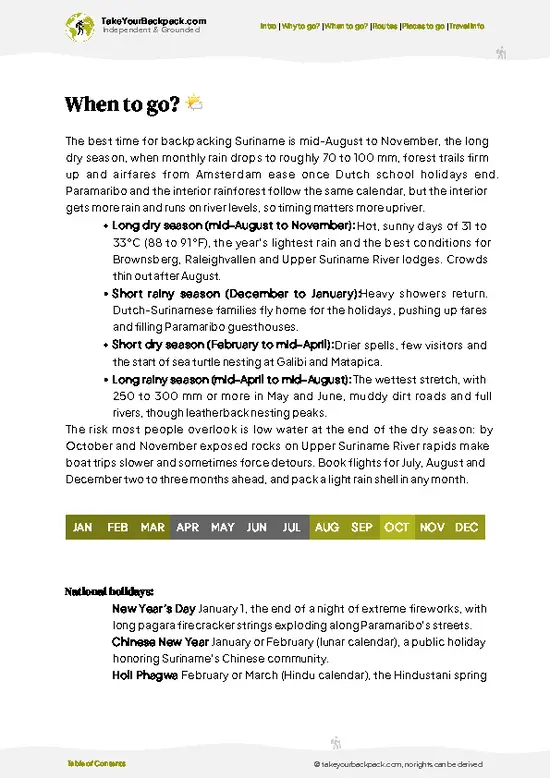
Best months for Suriname’s national parks: The best months are August to mid-November, the long dry season, when river levels are stable, trails are firmer and boats run reliably. A shorter dry window from February to early April also works. Temperatures stay steady at about 26 to 32°C (79 to 90°F) year-round, with humidity that leaves your shirt damp by 8 a.m.

Wet seasons and shoulder periods: The main wet season runs mid-April to mid-August, with heavy afternoon downpours, red-brown rivers and rainfall in the interior reaching roughly 2,000 to 3,000 mm a year overall. Trails turn to mud, and some savanna and swamp areas flood. A second, lighter rainy spell falls from December to January. Shoulder months like late April or early December can still be good, with fewer travelers and bright … read more 👉
Best months for Suriname’s national parks: The best months are August to mid-November, the long dry season, when river levels are stable, trails are firmer and boats run reliably. A shorter dry window from February to early April also works. Temperatures stay steady at about 26 to 32°C (79 to 90°F) year-round, with humidity that leaves your shirt damp by 8 a.m.

Wet seasons and shoulder periods: The main wet season runs mid-April to mid-August, with heavy afternoon downpours, red-brown rivers and rainfall in the interior reaching roughly 2,000 to 3,000 mm a year overall. Trails turn to mud, and some savanna and swamp areas flood. A second, lighter rainy spell falls from December to January. Shoulder months like late April or early December can still be good, with fewer travelers and bright mornings, but expect wet gear.

Crowds and prices: Crowds are thin all year. Demand for lodges and flights to the interior rises slightly around July to September and during the Christmas and New Year holidays, so book boats and beds a few weeks ahead then. Low-season rates for lodge packages can drop by 10 to 20 percent. Coastal areas have the strongest turtle and bird seasons, which depend on the month, so check timing before you commit.

national park hoppingOptimizing Your Multi-Stop Itinerary

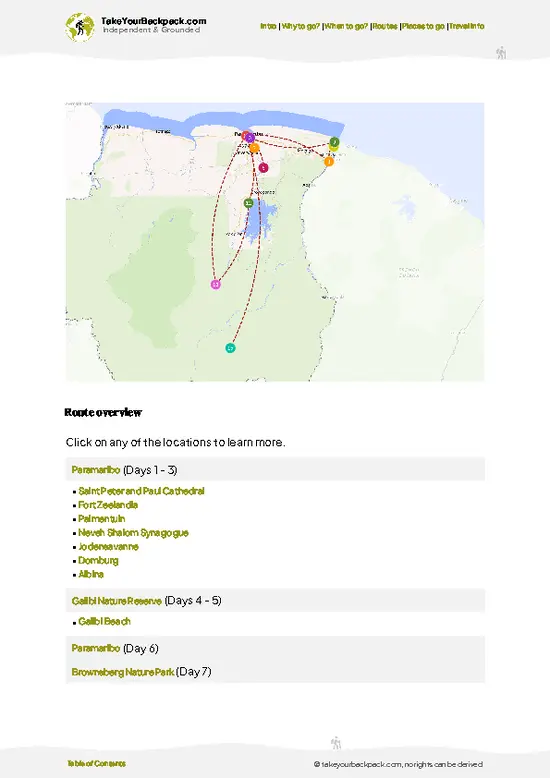
How many days to plan: A trip linking several parks in Suriname needs 8 to 14 days, because every transfer eats half a day or more. Paramaribo is the hub, and the sensible approach is to treat the country as two clusters: the northern coastal and savanna side, reachable by road, and the southern interior, reachable by river or small plane.

Direction and pacing: Start with the road-accessible areas near Paramaribo, 1 to 4 hours by minibus or private car, and give each 2 to 3 nights. Then head into the interior, where you should allow 3 to 5 nights per area, since reaching it can take 3 to 6 hours by road plus 2 to 5 hours by motorized dugout. Small charter flights from Zorg en Hoop airstrip cut that to about 45 minutes to 1.5 hours, at a much higher price. Finish back near the capital for … read more 👉
How many days to plan: A trip linking several parks in Suriname needs 8 to 14 days, because every transfer eats half a day or more. Paramaribo is the hub, and the sensible approach is to treat the country as two clusters: the northern coastal and savanna side, reachable by road, and the southern interior, reachable by river or small plane.

Direction and pacing: Start with the road-accessible areas near Paramaribo, 1 to 4 hours by minibus or private car, and give each 2 to 3 nights. Then head into the interior, where you should allow 3 to 5 nights per area, since reaching it can take 3 to 6 hours by road plus 2 to 5 hours by motorized dugout. Small charter flights from Zorg en Hoop airstrip cut that to about 45 minutes to 1.5 hours, at a much higher price. Finish back near the capital for slack before your flight.

Planning mistakes: The classic error is cramming the interior into a long weekend, then losing a day to a late boat or rain. Leave a buffer day before international flights. Another is skipping advance bookings: river transfers, guides and lodge beds usually need arranging days ahead. Travelers also assume they can hop between interior rivers, but there are few cross-links, so you return to Paramaribo between regions. Pack for hot sun, sudden downpours and long, bumpy seats.

The ListTop national parks of Suriname

1 Central Suriname Nature Reserve

Voltzberg dome, Coppename rapids, cock-of-the-rock, Tafelberg

Scramble up bare granite at daybreak for a canopy panorama, then spot orange cock-of-the-rock and black spider monkeys on lodge trails.

suriname-national-park-central-suriname-nature-reserve
© Google | Jean-michel Mallet

2 Brownsberg Nature Park

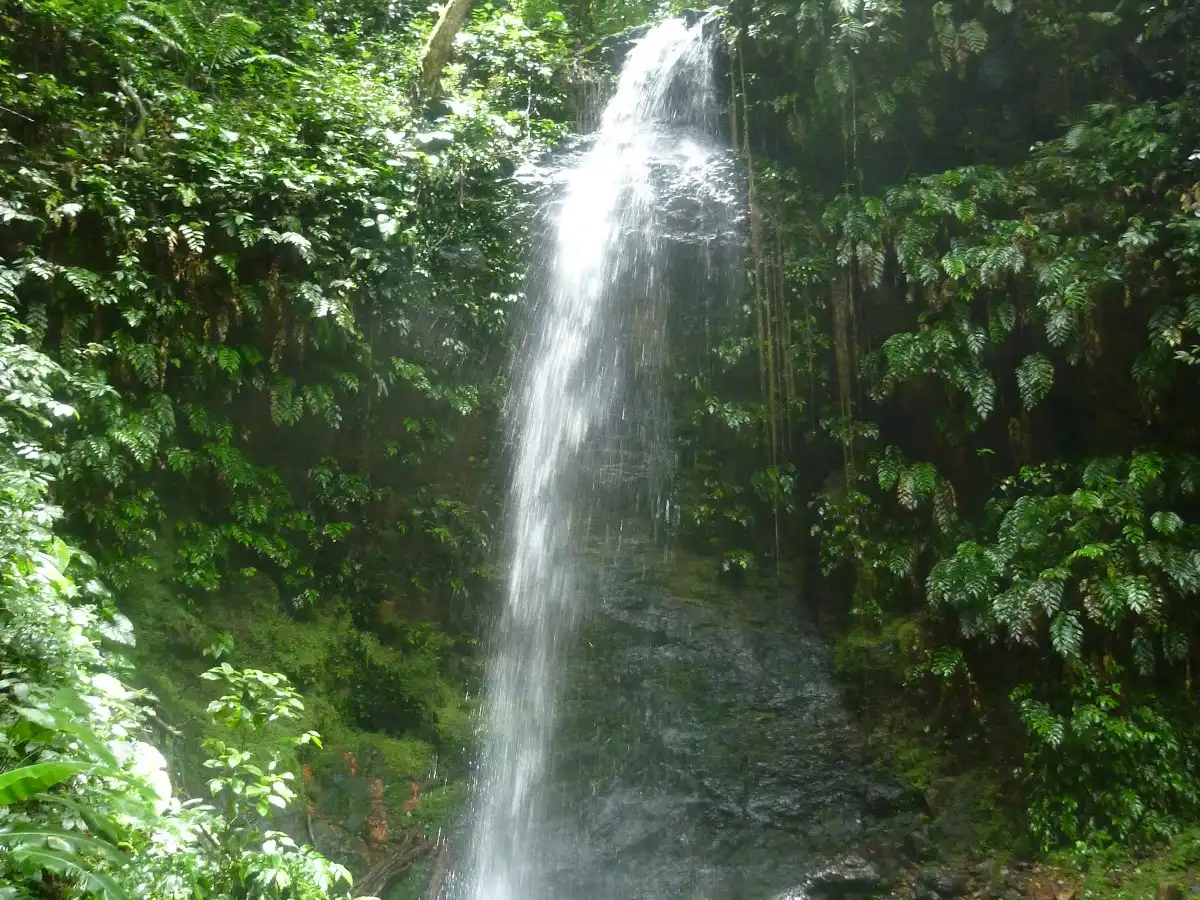
Leo Falls, plateau lodge, lake viewpoint, golden frog

Climb the plateau above the reservoir, swim beneath tiered waterfalls and wake to howler monkeys roaring over the forest canopy.

suriname-national-park-brownsberg-nature-park
© Google |

3 Galibi Nature Reserve

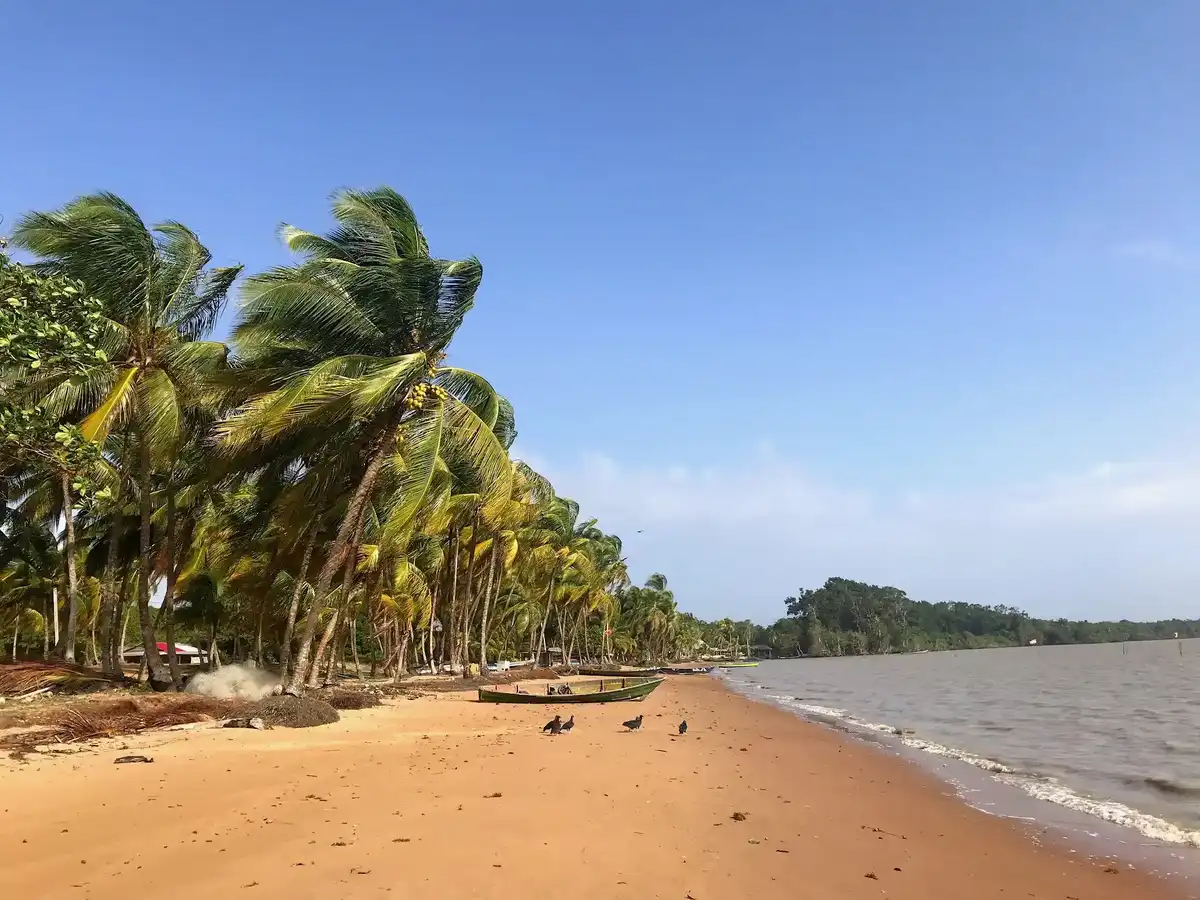
Leatherback nesting, Kali’na villages, Marowijne mouth, dugout crossing

Cross the river by dugout canoe, stay in a beachside village and watch turtles lay eggs by starlight with a guide.

suriname-national-park-galibi-nature-reserve
© Google | Hermes Van Amstel

4 Bigi Pan

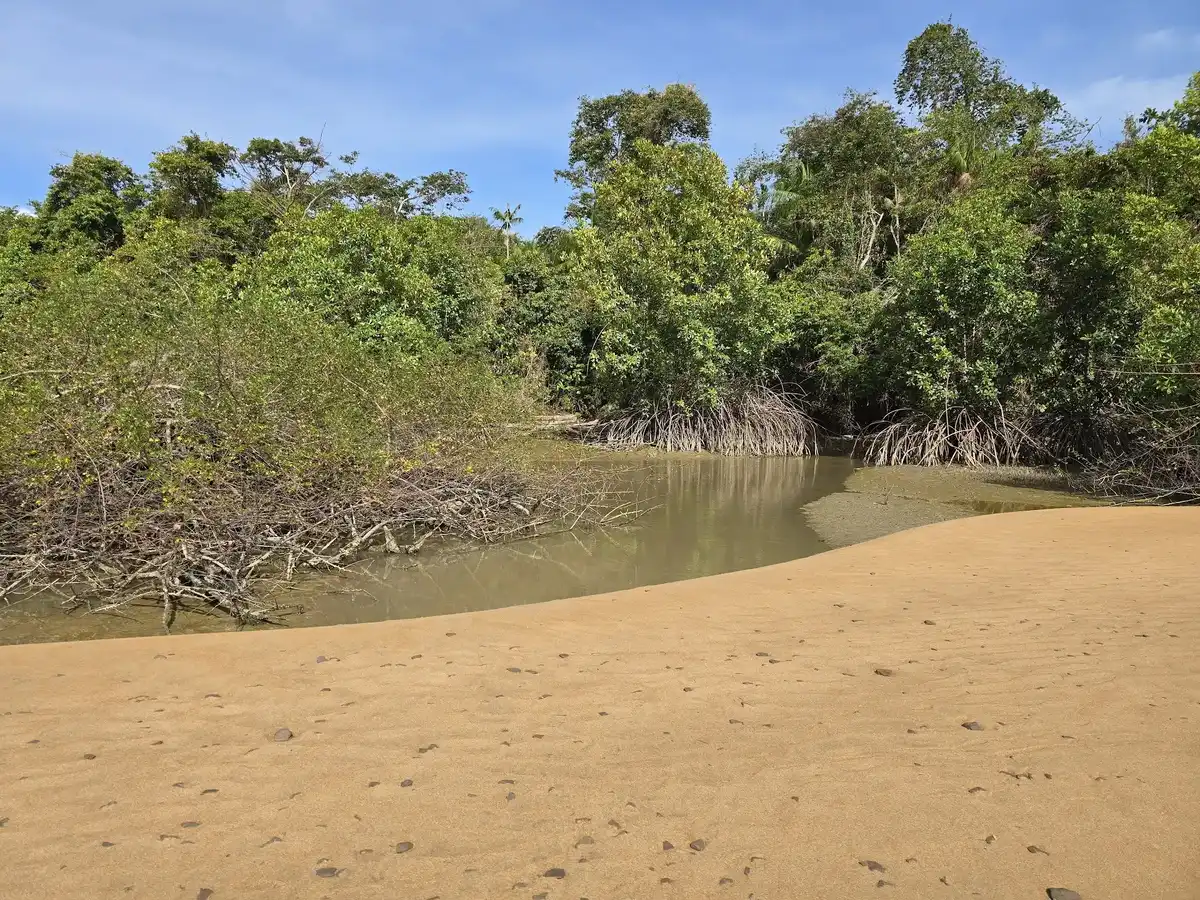
Scarlet ibis roosts, mangrove channels, stilt fishing huts, brackish lagoon

Board a guided boat at low light to drift through mangrove channels and watch scarlet ibis return to roost over the lagoon at dusk.

5 Boven Coesewijne Nature Reserve

Blackwater river, swamp forest, dawn howlers, night boat spotlighting

Drift the tea-dark upper Coesewijne by boat, from caiman eyeshine after dark to howler monkeys roaring over swamp, savanna and upland forest.

suriname-national-park-boven-coesewijne-nature-reserve
© Google |

6 Coppename Monding Nature Reserve

River mouth estuary, shorebird flats, shell ridges, Ramsar wetland

Ride a boat through the estuary to watch thousands of waders feed on exposed mud, then stay for ibis at dusk.

suriname-national-park-coppename-monding-nature-reserve
© Google |

7 Wia Wia Nature Reserve

Scarlet ibis roosts, tidal mudflats, mangrove edge, shell ridges

Watch red ibis gather at dusk over exposed mudflats and mangrove, then walk firm shell ridges where migrant waders feed along a shifting coast.

suriname-national-park-wia-wia-nature-reserve
© Google | Aspik

8 Brokopondo Reservoir

Drowned trees, Afobaka Dam, reservoir boats, Saramaka villages

Cruise the reservoir among bleached tree trunks, then walk lowland forest paths and visit riverside Saramaka villages with a local guide.

suriname-national-park-brokopondo-reservoir
© Google | Frits Ten Katen
Loading the map 🌍

Expert viewInsights from Locals and Experts

How many to visit: I would advise two to three parks or reserves on one trip. Distances are long, boats are slow, and each interior stop costs a day on each end. Two well-chosen places give you time to sit still, hear the forest change from dawn chorus to night frogs, and actually see wildlife instead of just ticking off names. Three works if one is a short, road-accessible stop.

Choosing between kinds: If your budget is tight, favor the coastal and savanna reserves. You get birds, mangrove and open sky with muddy boots and a simple guesthouse, and a day trip from Paramaribo is realistic. If you want the full rainforest experience, with granite domes, rapids, hammocks and the glow of a campfire on a riverbank, go for an interior park, and accept that it will cost three to five times as much. … read more 👉
How many to visit: I would advise two to three parks or reserves on one trip. Distances are long, boats are slow, and each interior stop costs a day on each end. Two well-chosen places give you time to sit still, hear the forest change from dawn chorus to night frogs, and actually see wildlife instead of just ticking off names. Three works if one is a short, road-accessible stop.

Choosing between kinds: If your budget is tight, favor the coastal and savanna reserves. You get birds, mangrove and open sky with muddy boots and a simple guesthouse, and a day trip from Paramaribo is realistic. If you want the full rainforest experience, with granite domes, rapids, hammocks and the glow of a campfire on a riverbank, go for an interior park, and accept that it will cost three to five times as much. Keen birders and wildlife watchers should put the interior first. Casual travelers who want a taste of jungle will be happy with one short coastal visit.

What it costs: Budget about US$40 to 70 a day on coastal trips, including entry fees (often a few US$), basic lodging, local meals and shared transport. Interior trips typically run US$100 to 200 a day all-in, since packages bundle boat transfers, guides, meals and bed. Guides cost roughly US$25 to 50 a day if arranged separately, and a small-plane charter can add US$150 to 300 per person each way. Carry cash, because card machines and ATMs disappear once you leave the capital. The reward is meals of fresh river fish with rice, eaten under a tin roof while rain drums down.

Safety and culture: The main risks are practical. Hydration, heat and sun catch people out, so carry 2 to 3 liters of water per day and wear a hat. Malaria exists in parts of the interior and yellow fever vaccination is commonly required, so talk to a travel clinic before leaving. Rivers carry strong currents near rapids, so wear a life jacket on every boat ride. Keep insect repellent handy, and sleep under a net.

Culturally, interior villages are home to Maroon and Indigenous families. Ask before photographing people, dress modestly in villages, and follow your guide’s lead on local customs and sacred sites. Buying crafts or paying village fees directly puts money where it counts, and the thanks you get is a welcome that feels earned.

✈️ The backpacker research shortcutSuriname Travel Guide

An offline-friendly backpacking guide with optimized travel routes, ranked highlights, transport advice, and the best areas to stay.
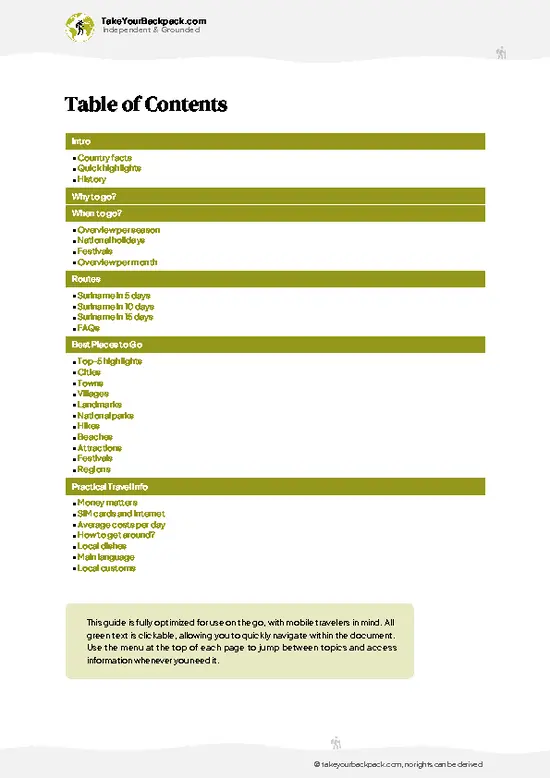
example page 0 from our offline Travel Guide for Suriname
example page 1 from our offline Travel Guide for Suriname
example page 2 from our offline Travel Guide for Suriname
example page 3 from our offline Travel Guide for Suriname
example page 4 from our offline Travel Guide for Suriname
example page 5 from our offline Travel Guide for Suriname
example page 6 from our offline Travel Guide for Suriname
example page 7 from our offline Travel Guide for Suriname
The digital guide (153 pages) contains:
✅ 40 highlights, ranked by travel appeal
✅ Optimized 5, 10 & 15-day travel routes
✅ Cities, national parks, landmarks, beaches
✅ How to get around
✅ Offline-friendly for travel without Wi-Fi
👉 Click to see all 30+ guide features

📅 Plan smarter in minutes, not weeks
✅ Month by month travel advice
✅ Festivals & national holidays
✅ Budget expectations

🗺️ Go to the right places, skip the overrated ones
✅ Honest pros & cons of destinations
✅ Top hikes, parks & viewpoints
✅ Lesser-known places most travelers miss
✅ Clear “worth it vs skip it” guidance

🛏️ Travel smoothly without rookie mistakes
✅ Best areas to stay
✅ Transport systems explained simply
✅ Common scams & safety advice
✅ SIM cards, money & practical tips

🌍 Understand the country, not just visit it
✅ Culture & traditions
✅ 52 Essential phrases & customs
✅ Festivals worth planning around
✅ Traveler-friendly historical context
✅ Insights that make places more meaningful

📱 Built for real travel conditions
✅ Fully downloadable PDF
✅ Works completely offline
✅ Optimized for phone use
✅ Useful in remote areas & buses
✅ Everything in one place
Stop searching, start planning
Get instant access to your full guide. 30‑day money-back guarantee.
+ Add another guide for just

By proceeding you agree to our terms.
Sent to your inbox immediately after payment • 100% Secure Checkout
Best Backpacking Travel Advisor 2025 tourism awardBest Backpacking
Travel Advisor
2025
What others say about Take Your Backpack Guides:
⭐⭐⭐⭐⭐
Fantastic, amazing amount of information!
⭐⭐⭐⭐⭐
My goodness this is amazing, it's what I've been looking for hats off too you!
⭐⭐⭐⭐⭐
I think this is absolutely BRILLIANT
⭐⭐⭐⭐
Very complete and informative. It's still missing places, but I gotta to commend you
⭐⭐⭐⭐⭐
This is truly amazing, thank you, can't wait to explore it with my kids!
⭐⭐⭐⭐⭐
Awesome resource, thank you!
⭐⭐⭐⭐⭐
This is amazing! Can't wait to explore the ones I haven't seen
⭐⭐⭐⭐
I love this! Well done, great idea.
⭐⭐⭐⭐⭐
Thanks for taking the time to make this gem!
⭐⭐⭐⭐⭐
This might be the best website I've ever seen.
⭐⭐⭐⭐⭐
Congratulations, and thank you so much for your work; it's incredibly valuable.
⭐⭐⭐⭐
In all seriousness I think you did a great job pointing out the important spots
⭐⭐⭐⭐⭐
10/10 very good
⭐⭐⭐⭐⭐
As someone who's only just starting to visit regularly this is awesome, thank you.
⭐⭐⭐⭐
Thank you very much! I'm going to visit my dad, it's going to be very useful!
⭐⭐⭐⭐⭐
This is really cool! We'll be travelling for the first time and this definitely come in handy.
⭐⭐⭐⭐⭐
You are now our minister of culture, congratulations 👨‍💼
⭐⭐⭐⭐⭐
Just wanted to tell you that this is a pearl! Going to follow your recommendations.
⭐⭐⭐⭐⭐
This is so cool. I'll definitely be using the resource for my travels soon.
⭐⭐⭐⭐⭐
This is very impressive! Good work.
⭐⭐⭐⭐⭐
This is an amazing and informative site. Very well done!

🛏️ Where to stay?Best Places to Stay in Suriname

Suriname has a small but workable spread of hostels and guesthouses, nearly all in Paramaribo, where dorm beds run about SRD 550 to 950 (US$15 to 25) and private rooms in family-run guesthouses cost about SRD 1,100 to 1,850 (US$30 to 50). The wooden streets of the historic inner city near the Waterkant put you within walking distance of the UNESCO-listed center and riverfront food stalls, but the area empties after dark, so take a taxi at night. The leafier residential pocket around the Kleine Waterstraat entertainment strip is livelier, with bars and casinos on your doorstep, while neighborhoods further out such as Zorg en Hoop are quieter and cheaper but need a bus or taxi for most sights. … read more 👉
Suriname has a small but workable spread of hostels and guesthouses, nearly all in Paramaribo, where dorm beds run about SRD 550 to 950 (US$15 to 25) and private rooms in family-run guesthouses cost about SRD 1,100 to 1,850 (US$30 to 50). The wooden streets of the historic inner city near the Waterkant put you within walking distance of the UNESCO-listed center and riverfront food stalls, but the area empties after dark, so take a taxi at night. The leafier residential pocket around the Kleine Waterstraat entertainment strip is livelier, with bars and casinos on your doorstep, while neighborhoods further out such as Zorg en Hoop are quieter and cheaper but need a bus or taxi for most sights.

If you enjoy meeting fellow travelers, consider choosing hostels with high ratings for atmosphere. On the other hand, if you prefer having your own space, a hotel might be a better option.

SurinameExplore Suriname

👋 Meet the founderWho’s Behind Take Your Backpack?

Johan, backpacker and founder of TakeYourBackpackHi, I’m Johan (Netherlands 🇳🇱), the creator of TakeYourBackpack. Over the past 3 decades, I’ve backpacked through 90+ countries across six continents, gaining extensive experience with independent travel, long-term trips, and overland routes.

This site is built on a combination of firsthand travel experience and carefully curated insights from other backpackers. Many guides are based on places I’ve personally visited, while others bring together tips, observations, and practical advice shared by trusted travelers I’ve met along the way.

The goal is to provide realistic, experience-driven guidance — not generic itineraries — so you can explore destinations with better context, clearer expectations, and more confidence.