×

Suriname🇸🇷 | national parksCentral Suriname Nature ReserveVoltzberg dome, Coppename rapids, cock-of-the-rock, Tafelberg | things to do and best time to go

Explore Brokopondo ReservoirExplore Galibi Nature Reserve

Backpacking in Central Suriname Nature Reserve
🏆 Top picknational park ranked #1
By Johan Kruseman 🇳🇱 | Updated October 19, 2026

Before dawn on the Voltzberg granite dome, the howler monkeys start up from the canopy below, a low, wet roar that rolls across the forest, and the rock under your palms is still cool and gritty. That is the reserve at its best. Central Suriname Nature Reserve sits in the interior of Suriname, deep in the rainforest south of the coastal belt, and the Coppename River is its main artery. The forest is almost entirely intact, with black spider monkeys, harpy eagles and the occasional jaguar track on the riverbank sand. The cost is remoteness. There are no roads inside, so you arrive by river or small plane, and that is why nearly everyone books through a lodge or operator that handles boats, food and guides. Experienced travelers send a message weeks ahead, because lodge space is limited and boats only run when someone books. Humidity soaks everything, so pack dry bags. A first day usually means a boat ride upriver, a swim by the rapids at Raleighvallen, and a night of frogs and insects from a hammock.

Discover everything you want to know in the 📖 Suriname Travel Guide.


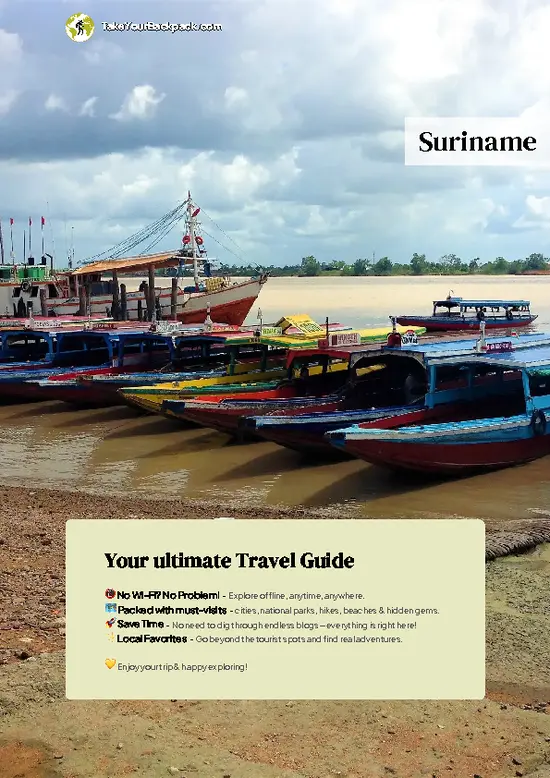
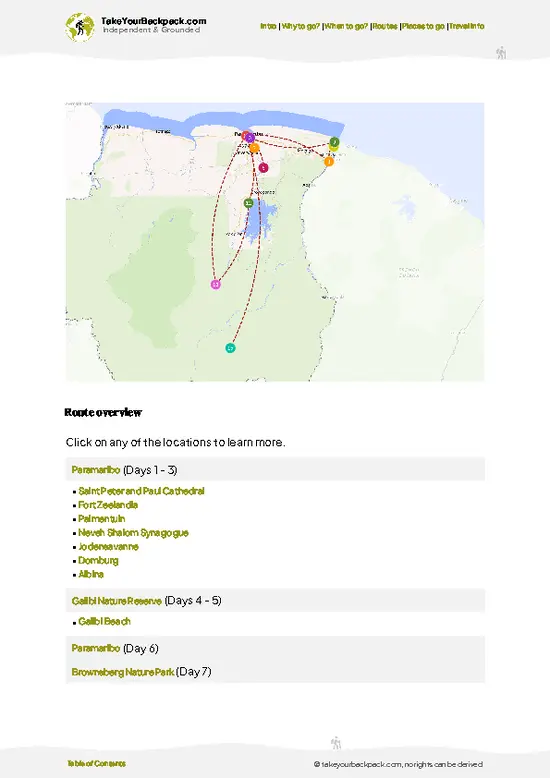
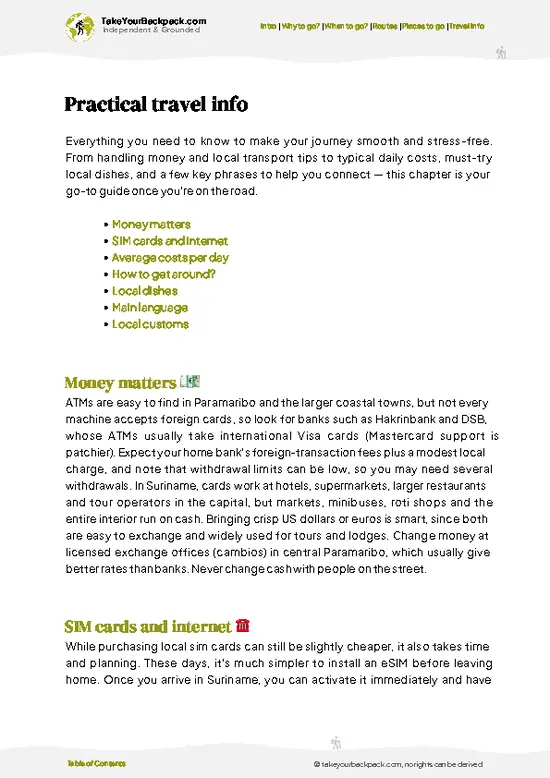
example page 0 from our offline Travel Guide for Suriname
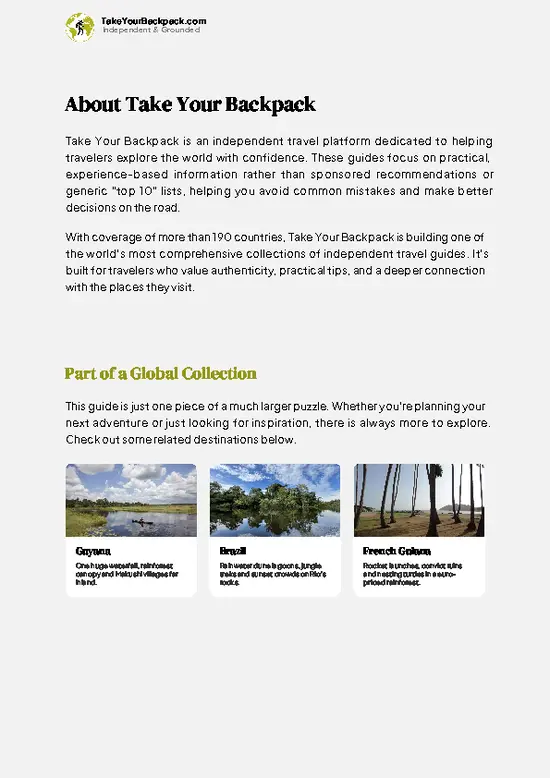
example page 1 from our offline Travel Guide for Suriname
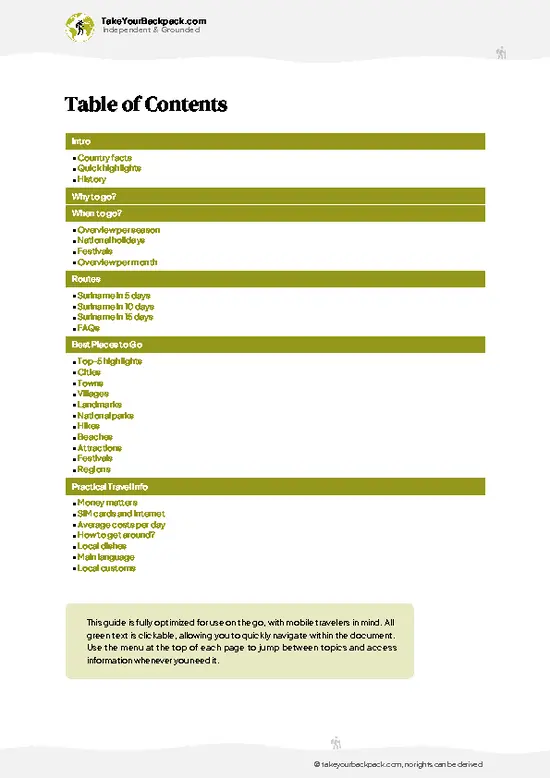
example page 2 from our offline Travel Guide for Suriname
example page 3 from our offline Travel Guide for Suriname
example page 4 from our offline Travel Guide for Suriname
example page 5 from our offline Travel Guide for Suriname
example page 6 from our offline Travel Guide for Suriname
example page 7 from our offline Travel Guide for Suriname
Loading the map 🌍
CLICK TO FILTER
cities
towns
villages
landmarks
national parks
hikes
beaches
attractions
festivals
regions
SHOW COUNTRY’S BESTSHOW ALL

✨ Why go?
Ranked #1 national park in Suriname
Why visitors keep coming back

Central Suriname Nature Reserve suits backpackers who want real jungle without a cruise-ship feel. About 1.6 million hectares of protected forest span three former reserves, which is why it holds UNESCO World Heritage status. Here, a few days gets you Voltzberg, a granite dome that you climb at first light to see an unbroken green carpet, and Raleighvallen, the rapids on the Coppename where you can cool off after a sweaty walk. The reserve is hard to reach on your own, so going independent mostly means choosing a simple basic package and skipping the bells and whistles rather than hacking your own route. Lodge hammocks and shared rooms keep things modest. Guides are part of the deal, and they are worth it: they spot the Guianan cock-of-the-rock displaying at its lek, a bright orange bird you … read more 👉
Central Suriname Nature Reserve suits backpackers who want real jungle without a cruise-ship feel. About 1.6 million hectares of protected forest span three former reserves, which is why it holds UNESCO World Heritage status. Here, a few days gets you Voltzberg, a granite dome that you climb at first light to see an unbroken green carpet, and Raleighvallen, the rapids on the Coppename where you can cool off after a sweaty walk. The reserve is hard to reach on your own, so going independent mostly means choosing a simple basic package and skipping the bells and whistles rather than hacking your own route. Lodge hammocks and shared rooms keep things modest. Guides are part of the deal, and they are worth it: they spot the Guianan cock-of-the-rock displaying at its lek, a bright orange bird you would walk right past alone. Travelers who prefer cities and schedules will find it slow. Everyone else gets silence, wildlife and rock-climbing views without queues.

💡 HighlightsPlaces and moments you shouldn't skip

  1. Voltzberg: A bald granite dome rising out of the forest, reached by a jungle trail and a final scramble up bare rock. The top gives a 360-degree view over the canopy and the Coppename, and the climb at daybreak is the classic reserve experience.
  2. Raleighvallen (Raleigh Falls): A broad series of rapids on the Coppename River, with smooth black boulders and pools you can wade into. The noise of the water carries a long way through the trees.
  3. Foengoe Island: The island in the river holding the main research station and lodge. Its forest trails start straight from the camp, and the evening chorus of frogs and insects is loud.
  4. Cock-of-the-rock lek: A display ground where male Guianan cock-of-the-rock, bright orange with crests like half-moons, squabble and call. Guides know the spots and the best timing,
… read more 👉
  1. Voltzberg: A bald granite dome rising out of the forest, reached by a jungle trail and a final scramble up bare rock. The top gives a 360-degree view over the canopy and the Coppename, and the climb at daybreak is the classic reserve experience.
  2. Raleighvallen (Raleigh Falls): A broad series of rapids on the Coppename River, with smooth black boulders and pools you can wade into. The noise of the water carries a long way through the trees.
  3. Foengoe Island: The island in the river holding the main research station and lodge. Its forest trails start straight from the camp, and the evening chorus of frogs and insects is loud.
  4. Cock-of-the-rock lek: A display ground where male Guianan cock-of-the-rock, bright orange with crests like half-moons, squabble and call. Guides know the spots and the best timing, usually early morning or late afternoon.
  5. Black spider monkeys and other primates: The forest around the lodge has black spider monkeys, brown capuchins and red howlers. Look up on the quiet trails and listen first, since the howlers are heard long before they are seen.
  6. Tafelberg: A huge flat-topped sandstone tepui in the south of the reserve, with plateau vegetation found nowhere else. It is difficult to reach and needs a charter flight and a long expedition, so it suits only the most committed.
  7. Eilerts de Haan Mountains: The remote range in the reserve’s interior, mostly visited by scientists and expedition groups. Seeing it from the air gives a sense of how big and untouched the reserve is.
Voltzberg and Raleighvallen together take three to four days with a lodge, while Tafelberg and the Eilerts de Haan area add a week or more of expedition time.
Spotted a mistake or missing something? Contact us.

Things to do near Central Suriname Nature Reserve

Ratings based on Tripadvisor reviews. When you book through this link, you support our work at no extra cost to you.

🌤️ When to go?When to go for the best experience

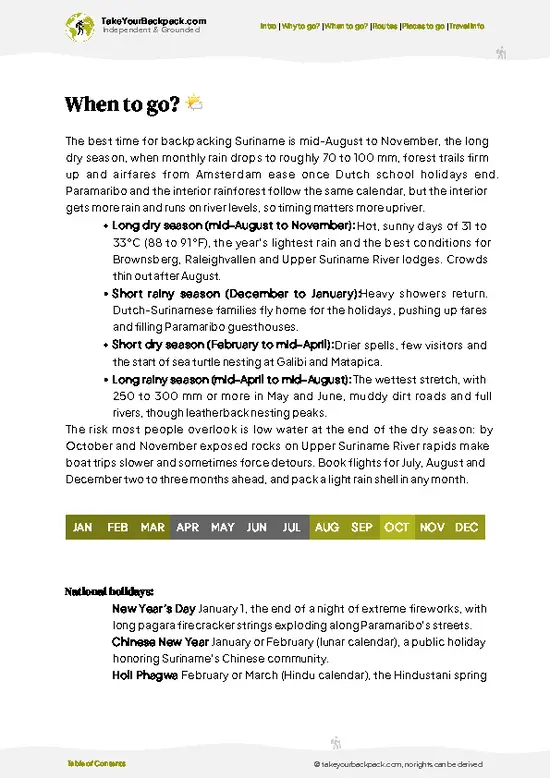
The long dry season from late August to early December is the most practical window for Central Suriname Nature Reserve, and the short dry spell from February to early April is a close second.
  • Long Dry Season (Aug to Dec): Days run roughly 30 to 33°C (86 to 91°F), nights 22 to 24°C (72 to 75°F). Rivers drop, rapids and granite domes become easier to reach, and the Coppename route is most reliable. Charter flights and Voltzberg trips book out, so prices sit at their highest.
  • Short Wet Season (Dec to Jan): Showers come in sharp bursts, trails turn slick, and operators run fewer trips. Fares can soften a little.
  • Short Dry Season (Feb to early Apr): Similar temperatures with lower crowds and decent water levels. Good for Raleighvallen and Voltzberg climbs.
  • Long Wet Season (late Apr to mid Aug): Heavy
… read more 👉
The long dry season from late August to early December is the most practical window for Central Suriname Nature Reserve, and the short dry spell from February to early April is a close second.
  • Long Dry Season (Aug to Dec): Days run roughly 30 to 33°C (86 to 91°F), nights 22 to 24°C (72 to 75°F). Rivers drop, rapids and granite domes become easier to reach, and the Coppename route is most reliable. Charter flights and Voltzberg trips book out, so prices sit at their highest.
  • Short Wet Season (Dec to Jan): Showers come in sharp bursts, trails turn slick, and operators run fewer trips. Fares can soften a little.
  • Short Dry Season (Feb to early Apr): Similar temperatures with lower crowds and decent water levels. Good for Raleighvallen and Voltzberg climbs.
  • Long Wet Season (late Apr to mid Aug): Heavy rain, high rivers, flooded trails and mud. Bugs multiply, but birdlife is lively and rates drop. Daylight stays close to 12 hours all year.
Book your Voltzberg sunrise climb and any river transfer at least a month ahead for August to October.


source: climatestotravel.comJANJanuary: fair for travelingFEBFebruary: fair for travelingMARMarch: fair for travelingAPRApril: fair for travelingMAYMay: fair for travelingJUNJune: fair for travelingJULJuly: fair for travelingAUGAugust: highly recommended for travelingSEPSeptember: excellent for travelingOCTOctober: excellent for travelingNOVNovember: highly recommended for travelingDECDecember: fair for traveling
suriname-national-park-central-suriname-nature-reserve
© Google | Jean-michel Mallet

✈️ The backpacker research shortcutSuriname Travel Guide

An offline-friendly backpacking guide with optimized travel routes, ranked highlights, transport advice, and the best areas to stay.
example page 0 from our offline Travel Guide for Suriname
example page 1 from our offline Travel Guide for Suriname
example page 2 from our offline Travel Guide for Suriname
example page 3 from our offline Travel Guide for Suriname
example page 4 from our offline Travel Guide for Suriname
example page 5 from our offline Travel Guide for Suriname
example page 6 from our offline Travel Guide for Suriname
example page 7 from our offline Travel Guide for Suriname
The digital guide (153 pages) contains:
✅ 40 highlights, ranked by travel appeal
✅ Optimized 5, 10 & 15-day travel routes
✅ Cities, national parks, landmarks, beaches
✅ How to get around
✅ Offline-friendly for travel without Wi-Fi
👉 Click to see all 30+ guide features

📅 Plan smarter in minutes, not weeks
✅ Month by month travel advice
✅ Festivals & national holidays
✅ Budget expectations

🗺️ Go to the right places, skip the overrated ones
✅ Honest pros & cons of destinations
✅ Top hikes, parks & viewpoints
✅ Lesser-known places most travelers miss
✅ Clear “worth it vs skip it” guidance

🛏️ Travel smoothly without rookie mistakes
✅ Best areas to stay
✅ Transport systems explained simply
✅ Common scams & safety advice
✅ SIM cards, money & practical tips

🌍 Understand the country, not just visit it
✅ Culture & traditions
✅ 52 Essential phrases & customs
✅ Festivals worth planning around
✅ Traveler-friendly historical context
✅ Insights that make places more meaningful

📱 Built for real travel conditions
✅ Fully downloadable PDF
✅ Works completely offline
✅ Optimized for phone use
✅ Useful in remote areas & buses
✅ Everything in one place
Stop searching, start planning
Get instant access to your full guide. 30‑day money-back guarantee.
+ Add another guide for just

By proceeding you agree to our terms.
Sent to your inbox immediately after payment • 100% Secure Checkout
Best Backpacking Travel Advisor 2025 tourism awardBest Backpacking
Travel Advisor
2025
What others say about Take Your Backpack Guides:
⭐⭐⭐⭐⭐
Fantastic, amazing amount of information!
⭐⭐⭐⭐⭐
My goodness this is amazing, it's what I've been looking for hats off too you!
⭐⭐⭐⭐⭐
I think this is absolutely BRILLIANT
⭐⭐⭐⭐
Very complete and informative. It's still missing places, but I gotta to commend you
⭐⭐⭐⭐⭐
This is truly amazing, thank you, can't wait to explore it with my kids!
⭐⭐⭐⭐⭐
Awesome resource, thank you!
⭐⭐⭐⭐⭐
This is amazing! Can't wait to explore the ones I haven't seen
⭐⭐⭐⭐
I love this! Well done, great idea.
⭐⭐⭐⭐⭐
Thanks for taking the time to make this gem!
⭐⭐⭐⭐⭐
This might be the best website I've ever seen.
⭐⭐⭐⭐⭐
Congratulations, and thank you so much for your work; it's incredibly valuable.
⭐⭐⭐⭐
In all seriousness I think you did a great job pointing out the important spots
⭐⭐⭐⭐⭐
10/10 very good
⭐⭐⭐⭐⭐
As someone who's only just starting to visit regularly this is awesome, thank you.
⭐⭐⭐⭐
Thank you very much! I'm going to visit my dad, it's going to be very useful!
⭐⭐⭐⭐⭐
This is really cool! We'll be travelling for the first time and this definitely come in handy.
⭐⭐⭐⭐⭐
You are now our minister of culture, congratulations 👨‍💼
⭐⭐⭐⭐⭐
Just wanted to tell you that this is a pearl! Going to follow your recommendations.
⭐⭐⭐⭐⭐
This is so cool. I'll definitely be using the resource for my travels soon.
⭐⭐⭐⭐⭐
This is very impressive! Good work.
⭐⭐⭐⭐⭐
This is an amazing and informative site. Very well done!

🛏️ Where to stay?Best areas and accommodation options

Inside Central Suriname Nature Reserve you sleep at basic lodges and hammock camps run through STINASU, the foundation that manages the reserve, and there is no other lodging within the park.
Raleighvallen has the main lodge cluster on the Coppename River, with simple cabins, shared bathrooms and a communal dining area, roughly US$60 to 110 per person per night with meals on packages. Foengoe Island is the quietest base, with rustic cabins on a small island in the river. At Voltzberg, a camp at the foot of the granite dome has hammock shelters at about US$20 to 40, handy for the pre-dawn climb. … read more 👉
Inside Central Suriname Nature Reserve you sleep at basic lodges and hammock camps run through STINASU, the foundation that manages the reserve, and there is no other lodging within the park.
Raleighvallen has the main lodge cluster on the Coppename River, with simple cabins, shared bathrooms and a communal dining area, roughly US$60 to 110 per person per night with meals on packages. Foengoe Island is the quietest base, with rustic cabins on a small island in the river. At Voltzberg, a camp at the foot of the granite dome has hammock shelters at about US$20 to 40, handy for the pre-dawn climb.
Bring your own hammock and mosquito net, since bedding is limited. Packages generally bundle boat transfers, food and guides, which is how most independent travelers handle logistics here.
Outside the reserve, Paramaribo is the practical base for booking and the place to stay before and after. Guesthouses and hostels in the old center run about US$20 to 45 for a dorm or simple room. Small villages such as Kwakoegron and Brownsweg are on the way in some routes, but they offer only a handful of simple rooms. Most trips to the reserve leave from Paramaribo by small plane to the Kayser or Raleigh (Foengoe Island) airstrips or by long river journeys, so plan your first and last nights in the capital.

👛 Costs (as of 19 October 2026)How expensive it really is

Budget about US$150 per day for Central Suriname Nature Reserve, which is expensive for Suriname because access is by charter flight or long river transfer.
CategoryBudget RangeLocal Reality
Entrance FeesUS$5 to 15Park fees are usually folded into the STINASU package price.
Accommodation (High Season)US$30 to 70Hammock camps at the low end, simple lodge cabins at the high end. Full-board packages cost more per night.
Accommodation (Low Season)US$25 to 55Fewer bookings from April to August can mean small discounts.
Local TransportUS$40 to 90Small plane or boat transfers are the biggest cost. Shared charters split between travelers cut the price noticeably.
Food and SuppliesUS$15 to 30Meals are simple rice, chicken, fish and vegetables. Bring snacks and water purification from Paramaribo.
Guides and
… read more 👉
Budget about US$150 per day for Central Suriname Nature Reserve, which is expensive for Suriname because access is by charter flight or long river transfer.
CategoryBudget RangeLocal Reality
Entrance FeesUS$5 to 15Park fees are usually folded into the STINASU package price.
Accommodation (High Season)US$30 to 70Hammock camps at the low end, simple lodge cabins at the high end. Full-board packages cost more per night.
Accommodation (Low Season)US$25 to 55Fewer bookings from April to August can mean small discounts.
Local TransportUS$40 to 90Small plane or boat transfers are the biggest cost. Shared charters split between travelers cut the price noticeably.
Food and SuppliesUS$15 to 30Meals are simple rice, chicken, fish and vegetables. Bring snacks and water purification from Paramaribo.
Guides and ActivitiesUS$15 to 30Guided hikes to Voltzberg and boat trips are usually required and priced per day.
Total Daily BudgetUS$130 to 150Based on high-season accommodation, shared transfers and package meals. Pay in cash, usually in Surinamese dollars or US dollars.


source: suriname.nu
⚠️ Prices can change and everyone travels differently, so take this as a rough guide. Hope it helps you plan your adventure!

🥾 TrailsExploring Central Suriname Nature Reserve: trails, terrain, and views

Central Suriname Nature Reserve offers a small set of guided walks around Raleighvallen and the Voltzberg camp, plus long expedition routes deeper into the interior. Most of the hiking here is hot, humid and on narrow forest paths with roots, mud and occasional stream crossings.
  • Voltzberg Trail: The signature hike, usually done as a sunrise climb from the Voltzberg camp. It crosses flat rainforest for a couple of hours, then ends with a steep scramble up bare granite. Difficulty is moderate to hard because of the heat and the final rock section, which can be slippery after rain. Allow half a day
… read more 👉
Central Suriname Nature Reserve offers a small set of guided walks around Raleighvallen and the Voltzberg camp, plus long expedition routes deeper into the interior. Most of the hiking here is hot, humid and on narrow forest paths with roots, mud and occasional stream crossings.
  • Voltzberg Trail: The signature hike, usually done as a sunrise climb from the Voltzberg camp. It crosses flat rainforest for a couple of hours, then ends with a steep scramble up bare granite. Difficulty is moderate to hard because of the heat and the final rock section, which can be slippery after rain. Allow half a day with the return.
  • Foengoe Island forest trails: Short loops from the lodge through tall forest, good for primates and birds. Easy walking, flat and shaded, one to a few hours depending on how often the guide stops to point things out.
  • Cock-of-the-rock walk: A gentle forest walk to the display ground, best at dawn or dusk. Easy terrain, but you need to be quiet and patient.
  • Raleighvallen riverside walks: Trails and boat hops along the rapids, with wading spots on the rocks. Easy, though the boulders are slick.
  • Tafelberg expedition: A multi-day trek onto the sandstone plateau in the south. It is demanding, requires permits and a specialist operator, and is only for experienced trekkers.
Wildlife includes black spider monkeys, red howlers, capuchins, tapirs, giant otters on the river and harpy eagles for those who are lucky. Jaguars live here but are seen rarely.
There is no public transport to the reserve. Access is by boat along the Coppename or by small charter aircraft landing on airstrips in the interior. Almost every visitor goes through a Paramaribo operator, and the entrance fee and guide are normally included in the package price. Crowds are close to zero, and you may share the whole Voltzberg summit with only your guide. Bring a headlamp, a dry bag, long light trousers and plenty of insect repellent.
⚠️ Hiking info can sometimes be outdated or inaccurate. Before you hit the trail, check the latest conditions with locals. If you do spot anything that's off, I'd love to hear from you, so I can update it for fellow travelers.

🛡️ SafetyTraveler Safety Guide

Central Suriname Nature Reserve is a remote rainforest park where the main risks are heat, slippery rock and distance from help, not crime or large animals.
Temperatures run high and humidity stays near saturation, so hike early, carry at least 3 liters of water per day, and rest in shade. Trails are rooted and muddy, and the granite on Voltzberg turns slick when wet, so wear shoes with real grip and skip the climb in a downpour. Guides are included in most packages and are worth following closely, as the forest is easy to get lost in without them.
Jaguars, snakes and peccaries live here but rarely cause problems. Keep distance, never feed monkeys, and shake out boots in the morning. River crossings in small boats run through rapids, so wear the life jacket provided.
Cell signal is absent in … read more 👉
Central Suriname Nature Reserve is a remote rainforest park where the main risks are heat, slippery rock and distance from help, not crime or large animals.
Temperatures run high and humidity stays near saturation, so hike early, carry at least 3 liters of water per day, and rest in shade. Trails are rooted and muddy, and the granite on Voltzberg turns slick when wet, so wear shoes with real grip and skip the climb in a downpour. Guides are included in most packages and are worth following closely, as the forest is easy to get lost in without them.
Jaguars, snakes and peccaries live here but rarely cause problems. Keep distance, never feed monkeys, and shake out boots in the morning. River crossings in small boats run through rapids, so wear the life jacket provided.
Cell signal is absent in most of the reserve. Bring a basic first aid kit, insect repellent, rehydration salts and any medication. Yellow fever vaccination is advisable, and malaria precautions are worth discussing with a travel clinic before you go.

FAQCommon questions from travelers

Plan 3 to 4 days for Central Suriname Nature Reserve, since most of the time goes to getting in and out. A typical package covers Raleighvallen, Foengoe Island and the Voltzberg climb, which takes about 3 to 4 hours round trip. Two nights is the practical minimum, and 5 to 6 days lets you add Eilerts de Haan or longer river trips.
Visiting Central Suriname Nature Reserve without a car is the normal way to do it, because no public road reaches the interior. Most travelers fly from Paramaribo to the Kayser or Raleigh (Foengoe Island) airstrips on a small charter, then transfer by motorized dugout canoe for 1 to 3 hours. Overland trips combine a road to the Coppename or Brokopondo area with a long boat ride and can take a full day or more.
Yes, Central Suriname Nature Reserve requires a permit, arranged through STINASU, the foundation that manages the park. Entry fees are modest, roughly US$5 to 15 per person, and are normally included in the package that covers lodging, guide and boat transfers. Book in Paramaribo in advance, especially for August to October, and carry your passport.
⚠️ Things can change over time, so always validate details locally before you go.

Other Surinamese national parks near Central Suriname Nature Reserve

Explore more nearby:


💡 Not sure where to go next?
Create a personalized itinerary for Suriname including Central Suriname Nature Reserve and the places that fit your trip.

Generate my itinerary

👉 Discover all national parks

Or checkout all Suriname has to offer (think cities, towns, villages, national parks, hikes, beaches, festivals)
Country photo of Suriname

We 💚 feedbackIs it worth it?

Central Suriname Nature Reserve is for people who like their adventure slow and sweaty, who can happily spend a day listening to a forest rather than ticking off sights. Birders, photographers and anyone chasing monkeys will be thrilled, while those who need Wi-Fi and nightlife will struggle. I would bring a good dry bag, a small headlamp and a lot of patience, and book the Voltzberg sunrise climb on the first clear morning.

✍️ Help improve this page!
The information on this page is based on in-depth research, insights shared by experienced travelers, and feedback from the local travel community in Suriname. While every effort is made to keep the information accurate and current, conditions can change — so if you spot anything incorrect or outdated, please get in touch.


🙋‍♂️ Give feedback

👋 Meet the founderWho’s Behind Take Your Backpack?

Johan, backpacker and founder of TakeYourBackpackHi, I’m Johan (Netherlands 🇳🇱), the creator of TakeYourBackpack. Over the past 3 decades, I’ve backpacked through 90+ countries across six continents, gaining extensive experience with independent travel, long-term trips, and overland routes.

This site is built on a combination of firsthand travel experience and carefully curated insights from other backpackers. Many guides are based on places I’ve personally visited, while others bring together tips, observations, and practical advice shared by trusted travelers I’ve met along the way.

The goal is to provide realistic, experience-driven guidance — not generic itineraries — so you can explore destinations with better context, clearer expectations, and more confidence.