×

Suriname🇸🇷 | national parksBrownsberg Nature ParkLeo Falls, plateau lodge, lake viewpoint, golden frog | things to do and best time to go

Explore Wia Wia Nature ReserveExplore Coppename Monding Nature Reserve

Backpacking in Brownsberg Nature Park
🏆 Top picknational park ranked #2
By Johan Kruseman 🇳🇱 | Updated October 19, 2026

The big decision at Brownsberg Nature Park is whether to rush it as a day trip or sleep on the plateau, and the dawn chorus tips it toward staying. Brownsberg sits in the north of Suriname, south of Paramaribo, on a forested plateau rising above the Brokopondo reservoir. The park is run by the foundation STINASU, which handles bookings, so reserve ahead rather than turning up hoping for a bunk. The last stretch of road is steep red laterite that turns greasy after rain, which is why most people go in a 4x4 or a booked transfer instead of a rental sedan. Trails are well marked, waterfalls are close, and the canopy is loud with howler monkeys and toucans. Crowds stay thin on weekdays, but weekends fill with local families. Heat and humidity cling to your shirt by 9 a.m. The view over the lake is dotted with drowned tree trunks, pale and bare against the green.

Discover everything you want to know in the 📖 Suriname Travel Guide.


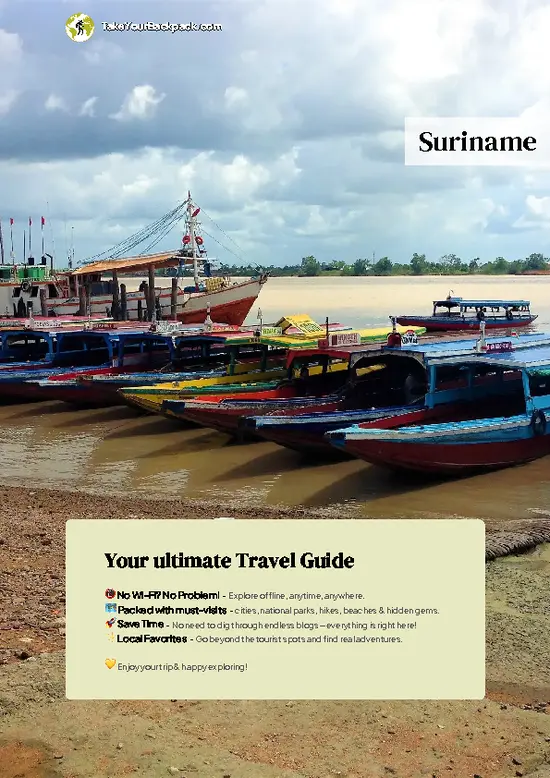
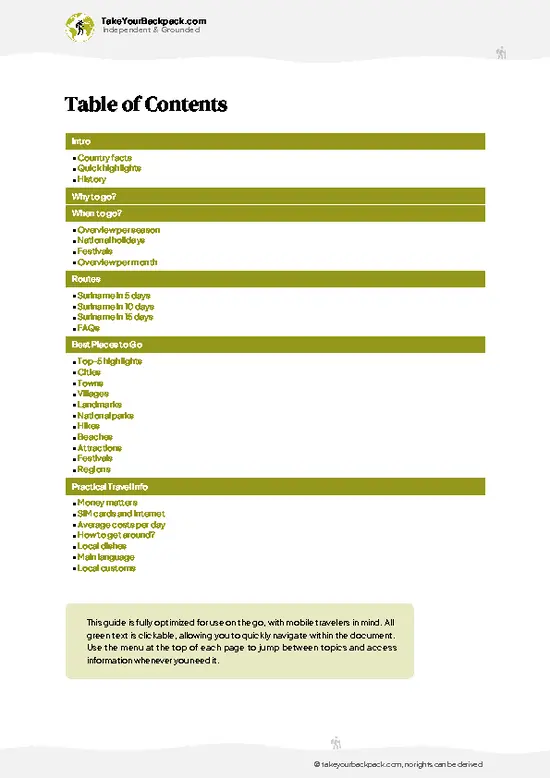
example page 0 from our offline Travel Guide for Suriname
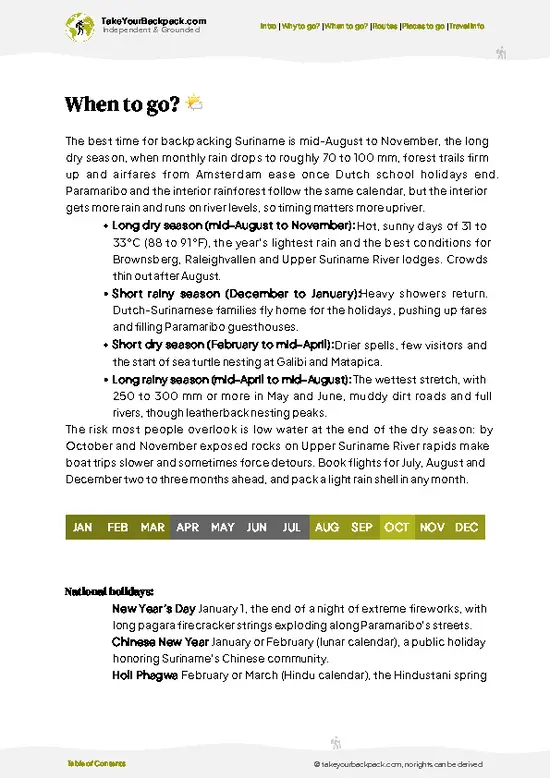
example page 1 from our offline Travel Guide for Suriname
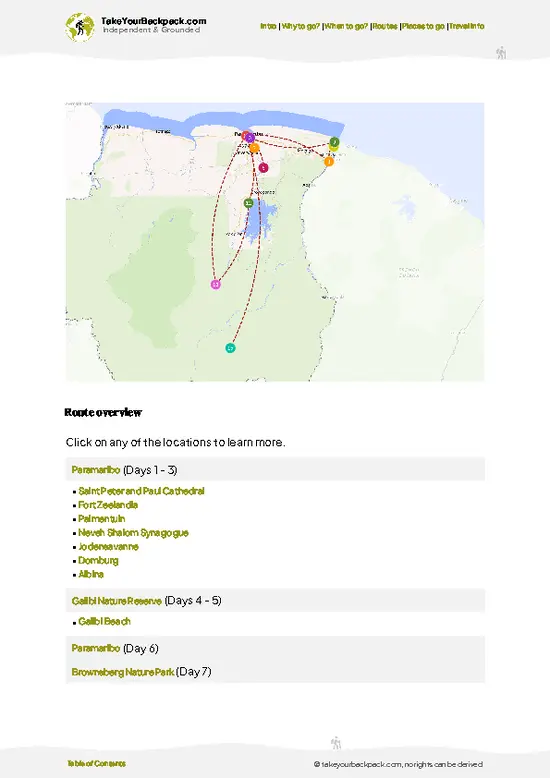
example page 2 from our offline Travel Guide for Suriname
example page 3 from our offline Travel Guide for Suriname
example page 4 from our offline Travel Guide for Suriname
example page 5 from our offline Travel Guide for Suriname
example page 6 from our offline Travel Guide for Suriname
example page 7 from our offline Travel Guide for Suriname
Loading the map 🌍
CLICK TO FILTER
cities
towns
villages
landmarks
national parks
hikes
beaches
attractions
festivals
regions
SHOW COUNTRY’S BESTSHOW ALL

✨ Why go?
Ranked #2 national park in Suriname
What makes this national park worth exploring

Brownsberg Nature Park gives you rainforest walking without a guide-and-tour package, which is rare in Suriname, where most interior travel runs through lodges and boat operators. The trails are signed and short enough to link on your own, and you can stay up on the plateau so you hear the forest at dusk and again before dawn. Another draw is the Brokopondo reservoir view, a huge flooded landscape that you can only appreciate from this height. The plateau is also home to golden frogs and howler monkeys, and the trails to the falls put you in the right habitat for both. Because the park sits within reach of Paramaribo yet feels like deep forest, it works for travelers with only a few days. You skip the long river journeys of the deeper interior and still get real jungle sounds, mud on your boots and a proper night under the trees.

💡 HighlightsTop highlights of Brownsberg Nature Park

  1. Leo Falls: The best-known walk in the park, ending at a multi-tiered waterfall where you can cool off in the pools. The approach crosses streams and roots, so wear shoes with grip.
  2. Irene Falls: A smaller, quieter cascade reached by forest track, good for a rest stop and a swim when water levels allow.
  3. Brokopondo Reservoir Viewpoint: From the plateau edge you look over one of the largest reservoirs in South America, with skeletal trees poking out of the water. Morning mist often sits low over it.
  4. Howler Monkey Chorus: Red howlers roar across the canopy at first light, a deep rolling sound that carries for kilometers. You hear them from the lodge area without walking at all.
  5. Mazaroni Falls: A shorter walk to a falls fed by a stream, with clear water and shaded rocks. It suits people who want a gentler
… read more 👉
  1. Leo Falls: The best-known walk in the park, ending at a multi-tiered waterfall where you can cool off in the pools. The approach crosses streams and roots, so wear shoes with grip.
  2. Irene Falls: A smaller, quieter cascade reached by forest track, good for a rest stop and a swim when water levels allow.
  3. Brokopondo Reservoir Viewpoint: From the plateau edge you look over one of the largest reservoirs in South America, with skeletal trees poking out of the water. Morning mist often sits low over it.
  4. Howler Monkey Chorus: Red howlers roar across the canopy at first light, a deep rolling sound that carries for kilometers. You hear them from the lodge area without walking at all.
  5. Mazaroni Falls: A shorter walk to a falls fed by a stream, with clear water and shaded rocks. It suits people who want a gentler hike than Leo.
  6. Golden Frog Habitat: The tiny, bright Atelopus frog lives in the streams here. It is rare and tiny, so look carefully at wet rocks and leaf litter, and never touch it.
  7. Night Forest Walk: After dark the plateau fills with insect noise, frog calls and eyeshine in a flashlight beam. Walk with a headlamp near the huts and keep to the paths.
All of it fits comfortably into two days, or one long day if you start early.
Spotted a mistake or missing something? Contact us.

Things to do near Brownsberg Nature Park

Ratings based on Tripadvisor reviews. When you book through this link, you support our work at no extra cost to you.

🌤️ When to go?Best time to explore Brownsberg Nature Park

The long dry season from mid-August to early December is the most reliable window for Brownsberg Nature Park, with a shorter dry spell in February and March.
  • Long Dry Season (mid-August to early December): Trails firm up, the Mazaroni plateau gets little rain, and the view over Brokopondo Lake is clearest. Daytime highs run 29 to 33°C (84 to 91°F), nights 21 to 23°C (70 to 73°F). Lodging fills on weekends.
  • Short Dry Season (February to March): Drier than the months around it, with similar temperatures. Waterfall flow drops but stays decent at Irene and Leo Falls.
  • Long Rainy Season (late April to mid-August): Downpours turn the steep paths to mud and the road up from Brownsweg can get slick. Falls run strongest. Crowds are thin and beds are easy to get.
  • Short Rainy Season (December to January):
… read more 👉
The long dry season from mid-August to early December is the most reliable window for Brownsberg Nature Park, with a shorter dry spell in February and March.
  • Long Dry Season (mid-August to early December): Trails firm up, the Mazaroni plateau gets little rain, and the view over Brokopondo Lake is clearest. Daytime highs run 29 to 33°C (84 to 91°F), nights 21 to 23°C (70 to 73°F). Lodging fills on weekends.
  • Short Dry Season (February to March): Drier than the months around it, with similar temperatures. Waterfall flow drops but stays decent at Irene and Leo Falls.
  • Long Rainy Season (late April to mid-August): Downpours turn the steep paths to mud and the road up from Brownsweg can get slick. Falls run strongest. Crowds are thin and beds are easy to get.
  • Short Rainy Season (December to January): Showers come in bursts, often in the afternoon.
Daylight stays close to 12 hours all year, so start walking early and finish before the 6 pm dusk.
Book ahead for weekends in the dry months, since the park has limited beds.


source: climatestotravel.comJANJanuary: fair for travelingFEBFebruary: fair for travelingMARMarch: fair for travelingAPRApril: fair for travelingMAYMay: fair for travelingJUNJune: fair for travelingJULJuly: fair for travelingAUGAugust: highly recommended for travelingSEPSeptember: excellent for travelingOCTOctober: excellent for travelingNOVNovember: excellent for travelingDECDecember: fair for traveling
suriname-national-park-brownsberg-nature-park
© Google |

✈️ The backpacker research shortcutSuriname Travel Guide

An offline-friendly backpacking guide with optimized travel routes, ranked highlights, transport advice, and the best areas to stay.
example page 0 from our offline Travel Guide for Suriname
example page 1 from our offline Travel Guide for Suriname
example page 2 from our offline Travel Guide for Suriname
example page 3 from our offline Travel Guide for Suriname
example page 4 from our offline Travel Guide for Suriname
example page 5 from our offline Travel Guide for Suriname
example page 6 from our offline Travel Guide for Suriname
example page 7 from our offline Travel Guide for Suriname
The digital guide (153 pages) contains:
✅ 40 highlights, ranked by travel appeal
✅ Optimized 5, 10 & 15-day travel routes
✅ Cities, national parks, landmarks, beaches
✅ How to get around
✅ Offline-friendly for travel without Wi-Fi
👉 Click to see all 30+ guide features

📅 Plan smarter in minutes, not weeks
✅ Month by month travel advice
✅ Festivals & national holidays
✅ Budget expectations

🗺️ Go to the right places, skip the overrated ones
✅ Honest pros & cons of destinations
✅ Top hikes, parks & viewpoints
✅ Lesser-known places most travelers miss
✅ Clear “worth it vs skip it” guidance

🛏️ Travel smoothly without rookie mistakes
✅ Best areas to stay
✅ Transport systems explained simply
✅ Common scams & safety advice
✅ SIM cards, money & practical tips

🌍 Understand the country, not just visit it
✅ Culture & traditions
✅ 52 Essential phrases & customs
✅ Festivals worth planning around
✅ Traveler-friendly historical context
✅ Insights that make places more meaningful

📱 Built for real travel conditions
✅ Fully downloadable PDF
✅ Works completely offline
✅ Optimized for phone use
✅ Useful in remote areas & buses
✅ Everything in one place
Stop searching, start planning
Get instant access to your full guide. 30‑day money-back guarantee.
+ Add another guide for just

By proceeding you agree to our terms.
Sent to your inbox immediately after payment • 100% Secure Checkout
Best Backpacking Travel Advisor 2025 tourism awardBest Backpacking
Travel Advisor
2025
What others say about Take Your Backpack Guides:
⭐⭐⭐⭐⭐
Fantastic, amazing amount of information!
⭐⭐⭐⭐⭐
My goodness this is amazing, it's what I've been looking for hats off too you!
⭐⭐⭐⭐⭐
I think this is absolutely BRILLIANT
⭐⭐⭐⭐
Very complete and informative. It's still missing places, but I gotta to commend you
⭐⭐⭐⭐⭐
This is truly amazing, thank you, can't wait to explore it with my kids!
⭐⭐⭐⭐⭐
Awesome resource, thank you!
⭐⭐⭐⭐⭐
This is amazing! Can't wait to explore the ones I haven't seen
⭐⭐⭐⭐
I love this! Well done, great idea.
⭐⭐⭐⭐⭐
Thanks for taking the time to make this gem!
⭐⭐⭐⭐⭐
This might be the best website I've ever seen.
⭐⭐⭐⭐⭐
Congratulations, and thank you so much for your work; it's incredibly valuable.
⭐⭐⭐⭐
In all seriousness I think you did a great job pointing out the important spots
⭐⭐⭐⭐⭐
10/10 very good
⭐⭐⭐⭐⭐
As someone who's only just starting to visit regularly this is awesome, thank you.
⭐⭐⭐⭐
Thank you very much! I'm going to visit my dad, it's going to be very useful!
⭐⭐⭐⭐⭐
This is really cool! We'll be travelling for the first time and this definitely come in handy.
⭐⭐⭐⭐⭐
You are now our minister of culture, congratulations 👨‍💼
⭐⭐⭐⭐⭐
Just wanted to tell you that this is a pearl! Going to follow your recommendations.
⭐⭐⭐⭐⭐
This is so cool. I'll definitely be using the resource for my travels soon.
⭐⭐⭐⭐⭐
This is very impressive! Good work.
⭐⭐⭐⭐⭐
This is an amazing and informative site. Very well done!

🛏️ Where to stay?How to pick the right area

The simplest place to stay is inside Brownsberg Nature Park itself, at the lodges and cabins run by STINASU (the Foundation for Nature Conservation in Suriname) on the plateau, roughly 130 km (about 2.5 to 3 hours by road) south of Paramaribo.
Accommodation includes simple wooden bungalows and dorm-style lodges with bunk beds, mattresses and mosquito nets, plus a few larger family cabins. Expect around US$15 to 30 per person for a bed, with the best rooms on the plateau edge looking out over the lake. There is a small dining hall where meals are served to order, and you can usually bring your own … read more 👉
The simplest place to stay is inside Brownsberg Nature Park itself, at the lodges and cabins run by STINASU (the Foundation for Nature Conservation in Suriname) on the plateau, roughly 130 km (about 2.5 to 3 hours by road) south of Paramaribo.
Accommodation includes simple wooden bungalows and dorm-style lodges with bunk beds, mattresses and mosquito nets, plus a few larger family cabins. Expect around US$15 to 30 per person for a bed, with the best rooms on the plateau edge looking out over the lake. There is a small dining hall where meals are served to order, and you can usually bring your own food to cook. Book through STINASU in Paramaribo, since walk-ins are not guaranteed a bed, especially on weekends.
Inside the park you can also hang a hammock in designated spots if you bring your own gear, which is the cheapest route.
Outside the park, Brownsweg is the village at the foot of the road up, with a few small shops and basic guesthouses, though options are limited. Afobaka and the Brokopondo lake area have scattered resorts for a more relaxed stay. Most backpackers skip these and sleep on the plateau so they can reach the trails and waterfalls at first light, when birds and howler monkeys are most active.

👛 Costs (as of 19 October 2026)Travel costs and budget guide for Brownsberg Nature Park

A realistic budget for Brownsberg Nature Park is about US$60 to 95 per day, and the table below totals US$93 at high-season lodging rates.
CategoryBudget RangeLocal Reality
Entrance FeeUS$5 to 10Paid per person at the park, usually bundled with the booking made through STINASU.
Accommodation (high season)US$20 to 35Dorm bunks or basic bungalows on the plateau; hammock spots cost less if you bring your own gear.
Accommodation (low season)US$15 to 25Easier to find a bed, with fewer visitors on weekdays.
TransportUS$15 to 30Shared minibus or taxi from Paramaribo toward Brownsweg, then a transfer up the plateau road; 4WD is needed for the final climb.
Food and SuppliesUS$10 to 20Meals at the park dining hall or groceries bought in Paramaribo to cook yourself; options on the plateau are limited.
GuideUS$10
… read more 👉
A realistic budget for Brownsberg Nature Park is about US$60 to 95 per day, and the table below totals US$93 at high-season lodging rates.
CategoryBudget RangeLocal Reality
Entrance FeeUS$5 to 10Paid per person at the park, usually bundled with the booking made through STINASU.
Accommodation (high season)US$20 to 35Dorm bunks or basic bungalows on the plateau; hammock spots cost less if you bring your own gear.
Accommodation (low season)US$15 to 25Easier to find a bed, with fewer visitors on weekdays.
TransportUS$15 to 30Shared minibus or taxi from Paramaribo toward Brownsweg, then a transfer up the plateau road; 4WD is needed for the final climb.
Food and SuppliesUS$10 to 20Meals at the park dining hall or groceries bought in Paramaribo to cook yourself; options on the plateau are limited.
GuideUS$10 to 20Ranger-led walks to the falls are optional but useful for wildlife spotting.
Total Daily BudgetUS$93Per person, per day, in high season.


source: surinametourism.com
⚠️ Prices can change and everyone travels differently, so take this as a rough guide. Hope it helps you plan your adventure!

🥾 TrailsScenic routes and wildlife spotting in Brownsberg Nature Park

Brownsberg Nature Park is a plateau of dense primary forest at roughly 500 meters, so walks start with gentle ridge paths and then drop steeply to the waterfalls. Terrain is red clay, roots and stream crossings, slick after rain, and the humidity makes even short walks tiring. The forest is home to howler and capuchin monkeys, toucans, agoutis and a lot of insects, so bring repellent.
  • Leo Falls Trail: Roughly 5 to 6 km round trip, 2.5 to 4 hours, moderate. A descent through forest to a tiered waterfall with swimming pools, with a climb back out that burns the legs.
  • Irene Falls Trail: Around 3 to
… read more 👉
Brownsberg Nature Park is a plateau of dense primary forest at roughly 500 meters, so walks start with gentle ridge paths and then drop steeply to the waterfalls. Terrain is red clay, roots and stream crossings, slick after rain, and the humidity makes even short walks tiring. The forest is home to howler and capuchin monkeys, toucans, agoutis and a lot of insects, so bring repellent.
  • Leo Falls Trail: Roughly 5 to 6 km round trip, 2.5 to 4 hours, moderate. A descent through forest to a tiered waterfall with swimming pools, with a climb back out that burns the legs.
  • Irene Falls Trail: Around 3 to 4 km round trip, 1.5 to 2.5 hours, easy to moderate. Shaded forest track to a small cascade.
  • Mazaroni Falls Trail: A shorter outing of about 1 to 2 hours, easy to moderate, with stream crossings and good chances of birds along the way.
  • Plateau Viewpoint Walk: A flat, easy stroll of under an hour from the lodge area to the lookout over the reservoir, best early when the air is cooler.
The park is reached by road from Paramaribo, and the final climb is rough, so shared minibus access is limited and many travelers arrange a transfer or a 4x4 through STINASU. A small entrance fee is paid in Surinamese currency, and overnight bookings are made in advance. Weekdays are quiet. Weekends and holidays bring local groups, and the trails to the falls are busiest then. Carry water, rain gear and a flashlight.
⚠️ Hiking info can sometimes be outdated or inaccurate. Before you hit the trail, check the latest conditions with locals. If you do spot anything that's off, I'd love to hear from you, so I can update it for fellow travelers.

🛡️ SafetyTraveler Safety Guide

Brownsberg Nature Park is straightforward and well managed, and most problems come from heat, slippery ground and poor preparation rather than danger.
The paths to Irene Falls, Leo Falls and Koemboe Falls climb and drop steeply, and clay and roots turn slick after rain, so wear shoes with real grip and take your time on descents. Trails are marked but junctions can confuse, so stick to named routes or hire a ranger guide, which is easy to arrange at the lodge. Humidity is high. Carry at least 2 to 3 liters of water per person and start early to avoid midday heat.
Wildlife is mostly seen and heard: howler monkeys, toucans, frogs and the occasional snake. Keep to the path, watch where you place hands and feet, and give animals space. Mosquitoes are common, so bring repellent and long, light clothing. … read more 👉
Brownsberg Nature Park is straightforward and well managed, and most problems come from heat, slippery ground and poor preparation rather than danger.
The paths to Irene Falls, Leo Falls and Koemboe Falls climb and drop steeply, and clay and roots turn slick after rain, so wear shoes with real grip and take your time on descents. Trails are marked but junctions can confuse, so stick to named routes or hire a ranger guide, which is easy to arrange at the lodge. Humidity is high. Carry at least 2 to 3 liters of water per person and start early to avoid midday heat.
Wildlife is mostly seen and heard: howler monkeys, toucans, frogs and the occasional snake. Keep to the path, watch where you place hands and feet, and give animals space. Mosquitoes are common, so bring repellent and long, light clothing. Cell signal is patchy, so tell the staff your route and expected return time before heading out.

FAQFrequently asked questions about Brownsberg Nature Park

Two days and one night is the practical minimum for Brownsberg Nature Park, and three days lets you cover more. The main walks to Irene Falls, Leo Falls and Koemboe Falls each take 1 to 3 hours return, and the lake lookout is best at dawn. Getting there from Paramaribo takes roughly 2.5 to 3 hours, so a day trip leaves little time on the trails.
Yes, but it takes planning. Minibuses and taxis run from Paramaribo to Brownsweg, the village at the base of the plateau, in about 2 to 2.5 hours. The steep road up to Brownsberg Nature Park is rough, so most visitors pay for a park transfer or a shared 4WD arranged with STINASU, which costs around US$20 to 40 per vehicle leg.
Yes, Brownsberg Nature Park charges a small entrance fee of roughly US$5 to 10 per person, and you should book in advance through STINASU in Paramaribo. There is no separate hiking permit for the standard trails, but overnight stays need a reservation. Rates are paid in local currency or by arrangement, and guide fees of around US$10 to 20 are extra.
⚠️ Things can change over time, so always validate details locally before you go.

Other Surinamese national parks near Brownsberg Nature Park

Explore more nearby:


💡 Not sure where to go next?
Create a personalized itinerary for Suriname including Brownsberg Nature Park and the places that fit your trip.

Generate my itinerary

👉 Discover all national parks

Or checkout all Suriname has to offer (think cities, towns, villages, national parks, hikes, beaches, festivals)
Country photo of Suriname

We 💚 feedbackSumming up the experience

Brownsberg Nature Park pairs well with a night or two in Paramaribo before and a Saramaka or Upper Suriname River stay after, so you move from city to plateau to riverside village. I would book the overnight, bring a headlamp and skip the rental sedan. The howlers at dawn are worth the early alarm.

✍️ Help improve this page!
The information on this page is based on in-depth research, insights shared by experienced travelers, and feedback from the local travel community in Suriname. While every effort is made to keep the information accurate and current, conditions can change — so if you spot anything incorrect or outdated, please get in touch.


🙋‍♂️ Give feedback

👋 Meet the founderWho’s Behind Take Your Backpack?

Johan, backpacker and founder of TakeYourBackpackHi, I’m Johan (Netherlands 🇳🇱), the creator of TakeYourBackpack. Over the past 3 decades, I’ve backpacked through 90+ countries across six continents, gaining extensive experience with independent travel, long-term trips, and overland routes.

This site is built on a combination of firsthand travel experience and carefully curated insights from other backpackers. Many guides are based on places I’ve personally visited, while others bring together tips, observations, and practical advice shared by trusted travelers I’ve met along the way.

The goal is to provide realistic, experience-driven guidance — not generic itineraries — so you can explore destinations with better context, clearer expectations, and more confidence.