×

Suriname🇸🇷 | festivalsJavanese Immigration Day9 August, Javanese warung, gamelan, kuda kepang | things to do and best time to go

Explore Holi PhagwaExplore Voltzberg

Backpacking in Javanese Immigration Day
👀 For curious travelersfestival ranked #7
By Johan Kruseman 🇳🇱 | Updated October 18, 2026

Javanese Immigration Day suits curious travelers who like food, music and family-run events more than polished spectacle. If you need a set program, English signage and a ticketed gate, you may find it less rewarding. It happens on 9 August in Suriname, with the biggest gatherings around Paramaribo and in the Javanese farming districts of Commewijne and Wanica. On the ground, that means warm roadside warung kitchens, the smell of frying peanut sauce and lemongrass, and the clang of gamelan drifting from a community hall. Heat sits heavy by midday, and sound systems can get loud, but a plate of bami or saoto soup in the shade makes up for it. Start your first day with a late breakfast at a warung, then follow the music to wherever the nearest celebration is.

Discover everything you want to know in the 📖 Suriname Travel Guide.


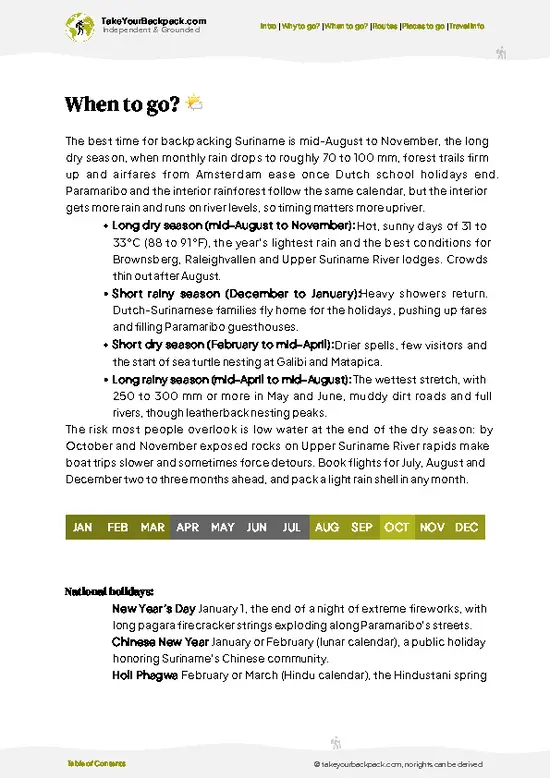
example page 0 from our offline Travel Guide for Suriname
example page 1 from our offline Travel Guide for Suriname
example page 2 from our offline Travel Guide for Suriname
example page 3 from our offline Travel Guide for Suriname
example page 4 from our offline Travel Guide for Suriname
example page 5 from our offline Travel Guide for Suriname
example page 6 from our offline Travel Guide for Suriname
example page 7 from our offline Travel Guide for Suriname
Loading the map 🌍
CLICK TO FILTER
cities
towns
villages
landmarks
national parks
hikes
beaches
attractions
festivals
regions
SHOW COUNTRY’S BESTSHOW ALL

✨ Why go?
Ranked #7 festival in Suriname
What makes this festival worth celebrating

Javanese Immigration Day marks the arrival of the first Javanese laborers in Suriname in 1890, and it is the one date when that story is told by the people who carry it. Backpackers plan around it for the 9 August timing, because food stalls, dance performances and family gatherings appear in a country where such events are otherwise scattered through the year. The social energy is local and warm. You will be handed food, asked where you are from, and pulled into conversation in a mix of Dutch, Sranan Tongo and Javanese words. It also costs very little to take part compared with ticketed festivals elsewhere. It fits neatly into a longer Suriname route, since you can pair it with time in Paramaribo and a visit to the Commewijne plantation area, where much of the Javanese community has deep … read more 👉
Javanese Immigration Day marks the arrival of the first Javanese laborers in Suriname in 1890, and it is the one date when that story is told by the people who carry it. Backpackers plan around it for the 9 August timing, because food stalls, dance performances and family gatherings appear in a country where such events are otherwise scattered through the year. The social energy is local and warm. You will be handed food, asked where you are from, and pulled into conversation in a mix of Dutch, Sranan Tongo and Javanese words. It also costs very little to take part compared with ticketed festivals elsewhere. It fits neatly into a longer Suriname route, since you can pair it with time in Paramaribo and a visit to the Commewijne plantation area, where much of the Javanese community has deep roots. Come hungry and curious, and you leave with a clearer picture of the country.

💡 HighlightsEssential experiences to have while celebrating the Javanese Immigration Day

  1. Javanese Immigration Monument: The commemoration is anchored in remembrance of the 1890 arrival, and wreath-laying and speeches give the day its meaning. Go here first to understand what everything else is celebrating.
  2. Warung food: Stalls and family kitchens serve bami, nasi, saoto soup, satay and sweet snacks. The flavors are Indonesian but adapted over generations in Suriname, so you taste a distinct local cuisine.
  3. Gamelan and traditional music: Community groups perform gamelan, with its layered metallic chimes and gongs. Sitting close, you feel the rhythm as much as hear it.
  4. Dance and kuda kepang performances: Costumed dancers perform traditional Javanese pieces, including the hobbyhorse dance kuda kepang. The costumes, color and drumming make these the most photogenic part of the day.
  5. Commewijne
… read more 👉
  1. Javanese Immigration Monument: The commemoration is anchored in remembrance of the 1890 arrival, and wreath-laying and speeches give the day its meaning. Go here first to understand what everything else is celebrating.
  2. Warung food: Stalls and family kitchens serve bami, nasi, saoto soup, satay and sweet snacks. The flavors are Indonesian but adapted over generations in Suriname, so you taste a distinct local cuisine.
  3. Gamelan and traditional music: Community groups perform gamelan, with its layered metallic chimes and gongs. Sitting close, you feel the rhythm as much as hear it.
  4. Dance and kuda kepang performances: Costumed dancers perform traditional Javanese pieces, including the hobbyhorse dance kuda kepang. The costumes, color and drumming make these the most photogenic part of the day.
  5. Commewijne district gatherings: Village celebrations in the countryside across the river feel smaller and more personal than city events. You get long conversations, shared meals and a look at Javanese rural life.
Start with the monument ceremony in the morning, since the history gives the music and food everything they mean, and the crowds are calmer before the heat builds.
Spotted a mistake or missing something? Contact us.

🌤️ When to go?When is the celebration of Javanese Immigration Day?

Javanese Immigration Day is held every year on 9 August, a one-day public commemoration of the first Javanese arrivals in 1890, with the main events in Paramaribo and in the Javanese districts of Commewijne, Wanica and Nickerie.
  • Best part of the day: Go in the morning for the wreath-laying and speeches, then stay for the afternoon, when gamelan, kuda kepang dancing and food stalls take over.
  • Weather: Expect 24 to 31°C (75 to 88°F), humid, with short showers possible. Bring a light rain jacket, sunscreen, a hat and sandals you can walk in on wet grass.
  • Booking: Entry to most events is free, so only beds matter. Reserve Paramaribo rooms two to three weeks ahead, since prices barely rise.
  • Crowds and roads: Roads toward Commewijne and Wanica clog from late morning, so arrive before 10 am and leave
… read more 👉
Javanese Immigration Day is held every year on 9 August, a one-day public commemoration of the first Javanese arrivals in 1890, with the main events in Paramaribo and in the Javanese districts of Commewijne, Wanica and Nickerie.
  • Best part of the day: Go in the morning for the wreath-laying and speeches, then stay for the afternoon, when gamelan, kuda kepang dancing and food stalls take over.
  • Weather: Expect 24 to 31°C (75 to 88°F), humid, with short showers possible. Bring a light rain jacket, sunscreen, a hat and sandals you can walk in on wet grass.
  • Booking: Entry to most events is free, so only beds matter. Reserve Paramaribo rooms two to three weeks ahead, since prices barely rise.
  • Crowds and roads: Roads toward Commewijne and Wanica clog from late morning, so arrive before 10 am and leave before dusk.
Base yourself in Paramaribo the night before and cross to Commewijne by the early ferry.


source: climatestotravel.comJANJanuary: not recommended for travelingFEBFebruary: not recommended for travelingMARMarch: not recommended for travelingAPRApril: not recommended for travelingMAYMay: not recommended for travelingJUNJune: not recommended for travelingJULJuly: not recommended for travelingAUGAugust: excellent for travelingSEPSeptember: not recommended for travelingOCTOctober: not recommended for travelingNOVNovember: not recommended for travelingDECDecember: not recommended for traveling

✈️ The backpacker research shortcutSuriname Travel Guide

An offline-friendly backpacking guide with optimized travel routes, ranked highlights, transport advice, and the best areas to stay.
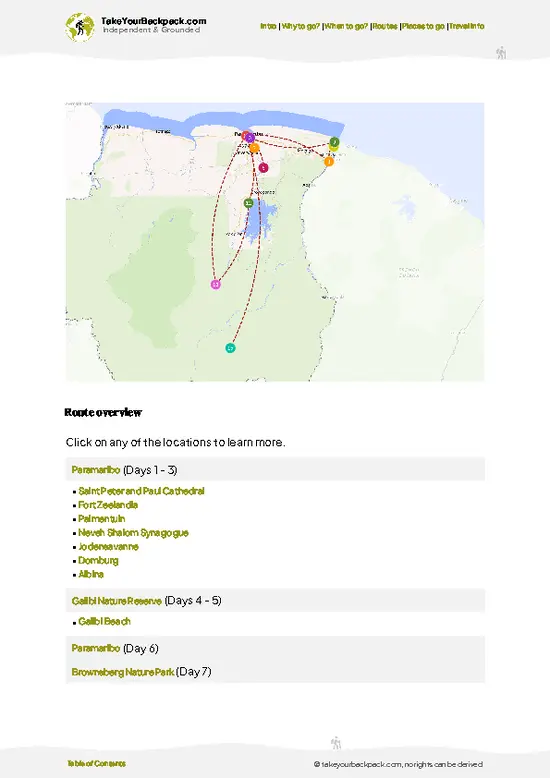
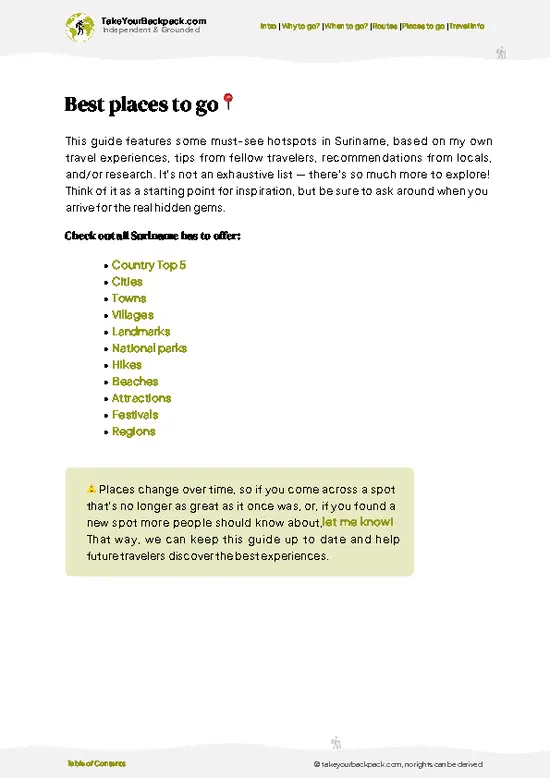
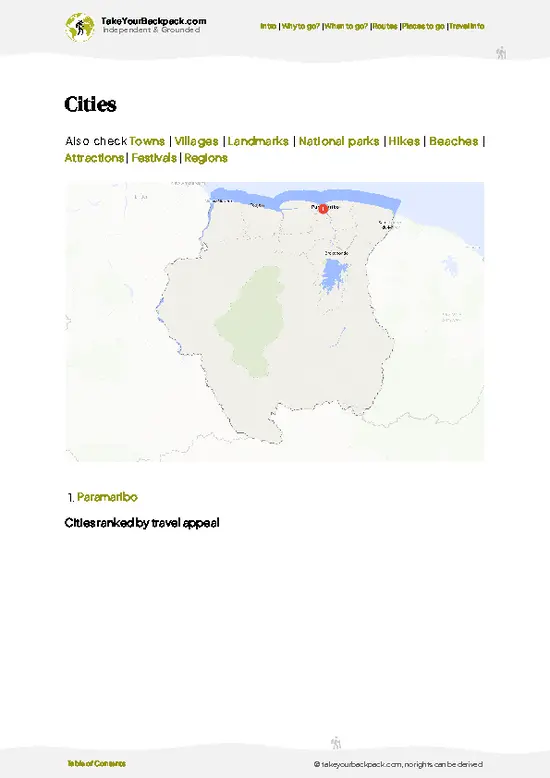
example page 0 from our offline Travel Guide for Suriname
example page 1 from our offline Travel Guide for Suriname
example page 2 from our offline Travel Guide for Suriname
example page 3 from our offline Travel Guide for Suriname
example page 4 from our offline Travel Guide for Suriname
example page 5 from our offline Travel Guide for Suriname
example page 6 from our offline Travel Guide for Suriname
example page 7 from our offline Travel Guide for Suriname
The digital guide (153 pages) contains:
✅ 40 highlights, ranked by travel appeal
✅ Optimized 5, 10 & 15-day travel routes
✅ Cities, national parks, landmarks, beaches
✅ How to get around
✅ Offline-friendly for travel without Wi-Fi
👉 Click to see all 30+ guide features

📅 Plan smarter in minutes, not weeks
✅ Month by month travel advice
✅ Festivals & national holidays
✅ Budget expectations

🗺️ Go to the right places, skip the overrated ones
✅ Honest pros & cons of destinations
✅ Top hikes, parks & viewpoints
✅ Lesser-known places most travelers miss
✅ Clear “worth it vs skip it” guidance

🛏️ Travel smoothly without rookie mistakes
✅ Best areas to stay
✅ Transport systems explained simply
✅ Common scams & safety advice
✅ SIM cards, money & practical tips

🌍 Understand the country, not just visit it
✅ Culture & traditions
✅ 52 Essential phrases & customs
✅ Festivals worth planning around
✅ Traveler-friendly historical context
✅ Insights that make places more meaningful

📱 Built for real travel conditions
✅ Fully downloadable PDF
✅ Works completely offline
✅ Optimized for phone use
✅ Useful in remote areas & buses
✅ Everything in one place
Stop searching, start planning
Get instant access to your full guide. 30‑day money-back guarantee.
+ Add another guide for just

By proceeding you agree to our terms.
Sent to your inbox immediately after payment • 100% Secure Checkout
Best Backpacking Travel Advisor 2025 tourism awardBest Backpacking
Travel Advisor
2025
What others say about Take Your Backpack Guides:
⭐⭐⭐⭐⭐
Fantastic, amazing amount of information!
⭐⭐⭐⭐⭐
My goodness this is amazing, it's what I've been looking for hats off too you!
⭐⭐⭐⭐⭐
I think this is absolutely BRILLIANT
⭐⭐⭐⭐
Very complete and informative. It's still missing places, but I gotta to commend you
⭐⭐⭐⭐⭐
This is truly amazing, thank you, can't wait to explore it with my kids!
⭐⭐⭐⭐⭐
Awesome resource, thank you!
⭐⭐⭐⭐⭐
This is amazing! Can't wait to explore the ones I haven't seen
⭐⭐⭐⭐
I love this! Well done, great idea.
⭐⭐⭐⭐⭐
Thanks for taking the time to make this gem!
⭐⭐⭐⭐⭐
This might be the best website I've ever seen.
⭐⭐⭐⭐⭐
Congratulations, and thank you so much for your work; it's incredibly valuable.
⭐⭐⭐⭐
In all seriousness I think you did a great job pointing out the important spots
⭐⭐⭐⭐⭐
10/10 very good
⭐⭐⭐⭐⭐
As someone who's only just starting to visit regularly this is awesome, thank you.
⭐⭐⭐⭐
Thank you very much! I'm going to visit my dad, it's going to be very useful!
⭐⭐⭐⭐⭐
This is really cool! We'll be travelling for the first time and this definitely come in handy.
⭐⭐⭐⭐⭐
You are now our minister of culture, congratulations 👨‍💼
⭐⭐⭐⭐⭐
Just wanted to tell you that this is a pearl! Going to follow your recommendations.
⭐⭐⭐⭐⭐
This is so cool. I'll definitely be using the resource for my travels soon.
⭐⭐⭐⭐⭐
This is very impressive! Good work.
⭐⭐⭐⭐⭐
This is an amazing and informative site. Very well done!

🛏️ Where to stay?Best areas to stay in Suriname

Stay in central Paramaribo, because it puts you within reach of every commemoration and keeps costs down. The historic inner city around the Waterkant and Onafhankelijkheidsplein is the most social choice. It is compact, walkable and full of guesthouses, hostel-style dorms and small cafes where solo travelers swap plans easily. Evenings on the waterfront feel safe while the food stalls are open, though taking a taxi after dark is wise once the streets empty out.
For a quieter option, look at the Commewijne side of the river, reached by ferry from Paramaribo. Guesthouses there put you close to the … read more 👉
Stay in central Paramaribo, because it puts you within reach of every commemoration and keeps costs down. The historic inner city around the Waterkant and Onafhankelijkheidsplein is the most social choice. It is compact, walkable and full of guesthouses, hostel-style dorms and small cafes where solo travelers swap plans easily. Evenings on the waterfront feel safe while the food stalls are open, though taking a taxi after dark is wise once the streets empty out.
For a quieter option, look at the Commewijne side of the river, reached by ferry from Paramaribo. Guesthouses there put you close to the plantation district and its Javanese villages, and you wake up among the people hosting the celebrations. Expect fewer travelers, more conversation with locals and the need to arrange transport in advance.
The Wanica area, south of the city, suits you if you want village life and have your own wheels or a driver. For most backpackers, though, Paramaribo is the practical anchor. Book early for the days around 9 August, as dorms fill with visiting families and domestic travelers.

👛 Costs (as of 18 October 2026)What things cost and how to budget

A day at Javanese Immigration Day costs roughly US$43 to 86 for an independent traveler, with the event itself free to attend in most places.
CategoryBudget RangeLocal Reality
Festival ticketsUS$0 to 3Public ceremonies and street events are free. Some cultural shows may ask a small donation.
AccommodationUS$20 to 45Dorms and basic guesthouses in Paramaribo start around US$20. Private rooms run US$35 to 45 in high season.
Local transportUS$5 to 15Shared minibuses to nearby districts are cheap. A ferry across the river costs very little, and taxis from the city cost US$10 to 25 one way.
Food & drinksUS$8 to 15Warung plates cost US$3 to 6. Beer and juices cost US$1 to 3 each.
Miscellaneous expensesUS$3 to 8Small donations, snacks, sunscreen and a rain poncho.
Total Daily BudgetUS$43 to 86About US$65
… read more 👉
A day at Javanese Immigration Day costs roughly US$43 to 86 for an independent traveler, with the event itself free to attend in most places.
CategoryBudget RangeLocal Reality
Festival ticketsUS$0 to 3Public ceremonies and street events are free. Some cultural shows may ask a small donation.
AccommodationUS$20 to 45Dorms and basic guesthouses in Paramaribo start around US$20. Private rooms run US$35 to 45 in high season.
Local transportUS$5 to 15Shared minibuses to nearby districts are cheap. A ferry across the river costs very little, and taxis from the city cost US$10 to 25 one way.
Food & drinksUS$8 to 15Warung plates cost US$3 to 6. Beer and juices cost US$1 to 3 each.
Miscellaneous expensesUS$3 to 8Small donations, snacks, sunscreen and a rain poncho.
Total Daily BudgetUS$43 to 86About US$65 for a typical day with a mid-range guesthouse bed.
⚠️ Prices can change and everyone travels differently, so take this as a rough guide. Hope it helps you plan your adventure!

🍲 FoodWhat to Eat & Drink

The food is the reason many people come, and the best of it is Javanese-Surinamese. Look for bami and nasi plates, pom, and skewered saté in peanut sauce, all sold from warungs and festival stalls near the event grounds. Pisang goreng (fried banana), petjel with vegetables and peanut dressing, and soto soup are worth tracking down for something properly local.
Go for the warung-style plates over anything labeled generic. A plate of nasi with chicken, egg, long beans and sambal is filling and gives you the authentic version of a Javanese family lunch. Sweet snacks like dawet (a coconut milk and palm sugar drink) cool you down when the afternoon heat builds.
Drinks lean toward Parbo beer, fresh coconut water, sugarcane juice and sweet iced tea. Pay in cash, using Surinamese currency, and carry … read more 👉
The food is the reason many people come, and the best of it is Javanese-Surinamese. Look for bami and nasi plates, pom, and skewered saté in peanut sauce, all sold from warungs and festival stalls near the event grounds. Pisang goreng (fried banana), petjel with vegetables and peanut dressing, and soto soup are worth tracking down for something properly local.
Go for the warung-style plates over anything labeled generic. A plate of nasi with chicken, egg, long beans and sambal is filling and gives you the authentic version of a Javanese family lunch. Sweet snacks like dawet (a coconut milk and palm sugar drink) cool you down when the afternoon heat builds.
Drinks lean toward Parbo beer, fresh coconut water, sugarcane juice and sweet iced tea. Pay in cash, using Surinamese currency, and carry small notes because stalls rarely have change. Portions are generous, so sharing a plate works fine. Lines move slowly at popular stalls, so join one early and be patient. Sambal can be seriously hot, so ask for it on the side.

FAQFrequently asked questions about Javanese Immigration Day

Javanese Immigration Day takes place every year on 9 August, marking the arrival of the first Javanese laborers in Suriname in 1890. It is a single-day commemoration, with main events in Paramaribo and in the Javanese districts of Commewijne, Wanica and Nickerie. Ceremonies usually start in the morning, and cultural performances run through the afternoon.
Attending Javanese Immigration Day is mostly free, since the ceremonies, music and dance in public spaces carry no entry fee. Your real costs are food, at around US$3 to 6 per plate, and transport, with taxis from Paramaribo to Commewijne or Wanica at roughly US$10 to 25 one way. A budget traveler can manage the day for around US$45 to 75 including a bed.
Javanese Immigration Day does not require advance tickets for the main public commemorations and street events. Some staged shows or private gatherings may charge a small fee at the door, usually under US$3. The thing to book ahead is your bed in Paramaribo, ideally two to three weeks before 9 August, as guesthouses fill with visiting families.
⚠️ Things can change over time, so always validate details locally before you go.

Other Surinamese festivals near Javanese Immigration Day

Explore more nearby:

  • Keti Koti—1 July, white cloth, winti drums, Waterkant, kotomisi
  • Holi Phagwa—Abir powder, chowtal singing, Holika Dahan bonfire, pholourie stalls
  • Maroon Day—10 October, apinti drums, river villages, pangi cloth, ancestral libations

💡 Not sure where to go next?
Create a personalized itinerary for Suriname including Javanese Immigration Day and the places that fit your trip.

Generate my itinerary

👉 Discover all festivals

Or checkout all Suriname has to offer (think cities, towns, villages, national parks, hikes, beaches, festivals)
Country photo of Suriname

We 💚 feedbackIs it worth it?

Many travelers treat Javanese Immigration Day as a single event to tick off in an hour, then leave before the food and music properly start. Give it a full day instead. Arrive for the morning ceremony, eat slowly at a warung, and stay into the afternoon when the performances warm up. Carry small cash and a hat.

✍️ Help improve this page!
The information on this page is based on in-depth research, insights shared by experienced travelers, and feedback from the local travel community in Suriname. While every effort is made to keep the information accurate and current, conditions can change — so if you spot anything incorrect or outdated, please get in touch.


🙋‍♂️ Give feedback

👋 Meet the founderWho’s Behind Take Your Backpack?

Johan, backpacker and founder of TakeYourBackpackHi, I’m Johan (Netherlands 🇳🇱), the creator of TakeYourBackpack. Over the past 3 decades, I’ve backpacked through 90+ countries across six continents, gaining extensive experience with independent travel, long-term trips, and overland routes.

This site is built on a combination of firsthand travel experience and carefully curated insights from other backpackers. Many guides are based on places I’ve personally visited, while others bring together tips, observations, and practical advice shared by trusted travelers I’ve met along the way.

The goal is to provide realistic, experience-driven guidance — not generic itineraries — so you can explore destinations with better context, clearer expectations, and more confidence.