

×

Suriname🇸🇷 | attractionsPeperpot Nature ParkPlantation ruins, sloths, easy trails, Commewijne side | things to do and best time to go

Explore KwamalasamutuExplore Palmentuin

Backpacking in Peperpot Nature Park
👍 Recommendedattraction ranked #5
By Johan Kruseman 🇳🇱 | Updated October 19, 2026

A former coffee, cacao and citrus plantation, Peperpot is known for its old plantation grounds, where the ruins of a drainage system and the Dutch-era layout still run beneath tall tropical trees. The park sits in the Commewijne district of Suriname, across the Suriname River from Paramaribo, near Meerzorg. Walking the flat, shaded paths, you hear howler monkeys at dawn and the rustle of leaf litter, and you feel the thick humidity on your skin. Mosquitoes are a fact of life, and trails turn muddy after rain. Crowds are almost nonexistent, so birdwatchers get the canopy to themselves. Compared with Bigi Pan or the interior reserves, Peperpot is far easier to reach and much tamer, with gentle terrain and a day's worth of walking rather than a jungle expedition.

Discover everything you want to know in the 📖 Suriname Travel Guide.


example page 0 from our offline Travel Guide for Suriname
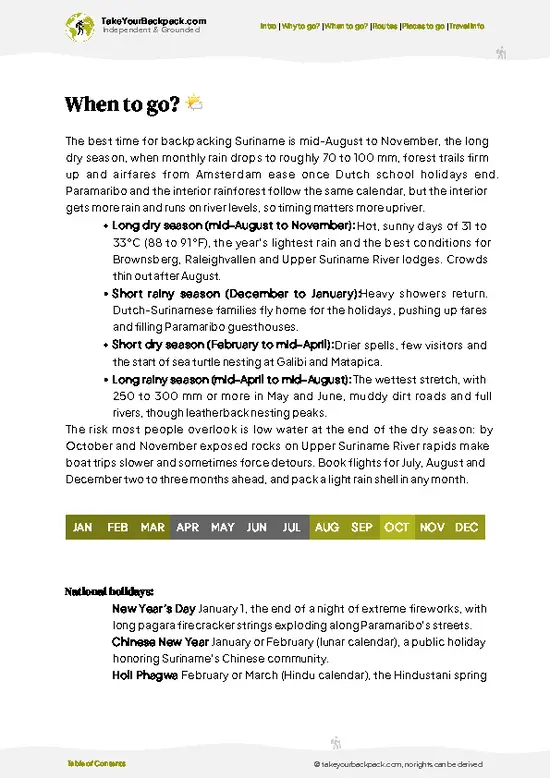
example page 1 from our offline Travel Guide for Suriname
example page 2 from our offline Travel Guide for Suriname
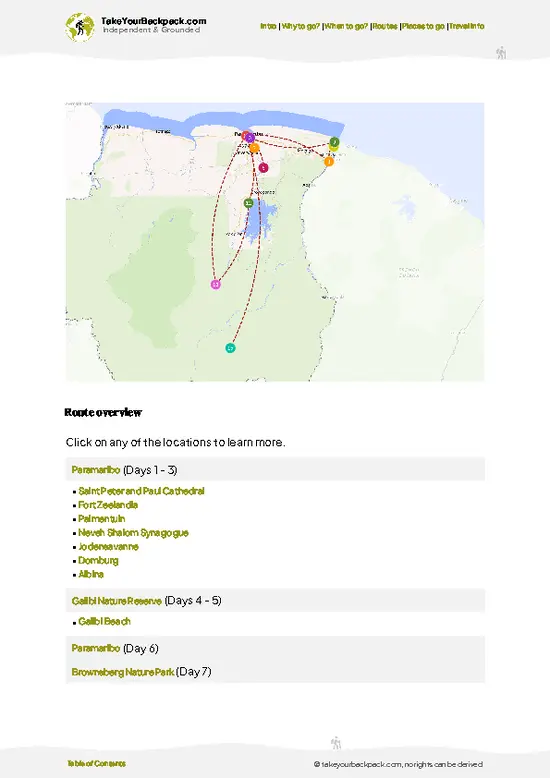
example page 3 from our offline Travel Guide for Suriname
example page 4 from our offline Travel Guide for Suriname
example page 5 from our offline Travel Guide for Suriname
example page 6 from our offline Travel Guide for Suriname
example page 7 from our offline Travel Guide for Suriname
Loading the map 🌍
CLICK TO FILTER
cities
towns
villages
landmarks
national parks
hikes
beaches
attractions
festivals
regions
SHOW COUNTRY’S BESTSHOW ALL

✨ Why go?
Ranked #5 attraction in Suriname
What sets this place apart

Peperpot Nature Park suits the traveler who wants rainforest without hiring a guide or booking a multi-day boat trip. Trails are short and flat, so you can wander at your own pace with binoculars and a bottle of water, and the park is small enough that you won't get lost for long. The real draw is the density of wildlife on the doorstep of the capital. Over 200 bird species have been recorded here, and you can find howler monkeys, capuchins and squirrel monkeys along the paths, plus sloths and agoutis if you scan the trees patiently. The old plantation setting adds a layer of history you won't find in the deep interior, with remnants of the Dutch plantation canals running through the forest. Guides are available if you want help spotting animals, but self-guided walking works well, and the … read more 👉
Peperpot Nature Park suits the traveler who wants rainforest without hiring a guide or booking a multi-day boat trip. Trails are short and flat, so you can wander at your own pace with binoculars and a bottle of water, and the park is small enough that you won't get lost for long. The real draw is the density of wildlife on the doorstep of the capital. Over 200 bird species have been recorded here, and you can find howler monkeys, capuchins and squirrel monkeys along the paths, plus sloths and agoutis if you scan the trees patiently. The old plantation setting adds a layer of history you won't find in the deep interior, with remnants of the Dutch plantation canals running through the forest. Guides are available if you want help spotting animals, but self-guided walking works well, and the park pairs easily with a day exploring Commewijne's plantations.

💡 HighlightsTop highlights of Peperpot Nature Park

  1. Plantation canals and ruins: Old Dutch-era drainage channels and brick remains run through the forest, showing how the land was farmed before the trees took over.
  2. Howler monkey troops: Their roars carry across the park in the early morning, and you can often track them to a single tree.
  3. Birdwatching trails: Toucans, parrots, trogons and a long list of smaller forest birds are active around the canopy openings near the main paths.
  4. Capuchin and squirrel monkeys: Smaller, faster groups that move through the middle layers of forest, easiest to spot where fruiting trees attract them.
  5. Three-toed sloths: Slow and well camouflaged, they hang in cecropia trees, and a guide can point them out quickly.
  6. Citrus and cacao remnants: Old cultivated trees still grow among the wild forest, a reminder of the plantation
… read more 👉
  1. Plantation canals and ruins: Old Dutch-era drainage channels and brick remains run through the forest, showing how the land was farmed before the trees took over.
  2. Howler monkey troops: Their roars carry across the park in the early morning, and you can often track them to a single tree.
  3. Birdwatching trails: Toucans, parrots, trogons and a long list of smaller forest birds are active around the canopy openings near the main paths.
  4. Capuchin and squirrel monkeys: Smaller, faster groups that move through the middle layers of forest, easiest to spot where fruiting trees attract them.
  5. Three-toed sloths: Slow and well camouflaged, they hang in cecropia trees, and a guide can point them out quickly.
  6. Citrus and cacao remnants: Old cultivated trees still grow among the wild forest, a reminder of the plantation past.
  7. Forest walks at dawn: Cooler air, active wildlife and soft light make the early hours the best time for the trails.
Allow half a day to see everything, or a full morning if you go slowly for birds.
Spotted a mistake or missing something? Contact us.

Things to do near Peperpot Nature Park

Ratings based on Tripadvisor reviews. When you book through this link, you support our work at no extra cost to you.

🌤️ When to go?Best time to visit Peperpot Nature Park

  • Long Dry Season (mid-August to early December): Trails are firmest and mosquitoes thinnest. Highs run 31 to 33°C (88 to 91°F), nights 22 to 24°C (72 to 75°F). Birdwatchers arrive at dawn, when the old plantation paths are cooler and noisier with parrots.
  • Short Wet Season (early December to late January): Showers come in bursts, and the park stays green with fewer visitors. Expect 26 to 31°C (79 to 88°F).
  • Short Dry Season (February to mid-April): Humid but mostly sunny, with a quieter feel and easy walking.
  • Long Wet Season (late April to mid-August): Paths turn muddy and parts of the plantation grounds flood. Days hold close to 12 hours of light all year, so plan around the heat, not the sun.
Crowds are small year-round and no entry prices swing by season. Book guided night or bird walks a day … read more 👉
  • Long Dry Season (mid-August to early December): Trails are firmest and mosquitoes thinnest. Highs run 31 to 33°C (88 to 91°F), nights 22 to 24°C (72 to 75°F). Birdwatchers arrive at dawn, when the old plantation paths are cooler and noisier with parrots.
  • Short Wet Season (early December to late January): Showers come in bursts, and the park stays green with fewer visitors. Expect 26 to 31°C (79 to 88°F).
  • Short Dry Season (February to mid-April): Humid but mostly sunny, with a quieter feel and easy walking.
  • Long Wet Season (late April to mid-August): Paths turn muddy and parts of the plantation grounds flood. Days hold close to 12 hours of light all year, so plan around the heat, not the sun.
Crowds are small year-round and no entry prices swing by season. Book guided night or bird walks a day ahead, and start at first light to beat both heat and rain.


source: climatestotravel.comJANJanuary: highly recommended for travelingFEBFebruary: highly recommended for travelingMARMarch: excellent for travelingAPRApril: fair for travelingMAYMay: fair for travelingJUNJune: fair for travelingJULJuly: fair for travelingAUGAugust: fair for travelingSEPSeptember: excellent for travelingOCTOctober: highly recommended for travelingNOVNovember: highly recommended for travelingDECDecember: highly recommended for traveling
suriname-attraction-peperpot-nature-park
© Google | Ivo Van Der Werk

✈️ The backpacker research shortcutSuriname Travel Guide

An offline-friendly backpacking guide with optimized travel routes, ranked highlights, transport advice, and the best areas to stay.
example page 0 from our offline Travel Guide for Suriname
example page 1 from our offline Travel Guide for Suriname
example page 2 from our offline Travel Guide for Suriname
example page 3 from our offline Travel Guide for Suriname
example page 4 from our offline Travel Guide for Suriname
example page 5 from our offline Travel Guide for Suriname
example page 6 from our offline Travel Guide for Suriname
example page 7 from our offline Travel Guide for Suriname
The digital guide (153 pages) contains:
✅ 40 highlights, ranked by travel appeal
✅ Optimized 5, 10 & 15-day travel routes
✅ Cities, national parks, landmarks, beaches
✅ How to get around
✅ Offline-friendly for travel without Wi-Fi
👉 Click to see all 30+ guide features

📅 Plan smarter in minutes, not weeks
✅ Month by month travel advice
✅ Festivals & national holidays
✅ Budget expectations

🗺️ Go to the right places, skip the overrated ones
✅ Honest pros & cons of destinations
✅ Top hikes, parks & viewpoints
✅ Lesser-known places most travelers miss
✅ Clear “worth it vs skip it” guidance

🛏️ Travel smoothly without rookie mistakes
✅ Best areas to stay
✅ Transport systems explained simply
✅ Common scams & safety advice
✅ SIM cards, money & practical tips

🌍 Understand the country, not just visit it
✅ Culture & traditions
✅ 52 Essential phrases & customs
✅ Festivals worth planning around
✅ Traveler-friendly historical context
✅ Insights that make places more meaningful

📱 Built for real travel conditions
✅ Fully downloadable PDF
✅ Works completely offline
✅ Optimized for phone use
✅ Useful in remote areas & buses
✅ Everything in one place
Stop searching, start planning
Get instant access to your full guide. 30‑day money-back guarantee.
+ Add another guide for just

By proceeding you agree to our terms.
Sent to your inbox immediately after payment • 100% Secure Checkout
Best Backpacking Travel Advisor 2025 tourism awardBest Backpacking
Travel Advisor
2025
What others say about Take Your Backpack Guides:
⭐⭐⭐⭐⭐
Fantastic, amazing amount of information!
⭐⭐⭐⭐⭐
My goodness this is amazing, it's what I've been looking for hats off too you!
⭐⭐⭐⭐⭐
I think this is absolutely BRILLIANT
⭐⭐⭐⭐
Very complete and informative. It's still missing places, but I gotta to commend you
⭐⭐⭐⭐⭐
This is truly amazing, thank you, can't wait to explore it with my kids!
⭐⭐⭐⭐⭐
Awesome resource, thank you!
⭐⭐⭐⭐⭐
This is amazing! Can't wait to explore the ones I haven't seen
⭐⭐⭐⭐
I love this! Well done, great idea.
⭐⭐⭐⭐⭐
Thanks for taking the time to make this gem!
⭐⭐⭐⭐⭐
This might be the best website I've ever seen.
⭐⭐⭐⭐⭐
Congratulations, and thank you so much for your work; it's incredibly valuable.
⭐⭐⭐⭐
In all seriousness I think you did a great job pointing out the important spots
⭐⭐⭐⭐⭐
10/10 very good
⭐⭐⭐⭐⭐
As someone who's only just starting to visit regularly this is awesome, thank you.
⭐⭐⭐⭐
Thank you very much! I'm going to visit my dad, it's going to be very useful!
⭐⭐⭐⭐⭐
This is really cool! We'll be travelling for the first time and this definitely come in handy.
⭐⭐⭐⭐⭐
You are now our minister of culture, congratulations 👨‍💼
⭐⭐⭐⭐⭐
Just wanted to tell you that this is a pearl! Going to follow your recommendations.
⭐⭐⭐⭐⭐
This is so cool. I'll definitely be using the resource for my travels soon.
⭐⭐⭐⭐⭐
This is very impressive! Good work.
⭐⭐⭐⭐⭐
This is an amazing and informative site. Very well done!

🛏️ Where to stay?Where staying makes the most sense

Paramaribo is the practical place to stay, since Peperpot Nature Park has no lodging of its own and sits about 20 to 30 minutes by road southeast of the capital, across the Suriname River bridge near Commewijne. Backpackers do best in the old center near the Waterkant, where hostels and guesthouses cluster within walking distance of the minibus stops and restaurants. Dorm beds run roughly US$15 to 25, private rooms in simple guesthouses US$35 to 60. Several budget places will arrange a taxi or a tour to the park, which saves hunting for transport at dawn.

For a quieter option, the Commewijne … read more 👉
Paramaribo is the practical place to stay, since Peperpot Nature Park has no lodging of its own and sits about 20 to 30 minutes by road southeast of the capital, across the Suriname River bridge near Commewijne. Backpackers do best in the old center near the Waterkant, where hostels and guesthouses cluster within walking distance of the minibus stops and restaurants. Dorm beds run roughly US$15 to 25, private rooms in simple guesthouses US$35 to 60. Several budget places will arrange a taxi or a tour to the park, which saves hunting for transport at dawn.

For a quieter option, the Commewijne district across the river has a few plantation guesthouses and small lodges, usually US$50 to 100 a night, and they put you closer to the park entrance. Staying here suits birders who want first-light walks without a long ride. Camping inside the park is not a standard option, so plan on sleeping in either Paramaribo or Commewijne. Book ahead from December to April, and in the August to October dry months, when rooms fill faster in the capital.

👛 Costs (as of 19 October 2026)Travel costs and budget guide for Peperpot Nature Park

A day at Peperpot Nature Park costs about US$58 to 160 for a backpacker based in Paramaribo, with most of it going to transport and a bed. The figures below are rough ranges and local payments are made in Surinamese dollars.
CategoryBudget RangeLocal Reality
Entrance feeUS$3 to 10Small per-person fee for foreign visitors, paid at the gate; guided walks cost extra.
Guided walkUS$10 to 30Optional but useful for birds, sloths and monkeys; arrange the day before.
Accommodation (high season)US$15 to 60Hostel dorms or simple guesthouses in Paramaribo; Commewijne lodges cost more.
Local transportUS$20 to 40Taxi round trip from Paramaribo is the easiest way; minibuses cover part of the route and are cheaper.
Food and suppliesUS$10 to 20Warung meals cost US$4 to 8; bring water and snacks, as there is little
… read more 👉
A day at Peperpot Nature Park costs about US$58 to 160 for a backpacker based in Paramaribo, with most of it going to transport and a bed. The figures below are rough ranges and local payments are made in Surinamese dollars.
CategoryBudget RangeLocal Reality
Entrance feeUS$3 to 10Small per-person fee for foreign visitors, paid at the gate; guided walks cost extra.
Guided walkUS$10 to 30Optional but useful for birds, sloths and monkeys; arrange the day before.
Accommodation (high season)US$15 to 60Hostel dorms or simple guesthouses in Paramaribo; Commewijne lodges cost more.
Local transportUS$20 to 40Taxi round trip from Paramaribo is the easiest way; minibuses cover part of the route and are cheaper.
Food and suppliesUS$10 to 20Warung meals cost US$4 to 8; bring water and snacks, as there is little to buy near the park.
Total Daily BudgetUS$58 to 160Roughly US$100 on average with a taxi, guide and a mid-range bed.
⚠️ Prices can change and everyone travels differently, so take this as a rough guide. Hope it helps you plan your adventure!

🛡️ SafetyStaying Safe: What Travelers Should Know

Peperpot Nature Park is a low-risk, well-managed place to walk, and the main issues are heat, mosquitoes and mud. The old plantation tracks are flat and clearly laid out, so navigation is easy, though footing gets slick after rain. Carry at least 2 liters of water, wear light long sleeves and apply repellent, especially at dusk. Sun is strong even under tree cover at midday, so start early.

Monkeys, sloths, caiman and snakes live here, but encounters are generally calm. Keep your distance, never feed the monkeys, and watch where you step or reach on dim paths. Mind the ground near water edges. Stay on marked routes, and let a guide lead on night walks. Bring a small flashlight and a rain layer, since afternoon downpours are the usual surprise.

FAQTraveler FAQ

Half a day is enough for Peperpot Nature Park, and most visitors spend 3 to 5 hours walking the old plantation trails. Start at dawn for the best birdlife, then head back to Paramaribo for lunch. Add a second morning if you want a guided night walk or a visit to nearby Commewijne plantations.
Yes, though it takes some planning, since Peperpot Nature Park lies roughly 20 to 30 minutes south of Paramaribo across the river bridge. A taxi costs about US$20 to 40 round trip, and many hostels in Paramaribo can book one with a waiting driver. Minibuses toward Commewijne cover part of the route, but you will still need a short ride or walk to reach the entrance.
Yes, Peperpot Nature Park charges a small entrance fee, roughly US$3 to 10 for foreign visitors, paid at the gate. No special permit is needed for a day visit on the main trails. Guided walks cost about US$10 to 30 extra and are best arranged a day in advance.
⚠️ Things can change over time, so always validate details locally before you go.

Other Surinamese attractions near Peperpot Nature Park

Explore more nearby:

  • Surinaams Museum—colonial artifacts, Fort Zeelandia, cultural exhibits| 4 km away
  • Palmentuin—Royal palm avenue, presidential palace, capuchin monkeys, shaded benches| 5 km away
  • Saint Peter and Paul Cathedral—Timber twin towers, wooden vaults, Sunday Mass, Henck Arronstraat| 5 km away

💡 Not sure where to go next?
Create a personalized itinerary for Suriname including Peperpot Nature Park and the places that fit your trip.

Generate my itinerary

👉 Discover all attractions

Or checkout all Suriname has to offer (think cities, towns, villages, national parks, hikes, beaches, festivals)
Country photo of Suriname

We 💚 feedbackParting advice and final tips

Peperpot Nature Park is a former plantation, and the old coffee and cacao estate layout still shapes it: straight, flat tracks lined with trees, not winding jungle paths. Most people walk once and leave, yet the quiet hours of early morning are when birds and howler monkeys show themselves along those straight lines. Bring long sleeves and repellent for the mosquitoes, and keep your pace slow enough to hear the canopy.

✍️ Help improve this page!
The information on this page is based on in-depth research, insights shared by experienced travelers, and feedback from the local travel community in Suriname. While every effort is made to keep the information accurate and current, conditions can change — so if you spot anything incorrect or outdated, please get in touch.


🙋‍♂️ Give feedback

👋 Meet the founderWho’s Behind Take Your Backpack?

Johan, backpacker and founder of TakeYourBackpackHi, I’m Johan (Netherlands 🇳🇱), the creator of TakeYourBackpack. Over the past 3 decades, I’ve backpacked through 90+ countries across six continents, gaining extensive experience with independent travel, long-term trips, and overland routes.

This site is built on a combination of firsthand travel experience and carefully curated insights from other backpackers. Many guides are based on places I’ve personally visited, while others bring together tips, observations, and practical advice shared by trusted travelers I’ve met along the way.

The goal is to provide realistic, experience-driven guidance — not generic itineraries — so you can explore destinations with better context, clearer expectations, and more confidence.