×

Sweden🇸🇪 | townsKirunairon mine, northern lights, relocated town center | things to do and best time to go

Explore ÖstersundExplore Lund

Backpacking in Kiruna
🏆 Top picktown ranked #2
By Johan Kruseman 🇳🇱 | Updated June 18, 2026

Kiruna is not for anyone chasing big-city buzz, bar crawls, or cute cobblestone alleys. It’s a mining town above the Arctic Circle, way up in Sweden’s far north, more about iron ore and open sky than café culture. But that’s exactly why backpackers should care: Kiruna is a launchpad. You come here to step off the map a little. It sits in Swedish Lapland, north of Luleå and roughly west of the Torne River valley, with trains and buses linking it to Abisko, Narvik in Norway, and the wider north.

The town itself feels spread out, practical, a bit raw, with low winter light bouncing off snowbanks and the faint smell of cold metal near the mine. It works best as a base for northern lights trips, dogsledding, and heading toward Abisko or the Kungsleden, not as a destination in its own right. Walking is doable but distances add up; local buses help, especially in winter. Social life clusters in a couple of hostels, bars, and hotel lounges, where people swap aurora photos instead of partying until dawn. It’s safe, not cheap, but manageable if you self-cater and treat it as a staging point. Compared with Abisko, Kiruna feels more local and workaday; compared with Luleå, more remote and weather-beaten, but closer to the real Arctic wilderness you probably came for.

Discover everything you want to know in the 📖 Sweden Travel Guide.


Get your Sweden guide
119 ranked highlights, routes & tips, works offline (446 pages)
Loading the map 🌍
CLICK TO FILTER
cities
towns
villages
landmarks
national parks
hikes
beaches
attractions
festivals
regions
SHOW COUNTRY’S BESTSHOW ALL

✨ Why go?
Ranked #2 town in Sweden
Why Kiruna should be on your travel list

Backpackers flock to Kiruna for its strategic location at the edge of Sweden’s wild north. It’s a gateway to stunning hikes in Abisko National Park and the Kungsleden Trail, where the air is crisp and the views are breathtaking. The town’s walkable streets make it easy to explore local food spots serving hearty dishes, perfect after a day outdoors. Accommodations range from cozy hostels to charming guesthouses, fostering a friendly, communal vibe. Most travelers stay a few days, soaking in the slow pace and connecting with fellow adventurers. It’s ideal for solo travelers and small groups seeking both adventure and camaraderie.
Want to include Kiruna in your Sweden route?
Create a personalized Sweden itinerary that includes Kiruna and the places that fit your trip — based on your travel style, budget, and available time. Get your route in seconds.

Generate my trip

💡 HighlightsEssential experiences to have while visiting Kiruna

Kiruna Church
Step inside Kiruna Church and you’ll understand why locals call it the “heart” of the town. Built in 1912, this wooden church is shaped like a Sami goahti (tent), with a deep-red exterior that glows against the snow or under the midnight sun. The scent of pine and tar lingers inside, and the silence feels thick, almost reverent. It’s not just a photo stop—the church is a living symbol of Kiruna’s blend of Swedish and indigenous Sami culture. Visit in the morning for soft light through the stained glass. Entry is free, and you’ll want 30-45 minutes to soak it in, especially if you catch the organist practicing.


LKAB’s Visitor Centre (Kiruna Mine Tour)
Kiruna exists because of iron ore, and the LKAB mine is the reason the whole town is literally moving. The tour plunges you 540 … read more 👉
Kiruna Church
Step inside Kiruna Church and you’ll understand why locals call it the “heart” of the town. Built in 1912, this wooden church is shaped like a Sami goahti (tent), with a deep-red exterior that glows against the snow or under the midnight sun. The scent of pine and tar lingers inside, and the silence feels thick, almost reverent. It’s not just a photo stop—the church is a living symbol of Kiruna’s blend of Swedish and indigenous Sami culture. Visit in the morning for soft light through the stained glass. Entry is free, and you’ll want 30-45 minutes to soak it in, especially if you catch the organist practicing.


LKAB’s Visitor Centre (Kiruna Mine Tour)
Kiruna exists because of iron ore, and the LKAB mine is the reason the whole town is literally moving. The tour plunges you 540 meters underground in a bus, where you’ll feel the temperature drop and taste the metallic tang in the air. You’ll see giant machines, learn how the mine shaped the city, and get a sense of the scale—this is the world’s largest underground iron ore mine. Tours run year-round, but book ahead, especially in winter. Expect to pay around 400 SEK (about €35-40) for a 3-hour tour. Wear sturdy shoes and bring a jacket; the mine is chilly even in July.


Sami Siida - Márkanbáiki
This open-air museum and cultural center, just on the edge of town, offers a rare, respectful look at Sami life. You’ll meet reindeer, taste smoked meat, and hear stories from Sami guides who don’t sugarcoat the challenges of living in the Arctic. The scent of woodsmoke and reindeer hides lingers in the air. It’s best in winter, when you can try lasso-throwing or join a traditional meal in a lavvu (tent). Entry is around 200 SEK, and a full visit takes 1-2 hours. Go midday for the most activity.


Kiruna Stadshuset (Old Town Hall Bell Tower)
The original Kiruna Town Hall was a modernist icon, now mostly demolished due to the town’s relocation. But the bell tower remains, standing alone like a sentinel over a shifting landscape. Climb up for a view that’s both beautiful and bittersweet—old Kiruna on one side, new Kiruna rising on the other. The bells chime on the hour, echoing across the snowfields. Free to visit, and 20 minutes is enough for reflection and photos. Best at sunset, when the light turns the snow gold.


Midnight Sun and Northern Lights Walks (Central Kiruna)
Kiruna’s latitude is its secret weapon. In summer, the sun never sets; in winter, the aurora dances overhead. You don’t need a tour—just walk out after dinner. The air is sharp, the snow squeaks underfoot, and the sky feels impossibly wide. For the midnight sun, visit late May to mid-July; for the northern lights, September to March is prime. Free, and as long as you want to stay out. Bring a thermos of coffee and let your eyes adjust—this is the real Kiruna, raw and unscripted.


If you’re itching to roam further, Abisko National Park, the Icehotel in Jukkasjärvi, and the wild Torne River are all within easy reach for day trips. Abisko, with its blue hour and mountain silence, is my personal favorite for a soul-reset.
Spotted a mistake or missing something? Contact us.

Things to do around Kiruna

Ratings based on Tripadvisor reviews. When you book through this link, you support our work at no extra cost to you.

🏘️ NeighborhoodsUnderstanding the local layout

Kiruna is a unique blend of Arctic charm and modernity, perfect for backpackers seeking adventure and culture.

City Center: This is the heartbeat of Kiruna. You’ll find shops, cafes, and the iconic church. It’s walkable, making it easy to explore. Prices are moderate, and the nightlife is low-key, perfect for unwinding after a day of hiking. Ideal for short stays.

Tuolluvaara: A quieter residential area with a local vibe. It’s less touristy, giving you a taste of everyday life. Transport options are limited, but it’s a short bus ride to the center. Great for longer stays if you want to immerse yourself in the community.

Riksgränsen: A bit further out, this area is a winter sports haven. If you’re into skiing or snowboarding, it’s a must. The atmosphere is lively during the season, but … read more 👉
Kiruna is a unique blend of Arctic charm and modernity, perfect for backpackers seeking adventure and culture.

City Center: This is the heartbeat of Kiruna. You’ll find shops, cafes, and the iconic church. It’s walkable, making it easy to explore. Prices are moderate, and the nightlife is low-key, perfect for unwinding after a day of hiking. Ideal for short stays.

Tuolluvaara: A quieter residential area with a local vibe. It’s less touristy, giving you a taste of everyday life. Transport options are limited, but it’s a short bus ride to the center. Great for longer stays if you want to immerse yourself in the community.

Riksgränsen: A bit further out, this area is a winter sports haven. If you’re into skiing or snowboarding, it’s a must. The atmosphere is lively during the season, but it quiets down in summer. Best for those looking to blend adventure with relaxation.

⌛️ 1 dayHow to make the most of one day

Kiruna, Sweden, is a town that feels like a frontier, where the Arctic landscape meets a rich cultural tapestry. The air is crisp, and the light dances differently here, especially in winter when the sun barely rises. Start your day with a hearty breakfast at Café Safari, where the scent of freshly baked cinnamon buns mingles with the aroma of strong coffee.

After fueling up, head to the Kiruna Church, an architectural marvel that resembles a wooden cathedral. Its unique design is worth the short walk through the quiet streets. From there, make your way to the nearby Icehotel, a stunning creation made entirely of ice and snow. Even if you don’t stay overnight, exploring its intricate sculptures and frosty rooms is a must.

In the afternoon, venture to the less-trodden paths of the nearby … read more 👉
Kiruna, Sweden, is a town that feels like a frontier, where the Arctic landscape meets a rich cultural tapestry. The air is crisp, and the light dances differently here, especially in winter when the sun barely rises. Start your day with a hearty breakfast at Café Safari, where the scent of freshly baked cinnamon buns mingles with the aroma of strong coffee.

After fueling up, head to the Kiruna Church, an architectural marvel that resembles a wooden cathedral. Its unique design is worth the short walk through the quiet streets. From there, make your way to the nearby Icehotel, a stunning creation made entirely of ice and snow. Even if you don’t stay overnight, exploring its intricate sculptures and frosty rooms is a must.

In the afternoon, venture to the less-trodden paths of the nearby Luossavaara Mountain. The hike offers panoramic views of the town and the surrounding wilderness, a perfect spot for reflection. As evening approaches, return to the town center for dinner at a local eatery like the Spis Mat & Dryck, where you can savor traditional Swedish dishes.

As night falls, if you’re lucky, the Northern Lights might grace the sky. It’s a fitting end to a day that captures the essence of Kiruna—raw, beautiful, and deeply rewarding.
Turn your Kiruna visit into an Sweden adventure
Build a complete Sweden route with Kiruna, hidden gems, must-see destinations, and realistic travel times included.

Generate my trip

🌤️ When to go?When to go for the best experience


  • Weather: Kiruna’s weather swings dramatically. Winters plunge to -20°C (-4°F) or colder, blanketing the town in snow and ice, while summers hover around a mild 15°C to 20°C (59°F to 68°F). If you want to avoid frostbite and still enjoy outdoor trekking, late June through August is your sweet spot.

  • Daylight Hours: The midnight sun dominates from late May to mid-July, bathing the landscape in endless light that stretches your hiking hours and energizes your spirit. Conversely, from December to January, Kiruna slips into polar night, with barely any daylight—perfect for aurora chasers but tough for daytime adventures.

  • Crowds: Tourist flow peaks in winter for Northern Lights tours and in summer for hiking and fishing. Shoulder seasons like May and September offer quieter trails and more
read more 👉

  • Weather: Kiruna’s weather swings dramatically. Winters plunge to -20°C (-4°F) or colder, blanketing the town in snow and ice, while summers hover around a mild 15°C to 20°C (59°F to 68°F). If you want to avoid frostbite and still enjoy outdoor trekking, late June through August is your sweet spot.

  • Daylight Hours: The midnight sun dominates from late May to mid-July, bathing the landscape in endless light that stretches your hiking hours and energizes your spirit. Conversely, from December to January, Kiruna slips into polar night, with barely any daylight—perfect for aurora chasers but tough for daytime adventures.

  • Crowds: Tourist flow peaks in winter for Northern Lights tours and in summer for hiking and fishing. Shoulder seasons like May and September offer quieter trails and more local interactions, but some services may scale back.

  • Seasonal Activities: Winter is all about snowmobiling, dog sledding, and ice hotels. Summer invites fishing, hiking, and mountain biking. Pick your season based on what you want to do, not just the weather.

  • Price Fluctuations: Winter’s Northern Lights season and summer’s midnight sun period drive prices up, especially accommodation. Shoulder seasons often bring better deals but come with trade-offs in daylight and activity availability.


Pro-tip: Aim for early July to catch endless daylight and mild temps—perfect for stretching your legs on the trails without the winter chill or summer crowds.


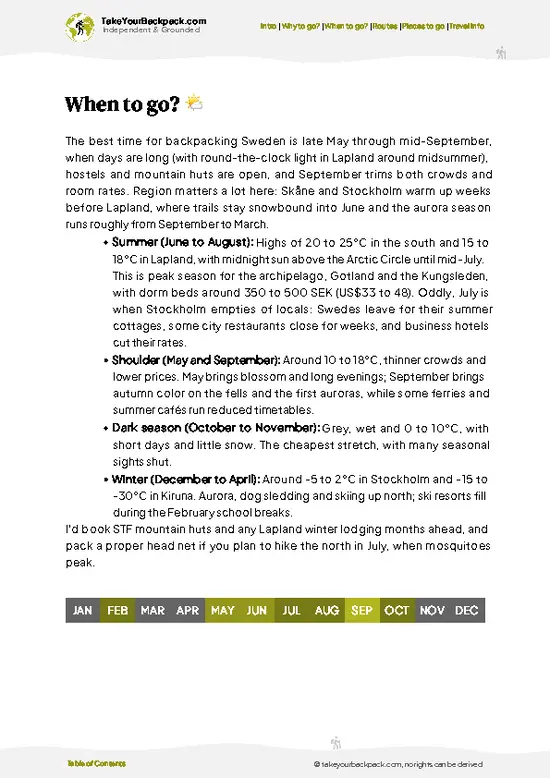
source: climatestotravel.comJANJanuary: good for travelingFEBFebruary: good for travelingMARMarch: fair for travelingAPRApril: fair for travelingMAYMay: highly recommended for travelingJUNJune: excellent for travelingJULJuly: excellent for travelingAUGAugust: highly recommended for travelingSEPSeptember: highly recommended for travelingOCTOctober: fair for travelingNOVNovember: fair for travelingDECDecember: good for traveling
when-to-go

✈️ The backpacker research shortcutSweden Travel Guide

An offline-friendly backpacking guide with optimized travel routes, ranked highlights, transport advice, and the best areas to stay.
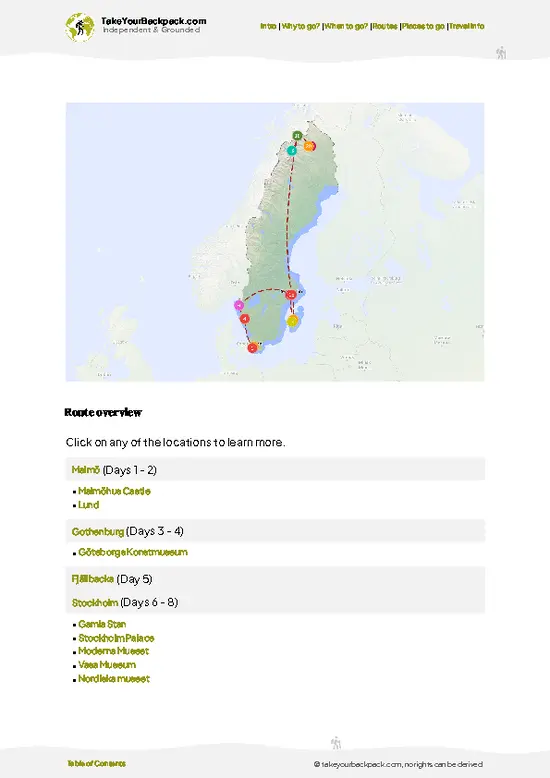
example page 0 from our offline Travel Guide for Sweden
example page 1 from our offline Travel Guide for Sweden
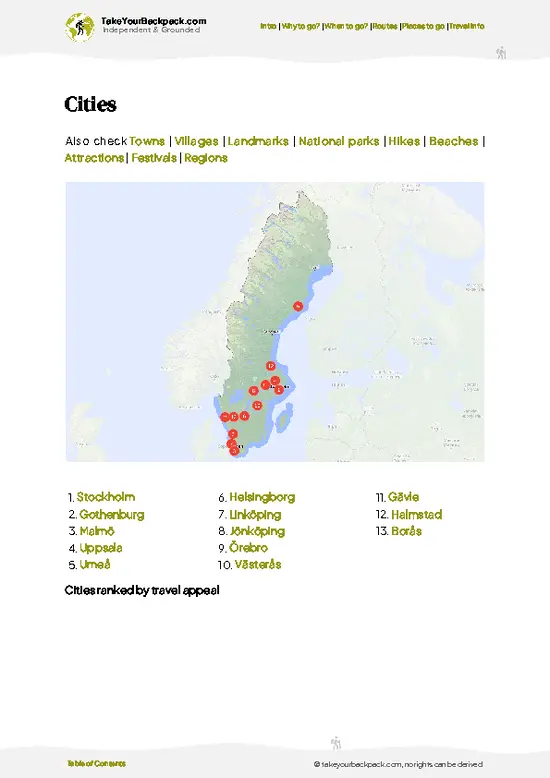
example page 2 from our offline Travel Guide for Sweden
example page 3 from our offline Travel Guide for Sweden
example page 4 from our offline Travel Guide for Sweden
example page 5 from our offline Travel Guide for Sweden
example page 6 from our offline Travel Guide for Sweden
example page 7 from our offline Travel Guide for Sweden
The digital guide (446 pages) contains:
119 highlights, ranked by travel appeal
Optimized 5, 10 & 15-day travel routes
Cities, national parks, landmarks, beaches
How to get around
Offline-friendly for travel without Wi-Fi
👉 Click to see all 30+ guide features

📅 Plan smarter in minutes, not weeks
Month by month travel advice
Festivals & national holidays
Budget expectations

🗺️ Go to the right places, skip the overrated ones
Honest pros & cons of destinations
Top hikes, parks & viewpoints
Lesser-known places most travelers miss
Clear “worth it vs skip it” guidance

🛏️ Travel smoothly without rookie mistakes
Best areas to stay
Transport systems explained simply
Common scams & safety advice
SIM cards, money & practical tips

🌍 Understand the country, not just visit it
Culture & traditions
52 Essential phrases & customs
Festivals worth planning around
Traveler-friendly historical context
Insights that make places more meaningful

📱 Built for real travel conditions
Fully downloadable PDF
Works completely offline
Optimized for phone use
Useful in remote areas & buses
Everything in one place
Save weeks of stressful planning
Get instant access to your full guide. 30‑day money-back guarantee.


By proceeding you agree to our terms.
Sent to your inbox immediately after payment • 100% Secure Checkout
Best Backpacking Travel Advisor 2025 tourism awardBest Backpacking
Travel Advisor
2025
What others say about Take Your Backpack Guides:
⭐⭐⭐⭐⭐
Fantastic, amazing amount of information!
⭐⭐⭐⭐⭐
My goodness this is amazing, it's what I've been looking for hats off too you!
⭐⭐⭐⭐⭐
I think this is absolutely BRILLIANT
⭐⭐⭐⭐
Very complete and informative. It's still missing places, but I gotta to commend you
⭐⭐⭐⭐⭐
This is truly amazing, thank you, can't wait to explore it with my kids!
⭐⭐⭐⭐⭐
Awesome resource, thank you!
⭐⭐⭐⭐⭐
This is amazing! Can't wait to explore the ones I haven't seen
⭐⭐⭐⭐
I love this! Well done, great idea.
⭐⭐⭐⭐⭐
Thanks for taking the time to make this gem!
⭐⭐⭐⭐⭐
This might be the best website I've ever seen.
⭐⭐⭐⭐⭐
Congratulations, and thank you so much for your work; it's incredibly valuable.
⭐⭐⭐⭐
In all seriousness I think you did a great job pointing out the important spots
⭐⭐⭐⭐⭐
10/10 very good
⭐⭐⭐⭐⭐
As someone who's only just starting to visit regularly this is awesome, thank you.
⭐⭐⭐⭐
Thank you very much! I'm going to visit my dad, it's going to be very useful!
⭐⭐⭐⭐⭐
This is really cool! We'll be travelling for the first time and this definitely come in handy.
⭐⭐⭐⭐⭐
You are now our minister of culture, congratulations 👨‍💼
⭐⭐⭐⭐⭐
Just wanted to tell you that this is a pearl! Going to follow your recommendations.
⭐⭐⭐⭐⭐
This is so cool. I'll definitely be using the resource for my travels soon.
⭐⭐⭐⭐⭐
This is very impressive! Good work.
⭐⭐⭐⭐⭐
This is an amazing and informative site. Very well done!

🛏️ Where to stay?Best areas to stay in Sweden

Kiruna’s heart for backpackers beats strongest around the central district, where the town’s pulse is easiest to catch. Staying near the railway station isn’t just about convenience; it’s where the town’s rhythm syncs with the traveler’s pace. This area hums with a quiet energy—easy access to buses, shops, and eateries means you’re never far from the essentials, and the light here shifts dramatically with the seasons, casting long, soft shadows in winter and a persistent glow in summer. It’s a practical base that feels alive without overwhelming.

Compared to the outskirts, which can feel isolated … read more 👉
Kiruna’s heart for backpackers beats strongest around the central district, where the town’s pulse is easiest to catch. Staying near the railway station isn’t just about convenience; it’s where the town’s rhythm syncs with the traveler’s pace. This area hums with a quiet energy—easy access to buses, shops, and eateries means you’re never far from the essentials, and the light here shifts dramatically with the seasons, casting long, soft shadows in winter and a persistent glow in summer. It’s a practical base that feels alive without overwhelming.

Compared to the outskirts, which can feel isolated and require a car, the central neighborhood offers a social atmosphere that’s crucial for solo backpackers craving connection. Hostels cluster here, creating a natural meeting point for travelers swapping stories over coffee or planning northern lights chases. The vibe is low-key but welcoming, with a mix of locals and visitors that keeps things grounded and genuine.

Venturing beyond the center, you’ll find quieter residential zones, but these lack the buzz and easy access that make backpacking smooth. In Kiruna, the best stay isn’t just about a roof—it’s about stepping into a community that’s as ready for adventure as you are, where every street corner hints at the next story waiting to unfold.

🚌 Getting aroundGetting around like a local

Kiruna moves at its own pace, a rhythm carved by the Arctic light and the long shadows of winter. It’s not a place where you’ll find the relentless tick of a city clock, but rather a flow shaped by nature’s stubborn hold and the practical needs of a mining town. The air carries a crispness that sharpens your senses, and the streets—quiet, often dusted with snow—invite you to slow down and tune in. Here, transit isn’t about rushing; it’s about syncing with the sparse but steady pulse of a community that knows how to make distance feel manageable without losing its edge.


  • Walking: Kiruna’s compact center is best explored on foot. The crisp Arctic air and low winter sun create a tactile experience—each step crunching on frosted pavement or soft snow. Most key spots, including the town square,
read more 👉
Kiruna moves at its own pace, a rhythm carved by the Arctic light and the long shadows of winter. It’s not a place where you’ll find the relentless tick of a city clock, but rather a flow shaped by nature’s stubborn hold and the practical needs of a mining town. The air carries a crispness that sharpens your senses, and the streets—quiet, often dusted with snow—invite you to slow down and tune in. Here, transit isn’t about rushing; it’s about syncing with the sparse but steady pulse of a community that knows how to make distance feel manageable without losing its edge.


  • Walking: Kiruna’s compact center is best explored on foot. The crisp Arctic air and low winter sun create a tactile experience—each step crunching on frosted pavement or soft snow. Most key spots, including the town square, shops, and the Kiruna Church, are within a 15-20 minute walk. Walking is free, naturally, and the best way to absorb the town’s quiet character.


  • Local Bus (Länstrafiken Norrbotten): The bus network is sparse but reliable, with routes connecting Kiruna to nearby neighborhoods and the airport. Buses typically run from early morning (around 6:30 AM) until early evening (around 6 PM), with fewer runs on weekends. A single ticket costs about 40 SEK, and the ride is smooth but not luxurious—think practical warmth over plush comfort.


  • Airport Shuttle Bus: For budget travelers flying in or out, the shuttle between Kiruna Airport and the town center is essential. It runs on a schedule synced with flight arrivals and departures, usually starting early morning and ending late evening. Tickets hover around 60 SEK. The shuttle is straightforward—no frills, just a steady, warm ride through the stark, open landscape.


  • Taxi: Taxis are available but pricey compared to other options, with fares starting around 150 SEK for short trips within town. They’re best reserved for late-night returns or when you’re hauling heavy gear. The cars are clean and heated, a cozy refuge from the biting cold, but not the go-to for budget travelers.


  • Bicycle (Seasonal): In summer, renting a bike can be a surprisingly efficient way to cover more ground. Kiruna’s flat terrain and long daylight hours make cycling a breeze. Rentals cost roughly 150-200 SEK per day. Winter cycling is possible but demands serious gear and confidence on icy roads—definitely not for the faint-hearted.

👛 Costs (as of 29 August 2025)Travel costs and budget guide for Kiruna

Backpacking in Kiruna, Sweden, comes with a price tag that reflects its remote Arctic location and unique cultural landscape. Here’s a breakdown of what you can expect to spend daily as an independent traveler.
  • Dorm Accommodation: Hostels in Kiruna typically charge between 30 and 50 USD per night for a dorm bed. These places are basic but clean, often with a cozy, woodsy vibe that matches the northern surroundings. Booking ahead is smart, especially in peak seasons when the Northern Lights draw crowds.
  • Meals: Eating out leans toward the pricey side. A simple meal at a casual café or takeaway spot will run you about 15 to 25 USD. If you shop at local grocery stores and cook, you can bring this down to around 8 to 12 USD per day, but fresh produce and imported goods can push costs up.
  • Local
read more 👉
Backpacking in Kiruna, Sweden, comes with a price tag that reflects its remote Arctic location and unique cultural landscape. Here’s a breakdown of what you can expect to spend daily as an independent traveler.
  • Dorm Accommodation: Hostels in Kiruna typically charge between 30 and 50 USD per night for a dorm bed. These places are basic but clean, often with a cozy, woodsy vibe that matches the northern surroundings. Booking ahead is smart, especially in peak seasons when the Northern Lights draw crowds.
  • Meals: Eating out leans toward the pricey side. A simple meal at a casual café or takeaway spot will run you about 15 to 25 USD. If you shop at local grocery stores and cook, you can bring this down to around 8 to 12 USD per day, but fresh produce and imported goods can push costs up.
  • Local Transport: Kiruna is small, and many spots are walkable, but buses are available for about 3 to 5 USD per ride. If you plan to explore the surrounding wilderness or nearby attractions, consider budgeting for occasional taxi rides or renting a bike, which can cost around 20 to 40 USD per day.
  • Basic Activities/Entry Fees: Many natural attractions like hiking trails are free, but guided tours or entry to cultural sites such as the Icehotel or Sami museums typically cost 20 to 50 USD. Winter activities like dog sledding or snowmobiling push this higher, so plan accordingly if you want the full Arctic experience.
  • Miscellaneous Expenses: This covers essentials like water, snacks, occasional coffee, or small souvenirs. Expect to spend around 5 to 10 USD daily here, though it can vary depending on your habits and the season.

All told, a realistic daily budget for Kiruna ranges from about 60 to 130 USD. The lower end suits those who cook and stick to free or low-cost activities, while the higher end reflects a more comfortable pace with guided tours and dining out. The crisp, clean air and long twilight hours make every dollar feel like an investment in a rare Arctic adventure.


source: visitsweden.com
⚠️ Prices can change and everyone travels differently, so take this as a rough guide. Hope it helps you plan your adventure!

🚌 Day tripsBest day trips from Kiruna

Kiruna is a backpacker’s dream base, offering easy access to some of Sweden’s most captivating landscapes. The town itself is a blend of modernity and tradition, with the crisp air carrying hints of pine and wood smoke. Here are some day trips that will elevate your adventure.

Abisko National Park
Just a 90-minute train ride from Kiruna, Abisko is a paradise for nature lovers. The park is famous for its stunning views and the chance to see the Northern Lights in winter. In summer, the hiking trails burst with wildflowers and the scent of fresh earth. A round-trip ticket costs around 200 SEK. Don’t miss the chairlift to Nuolja for panoramic views; many first-timers skip it, thinking they can hike up. Trust me, the ride is worth it.


Icehotel in Jukkasjärvi
Only 20 minutes away, the … read more 👉
Kiruna is a backpacker’s dream base, offering easy access to some of Sweden’s most captivating landscapes. The town itself is a blend of modernity and tradition, with the crisp air carrying hints of pine and wood smoke. Here are some day trips that will elevate your adventure.

Abisko National Park
Just a 90-minute train ride from Kiruna, Abisko is a paradise for nature lovers. The park is famous for its stunning views and the chance to see the Northern Lights in winter. In summer, the hiking trails burst with wildflowers and the scent of fresh earth. A round-trip ticket costs around 200 SEK. Don’t miss the chairlift to Nuolja for panoramic views; many first-timers skip it, thinking they can hike up. Trust me, the ride is worth it.


Icehotel in Jukkasjärvi
Only 20 minutes away, the Icehotel is a marvel of creativity and craftsmanship. Even if you don’t stay overnight, a guided tour reveals the artistry behind this icy wonder. Expect to pay about 250 SEK for entry. The best time to visit is during the winter months when the hotel is fully constructed. Many backpackers overlook the nearby village, which offers cozy cafes and local crafts.


Riksgränsen
For the adventurous, Riksgränsen is a must-visit, especially for skiing or snowboarding. It’s about a two-hour bus ride, and you can find day passes for around 600 SEK. The slopes are less crowded than in larger resorts, giving you a chance to carve your own path. Many first-timers underestimate the cold; dress in layers to fully enjoy the experience.


Kungsleden Trail
The Kungsleden, or King’s Trail, is a legendary hiking route that starts near Kiruna. You can tackle a section of it in a day, with stunning views of mountains and lakes. A bus to the trailhead takes about an hour and costs around 150 SEK. Late summer is ideal, as the trails are clear and the weather mild. A common mistake is underestimating the terrain; sturdy boots are essential for comfort.
Want to know what more Sweden offers?
The Sweden Travel Guide describes 119 highlights, from cities to national parks, from beaches to hikes

Get the Travel Guide -

🛡️ SafetyScams, Hazards, and Annoyances

Kiruna is generally safe, but staying aware enhances your experience. Stick to well-lit areas at night, especially around the train station and main square. Solo travelers should trust their instincts; if something feels off, it probably is.

While scams are rare, be cautious of overly friendly locals offering unsolicited help. It’s wise to keep your belongings close, especially in busy spots like the market. The cold can be annoying, so layer up to stay comfortable. Embrace the chill; it’s part of Kiruna’s charm.

Other Swedish towns near Kiruna

Explore more nearby:

  • Jokkmokk—Sámi culture, Arctic circle, winter market| 140 km away
  • Luleå—ice roads, coastal archipelago, Gammelstad church town| 265 km away
  • Skellefteå—wooden bridges, cultural center, northern rivers| 346 km away

💡 Not sure where to go next?
Create a personalized itinerary for Sweden including Kiruna and the places that fit your trip.

Generate my itinerary

👉 Discover all towns

Or checkout all Sweden has to offer (think cities, towns, villages, national parks, hikes, beaches, festivals)
Country photo of Sweden

We 💚 feedbackKey takeaways before you go

Kiruna’s raw beauty is magnetic—the Northern Lights dance above, and the crisp air fills your lungs with a sense of adventure. But be ready for the cold; it bites. Dress wisely, and you’ll unlock a winter wonderland that feels like a dream come true.

✈️ When did I visit Sweden?
Having played floorball (famous sport in Sweden, known as innebandy) for many years, I have visited Sweden many times too in the years between 1999 and 2012.

✍️ Help improve this page!
The information on this page is based on my own backpacking experience in Sweden, supplemented with up-to-date research and feedback from other travelers. Travel details can change, so if you notice anything outdated or incomplete, feel free to let me know.


🙋‍♂️ Give feedback

👋 Meet the founderWho’s Behind Take Your Backpack?

Johan, backpacker and founder of TakeYourBackpackHi, I’m Johan (Netherlands 🇳🇱), the creator of TakeYourBackpack. Over the past decade, I’ve backpacked through 80+ countries across six continents, gaining extensive experience with independent travel, long-term trips, and overland routes.

This site is built on a combination of firsthand travel experience and carefully curated insights from other backpackers. Many guides are based on places I’ve personally visited, while others bring together tips, observations, and practical advice shared by trusted travelers I’ve met along the way.

The goal is to provide realistic, experience-driven guidance — not generic itineraries — so you can explore destinations with better context, clearer expectations, and more confidence.

Get full Sweden guide •
Instant download • 119 highlights • Full Offline guide