v2.webp)
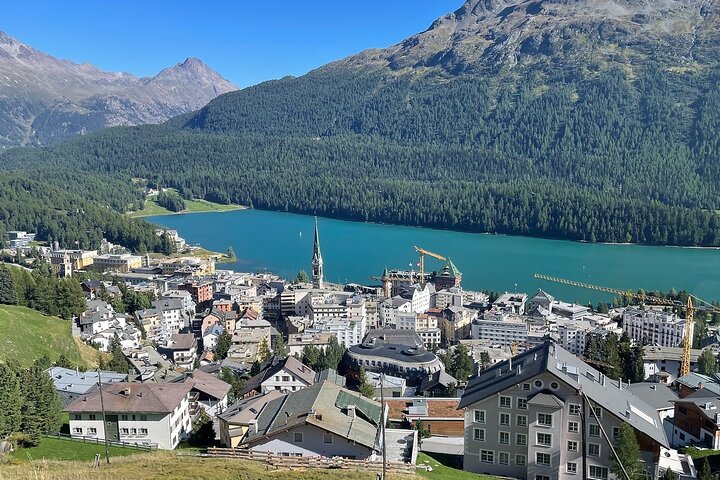
- Lake St. Moritz (Lej da San Murezzan) — The town’s heartbeat: a perfectly framed mountain lake for strolls, sunbathing in summer and fastening your spikes in winter when it freezes into a pale-white event stage (horse racing, polo, White Turf). Great for people-watching and photo ops any season.
- Segantini Museum — A small, atmospheric museum dedicated to Giovanni Segantini, the painter who defined Alpine symbolist landscapes. The collection and the setting above the lake make it easy to understand why the mountains obsessed him.
- Badrutt’s Palace Hotel (lobby & terrace) — You don’t need to be a guest to enjoy the theatrical lobby, historic photos and the famous terrace view over the lake. It’s where alpine glamour was invented; perfect for a (reasonably priced) coffee and people-watching
- Lake St. Moritz (Lej da San Murezzan) — The town’s heartbeat: a perfectly framed mountain lake for strolls, sunbathing in summer and fastening your spikes in winter when it freezes into a pale-white event stage (horse racing, polo, White Turf). Great for people-watching and photo ops any season.
- Segantini Museum — A small, atmospheric museum dedicated to Giovanni Segantini, the painter who defined Alpine symbolist landscapes. The collection and the setting above the lake make it easy to understand why the mountains obsessed him.
- Badrutt’s Palace Hotel (lobby & terrace) — You don’t need to be a guest to enjoy the theatrical lobby, historic photos and the famous terrace view over the lake. It’s where alpine glamour was invented; perfect for a (reasonably priced) coffee and people-watching with style.
- Kulm Hotel and Kulm Park — One of St. Moritz’s founding grand hotels with old-school winter-sports pedigree. The park and hotel terrace are pleasant to wander; you’ll feel the history of alpine tourism and get great views without a lift ticket.
- The Cresta Run (Cresta Club area) — The only natural ice skeleton track in the world. You can’t jump on a sled without experience, but watching runs, visiting the club area, or timing your visit for a public event gives a hands-on sense of local winter sport culture.
- St. Moritz Casino — A Belle Époque building on the lakefront that rounds out the town’s high-society history. Even if you skip gambling, the interior and the people inside tell you a lot about why St. Moritz became a playground for the wealthy.
- Via Serlas and Via Maistra (Engadin streets) — The compact center’s mix of luxury boutiques, traditional Engadin houses with sgraffito façades, and cafés. Best experienced on foot — it’s where old alpine life and contemporary tourism collide in a few lively blocks.
- St. Mauritius Church (Dorf Church) — A modest, historic parish church in the old village with typical Engadin stonework and a peaceful graveyard. Gives a quieter, more local counterpoint to the glitz around the lake.
- St. Moritz Railway Station (Rhaetian Railway terminus) — More than a transit hub: the red trains and timetables are part of the landscape. It’s a practical place to experience Swiss alpine rail culture and the jump-off point for scenic rides like the Bernina line.
- Chesa Futura (Zaha Hadid building) — A striking modern architectural contrast to the traditional town: a bold contemporary building by Zaha Hadid that’s worth seeing for design fans and for the way it highlights St. Moritz’s mix of old and new.
Spotted a mistake or missing something? Contact us.

St Moritz & Swiss Alps Day Trip with Bernina Red Train from Milan

From Milan: St. Moritz and Panoramic Bernina Express Tour

Explore St. Moritz in 60 minutes with a Local

Bernina Red Train Experience
St Moritz Private Guided Panorama Hike

Lake, Legends & Luxury: A St. Moritz Walking Experience

Private Transfer from Sankt-Moritz to Zurich Airport

St Moritz, Switzerland to Malpensa Airport (MXP) -Departure Private Transfer

Ski & Snowboard Lesson - 3 Hours St Moritz


 Best Backpacking
.jpg) Hi, I’m Johan (Netherlands 🇳🇱), the creator of TakeYourBackpack. Over the past 3 decades, I’ve backpacked through 90+ countries across six continents, gaining extensive experience with independent travel, long-term trips, and overland routes.
Hi, I’m Johan (Netherlands 🇳🇱), the creator of TakeYourBackpack. Over the past 3 decades, I’ve backpacked through 90+ countries across six continents, gaining extensive experience with independent travel, long-term trips, and overland routes.