×

Switzerland🇨🇭 | best townsThe Must-See 10 towns in Switzerland

Swiss towns are small, orderly and unusually well connected, but they split into distinct types by region. In the German-speaking north and center, medieval old towns sit on rivers and lakes, with arcades, fountains and trains every 30 minutes. The French-speaking west brings lakeside wine terraces and a softer pace. The Italian-speaking south in Ticino adds palm-lined promenades and a warmer climate. Alpine resort towns deliver mountain access at the highest prices, while lowland towns cost noticeably less. For backpackers and other independent travelers, the choice comes down to cost versus scenery: Switzerland’s dense rail network makes every type reachable without a car, so you can pick by atmosphere rather than logistics.

By Johan Kruseman 🇳🇱 | Updated October 19, 2026
Explore the best villages in Switzerland

Why go?Why Travelers Love These Spots

Switzerland suits town travel because its political history never produced one dominant capital. For centuries, cantons governed themselves, and each kept its own guild halls, market squares, town walls and local identity. That decentralization explains why even places of 10,000 to 30,000 people have full old quarters, museums and a distinct dialect or language.

Geography shaped the layout. Towns grew where rivers exit lakes, at mountain passes and along trade routes, so many are compact, walkable and set directly against water or slopes. Strict planning and heritage rules have preserved historic centers, and the country largely avoided wartime destruction, which is why old buildings survive in such quantity.

The infrastructure is the real advantage. Trains, buses and lake boats run on a … read more 👉
Switzerland suits town travel because its political history never produced one dominant capital. For centuries, cantons governed themselves, and each kept its own guild halls, market squares, town walls and local identity. That decentralization explains why even places of 10,000 to 30,000 people have full old quarters, museums and a distinct dialect or language.

Geography shaped the layout. Towns grew where rivers exit lakes, at mountain passes and along trade routes, so many are compact, walkable and set directly against water or slopes. Strict planning and heritage rules have preserved historic centers, and the country largely avoided wartime destruction, which is why old buildings survive in such quantity.

The infrastructure is the real advantage. Trains, buses and lake boats run on a coordinated clock-face timetable, so transfers are short and reliable, and the Swiss Travel Pass or Half Fare Card can cut costs substantially.

Before choosing Switzerland, know that it is among the most expensive countries in the world. A coffee often costs CHF 4 to 5 and a restaurant meal CHF 25 to 40. Four national languages mean signage, food and manners change within an hour of travel. Shops close early and on Sundays, and quiet hours are taken seriously.
Evaluating the Top Choices
The list of best towns in Switzerland is created based on charm, local culture, atmosphere, hidden gems, and visitor appeal. If you feel a town is missing in this list, please let us know.

When to go?Optimal Periods for Travel

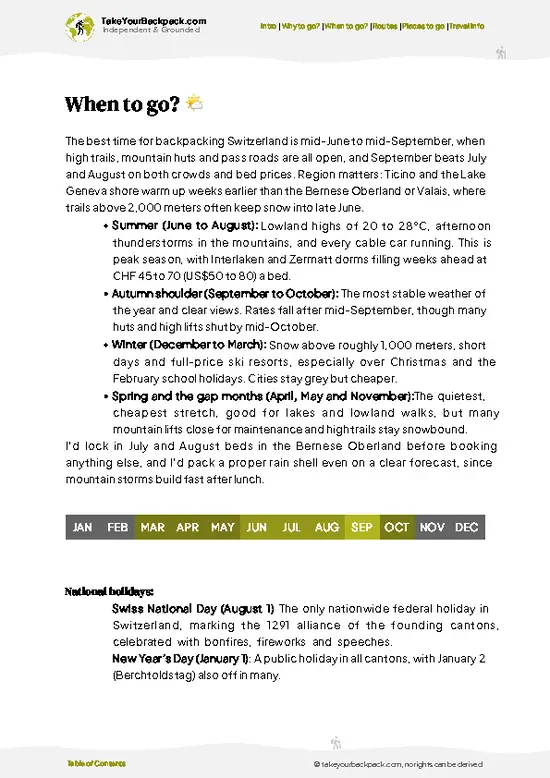
Best months and why: The best months for towns in Switzerland are May to June and September to early October, when daytime highs of 15 to 24°C (59 to 75°F) suit walking, terraces are open and crowds are thinner than in midsummer. Snow has left the lowlands by April, and lake boats run full schedules from late spring.

Summer and peak periods: July and August bring highs of 24 to 30°C (75 to 86°F) in the lowlands and the heaviest visitor numbers. Lakeside towns on Lake Geneva, Lake Lucerne and Lake Zurich are at their best for swimming, but alpine resort towns raise accommodation prices by roughly 20 to 40 percent. Afternoon thunderstorms are common in the mountains, and July is among the wetter months, with around 100 to 130 mm of rain in many places.

Winter and shoulder seasons: December … read more 👉
Best months and why: The best months for towns in Switzerland are May to June and September to early October, when daytime highs of 15 to 24°C (59 to 75°F) suit walking, terraces are open and crowds are thinner than in midsummer. Snow has left the lowlands by April, and lake boats run full schedules from late spring.

Summer and peak periods: July and August bring highs of 24 to 30°C (75 to 86°F) in the lowlands and the heaviest visitor numbers. Lakeside towns on Lake Geneva, Lake Lucerne and Lake Zurich are at their best for swimming, but alpine resort towns raise accommodation prices by roughly 20 to 40 percent. Afternoon thunderstorms are common in the mountains, and July is among the wetter months, with around 100 to 130 mm of rain in many places.

Winter and shoulder seasons: December to February averages around 0°C (32°F) in the Swiss Plateau, often under low fog that can last for days. Christmas markets in late November and December make German-speaking old towns appealing, while ski resort towns peak from late December to March at their highest prices. Ticino stays milder, with winter highs near 8 to 10°C (46 to 50°F) and more sunshine than north of the Alps.

In April and November, many mountain lifts, hotels and restaurants close for the off-season, so alpine towns can feel shut down. Lowland towns stay fully open all year.

town hoppingSuggested Travel Strategies

How many days to plan: A trip combining several towns in Switzerland needs 7 to 12 days, enough for four to six stops without constant packing. The country is small, but mountains and lakes make trips between regions slower than the map suggests.

Which regions group well: Cluster by region, using Zurich, Bern and Lucerne as the main rail hubs. The German-speaking north and center fits together in a loop, with most links taking 30 to 90 minutes. The French-speaking west along Lake Geneva connects to Bern in about 1 to 1.5 hours. Ticino sits behind the Alps, so reaching it from Zurich takes roughly 2 hours through the Gotthard Base Tunnel, and 3 to 4 hours from Geneva or Valais.

A sensible direction runs north to south or west to east, ending in Ticino or the Alps, so the longest transfer … read more 👉
How many days to plan: A trip combining several towns in Switzerland needs 7 to 12 days, enough for four to six stops without constant packing. The country is small, but mountains and lakes make trips between regions slower than the map suggests.

Which regions group well: Cluster by region, using Zurich, Bern and Lucerne as the main rail hubs. The German-speaking north and center fits together in a loop, with most links taking 30 to 90 minutes. The French-speaking west along Lake Geneva connects to Bern in about 1 to 1.5 hours. Ticino sits behind the Alps, so reaching it from Zurich takes roughly 2 hours through the Gotthard Base Tunnel, and 3 to 4 hours from Geneva or Valais.

A sensible direction runs north to south or west to east, ending in Ticino or the Alps, so the longest transfer happens once and you do not backtrack.

Time per stop and common mistakes: Allow one to two nights in most old towns and two or three in an alpine resort, where weather and lifts decide the day. The classic error is overpacking, with a new town every night, which wastes mornings on luggage and platforms. Another is ignoring mountain passes: scenic routes such as the Glacier Express take 8 hours or more for a trip a fast train covers in half that. Choose scenic lines for one segment, and use direct InterCity trains for the rest.

The ListMust-Visit towns in Switzerland

1 Zermatt

Matterhorn views, car-free village, glacier access

Arrive by train, hike beneath iconic peaks, and use mountain lifts for year-round access to high alpine terrain.

switzerland-city-zermatt
© Google | Reane Delseth

2 Lucerne

covered bridge, lakeside quay, mountain backdrop

Cross medieval bridges, board ferries for scenic rides, and ascend nearby peaks for sweeping views over the city and lake.

switzerland-city-lucerne
© Google | Benny Davidian

3 Interlaken

adventure sports, valley crossroads, lake cruises

Book paragliding or canyoning, transfer between lakes by train, and use the town as a launch point for the Bernese Alps.

switzerland-city-interlaken
© Google | Natalka

4 St. Moritz

alpine lakes, luxury hotels, winter sports legacy

Ski or hike above sparkling lakes, glimpse the origins of winter tourism, and observe a blend of alpine tradition and modernity.

5 Grindelwald

glacier views, hiking base, mountain railways

Set out on classic alpine hikes, ride cogwheel trains to high passes, and watch the north face of the Eiger catch evening light.

6 Lugano

palm trees, Italianate squares, hillside parks

Relax in lakeside gardens, explore open-air markets, and climb steep lanes for views across the southern Alps.

7 Davos

high plateau, conference venues, cross-country ski trails

Access extensive winter sports, attend international events, and find quiet alpine corners beyond the main thoroughfares.

8 Ascona

lakefront promenade, Mediterranean gardens, art galleries

Stroll along palm-lined shores, browse contemporary art, and enjoy mild evenings overlooking Lake Maggiore’s tranquil waters.

9 Engelberg

monastery, glacier access, cable cars

Ride lifts to high-altitude trails, visit a working monastery, and explore year-round snowfields above a compact mountain town.

10 Bellinzona

medieval castles, stone walls, Saturday market

Walk fortified ramparts, explore UNESCO-listed castles, and sample regional produce in a town shaped by centuries of border trade.

11 Schaffhausen

Rheinfall, frescoed facades, turreted old town

Stand beside Europe’s largest waterfall, explore painted merchant houses, and climb towers for river views.

12 Thun

castle hill, river islands, covered bridges

Wander between river channels, climb to a hilltop fortress, and watch local life unfold along the waterfront squares.

switzerland-city-thun
© Google |

13 Vevey

lakefront market, food museums, vineyard slopes

Sample regional produce at open-air stalls, visit culinary exhibits, and walk terraced hillsides above Lake Geneva.

14 Appenzell

painted houses, alpine meadows, cheese dairies

Hike through rolling hills, encounter traditional crafts, and sample local cheeses in a region where rural customs remain central.

switzerland-city-appenzell
© Google | Ari Po

15 Fribourg

Gothic cathedral, river gorge, student quarter

Descend steep lanes to riverside quarters, sample local fondue, and observe daily life shaped by a large university population.

16 Neuchâtel

lakeside château, Belle Époque facades, watch museums

Tour ornate buildings, visit horology exhibits, and enjoy sunset walks along the lakefront promenade.

17 Sion

hilltop fortresses, vineyards, Roman ruins

Walk between ancient castles, taste local wines, and discover remnants of Roman settlement in the valley below.

18 Solothurn

baroque architecture, riverside terraces, clock towers

Admire ornate facades, linger at open-air cafés by the Aare, and climb historic towers for city panoramas.

19 Arosa

mountain lakes, high-altitude trails, wildlife sanctuary

Experience crisp mountain air, spot marmots and ibex, and access panoramic hikes directly from the village edge.

switzerland-city-arosa
© Google |

20 Rapperswil

rose gardens, lakeside castle, wooden footbridge

Visit a hilltop castle, stroll through seasonal blooms, and cross the lake on Switzerland’s longest wooden bridge.

21 Biel

bilingual culture, watchmaking heritage, lakeside parks

Navigate a city where French and German meet, discover industrial history, and relax by the water’s edge after urban exploration.

22 Murten

rampart walkways, medieval arcades, lakeshore

Circle the old town atop preserved walls, browse shaded arcades, and swim or paddle in the shallow lake nearby.

23 Estavayer-le-Lac

medieval ramparts, lake beaches, water sports

Swim in clear lake waters, walk fortified walls, and try windsurfing or kayaking in a relaxed lakeside setting.

24 Chur

oldest city, cobbled alleys, mountain gateway

Wander ancient streets, uncover Roman roots, and use efficient rail links to reach remote valleys and alpine resorts.

Think you know Switzerland?

Prove you’re a true local — uncover 14 lesser-known towns in Switzerland that locals tend to keep to themselves.
Loading the map 🌍

Expert viewInsights from Locals and Experts

How many towns to visit: I advise four to six towns on a trip of one to two weeks. Swiss rail makes it easy to do more, but each old quarter takes only half a day to see properly, while lakes, hikes and viewpoints around them need extra time. Fewer stops also reduce hotel check-ins and luggage handling, and that saves money on transit.

Which kinds to prioritize: Choose by style. Travelers on tight budgets should favor lowland and mid-sized towns in the German-speaking regions, where hostels, supermarkets and free sights are plentiful. Hikers should pick alpine towns for trailheads and cable cars, accepting higher prices. Those who want warmth, Italian food and lake swimming should add one Ticino town. Wine and relaxed terraces suit the Lake Geneva region. Mixing one resort town with several … read more 👉
How many towns to visit: I advise four to six towns on a trip of one to two weeks. Swiss rail makes it easy to do more, but each old quarter takes only half a day to see properly, while lakes, hikes and viewpoints around them need extra time. Fewer stops also reduce hotel check-ins and luggage handling, and that saves money on transit.

Which kinds to prioritize: Choose by style. Travelers on tight budgets should favor lowland and mid-sized towns in the German-speaking regions, where hostels, supermarkets and free sights are plentiful. Hikers should pick alpine towns for trailheads and cable cars, accepting higher prices. Those who want warmth, Italian food and lake swimming should add one Ticino town. Wine and relaxed terraces suit the Lake Geneva region. Mixing one resort town with several lowland towns keeps the budget manageable and the scenery varied.

What it costs: Plan US$100 to 160 a day (about CHF 90 to 140) on a backpacker budget, with a dorm bed at CHF 40 to 65, supermarket meals from Coop or Migros at CHF 8 to 15, and a bakery lunch at CHF 6 to 10. Mid-range travel runs US$200 to 300. Local transport is the big variable: a short train hop costs CHF 10 to 30, so the Half Fare Card (around CHF 120 for a month) or a Swiss Travel Pass pays off when you take several trips. Most old towns are free to walk, but museums and castles charge CHF 10 to 25, and mountain cable cars can run CHF 50 to 120 return. Tap water is excellent and free from public fountains, so skip bottled water.

Safety and cultural points: Swiss towns are among the safest in the world, with low violent crime, though pickpocketing does occur around main stations and at tourist crowds in summer. Mountain weather is the real hazard, so check forecasts and lift closing times before heading up.

Culturally, punctuality and quiet matter. Trains leave exactly on time, and Sundays and evenings after 10 pm are quiet in residential areas, including loud talk in hostels and on trains. Most shops close on Sundays, so buy food on Saturday. Greet shopkeepers with a “Grüezi” in German-speaking areas or “Bonjour” in the west, since skipping greetings reads as rude. Cards are accepted nearly everywhere, but carry a little cash for mountain huts and small stalls. Tipping is optional, and rounding up the bill is enough.

Note that many towns charge a small visitor tax (CHF 2 to 5 a night), which often comes with a local transport card, so ask for it at check-in.

✈️ The backpacker research shortcutSwitzerland Travel Guide

An offline-friendly backpacking guide with optimized travel routes, ranked highlights, transport advice, and the best areas to stay.
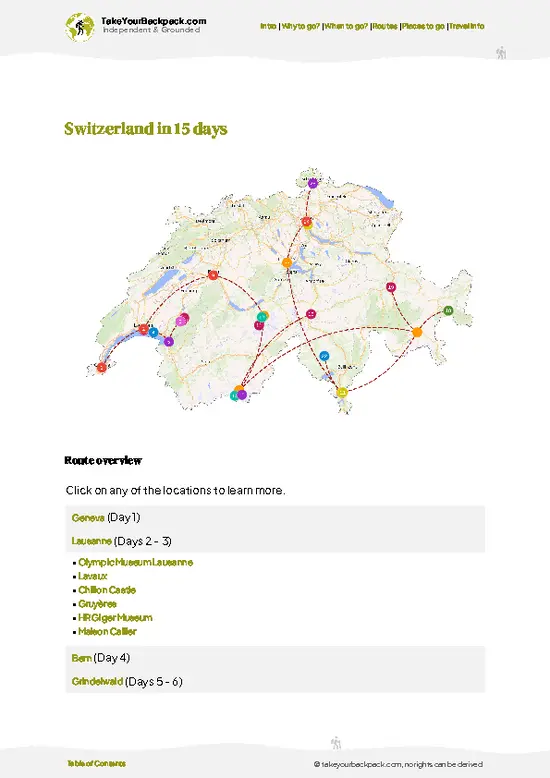
example page 0 from our offline Travel Guide for Switzerland
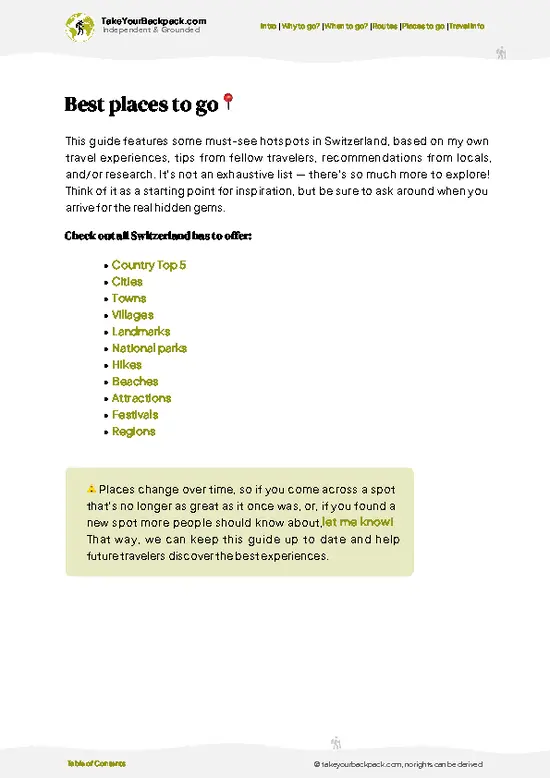
example page 1 from our offline Travel Guide for Switzerland
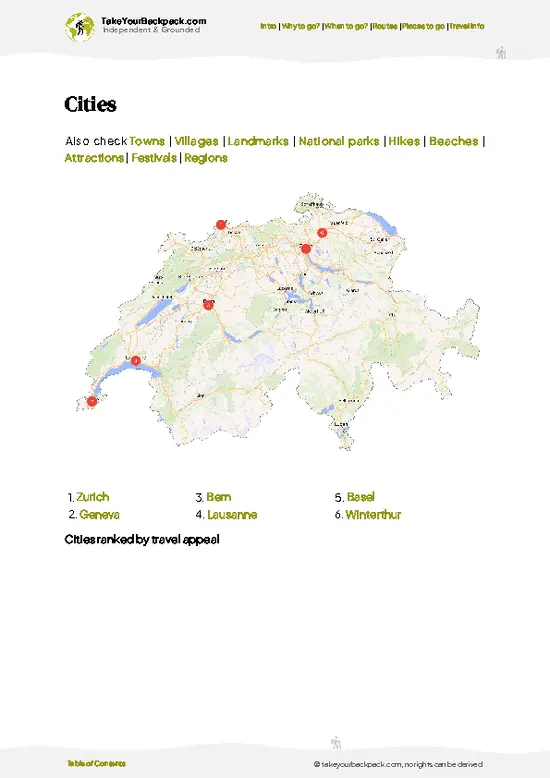
example page 2 from our offline Travel Guide for Switzerland
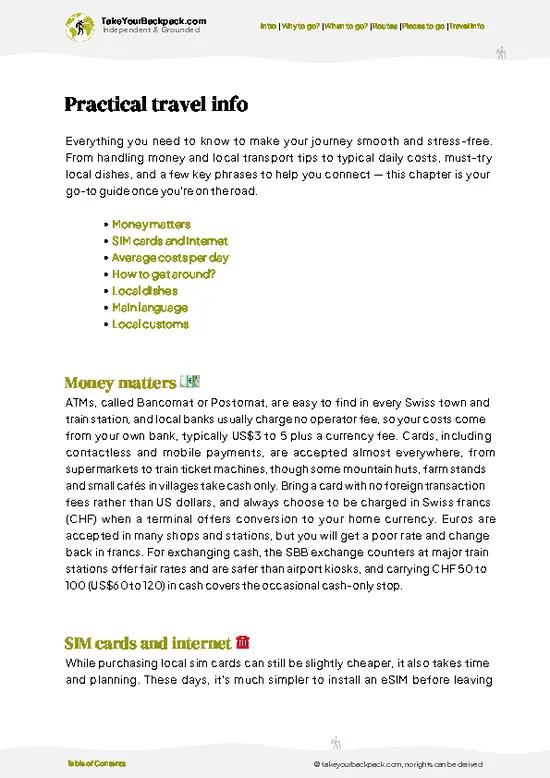
example page 3 from our offline Travel Guide for Switzerland
example page 4 from our offline Travel Guide for Switzerland
example page 5 from our offline Travel Guide for Switzerland
example page 6 from our offline Travel Guide for Switzerland
example page 7 from our offline Travel Guide for Switzerland
The digital guide (432 pages) contains:
✅ 117 highlights, ranked by travel appeal
✅ Optimized 5, 10 & 15-day travel routes
✅ Cities, national parks, landmarks, beaches
✅ How to get around
✅ Offline-friendly for travel without Wi-Fi
👉 Click to see all 30+ guide features

📅 Plan smarter in minutes, not weeks
✅ Month by month travel advice
✅ Festivals & national holidays
✅ Budget expectations

🗺️ Go to the right places, skip the overrated ones
✅ Honest pros & cons of destinations
✅ Top hikes, parks & viewpoints
✅ Lesser-known places most travelers miss
✅ Clear “worth it vs skip it” guidance

🛏️ Travel smoothly without rookie mistakes
✅ Best areas to stay
✅ Transport systems explained simply
✅ Common scams & safety advice
✅ SIM cards, money & practical tips

🌍 Understand the country, not just visit it
✅ Culture & traditions
✅ 52 Essential phrases & customs
✅ Festivals worth planning around
✅ Traveler-friendly historical context
✅ Insights that make places more meaningful

📱 Built for real travel conditions
✅ Fully downloadable PDF
✅ Works completely offline
✅ Optimized for phone use
✅ Useful in remote areas & buses
✅ Everything in one place
Stop searching, start planning
Get instant access to your full guide. 30‑day money-back guarantee.
+ Add another guide for just

By proceeding you agree to our terms.
Sent to your inbox immediately after payment • 100% Secure Checkout
Best Backpacking Travel Advisor 2025 tourism awardBest Backpacking
Travel Advisor
2025
What others say about Take Your Backpack Guides:
⭐⭐⭐⭐⭐
Fantastic, amazing amount of information!
⭐⭐⭐⭐⭐
My goodness this is amazing, it's what I've been looking for hats off too you!
⭐⭐⭐⭐⭐
I think this is absolutely BRILLIANT
⭐⭐⭐⭐
Very complete and informative. It's still missing places, but I gotta to commend you
⭐⭐⭐⭐⭐
This is truly amazing, thank you, can't wait to explore it with my kids!
⭐⭐⭐⭐⭐
Awesome resource, thank you!
⭐⭐⭐⭐⭐
This is amazing! Can't wait to explore the ones I haven't seen
⭐⭐⭐⭐
I love this! Well done, great idea.
⭐⭐⭐⭐⭐
Thanks for taking the time to make this gem!
⭐⭐⭐⭐⭐
This might be the best website I've ever seen.
⭐⭐⭐⭐⭐
Congratulations, and thank you so much for your work; it's incredibly valuable.
⭐⭐⭐⭐
In all seriousness I think you did a great job pointing out the important spots
⭐⭐⭐⭐⭐
10/10 very good
⭐⭐⭐⭐⭐
As someone who's only just starting to visit regularly this is awesome, thank you.
⭐⭐⭐⭐
Thank you very much! I'm going to visit my dad, it's going to be very useful!
⭐⭐⭐⭐⭐
This is really cool! We'll be travelling for the first time and this definitely come in handy.
⭐⭐⭐⭐⭐
You are now our minister of culture, congratulations 👨‍💼
⭐⭐⭐⭐⭐
Just wanted to tell you that this is a pearl! Going to follow your recommendations.
⭐⭐⭐⭐⭐
This is so cool. I'll definitely be using the resource for my travels soon.
⭐⭐⭐⭐⭐
This is very impressive! Good work.
⭐⭐⭐⭐⭐
This is an amazing and informative site. Very well done!

🛏️ Where to stay?Top Places to Consider Staying

Switzerland has a solid hostel network, with dorm beds typically running CHF 35 to 60 (about US$40 to 70) a night, plus campgrounds and simple mountain guesthouses for stretching the budget further. In Zurich, Langstrasse (Kreis 4) packs the cheapest beds and liveliest bars within walking distance of the main station, though weekend nights get loud, while in Geneva the Pâquis district puts you near the lake and station with good inexpensive food but feels a little rough late at night. Interlaken has the country’s densest cluster of backpacker hostels between its two train stations, social and handy for Jungfrau region trains, whereas Lucerne’s Old Town is compact, quiet after dark and a few … read more 👉
Switzerland has a solid hostel network, with dorm beds typically running CHF 35 to 60 (about US$40 to 70) a night, plus campgrounds and simple mountain guesthouses for stretching the budget further. In Zurich, Langstrasse (Kreis 4) packs the cheapest beds and liveliest bars within walking distance of the main station, though weekend nights get loud, while in Geneva the Pâquis district puts you near the lake and station with good inexpensive food but feels a little rough late at night. Interlaken has the country’s densest cluster of backpacker hostels between its two train stations, social and handy for Jungfrau region trains, whereas Lucerne’s Old Town is compact, quiet after dark and a few minutes on foot from the lakefront.

If you enjoy meeting fellow travelers, consider choosing hostels with high ratings for atmosphere. On the other hand, if you prefer having your own space, a hotel might be a better option.

SwitzerlandMore Places Across Switzerland

👋 Meet the founderWho’s Behind Take Your Backpack?

Johan, backpacker and founder of TakeYourBackpackHi, I’m Johan (Netherlands 🇳🇱), the creator of TakeYourBackpack. Over the past 3 decades, I’ve backpacked through 90+ countries across six continents, gaining extensive experience with independent travel, long-term trips, and overland routes.

This site is built on a combination of firsthand travel experience and carefully curated insights from other backpackers. Many guides are based on places I’ve personally visited, while others bring together tips, observations, and practical advice shared by trusted travelers I’ve met along the way.

The goal is to provide realistic, experience-driven guidance — not generic itineraries — so you can explore destinations with better context, clearer expectations, and more confidence.