×

Switzerland🇨🇭 | attractionsSwiss Museum of Transporthistoric vehicles, interactive simulators, aviation hall | things to do and best time to go

Explore Fondation BeyelerExplore Olympic Museum Lausanne

Backpacking in Swiss Museum of Transport
🌟 Highlightattraction ranked #5
By Johan Kruseman 🇳🇱 | Updated May 19, 2026

Forget the Instagram myth: the Swiss Museum of Transport isn’t some sleepy, niche spot for trainspotters or families dodging rain in Lucerne. It’s a full-throttle sensory overload, and yes, it’s packed—especially on weekends and rainy days, when half of Switzerland seems to descend on this lakeside complex just north of Lucerne’s old town. Here’s the straight talk: you’ll pay Swiss prices (entry isn’t cheap, and the planetarium or VR extras add up fast), and you’ll be elbow-to-elbow with everyone from toddlers to tech geeks. But if you’ve ever geeked out over how things move—trains, planes, cable cars, even space travel—this place is a kinetic playground. The sheer scale and interactivity blow most European museums out of the water. It’s not just about Swiss efficiency; it’s about the national obsession with movement, innovation, and precision. For backpackers, it’s a splurge, but the energy is infectious and the hands-on exhibits are a rare chance to play, not just observe.

Discover everything you want to know in the 📖 Switzerland Travel Guide.
Loading the map 🌍
CLICK TO FILTER
cities
towns
villages
landmarks
national parks
hikes
beaches
attractions
festivals
regions
SHOW COUNTRY’S BESTSHOW ALL

✨ Why go?
Ranked #5 attraction in Switzerland
What sets this place apart

The Swiss Museum of Transport isn’t just another stop on the tourist checklist—it’s a full-throttle dive into how Switzerland moved from horse-drawn carts to space-age speed. Yes, it’s popular, and yes, it can get crowded, especially on weekends and holidays. But here’s the kicker: this place is a masterclass in motion. You’re not just looking at old trains or planes behind glass; you’re stepping into the story of Swiss innovation and precision engineering that shaped not only the country but the entire transport world.

Backpackers who carve out time here aren’t just ticking a box—they’re soaking in the cultural pulse of Switzerland’s obsession with efficiency and connectivity. The museum’s hands-on exhibits and historic vehicles offer a rare chance to feel the evolution of travel under your … read more 👉
The Swiss Museum of Transport isn’t just another stop on the tourist checklist—it’s a full-throttle dive into how Switzerland moved from horse-drawn carts to space-age speed. Yes, it’s popular, and yes, it can get crowded, especially on weekends and holidays. But here’s the kicker: this place is a masterclass in motion. You’re not just looking at old trains or planes behind glass; you’re stepping into the story of Swiss innovation and precision engineering that shaped not only the country but the entire transport world.

Backpackers who carve out time here aren’t just ticking a box—they’re soaking in the cultural pulse of Switzerland’s obsession with efficiency and connectivity. The museum’s hands-on exhibits and historic vehicles offer a rare chance to feel the evolution of travel under your fingertips. It’s a milestone on any Swiss route because it breaks up the natural scenery with a jolt of adrenaline and brain fuel. The effort to get here—often in Lucerne, a hub itself—is rewarded with a deep, tactile understanding of how the Swiss keep their country humming. If you want a break from mountains and lakes that actually adds layers to your trip, this museum delivers.
Want to include Swiss Museum of Transport in your Switzerland route?
Create a personalized Switzerland itinerary that includes Swiss Museum of Transport and the places that fit your trip — based on your travel style, budget, and available time. Get your route in seconds.

Generate my trip

💡 HighlightsPlaces and moments you shouldn't skip

The Locomotive Hall
Forget the dainty, polished train sets you see on social media. The Locomotive Hall is a full-throttle, grease-under-the-nails celebration of Swiss rail obsession. You’re not just looking at trains—you’re walking under, around, and sometimes inside them. Steam, electric, and diesel (yes, the real deal) engines are lined up like a mechanical honor guard. The scale is humbling. The best part? You can climb into the cab of a real locomotive and feel the levers and switches that powered Swiss industry. This is not a museum for passive gawkers; it’s for anyone who ever wanted to pull the horn themselves.


The Aviation Hall
Instagram loves a shiny propeller, but the Aviation Hall is a deep dive into the Swiss relationship with flight. You’ll see everything from early gliders … read more 👉
The Locomotive Hall
Forget the dainty, polished train sets you see on social media. The Locomotive Hall is a full-throttle, grease-under-the-nails celebration of Swiss rail obsession. You’re not just looking at trains—you’re walking under, around, and sometimes inside them. Steam, electric, and diesel (yes, the real deal) engines are lined up like a mechanical honor guard. The scale is humbling. The best part? You can climb into the cab of a real locomotive and feel the levers and switches that powered Swiss industry. This is not a museum for passive gawkers; it’s for anyone who ever wanted to pull the horn themselves.


The Aviation Hall
Instagram loves a shiny propeller, but the Aviation Hall is a deep dive into the Swiss relationship with flight. You’ll see everything from early gliders to fighter jets suspended overhead, but the real magic is in the cockpit simulators. These aren’t just for kids—adults get to test their mettle in a flight simulator that’s more challenging than most video games. The hands-on tech is impressive, but the stories behind the aircraft—like the Swissair DC-3 that once flew chocolate to London—give it soul.


The Swiss Chocolate Adventure
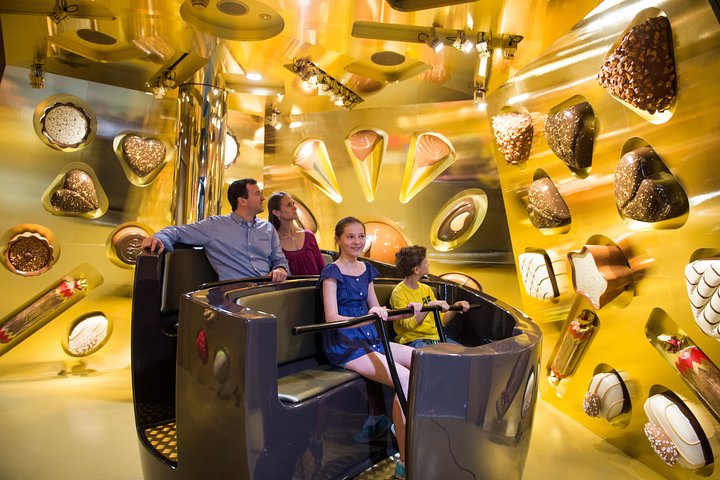
This is not your average “chocolate experience” with a few samples and a gift shop exit. You board a moving pod (think theme park ride, but Swiss-efficient) and get whisked through the entire chocolate-making process, from cocoa bean to bar. The sensory effects—real cocoa smells, warm air, and the sound of beans tumbling—make it immersive. Yes, you get to taste at the end, but the real treat is learning how chocolate became a Swiss national obsession. It’s a crowd-pleaser, but it earns its spot by being genuinely fun and surprisingly informative.


The Road Transport Hall
This is where the Swiss Museum of Transport flexes its muscle. You’re surrounded by a rotating cast of classic cars, motorcycles, and even futuristic prototypes. The curation is sharp: you’ll see everything from a 19th-century mail coach to a Formula 1 car that actually raced. The interactive exhibits—like the car crash simulator—are not just for show. They’re designed to make you think about speed, safety, and the evolution of travel. If you’re a gearhead, this is your playground.


The Planetarium
Here’s where the crowds thin out and the magic gets real. The planetarium is a dome of pure escapism, with shows that range from deep space journeys to explorations of the Swiss night sky. The visuals are razor-sharp, and the narration (available in multiple languages) is refreshingly jargon-free. It’s a rare place where you can sit back, breathe, and let your mind wander far beyond the Alps. This one’s my personal favorite—it’s the antidote to museum fatigue and a reminder that travel is about wonder, not just checklists.


The Communication Section
It’s easy to skip, but don’t. The museum’s deep dive into the evolution of communication—telegraphs, telephones, radio, and the internet—shows how Switzerland became a crossroads for ideas, not just trains. The interactive displays let you send Morse code, trace the path of a phone call, and even see how your own data moves across the globe. It’s nerdy, yes, but it’s also a sharp reminder that travel is about connection, not just movement.
Spotted a mistake or missing something? Contact us.

Things to do around Swiss Museum of Transport

Ratings based on Tripadvisor reviews. When you book through this link, you support our work at no extra cost to you.

🌤️ When to go?Weather, crowds, and seasonal trade-offs


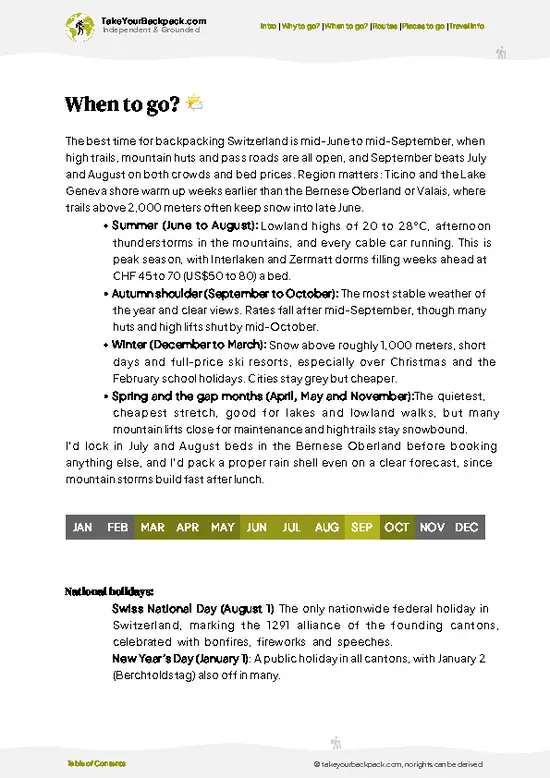
  • Weather: The Swiss Museum of Transport is indoors, so weather outside doesn’t dictate your visit as much as you might think. Still, avoid the wettest months—May and October—when Swiss rain can dampen your overall travel mood.

  • Temperature: Switzerland’s spring and fall hover between 8-15°C (46-59°F), perfect for exploring the city before or after the museum. Winter chills drop below freezing, but inside the museum, it’s cozy year-round.

  • Daylight Hours: From April to September, you get long daylight—up to 15 hours—giving you time to combine the museum with outdoor sights. In winter, daylight shrinks to about 8 hours, so plan accordingly.

  • Crowds: Peak tourist season is July and August, when the museum fills with families and school groups. For a quieter experience, aim for late September
read more 👉

  • Weather: The Swiss Museum of Transport is indoors, so weather outside doesn’t dictate your visit as much as you might think. Still, avoid the wettest months—May and October—when Swiss rain can dampen your overall travel mood.

  • Temperature: Switzerland’s spring and fall hover between 8-15°C (46-59°F), perfect for exploring the city before or after the museum. Winter chills drop below freezing, but inside the museum, it’s cozy year-round.

  • Daylight Hours: From April to September, you get long daylight—up to 15 hours—giving you time to combine the museum with outdoor sights. In winter, daylight shrinks to about 8 hours, so plan accordingly.

  • Crowds: Peak tourist season is July and August, when the museum fills with families and school groups. For a quieter experience, aim for late September or early November weekdays.

  • Seasonal Activities: Summer months often feature outdoor exhibits and special events like vintage vehicle parades. Winter is quieter but offers a more intimate look at the permanent collections without the buzz.

  • Price Fluctuations: Ticket prices stay steady year-round, but accommodation and transport costs spike in summer. Visiting shoulder seasons like April or October can save you money overall.


Pro-tip: Hit the museum on a weekday in late spring or early fall to dodge crowds, enjoy mild weather, and catch any seasonal outdoor exhibits without the tourist chaos.


source: climatestotravel.comJANJanuary: good for travelingFEBFebruary: good for travelingMARMarch: good for travelingAPRApril: highly recommended for travelingMAYMay: fair for travelingJUNJune: highly recommended for travelingJULJuly: good for travelingAUGAugust: good for travelingSEPSeptember: highly recommended for travelingOCTOctober: fair for travelingNOVNovember: highly recommended for travelingDECDecember: good for traveling
when-to-go

✈️ The backpacker research shortcutSwitzerland Travel Guide

An offline-friendly backpacking guide with optimized travel routes, ranked highlights, transport advice, and the best areas to stay.
example page 0 from our offline Travel Guide for Switzerland
example page 1 from our offline Travel Guide for Switzerland
example page 2 from our offline Travel Guide for Switzerland
example page 3 from our offline Travel Guide for Switzerland
example page 4 from our offline Travel Guide for Switzerland
example page 5 from our offline Travel Guide for Switzerland
example page 6 from our offline Travel Guide for Switzerland
example page 7 from our offline Travel Guide for Switzerland
The digital guide (449 pages) contains:
121 highlights, ranked by travel appeal
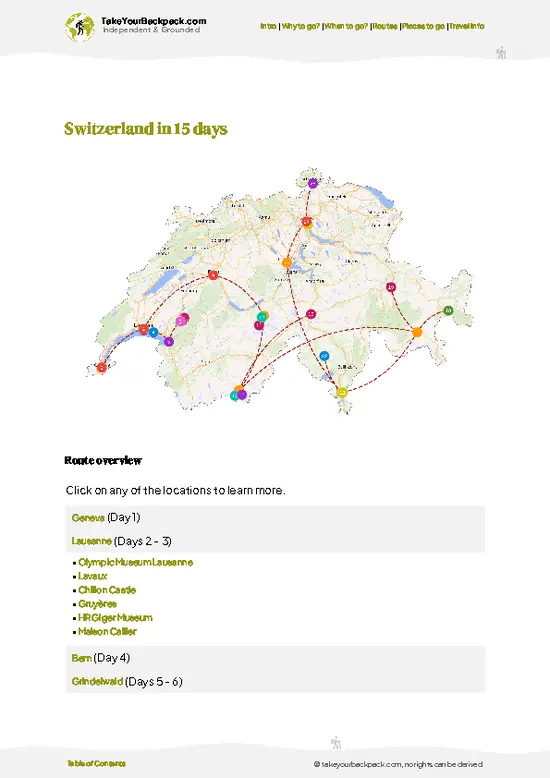
Optimized 5, 10 & 15-day travel routes
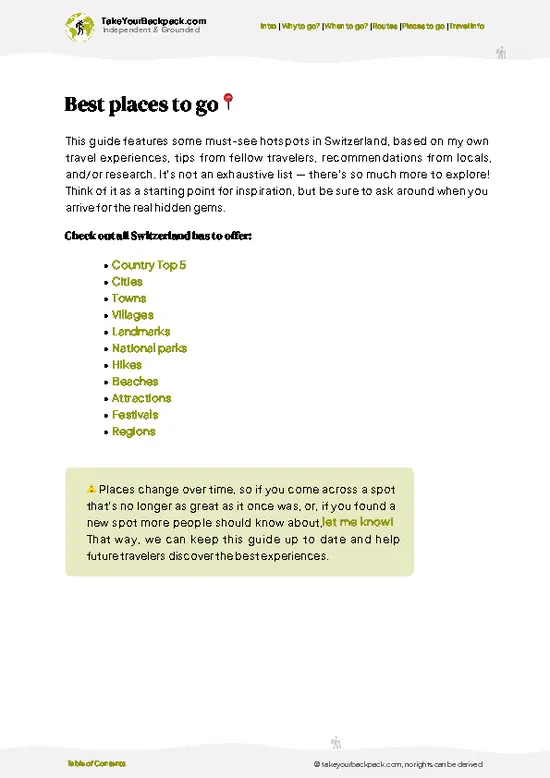
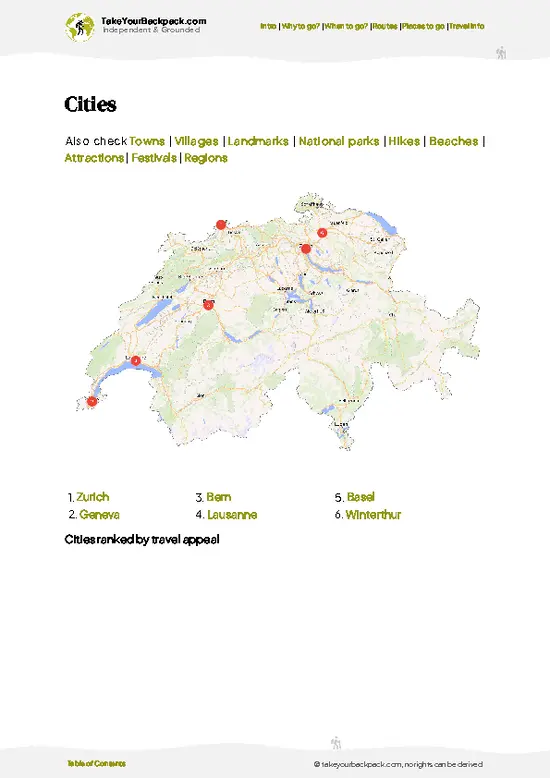
Cities, national parks, landmarks, beaches
How to get around
Offline-friendly for travel without Wi-Fi
👉 Click to see all 30+ guide features

📅 Plan smarter in minutes, not weeks
Month by month travel advice
Festivals & national holidays
Budget expectations

🗺️ Go to the right places, skip the overrated ones
Honest pros & cons of destinations
Top hikes, parks & viewpoints
Lesser-known places most travelers miss
Clear “worth it vs skip it” guidance

🛏️ Travel smoothly without rookie mistakes
Best areas to stay
Transport systems explained simply
Common scams & safety advice
SIM cards, money & practical tips

🌍 Understand the country, not just visit it
Culture & traditions
52 Essential phrases & customs
Festivals worth planning around
Traveler-friendly historical context
Insights that make places more meaningful

📱 Built for real travel conditions
Fully downloadable PDF
Works completely offline
Optimized for phone use
Useful in remote areas & buses
Everything in one place
Save weeks of stressful planning
Get instant access to your full guide. 30‑day money-back guarantee.


By proceeding you agree to our terms.
Sent to your inbox immediately after payment • 100% Secure Checkout
Best Backpacking Travel Advisor 2025 tourism awardBest Backpacking
Travel Advisor
2025
What others say about Take Your Backpack Guides:
⭐⭐⭐⭐⭐
Fantastic, amazing amount of information!
⭐⭐⭐⭐⭐
My goodness this is amazing, it's what I've been looking for hats off too you!
⭐⭐⭐⭐⭐
I think this is absolutely BRILLIANT
⭐⭐⭐⭐
Very complete and informative. It's still missing places, but I gotta to commend you
⭐⭐⭐⭐⭐
This is truly amazing, thank you, can't wait to explore it with my kids!
⭐⭐⭐⭐⭐
Awesome resource, thank you!
⭐⭐⭐⭐⭐
This is amazing! Can't wait to explore the ones I haven't seen
⭐⭐⭐⭐
I love this! Well done, great idea.
⭐⭐⭐⭐⭐
Thanks for taking the time to make this gem!
⭐⭐⭐⭐⭐
This might be the best website I've ever seen.
⭐⭐⭐⭐⭐
Congratulations, and thank you so much for your work; it's incredibly valuable.
⭐⭐⭐⭐
In all seriousness I think you did a great job pointing out the important spots
⭐⭐⭐⭐⭐
10/10 very good
⭐⭐⭐⭐⭐
As someone who's only just starting to visit regularly this is awesome, thank you.
⭐⭐⭐⭐
Thank you very much! I'm going to visit my dad, it's going to be very useful!
⭐⭐⭐⭐⭐
This is really cool! We'll be travelling for the first time and this definitely come in handy.
⭐⭐⭐⭐⭐
You are now our minister of culture, congratulations 👨‍💼
⭐⭐⭐⭐⭐
Just wanted to tell you that this is a pearl! Going to follow your recommendations.
⭐⭐⭐⭐⭐
This is so cool. I'll definitely be using the resource for my travels soon.
⭐⭐⭐⭐⭐
This is very impressive! Good work.
⭐⭐⭐⭐⭐
This is an amazing and informative site. Very well done!

🛏️ Where to stay?Best areas to stay in Switzerland

If you’re backpacking to see the Swiss Museum of Transport, don’t expect to find a buzzing backpacker hub right on its doorstep. The museum sits in Lucerne’s southern edge, an area that’s quieter and more residential than the city center. That means fewer hostels and social spots immediately nearby. But here’s the real deal: staying too close to the museum can feel a bit like camping out in a suburb—safe, yes, but not exactly where the action or fellow travelers gather.

Instead, aim for Lucerne’s Old Town or the area around the train station. These spots are the heartbeat for budget travelers … read more 👉
If you’re backpacking to see the Swiss Museum of Transport, don’t expect to find a buzzing backpacker hub right on its doorstep. The museum sits in Lucerne’s southern edge, an area that’s quieter and more residential than the city center. That means fewer hostels and social spots immediately nearby. But here’s the real deal: staying too close to the museum can feel a bit like camping out in a suburb—safe, yes, but not exactly where the action or fellow travelers gather.

Instead, aim for Lucerne’s Old Town or the area around the train station. These spots are the heartbeat for budget travelers and solo backpackers. You’ll find hostels, lively bars, and plenty of fellow wanderers swapping stories. Plus, it’s a short, scenic tram or bike ride to the museum, so you’re not sacrificing convenience. The Old Town’s cobblestone streets and vibrant markets offer a genuine Swiss vibe that the museum’s immediate neighborhood can’t match.

In short, don’t chase proximity to the museum at the expense of atmosphere. Lucerne’s center gives you safety, social life, and easy access to the museum without the sterile quiet of the outskirts. That’s where the real backpacker magic happens.

👛 Costs (as of 29 March 2026)Travel costs and budget guide for Swiss Museum of Transport

As of the most recent estimates, the Swiss Museum of Transport in Lucerne offers a Day Pass for adults at CHF 62, which includes admission to the museum, the Swiss Chocolate Adventure, and daytime shows in the Filmtheatre and Planetarium. ([verkehrshaus.ch](https://www.verkehrshaus.ch/en/visit/for-your-visit/admission-prices-and-tickets.html?utm_source=openai))

source: verkehrshaus.ch
⚠️ Prices can change and everyone travels differently, so take this as a rough guide. Hope it helps you plan your adventure!

Other Swiss attractions near Swiss Museum of Transport

Explore more nearby:


💡 Not sure where to go next?
Create a personalized itinerary for Switzerland including Swiss Museum of Transport and the places that fit your trip.

Generate my itinerary

👉 Discover all attractions

Or checkout all Switzerland has to offer (think cities, towns, villages, national parks, hikes, beaches, festivals)
Country photo of Switzerland

We 💚 feedbackWhat to keep in mind

The Swiss Museum of Transport isn’t just another museum—it’s a full-on playground for anyone fascinated by how we move. The hands-on exhibits and vintage vehicles give you a real sense of Swiss precision and innovation that you won’t get scrolling through Instagram. But heads up: it can get crowded, especially on weekends, and the entry fee isn’t exactly pocket change. Still, if you’re into tech, history, or just love geeking out over trains and planes, it’s worth carving out a few hours here.

✈️ When did I visit Switzerland?
Being so close to my home country, and me loving mountains, I have visited Switzerland many times in my childhood during summer holidays for hiking in the Alps. One of the most beautiful countries in the world, though expensive.

✍️ Help improve this page!
The information on this page is based on my own backpacking experience in Switzerland, supplemented with up-to-date research and feedback from other travelers. Travel details can change, so if you notice anything outdated or incomplete, feel free to let me know.


🙋‍♂️ Give feedback

👋 Meet the founderWho’s Behind Take Your Backpack?

Johan, backpacker and founder of TakeYourBackpackHi, I’m Johan (Netherlands 🇳🇱), the creator of TakeYourBackpack. Over the past decade, I’ve backpacked through 80+ countries across six continents, gaining extensive experience with independent travel, long-term trips, and overland routes.

This site is built on a combination of firsthand travel experience and carefully curated insights from other backpackers. Many guides are based on places I’ve personally visited, while others bring together tips, observations, and practical advice shared by trusted travelers I’ve met along the way.

The goal is to provide realistic, experience-driven guidance — not generic itineraries — so you can explore destinations with better context, clearer expectations, and more confidence.

Get full country guide •
Instant download • 121 highlights • Full Offline guide