×

Syria🇸🇾 | best villagesDiscover the Best villages Across Syria

Villages in Syria are stone, basalt and mountain settlements, and the region you pick changes everything. The Qalamoun and Anti-Lebanon foothills near Damascus are the easiest to reach and the most visited. The coastal mountains around Latakia and Tartus are green, cool and cheap, with little tourist infrastructure. The Hauran and Suwayda basalt villages in the south are quiet and rewarding but need local arrangements. The northern limestone massif around Aleppo and Idlib holds ruins in farmland, and it is not worth the time unless current conditions allow safe access. For independent travel, pick one region and a driver. Do not try to cover the country.

By Johan Kruseman 🇳🇱 | Updated October 19, 2026
Explore the best landmarks in Syria

Why go?Key Factors That Shape the Experience

Syria suits village travel because the country sits on one of the oldest continuously farmed landscapes on earth. Byzantine farming settlements in the northwest, Aramaic-speaking mountain communities, Druze and Christian highland towns and Alawite coastal hamlets all survive within a few hours of each other. That density of layered history is the real draw, and few countries of this size match it.

The limits are just as clear. Village infrastructure is thin. Expect few guesthouses, patchy electricity, and almost no signage in English. Most villages have no dedicated tourist services, so the day is built around a base city and a hired car, not buses. Cash is the norm, and cards rarely work outside Damascus.

Before choosing Syria for villages, check your government’s travel advisory and the current … read more 👉
Syria suits village travel because the country sits on one of the oldest continuously farmed landscapes on earth. Byzantine farming settlements in the northwest, Aramaic-speaking mountain communities, Druze and Christian highland towns and Alawite coastal hamlets all survive within a few hours of each other. That density of layered history is the real draw, and few countries of this size match it.

The limits are just as clear. Village infrastructure is thin. Expect few guesthouses, patchy electricity, and almost no signage in English. Most villages have no dedicated tourist services, so the day is built around a base city and a hired car, not buses. Cash is the norm, and cards rarely work outside Damascus.

Before choosing Syria for villages, check your government’s travel advisory and the current situation in each province, because conditions differ sharply between regions and can change quickly. Unexploded ordnance remains a hazard in parts of the north and in former front-line areas, so stay on paved roads and marked paths. Skip anywhere you cannot confirm access for. Do not expect polished heritage sites. The appeal is lived-in places where visitors are rare, and hospitality is often offered before you ask for it.
How the List Was Created
The list of best villages in Syria is created based on authenticity, scenic beauty, community spirit, traditions, and overall character. If you feel a village is missing in this list, please let us know.

When to go?Seasonal Guide to Visiting

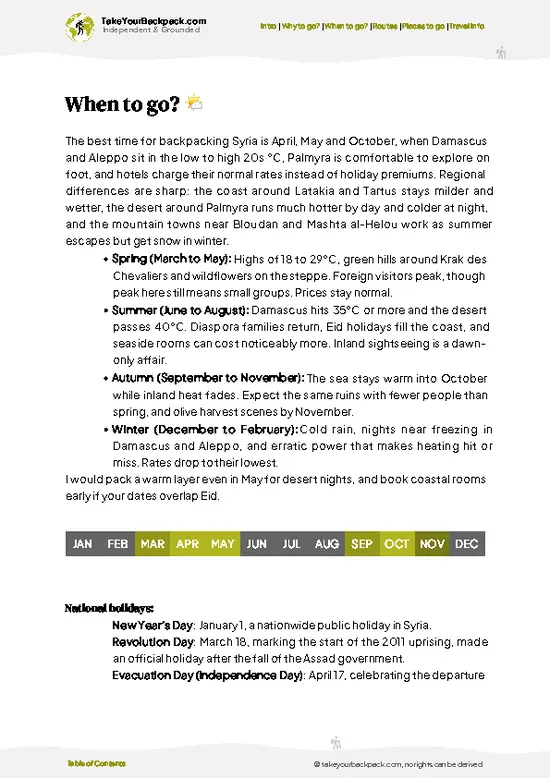
Best months: April to early June and September to October are the best months for villages in Syria, because daytime highs sit around 18 to 28°C and the roads, terraces and hillsides are dry enough to walk. Spring brings green slopes and wildflowers in the coastal mountains. Autumn brings olive and grape harvests across the highlands.Summer and winter: July and August are hot inland. Damascus and the southern basalt plains regularly reach 35 to 40°C, and stone villages without shade are miserable after 11 a.m. The coastal mountains stay more tolerable at 28 to 32°C, though humidity is high. Plan village walks for early morning and skip midday.

November to March is wet. The coast and western mountains receive most of Syria’s rain, often 800 to 1,200 mm a year, while Damascus gets roughly 100 … read more 👉
Best months: April to early June and September to October are the best months for villages in Syria, because daytime highs sit around 18 to 28°C and the roads, terraces and hillsides are dry enough to walk. Spring brings green slopes and wildflowers in the coastal mountains. Autumn brings olive and grape harvests across the highlands.Summer and winter: July and August are hot inland. Damascus and the southern basalt plains regularly reach 35 to 40°C, and stone villages without shade are miserable after 11 a.m. The coastal mountains stay more tolerable at 28 to 32°C, though humidity is high. Plan village walks for early morning and skip midday.

November to March is wet. The coast and western mountains receive most of Syria’s rain, often 800 to 1,200 mm a year, while Damascus gets roughly 100 to 200 mm. Mountain roads can be slick, and snow falls on the higher Qalamoun and Anti-Lebanon ranges, sometimes closing minor roads for days. Winter lows in the highlands drop to 0 to 5°C, and few village guesthouses are heated well.Crowds and prices: Crowds are not a factor outside a few weekends in spring, when Syrian families go to the hills. Prices for rooms and drivers move little by season, so the choice should be driven by weather. Ramadan is worth avoiding for village trips: many food stalls and small cafés close during daylight, and drivers are less available around Eid.

village hoppingSuggested Travel Strategies

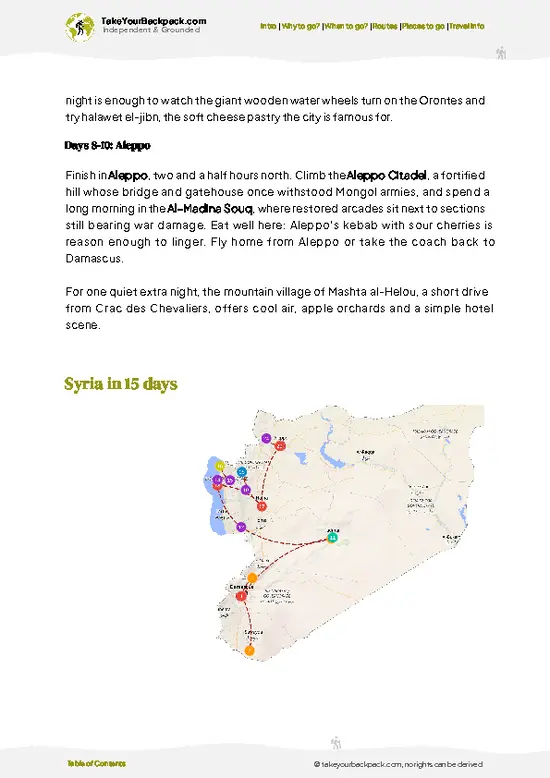
How many days: A trip combining several villages in Syria needs 7 to 12 days, and that includes at least two days for transit and paperwork. Anything shorter turns into a car ride with photo stops.Regions that group well: Damascus anchors the south. The Qalamoun and Anti-Lebanon foothills are a 1 to 2 hour drive away, and the Hauran and Suwayda plateau is about 2 to 2.5 hours. These two pair easily in one cluster. The central corridor runs through Homs, 2 to 2.5 hours north of Damascus, and from there the coastal mountains are another 2 to 3 hours toward Latakia or Tartus. Aleppo is 4.5 to 6 hours from Damascus and is its own region, best treated as a separate trip.

Travel south to north: Damascus, then the foothills, then Homs, then the coast. This keeps the longest drive at the end and lets … read more 👉
How many days: A trip combining several villages in Syria needs 7 to 12 days, and that includes at least two days for transit and paperwork. Anything shorter turns into a car ride with photo stops.Regions that group well: Damascus anchors the south. The Qalamoun and Anti-Lebanon foothills are a 1 to 2 hour drive away, and the Hauran and Suwayda plateau is about 2 to 2.5 hours. These two pair easily in one cluster. The central corridor runs through Homs, 2 to 2.5 hours north of Damascus, and from there the coastal mountains are another 2 to 3 hours toward Latakia or Tartus. Aleppo is 4.5 to 6 hours from Damascus and is its own region, best treated as a separate trip.

Travel south to north: Damascus, then the foothills, then Homs, then the coast. This keeps the longest drive at the end and lets a driver return you without backtracking. Give each village stop half a day to one day, and base for two nights in a town rather than moving daily.Planning mistakes: The common error is stacking the south, the coast and the north into a week. Roads are slower than the map suggests, with frequent checkpoints, and few drivers will travel after dark. Cut a region instead. Another mistake is relying on public minibuses to reach villages. They run between towns, not to hamlets, so hire a car with a driver for the final leg. Build in one spare day for closures or weather.

The ListHighly Recommended villages of Syria

1 Al-Tanf

remote border post, desert highway, military presence

Cross a strategic desert checkpoint on the Iraq border, where isolation and security define the traveler’s experience.

Loading the map 🌍

Expert viewInsights from Locals and Experts

How many villages to visit: Visit four to six villages in total, spread over no more than two regions. Each takes half a day to reach, walk and talk to people, and Syrian roads add time through checkpoints and slow traffic. A seventh or eighth stop only means more hours in a car and less time at the places that matter.Which kind to prioritize: Choose by travel style. For a first trip, pick the foothill and mountain villages near Damascus: shortest transfers, the most guesthouses, and the best chance of someone who speaks English. For photography and architecture, the basalt villages of the south reward a dedicated driver. For hiking and cool air, the coastal mountains are the right choice, but they are the least set up for visitors. The northern ruined farming villages are only worth the effort … read more 👉
How many villages to visit: Visit four to six villages in total, spread over no more than two regions. Each takes half a day to reach, walk and talk to people, and Syrian roads add time through checkpoints and slow traffic. A seventh or eighth stop only means more hours in a car and less time at the places that matter.Which kind to prioritize: Choose by travel style. For a first trip, pick the foothill and mountain villages near Damascus: shortest transfers, the most guesthouses, and the best chance of someone who speaks English. For photography and architecture, the basalt villages of the south reward a dedicated driver. For hiking and cool air, the coastal mountains are the right choice, but they are the least set up for visitors. The northern ruined farming villages are only worth the effort if access is confirmed, as they are far from services and the ground may still hold ordnance.What it costs: A realistic budget is US$25 to 45 a day: a simple guesthouse or small hotel at US$12 to 25, meals at US$4 to 8, and shared transport between towns for US$2 to 8. Add a private driver for village access at roughly US$40 to 80 a day, split between travelers. A local guide adds US$20 to 40. Most villages charge no entry, but sites with a caretaker may ask for US$1 to 5. Bring clean US dollar notes and sufficient cash in advance, because cards and ATMs are unreliable outside big cities.Costs and mistakes that catch travelers out: Booking a driver on the spot in a village often triples the price, so arrange transport the day before in the base town and agree the total in writing. Arriving without a place to sleep is the second trap: guesthouses are few and may be closed, so confirm a bed by phone first. Last, setting out late costs the most. Checkpoints and mountain roads mean a 90-minute drive can take three hours, so leave by 8 a.m. and be back before dark.Safety and etiquette: Check current government advice for each province before you book, and register your route with someone at home. Stay on paved roads and established paths, because mines and unexploded ordnance remain a risk in former conflict zones. Carry your passport and any permits at all times, since checkpoints are routine and officials may ask for them. Do not photograph military sites, checkpoints or officials. Ask before photographing people, especially women. Dress modestly, with covered shoulders and knees, and more conservatively in Muslim, Druze and Christian villages alike. If invited into a home, accept tea, remove your shoes, and do not push a payment on your host.

✈️ The backpacker research shortcutSyria Travel Guide

An offline-friendly backpacking guide with optimized travel routes, ranked highlights, transport advice, and the best areas to stay.
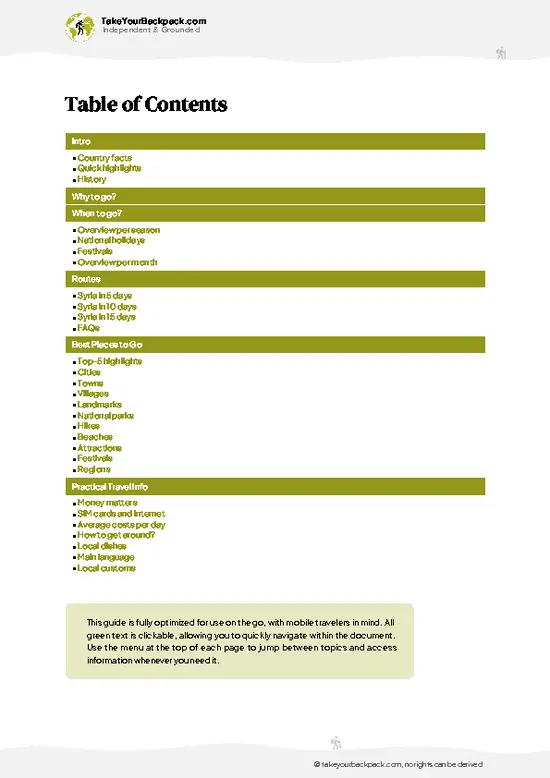
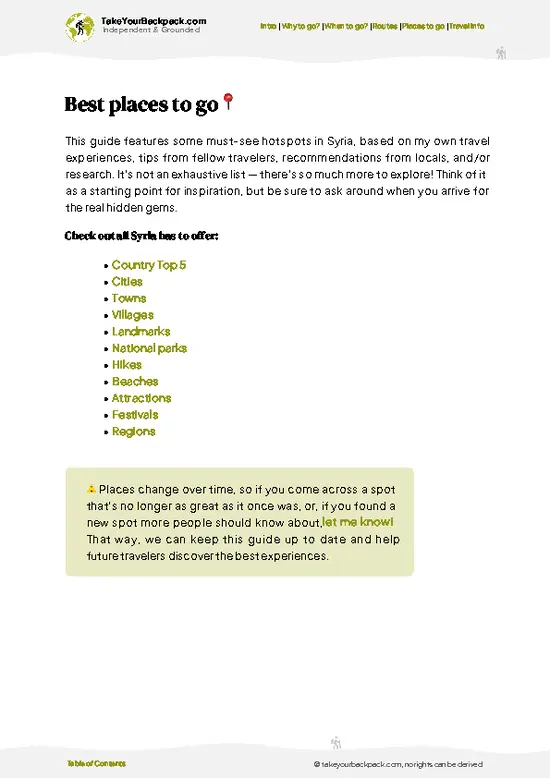
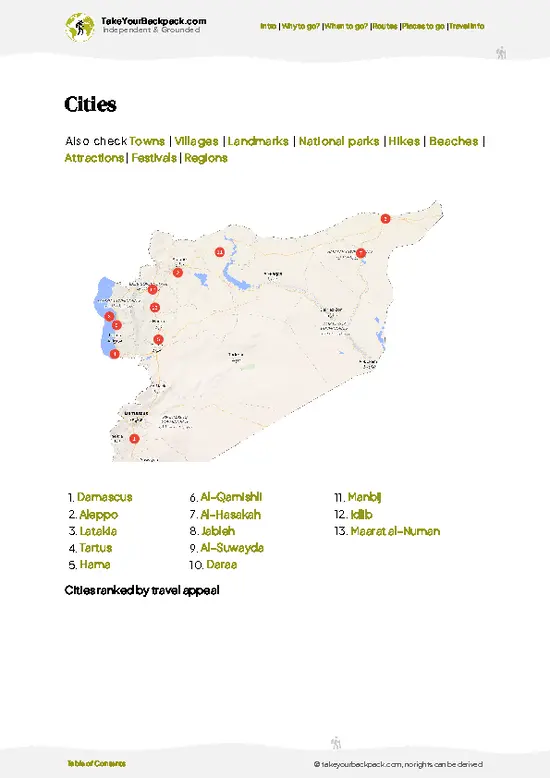
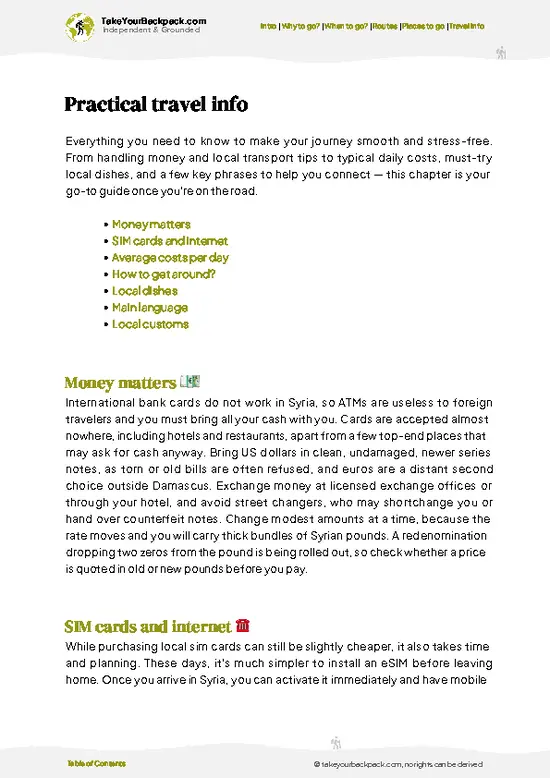
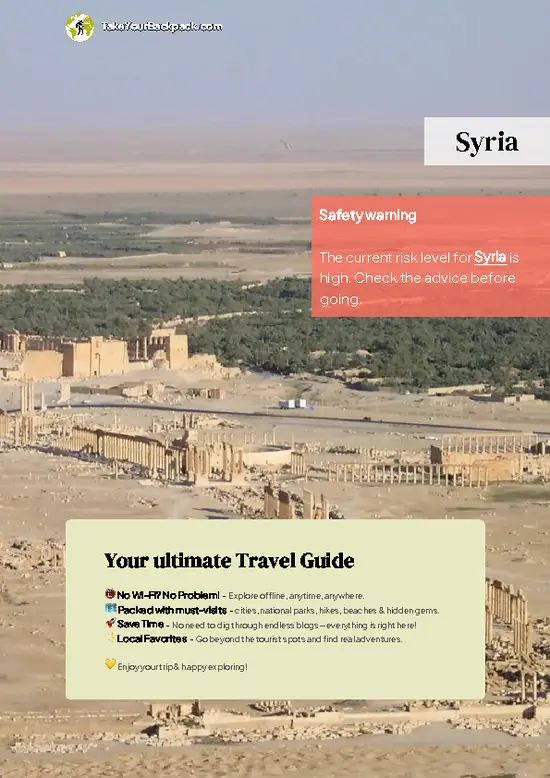
example page 0 from our offline Travel Guide for Syria
example page 1 from our offline Travel Guide for Syria
example page 2 from our offline Travel Guide for Syria
example page 3 from our offline Travel Guide for Syria
example page 4 from our offline Travel Guide for Syria
example page 5 from our offline Travel Guide for Syria
example page 6 from our offline Travel Guide for Syria
example page 7 from our offline Travel Guide for Syria
The digital guide (288 pages) contains:
✅ 70 highlights, ranked by travel appeal
✅ Optimized 5, 10 & 15-day travel routes
✅ Cities, national parks, landmarks, beaches
✅ How to get around
✅ Offline-friendly for travel without Wi-Fi
👉 Click to see all 30+ guide features

📅 Plan smarter in minutes, not weeks
✅ Month by month travel advice
✅ Festivals & national holidays
✅ Budget expectations

🗺️ Go to the right places, skip the overrated ones
✅ Honest pros & cons of destinations
✅ Top hikes, parks & viewpoints
✅ Lesser-known places most travelers miss
✅ Clear “worth it vs skip it” guidance

🛏️ Travel smoothly without rookie mistakes
✅ Best areas to stay
✅ Transport systems explained simply
✅ Common scams & safety advice
✅ SIM cards, money & practical tips

🌍 Understand the country, not just visit it
✅ Culture & traditions
✅ 52 Essential phrases & customs
✅ Festivals worth planning around
✅ Traveler-friendly historical context
✅ Insights that make places more meaningful

📱 Built for real travel conditions
✅ Fully downloadable PDF
✅ Works completely offline
✅ Optimized for phone use
✅ Useful in remote areas & buses
✅ Everything in one place
Stop searching, start planning
Get instant access to your full guide. 30‑day money-back guarantee.
+ Add another guide for just

By proceeding you agree to our terms.
Sent to your inbox immediately after payment • 100% Secure Checkout
Best Backpacking Travel Advisor 2025 tourism awardBest Backpacking
Travel Advisor
2025
What others say about Take Your Backpack Guides:
⭐⭐⭐⭐⭐
Fantastic, amazing amount of information!
⭐⭐⭐⭐⭐
My goodness this is amazing, it's what I've been looking for hats off too you!
⭐⭐⭐⭐⭐
I think this is absolutely BRILLIANT
⭐⭐⭐⭐
Very complete and informative. It's still missing places, but I gotta to commend you
⭐⭐⭐⭐⭐
This is truly amazing, thank you, can't wait to explore it with my kids!
⭐⭐⭐⭐⭐
Awesome resource, thank you!
⭐⭐⭐⭐⭐
This is amazing! Can't wait to explore the ones I haven't seen
⭐⭐⭐⭐
I love this! Well done, great idea.
⭐⭐⭐⭐⭐
Thanks for taking the time to make this gem!
⭐⭐⭐⭐⭐
This might be the best website I've ever seen.
⭐⭐⭐⭐⭐
Congratulations, and thank you so much for your work; it's incredibly valuable.
⭐⭐⭐⭐
In all seriousness I think you did a great job pointing out the important spots
⭐⭐⭐⭐⭐
10/10 very good
⭐⭐⭐⭐⭐
As someone who's only just starting to visit regularly this is awesome, thank you.
⭐⭐⭐⭐
Thank you very much! I'm going to visit my dad, it's going to be very useful!
⭐⭐⭐⭐⭐
This is really cool! We'll be travelling for the first time and this definitely come in handy.
⭐⭐⭐⭐⭐
You are now our minister of culture, congratulations 👨‍💼
⭐⭐⭐⭐⭐
Just wanted to tell you that this is a pearl! Going to follow your recommendations.
⭐⭐⭐⭐⭐
This is so cool. I'll definitely be using the resource for my travels soon.
⭐⭐⭐⭐⭐
This is very impressive! Good work.
⭐⭐⭐⭐⭐
This is an amazing and informative site. Very well done!

🛏️ Where to stay?Top Places to Consider Staying

True dorm-style hostels are rare in Syria, but budget guesthouses and small family-run hotels are easy to find, with private rooms typically running US$15 to 35 a night. In Damascus, the Old City around Bab Touma and Bab Sharqi has the most character, with courtyard houses and lively cafes and bars within walking distance of the main sights, though street noise carries late into the evening. Marjeh, near Martyrs’ Square, has the cheapest rooms close to transport and souqs but feels grittier after dark, while in Aleppo the area around Bab al-Faraj keeps you near the citadel and old souqs with fewer evening options.

If you enjoy meeting fellow travelers, consider choosing hostels with high ratings … read more 👉
True dorm-style hostels are rare in Syria, but budget guesthouses and small family-run hotels are easy to find, with private rooms typically running US$15 to 35 a night. In Damascus, the Old City around Bab Touma and Bab Sharqi has the most character, with courtyard houses and lively cafes and bars within walking distance of the main sights, though street noise carries late into the evening. Marjeh, near Martyrs’ Square, has the cheapest rooms close to transport and souqs but feels grittier after dark, while in Aleppo the area around Bab al-Faraj keeps you near the citadel and old souqs with fewer evening options.

If you enjoy meeting fellow travelers, consider choosing hostels with high ratings for atmosphere. On the other hand, if you prefer having your own space, a hotel might be a better option.

SyriaMore Places Across Syria

👋 Meet the founderWho’s Behind Take Your Backpack?

Johan, backpacker and founder of TakeYourBackpackHi, I’m Johan (Netherlands 🇳🇱), the creator of TakeYourBackpack. Over the past 3 decades, I’ve backpacked through 90+ countries across six continents, gaining extensive experience with independent travel, long-term trips, and overland routes.

This site is built on a combination of firsthand travel experience and carefully curated insights from other backpackers. Many guides are based on places I’ve personally visited, while others bring together tips, observations, and practical advice shared by trusted travelers I’ve met along the way.

The goal is to provide realistic, experience-driven guidance — not generic itineraries — so you can explore destinations with better context, clearer expectations, and more confidence.