×

Togo🇹🇬 | best regionsTop-Rated regions in Togo

Togo is a thin strip of West Africa, barely 120 kilometers wide, yet it shifts from humid Atlantic coast to palm-shaded plateaus to dry savanna in about 650 kilometers. Heat, red dust and woodsmoke change with each latitude. Costs stay low, shared taxis reach most towns, and crowds are thin, so independent travelers meet markets and village life without tour buses. The north is slower and rougher.

By Johan Kruseman 🇳🇱 | Updated October 23, 2026
Explore the best cities in Togo

Why go?What Makes Them Special

Togo suits regional travel because its north-south shape packs several climates and cultures into one narrow country. Coastal humidity gives way to forested hills, then to dry, ochre-colored savanna where mud-walled compounds stand. Roads run mostly along one main spine, so distances are short, but surfaces vary from smooth asphalt to rutted laterite that coats everything in orange dust. Over forty ethnic groups live here, and vodun traditions remain part of daily life, so drumming, fetish markets and ceremonies are woven into ordinary routines. Travelers should know that tourism infrastructure is modest: French is the working language, cash in West African CFA francs is essential, and ATMs vanish outside larger towns. Security advisories for the far north border areas change, so check current … read more 👉
Togo suits regional travel because its north-south shape packs several climates and cultures into one narrow country. Coastal humidity gives way to forested hills, then to dry, ochre-colored savanna where mud-walled compounds stand. Roads run mostly along one main spine, so distances are short, but surfaces vary from smooth asphalt to rutted laterite that coats everything in orange dust. Over forty ethnic groups live here, and vodun traditions remain part of daily life, so drumming, fetish markets and ceremonies are woven into ordinary routines. Travelers should know that tourism infrastructure is modest: French is the working language, cash in West African CFA francs is essential, and ATMs vanish outside larger towns. Security advisories for the far north border areas change, so check current government guidance before heading there. Expect motorbike taxis, crowded minibuses and few signposts, with the reward being unscripted encounters.
How the List Was Created
The list of best regions in Togo is created based on landscapes, local culture, attractions, vibes, and overall appeal. If you feel a region is missing in this list, please let us know.

When to go?Best Time to Visit Togo for regions

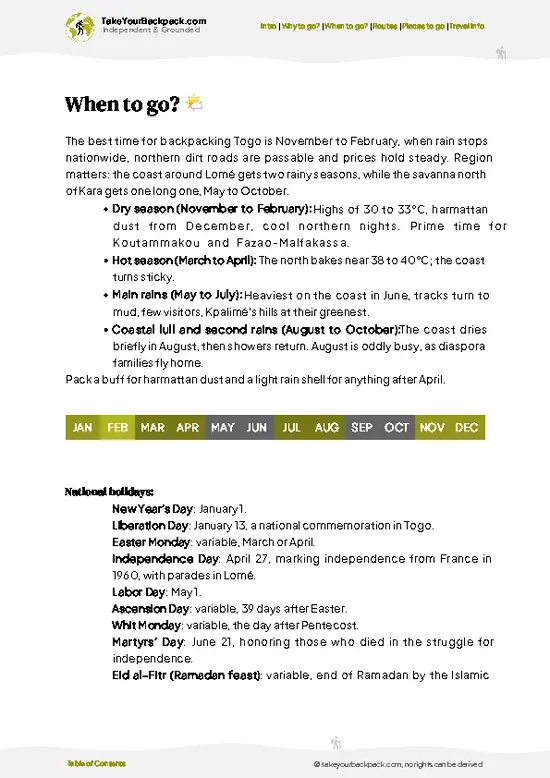
Best months and seasons: The best months are November to February, when the dry season brings clear days of 28 to 33°C and little rain. The harmattan, a dusty wind from the Sahara, drifts in from December to February, turning the sky hazy and leaving a fine grit on skin and lenses, while nights in the north can fall to about 15 to 20°C. Shoulder and wet periods: March to May turns hot and sticky, with southern temperatures near 33 to 36°C and the north hotter, often above 38°C before the rains. The main rainy season runs roughly April to July in the south, with a short second rainy period around September and October, and rainfall on the coast reaches about 800 to 1,000 millimeters a year. In the north there is a single rainy season from about May to October, when dirt roads turn to thick … read more 👉
Best months and seasons: The best months are November to February, when the dry season brings clear days of 28 to 33°C and little rain. The harmattan, a dusty wind from the Sahara, drifts in from December to February, turning the sky hazy and leaving a fine grit on skin and lenses, while nights in the north can fall to about 15 to 20°C. Shoulder and wet periods: March to May turns hot and sticky, with southern temperatures near 33 to 36°C and the north hotter, often above 38°C before the rains. The main rainy season runs roughly April to July in the south, with a short second rainy period around September and October, and rainfall on the coast reaches about 800 to 1,000 millimeters a year. In the north there is a single rainy season from about May to October, when dirt roads turn to thick red mud and some tracks become impassable. Prices barely change by season, though guesthouses fill during festivals.

region hoppingPlanning Your Route Efficiently

Trip length and direction: A trip linking several regions of Togo needs 10 to 14 days, which leaves room for slow roads and a day lost to breakdowns. Travel south to north, starting at Lomé, the capital and arrival point, then climbing through the central hubs of Atakpamé and Sokodé before reaching Kara and the savanna beyond. Give each stop two to three nights, because the coast, plateau and north each demand a different pace. Getting between stops: Lomé to Kpalimé takes about 2.5 to 3 hours, Lomé to Sokodé 5 to 6 hours, and Lomé to Kara 7 to 9 hours by bus or shared taxi, which leave once full. A common mistake is cramming the whole country into a week and spending it on dusty roads. Another is leaving after midday, when arrivals come after dark. Depart early, accept that vehicles wait to fill, and keep slack days for northern tracks.

The ListHighly Recommended regions of Togo

1 Lake Togo

Togoville shrines, pirogue crossings, Aného colonial quarter, Guin heritage, lagoon fishing hamlets

Cross the lagoon by pirogue to Togoville’s pilgrimage church and family shrines, then follow the sand bar west to Aného’s faded colonial streets.

Loading the map 🌍

Expert viewTips and Advice from Travelers

How many regions to visit: I advise three regions in one trip of two weeks, because Togo’s roads are slow and shared taxis wait until every seat is taken. Two regions feel rushed only when you add a day of mud or a breakdown, and four leaves you watching the windshield more than the places. Three gives time to sit in a market, eat grilled fish or fufu with spicy sauce, and listen to the evening drumming. Prioritizing by style: Choose the coast and southern hills for easy logistics, cooler air and forest walks that end at a waterfall. Choose the north if you want mud-brick compounds, hot savanna light and cultural depth, accepting longer rides and basic rooms. Travelers drawn to vodun ceremonies should add a guide who can arrange respectful introductions. What it costs: Budget US$25 to 45 a … read more 👉
How many regions to visit: I advise three regions in one trip of two weeks, because Togo’s roads are slow and shared taxis wait until every seat is taken. Two regions feel rushed only when you add a day of mud or a breakdown, and four leaves you watching the windshield more than the places. Three gives time to sit in a market, eat grilled fish or fufu with spicy sauce, and listen to the evening drumming. Prioritizing by style: Choose the coast and southern hills for easy logistics, cooler air and forest walks that end at a waterfall. Choose the north if you want mud-brick compounds, hot savanna light and cultural depth, accepting longer rides and basic rooms. Travelers drawn to vodun ceremonies should add a guide who can arrange respectful introductions. What it costs: Budget US$25 to 45 a day, or roughly 15,000 to 27,000 CFA francs. Guesthouses run US$10 to 25, meals at local spots US$2 to 5, and shared taxis US$3 to 12 per leg. Local guides cost about US$10 to 25 a day, and site or village fees are often small contributions of US$2 to 6. For a typical visit expect US$350 to 600 over two weeks without flights. Safety and culture: Petty theft is uncommon but real in crowded Lomé markets, so keep phones out of sight at night. Ask before photographing people, ceremonies or shrines, since fetish items are sacred and some fees are expected. Dress modestly in the Muslim-majority north, greet everyone first with “bonjour,” and carry small CFA notes. Keep checking current government advisories for the far northern border zone, and avoid night driving on unlit roads.

✈️ The backpacker research shortcutTogo Travel Guide

An offline-friendly backpacking guide with optimized travel routes, ranked highlights, transport advice, and the best areas to stay.
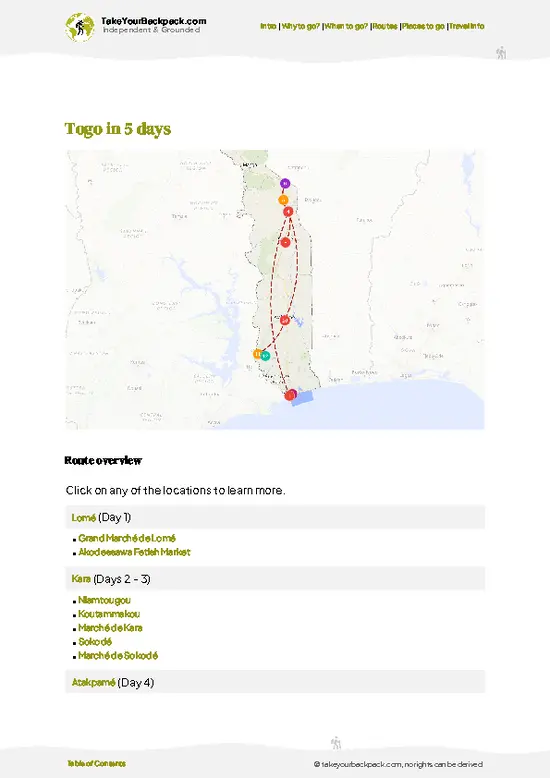
example page 0 from our offline Travel Guide for Togo
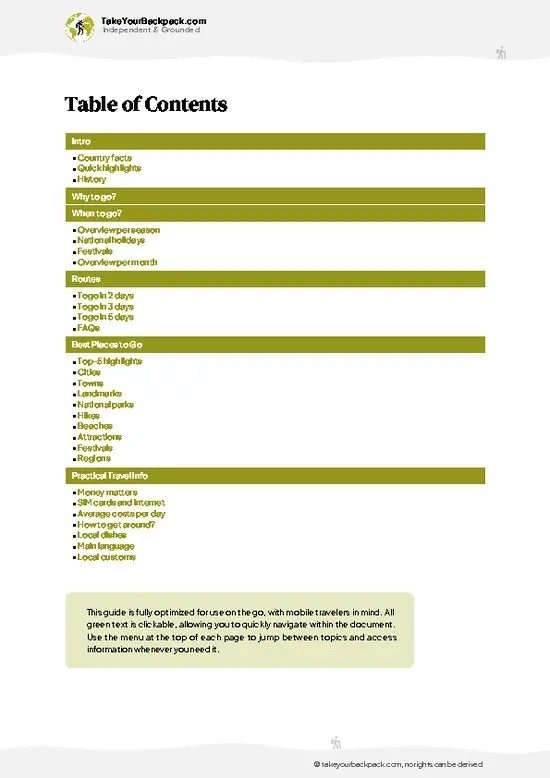
example page 1 from our offline Travel Guide for Togo
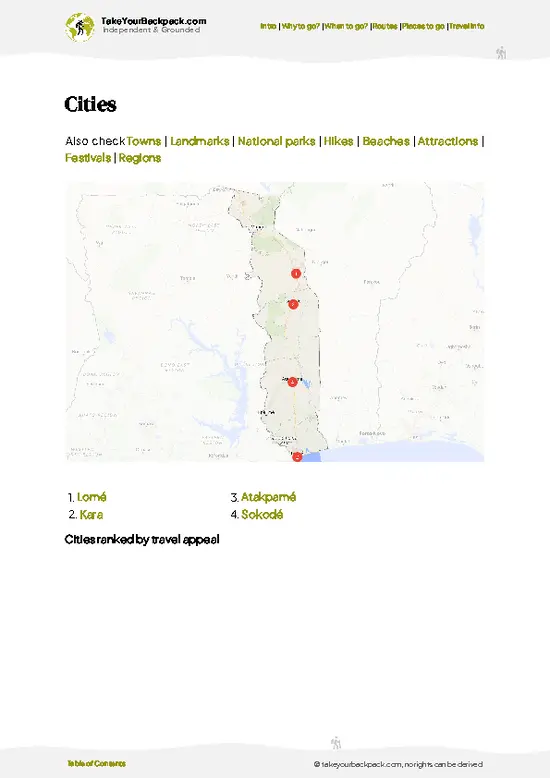
example page 2 from our offline Travel Guide for Togo
example page 3 from our offline Travel Guide for Togo
example page 4 from our offline Travel Guide for Togo
example page 5 from our offline Travel Guide for Togo
example page 6 from our offline Travel Guide for Togo
example page 7 from our offline Travel Guide for Togo
The digital guide (194 pages) contains:
✅ 42 highlights, ranked by travel appeal
✅ Optimized 2, 3 & 5-day travel routes
✅ Cities, national parks, landmarks, beaches
✅ How to get around
✅ Offline-friendly for travel without Wi-Fi
👉 Click to see all 30+ guide features

📅 Plan smarter in minutes, not weeks
✅ Month by month travel advice
✅ Festivals & national holidays
✅ Budget expectations

🗺️ Go to the right places, skip the overrated ones
✅ Honest pros & cons of destinations
✅ Top hikes, parks & viewpoints
✅ Lesser-known places most travelers miss
✅ Clear “worth it vs skip it” guidance

🛏️ Travel smoothly without rookie mistakes
✅ Best areas to stay
✅ Transport systems explained simply
✅ Common scams & safety advice
✅ SIM cards, money & practical tips

🌍 Understand the country, not just visit it
✅ Culture & traditions
✅ 52 Essential phrases & customs
✅ Festivals worth planning around
✅ Traveler-friendly historical context
✅ Insights that make places more meaningful

📱 Built for real travel conditions
✅ Fully downloadable PDF
✅ Works completely offline
✅ Optimized for phone use
✅ Useful in remote areas & buses
✅ Everything in one place
Stop searching, start planning
Get instant access to your full guide. 30‑day money-back guarantee.
+ Add another guide for just

By proceeding you agree to our terms.
Sent to your inbox immediately after payment • 100% Secure Checkout
Best Backpacking Travel Advisor 2025 tourism awardBest Backpacking
Travel Advisor
2025
What others say about Take Your Backpack Guides:
⭐⭐⭐⭐⭐
Fantastic, amazing amount of information!
⭐⭐⭐⭐⭐
My goodness this is amazing, it's what I've been looking for hats off too you!
⭐⭐⭐⭐⭐
I think this is absolutely BRILLIANT
⭐⭐⭐⭐
Very complete and informative. It's still missing places, but I gotta to commend you
⭐⭐⭐⭐⭐
This is truly amazing, thank you, can't wait to explore it with my kids!
⭐⭐⭐⭐⭐
Awesome resource, thank you!
⭐⭐⭐⭐⭐
This is amazing! Can't wait to explore the ones I haven't seen
⭐⭐⭐⭐
I love this! Well done, great idea.
⭐⭐⭐⭐⭐
Thanks for taking the time to make this gem!
⭐⭐⭐⭐⭐
This might be the best website I've ever seen.
⭐⭐⭐⭐⭐
Congratulations, and thank you so much for your work; it's incredibly valuable.
⭐⭐⭐⭐
In all seriousness I think you did a great job pointing out the important spots
⭐⭐⭐⭐⭐
10/10 very good
⭐⭐⭐⭐⭐
As someone who's only just starting to visit regularly this is awesome, thank you.
⭐⭐⭐⭐
Thank you very much! I'm going to visit my dad, it's going to be very useful!
⭐⭐⭐⭐⭐
This is really cool! We'll be travelling for the first time and this definitely come in handy.
⭐⭐⭐⭐⭐
You are now our minister of culture, congratulations 👨‍💼
⭐⭐⭐⭐⭐
Just wanted to tell you that this is a pearl! Going to follow your recommendations.
⭐⭐⭐⭐⭐
This is so cool. I'll definitely be using the resource for my travels soon.
⭐⭐⭐⭐⭐
This is very impressive! Good work.
⭐⭐⭐⭐⭐
This is an amazing and informative site. Very well done!

🛏️ Where to stay?Top Areas to Stay

Dedicated backpacker hostels are rare in Togo, but simple guesthouses and auberges are easy to find, usually at 8,000 to 15,000 CFA (about €12 to 23) for a fan room and a bit more with air-conditioning. In Lomé, Kodjoviakopé and Nyékonakpoè near the beach and the Ghana border hold the most budget rooms and are quiet and walkable to the coast road, while Bè puts you closer to cheap maquis bars and late music but gets rowdier at night, and the area around the Grand Marché is central for errands yet empties out after dark. Up-country, Kpalimé has a good spread of cheap, calm guesthouses within easy reach of the hills and waterfalls, and Aného offers a handful of laid-back lagoon-side options.

If … read more 👉
Dedicated backpacker hostels are rare in Togo, but simple guesthouses and auberges are easy to find, usually at 8,000 to 15,000 CFA (about €12 to 23) for a fan room and a bit more with air-conditioning. In Lomé, Kodjoviakopé and Nyékonakpoè near the beach and the Ghana border hold the most budget rooms and are quiet and walkable to the coast road, while Bè puts you closer to cheap maquis bars and late music but gets rowdier at night, and the area around the Grand Marché is central for errands yet empties out after dark. Up-country, Kpalimé has a good spread of cheap, calm guesthouses within easy reach of the hills and waterfalls, and Aného offers a handful of laid-back lagoon-side options.

If you enjoy meeting fellow travelers, consider choosing hostels with high ratings for atmosphere. On the other hand, if you prefer having your own space, a hotel might be a better option.

TogoDiscover the Country

👋 Meet the founderWho’s Behind Take Your Backpack?

Johan, backpacker and founder of TakeYourBackpackHi, I’m Johan (Netherlands 🇳🇱), the creator of TakeYourBackpack. Over the past 3 decades, I’ve backpacked through 90+ countries across six continents, gaining extensive experience with independent travel, long-term trips, and overland routes.

This site is built on a combination of firsthand travel experience and carefully curated insights from other backpackers. Many guides are based on places I’ve personally visited, while others bring together tips, observations, and practical advice shared by trusted travelers I’ve met along the way.

The goal is to provide realistic, experience-driven guidance — not generic itineraries — so you can explore destinations with better context, clearer expectations, and more confidence.