×

Tonga🇹🇴 | landmarksHa‘amonga ‘a MauiCoral limestone trilithon, notched lintel, solstice sightline, Tu‘itātui legend | things to do and best time to go

Explore KolovaiExplore Hufangalupe Natural Land Bridge

Backpacking in Ha‘amonga ‘a Maui
🏆 Top pickunique site ranked #1
By Johan Kruseman 🇳🇱 | Updated October 7, 2026

A human king, the Tu‘i Tonga Tu‘itātui, had Ha‘amonga ‘a Maui raised around the 13th century, whatever the demigod legend says about shoulders and stones. The trilithon stands in the northeast of Tongatapu, Tonga’s main island, a flat run of coconut palms and bush from Nuku‘alofa. What you get is two massive coral limestone uprights with a lintel across them, pale and pitted, warm under the hand and loud with cicadas by midday. It is worth your time for the sheer scale of the blocks and for the way the light lands on them in the early morning. It is not worth a long stay: there is no museum, little shade, and the crowds are usually a couple of other travelers. Photos work best low and wide. Spend a first day here by arriving early, circling the stones slowly, then riding on to the nearby coast for a swim.

Discover everything you want to know in the 📖 Tonga Travel Guide.


Loading the map 🌍
CLICK TO FILTER
towns
villages
landmarks
national parks
hikes
beaches
attractions
festivals
regions
SHOW COUNTRY’S BESTSHOW ALL

✨ Why go?
Ranked #1 unique site in Tonga
Reasons people choose to visit here

Ha‘amonga ‘a Maui is the one place in the Pacific where you can stand under a trilithon built by a Polynesian king, and nothing else in Tonga looks like it. The two uprights and the lintel are cut from coral limestone, and the whole gateway rises roughly 5 meters. That is the kind of detail that makes people stop mid-sentence.

The site is also easy to reach. It sits on Tongatapu, so you can fit it into a day loop from Nuku‘alofa without booking a tour or paying for a boat, and nobody will stop you from walking up to the stones at your own speed. Local legend ties the structure to the demigod Maui, and a more practical theory links it to the solstice sunrise, so you get both myth and a puzzle to chew on.

It also rounds out a wider island route. Pair it with the royal tombs and archway sites … read more 👉
Ha‘amonga ‘a Maui is the one place in the Pacific where you can stand under a trilithon built by a Polynesian king, and nothing else in Tonga looks like it. The two uprights and the lintel are cut from coral limestone, and the whole gateway rises roughly 5 meters. That is the kind of detail that makes people stop mid-sentence.

The site is also easy to reach. It sits on Tongatapu, so you can fit it into a day loop from Nuku‘alofa without booking a tour or paying for a boat, and nobody will stop you from walking up to the stones at your own speed. Local legend ties the structure to the demigod Maui, and a more practical theory links it to the solstice sunrise, so you get both myth and a puzzle to chew on.

It also rounds out a wider island route. Pair it with the royal tombs and archway sites on the south and east of the island, and you get a proper picture of the Tu‘i Tonga dynasty without spending more than a day or two on land.

💡 HighlightsEssential experiences to have while visiting Ha‘amonga ‘a Maui

  1. The Trilithon: The reason you came. Two upright blocks of coral limestone support a third laid across the top, a gateway roughly 5 meters high. The surface is rough and sun-bleached, and the sheer weight of each stone becomes clear once you stand beside it and try to imagine moving it without machines.
  2. The Lintel and Its Notches: The top stone sits in grooves cut into the uprights, so it locks in place instead of just resting. Look closely at these joints; they show builders who planned the fit and did not simply stack rock. Marks on the lintel’s upper surface are also central to the alignment theories.
  3. The Solstice Alignment: Tradition and later study connect the structure with the seasons, with sightlines across the gateway pointing toward the sunrise at the summer solstice in December. Stand
… read more 👉
  1. The Trilithon: The reason you came. Two upright blocks of coral limestone support a third laid across the top, a gateway roughly 5 meters high. The surface is rough and sun-bleached, and the sheer weight of each stone becomes clear once you stand beside it and try to imagine moving it without machines.
  2. The Lintel and Its Notches: The top stone sits in grooves cut into the uprights, so it locks in place instead of just resting. Look closely at these joints; they show builders who planned the fit and did not simply stack rock. Marks on the lintel’s upper surface are also central to the alignment theories.
  3. The Solstice Alignment: Tradition and later study connect the structure with the seasons, with sightlines across the gateway pointing toward the sunrise at the summer solstice in December. Stand in the gap and look through it, and the idea starts to feel believable even if you never see the exact moment.
  4. The Maui Legend: Locals tell of the demigod Maui carrying the stones on his shoulders, which is where the name Ha‘amonga ‘a Maui (the burden of Maui) comes from. It is the story you will hear most often, and it explains why the monument holds a special place in Tongan memory even where the historical account differs.
  5. The Tu‘itātui Story: The more grounded explanation credits the 11th Tu‘i Tonga, Tu‘itātui, who is said to have raised the gateway around the 13th century. Accounts vary on whether it commemorated two sons, served as a royal gate, or tracked the sun, and being able to hold all three in mind is part of the fun.
  6. The Surrounding Clearing: The monument sits in an open grassy patch among palms, with a low horizon and plenty of sky. Walk the full circle to see how each face of the stones catches different light. Early morning gives soft color and fewer people, while midday flattens everything and gets hot fast.
All of it fits comfortably into 30 to 60 minutes, and a little longer if you wait for the light.
Spotted a mistake or missing something? Contact us.
🌤️ When to go?Best time to visit Ha‘amonga ‘a Maui

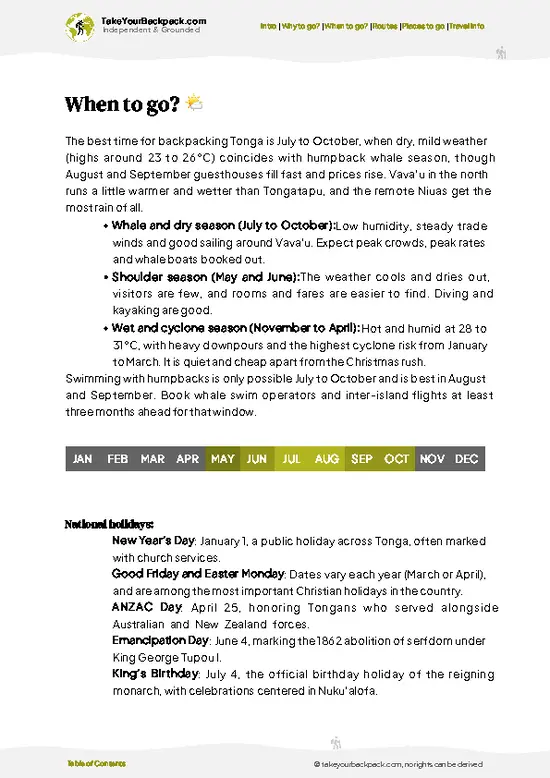
May to October is the best window for Ha‘amonga ‘a Maui, the stone trilithon at Niutoua on Tongatapu’s northeast coast, because rain is lowest and the open site is comfortable to walk around.
  • Dry Season (May to October): Days run 23 to 27°C (73 to 81°F) with lower humidity and cooler nights around 17 to 20°C (63 to 68°F). Daylight lasts roughly 11 to 12 hours, with sunset near 5:30 to 6:15 pm. Humpback whales visit from July to October, so you can pair the trilithon with a whale swim. Flights and rooms cost most in July and August.
  • Wet Season (November to April): Expect 27 to 31°C (81 to 88°F), heavy humidity, and sudden downpours that turn the dirt track to the site muddy. Daylight stretches to about 13 hours. Mosquitoes thrive after rain. Prices soften and you may have the stones to yourself.
… read more 👉
May to October is the best window for Ha‘amonga ‘a Maui, the stone trilithon at Niutoua on Tongatapu’s northeast coast, because rain is lowest and the open site is comfortable to walk around.
  • Dry Season (May to October): Days run 23 to 27°C (73 to 81°F) with lower humidity and cooler nights around 17 to 20°C (63 to 68°F). Daylight lasts roughly 11 to 12 hours, with sunset near 5:30 to 6:15 pm. Humpback whales visit from July to October, so you can pair the trilithon with a whale swim. Flights and rooms cost most in July and August.
  • Wet Season (November to April): Expect 27 to 31°C (81 to 88°F), heavy humidity, and sudden downpours that turn the dirt track to the site muddy. Daylight stretches to about 13 hours. Mosquitoes thrive after rain. Prices soften and you may have the stones to yourself.
  • Cyclone Risk (December to April): Tropical storms can close roads and cancel flights, so keep your schedule flexible.
  • Crowds: The site is quiet year-round, with a handful of visitors at most.
Arrive in the first hour after sunrise or the last before sunset, when the light hits the coral limestone slabs and the heat is gentle.


source: climatestotravel.comJANJanuary: fair for travelingFEBFebruary: fair for travelingMARMarch: fair for travelingAPRApril: fair for travelingMAYMay: highly recommended for travelingJUNJune: excellent for travelingJULJuly: excellent for travelingAUGAugust: excellent for travelingSEPSeptember: highly recommended for travelingOCTOctober: excellent for travelingNOVNovember: fair for travelingDECDecember: fair for traveling
tonga-unique-site-haamonga-a-maui
© Google |

✈️ The backpacker research shortcutTonga Travel Guide

An offline-friendly backpacking guide with optimized travel routes, ranked highlights, transport advice, and the best areas to stay.
example page 0 from our offline Travel Guide for Tonga
example page 1 from our offline Travel Guide for Tonga
example page 2 from our offline Travel Guide for Tonga
example page 3 from our offline Travel Guide for Tonga
example page 4 from our offline Travel Guide for Tonga
example page 5 from our offline Travel Guide for Tonga
example page 6 from our offline Travel Guide for Tonga
example page 7 from our offline Travel Guide for Tonga
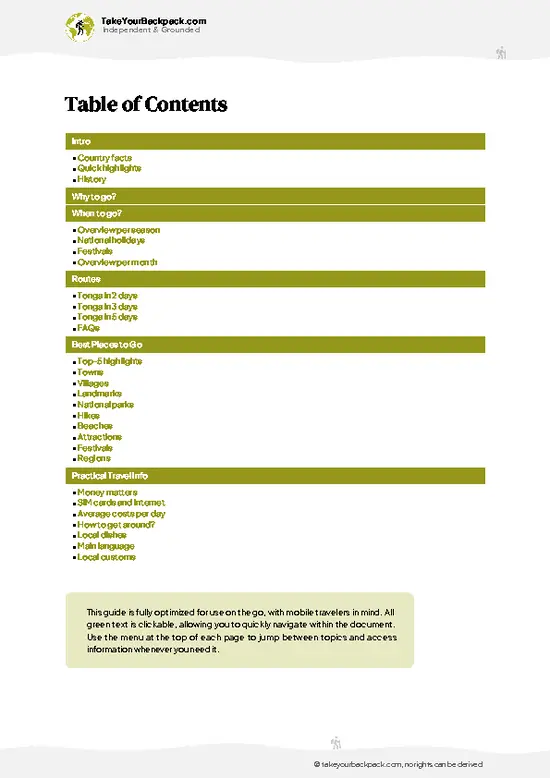
The digital guide (132 pages) contains:
✅ 33 highlights, ranked by travel appeal
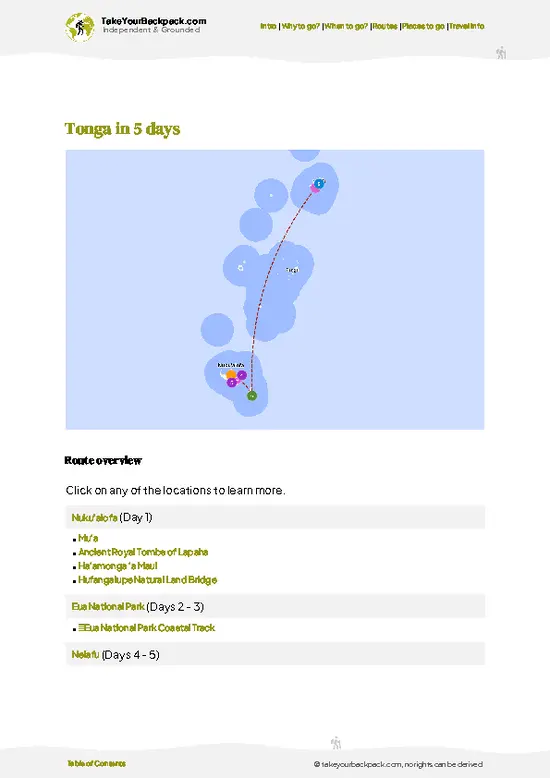
✅ Optimized 2, 3 & 5-day travel routes
✅ Cities, national parks, landmarks, beaches
✅ How to get around
✅ Offline-friendly for travel without Wi-Fi
👉 Click to see all 30+ guide features

📅 Plan smarter in minutes, not weeks
✅ Month by month travel advice
✅ Festivals & national holidays
✅ Budget expectations

🗺️ Go to the right places, skip the overrated ones
✅ Honest pros & cons of destinations
✅ Top hikes, parks & viewpoints
✅ Lesser-known places most travelers miss
✅ Clear “worth it vs skip it” guidance

🛏️ Travel smoothly without rookie mistakes
✅ Best areas to stay
✅ Transport systems explained simply
✅ Common scams & safety advice
✅ SIM cards, money & practical tips

🌍 Understand the country, not just visit it
✅ Culture & traditions
✅ 52 Essential phrases & customs
✅ Festivals worth planning around
✅ Traveler-friendly historical context
✅ Insights that make places more meaningful

📱 Built for real travel conditions
✅ Fully downloadable PDF
✅ Works completely offline
✅ Optimized for phone use
✅ Useful in remote areas & buses
✅ Everything in one place
Save weeks of stressful planning
Get instant access to your full guide. 30‑day money-back guarantee.
+ Add another guide for just

By proceeding you agree to our terms.
Sent to your inbox immediately after payment • 100% Secure Checkout
Best Backpacking Travel Advisor 2025 tourism awardBest Backpacking
Travel Advisor
2025
What others say about Take Your Backpack Guides:
⭐⭐⭐⭐⭐
Fantastic, amazing amount of information!
⭐⭐⭐⭐⭐
My goodness this is amazing, it's what I've been looking for hats off too you!
⭐⭐⭐⭐⭐
I think this is absolutely BRILLIANT
⭐⭐⭐⭐
Very complete and informative. It's still missing places, but I gotta to commend you
⭐⭐⭐⭐⭐
This is truly amazing, thank you, can't wait to explore it with my kids!
⭐⭐⭐⭐⭐
Awesome resource, thank you!
⭐⭐⭐⭐⭐
This is amazing! Can't wait to explore the ones I haven't seen
⭐⭐⭐⭐
I love this! Well done, great idea.
⭐⭐⭐⭐⭐
Thanks for taking the time to make this gem!
⭐⭐⭐⭐⭐
This might be the best website I've ever seen.
⭐⭐⭐⭐⭐
Congratulations, and thank you so much for your work; it's incredibly valuable.
⭐⭐⭐⭐
In all seriousness I think you did a great job pointing out the important spots
⭐⭐⭐⭐⭐
10/10 very good
⭐⭐⭐⭐⭐
As someone who's only just starting to visit regularly this is awesome, thank you.
⭐⭐⭐⭐
Thank you very much! I'm going to visit my dad, it's going to be very useful!
⭐⭐⭐⭐⭐
This is really cool! We'll be travelling for the first time and this definitely come in handy.
⭐⭐⭐⭐⭐
You are now our minister of culture, congratulations 👨‍💼
⭐⭐⭐⭐⭐
Just wanted to tell you that this is a pearl! Going to follow your recommendations.
⭐⭐⭐⭐⭐
This is so cool. I'll definitely be using the resource for my travels soon.
⭐⭐⭐⭐⭐
This is very impressive! Good work.
⭐⭐⭐⭐⭐
This is an amazing and informative site. Very well done!

🛏️ Where to stay?Where staying makes the most sense

Nuku‘alofa is the best base for Ha‘amonga ‘a Maui, since it holds nearly all of Tongatapu’s hostels and guesthouses, and the site is roughly 30 to 40 minutes away by road.
The downtown waterfront area around Taufa‘ahau Road and the harbor is where budget travelers gather. Dorm-style and guesthouse stays here cluster within walking distance of the market, bus terminal, ferry wharf and the cafes, so meeting other travelers over breakfast or a kava evening is easy. It is also the safest option after dark, with lit streets and plenty of people about, though solo women should still take a taxi late … read more 👉
Nuku‘alofa is the best base for Ha‘amonga ‘a Maui, since it holds nearly all of Tongatapu’s hostels and guesthouses, and the site is roughly 30 to 40 minutes away by road.
The downtown waterfront area around Taufa‘ahau Road and the harbor is where budget travelers gather. Dorm-style and guesthouse stays here cluster within walking distance of the market, bus terminal, ferry wharf and the cafes, so meeting other travelers over breakfast or a kava evening is easy. It is also the safest option after dark, with lit streets and plenty of people about, though solo women should still take a taxi late at night. Buses to the east depart from the main terminal, and rental scooters, bikes and cars are arranged here too.
The quieter lagoon-side strip along the north coast, toward Fana and Sia ko Kaiga, suits those wanting beach views and a slower pace. You get fewer social options, and you will need your own wheels or a taxi for supplies.
For a night near the trilithon itself, village homestays and a few simple beach fales around Niutoua and the northeast coast exist, but they are sparse, with limited food and no nightlife. Book ahead, bring snacks, and treat it as a peaceful one-night add-on.
Most backpackers choose Nuku‘alofa for the whole stay and make the stones a half-day trip.

👛 Costs (as of 7 October 2026)Travel costs and budget guide for Ha‘amonga ‘a Maui

Expect to spend about US$55 to 110 a day around Ha‘amonga ‘a Maui when based in Nuku‘alofa, with the site itself costing little. Prices below are in Tongan pa‘anga (TOP) with US$ equivalents, and the total uses high-season accommodation.
CategoryBudget RangeLocal Reality
Site EntryTOP 0 to 10 (US$0 to 4)The trilithon sits in an open grassy reserve, and any fee is small and collected locally.
Accommodation (high season)US$20 to 45Dorm beds and basic guesthouse rooms in Nuku‘alofa; private rooms with air-conditioning sit at the top of the range.
FoodUS$12 to 25Market stalls and bakeries sell cheap meals; a sit-down lunch of fish and root crops costs more.
Local TransportUS$3 to 10Buses on the island are cheap but infrequent and may not reach Niutoua directly, so a shared ride is common.
Taxi or Rental
… read more 👉
Expect to spend about US$55 to 110 a day around Ha‘amonga ‘a Maui when based in Nuku‘alofa, with the site itself costing little. Prices below are in Tongan pa‘anga (TOP) with US$ equivalents, and the total uses high-season accommodation.
CategoryBudget RangeLocal Reality
Site EntryTOP 0 to 10 (US$0 to 4)The trilithon sits in an open grassy reserve, and any fee is small and collected locally.
Accommodation (high season)US$20 to 45Dorm beds and basic guesthouse rooms in Nuku‘alofa; private rooms with air-conditioning sit at the top of the range.
FoodUS$12 to 25Market stalls and bakeries sell cheap meals; a sit-down lunch of fish and root crops costs more.
Local TransportUS$3 to 10Buses on the island are cheap but infrequent and may not reach Niutoua directly, so a shared ride is common.
Taxi or Rental for the SiteUS$15 to 20A round-trip taxi with waiting time from town runs roughly US$30 to 60 split among passengers; scooters and cars cost more per day but let you add other east-coast stops.
ExtrasUS$5 to 10Drinking water, snacks, and kava sessions or small souvenirs.
Total Daily BudgetUS$55 to 110Per person, per day, in high season.
Cash is useful in the east, where card machines are rare. ATMs are in Nuku‘alofa.
⚠️ Prices can change and everyone travels differently, so take this as a rough guide. Hope it helps you plan your adventure!

FAQTraveler FAQ

Ha‘amonga ‘a Maui is a coral limestone trilithon at Niutoua on Tongatapu’s northeast coast, built around the 13th century. Two upright stones about 5 meters (16 feet) tall carry a lintel, and it is often called the Stonehenge of the Pacific. Tradition links it to Tu‘i Tonga Tu‘itatui, and the gap may align with the sunrise at the winter and summer solstices.
Plan about 30 to 45 minutes at the site itself, since it is a single monument in an open reserve. With travel from Nuku‘alofa (about 30 to 40 minutes each way), a half day is realistic. Add 2 to 3 hours if you want to stop at the Mapu‘a ‘a Vaea blowholes or Lapaha royal tombs on a loop.
Drive or ride roughly 20 km (12 miles) northeast from Nuku‘alofa along the Taufa‘ahau and Hala Fatafehi roads toward Niutoua, about 30 to 40 minutes. Local buses go east from the Nuku‘alofa terminal but run infrequently and may stop short, so many travelers take a taxi (roughly US$30 to 60 round trip with waiting) or rent a scooter or car. Signs near the village point to the reserve, and the final stretch is a short unpaved track.
⚠️ Things can change over time, so always validate details locally before you go.

Other Tongan landmarks near Ha‘amonga ‘a Maui

Explore more nearby:


💡 Not sure where to go next?
Create a personalized itinerary for Tonga including Ha‘amonga ‘a Maui and the places that fit your trip.

Generate my itinerary

👉 Discover all landmarks

Or checkout all Tonga has to offer (think cities, towns, villages, national parks, hikes, beaches, festivals)
Country photo of Tonga

We 💚 feedbackIs it worth it?

Most visitors photograph the gateway from the front and leave. Walk around to the side and look at the joints where the lintel sits in its grooves, because that is where the builders’ skill shows. I would also arrive early, bring water and a hat, and pause to look through the gap toward the east.

✍️ Help improve this page!
The information on this page is based on in-depth research, insights shared by experienced travelers, and feedback from the local travel community in Tonga. While every effort is made to keep the information accurate and current, conditions can change — so if you spot anything incorrect or outdated, please get in touch.


🙋‍♂️ Give feedback

👋 Meet the founderWho’s Behind Take Your Backpack?

Johan, backpacker and founder of TakeYourBackpackHi, I’m Johan (Netherlands 🇳🇱), the creator of TakeYourBackpack. Over the past 3 decades, I’ve backpacked through 90+ countries across six continents, gaining extensive experience with independent travel, long-term trips, and overland routes.

This site is built on a combination of firsthand travel experience and carefully curated insights from other backpackers. Many guides are based on places I’ve personally visited, while others bring together tips, observations, and practical advice shared by trusted travelers I’ve met along the way.

The goal is to provide realistic, experience-driven guidance — not generic itineraries — so you can explore destinations with better context, clearer expectations, and more confidence.

Get full Tonga guide •
Instant download • 33 highlights • Full Offline guide