×

Trinidad and Tobago🇹🇹 | national parksNariva SwampBush Bush Island, tidal channels, red howlers, manatee waters | things to do and best time to go

Explore Tobago Main Ridge Forest ReserveExplore Little Tobago Island

Backpacking in Nariva Swamp
👍 Recommendednational park ranked #5
By Johan Kruseman 🇳🇱 | Updated October 20, 2026

The real decision at Nariva Swamp is whether to go with a guide or try to do it yourself, and the swamp settles it fast: there are no marked trails, the water is tidal and the roads end at mud. Nariva Swamp sits on the east coast of Trinidad and Tobago, in the island of Trinidad, running behind Manzanilla and Mayaro beaches. Local guides exist because the channels, the Bush Bush Island access and the caiman and manatee spots are known to them and not to your phone. An experienced traveler books one by phone a day ahead and skips the improvising. Expect red howler monkeys, anacondas if luck cooperates, and birds galore, but not crowds or cafés. Unlike Caroni Swamp, which is a quick boat loop at dusk for scarlet ibis, Nariva is wider, quieter and far less polished.

Discover everything you want to know in the 📖 Trinidad and Tobago Travel Guide.


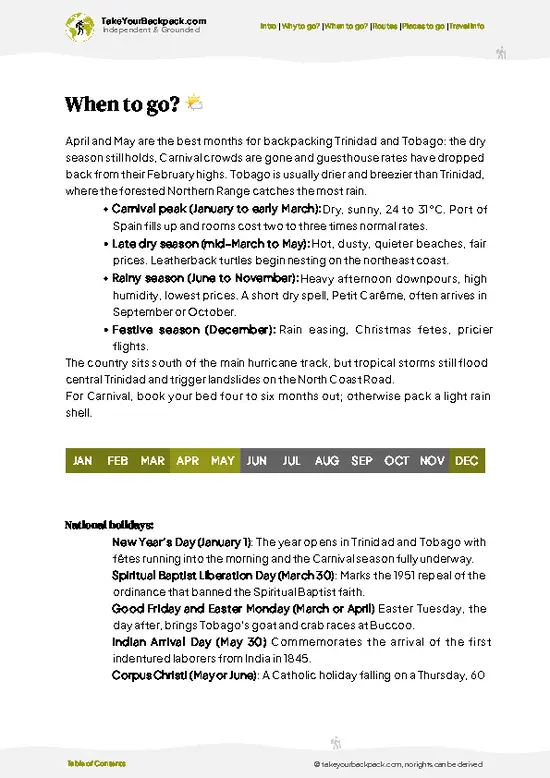
example page 0 from our offline Travel Guide for Trinidad and Tobago
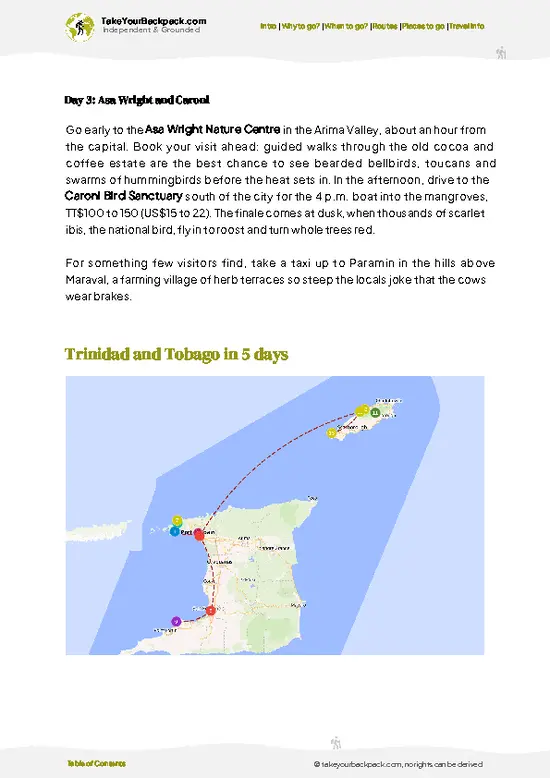
example page 1 from our offline Travel Guide for Trinidad and Tobago
example page 2 from our offline Travel Guide for Trinidad and Tobago
example page 3 from our offline Travel Guide for Trinidad and Tobago
example page 4 from our offline Travel Guide for Trinidad and Tobago
example page 5 from our offline Travel Guide for Trinidad and Tobago
example page 6 from our offline Travel Guide for Trinidad and Tobago
example page 7 from our offline Travel Guide for Trinidad and Tobago
Loading the map 🌍
CLICK TO FILTER
cities
towns
villages
landmarks
national parks
hikes
beaches
attractions
festivals
regions
SHOW COUNTRY’S BESTSHOW ALL

✨ Why go?
Ranked #5 national park in Trinidad and Tobago
The unique appeal for travelers

Nariva Swamp is where backpackers go when they have already ticked off the beaches and want Trinidad's wild interior without a tour bus. The wetland covers roughly 60 square kilometers of freshwater swamp, marsh and palm forest, the largest wetland in the country, and it is protected as a Ramsar site. That means real habitat: red howler monkeys on Bush Bush Island, West Indian manatees in the channels, spectacled caiman, and well over a hundred bird species including the blue-and-yellow macaw reintroduced here. Independent exploration is possible along the coast road and the edges of the swamp, which suits the self-guided crowd, but the interior really needs a local boatman or birding guide. That keeps money in nearby villages and gives you someone who can tell a caiman eye from a floating … read more 👉
Nariva Swamp is where backpackers go when they have already ticked off the beaches and want Trinidad's wild interior without a tour bus. The wetland covers roughly 60 square kilometers of freshwater swamp, marsh and palm forest, the largest wetland in the country, and it is protected as a Ramsar site. That means real habitat: red howler monkeys on Bush Bush Island, West Indian manatees in the channels, spectacled caiman, and well over a hundred bird species including the blue-and-yellow macaw reintroduced here. Independent exploration is possible along the coast road and the edges of the swamp, which suits the self-guided crowd, but the interior really needs a local boatman or birding guide. That keeps money in nearby villages and gives you someone who can tell a caiman eye from a floating leaf. If you like your nature unpackaged, the Manzanilla to Mayaro coast road makes a good frame, with the surf on one side and the swamp on the other.

💡 HighlightsPlaces and moments you shouldn't skip

  1. Bush Bush Island Wildlife Sanctuary: The swamp's best-known spot, a forested island reached by boat, home to red howler monkeys, agoutis and many forest birds. Access needs a permit and guide.
  2. Nariva Swamp Channels by Boat: Slow paddling or motor trips through narrow channels where caiman, herons and kingfishers sit along the banks.
  3. Manatee Spotting: The West Indian manatee lives in the swamp's waters. Sightings are rare and quiet, so patience is part of the deal.
  4. Blue-and-Yellow Macaws: A reintroduced population flies over the palm stands, loud and easy to hear before you see them.
  5. Cocal Beach Edge: A long, wild stretch of coconut-lined coast along Manzanilla Bay, with strong surf and a clear view toward the swamp.
  6. Nariva Bird Watching: Jacanas, herons, hawks and parrots show up in the marsh,
… read more 👉
  1. Bush Bush Island Wildlife Sanctuary: The swamp's best-known spot, a forested island reached by boat, home to red howler monkeys, agoutis and many forest birds. Access needs a permit and guide.
  2. Nariva Swamp Channels by Boat: Slow paddling or motor trips through narrow channels where caiman, herons and kingfishers sit along the banks.
  3. Manatee Spotting: The West Indian manatee lives in the swamp's waters. Sightings are rare and quiet, so patience is part of the deal.
  4. Blue-and-Yellow Macaws: A reintroduced population flies over the palm stands, loud and easy to hear before you see them.
  5. Cocal Beach Edge: A long, wild stretch of coconut-lined coast along Manzanilla Bay, with strong surf and a clear view toward the swamp.
  6. Nariva Bird Watching: Jacanas, herons, hawks and parrots show up in the marsh, best early in the morning when the light is soft and the air is cool.
  7. Coconut Groves of Manzanilla: The road beside the swamp passes endless palm rows, a good place to stop for fresh coconut water from roadside vendors.
For a first visit, the guided boat trip through the channels gives the best mix of wildlife and access.
Spotted a mistake or missing something? Contact us.

Things to do near Nariva Swamp

Ratings based on Tripadvisor reviews. When you book through this link, you support our work at no extra cost to you.

🌤️ When to go?When to go for the best experience

  • Dry Season (January to May): Water levels drop, trails and boat channels are easier to reach, and birding is at its best. Days run 24 to 32°C (75 to 90°F), with roughly 11.5 to 12 hours of daylight. March to May is hottest and driest.
  • Wet Season (June to December): Heavy afternoon downpours flood roads around Manzanilla and Plum Mitan, and mosquitoes multiply. Temperatures stay 23 to 31°C (73 to 88°F). Few tourists show up, and guides are easy to book.
  • Crowds and Prices: Visitor numbers are low all year. Local guide and lodging rates stay steady, apart from Carnival weekends and Easter, when beach towns on the coast fill with Trinidadians.
  • Seasonal Wildlife: Red-bellied macaws feed in the Manzanilla palm stands at dawn and dusk year-round, while manatees and caiman are seen more easily when water
… read more 👉
  • Dry Season (January to May): Water levels drop, trails and boat channels are easier to reach, and birding is at its best. Days run 24 to 32°C (75 to 90°F), with roughly 11.5 to 12 hours of daylight. March to May is hottest and driest.
  • Wet Season (June to December): Heavy afternoon downpours flood roads around Manzanilla and Plum Mitan, and mosquitoes multiply. Temperatures stay 23 to 31°C (73 to 88°F). Few tourists show up, and guides are easy to book.
  • Crowds and Prices: Visitor numbers are low all year. Local guide and lodging rates stay steady, apart from Carnival weekends and Easter, when beach towns on the coast fill with Trinidadians.
  • Seasonal Wildlife: Red-bellied macaws feed in the Manzanilla palm stands at dawn and dusk year-round, while manatees and caiman are seen more easily when water is lower.
Book a guide for a weekday morning in February or March, when light is soft and the swamp is calm.


source: climatestotravel.comJANJanuary: excellent for travelingFEBFebruary: excellent for travelingMARMarch: excellent for travelingAPRApril: excellent for travelingMAYMay: highly recommended for travelingJUNJune: fair for travelingJULJuly: fair for travelingAUGAugust: fair for travelingSEPSeptember: fair for travelingOCTOctober: fair for travelingNOVNovember: fair for travelingDECDecember: fair for traveling
trinidad-and-tobago-national-park-nariva-swamp
© Google |

✈️ The backpacker research shortcutTrinidad and Tobago Travel Guide

An offline-friendly backpacking guide with optimized travel routes, ranked highlights, transport advice, and the best areas to stay.
example page 0 from our offline Travel Guide for Trinidad and Tobago
example page 1 from our offline Travel Guide for Trinidad and Tobago
example page 2 from our offline Travel Guide for Trinidad and Tobago
example page 3 from our offline Travel Guide for Trinidad and Tobago
example page 4 from our offline Travel Guide for Trinidad and Tobago
example page 5 from our offline Travel Guide for Trinidad and Tobago
example page 6 from our offline Travel Guide for Trinidad and Tobago
example page 7 from our offline Travel Guide for Trinidad and Tobago
The digital guide (222 pages) contains:
✅ 58 highlights, ranked by travel appeal
✅ Optimized 2, 3 & 5-day travel routes
✅ Cities, national parks, landmarks, beaches
✅ How to get around
✅ Offline-friendly for travel without Wi-Fi
👉 Click to see all 30+ guide features

📅 Plan smarter in minutes, not weeks
✅ Month by month travel advice
✅ Festivals & national holidays
✅ Budget expectations

🗺️ Go to the right places, skip the overrated ones
✅ Honest pros & cons of destinations
✅ Top hikes, parks & viewpoints
✅ Lesser-known places most travelers miss
✅ Clear “worth it vs skip it” guidance

🛏️ Travel smoothly without rookie mistakes
✅ Best areas to stay
✅ Transport systems explained simply
✅ Common scams & safety advice
✅ SIM cards, money & practical tips

🌍 Understand the country, not just visit it
✅ Culture & traditions
✅ Local customs
✅ Festivals worth planning around
✅ Traveler-friendly historical context
✅ Insights that make places more meaningful

📱 Built for real travel conditions
✅ Fully downloadable PDF
✅ Works completely offline
✅ Optimized for phone use
✅ Useful in remote areas & buses
✅ Everything in one place
Stop searching, start planning
Get instant access to your full guide. 30‑day money-back guarantee.
+ Add another guide for just

By proceeding you agree to our terms.
Sent to your inbox immediately after payment • 100% Secure Checkout
Best Backpacking Travel Advisor 2025 tourism awardBest Backpacking
Travel Advisor
2025
What others say about Take Your Backpack Guides:
⭐⭐⭐⭐⭐
Fantastic, amazing amount of information!
⭐⭐⭐⭐⭐
My goodness this is amazing, it's what I've been looking for hats off too you!
⭐⭐⭐⭐⭐
I think this is absolutely BRILLIANT
⭐⭐⭐⭐
Very complete and informative. It's still missing places, but I gotta to commend you
⭐⭐⭐⭐⭐
This is truly amazing, thank you, can't wait to explore it with my kids!
⭐⭐⭐⭐⭐
Awesome resource, thank you!
⭐⭐⭐⭐⭐
This is amazing! Can't wait to explore the ones I haven't seen
⭐⭐⭐⭐
I love this! Well done, great idea.
⭐⭐⭐⭐⭐
Thanks for taking the time to make this gem!
⭐⭐⭐⭐⭐
This might be the best website I've ever seen.
⭐⭐⭐⭐⭐
Congratulations, and thank you so much for your work; it's incredibly valuable.
⭐⭐⭐⭐
In all seriousness I think you did a great job pointing out the important spots
⭐⭐⭐⭐⭐
10/10 very good
⭐⭐⭐⭐⭐
As someone who's only just starting to visit regularly this is awesome, thank you.
⭐⭐⭐⭐
Thank you very much! I'm going to visit my dad, it's going to be very useful!
⭐⭐⭐⭐⭐
This is really cool! We'll be travelling for the first time and this definitely come in handy.
⭐⭐⭐⭐⭐
You are now our minister of culture, congratulations 👨‍💼
⭐⭐⭐⭐⭐
Just wanted to tell you that this is a pearl! Going to follow your recommendations.
⭐⭐⭐⭐⭐
This is so cool. I'll definitely be using the resource for my travels soon.
⭐⭐⭐⭐⭐
This is very impressive! Good work.
⭐⭐⭐⭐⭐
This is an amazing and informative site. Very well done!

🛏️ Where to stay?How to pick the right area

Nothing is permitted inside Nariva Swamp itself, so you sleep in the small towns on its edge. Plum Mitan, Manzanilla and Mayaro are the practical choices, and all three are close to the guides and boat launches.
Manzanilla is the best base. It sits on the Atlantic coast beside the swamp, with a few guesthouses and small beachfront apartments, typically US$45 to 90 a night. Cafes and roadside stalls serve fresh fish and roti, and it is easy to arrange a morning birding trip from here.
Mayaro, farther south, has more rental houses and small hotels, around US$50 to 110, plus shops and a bigger range … read more 👉
Nothing is permitted inside Nariva Swamp itself, so you sleep in the small towns on its edge. Plum Mitan, Manzanilla and Mayaro are the practical choices, and all three are close to the guides and boat launches.
Manzanilla is the best base. It sits on the Atlantic coast beside the swamp, with a few guesthouses and small beachfront apartments, typically US$45 to 90 a night. Cafes and roadside stalls serve fresh fish and roti, and it is easy to arrange a morning birding trip from here.
Mayaro, farther south, has more rental houses and small hotels, around US$50 to 110, plus shops and a bigger range of food. It works well if you want a car-based exploration of the long coastline.
San Fernando and Sangre Grande are bigger towns with supermarkets, banks and more affordable lodging, usually US$35 to 70. They suit you if you are traveling by public transport and prefer to take early shared taxis.
Trinidad has few hostels, so most backpackers use budget guesthouses and Airbnb rooms. Book ahead for Carnival and Easter weekends. Bring mosquito repellent whichever place you choose.

👛 Costs (as of 20 October 2026)What things cost and how to budget

Nariva Swamp costs a backpacker about US$85 a day with a guide and a guesthouse bed in high season. Most expenses come from tours and local transport, since access is free.
CategoryBudget RangeLocal Reality
Entrance feesUS$0The swamp has no gate or ticket, and you pay only for guided access.
Accommodation (high season)US$30 to 55Basic guesthouses or shared rooms in Manzanilla and Mayaro. Prices rise at Carnival and Easter, and low-season rates drop by roughly US$5 to 10.
Guided toursUS$15 to 30Birding or boat outings usually cost US$30 to 60 per group or person, so sharing a tour with others brings the daily average down.
Local transportUS$5 to 15Shared taxis, called maxis, run on the main roads between Sangre Grande and Manzanilla for about US$1 to 3. Reaching trailheads often means a private
… read more 👉
Nariva Swamp costs a backpacker about US$85 a day with a guide and a guesthouse bed in high season. Most expenses come from tours and local transport, since access is free.
CategoryBudget RangeLocal Reality
Entrance feesUS$0The swamp has no gate or ticket, and you pay only for guided access.
Accommodation (high season)US$30 to 55Basic guesthouses or shared rooms in Manzanilla and Mayaro. Prices rise at Carnival and Easter, and low-season rates drop by roughly US$5 to 10.
Guided toursUS$15 to 30Birding or boat outings usually cost US$30 to 60 per group or person, so sharing a tour with others brings the daily average down.
Local transportUS$5 to 15Shared taxis, called maxis, run on the main roads between Sangre Grande and Manzanilla for about US$1 to 3. Reaching trailheads often means a private taxi at US$10 to 25.
Food and suppliesUS$8 to 15Roadside roti, doubles and fresh fish cost US$2 to 8 per meal. Buy water and repellent in town beforehand.
Total Daily BudgetUS$58 to 115Around US$85 is realistic with a shared tour and a mid-range guesthouse bed.
⚠️ Prices can change and everyone travels differently, so take this as a rough guide. Hope it helps you plan your adventure!

🥾 TrailsBest hikes in Nariva Swamp national park

Nariva Swamp is a wetland more than a hiking park, so most outings combine short walks with boat travel, and the terrain is flat, wet and often muddy. Guides shape the day, since there are no signed trails.
  • Bush Bush Island walk: A guided forest walk of about 1 to 2 hours on flat, damp ground, easy in difficulty but slippery after rain, with howler monkeys overhead and agoutis underfoot.
  • Channel paddle or boat loop: Two to three hours on water through reeds and palm stands, easy effort, best for caiman, herons and sometimes manatees.
  • Coast road birding walk: A relaxed stroll of one to two hours on
… read more 👉
Nariva Swamp is a wetland more than a hiking park, so most outings combine short walks with boat travel, and the terrain is flat, wet and often muddy. Guides shape the day, since there are no signed trails.
  • Bush Bush Island walk: A guided forest walk of about 1 to 2 hours on flat, damp ground, easy in difficulty but slippery after rain, with howler monkeys overhead and agoutis underfoot.
  • Channel paddle or boat loop: Two to three hours on water through reeds and palm stands, easy effort, best for caiman, herons and sometimes manatees.
  • Coast road birding walk: A relaxed stroll of one to two hours on the roadside near Manzanilla, easy and shaded in patches, good for parrots and raptors.
  • Palm forest edge walk: A short, muddy track along the swamp margin, moderate in wet weather, where you may hear macaws and frogs.
Wear rubber boots or quick-dry shoes, long sleeves and strong insect repellent, since mosquitoes are serious. Reaching Nariva Swamp without a car is slow, with route taxis and maxi taxis running toward Manzanilla and Mayaro, then a local arrangement for the last stretch. Crowds are minimal, often just you and the guide. Bush Bush Island needs permission from the forestry authority, and guides usually handle this; costs for boat trips are paid in local currency.
⚠️ Hiking info can sometimes be outdated or inaccurate. Before you hit the trail, check the latest conditions with locals. If you do spot anything that's off, I'd love to hear from you, so I can update it for fellow travelers.

🛡️ SafetyScams, Hazards, and Annoyances

Nariva Swamp is a low-risk place to explore if you go with a local guide and respect the heat and the water. Most of the area is flat, but the terrain is wet, muddy and hard to navigate, and tracks are poorly marked, so a guide is far more useful than a map. Wear closed shoes you do not mind soaking, long light clothing, and strong insect repellent. Heat and humidity drain you quickly, so carry at least 2 to 3 liters of water per person and start early. Caiman, snakes and howler monkeys live here, and they leave you alone if you keep your distance, stay on the boat or path, and never feed anything. Do not swim in the swamp. Along the Manzanilla beach, rip currents can be strong, so check with locals before entering. Tell someone your plan, and keep valuables out of parked cars at trailheads.

FAQCommon questions from travelers

Two days is enough for Nariva Swamp if you want a guided boat trip plus time on the Manzanilla coast. One morning on the water covers the macaws, birds and caiman, which typically takes 3 to 4 hours. Add a second day for Cocal beach, mangrove trails or Mayaro, and a third if you want a relaxed pace.
Visiting Nariva Swamp without a car is possible but slow. Shared maxi taxis run from Sangre Grande to Manzanilla, usually about 45 to 60 minutes, and from there you can arrange a local guide or private taxi for US$10 to 25 to the trailheads. Public transport thins out in the afternoon, so start early and plan a guesthouse in Manzanilla or Plum Mitan.
Nariva Swamp has no entrance fee, and no general permit is needed for visiting the public areas. Access to forest reserves can require permission from the Forestry Division, and most visitors simply pay a guide US$30 to 60 for a birding or boat outing. Bring cash, since small operators rarely take cards.
⚠️ Things can change over time, so always validate details locally before you go.

Other Trinidadian and Tobagonian national parks near Nariva Swamp

Explore more nearby:

  • Caroni Bird Sanctuary—Scarlet ibis dusk roost, mangrove channels, tree boas, flat-bottomed boats| 47 km away
  • Maracas National Park—mountain rainforest, river pools, scenic drive| 56 km away
  • La Brea—industrial heritage, asphalt mining, village life| 65 km away

💡 Not sure where to go next?
Create a personalized itinerary for Trinidad and Tobago including Nariva Swamp and the places that fit your trip.

Generate my itinerary

👉 Discover all national parks

Or checkout all Trinidad and Tobago has to offer (think cities, towns, villages, national parks, hikes, beaches, festivals)
Country photo of Trinidad and Tobago

We 💚 feedbackSumming up the experience

Nariva Swamp suits patient birders, wildlife nerds and anyone who prefers mud to marked paths. If you want boardwalks and snack stands, skip it. Book a local guide the day before and bring rubber boots and binoculars. Go early, speak softly, and let the howler monkeys do the shouting.

✍️ Help improve this page!
The information on this page is based on in-depth research, insights shared by experienced travelers, and feedback from the local travel community in Trinidad and Tobago. While every effort is made to keep the information accurate and current, conditions can change — so if you spot anything incorrect or outdated, please get in touch.


🙋‍♂️ Give feedback

👋 Meet the founderWho’s Behind Take Your Backpack?

Johan, backpacker and founder of TakeYourBackpackHi, I’m Johan (Netherlands 🇳🇱), the creator of TakeYourBackpack. Over the past 3 decades, I’ve backpacked through 90+ countries across six continents, gaining extensive experience with independent travel, long-term trips, and overland routes.

This site is built on a combination of firsthand travel experience and carefully curated insights from other backpackers. Many guides are based on places I’ve personally visited, while others bring together tips, observations, and practical advice shared by trusted travelers I’ve met along the way.

The goal is to provide realistic, experience-driven guidance — not generic itineraries — so you can explore destinations with better context, clearer expectations, and more confidence.