×

Tunisia🇹🇳 | hikesKsar Ghilane to Douz TrekMulti-day dunes, Grand Erg, oasis hot spring, Douz finish | things to do and best time to go

Explore Le Cap BonExplore Chott el Jerid Salt Flats Walk

Backpacking in Ksar Ghilane to Douz Trek
🌟 Highlighthike ranked #2
By Johan Kruseman 🇳🇱 | Updated October 22, 2026

Ksar Ghilane has no regular bus or louage service, so this trek runs north toward Douz, where public transport does exist. The route crosses the Grand Erg Oriental in southern Tunisia, from the spring-fed oasis to the town on the Sahara’s edge. Expect roughly 110 to 150 kilometers of dunes, gravel flats and a horizon with nothing on it, which is either meditative or deeply boring depending on your snack supply. Fitness-wise it is moderate. Logistics-wise it is serious: no marked trail, no wells you can rely on, and phone signal that comes and goes like a shy cat. Soft sand turns one flat kilometer into a negotiation. The scenery is superb, the start has a warm swimming pool, and the finish has a café with a chair. Before going, arrange a local guide and water support through an agency in Douz, because this is not a route to improvise.

Discover everything you want to know in the 📖 Tunisia Travel Guide.
Best time to go: February - May, September - December
Duration: 5 days
Distance: 120 kilometers
Total ascent: 500 meters


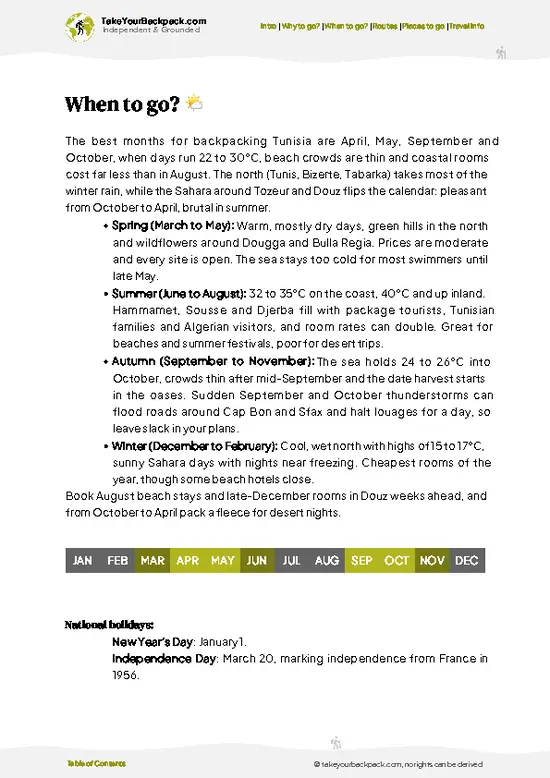
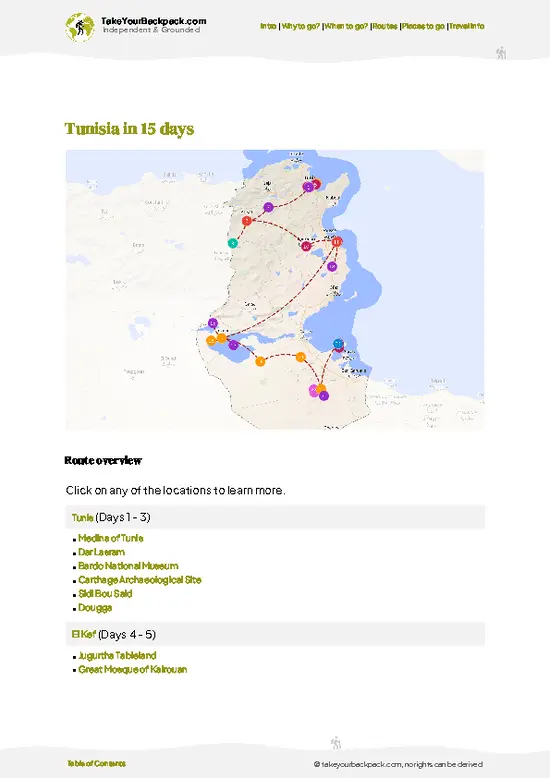
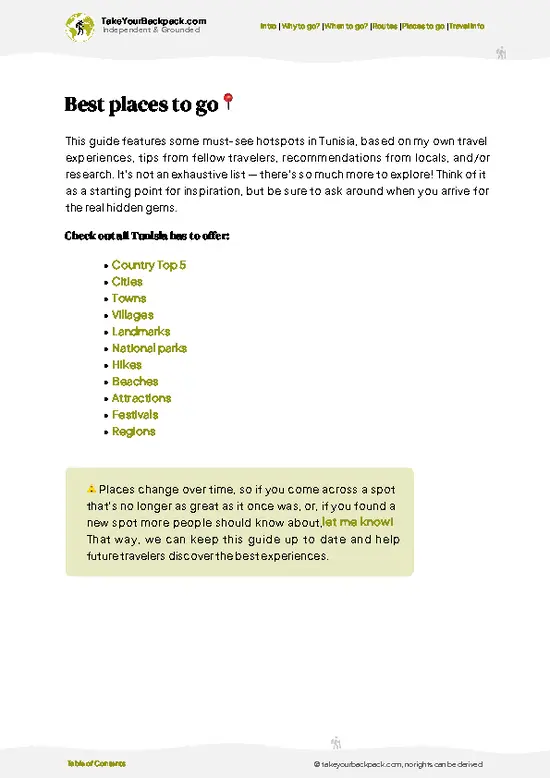
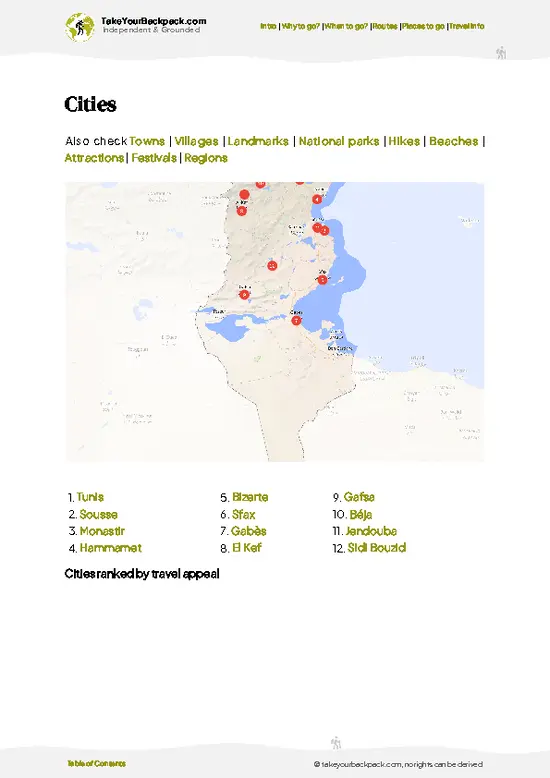
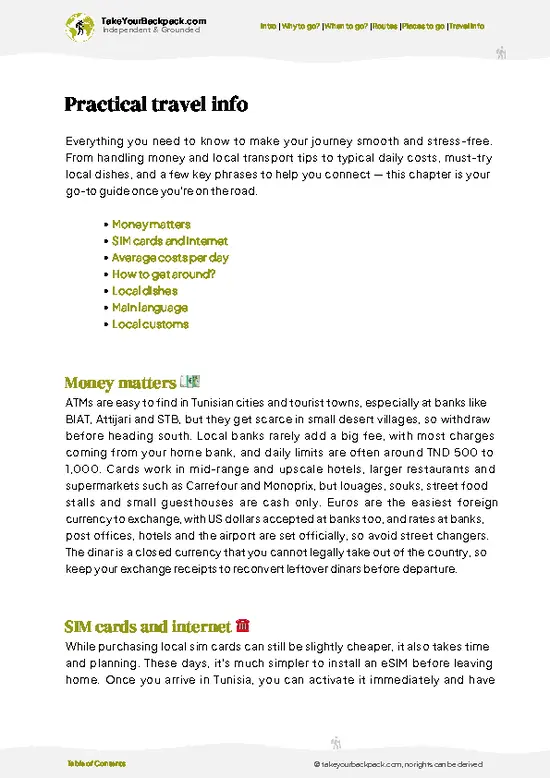
example page 0 from our offline Travel Guide for Tunisia
example page 1 from our offline Travel Guide for Tunisia
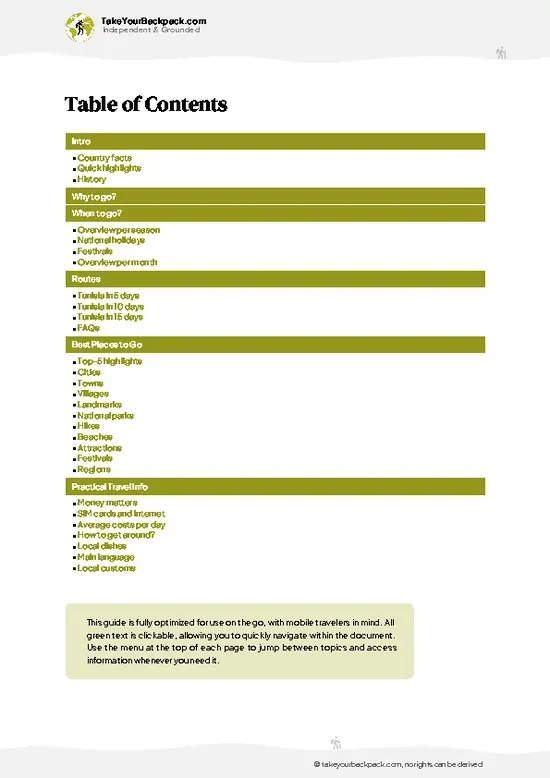
example page 2 from our offline Travel Guide for Tunisia
example page 3 from our offline Travel Guide for Tunisia
example page 4 from our offline Travel Guide for Tunisia
example page 5 from our offline Travel Guide for Tunisia
example page 6 from our offline Travel Guide for Tunisia
example page 7 from our offline Travel Guide for Tunisia
Loading the map 🌍
CLICK TO FILTER
cities
towns
villages
landmarks
national parks
hikes
beaches
attractions
festivals
regions
SHOW COUNTRY’S BESTSHOW ALL

✨ Why go?
Ranked #2 hike in Tunisia
The unique appeal for travelers

Ksar Ghilane to Douz Trek gives you something few hikes in Africa can: a point-to-point walk across a real sand sea, with an oasis at one end and a town at the other. Backpackers seek it out for the Grand Erg Oriental dunes, where ridgelines run for kilometers and the only footprints are fennec and gerbil tracks. The camel-supported format also matters. Your pack stays light, and nights are spent in simple bivouacs under a sky with no competing light.

It also fits neatly into a longer Tunisian loop. Most people start with a soak in the warm spring pool at Ksar Ghilane, walk for several days, and finish in Douz, where louages head on to Tozeur, Kebili and Gabès. The distance is flexible too. Agencies can shorten it to three or four days or stretch it, so you can match it to your schedule and legs.

💡 HighlightsDon't-miss highlights and experiences

  1. Tisavar Roman Fort: The small Roman fort of Tisavar stands just outside the Ksar Ghilane oasis. Built in the Roman period to guard the desert frontier, it is a squat, sand-colored enclosure with thick walls, and it makes a fitting place to start your walk. Climb the walls for your first long look at the dunes you are about to cross.
  2. Ksar Ghilane Hot Spring Pool: A warm, spring-fed pool sits among the date palms at the oasis. It is the best pre-trek soak and the best way to loosen legs before the sand begins. Locals and campers share it, so expect company and the occasional camel nearby.
  3. Grand Erg Oriental Dunes: The heart of the trek is the sand itself. Dunes here shift from low rippled swells to tall crescent ridges, and the color changes from pale gold at midday to deep orange as the light
… read more 👉
  1. Tisavar Roman Fort: The small Roman fort of Tisavar stands just outside the Ksar Ghilane oasis. Built in the Roman period to guard the desert frontier, it is a squat, sand-colored enclosure with thick walls, and it makes a fitting place to start your walk. Climb the walls for your first long look at the dunes you are about to cross.
  2. Ksar Ghilane Hot Spring Pool: A warm, spring-fed pool sits among the date palms at the oasis. It is the best pre-trek soak and the best way to loosen legs before the sand begins. Locals and campers share it, so expect company and the occasional camel nearby.
  3. Grand Erg Oriental Dunes: The heart of the trek is the sand itself. Dunes here shift from low rippled swells to tall crescent ridges, and the color changes from pale gold at midday to deep orange as the light drops. Walk the crests when you can; the sand is firmer there, and the views are wide.
  4. Douz Sahara Museum: Once you arrive, this small museum in Douz covers Saharan life, from nomadic tents and jewelry to tools, clothing and desert crafts. It gives context to the landscape you have just spent days crossing and offers some shade after all that sun.
  5. Douz Thursday Market: The weekly souk in Douz draws herders and farmers from the surrounding oases. Look for dates, spices, woven goods and livestock. It is the most local way to celebrate the end of the trek, and a good place to buy a desert scarf before you leave.
Ksar Ghilane to Douz Trek takes about four to six days on foot, with an extra half day if you want to soak at the spring first and see the fort, and another half day in Douz for the museum and the market.
Spotted a mistake or missing something? Contact us.

Things to do near Ksar Ghilane to Douz Trek

Ratings based on Tripadvisor reviews. When you book through this link, you support our work at no extra cost to you.

🌤️ When to go?Best time to hike the Ksar Ghilane to Douz Trek

  • Winter (December to February): Late November to February is the prime window for walking the Sahara between Ksar Ghilane and Douz. Days run 15 to 21°C (59 to 70°F), nights drop to 2 to 6°C (36 to 43°F), and daylight lasts about 10 hours. Camps are busiest at Christmas and New Year, and guided tour prices rise then.
  • Spring (March to May): Daytime highs climb from 22°C (72°F) to 33°C (91°F) or more by May, with nights around 10 to 18°C (50 to 64°F). March and early April are comfortable, but sandstorms (sirocco) can cut visibility for a day. Daylight stretches to 12 to 14 hours.
  • Summer (June to September): Highs of 38 to 45°C (100 to 113°F) make multi-day dune walking dangerous. Operators mostly pause treks, and prices for camps and 4x4 transfers drop.
  • Autumn (October to November): Days of 25 to
… read more 👉
  • Winter (December to February): Late November to February is the prime window for walking the Sahara between Ksar Ghilane and Douz. Days run 15 to 21°C (59 to 70°F), nights drop to 2 to 6°C (36 to 43°F), and daylight lasts about 10 hours. Camps are busiest at Christmas and New Year, and guided tour prices rise then.
  • Spring (March to May): Daytime highs climb from 22°C (72°F) to 33°C (91°F) or more by May, with nights around 10 to 18°C (50 to 64°F). March and early April are comfortable, but sandstorms (sirocco) can cut visibility for a day. Daylight stretches to 12 to 14 hours.
  • Summer (June to September): Highs of 38 to 45°C (100 to 113°F) make multi-day dune walking dangerous. Operators mostly pause treks, and prices for camps and 4x4 transfers drop.
  • Autumn (October to November): Days of 25 to 30°C (77 to 86°F) fade to cooler ones, and crowds build ahead of the Douz festival in late December.
Book your guide and camel support at least a few weeks ahead for December and January.


source: climatestotravel.comJANJanuary: fair for travelingFEBFebruary: good for travelingMARMarch: excellent for travelingAPRApril: excellent for travelingMAYMay: highly recommended for travelingJUNJune: fair for travelingJULJuly: below average for travelingAUGAugust: below average for travelingSEPSeptember: highly recommended for travelingOCTOctober: excellent for travelingNOVNovember: excellent for travelingDECDecember: good for traveling
when-to-go

✈️ The backpacker research shortcutTunisia Travel Guide

An offline-friendly backpacking guide with optimized travel routes, ranked highlights, transport advice, and the best areas to stay.
example page 0 from our offline Travel Guide for Tunisia
example page 1 from our offline Travel Guide for Tunisia
example page 2 from our offline Travel Guide for Tunisia
example page 3 from our offline Travel Guide for Tunisia
example page 4 from our offline Travel Guide for Tunisia
example page 5 from our offline Travel Guide for Tunisia
example page 6 from our offline Travel Guide for Tunisia
example page 7 from our offline Travel Guide for Tunisia
The digital guide (355 pages) contains:
✅ 90 highlights, ranked by travel appeal
✅ Optimized 5, 10 & 15-day travel routes
✅ Cities, national parks, landmarks, beaches
✅ How to get around
✅ Offline-friendly for travel without Wi-Fi
👉 Click to see all 30+ guide features

📅 Plan smarter in minutes, not weeks
✅ Month by month travel advice
✅ Festivals & national holidays
✅ Budget expectations

🗺️ Go to the right places, skip the overrated ones
✅ Honest pros & cons of destinations
✅ Top hikes, parks & viewpoints
✅ Lesser-known places most travelers miss
✅ Clear “worth it vs skip it” guidance

🛏️ Travel smoothly without rookie mistakes
✅ Best areas to stay
✅ Transport systems explained simply
✅ Common scams & safety advice
✅ SIM cards, money & practical tips

🌍 Understand the country, not just visit it
✅ Culture & traditions
✅ 52 Essential phrases & customs
✅ Festivals worth planning around
✅ Traveler-friendly historical context
✅ Insights that make places more meaningful

📱 Built for real travel conditions
✅ Fully downloadable PDF
✅ Works completely offline
✅ Optimized for phone use
✅ Useful in remote areas & buses
✅ Everything in one place
Stop searching, start planning
Get instant access to your full guide. 30‑day money-back guarantee.
+ Add another guide for just

By proceeding you agree to our terms.
Sent to your inbox immediately after payment • 100% Secure Checkout
Best Backpacking Travel Advisor 2025 tourism awardBest Backpacking
Travel Advisor
2025
What others say about Take Your Backpack Guides:
⭐⭐⭐⭐⭐
Fantastic, amazing amount of information!
⭐⭐⭐⭐⭐
My goodness this is amazing, it's what I've been looking for hats off too you!
⭐⭐⭐⭐⭐
I think this is absolutely BRILLIANT
⭐⭐⭐⭐
Very complete and informative. It's still missing places, but I gotta to commend you
⭐⭐⭐⭐⭐
This is truly amazing, thank you, can't wait to explore it with my kids!
⭐⭐⭐⭐⭐
Awesome resource, thank you!
⭐⭐⭐⭐⭐
This is amazing! Can't wait to explore the ones I haven't seen
⭐⭐⭐⭐
I love this! Well done, great idea.
⭐⭐⭐⭐⭐
Thanks for taking the time to make this gem!
⭐⭐⭐⭐⭐
This might be the best website I've ever seen.
⭐⭐⭐⭐⭐
Congratulations, and thank you so much for your work; it's incredibly valuable.
⭐⭐⭐⭐
In all seriousness I think you did a great job pointing out the important spots
⭐⭐⭐⭐⭐
10/10 very good
⭐⭐⭐⭐⭐
As someone who's only just starting to visit regularly this is awesome, thank you.
⭐⭐⭐⭐
Thank you very much! I'm going to visit my dad, it's going to be very useful!
⭐⭐⭐⭐⭐
This is really cool! We'll be travelling for the first time and this definitely come in handy.
⭐⭐⭐⭐⭐
You are now our minister of culture, congratulations 👨‍💼
⭐⭐⭐⭐⭐
Just wanted to tell you that this is a pearl! Going to follow your recommendations.
⭐⭐⭐⭐⭐
This is so cool. I'll definitely be using the resource for my travels soon.
⭐⭐⭐⭐⭐
This is very impressive! Good work.
⭐⭐⭐⭐⭐
This is an amazing and informative site. Very well done!

🛏️ Where to stay?Best areas to stay in Tunisia

If you enjoy meeting fellow travelers, consider choosing hostels with high ratings for atmosphere. On the other hand, if you prefer having your own space, a hotel might be a better option.

🥾 Hike detailsA practical overview of the hike

Total Distance: Ksar Ghilane to Douz Trek covers roughly 110 to 150 kilometers, depending on the dune route your guide picks.
Estimated Duration: Four to six days of walking, usually with camel support carrying water and food.
Difficulty: Moderate to hard. Daily distances are modest, but soft sand, heat and the lack of reliable water make it demanding.
Starting Point: The oasis of Ksar Ghilane, in the far south of the Kebili region. No regular public transport serves it, so most walkers arrange a 4x4 transfer from Douz or beyond, then walk back north. Douz itself is reached by louage from Kebili,
… read more 👉
Total Distance: Ksar Ghilane to Douz Trek covers roughly 110 to 150 kilometers, depending on the dune route your guide picks.
Estimated Duration: Four to six days of walking, usually with camel support carrying water and food.
Difficulty: Moderate to hard. Daily distances are modest, but soft sand, heat and the lack of reliable water make it demanding.
Starting Point: The oasis of Ksar Ghilane, in the far south of the Kebili region. No regular public transport serves it, so most walkers arrange a 4x4 transfer from Douz or beyond, then walk back north. Douz itself is reached by louage from Kebili, Gabès and Tozeur.
Major Landmarks:
  • Tisavar Fort: Roman ruins beside the oasis.
  • Ksar Ghilane Spring: A warm pool among the palms.
  • Grand Erg Oriental: Tall dunes, flat gravel patches and sand plains that fill the middle of the route.
  • Douz: The end point, with its dune edge, palm grove, museum and Thursday market.
Terrain and Scenery: Mostly sand, from firm crests to ankle-deep slopes, broken by hard gravel flats. Distances look short on the horizon and are not. Camps are open bivouacs with little shelter from wind.
Vegetation: Date palms and gardens at the oasis, then sparse desert grasses, tamarisk and low shrubs between the dunes. Large stretches are bare sand.
Wildlife: Fennec foxes, jerboas and other small rodents leave tracks you will see at dawn. Desert lizards, scarab beetles and occasional horned vipers or scorpions are present, so shake out your boots. Dromedaries are the animals you will see most.
Practical Notes: Go with a local guide and arrange water in advance. Carry a hat, sun protection, a scarf for wind and spare batteries.
⚠️ Hiking info can sometimes be outdated or inaccurate. Before you hit the trail, check the latest conditions with locals. If you do spot anything that's off, I'd love to hear from you, so I can update it for fellow travelers.

🛡️ SafetyTraveler Safety Guide

Heat, navigation and water are the three things that decide how a Ksar Ghilane to Douz trek goes. The route crosses open dunes of the Grand Erg Oriental with almost no shade, landmarks or reliable signal, so walking without a local guide who knows the wells and dune lines is a poor idea. Carry at least 4 to 6 liters of water per person per day unless your support vehicle or camels hold the supply, and wear a hat, sunglasses, and a scarf you can pull over your face. Walk in the cool hours and rest through midday. Winter nights are cold enough for a proper sleeping bag. Sand slows you down more than first-timers expect, so keep daily distances modest. Wind can whip up sand quickly, and your guide will decide when to stop. Scorpions and snakes are present but rarely met. Shake out boots and shoes … read more 👉
Heat, navigation and water are the three things that decide how a Ksar Ghilane to Douz trek goes. The route crosses open dunes of the Grand Erg Oriental with almost no shade, landmarks or reliable signal, so walking without a local guide who knows the wells and dune lines is a poor idea. Carry at least 4 to 6 liters of water per person per day unless your support vehicle or camels hold the supply, and wear a hat, sunglasses, and a scarf you can pull over your face. Walk in the cool hours and rest through midday. Winter nights are cold enough for a proper sleeping bag. Sand slows you down more than first-timers expect, so keep daily distances modest. Wind can whip up sand quickly, and your guide will decide when to stop. Scorpions and snakes are present but rarely met. Shake out boots and shoes each morning, and keep your tent zipped. Dromedaries are placid but should be approached from the side, not behind.

FAQCommon questions from travelers

Plan on 4 to 6 days to cover the roughly 120 to 150 kilometers (75 to 93 miles) between Ksar Ghilane and Douz on foot. Most groups walk 20 to 30 kilometers a day with camels carrying gear, camping in the dunes near Bir Soltane and other desert stops. Faster versions with 4x4 support exist but cut the walking.
Ksar Ghilane to Douz Trek is moderately demanding, mainly because of soft sand, heat and the lack of shade rather than technical terrain. There is no steep climbing, but 6 to 8 hours of walking a day over dunes tires legs quickly. Winter is the easiest season, when daytime highs sit around 15 to 21°C (59 to 70°F). Reasonable fitness is enough, and no mountaineering skills are needed.
Ksar Ghilane to Douz Trek is best done with a local guide, and most travelers book one through an agency in Douz or Tozeur. Expect to pay about US$80 to 150 per person per day, covering guide, camels, food and camping. Part of the area lies within Jebil National Park, where entry has been controlled, and a local operator handles permits and any military checkpoint paperwork.
⚠️ Things can change over time, so always validate details locally before you go.

Other Tunisian hikes near Ksar Ghilane to Douz Trek

Explore more nearby:


💡 Not sure where to go next?
Create a personalized itinerary for Tunisia including Ksar Ghilane to Douz Trek and the places that fit your trip.

Generate my itinerary

👉 Discover all hikes

Or checkout all Tunisia has to offer (think cities, towns, villages, national parks, hikes, beaches, festivals)
Country photo of Tunisia

We 💚 feedbackIs it worth it?

Ksar Ghilane to Douz Trek works best at four to five days: enough to settle into the rhythm of sand and silence, not so long that the scenery starts to repeat. I would add one night at the oasis before starting, to soak in the spring and watch the dunes at dusk. Bring more water than seems sensible and a scarf for the wind.

✍️ Help improve this page!
The information on this page is based on in-depth research, insights shared by experienced travelers, and feedback from the local travel community in Tunisia. While every effort is made to keep the information accurate and current, conditions can change — so if you spot anything incorrect or outdated, please get in touch.


🙋‍♂️ Give feedback

👋 Meet the founderWho’s Behind Take Your Backpack?

Johan, backpacker and founder of TakeYourBackpackHi, I’m Johan (Netherlands 🇳🇱), the creator of TakeYourBackpack. Over the past 3 decades, I’ve backpacked through 90+ countries across six continents, gaining extensive experience with independent travel, long-term trips, and overland routes.

This site is built on a combination of firsthand travel experience and carefully curated insights from other backpackers. Many guides are based on places I’ve personally visited, while others bring together tips, observations, and practical advice shared by trusted travelers I’ve met along the way.

The goal is to provide realistic, experience-driven guidance — not generic itineraries — so you can explore destinations with better context, clearer expectations, and more confidence.