×

Tunisia🇹🇳 | townsTabarkaGenoese fort, coral dives, rock needles, Kroumirie backdrop | things to do and best time to go

Explore KelibiaExplore Médenine

Backpacking in Tabarka
🌟 Highlighttown ranked #7
By Johan Kruseman 🇳🇱 | Updated October 22, 2026

Tabarka is famous for its coral reefs and the diving that comes with them, yet the cork oak forests of the Kroumirie hills behind town matter just as much, and few people plan for them. The town sits on the northwest coast of Tunisia, close to the Algerian border. Getting here is a long ride from Tunis, and the airport sees mostly seasonal charter flights, so an experienced traveler books a bus or shared taxi and accepts the slow road. Evenings are quiet outside summer, with a few cafés and a modest hostel scene, so meeting other backpackers takes effort. Winter brings rain and many closed hotels. Bring cash, because ATMs are scarce and sometimes empty on weekends.

Discover everything you want to know in the 📖 Tunisia Travel Guide.


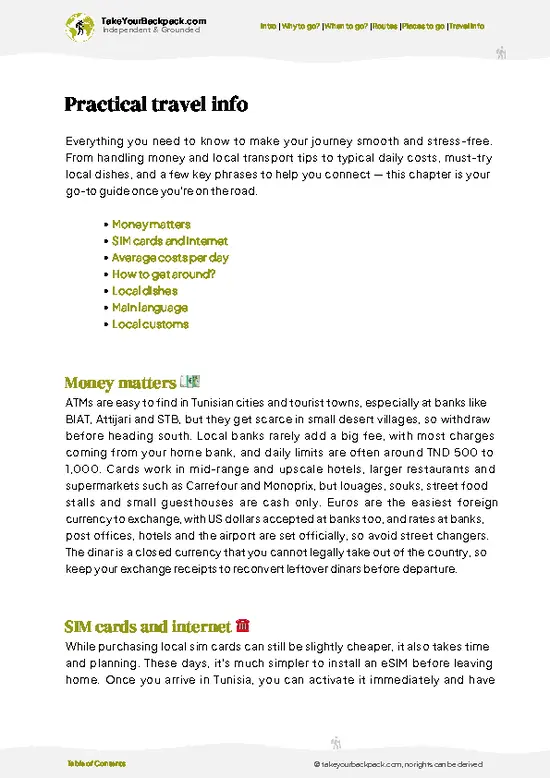
example page 0 from our offline Travel Guide for Tunisia
example page 1 from our offline Travel Guide for Tunisia
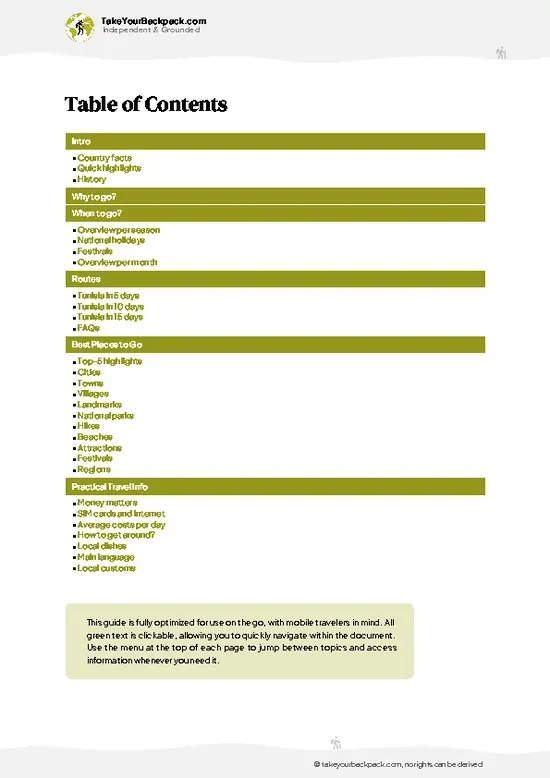
example page 2 from our offline Travel Guide for Tunisia
example page 3 from our offline Travel Guide for Tunisia
example page 4 from our offline Travel Guide for Tunisia
example page 5 from our offline Travel Guide for Tunisia
example page 6 from our offline Travel Guide for Tunisia
example page 7 from our offline Travel Guide for Tunisia
Loading the map 🌍
CLICK TO FILTER
cities
towns
villages
landmarks
national parks
hikes
beaches
attractions
festivals
regions
SHOW COUNTRY’S BESTSHOW ALL

✨ Why go?
Ranked #7 town in Tunisia
The unique appeal for travelers

Tabarka works because the sea and the forest sit within minutes of each other. Divers come for the grouper and coral at the island reefs, while hikers head up into the Kroumirie hills, where cork oaks and wet green slopes look nothing like the Tunisia of postcards. Most travelers stay two or three days, long enough to dive once, climb to the Genoese Fort and eat grilled fish at the port without rushing. The town is small and walkable, and its guesthouses are modest and low-key rather than party-oriented. That suits solo travelers, divers and slow travelers who like a quiet base more than a lively scene. If you need nightlife or a big hostel crowd, this is better as a short stop on the way along the northern coast. Summer is the exception, when the beach fills and the evenings get livelier around the Port of Tabarka.

💡 HighlightsTop highlights of Tabarka

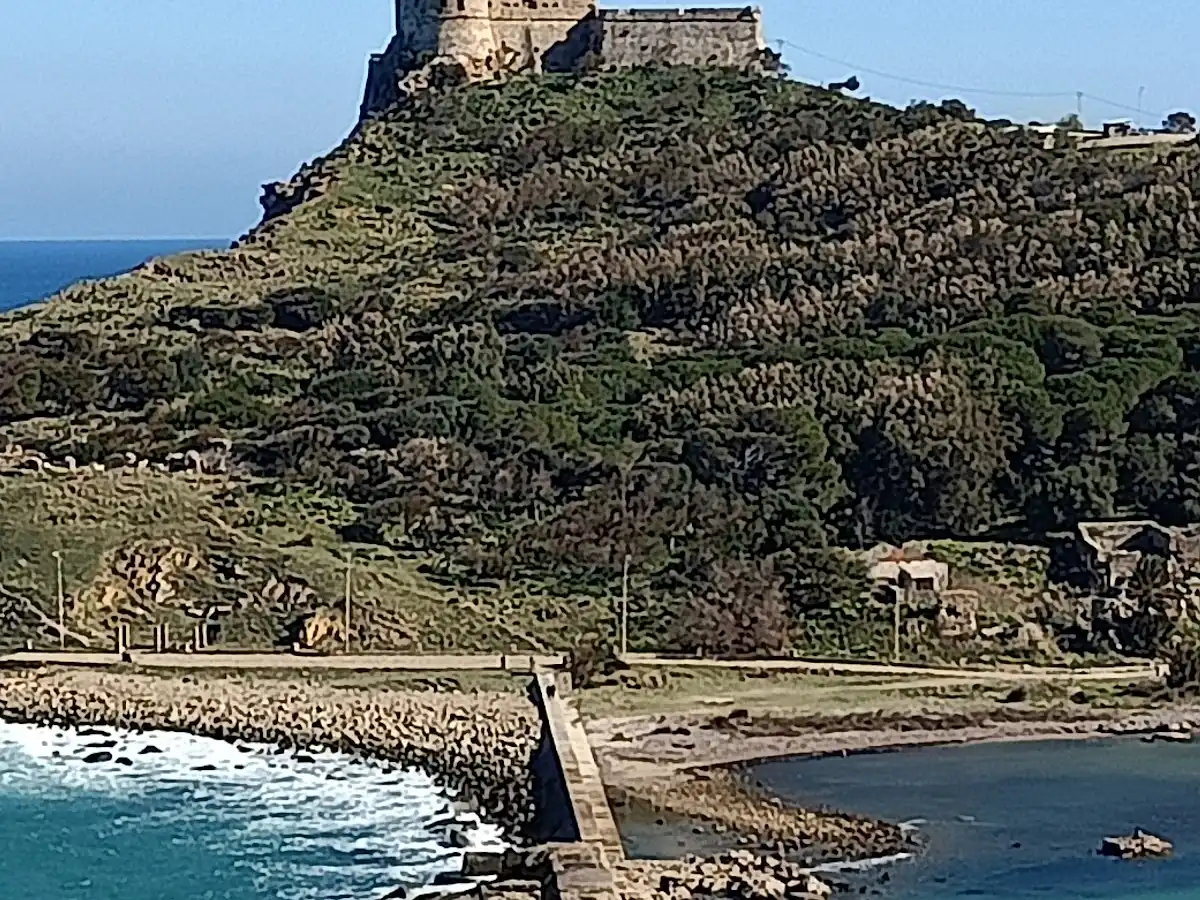
  1. Genoese Fort: The hilltop fortress built in the 16th century by the Genoese looks over the harbor and the rock needles on the shore. Go in the late afternoon for the light on the water. Plan 1 hour for the walk up and the view. Access is often free, but the fort is a working site, so check that the gate is open.
  2. Port of Tabarka: The small harbor is lined with fish restaurants and dive centers, and it is the best place to watch boats come in. Visit in the evening for grilled fish. Allow 1 to 2 hours. Walking around costs nothing.
  3. Tabarka Diving Reefs: The reefs off the coast hold coral, groupers and sea fans. Book with a port dive center in late spring to early autumn. A single dive typically costs around US$35 to 55 and takes half a day including the boat.
  4. Les Aiguilles: These jagged rock spires
… read more 👉
  1. Genoese Fort: The hilltop fortress built in the 16th century by the Genoese looks over the harbor and the rock needles on the shore. Go in the late afternoon for the light on the water. Plan 1 hour for the walk up and the view. Access is often free, but the fort is a working site, so check that the gate is open.
  2. Port of Tabarka: The small harbor is lined with fish restaurants and dive centers, and it is the best place to watch boats come in. Visit in the evening for grilled fish. Allow 1 to 2 hours. Walking around costs nothing.
  3. Tabarka Diving Reefs: The reefs off the coast hold coral, groupers and sea fans. Book with a port dive center in late spring to early autumn. A single dive typically costs around US$35 to 55 and takes half a day including the boat.
  4. Les Aiguilles: These jagged rock spires rise from the sea just outside town, and are best seen in the morning or at sunset from the road. Plan 30 to 45 minutes. It is free and easy to reach on foot or by a short taxi ride.
  5. Basilica Museum: A small museum holds Roman and early Christian mosaics from the ancient Thabraca, including funerary mosaics. Visit during the morning. Expect an entry of about US$3 to 5 and about 45 minutes.
Around Tabarka, the day trips include Bulla Regia, the Roman ruins with underground villas, the Kroumirie forests and the hill town of Ain Draham. All five sights fit comfortably into one full day, or a relaxed two if you add a dive.
Spotted a mistake or missing something? Contact us.
🏘️ NeighborhoodsWhere things are and how it's laid out

Tabarka is small enough that you can sort it into four areas in one lazy afternoon, and the sorting is half the fun.
  • Town center (Avenue Habib Bourguiba): The main drag of cafés, pharmacies and grilled-fish counters, all within a ten-minute walk. Prices drop a block or two back from the seafront, so eat there. Evenings are a parade of locals on café terraces, which is the nightlife.
  • Port and Genoese Fort: A short stroll from the center. The fort sits on a rocky islet joined by a causeway, and the harbor fish restaurants charge more for the view. Go for a coffee, not a full meal. The climb to the fort is steep, so wear real shoes.
  • Zone Touristique (Cap Nègre side): A few kilometers east, with big resort hotels, the golf course and the beach. It is quiet outside summer and mostly shuttered in winter,
… read more 👉
Tabarka is small enough that you can sort it into four areas in one lazy afternoon, and the sorting is half the fun.
  • Town center (Avenue Habib Bourguiba): The main drag of cafés, pharmacies and grilled-fish counters, all within a ten-minute walk. Prices drop a block or two back from the seafront, so eat there. Evenings are a parade of locals on café terraces, which is the nightlife.
  • Port and Genoese Fort: A short stroll from the center. The fort sits on a rocky islet joined by a causeway, and the harbor fish restaurants charge more for the view. Go for a coffee, not a full meal. The climb to the fort is steep, so wear real shoes.
  • Zone Touristique (Cap Nègre side): A few kilometers east, with big resort hotels, the golf course and the beach. It is quiet outside summer and mostly shuttered in winter, because the clientele arrives on package flights. Taxis connect it to town.
  • Old town and Basilica quarter: Low-key residential streets with the Roman-era remains and the little museum. Nobody is hurrying here, so neither should you.
Bring cash for everything. Cafés in Tabarka rarely take cards, which is why the ATM on the main avenue gets a queue.

⌛️ 1 day1-day itinerary for Tabarka

8:00 AM: Genoese Fort
Climb to the fort first, before the heat and the tour groups, and take in the harbor and the coast from the walls. The walk from the center is short and slightly steep.

10:00 AM: Basilica Museum
Walk down into town and spend about 45 minutes with the Roman and early Christian mosaics from Thabraca. They give the harbor below its history.

12:00 PM: Les Aiguilles
Head along the coast road to the rock spires. A short taxi ride saves time, and you can walk back along the shore.

1:30 PM: Port of Tabarka
Lunch on grilled fish at a harbor restaurant. Prices vary by catch, so check the fish before it is weighed.

3:30 PM: Old cork workshops and the town market
Wander the back streets, away from the main tourist strip, where small shops sell cork crafts and local honey. Locals shop … read more 👉
8:00 AM: Genoese Fort
Climb to the fort first, before the heat and the tour groups, and take in the harbor and the coast from the walls. The walk from the center is short and slightly steep.

10:00 AM: Basilica Museum
Walk down into town and spend about 45 minutes with the Roman and early Christian mosaics from Thabraca. They give the harbor below its history.

12:00 PM: Les Aiguilles
Head along the coast road to the rock spires. A short taxi ride saves time, and you can walk back along the shore.

1:30 PM: Port of Tabarka
Lunch on grilled fish at a harbor restaurant. Prices vary by catch, so check the fish before it is weighed.

3:30 PM: Old cork workshops and the town market
Wander the back streets, away from the main tourist strip, where small shops sell cork crafts and local honey. Locals shop here, and few tourists bother.

5:30 PM: Beach or reef visit
If you dive, book the afternoon boat with a port center. If not, swim from the town beach and watch the light drop over the island.

🌤️ When to go?Best time to visit Tabarka

  • Summer (June to September): Hot and beach-ready, 28 to 33°C (82 to 91°F), with long days. Tunisian families fill the coast in July and August, and rooms cost the most.
  • Autumn (October to November): Sea still swimmable early on, 18 to 25°C (64 to 77°F). Rain begins. Crowds thin out and prices ease. Early October brings the Tabarka Jazz festival feel to some years, though dates vary.
  • Winter (December to February): Tabarka is among the wettest spots in Tunisia, with highs of 12 to 16°C (54 to 61°F), mist in the cork-oak hills and some resort places closed. Days are short, and rooms are cheapest.
  • Spring (March to May): Green hills, wildflowers and 16 to 24°C (61 to 75°F). Good for hiking, with the sea still cold.
Book summer beds well ahead, or aim for late May or September for warm water without the crush.

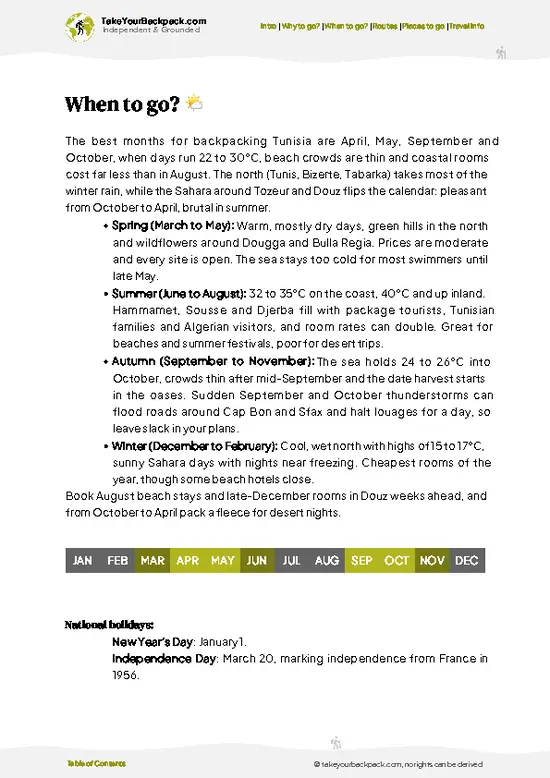
source: climatestotravel.comJANJanuary: fair for travelingFEBFebruary: fair for travelingMARMarch: good for travelingAPRApril: highly recommended for travelingMAYMay: excellent for travelingJUNJune: highly recommended for travelingJULJuly: good for travelingAUGAugust: good for travelingSEPSeptember: excellent for travelingOCTOctober: highly recommended for travelingNOVNovember: good for travelingDECDecember: fair for traveling
tunisia-city-tabarka
© Google |

✈️ The backpacker research shortcutTunisia Travel Guide

An offline-friendly backpacking guide with optimized travel routes, ranked highlights, transport advice, and the best areas to stay.
example page 0 from our offline Travel Guide for Tunisia
example page 1 from our offline Travel Guide for Tunisia
example page 2 from our offline Travel Guide for Tunisia
example page 3 from our offline Travel Guide for Tunisia
example page 4 from our offline Travel Guide for Tunisia
example page 5 from our offline Travel Guide for Tunisia
example page 6 from our offline Travel Guide for Tunisia
example page 7 from our offline Travel Guide for Tunisia
The digital guide (355 pages) contains:
✅ 90 highlights, ranked by travel appeal
✅ Optimized 5, 10 & 15-day travel routes
✅ Cities, national parks, landmarks, beaches
✅ How to get around
✅ Offline-friendly for travel without Wi-Fi
👉 Click to see all 30+ guide features

📅 Plan smarter in minutes, not weeks
✅ Month by month travel advice
✅ Festivals & national holidays
✅ Budget expectations

🗺️ Go to the right places, skip the overrated ones
✅ Honest pros & cons of destinations
✅ Top hikes, parks & viewpoints
✅ Lesser-known places most travelers miss
✅ Clear “worth it vs skip it” guidance

🛏️ Travel smoothly without rookie mistakes
✅ Best areas to stay
✅ Transport systems explained simply
✅ Common scams & safety advice
✅ SIM cards, money & practical tips

🌍 Understand the country, not just visit it
✅ Culture & traditions
✅ 52 Essential phrases & customs
✅ Festivals worth planning around
✅ Traveler-friendly historical context
✅ Insights that make places more meaningful

📱 Built for real travel conditions
✅ Fully downloadable PDF
✅ Works completely offline
✅ Optimized for phone use
✅ Useful in remote areas & buses
✅ Everything in one place
Stop searching, start planning
Get instant access to your full guide. 30‑day money-back guarantee.
+ Add another guide for just

By proceeding you agree to our terms.
Sent to your inbox immediately after payment • 100% Secure Checkout
Best Backpacking Travel Advisor 2025 tourism awardBest Backpacking
Travel Advisor
2025
What others say about Take Your Backpack Guides:
⭐⭐⭐⭐⭐
Fantastic, amazing amount of information!
⭐⭐⭐⭐⭐
My goodness this is amazing, it's what I've been looking for hats off too you!
⭐⭐⭐⭐⭐
I think this is absolutely BRILLIANT
⭐⭐⭐⭐
Very complete and informative. It's still missing places, but I gotta to commend you
⭐⭐⭐⭐⭐
This is truly amazing, thank you, can't wait to explore it with my kids!
⭐⭐⭐⭐⭐
Awesome resource, thank you!
⭐⭐⭐⭐⭐
This is amazing! Can't wait to explore the ones I haven't seen
⭐⭐⭐⭐
I love this! Well done, great idea.
⭐⭐⭐⭐⭐
Thanks for taking the time to make this gem!
⭐⭐⭐⭐⭐
This might be the best website I've ever seen.
⭐⭐⭐⭐⭐
Congratulations, and thank you so much for your work; it's incredibly valuable.
⭐⭐⭐⭐
In all seriousness I think you did a great job pointing out the important spots
⭐⭐⭐⭐⭐
10/10 very good
⭐⭐⭐⭐⭐
As someone who's only just starting to visit regularly this is awesome, thank you.
⭐⭐⭐⭐
Thank you very much! I'm going to visit my dad, it's going to be very useful!
⭐⭐⭐⭐⭐
This is really cool! We'll be travelling for the first time and this definitely come in handy.
⭐⭐⭐⭐⭐
You are now our minister of culture, congratulations 👨‍💼
⭐⭐⭐⭐⭐
Just wanted to tell you that this is a pearl! Going to follow your recommendations.
⭐⭐⭐⭐⭐
This is so cool. I'll definitely be using the resource for my travels soon.
⭐⭐⭐⭐⭐
This is very impressive! Good work.
⭐⭐⭐⭐⭐
This is an amazing and informative site. Very well done!

🛏️ Where to stay?Best areas to stay in Tunisia

The town center around Avenue Habib Bourguiba is the best bet for a budget bed. It holds the few hostel-style rooms and cheap guesthouses, plus most of the cafés, so you can walk to the louage stop, port and restaurants without paying for a taxi. Expect US$15 to 30 for a basic room, and expect fewer true dorms than in bigger Tunisian cities. Streets are lit and busy in the evening, and noise mostly comes from café terraces and the odd late scooter.

The port area is the second option, with a few simple guesthouses a short walk from the fort and fish restaurants. It is pleasant and fairly calm … read more 👉
The town center around Avenue Habib Bourguiba is the best bet for a budget bed. It holds the few hostel-style rooms and cheap guesthouses, plus most of the cafés, so you can walk to the louage stop, port and restaurants without paying for a taxi. Expect US$15 to 30 for a basic room, and expect fewer true dorms than in bigger Tunisian cities. Streets are lit and busy in the evening, and noise mostly comes from café terraces and the odd late scooter.

The port area is the second option, with a few simple guesthouses a short walk from the fort and fish restaurants. It is pleasant and fairly calm after dark, though harbor mornings start early.

The Zone Touristique has resorts rather than budget beds, plus a taxi fare each way, so skip it unless you find an off-season deal. In July and August, book ahead, since the budget rooms near the center go first.

🚌 Getting aroundHow to get from A to B

Tabarka’s shared and metered taxis cost roughly US$1 to 3 for a ride inside town, paid in cash in dinars, and you should ask for the meter (“compteur”) before getting in. The center is flat and compact, so most backpackers walk everywhere except the beach zone and the airport. Traffic is light, and public transport is thin, so plan around that.
  • Walking: Free, and it covers the center, port and fort in about 20 minutes end to end. Pavements are patchy, so keep an eye on your feet.
  • Taxis: Yellow cars everywhere in the center. Short hops cost US$1 to 3, and the run to the Zone Touristique is about US$3 to 5. Agree on the price if the driver says the meter is “broken”, which is a very reliable meter malfunction.
  • Louages (shared vans): The way to leave town. They go to Jendouba (about 1 hour, US$3
… read more 👉
Tabarka’s shared and metered taxis cost roughly US$1 to 3 for a ride inside town, paid in cash in dinars, and you should ask for the meter (“compteur”) before getting in. The center is flat and compact, so most backpackers walk everywhere except the beach zone and the airport. Traffic is light, and public transport is thin, so plan around that.
  • Walking: Free, and it covers the center, port and fort in about 20 minutes end to end. Pavements are patchy, so keep an eye on your feet.
  • Taxis: Yellow cars everywhere in the center. Short hops cost US$1 to 3, and the run to the Zone Touristique is about US$3 to 5. Agree on the price if the driver says the meter is “broken”, which is a very reliable meter malfunction.
  • Louages (shared vans): The way to leave town. They go to Jendouba (about 1 hour, US$3 to 4) and Tunis (about 3.5 to 4 hours, US$10 to 14). They depart when full, mostly in the morning, and few run after mid-afternoon, so arrive early.
  • Regional buses (SNTRI and local lines): Cheaper than louages, with services to Tunis and Jendouba, but fewer departures. Ask at the station the day before, as timetables are flexible.
  • Airport transfer: Tabarka-Aïn Draham airport lies about 8 km from town. A taxi is the only practical option, around US$6 to 10, and flights are seasonal.

👛 Costs (as of 22 October 2026)What things cost and how to budget

Tabarka costs about US$38 to 62 a day for a backpacker in high season, and it is cheaper than the resort look suggests if you avoid the harbor restaurants.
CategoryBudget RangeLocal Reality
Dorm accommodationUS$12 to 25Dorms are scarce, so most people take a basic private room or guesthouse bed in the center. Summer prices climb.
MealsUS$8 to 16Sandwiches and grilled fish plates at cafés run cheap, while harbor seafood is priced for tourists.
Local transportUS$2 to 6Short taxi hops cost US$1 to 3, and most of the center is walkable.
Basic activities/entry feesUS$3 to 8Museum and site fees are a few dollars. Beaches and the fort exterior are free.
Miscellaneous expensesUS$3 to 7Coffee, water, SIM data and the odd beach umbrella rental.
Total Daily BudgetUS$38 to 62For one day in high season.
Buy fish … read more 👉
Tabarka costs about US$38 to 62 a day for a backpacker in high season, and it is cheaper than the resort look suggests if you avoid the harbor restaurants.
CategoryBudget RangeLocal Reality
Dorm accommodationUS$12 to 25Dorms are scarce, so most people take a basic private room or guesthouse bed in the center. Summer prices climb.
MealsUS$8 to 16Sandwiches and grilled fish plates at cafés run cheap, while harbor seafood is priced for tourists.
Local transportUS$2 to 6Short taxi hops cost US$1 to 3, and most of the center is walkable.
Basic activities/entry feesUS$3 to 8Museum and site fees are a few dollars. Beaches and the fort exterior are free.
Miscellaneous expensesUS$3 to 7Coffee, water, SIM data and the odd beach umbrella rental.
Total Daily BudgetUS$38 to 62For one day in high season.
Buy fish at the port market or eat the set lunch at a local café, which often costs half what harbor restaurants charge.
⚠️ Prices can change and everyone travels differently, so take this as a rough guide. Hope it helps you plan your adventure!

🚌 Day tripsEasy escapes and nearby places

Tabarka sits in the green northwest, and most trips here are short hops by louage or taxi, so a base here works well if you start early.Aïn Draham: Cool cork-oak forest and hiking trails in the hills, about 25 km away. A louage costs roughly US$1 to 2 each way and takes 30 to 40 minutes. Go in spring or autumn, and bring a jacket, because first-timers often arrive in shorts and meet mist.
Bulla Regia: Roman villas whose rooms were built underground to escape the heat, with mosaics still in place. It is near Jendouba, roughly 1.5 to 2 hours each way with a change, and costs about US$12 to 18 in transport, plus an entry of around US$3 to 5. Spring and autumn are best. Many people try it on a late start and the last louage back is gone.
👉 Explore Bulla RegiaChemtou: Old Numidian marble quarries … read more 👉
Tabarka sits in the green northwest, and most trips here are short hops by louage or taxi, so a base here works well if you start early.Aïn Draham: Cool cork-oak forest and hiking trails in the hills, about 25 km away. A louage costs roughly US$1 to 2 each way and takes 30 to 40 minutes. Go in spring or autumn, and bring a jacket, because first-timers often arrive in shorts and meet mist.
Bulla Regia: Roman villas whose rooms were built underground to escape the heat, with mosaics still in place. It is near Jendouba, roughly 1.5 to 2 hours each way with a change, and costs about US$12 to 18 in transport, plus an entry of around US$3 to 5. Spring and autumn are best. Many people try it on a late start and the last louage back is gone.
👉 Explore Bulla RegiaChemtou: Old Numidian marble quarries and a museum, a calm and rarely crowded outing near Jendouba. Allow about 2 hours each way and US$10 to 15 in fares plus entry of a few dollars. Combine it with Bulla Regia if you leave at dawn.
Cap Serrat: A wild stretch of coast east of Tabarka with empty beaches, reached via Sejnane or by taxi. Expect about 1.5 hours and US$20 to 35 round trip by taxi. Visit from May to September, and bring your own water and food.

🛡️ SafetyTraveler Safety Guide

Tabarka is calm and safe, with low street crime and a relaxed pace even after dark. Solo travelers, including women, generally manage fine on the main avenue and around the port in the evening, though quiet side streets late at night are best skipped, and women will get more attention than they want, which a firm “no, thank you” and steady walking usually ends. The usual annoyances are touts around the fort and taxi drivers who claim the meter is broken, so agree on a fare beforehand. Keep a phone and wallet in front pockets in summer crowds. Swim only at beaches that are staffed, since currents can be strong on the open coast, and respect forest fire restrictions in dry months when you hike in the hills.

FAQCommon questions from travelers

Tabarka is worth two or three nights, particularly from June to September when the beaches and diving are at their best. The Genoese fort on its rocky islet, the dive sites around the coral-rich waters, and the cork-oak forests of Aïn Draham (about 25 km inland) give you coast and mountains in one base. Travelers who treat it as a quick stopover usually leave wishing they had booked a second night.
Two full days cover Tabarka itself: the Genoese fort and old port, the Needles rock formations, and a beach afternoon. A third day suits a hike or drive into the Kroumirie hills around Aïn Draham, and divers should add one or two more for boat dives. In July and August, plan for at least three nights, since the town is lively and the sea is the main draw.
Tabarka works as a day trip from Jendouba (about 55 km, roughly 1 hour by louage or car) and, with an early start, from Bizerte or Tunis (roughly 3.5 to 4 hours each way by road). From Tunis, the long transfer leaves only a few hours on the ground, so a night is far more comfortable. From Jendouba, a shared louage costs roughly US$3 to 5 and a day is enough for the fort, the harbor and a swim.
⚠️ Things can change over time, so always validate details locally before you go.

Other Tunisian towns near Tabarka

Explore more nearby:

  • Ain Draham—Cork oak trails, chalet roofs, wild boar grills| 21 km away
  • Mateur—Olive stalls, railway platforms, farmland edge, louage junction| 81 km away
  • Menzel Bourguiba—Ferryville grid, Lake Bizerte, shipyard cranes, lake fish| 94 km away

💡 Not sure where to go next?
Create a personalized itinerary for Tunisia including Tabarka and the places that fit your trip.

Generate my itinerary

👉 Discover all towns

Or checkout all Tunisia has to offer (think cities, towns, villages, national parks, hikes, beaches, festivals)
Country photo of Tunisia

We 💚 feedbackFinal thoughts on visiting Tabarka

Many travelers treat Tabarka as a quick beach stop and leave before seeing the hills. Give it a second day and head inland toward Ain Draham, where the forest is cool and green. I would book the dive ahead in summer, and bring cash for everything.

✍️ Help improve this page!
The information on this page is based on in-depth research, insights shared by experienced travelers, and feedback from the local travel community in Tunisia. While every effort is made to keep the information accurate and current, conditions can change — so if you spot anything incorrect or outdated, please get in touch.


🙋‍♂️ Give feedback

👋 Meet the founderWho’s Behind Take Your Backpack?

Johan, backpacker and founder of TakeYourBackpackHi, I’m Johan (Netherlands 🇳🇱), the creator of TakeYourBackpack. Over the past 3 decades, I’ve backpacked through 90+ countries across six continents, gaining extensive experience with independent travel, long-term trips, and overland routes.

This site is built on a combination of firsthand travel experience and carefully curated insights from other backpackers. Many guides are based on places I’ve personally visited, while others bring together tips, observations, and practical advice shared by trusted travelers I’ve met along the way.

The goal is to provide realistic, experience-driven guidance — not generic itineraries — so you can explore destinations with better context, clearer expectations, and more confidence.