v2.webp)
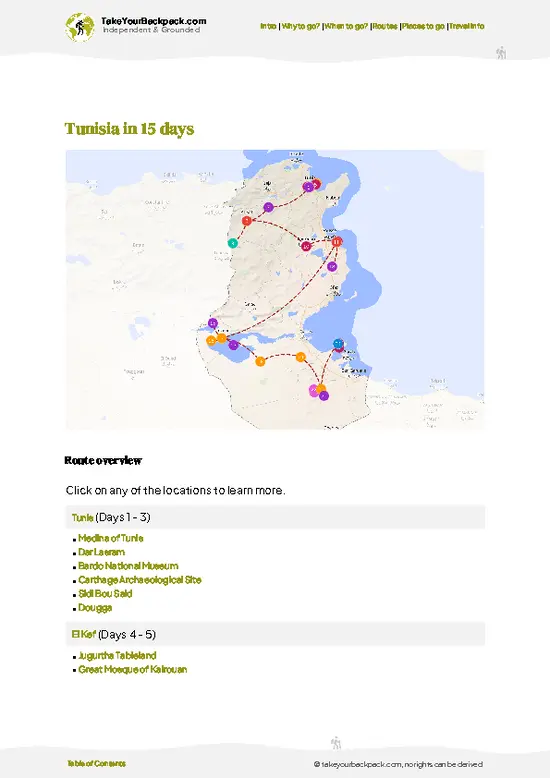
- Temple of Waters (Nymphaeum): A second-century Roman sanctuary with a semicircle of niches where the spring once fed the aqueduct. Go in the morning when the light is soft. Entry is about US$3 to 4, and 45 minutes is enough.
- Roman Aqueduct Remains: Arches stretch across the fields outside town, still tall and photogenic. Late afternoon is best. Free to see, allow 1 hour.
- Jebbel Zaghouan Hike: Trails climb above the temple toward the ridge, with views over olive groves and plains. Start early in spring or autumn. Free, 3 to 5 hours return.
- Old Medina and Andalusian Quarter: Whitewashed lanes with blue doors and Moorish details left by refugees from Spain. Wander at dusk when families are out. Free, 1 hour.
- Souk and Weekly Market: Stalls sell local produce, olives and Zaghouan’s rosewater and orange
- Temple of Waters (Nymphaeum): A second-century Roman sanctuary with a semicircle of niches where the spring once fed the aqueduct. Go in the morning when the light is soft. Entry is about US$3 to 4, and 45 minutes is enough.
- Roman Aqueduct Remains: Arches stretch across the fields outside town, still tall and photogenic. Late afternoon is best. Free to see, allow 1 hour.
- Jebbel Zaghouan Hike: Trails climb above the temple toward the ridge, with views over olive groves and plains. Start early in spring or autumn. Free, 3 to 5 hours return.
- Old Medina and Andalusian Quarter: Whitewashed lanes with blue doors and Moorish details left by refugees from Spain. Wander at dusk when families are out. Free, 1 hour.
- Souk and Weekly Market: Stalls sell local produce, olives and Zaghouan’s rosewater and orange blossom water. Mornings are liveliest. Browsing is free, 1 hour.
Spotted a mistake or missing something? Contact us.

Private tour: Medina,Carthage ,Sidi Bou Said, Bardo Museum+lunch

Hammamet : Quad adventure through the hills

From Hammamet or Tunis Carthage Bardo Sidi Bou Said Tour

Hammamet: Guided Sunrise & Sunset Paddle-boarding Experience

Tunis,Carthage&Sidi Bou Said:Premium Private Day Tour with Pickup

2D/1N Private Adventure – Explore Southern Tunisia, Douz & Tozeur

Tunis, Sidi Bousaid and Carthage day trip from Hammamet

Adventure Quad Biking in Hammamet

Private Day Tour Tunis Medina Carthage Sidi Bou Said Bardo Museum


 Best Backpacking
.jpg) Hi, I’m Johan (Netherlands 🇳🇱), the creator of TakeYourBackpack. Over the past 3 decades, I’ve backpacked through 90+ countries across six continents, gaining extensive experience with independent travel, long-term trips, and overland routes.
Hi, I’m Johan (Netherlands 🇳🇱), the creator of TakeYourBackpack. Over the past 3 decades, I’ve backpacked through 90+ countries across six continents, gaining extensive experience with independent travel, long-term trips, and overland routes.