v2.webp)
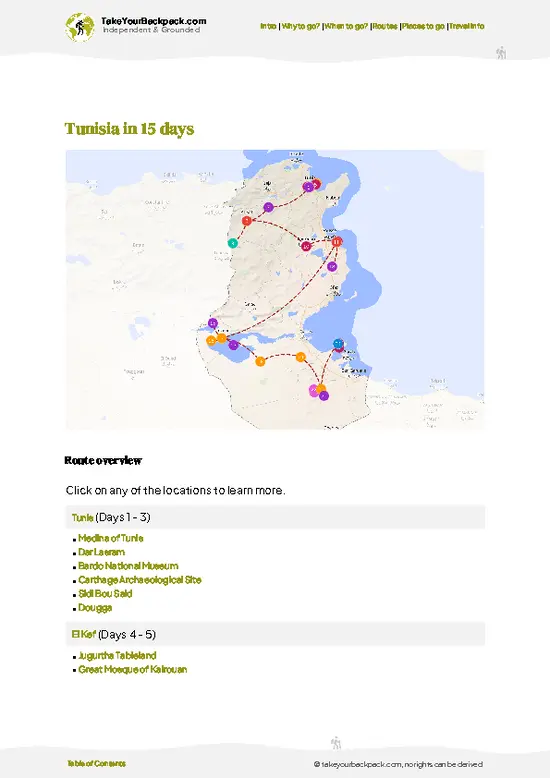
- Antonine Baths: The largest Roman baths built in Africa, and among the biggest in the empire, set right by the sea. Only the foundations and a single tall column remain, but the underground vaults give a real sense of scale. Go in the morning for cooler air. Entry is covered by the combined site ticket, about US$3 to 5 depending on the version, and 1 to 1.5 hours is enough.
- Byrsa Hill and the Carthage National Museum: The citadel hill where the Punic city began, with Phoenician and Roman finds, mosaics and views across the bay. The cathedral at the top is now a cultural venue. Allow 1.5 to 2 hours, budget around US$3 to 5, and aim for late afternoon when the light softens the stone.
- Tophet of Salammbô: A small sacred precinct with rows of stone markers above burial urns, linked to the Punic
- Antonine Baths: The largest Roman baths built in Africa, and among the biggest in the empire, set right by the sea. Only the foundations and a single tall column remain, but the underground vaults give a real sense of scale. Go in the morning for cooler air. Entry is covered by the combined site ticket, about US$3 to 5 depending on the version, and 1 to 1.5 hours is enough.
- Byrsa Hill and the Carthage National Museum: The citadel hill where the Punic city began, with Phoenician and Roman finds, mosaics and views across the bay. The cathedral at the top is now a cultural venue. Allow 1.5 to 2 hours, budget around US$3 to 5, and aim for late afternoon when the light softens the stone.
- Tophet of Salammbô: A small sacred precinct with rows of stone markers above burial urns, linked to the Punic cult of Baal Hammon and Tanit. It is compact, 30 to 45 minutes, and usually quiet. Entry is typically on the combined ticket or about US$2 to 3.
- Punic Ports: Two circular and rectangular lagoons that once held the Carthaginian fleet and merchant ships. You can see the island that held the admiralty, and a small museum is nearby. Good at any hour, 30 to 45 minutes, free to walk around the edges.
- Roman Villas and Odeon: The villa area has mosaics and an archaeological park with rows of columns, with an odeon and theater close by. Plan 1 to 1.5 hours, use the combined ticket, and visit in the morning before tour buses arrive.
Spotted a mistake or missing something? Contact us.

VIP transfer between Tunis Carthage Airport and a hotel in Tunis

07 -Guided day Tour Tunisia Monumental

10 Day Historical and Cultural Tour of Tunisia

8 Days Tunisia Essential Discovery Private Tour

Bizerte Utique Day and Cape Angela the Far North of Africa

Explore Tunisia in Depth:The Private Grand Tour in 8 Days

Half-Day Traditional Tunisian Cuisine Cooking Class in Tunis

3 Day Tunisian Desert Adventure Dunes, Oases and Bedouin Nights

Private Tour to Kairouan, El Jem and Sousse


 Best Backpacking
.jpg) Hi, I’m Johan (Netherlands 🇳🇱), the creator of TakeYourBackpack. Over the past 3 decades, I’ve backpacked through 90+ countries across six continents, gaining extensive experience with independent travel, long-term trips, and overland routes.
Hi, I’m Johan (Netherlands 🇳🇱), the creator of TakeYourBackpack. Over the past 3 decades, I’ve backpacked through 90+ countries across six continents, gaining extensive experience with independent travel, long-term trips, and overland routes.