×

Türkiye🇹🇷 | best regionsWhere to Find the 6 Best regions in Türkiye

Türkiye (or Turkey) is a country where one bus ticket can move you between three different climates, two continents' worth of habits and a wildly different bill for the same tea. Regions here are not tidy tourism zones. They are big, distinct blocks of land: a coastal west with ferries, ruins and sunburn, a Mediterranean south with resort prices that fall the moment you leave the beach, a central plateau of dust, fairy chimneys and cave rooms, and an eastern interior where crowds thin out and the distances stop being funny. Costs, comfort and company shift with every one of them. The west is easy, well signed and busy in summer. The east rewards independent travel with empty sites and long bus rides, plus hospitality that arrives uninvited, usually with a glass of tea. Pick by temperament, not by photo, and remember that Türkiye is roughly the size of Texas, give or take a few delays.

By Johan Kruseman 🇳🇱 | Updated October 19, 2026
Explore the best cities in Türkiye

Why go?Key Factors That Shape the Experience

Few countries stack as many layers into one passport stamp. Geography does the heavy lifting: Türkiye straddles Europe and Asia, with the Aegean, Mediterranean and Black Sea on three sides and a high interior plateau ringed by mountains. That produces climates ranging from olive-grove mild to snow-bound winters, sometimes within a few hours of driving. History then piles on top. Hittites, Greeks, Romans, Byzantines, Seljuks and Ottomans all built here, so a region is rarely about one era, and a single day can swing from a Roman theater to a medieval caravanserai. That is why the country divides so naturally into regions with their own food, dialects and rhythms.

The infrastructure makes this workable. Long-distance buses are frequent, comfortable and priced far below Western European equivalents, … read more 👉
Few countries stack as many layers into one passport stamp. Geography does the heavy lifting: Türkiye straddles Europe and Asia, with the Aegean, Mediterranean and Black Sea on three sides and a high interior plateau ringed by mountains. That produces climates ranging from olive-grove mild to snow-bound winters, sometimes within a few hours of driving. History then piles on top. Hittites, Greeks, Romans, Byzantines, Seljuks and Ottomans all built here, so a region is rarely about one era, and a single day can swing from a Roman theater to a medieval caravanserai. That is why the country divides so naturally into regions with their own food, dialects and rhythms.

The infrastructure makes this workable. Long-distance buses are frequent, comfortable and priced far below Western European equivalents, with tea service and a steward who hands out cologne for your hands. Domestic flights are cheap enough to rescue you from a 15-hour overland slog. Hostels and pensions cluster in the west and center, while the east leans on small family hotels.

Before choosing, know the scale. Distances are large, and a map flatters you. Prices vary sharply between resort coasts and inland towns, and the lira has been unstable, so costs move faster than guidebooks. Cities run on cash and card, villages prefer cash. Dress is relaxed in the west and more conservative in the east and in religious sites. Learn a few Turkish words, because hospitality is a genuine national sport, and you will lose at it gracefully.
Behind the Scenes of Selection
The list of best regions in Türkiye is created based on landscapes, local culture, attractions, vibes, and overall appeal. If you feel a region is missing in this list, please let us know.

When to go?Best Time to Visit Türkiye for regions

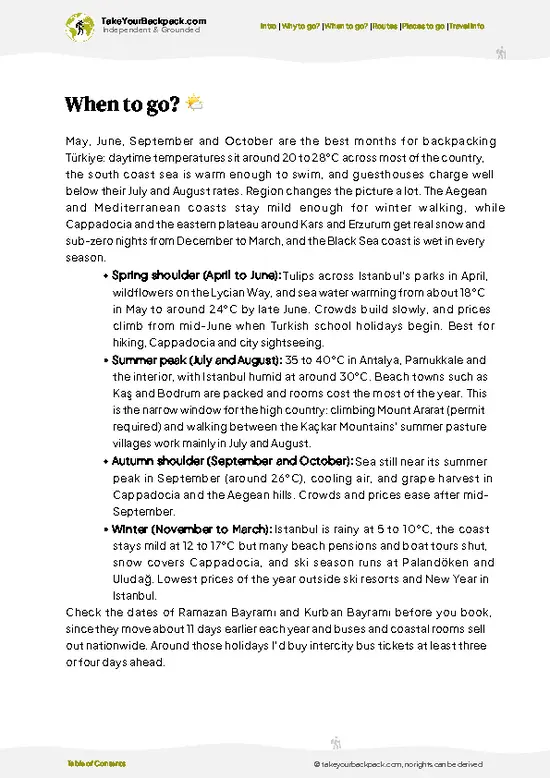
Best Months: April to May and September to October are the best months across most of Türkiye, with daytime highs of about 18 to 28°C, open sites and sea warm enough in autumn to swim. Spring brings wildflowers and the occasional shower, while autumn holds heat in the sea long after the crowds head home.
Summer: July and August are hot and crowded. The Aegean and Mediterranean coasts hit 32 to 38°C, and the southeast, around Şanlıurfa and Mardin, can push past 40°C, which makes midday sightseeing an exercise in regret. Coastal accommodation can cost 30 to 60 percent more than in shoulder months, and domestic holidaymakers fill buses and beaches. The central plateau is easier in summer, with dry heat and cool nights, but still sunburn-friendly at altitude.
Winter: November to March is cheap and … read more 👉
Best Months: April to May and September to October are the best months across most of Türkiye, with daytime highs of about 18 to 28°C, open sites and sea warm enough in autumn to swim. Spring brings wildflowers and the occasional shower, while autumn holds heat in the sea long after the crowds head home.
Summer: July and August are hot and crowded. The Aegean and Mediterranean coasts hit 32 to 38°C, and the southeast, around Şanlıurfa and Mardin, can push past 40°C, which makes midday sightseeing an exercise in regret. Coastal accommodation can cost 30 to 60 percent more than in shoulder months, and domestic holidaymakers fill buses and beaches. The central plateau is easier in summer, with dry heat and cool nights, but still sunburn-friendly at altitude.
Winter: November to March is cheap and quiet, with a catch. Mediterranean and Aegean coasts see mild, wet weather, around 8 to 15°C, and many seaside pensions and boat operators close. Istanbul turns gray and drizzly. The central plateau and the east are properly cold, with snow and temperatures well below freezing in places like Kars and Erzurum, and mountain roads can close. Ski towns come alive while everywhere else hibernates.
Special Periods: Ramadan shifts by about 11 days earlier each year. Restaurants in tourist areas stay open, but eastern towns can be quieter by day. The Kurban Bayramı and Ramazan Bayramı holidays flood transport with families, so book buses and flights early and expect higher fares. Black Sea regions stay damp year-round, with rain peaking in autumn.

region hoppingPlanning Your Route Efficiently

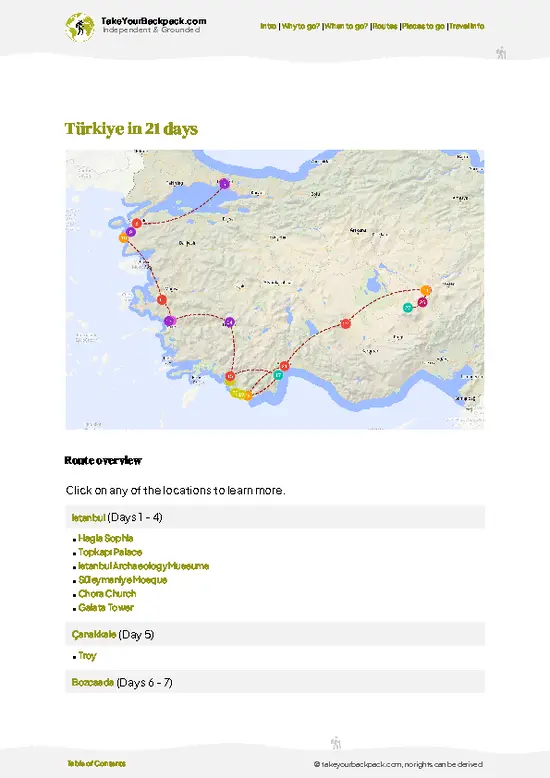
How Long You Need: A trip linking several regions in Türkiye works best with 14 to 21 days, and anything under 10 days should stick to two regions at most. The country is larger than it looks, and ambition on a map turns into a lot of bus seat.
Grouping and Direction: Regions cluster well along an arc. The Istanbul and Aegean west pair naturally, with Izmir as the hub, and the Mediterranean coast follows by bus or short flight from there. From the south, climb inland to the central plateau via Konya or Antalya, then fly or take an overnight bus onward if the east is on the list. Going west to east keeps you ending in the quieter, cheaper part of the country, and flying out of Istanbul, Ankara or Kayseri at the end is simpler than backtracking. A reverse loop works if you land in Istanbul late … read more 👉
How Long You Need: A trip linking several regions in Türkiye works best with 14 to 21 days, and anything under 10 days should stick to two regions at most. The country is larger than it looks, and ambition on a map turns into a lot of bus seat.
Grouping and Direction: Regions cluster well along an arc. The Istanbul and Aegean west pair naturally, with Izmir as the hub, and the Mediterranean coast follows by bus or short flight from there. From the south, climb inland to the central plateau via Konya or Antalya, then fly or take an overnight bus onward if the east is on the list. Going west to east keeps you ending in the quieter, cheaper part of the country, and flying out of Istanbul, Ankara or Kayseri at the end is simpler than backtracking. A reverse loop works if you land in Istanbul late and want the easy region first.
Time per Stop: Allow 3 to 5 nights for the larger regions and 2 to 3 for a compact area. Overland legs run roughly 4 to 7 hours between neighboring regions and 10 to 14 hours for the long jumps, such as the Mediterranean to the east. Overnight buses save a hotel bill but cost you the next morning. Flights of about 1 to 1.5 hours between big cities frequently cost US$30 to 80 if booked ahead.
Common Planning Mistakes: The classic error is cramming five regions into ten days, then discovering that Türkiye has a long coastline and a longer highway. Count travel days as real days. Another is ignoring seasons: the east in deep winter or the coast in January means closed boats and shuttered pensions. Last-minute holiday travel also jams buses. Instead, fly the big gaps, bus the short ones, and keep one slack day per week for the inevitable delayed minibus.

The ListMust-Visit regions in Türkiye

1 Cappadocia

fairy chimneys, cave dwellings, volcanic valleys

Drift through a landscape shaped by ancient eruptions, where soft rock shelters and surreal formations create a sense of otherworldly exploration.

2 Cunda Island

stone houses, olive groves, Aegean harbor

Wander narrow lanes lined with neoclassical facades, sample local seafood, and watch daily life unfold beside calm island waters.

3 Datça Peninsula

pine forests, secluded coves, ancient Knidos

Trace winding coastal roads past quiet beaches and hillside ruins, where the Aegean and Mediterranean meet under open skies.

4 Gökçeada

windmills, Greek villages, freshwater springs

Experience a slower rhythm among stone hamlets, taste island cheeses, and hike between green hills and clear, pebbled shores.

5 Hatay Province

mosaic museums, spice bazaars, multi-faith quarters

Sample layered cuisines, walk through ancient streets shaped by diverse cultures, and discover relics from empires that once converged here.

turkiye-region-hatay-province
© Google |

6 Phrygian Valley

rock-cut tombs, monumental carvings, rolling steppe

Follow footpaths past weathered monuments and open grasslands, where traces of a vanished civilization remain etched into the landscape.

Loading the map 🌍

Expert viewTips and Advice from Travelers

How Many Regions: Three regions is the number I would advise for a trip of two to three weeks, and two for anything under ten days. Türkiye distances are long, transport is good but not instant, and every extra region costs a full travel day of fluorescent bus-station lighting. Three gives variety without turning the trip into logistics.
Choosing by Travel Style: First-timers and anyone who wants easy hostels, ferries and well-organized day trips should lean on the western and coastal kinds. They are worth the time, and the most social for solo travelers. History fans should prioritize the central plateau and interior, where the sites are dramatic and the day tours are decent value. Travelers after quiet and unpolished hospitality should add the east, where tourists are scarce and plans take … read more 👉
How Many Regions: Three regions is the number I would advise for a trip of two to three weeks, and two for anything under ten days. Türkiye distances are long, transport is good but not instant, and every extra region costs a full travel day of fluorescent bus-station lighting. Three gives variety without turning the trip into logistics.
Choosing by Travel Style: First-timers and anyone who wants easy hostels, ferries and well-organized day trips should lean on the western and coastal kinds. They are worth the time, and the most social for solo travelers. History fans should prioritize the central plateau and interior, where the sites are dramatic and the day tours are decent value. Travelers after quiet and unpolished hospitality should add the east, where tourists are scarce and plans take longer, which is the point. The resort strip is the one I would skip as a backpacker priority: package-tourism pricing, little local texture and nightlife that mostly serves people who booked it a year ago. The Black Sea is worth it only if you like green hills, damp weather and almost no company.
What It Costs: A frugal backpacker can manage about US$30 to 45 a day: a dorm bed at US$10 to 20, local meals at US$5 to 10, buses and minibuses at US$3 to 15 per leg. Mid-range comfort runs around US$55 to 90 a day with private rooms and the odd restaurant meal. Entry fees at major sites generally run US$8 to 25, with places like Hagia Sophia, Ephesus and Cappadocia’s open-air museum at the higher end, so a trip with plenty of ruins can add US$150 to 300 in tickets. Museum Pass Türkiye can pay off if you cover many sites in a short time. Guides cost US$40 to 100 a day for private ones; group tours cost less and tend to run a shopping stop too many. Hot-air balloon flights are the real splurge at roughly US$150 to 250, and I would do it once if the budget allows. Prices are quoted in dollars or euros in tourist areas, yet you pay in lira, and inflation has moved prices quickly, so keep a buffer of 15 to 20 percent.
Safety and Etiquette: Türkiye is generally safe for backpackers, and petty crime is far lower than in many European capitals. The usual annoyances are touts, rigged taxis in big cities and carpet-shop friendliness that has an agenda. Use meters or ride-hailing apps, and agree prices before accepting a long invitation to tea in a shop. Check government travel advisories before heading toward the Syrian and Iraqi borders; the southeast and parts of the east can change quickly. Earthquakes are a real hazard across the country, and recent ones damaged parts of the south and southeast, so check local conditions and accommodation safety.
Culture and Conduct: Dress modestly in mosques: covered shoulders and knees, scarves for women, shoes off. Cover more in conservative eastern towns. Alcohol is easy to find in the west and tourist coasts, but scarce in religious or smaller inland towns. Public drunkenness is poor form anywhere. Criticizing Atatürk or the Turkish state is illegal and genuinely unwise, so keep politics light. Photograph people only with permission. Haggling is expected in bazaars, but not in shops with fixed prices or at restaurants. Say thank you in Turkish, “teşekkürler,” and you will be fed.

✈️ The backpacker research shortcutTürkiye Travel Guide

An offline-friendly backpacking guide with optimized travel routes, ranked highlights, transport advice, and the best areas to stay.
example page 0 from our offline Travel Guide for Türkiye
example page 1 from our offline Travel Guide for Türkiye
example page 2 from our offline Travel Guide for Türkiye
example page 3 from our offline Travel Guide for Türkiye
example page 4 from our offline Travel Guide for Türkiye
example page 5 from our offline Travel Guide for Türkiye
example page 6 from our offline Travel Guide for Türkiye
example page 7 from our offline Travel Guide for Türkiye
The digital guide (445 pages) contains:
✅ 130 highlights, ranked by travel appeal
✅ Optimized 7, 14 & 21-day travel routes
✅ Cities, national parks, landmarks, beaches
✅ How to get around
✅ Offline-friendly for travel without Wi-Fi
👉 Click to see all 30+ guide features

📅 Plan smarter in minutes, not weeks
✅ Month by month travel advice
✅ Festivals & national holidays
✅ Budget expectations

🗺️ Go to the right places, skip the overrated ones
✅ Honest pros & cons of destinations
✅ Top hikes, parks & viewpoints
✅ Lesser-known places most travelers miss
✅ Clear “worth it vs skip it” guidance

🛏️ Travel smoothly without rookie mistakes
✅ Best areas to stay
✅ Transport systems explained simply
✅ Common scams & safety advice
✅ SIM cards, money & practical tips

🌍 Understand the country, not just visit it
✅ Culture & traditions
✅ 52 Essential phrases & customs
✅ Festivals worth planning around
✅ Traveler-friendly historical context
✅ Insights that make places more meaningful

📱 Built for real travel conditions
✅ Fully downloadable PDF
✅ Works completely offline
✅ Optimized for phone use
✅ Useful in remote areas & buses
✅ Everything in one place
Stop searching, start planning
Get instant access to your full guide. 30‑day money-back guarantee.
+ Add another guide for just

By proceeding you agree to our terms.
Sent to your inbox immediately after payment • 100% Secure Checkout
Best Backpacking Travel Advisor 2025 tourism awardBest Backpacking
Travel Advisor
2025
What others say about Take Your Backpack Guides:
⭐⭐⭐⭐⭐
Fantastic, amazing amount of information!
⭐⭐⭐⭐⭐
My goodness this is amazing, it's what I've been looking for hats off too you!
⭐⭐⭐⭐⭐
I think this is absolutely BRILLIANT
⭐⭐⭐⭐
Very complete and informative. It's still missing places, but I gotta to commend you
⭐⭐⭐⭐⭐
This is truly amazing, thank you, can't wait to explore it with my kids!
⭐⭐⭐⭐⭐
Awesome resource, thank you!
⭐⭐⭐⭐⭐
This is amazing! Can't wait to explore the ones I haven't seen
⭐⭐⭐⭐
I love this! Well done, great idea.
⭐⭐⭐⭐⭐
Thanks for taking the time to make this gem!
⭐⭐⭐⭐⭐
This might be the best website I've ever seen.
⭐⭐⭐⭐⭐
Congratulations, and thank you so much for your work; it's incredibly valuable.
⭐⭐⭐⭐
In all seriousness I think you did a great job pointing out the important spots
⭐⭐⭐⭐⭐
10/10 very good
⭐⭐⭐⭐⭐
As someone who's only just starting to visit regularly this is awesome, thank you.
⭐⭐⭐⭐
Thank you very much! I'm going to visit my dad, it's going to be very useful!
⭐⭐⭐⭐⭐
This is really cool! We'll be travelling for the first time and this definitely come in handy.
⭐⭐⭐⭐⭐
You are now our minister of culture, congratulations 👨‍💼
⭐⭐⭐⭐⭐
Just wanted to tell you that this is a pearl! Going to follow your recommendations.
⭐⭐⭐⭐⭐
This is so cool. I'll definitely be using the resource for my travels soon.
⭐⭐⭐⭐⭐
This is very impressive! Good work.
⭐⭐⭐⭐⭐
This is an amazing and informative site. Very well done!

🛏️ Where to stay?Best Places to Stay in Türkiye

Türkiye has plenty of hostels and budget guesthouses, with dorm beds in Istanbul typically running €10 to 20 a night and private doubles in family pensions from roughly €30 to 50. In Istanbul, Sultanahmet puts you within walking distance of Hagia Sophia and the Blue Mosque but goes quiet after dark, while Beyoğlu and Karaköy around Galata have the liveliest bars and late-night street noise to match, and Kadıköy on the Asian side trades sightseeing convenience for cheaper, more local nightlife a ferry ride away. Beyond the big city, Göreme in Cappadocia is packed with cave-room hostels steps from the valley trails (sleepy at night, with early balloon-launch wake-ups), and Kaleiçi, the walled … read more 👉
Türkiye has plenty of hostels and budget guesthouses, with dorm beds in Istanbul typically running €10 to 20 a night and private doubles in family pensions from roughly €30 to 50. In Istanbul, Sultanahmet puts you within walking distance of Hagia Sophia and the Blue Mosque but goes quiet after dark, while Beyoğlu and Karaköy around Galata have the liveliest bars and late-night street noise to match, and Kadıköy on the Asian side trades sightseeing convenience for cheaper, more local nightlife a ferry ride away. Beyond the big city, Göreme in Cappadocia is packed with cave-room hostels steps from the valley trails (sleepy at night, with early balloon-launch wake-ups), and Kaleiçi, the walled old town of Antalya, mixes pensions near the harbor and beaches with weekend bar noise along its lanes.

If you enjoy meeting fellow travelers, consider choosing hostels with high ratings for atmosphere. On the other hand, if you prefer having your own space, a hotel might be a better option.

TürkiyeExplore Türkiye

👋 Meet the founderWho’s Behind Take Your Backpack?

Johan, backpacker and founder of TakeYourBackpackHi, I’m Johan (Netherlands 🇳🇱), the creator of TakeYourBackpack. Over the past 3 decades, I’ve backpacked through 90+ countries across six continents, gaining extensive experience with independent travel, long-term trips, and overland routes.

This site is built on a combination of firsthand travel experience and carefully curated insights from other backpackers. Many guides are based on places I’ve personally visited, while others bring together tips, observations, and practical advice shared by trusted travelers I’ve met along the way.

The goal is to provide realistic, experience-driven guidance — not generic itineraries — so you can explore destinations with better context, clearer expectations, and more confidence.