×

Türkiye🇹🇷 | best attractionsWhere to Find the 10 Best attractions in Türkiye

Attractions in Türkiye (or Turkey, if you prefer the older spelling on your boarding pass) come in layers, and the layers behave differently depending on where you stand. Istanbul and the Aegean and Mediterranean coast pack the famous ruins and mosques, along with the queues, the carpet-shop small talk and prices that creep upward each season. Central Anatolia trades that for cave valleys and balloon-dawn crowds that are smaller than the photos suggest, but only just. The east and southeast are cheaper, quieter and less polished, with fewer English signs and far more tea offered by strangers. Entry fees at major sites are now priced in the foreigner tier, so the budget gap between regions is real. Independent travel and backpacking work well here because intercity buses are frequent and cheap, and you can swap a crowded headline site for an empty one two hours down the road.

By Johan Kruseman 🇳🇱 | Updated October 19, 2026
Explore the best festivals in Türkiye

Why go?Key Factors That Shape the Experience

Few countries stack so many civilizations on one piece of ground. Hittites, Greeks, Romans, Byzantines, Seljuks and Ottomans all built here, and none of them cleaned up completely after the last. The result is that ordinary towns sit on top of ruins, and a bus stop can double as an archaeological footnote. Geography adds to it: Türkiye bridges two continents, and its coasts, plateau, volcanic landscapes and mountain ranges give you very different settings within a single country.

The infrastructure helps. Long-distance buses are comfortable and frequent, domestic flights are often affordable if booked early, and the high-speed rail between a few major cities is quick. Even small towns usually have a pension or guesthouse within walking distance of the sights. That ease is what makes the country … read more 👉
Few countries stack so many civilizations on one piece of ground. Hittites, Greeks, Romans, Byzantines, Seljuks and Ottomans all built here, and none of them cleaned up completely after the last. The result is that ordinary towns sit on top of ruins, and a bus stop can double as an archaeological footnote. Geography adds to it: Türkiye bridges two continents, and its coasts, plateau, volcanic landscapes and mountain ranges give you very different settings within a single country.

The infrastructure helps. Long-distance buses are comfortable and frequent, domestic flights are often affordable if booked early, and the high-speed rail between a few major cities is quick. Even small towns usually have a pension or guesthouse within walking distance of the sights. That ease is what makes the country good for independent travelers who dislike rigid tours.

Before choosing Türkiye for attractions, know that distances are large. The country is roughly 1,600 kilometers from west to east, and a map makes everything look closer than it is. Also expect two-tier pricing: the big museums and archaeological sites charge foreigners much more than locals, and fees have risen sharply with inflation, so published prices go stale quickly. A Museum Pass can save money if you hit several paid sites in a region, though it is only worth buying after you count the entries. Finally, the best-known places are very popular, so timing and early starts matter more than clever planning. Plan for crowds at the headline sites and for delightful emptiness just about everywhere else.
Behind the Scenes of Selection
The list of best attractions in Türkiye is created based on cultural significance or entertainment value. If you feel a attraction is missing in this list, please let us know.

When to go?Best Time to Visit Türkiye for attractions

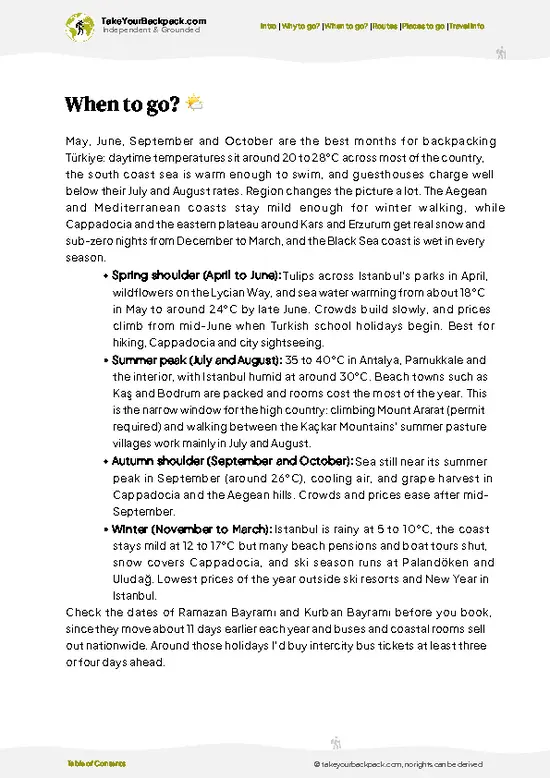
Best months for attractions: April to early June and September to October are the best months, because daytime temperatures sit around 18 to 28°C, the light is good and ruins do not turn into frying pans. Midsummer on the Aegean and Mediterranean coasts regularly reaches 33 to 40°C, which makes climbing a hillside amphitheater a personal challenge no one needed.

Shoulder seasons and winter: Spring brings wildflowers and green hills, with occasional rain, mostly in April. Autumn is warm, the sea is still swimmable on the coast into October, and prices drop compared with July and August. Coastal hotels and guesthouses can be 20 to 40 percent cheaper in the shoulder months than in peak summer. November to March is quiet and wet on the Aegean and Mediterranean coasts, and some seasonal sites … read more 👉
Best months for attractions: April to early June and September to October are the best months, because daytime temperatures sit around 18 to 28°C, the light is good and ruins do not turn into frying pans. Midsummer on the Aegean and Mediterranean coasts regularly reaches 33 to 40°C, which makes climbing a hillside amphitheater a personal challenge no one needed.

Shoulder seasons and winter: Spring brings wildflowers and green hills, with occasional rain, mostly in April. Autumn is warm, the sea is still swimmable on the coast into October, and prices drop compared with July and August. Coastal hotels and guesthouses can be 20 to 40 percent cheaper in the shoulder months than in peak summer. November to March is quiet and wet on the Aegean and Mediterranean coasts, and some seasonal sites and boat services reduce hours or close. Istanbul is cold and gray in winter, with temperatures of 3 to 9°C and short days, but the main museums remain open and queues are thin.

Regional differences: Central Anatolia has a dry continental climate: hot summers of 28 to 34°C and cold winters that bring snow and freezing nights, so spring and autumn are comfortable. The east and southeast are brutal in summer, with Mardin and Şanlıurfa often above 38°C, and bitter in winter at higher elevations such as Kars, where temperatures fall well below freezing. Visit those regions in May, June or September. The Black Sea coast is the wettest part of the country and rain can come in any month.

Peak periods and closures: Late June to August is peak for foreign visitors, and Turkish school holidays add domestic crowds. Religious holidays such as Ramazan Bayramı and Kurban Bayramı close banks and shops and fill buses and hotels, so book transport early. During Ramadan, many sites keep normal hours, though some local restaurants are closed during the day.

attraction hoppingPlanning Your Route Efficiently

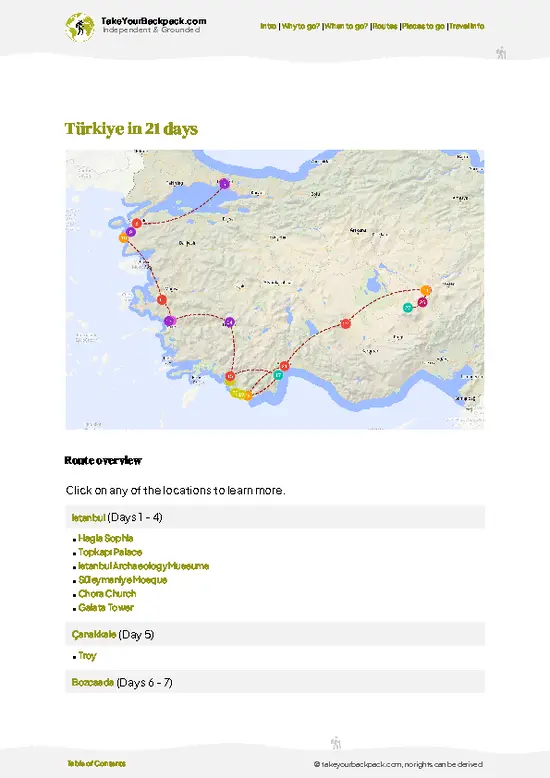
How many days you need: Ten to 16 days is a realistic span for combining several attractions in Türkiye, and 3 weeks lets you add the east without feeling like you are being chased by a bus timetable. The country is big, and trying to see it all in a week produces mostly photographs of bus windows.

Regions that group well: The western loop clusters naturally: Istanbul, the Aegean coast and Pamukkale, then south to the Mediterranean coast. Central Anatolia, with Cappadocia as its hub, links to the Mediterranean by a long but easy overnight or daytime bus. The east, around Gaziantep, Şanlıurfa, Mardin and Lake Van, works best as its own trip or as an add-on, entered by flight rather than by a 15 hour bus. A sensible direction is to start in Istanbul, move south along the west coast, cut inland … read more 👉
How many days you need: Ten to 16 days is a realistic span for combining several attractions in Türkiye, and 3 weeks lets you add the east without feeling like you are being chased by a bus timetable. The country is big, and trying to see it all in a week produces mostly photographs of bus windows.

Regions that group well: The western loop clusters naturally: Istanbul, the Aegean coast and Pamukkale, then south to the Mediterranean coast. Central Anatolia, with Cappadocia as its hub, links to the Mediterranean by a long but easy overnight or daytime bus. The east, around Gaziantep, Şanlıurfa, Mardin and Lake Van, works best as its own trip or as an add-on, entered by flight rather than by a 15 hour bus. A sensible direction is to start in Istanbul, move south along the west coast, cut inland to Cappadocia, then fly back from Kayseri or Nevşehir. Open-jaw flights, in and out of different airports, save a full day of backtracking.

Time per stop and travel times: Istanbul deserves three to four days. Cappadocia needs two to three. Selçuk or Ephesus area needs one to two, and Pamukkale works well in a night or an afternoon. Eastern cities need two days each. Typical journeys are Istanbul to Selçuk about 9 hours by bus or 1 hour by air to İzmir plus transfer, Pamukkale to Antalya 3.5 to 4 hours, Antalya to Cappadocia 8 to 10 hours, and Istanbul to Cappadocia 1 hour 20 minutes by air or 11 to 12 hours by road.

Planning mistakes: The classic error is trusting map distances, then discovering that a 300 kilometer line means a 6 hour mountain road. Another is cramming one night in every town. Choose fewer bases and use day trips. Travelers also book too tightly around early flights for balloon sunrises or ferry connections that depend on weather. Leave a spare buffer day, particularly in winter or in the east.

The ListMust-Visit attractions in Türkiye

1 Hagia Sophia

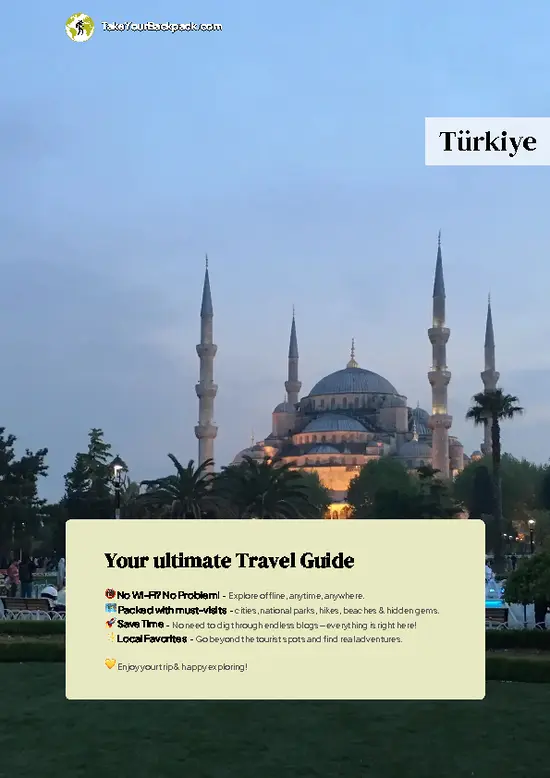
massive dome, mosaics, minarets

Stand beneath a soaring ceiling that has witnessed imperial ceremonies, religious shifts, and centuries of architectural innovation.

2 Göreme Open Air Museum

rock-cut churches, frescoed chapels, monastic dwellings

Wander through a cluster of cave sanctuaries where early Christians left vivid paintings and carved out communal spaces.

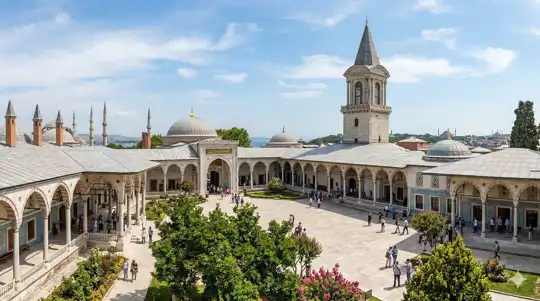
3 Topkapı Palace

imperial courtyards, treasury, harem quarters

Move through layered courtyards and ornate chambers that once housed sultans, royal relics, and the machinery of empire.

Türkiye - Topkapı Palace

4 Grand Bazaar

covered market, labyrinthine alleys, artisan stalls

Navigate a dense network of vaulted corridors where bargaining and craftsmanship shape the daily rhythm of commerce.

5 Basilica Cistern

underground reservoir, Medusa columns, vaulted ceilings

Descend into a cool, shadowy chamber where water once supplied emperors and carved heads peer from beneath the surface.

6 Aspendos Theatre

Roman amphitheater, ancient acoustics, stone seating

Sit among remarkably preserved rows and experience the scale and clarity of a venue still used for performances after two millennia.

7 Dolmabahçe Palace

Ottoman-European interiors, crystal staircase, Bosphorus waterfront

Tour lavish halls and ornate salons where sultans embraced Western influences while overlooking the strait’s busy shipping lanes.

8 Sumela Monastery

cliffside monastery, frescoed chapel, forested valley

Hike up a wooded slope to reach a remote sanctuary carved into rock, offering views over misty mountains and streams.

9 Anıtkabir

mausoleum, ceremonial plaza, Atatürk symbolism

Walk through landscaped grounds and solemn halls that reflect the nation’s founding era and the enduring legacy of modern Turkish identity.

10 Chora Church

Byzantine mosaics, frescoes, domed chapel

Admire intricate wall art that survived centuries of change, offering a rare glimpse into religious and artistic transitions.

11 Derinkuyu Underground City

multi-level tunnels, rock-cut chambers, ventilation shafts

Navigate a maze of subterranean passages that sheltered entire communities from danger, revealing ancient strategies for survival.

12 Mevlana Museum

Sufi mausoleum, whirling dervish relics, turquoise dome

Absorb the contemplative atmosphere where poetry, music, and spiritual philosophy converge around the tomb of Rumi.

13 Istanbul Archaeology Museums

ancient artifacts, sarcophagi, imperial collections

Survey relics spanning empires and continents, from royal tombs to everyday objects, all housed in neoclassical galleries.

14 Museum of Turkish and Islamic Arts

carpets, calligraphy, Seljuk ceramics

Examine centuries of artistry in textiles, manuscripts, and everyday objects displayed in a former palace setting.

15 Galata Tower

medieval stone tower, panoramic terrace, Genoese architecture

Climb to a circular lookout for sweeping city views and a sense of Istanbul’s shifting borders through centuries.

16 Rahmi M. Koç Museum

industrial heritage, vintage vehicles, maritime exhibits

Browse collections of machines, transport, and technology that chart the country’s industrial and scientific development.

Think you know Türkiye?

Prove you’re a true local — uncover 6 lesser-known attractions in Türkiye that locals tend to keep to themselves.
Loading the map 🌍

Expert viewTips and Advice from Travelers

How many attractions to aim for: Plan on one major attraction per day at most, and about 8 to 12 in a two to three week trip. That is not a limit on enthusiasm. Turkish sites are often large, hot and spread over uneven ground, and by the fifth ruin of the week your brain starts filing Roman columns under “more columns.” Leave room for the unlisted stuff: a tea garden, a market street, a ferry across the Bosphorus.

Which kind to prioritize: If your budget is tight, prioritize mosques and old quarters, which are usually free or cost very little, and walking neighborhoods. Mosques are active places of worship and most do not charge, though the biggest tourist-heavy ones may have separate visitor entrances and hours. History lovers should choose one or two major archaeological sites rather than … read more 👉
How many attractions to aim for: Plan on one major attraction per day at most, and about 8 to 12 in a two to three week trip. That is not a limit on enthusiasm. Turkish sites are often large, hot and spread over uneven ground, and by the fifth ruin of the week your brain starts filing Roman columns under “more columns.” Leave room for the unlisted stuff: a tea garden, a market street, a ferry across the Bosphorus.

Which kind to prioritize: If your budget is tight, prioritize mosques and old quarters, which are usually free or cost very little, and walking neighborhoods. Mosques are active places of worship and most do not charge, though the biggest tourist-heavy ones may have separate visitor entrances and hours. History lovers should choose one or two major archaeological sites rather than many small ones, and go at opening time. People who care more about landscape should put money into hiking, valley walks and boat days, which give more variety than another museum. Eastern towns suit travelers who want food, bazaars and fewer other foreigners.

Skip the add-on extras that stack up fast: hot air balloon flights are spectacular for some but cost roughly US$150 to 250 per person, and they are worth the splurge only if the weather is clear and you are a morning person. Watching the balloons from a viewpoint is free. Likewise, skip short “cultural shows” and carpet-factory stops included in package tours.

What things cost: A backpacker can manage on roughly US$35 to 60 a day in the cheaper regions, including a dorm bed or simple pension, local food, buses and a modest entry fee. In Istanbul, tourist coastal towns or Cappadocia, US$55 to 90 a day is more realistic if you visit paid sites daily. Foreigner entry fees at major museums and archaeological sites commonly range from about US$10 to 30 each, and a few top sites cost more. Guides cost around US$40 to 100 for a half day at big sites and are worth it only at those with little signage. Audio guides are cheaper. Local transport to sites runs US$1 to 6 by dolmuş or city bus, and taxis to remote sites can be US$20 to 60 round trip. A regional Museum Pass can save money only if you visit most of the included sites.

Safety and cultural considerations: Türkiye is generally safe for tourists at its main sites, but prices and pushy sellers are the usual hazard. Agree taxi fares or insist on the meter, and be wary of strangers who invite you for drinks or lead you to a particular shop. Pickpockets work crowded trams and ferry docks in Istanbul. Dress modestly for mosques: covered shoulders and knees, and a scarf for women. Remove shoes at the door. Do not walk through during prayers, and avoid visiting around Friday midday prayers. Photography is usually fine, but ask before photographing people. Do not climb on or take stones from archaeological sites, because removing antiquities is a serious crime. Check current government travel advisories for areas near the Syrian and Iraqi borders before planning eastern stops. Earthquakes affect the country, so check with locals or accommodations about the condition of buildings in recently affected southeastern cities.

✈️ The backpacker research shortcutTürkiye Travel Guide

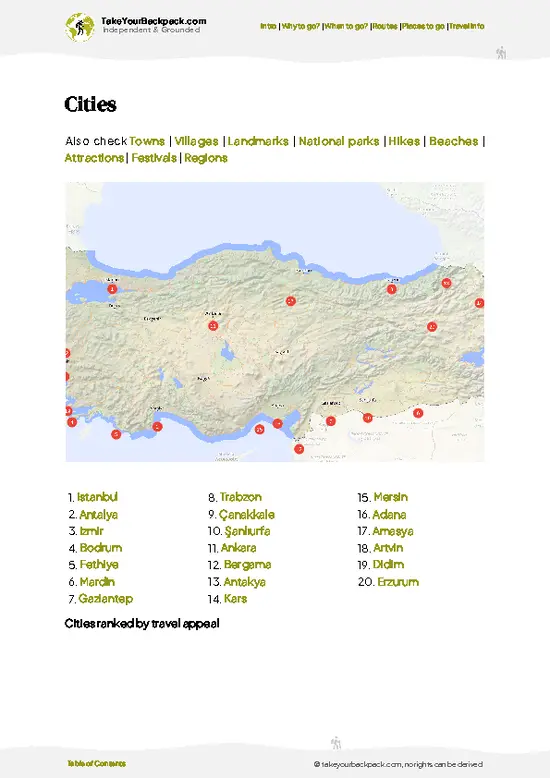
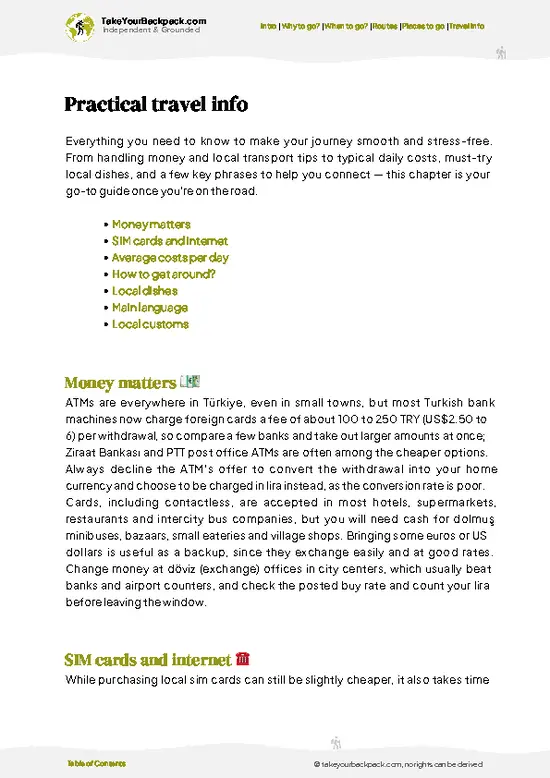
An offline-friendly backpacking guide with optimized travel routes, ranked highlights, transport advice, and the best areas to stay.
example page 0 from our offline Travel Guide for Türkiye
example page 1 from our offline Travel Guide for Türkiye
example page 2 from our offline Travel Guide for Türkiye
example page 3 from our offline Travel Guide for Türkiye
example page 4 from our offline Travel Guide for Türkiye
example page 5 from our offline Travel Guide for Türkiye
example page 6 from our offline Travel Guide for Türkiye
example page 7 from our offline Travel Guide for Türkiye
The digital guide (445 pages) contains:
✅ 130 highlights, ranked by travel appeal
✅ Optimized 7, 14 & 21-day travel routes
✅ Cities, national parks, landmarks, beaches
✅ How to get around
✅ Offline-friendly for travel without Wi-Fi
👉 Click to see all 30+ guide features

📅 Plan smarter in minutes, not weeks
✅ Month by month travel advice
✅ Festivals & national holidays
✅ Budget expectations

🗺️ Go to the right places, skip the overrated ones
✅ Honest pros & cons of destinations
✅ Top hikes, parks & viewpoints
✅ Lesser-known places most travelers miss
✅ Clear “worth it vs skip it” guidance

🛏️ Travel smoothly without rookie mistakes
✅ Best areas to stay
✅ Transport systems explained simply
✅ Common scams & safety advice
✅ SIM cards, money & practical tips

🌍 Understand the country, not just visit it
✅ Culture & traditions
✅ 52 Essential phrases & customs
✅ Festivals worth planning around
✅ Traveler-friendly historical context
✅ Insights that make places more meaningful

📱 Built for real travel conditions
✅ Fully downloadable PDF
✅ Works completely offline
✅ Optimized for phone use
✅ Useful in remote areas & buses
✅ Everything in one place
Stop searching, start planning
Get instant access to your full guide. 30‑day money-back guarantee.
+ Add another guide for just

By proceeding you agree to our terms.
Sent to your inbox immediately after payment • 100% Secure Checkout
Best Backpacking Travel Advisor 2025 tourism awardBest Backpacking
Travel Advisor
2025
What others say about Take Your Backpack Guides:
⭐⭐⭐⭐⭐
Fantastic, amazing amount of information!
⭐⭐⭐⭐⭐
My goodness this is amazing, it's what I've been looking for hats off too you!
⭐⭐⭐⭐⭐
I think this is absolutely BRILLIANT
⭐⭐⭐⭐
Very complete and informative. It's still missing places, but I gotta to commend you
⭐⭐⭐⭐⭐
This is truly amazing, thank you, can't wait to explore it with my kids!
⭐⭐⭐⭐⭐
Awesome resource, thank you!
⭐⭐⭐⭐⭐
This is amazing! Can't wait to explore the ones I haven't seen
⭐⭐⭐⭐
I love this! Well done, great idea.
⭐⭐⭐⭐⭐
Thanks for taking the time to make this gem!
⭐⭐⭐⭐⭐
This might be the best website I've ever seen.
⭐⭐⭐⭐⭐
Congratulations, and thank you so much for your work; it's incredibly valuable.
⭐⭐⭐⭐
In all seriousness I think you did a great job pointing out the important spots
⭐⭐⭐⭐⭐
10/10 very good
⭐⭐⭐⭐⭐
As someone who's only just starting to visit regularly this is awesome, thank you.
⭐⭐⭐⭐
Thank you very much! I'm going to visit my dad, it's going to be very useful!
⭐⭐⭐⭐⭐
This is really cool! We'll be travelling for the first time and this definitely come in handy.
⭐⭐⭐⭐⭐
You are now our minister of culture, congratulations 👨‍💼
⭐⭐⭐⭐⭐
Just wanted to tell you that this is a pearl! Going to follow your recommendations.
⭐⭐⭐⭐⭐
This is so cool. I'll definitely be using the resource for my travels soon.
⭐⭐⭐⭐⭐
This is very impressive! Good work.
⭐⭐⭐⭐⭐
This is an amazing and informative site. Very well done!

🛏️ Where to stay?Top Areas to Stay

Türkiye has plenty of hostels and budget guesthouses, with dorm beds in Istanbul typically running €10 to 20 a night and private doubles in family pensions from roughly €30 to 50. In Istanbul, Sultanahmet puts you within walking distance of Hagia Sophia and the Blue Mosque but goes quiet after dark, while Beyoğlu and Karaköy around Galata have the liveliest bars and late-night street noise to match, and Kadıköy on the Asian side trades sightseeing convenience for cheaper, more local nightlife a ferry ride away. Beyond the big city, Göreme in Cappadocia is packed with cave-room hostels steps from the valley trails (sleepy at night, with early balloon-launch wake-ups), and Kaleiçi, the walled … read more 👉
Türkiye has plenty of hostels and budget guesthouses, with dorm beds in Istanbul typically running €10 to 20 a night and private doubles in family pensions from roughly €30 to 50. In Istanbul, Sultanahmet puts you within walking distance of Hagia Sophia and the Blue Mosque but goes quiet after dark, while Beyoğlu and Karaköy around Galata have the liveliest bars and late-night street noise to match, and Kadıköy on the Asian side trades sightseeing convenience for cheaper, more local nightlife a ferry ride away. Beyond the big city, Göreme in Cappadocia is packed with cave-room hostels steps from the valley trails (sleepy at night, with early balloon-launch wake-ups), and Kaleiçi, the walled old town of Antalya, mixes pensions near the harbor and beaches with weekend bar noise along its lanes.

If you enjoy meeting fellow travelers, consider choosing hostels with high ratings for atmosphere. On the other hand, if you prefer having your own space, a hotel might be a better option.

TürkiyeDiscover the Country

👋 Meet the founderWho’s Behind Take Your Backpack?

Johan, backpacker and founder of TakeYourBackpackHi, I’m Johan (Netherlands 🇳🇱), the creator of TakeYourBackpack. Over the past 3 decades, I’ve backpacked through 90+ countries across six continents, gaining extensive experience with independent travel, long-term trips, and overland routes.

This site is built on a combination of firsthand travel experience and carefully curated insights from other backpackers. Many guides are based on places I’ve personally visited, while others bring together tips, observations, and practical advice shared by trusted travelers I’ve met along the way.

The goal is to provide realistic, experience-driven guidance — not generic itineraries — so you can explore destinations with better context, clearer expectations, and more confidence.