×

Türkiye🇹🇷 | best hikesWhere to Find the 8 Best hikes in Türkiye

Hiking in Türkiye (or Turkey, if you prefer the older spelling on your visa printout) comes with an unusual perk: the trail often ends at a village tea garden, where someone will hand you a glass of çay before you have finished untying your boots. The country is huge, so the experience splits sharply by region. The Mediterranean coast offers waymarked paths past ruins, easy to reach by minibus from Antalya or Fethiye and busy in spring. The Kaçkar and Eastern Black Sea mountains are wetter, greener and slower to get to, with plateau villages and few other foreigners. Central Anatolia and the southeast mean volcanic valleys and high peaks with thin crowds and cheap guides. For backpacking or independent travel, costs stay low outside coastal resorts, but signage, maps and English fade fast once you leave the tourist belt. Pick your region first, then your boots.

By Johan Kruseman 🇳🇱 | Updated October 19, 2026
Explore the best beaches in Türkiye

Why go?Key Factors That Shape the Experience

Türkiye sits where Europe, Asia and the Middle East overlap, and the trails show it. Walking routes here follow ancient roads, shepherd tracks and pilgrim paths that Lycians, Romans, Byzantines and Ottoman traders all used, so a day on foot regularly crosses carved tombs, old paving stones or abandoned stone villages. Few countries let you cover this much history without a ticket booth.

Geography does the rest. Coastal ranges drop straight into the sea, the Taurus rises above 3,700 meters, the Kaçkars top 3,900 meters, and the interior plateau is split by canyons and volcanic ash valleys. That gives you four distinct climates in one country, which is handy and also means a single packing list rarely works.

Infrastructure is uneven. Long-distance routes such as the Lycian Way and St Paul … read more 👉
Türkiye sits where Europe, Asia and the Middle East overlap, and the trails show it. Walking routes here follow ancient roads, shepherd tracks and pilgrim paths that Lycians, Romans, Byzantines and Ottoman traders all used, so a day on foot regularly crosses carved tombs, old paving stones or abandoned stone villages. Few countries let you cover this much history without a ticket booth.

Geography does the rest. Coastal ranges drop straight into the sea, the Taurus rises above 3,700 meters, the Kaçkars top 3,900 meters, and the interior plateau is split by canyons and volcanic ash valleys. That gives you four distinct climates in one country, which is handy and also means a single packing list rarely works.

Infrastructure is uneven. Long-distance routes such as the Lycian Way and St Paul Trail are waymarked with red and white stripes and supported by family pensions, but most mountain areas depend on local minibuses, shared taxis and a willingness to wait. Timetables are more of a suggestion. Huts are rare outside a few areas, so expect camping or village homestays.

Before choosing Türkiye, know that hospitality is real but plans bend. Trail marking can vanish after a landslide or road building, and mobile maps are better than printed ones. Shepherd dogs (the large Kangal type) guard flocks and are taken seriously. Villages are conservative in the east and mountains, so modest clothing helps. In exchange, you get long days outdoors that finish with a proper meal at a price that makes you suspicious of your calculator.
Evaluating the Top Choices
The list of best hikes in Türkiye is created based on scenery, challenge, trail quality, landmarks, and overall enjoyment. If you feel a hike is missing in this list, please let us know.

When to go?Best Time to Visit Türkiye for hikes

Best months and why: Late April to early June and September to October are the best months for hiking in Türkiye, because daytime temperatures sit around 15 to 25°C on most trails and the summer heat and winter snow are both out of the way. Spring brings wildflowers and running streams, autumn brings settled weather and warm sea for swimming afterward.

Region by region: The Mediterranean and Aegean coasts run hot from July to August, with highs of 33 to 38°C that make midday walking a poor idea. Winter (December to February) is mild at 10 to 16°C but rainy, and some pensions and restaurants close along quieter stretches. The best coastal window is March to May and October to November.

The Kaçkar and Eastern Black Sea mountains work in a short season, roughly late June to mid-September, when … read more 👉
Best months and why: Late April to early June and September to October are the best months for hiking in Türkiye, because daytime temperatures sit around 15 to 25°C on most trails and the summer heat and winter snow are both out of the way. Spring brings wildflowers and running streams, autumn brings settled weather and warm sea for swimming afterward.

Region by region: The Mediterranean and Aegean coasts run hot from July to August, with highs of 33 to 38°C that make midday walking a poor idea. Winter (December to February) is mild at 10 to 16°C but rainy, and some pensions and restaurants close along quieter stretches. The best coastal window is March to May and October to November.

The Kaçkar and Eastern Black Sea mountains work in a short season, roughly late June to mid-September, when high passes lose their snow. This is also the wettest corner of the country, so rain can arrive in any month, and fog is routine. The plateau villages are nearly empty outside summer.

Central Anatolia, including Cappadocia and the high Taurus, is best from May to June and September to October. Summer days reach 30 to 35°C but nights cool off, and winter brings snow and sub-zero temperatures that close higher routes. The southeast and the area around Lake Van are brutally hot in summer and cold in winter, so spring and autumn are strongly preferred.

Crowds and prices: Peak season on the coast is July and August, when accommodation costs 30 to 60 percent more than in shoulder months and beaches are packed with people who did not bring boots. April, May and October bring fewer crowds, easier bargaining and lower prices. Turkish school holidays and religious holidays (Eid) fill buses and pensions for several days, so book transport early then.

hike hoppingPlanning Your Route Efficiently

How long and where to start: A trip that combines several hikes in Türkiye needs 14 to 21 days, because distances are far larger than most maps suggest. Türkiye is roughly 1,600 kilometers from west to east, and a bus ride that looks short on a screen often takes 8 to 12 hours in reality.

Which regions cluster well: The Mediterranean coast pairs naturally with Cappadocia and the central Taurus. Antalya and Fethiye are the main hubs, with Konya or Kayseri bridging toward the interior, a journey of about 6 to 9 hours by bus. The Kaçkar and Black Sea region clusters with Trabzon, Rize and the northeast, and is best treated as its own trip leg because getting there from the south means a flight to Trabzon (about 1.5 to 2 hours from Istanbul or Ankara). A sensible direction is west to east, starting … read more 👉
How long and where to start: A trip that combines several hikes in Türkiye needs 14 to 21 days, because distances are far larger than most maps suggest. Türkiye is roughly 1,600 kilometers from west to east, and a bus ride that looks short on a screen often takes 8 to 12 hours in reality.

Which regions cluster well: The Mediterranean coast pairs naturally with Cappadocia and the central Taurus. Antalya and Fethiye are the main hubs, with Konya or Kayseri bridging toward the interior, a journey of about 6 to 9 hours by bus. The Kaçkar and Black Sea region clusters with Trabzon, Rize and the northeast, and is best treated as its own trip leg because getting there from the south means a flight to Trabzon (about 1.5 to 2 hours from Istanbul or Ankara). A sensible direction is west to east, starting on the coast while the weather is mild, crossing the interior, then finishing in the mountains in summer or early autumn.

Time per stop: Plan 3 to 5 days in each region: enough for one multi-day walk or several day routes, plus a rest day and transport slack. Long-distance trails need 7 to 10 days if done in sections, so choose either one long walk or a mix of short ones.

Common planning mistakes: The classic error is cramming too many regions into too few days and spending half the trip on overnight buses. Fix it by flying one long leg (domestic fares often run US$30 to 80 if booked ahead) and keeping the rest overland. Another mistake is ignoring seasonal conflicts, such as scheduling the Kaçkars in May when passes hold snow, while the coast is at its best. Order your regions by season, not by what looks neat on the map. Finally, leave a buffer day before flights, because minibuses wait until they are full, not until the clock says so.

The ListMust-Visit hikes in Türkiye

1 Lycian Way

Mediterranean coast, ancient ruins, pine forests

Trace rugged headlands and mountain slopes, discovering remote beaches and archaeological sites scattered along turquoise shores.

Türkiye - the Lycian Way

2 Carian Trail

Aegean bays, ancient roads, pine-clad hills

Walk along undulating coastal tracks, passing through rural settlements and archaeological remains with the scent of pine and salt air.

3 Ihlara Valley

river gorge, Byzantine frescoes, poplar groves

Follow a shaded canyon path past painted cave churches and riverside villages, with cool water and lush greenery even in midsummer.

turkiye-hike-ihlara-valley
© Google |

4 Mount Ararat

glacial summit, high-altitude ascent, Kurdish villages

Climb above the tree line into barren alpine terrain, where thin air and shifting weather demand preparation and reward with sweeping views.

turkiye-hike-mount-ararat
© Google |

5 Küre Mountains Trail

karst gorges, dense forest, remote villages

Venture through labyrinthine canyons and thick woodland, where isolation and rugged terrain define the journey.

6 Phrygian Way

rock-cut tombs, open steppe, ancient roads

Step into a landscape dotted with enigmatic monuments and broad horizons, where history and myth blend across rolling hills.

7 Kaş to Kalkan Coastal Walk

clifftop paths, sea vistas, olive terraces

Move between small coves and hillside villages, with constant sea breezes and panoramic views over the Lycian coastline.

turkiye-hike-kas-to-kalkan-coastal-walk
© Google |

8 Yenice Forest Trail

deciduous woodland, river crossings, wildlife tracks

Experience dense forests alive with birdsong and shifting light, following winding paths that cross streams and fern-filled glades.

Loading the map 🌍

Expert viewTips and Advice from Travelers

How many hikes to do: Three to five hikes in a single trip is the right number for most backpackers. That gives you one multi-day trek or two long days, plus a few shorter walks to break up the travel. Türkiye is big, transport is slow, and trying to tick off six or seven means you will see more bus windows than ridgelines. For a first visit, fewer and better beats a long list.

Which kind to prioritize: If you like history with your exercise, choose the coastal ancient-road routes. They are the easiest logistically, have pensions every few hours, and suit first-timers. If you want real mountains and quiet, put your time into the Kaçkars or the high Taurus. They demand more planning and decent fitness, but the empty plateau villages are worth the effort. If you are short on time or energy, … read more 👉
How many hikes to do: Three to five hikes in a single trip is the right number for most backpackers. That gives you one multi-day trek or two long days, plus a few shorter walks to break up the travel. Türkiye is big, transport is slow, and trying to tick off six or seven means you will see more bus windows than ridgelines. For a first visit, fewer and better beats a long list.

Which kind to prioritize: If you like history with your exercise, choose the coastal ancient-road routes. They are the easiest logistically, have pensions every few hours, and suit first-timers. If you want real mountains and quiet, put your time into the Kaçkars or the high Taurus. They demand more planning and decent fitness, but the empty plateau villages are worth the effort. If you are short on time or energy, volcanic valley walks in Cappadocia are flat to moderate, take half a day, and are well worth doing. Skip the idea that every famous viewpoint deserves a long detour. Several are crowded roadside stops with a short stroll and a lot of vendors, fine for a coffee and not for a day.

What it costs: Türkiye is cheaper than Western Europe but prices have climbed and the lira swings, so budget in ranges. Independent hikers can manage on roughly US$30 to 55 a day on coastal trails (pension with breakfast US$15 to 30, a hearty dinner US$5 to 10, minibus fares US$2 to 8 per leg). Remote mountain areas can run US$25 to 45 a day if you eat in villages and camp. Guides for high routes cost about US$60 to 120 a day, often split among a group, and a transfer by private minibus to a trailhead can add US$40 to 100. Entry fees at archaeological sites and national parks are usually US$3 to 15. Expect a total of US$300 to 600 for a typical week including local transport.

Safety and what to watch: The main practical hazard is shepherd dogs. Large Kangals and similar flock guardians can be aggressive. Stop, avoid eye contact, pick up a stone only if needed as a deterrent gesture, and give flocks a wide berth. Carry a real map or offline app, because waymarks fade, landslides reroute paths, and signal disappears. Water sources on the coast can be dry in summer, so carry 2 to 3 liters. In the mountains, afternoon storms build quickly, and fog on the Black Sea side hides trail junctions. Check conditions locally, especially for snow on passes into early July.

Cultural considerations: Hospitality is the norm, and refusing tea feels odd, so accept at least one glass. In conservative villages, particularly in the east, cover shoulders and knees, and ask before photographing people. Camping near houses or fields without asking is poor form, and locals usually offer a better spot anyway. Learn a few Turkish words (merhaba, teşekkürler) and expect the effort to be noticed. Finally, carry some cash in lira, because card machines in village shops are optional, and so is electricity.

✈️ The backpacker research shortcutTürkiye Travel Guide

An offline-friendly backpacking guide with optimized travel routes, ranked highlights, transport advice, and the best areas to stay.
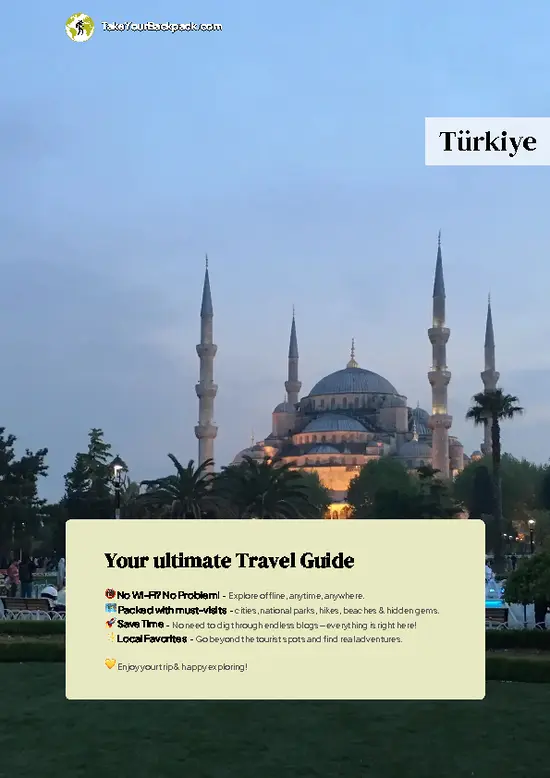
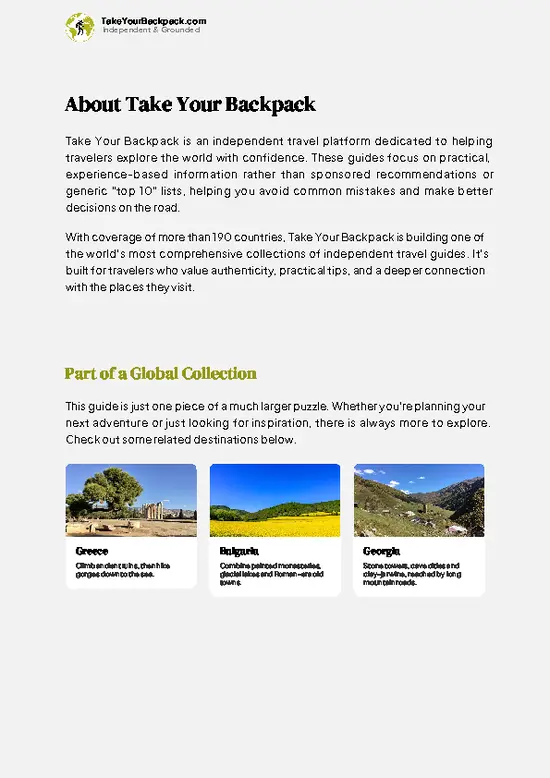
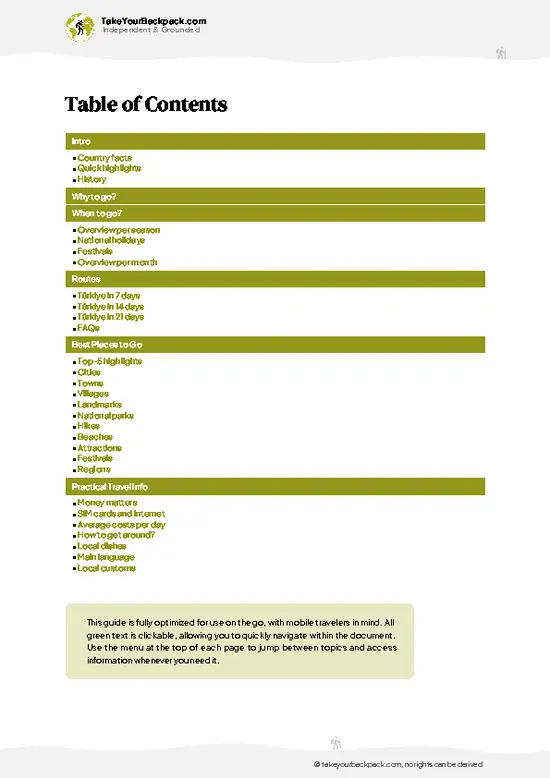
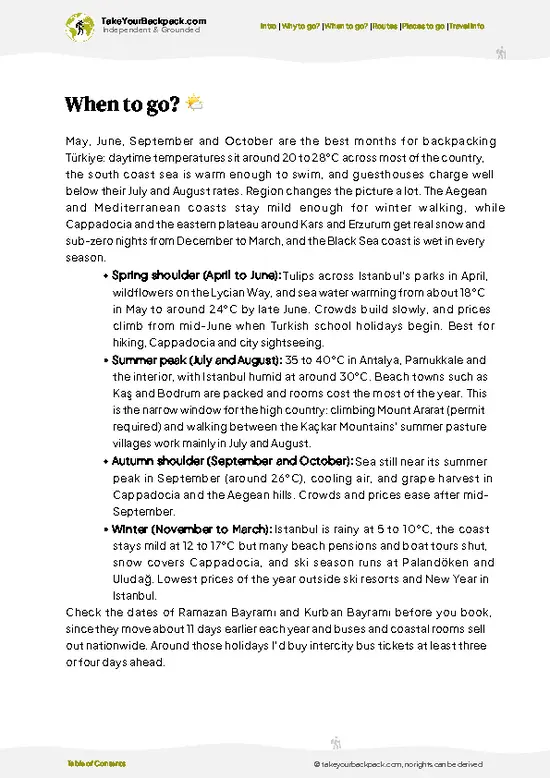
example page 0 from our offline Travel Guide for Türkiye
example page 1 from our offline Travel Guide for Türkiye
example page 2 from our offline Travel Guide for Türkiye
example page 3 from our offline Travel Guide for Türkiye
example page 4 from our offline Travel Guide for Türkiye
example page 5 from our offline Travel Guide for Türkiye
example page 6 from our offline Travel Guide for Türkiye
example page 7 from our offline Travel Guide for Türkiye
The digital guide (445 pages) contains:
✅ 130 highlights, ranked by travel appeal
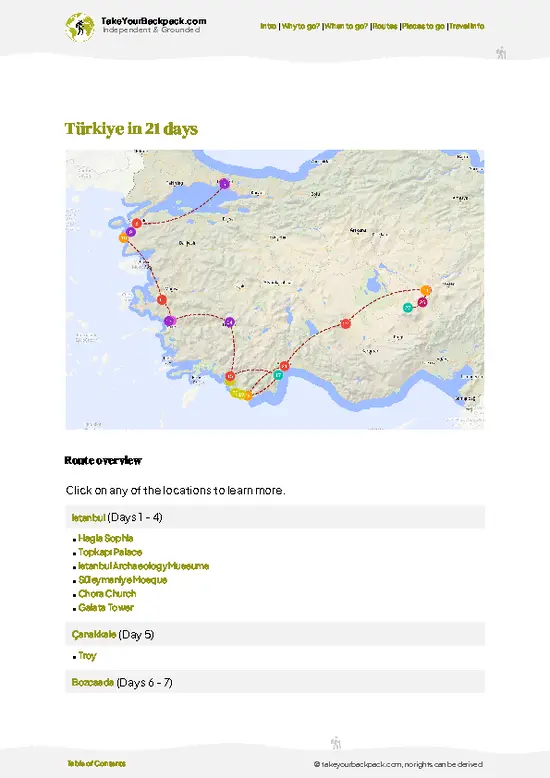
✅ Optimized 7, 14 & 21-day travel routes
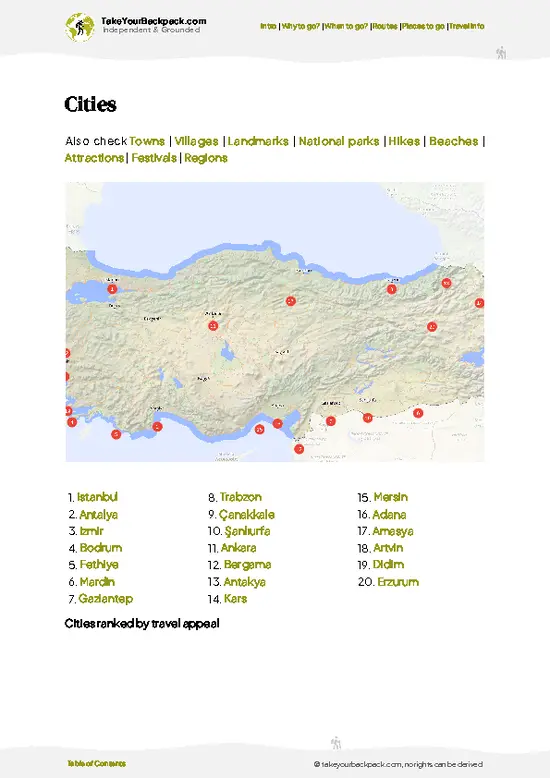
✅ Cities, national parks, landmarks, beaches
✅ How to get around
✅ Offline-friendly for travel without Wi-Fi
👉 Click to see all 30+ guide features

📅 Plan smarter in minutes, not weeks
✅ Month by month travel advice
✅ Festivals & national holidays
✅ Budget expectations

🗺️ Go to the right places, skip the overrated ones
✅ Honest pros & cons of destinations
✅ Top hikes, parks & viewpoints
✅ Lesser-known places most travelers miss
✅ Clear “worth it vs skip it” guidance

🛏️ Travel smoothly without rookie mistakes
✅ Best areas to stay
✅ Transport systems explained simply
✅ Common scams & safety advice
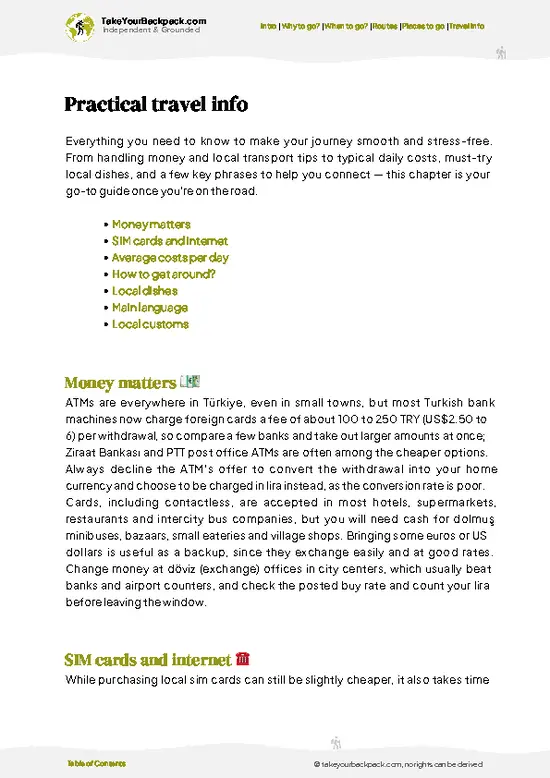
✅ SIM cards, money & practical tips

🌍 Understand the country, not just visit it
✅ Culture & traditions
✅ 52 Essential phrases & customs
✅ Festivals worth planning around
✅ Traveler-friendly historical context
✅ Insights that make places more meaningful

📱 Built for real travel conditions
✅ Fully downloadable PDF
✅ Works completely offline
✅ Optimized for phone use
✅ Useful in remote areas & buses
✅ Everything in one place
Stop searching, start planning
Get instant access to your full guide. 30‑day money-back guarantee.
+ Add another guide for just

By proceeding you agree to our terms.
Sent to your inbox immediately after payment • 100% Secure Checkout
Best Backpacking Travel Advisor 2025 tourism awardBest Backpacking
Travel Advisor
2025
What others say about Take Your Backpack Guides:
⭐⭐⭐⭐⭐
Fantastic, amazing amount of information!
⭐⭐⭐⭐⭐
My goodness this is amazing, it's what I've been looking for hats off too you!
⭐⭐⭐⭐⭐
I think this is absolutely BRILLIANT
⭐⭐⭐⭐
Very complete and informative. It's still missing places, but I gotta to commend you
⭐⭐⭐⭐⭐
This is truly amazing, thank you, can't wait to explore it with my kids!
⭐⭐⭐⭐⭐
Awesome resource, thank you!
⭐⭐⭐⭐⭐
This is amazing! Can't wait to explore the ones I haven't seen
⭐⭐⭐⭐
I love this! Well done, great idea.
⭐⭐⭐⭐⭐
Thanks for taking the time to make this gem!
⭐⭐⭐⭐⭐
This might be the best website I've ever seen.
⭐⭐⭐⭐⭐
Congratulations, and thank you so much for your work; it's incredibly valuable.
⭐⭐⭐⭐
In all seriousness I think you did a great job pointing out the important spots
⭐⭐⭐⭐⭐
10/10 very good
⭐⭐⭐⭐⭐
As someone who's only just starting to visit regularly this is awesome, thank you.
⭐⭐⭐⭐
Thank you very much! I'm going to visit my dad, it's going to be very useful!
⭐⭐⭐⭐⭐
This is really cool! We'll be travelling for the first time and this definitely come in handy.
⭐⭐⭐⭐⭐
You are now our minister of culture, congratulations 👨‍💼
⭐⭐⭐⭐⭐
Just wanted to tell you that this is a pearl! Going to follow your recommendations.
⭐⭐⭐⭐⭐
This is so cool. I'll definitely be using the resource for my travels soon.
⭐⭐⭐⭐⭐
This is very impressive! Good work.
⭐⭐⭐⭐⭐
This is an amazing and informative site. Very well done!

🛏️ Where to stay?Top Places to Consider Staying

Türkiye has plenty of hostels and budget guesthouses, with dorm beds in Istanbul typically running €10 to 20 a night and private doubles in family pensions from roughly €30 to 50. In Istanbul, Sultanahmet puts you within walking distance of Hagia Sophia and the Blue Mosque but goes quiet after dark, while Beyoğlu and Karaköy around Galata have the liveliest bars and late-night street noise to match, and Kadıköy on the Asian side trades sightseeing convenience for cheaper, more local nightlife a ferry ride away. Beyond the big city, Göreme in Cappadocia is packed with cave-room hostels steps from the valley trails (sleepy at night, with early balloon-launch wake-ups), and Kaleiçi, the walled … read more 👉
Türkiye has plenty of hostels and budget guesthouses, with dorm beds in Istanbul typically running €10 to 20 a night and private doubles in family pensions from roughly €30 to 50. In Istanbul, Sultanahmet puts you within walking distance of Hagia Sophia and the Blue Mosque but goes quiet after dark, while Beyoğlu and Karaköy around Galata have the liveliest bars and late-night street noise to match, and Kadıköy on the Asian side trades sightseeing convenience for cheaper, more local nightlife a ferry ride away. Beyond the big city, Göreme in Cappadocia is packed with cave-room hostels steps from the valley trails (sleepy at night, with early balloon-launch wake-ups), and Kaleiçi, the walled old town of Antalya, mixes pensions near the harbor and beaches with weekend bar noise along its lanes.

If you enjoy meeting fellow travelers, consider choosing hostels with high ratings for atmosphere. On the other hand, if you prefer having your own space, a hotel might be a better option.

TürkiyeMore Places Across Türkiye

👋 Meet the founderWho’s Behind Take Your Backpack?

Johan, backpacker and founder of TakeYourBackpackHi, I’m Johan (Netherlands 🇳🇱), the creator of TakeYourBackpack. Over the past 3 decades, I’ve backpacked through 90+ countries across six continents, gaining extensive experience with independent travel, long-term trips, and overland routes.

This site is built on a combination of firsthand travel experience and carefully curated insights from other backpackers. Many guides are based on places I’ve personally visited, while others bring together tips, observations, and practical advice shared by trusted travelers I’ve met along the way.

The goal is to provide realistic, experience-driven guidance — not generic itineraries — so you can explore destinations with better context, clearer expectations, and more confidence.